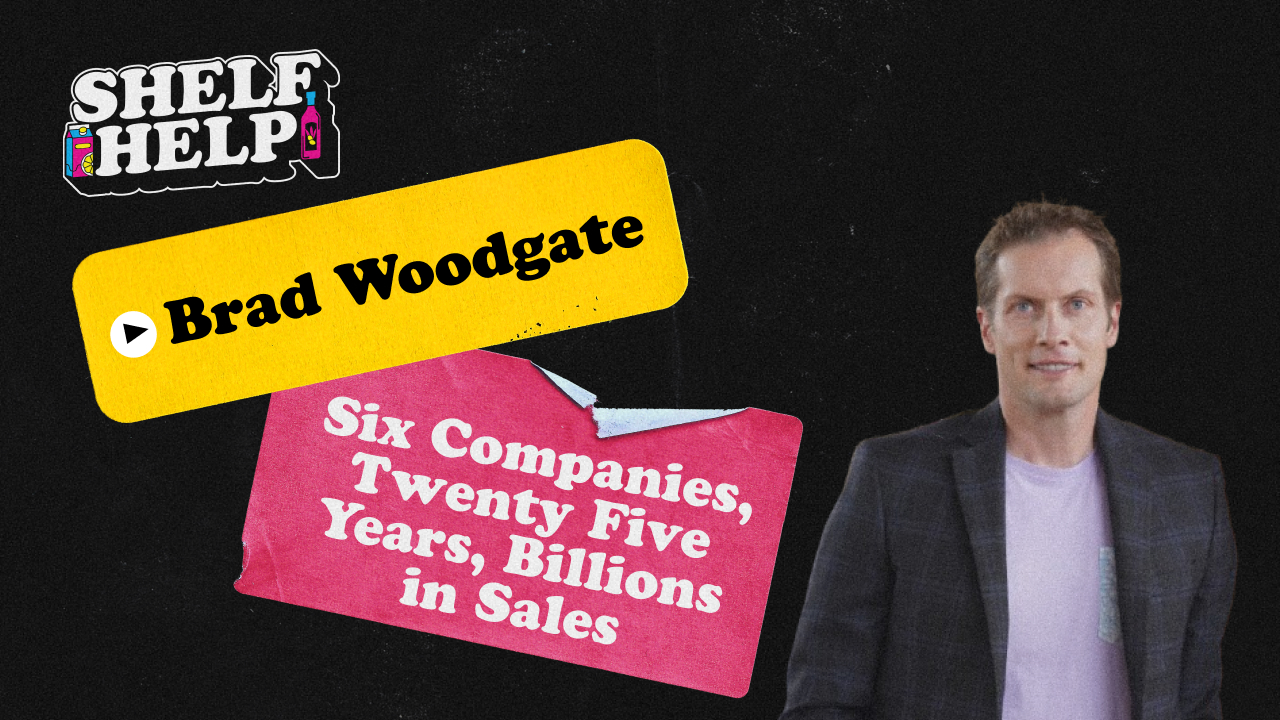



On this episode, we're joined by Brad Woodgate, Founder and CEO of the No Sugar Company, Joyburst, and Wellnx Life Sciences - the serial entrepreneur behind six companies and billions in lifetime sales.
Brad has spent 25 years building across supplements, snacks, and beverages, turning a thirty-thousand-dollar start into a self-funded portfolio.
We start with the full origin story, from launching Wellnx Life Sciences in 2000 and scaling it to roughly 150 million a year, to the 2008 collapse that brought nine-figure lawsuits, mass layoffs, and a near-death rebuild. Brad breaks down the patterns that carried across every brand since, starting with his belief that in business there is no such thing as no, only not now.
We get into his unusual club-first go-to-market, why he launches at Costco and Sam's instead of graduating into them, and how in-store demos became his most powerful marketing tool. Brad walks through the real mechanics of club margins, minimum order quantities, and the buyer and shopper differences between the two.
---------------
Episode Highlights:
🚀 Building six companies over 25 years
⚠️ Surviving the 2008 collapse and nine-figure lawsuits
🔁 Why "no" really means "not now" in retail
🤝 Skillful persistence vs persistently annoying
🛒 Starting at club instead of graduating into it
🆚 Costco vs Sam's, the buyer and the shopper
💰 Planning around club's lower margins
📊 Demos as his most powerful marketing tool
🧪 Cracking soluble creatine for Kreo Joy
🥤 Why protein soda gets won on taste
📈 Joyburst's self-funded growth curve
📺 The reality show that birthed Mighty Minis
🔮 Implementing AI across ops and forecasting
---------------
Table of Contents:
00:00 – Intro
01:11 – Building six companies: the origin story
04:18 – The 2008 collapse and nine-figure lawsuits
08:06 – Patterns for winning in retail
09:30 – Skillful persistence vs being annoying
11:35 – Storytelling that gets buyers to grow their category
12:53 – Why he starts in the club channel
15:12 – Costco vs Sam's: buyer and shopper
16:54 – Planning around club's lower margins
19:38 – Running demos at scale
21:13 – Cracking creatine in a soda (Kreo Joy)
24:55 – Where the protein soda category gets won
27:47 – Joyburst's self-funded growth curve
31:17 – Splitting time across six companies
33:25 – The reality show behind Mighty Minis
36:11 – Implementing AI across ops and forecasting
---------------
Links:
Joyburst – https://joyburst.com/
No Sugar Company – https://thenosugarcompany.com/
Follow Brad on LinkedIn – https://www.linkedin.com/in/brad-woodgate-b30b8113/
Follow me on LinkedIn – https://www.linkedin.com/in/adam-martin-steinberg/
For help with CPG production design - packaging and label design, product renders, POS assets, retail media assets, quick-turn sales and marketing assets and all the other work that bogs down creative teams - check out https://www.kitprint.co/.
Shout out to my friends over at Glimpse, the go-to partner for automating retail-related back-office operations and unlocking margin trapped in invalid fees and manual processes.
Episode Transcript
Speaker: 00:00
Alright. Welcome to Shelf Help. Today we're speaking with Brad Woodgate, a prolific serial serial entrepreneur, to say the least. He started Dwellnix Life Sciences at 22, built it to close to 150 million in sales, 20 million a year in profit by 2007, 2008 hit. Whole host a lot of challenges propped up, like many around that time. Then kind of rebuilt, started the No Sugar Company in 2018, I believe. Scale that wouldn't have passed 100 million. Much joy burst in 2022 with a big Super Bowl ad. Self-funded reality show as well that birthed his fifth brand, Mighty Minis, which we'll probably talk about a bit as well, which I think is now expanding into Walmart. Yeah, six companies, billions of dollars in sales. Super excited to dive in to say the least. Yeah, Brad, maybe just to kind of first off for listeners that aren't all that familiar. I know you got a lot going on, but maybe just kind of once that aren't that familiar with No Sugar Company, Joyburst, Mighty Minis, maybe just kind of give quick lay of land, just kind of quick origin story, why behind each brand, and then uh we can go from there.
Speaker 1: 01:09
Sure, yeah. Thanks for having me on. Like you said, I started Well Next Life Sciences in 2000 in my last year of university. That company really blew up in the nutraceutical supplement space. So that got me the footprint across, you know, over 100,000 doors in the US alone, retail doors in the US alone. So when I decided to pivot in 2018 into the no sugar uh company, um, I had a distribution uh relationships that I could lean on. So it made that transition of bringing these up products to the market easier than just starting from scratch because I had built up relationships in different categories, but still had a relationship, had the you know, um company setups and things of that nature, but it still had to prove yourself from day one. I just felt in 2018 there was a movement that was going to be that reducing sugar was going to be extremely important and it wasn't gonna be just a fat. It was just gonna get something that got bigger and bigger and bigger over decades. And if I could take the kind of the positioning of like the foot in the ground, so to speak, of no sugar, like there's you can't be any better than that. You can't be no, no, no more sugar, like it's just that's final. It's it. And then have the positioning that in addition to being no sugar, all items had to be naturally sweetened and taste the same or better than our competitors. I felt that that would be an ownable position uh no matter what we did. And as long as we could deliver on that promise, we'd have some success. And we did. Our path to market is quite unusual because we have been able to start with club. Most people graduate with club, they go through like natural health channel, and then maybe you get a grocery channel, then they get maybe get a drug channel, and then maybe after that they get a mass channel, and then way down the line, they have like a national brand that's you know really kicking, and then they get a club opportunity. We have the ability to start off at club, and we've been able to prove that model successful. So club really leans in on us to bring the newest innovation in both, you know, no sugar beverages like Joyburst and so and assume to me mighty minis. So that's kind of you know how I got started having the retail footprint. No sugar as a food and snack company was always a passion of mine to reduce or remove sugar, and I felt that something was long lasting. And then in 2022, I thought, hey, with all that into play right now, the biggest bite in the CBG world is to figure out how to do a beverage company. The shipping is crazy, the competition is fierce, the marketing dollars are insane, the legalities of it are just next a headache every day. Uh, and I felt like I finally had kind of after essentially at that time, 22 years of experience and the capital needed to figure this out to make a run at it. And so far, you know, in our going into our finishing our fourth year for Joy Burst run pace to exceed 100 million in sales, so it's been quite the ride.
Speaker: 03:58
I think I just saw you post recently on LinkedIn at 2007, 29 years old, hit the 140 million sales, 20 million profit, bunch of employees, and then 2008 hit. You got hit, I think, with like 100 million plus in competitor lawsuits, class actions by state attorneys, ass layoffs, like nine-figure legal bills, sales take a hit. Uh kind of like an existential crisis to a certain extent, it sounds like I think that's probably less less uh uncommon than people probably think. Walk me through what actually happened there, how that experience impacted your approach to entrepreneurship and building companies since that time in your life, because you had so much success since then.
Speaker 1: 04:36
Yeah, I I I mean I would hate to say it was a blessing in disguise because it certainly wasn't a blessing in disguise. It was very, very painful, but you learned a lot more through painful situations than than than easier or great situations. At least I feel that way. When I was that age and you see, you know, the four years of grinding to even get off the ground, you are living in that moment and you're saying to yourself, like, you know, there's no statistic that says if you just keep doing this, you're eventually going to make it succeed. Like, that's not actual. Like, whenever people have these success stories and they talk about, oh, the first three or four years were really challenging, uh, they can say it from that perspective because they've already done it. But when you're in that moment and there's no guarantee you're going to be ever successful, it's it's it's a very uh uneasy time in your life. You have like no money. I I commonly say you weren't working for free, you were paying to work. Because if you're using up your savings, you're paying to work. And so when we finally had success uh in year four, and then we were able to rapidly grow to 140 million in sales, and obviously I don't have, I'm in my 20s, so I don't have experience like I do now. You think that 140 is going to turn into 250 and 250 is going to turn into half a billion, and then like what how is this thing not going to stop? And so for the very next year, for you know, to have a realization that okay, your competitors don't really like market share being taken from you, legality lawyers who make a living off of uh class action suits and and settlements are lurking when you get to a certain size on your IRI data, all these things unknown to me or my brother at the time, you have a rude awakening that comes very, very quickly. And so we had built the company to go from you know 140 to 250, both employees and cost structures and stuff like that. And we had just an absolute, you know, kick in the teeth. Um, we, you know, we had at one point, I think, lay off in a day like 60 or 70 people by department. And you're like uh in in my late 20s or whatever I was, and you're laying off people in their like you know, 40s, 50s with families, and it was extremely um, you know, painful, and you just thought the world was collapsing. You didn't know how you're gonna get through this. And you learn a lot of different things. You learn, you know, who in the legal world that you can trust and how do you structure companies to be able to shield yourself from that. You learn who are people that can help just take that side of the business into their own hands, not have it drained your mental psyche in addition to your dollars. And you learn that competitors use these types of things as competitive tactics to drain your marketing budgets. And so you learn those types of things that you don't necessarily have. So, all those key learnings I obviously apply today, which is why many times when I get served litigation papers like I did yesterday, I post about it because I'm like, I might as well get some marketing or a good story out of it, uh, than just the natural thing of getting legal papers because they just happen so often when you're when you have success. So I think that you know, that year, I didn't expect it to happen so suddenly, like you have one of your best years ever, and then for the next year just to be totally catastrophic. But as I said, I I I learned so much and things that you know that's you know, almost 20 years ago that I still apply on my daily entrepreneurial journey. So from that perspective, it was very helpful.
Speaker: 07:58
On the flip side, I mean you've had just so much success at retail across multiple brands. You've clearly figured some some things out. Any but patterns that have just emerged for you over the years when it comes to just succeeding in retail, no matter the category?
Speaker 1: 08:14
I think that a couple things that I obviously that I live by is that in the business world, I say this all the time is that there is no such thing as no. I take no as not now, right? So, like if a retailer says no, I say they didn't say no, they said like not now, and I'll consistently be persistent to make that no turn into a not now to into a potential into a yes. That can be the same say with a manufacturer, that could be the same say with a banker, that could be said with pretty much anything. So that's something that I certainly live by that no no no is final in the business world. And I also I believe that innovation is like the best marketing word for new. So if you can have new anything, new marketing, new products, new employees, new something, you're gonna have a conversation to talk about with retailers and you're gonna have a seat at the table eventually to discuss that newness. People, the world changes so quickly, people want to be on the cutting edge of newness. And there are retailers who will always be in that. Costco is one of them, you know, Casey's in convenience is one, you know, Target is one. Like there's many retailers that are just love new. And if you can uh align yourself with those retailers, you'll have some opportunities. I think that another thing that you have to consistently challenge yourself with is persistency is something that is a skill that you actually actually have to work on. So I hear so many people who say, like, oh, I'm persistent, but you can be persistent and annoying, and you can be persistent and skillful. And that's a great point. If you're persistent and just like filling up someone's email box or calling them nonstop, but you're adding absolutely zero value, or if you're persistent and figuring out ways to keep them enlightening on industry news, you're persistent with solving a problem that they are you're anticipating them having, you're persistent of how to grow their category. You're there's ways to be skillfully persistent. So I have a lot of respect for people who cold called because I've done a lot of cold calling in my life, but people who just blitz you and think that eventually that's going to work without a skillful persistence. I think they they get weeded out pretty quickly. So I think those are those are a few things that I've learned along the way to you know have the success that we've had.
Speaker: 10:27
Yeah. I think that seems like it's particularly relevant right now in terms of persistence with actually adding value with just all these AI capabilities coming online. I feel like the mass cold outreach is just gonna get more and more easier to do. And it it's if you can separate yourself by actually being actually adding value, I think it's gonna separate people even more. So I think that's a great point.
Speaker 1: 10:48
Just on AI alone, like everybody now, or you should be able to know, like if you just put the least amount of work in AI, the spit out of an AI email is gonna have dashes in there that are clear giveaways that they have just been an AI response. Put in the extra 10 seconds to personalize it some way to make it not seem like you are just an AI responded person. Because like no one's gonna tolerate that. Like, so those are the types of things that I'm saying is like that is someone just spitting out AI and thinking they're persistent is just being persistently annoying.
Speaker: 11:20
In terms of um thing do you found our keys from a storytelling standpoint when it comes to getting buyers excited about putting your brands on the shelf? Because you've cleared that some like said you have three brands that have gotten in thousands of doors, that clearly you've you've you figured something out in terms of getting buyers excited.
Speaker 1: 11:36
I think the number one thing that people lose sight on is they get so focused on selling their product, selling their services for them for their own benefit. And they need to completely rethink that is I'm doing this, and I need to go into the mindset as I'm going to show them how I'm going to grow their category. I'm going to grow their business, I'm going to grow their sales. So you need to think of it from the totally different lens of they get pitched all day, every day. And it's always about me, me, me, me, me, and me and my company, and me and my products the best. And they hear that all day long. So it's just like background noise. What they don't hear as often is I really understand your category. I understand it's challenging. It's either declining, growing, stay uh steady eddy. This is how I'm going to figure out how to grow it. And I'm not going to just figure out how to grow it this year. I'm going to figure out how to grow it in multiple years. So that to me is the biggest difference that you I always try to teach my team and that I've lived by myself. You cannot go in without the opportunity, without knowing how you're going to grow someone else's business. And then you are along for the journey and the ride, but your focus is how to grow their business first.
Speaker: 12:54
You touch on the club channel at the beginning too. It seemed like you've you've definitely kind of figured out a figured out how to have this like outside of success specifically in that channel. What are what have you found some of the just the biggest differences in terms of what it takes to succeed in the club channel compared to all the other retail channels?
Speaker 1: 13:11
Well, first and foremost, I you know, for the longest part of my entrepreneurial journey, I did not do business in club. And I really didn't understand how big of an opportunity club was. And and club's reporting of data is much different than the rest of the market. And you never truly sense get a sense of how impactful and how large club is versus the rest of the market. So since I've been in there since 2018, I've really figured out like really, it's almost like the best retail environment possible. You ship in pallets, so from an efficiency perspective of shipping and full truckloads, it's the best. In terms of stated margins that Sam's, BJ's, Costco use, which is public information, it's the lowest. And the biggest unlock that they all provide that most retailers haven't figured out is the ability to demo your product. And so demoing your product is essentially the number one marketing tool you could possibly have. Like at the end of the day, when you do a Super Bowl commercial to a key influencer to a celebrity, all you're trying to do is create awareness for them to try your product. Either try it for free and buy it, or try it and purchase it and then buy it again. That's it. That's that's all you're trying to do in any space. After that, if the product doesn't work or doesn't taste great or whatever the reasons are, it doesn't matter who you have, it's just not going to have repeat purchase. So doing demos in stores, we don't look at it as many brands do as an obligation to the to the retailer. We look at it as like, how can we do more of it? How can we put gas on this fire? How can we get as many people trying our products and giving us real feedback and trying our products and then hopefully you know liking it, buying it, and buying it again? So that is that exists in a very efficient way in club that just doesn't exist anywhere else. And they have the foot traffic to make it efficient, they have the process in the stores to make it efficient, they have the food safety that makes it efficient. Like it's just really, really efficient there. So that to me is what is the biggest benefit.
Speaker: 15:09
Within this club channel, delineating between some of the key players, let's just I don't compare Costco versus Sam's, let's say. Any big differences in terms of how each one buys, what each each rewards?
Speaker 1: 15:22
I think the biggest difference in Costco versus Sam's is their actual consumer. So the Sam's Club consumer is a much older consumer, the Costco Club consumer is a younger consumer. And I think that you know, just by that very nature, you know, I don't have any exact proof of it, I just have proof of what I've seen in terms of selling with them. Is an older demographic consumer takes just a little bit longer to be convinced to buy a product and is more skeptical because I don't know, that's just how they operate. And so you'll have to get in front of their faces much more, more samples, more time. It's a longer build, and that's who it is. But they're also on the on the flip side, if you get them, they're actually extremely loyal because they don't change brands that often. In Costco, it's a it's a younger demographic, it fits our target market, you know, for joyburse. Our target market is millennial moms. It's female focus on the joyburse side, and that is like a prime shopper of Costco, buying food for their kids, buying food for team sports, buying food for our drinks for all these different things. So they come in droves, they they're ready to purchase, they want to try new things. Uh, it's a modern consumer in clubs per se, and you can have a lot of impact. The flip side to that is like they're willing to try your brand and they're willing to try many other brands as well. And therefore, you really have to fight to keep them within, you know, buying and repeating your product. So I think that that is probably the biggest difference is their consumer base. Rather than that, you know, they're both kind of very efficient club channels to do business with.
Speaker: 16:54
My understanding is that the margins that the club channel requires brands to take is you know notably lower than other retail channels. When you're going after the club channel early, where I assume you know volumes from NISH are going to be lower or you don't have as much economies of scale, it's versus if you've you know scaled up, you're in 5,000 doors before you start going after club. How do you kind of plan around that from a margin perspective if you're going after club in early days, if that makes sense?
Speaker 1: 17:21
So, yeah, a couple you know key information is that um clubs, you know, stated margin that they are wanting to is around 14%. So they're wanting to only make, whereas like other retailers are 30, 40, 50%. So it's it's it's the it's the lowest margin. Now on the same token, they want to have the best price on the market. So you have to factor in, yes, you're getting a lower margin, but it's off of a lower price. Um but they have the buying power to buy at scale. So you literally, if you're in the cereal space, if you're in the chip space, if you're in the beverage space, if you're the bar protein bar space, they all have such large minimum quantity runs from manufacturers. That's just the name of the game of food and beverage. But Costco is one of the few retailers, or Sam's is one of the few retailers, or even BJ's to a certain extent, is one of the few retailers that if they bring the item on, you can hit the minimum quantities, and the minimum quantities are going to give you the efficiency. So, if like, for example, in cans, cans minimum volume for a flavor is 205,000 cans. You can easily with their minute with the opening orders from a Costco, just in a region, let alone nationally, hit the minimum quantity. So you're getting the scale pricing from them off the from off the bat. It's actually much harder to go to the other retailers like Walmart and Target and stuff and say, hey, if we brought you nationally, can we think that that the minimum quantities will be hit? They will be hit in a period of time and you'll have to bankroll and have inventory, but they won't be hit in the say first six to eight weeks, the way like a club environment would work. So it's actually very, very advantageous and has been a competitive advantage of ours to be able to go into club. And you're going to like through the demos, because literally we're spending tens of millions of dollars in demos per year. We're literally able to get real-time feedback of like we really like this flavor, we really don't like this one, we really like you're able to get that and make adjustments before you even go to the rest of the market. So there's a ton of there's a ton to be had.
Speaker: 19:23
You touch on the power of demos, especially in this channel. I think you're running, I assume, probably like thousands of demos a month across all the different club channels that you're in, how big of a presence you have there. How do you actually go about staffing, training, measuring a you know, a demo machine that that's that big effectively?
Speaker 1: 19:44
You have to invest in it. So we have a department that actually invests in, so each retailer has their demo partners that they have selected that you have to work with. So, like as an example, Costco, you have to work with CDS. Don't have to, but it's the preferred. You can do it on your own, but it's a huge lift. So CDS is for Costco. I think Advantage of someone else's for Sam's, and BJ's has their own, and everybody has their own team that they have set up that know the schedule of how to work within that environment, food safety, all that stuff is taken care of. So our job is to get these demo reps excited about the product through videos, sales sheets, let them know what the talking points are, have them armed with how the sample should be served, chilled if it's a beverage, the quantity amount, all that stuff. So our job internally is to use these sales and demo teams almost as a sales arm that can provide that knowledge that you're trying to get into a marketing campaign out to those consumers. And so that's what our job is, is to manage them. And then we obviously analyze the data on a daily basis of what people, because there's been so so many demos going off of what people are saying, how did it respond? How did sales initially hit? What was the lift? What's the demo on a Monday do compared to a Tuesday, and a Tuesday compared to a Saturday, and a Saturday compared to something? Like it's very analytical once you get down to that detail. And as it should be, when you're spending that type of an investment on something, you better have a team that's managing, giving you the data you need to make decisions.
Speaker: 21:10
Totally shifting gears a little bit. A lot of health experts you spoke to told you creatine in a soda is not going to work, science doesn't support it, consumers aren't going to trust it. Clearly, you've proven them wrong so far. Like what, but yeah, walk me through kind of the a bit about the formulation RD journey and kind of the key variables you're playing around between that first iteration to the final version where you said, okay, I feel good about this. This is, I'm ready for to take this to market.
Speaker 1: 21:35
So obviously, having been in the industry for as long as I have, creatine is one of the most studied ingredients of all time. And that the health benefits similar to protein are one of the greatest, you know, ingredients you can possibly have. What was once thought of as more of like a a bro, uh a bro ingredient may for fitness for males has recently, in the last kind of 18 months, taken on a new life that cognitive functions have. Beneficial from the ingredient, and therefore females have started to really explore it. And now the market has exploded that both males and females are doing it. So at that particular time is when I said, okay, in a new delivery format of a beverage, which is what you know males and females consume equally, this is the time to figure out how we can have this be soluble in liquid, which had never been done before. So we invested a lot to know that if we were to figure this out with a coding process, with a delivery format, with an overage and all these things and a pH level that we could specifically work on on this specific creatine, we'd have a shot of doing something that was kind of regarded as one of one. And as it stands today, we are the one of one. And that's why we've had, you know, even 15 million cans that have been pre-bought pre-bought that we can't even fulfill because we don't even have the ability to make the specialized creatine that we're using as quickly as we need to. So it really has been a game changer for us in terms of excitement around the product, pre-orders for the product. It's launching in, you know, two short months in July 2026. But I feel like my 25 years of history kind of has brought me to this point because I've known about, consumed, used, known the challenges of creatine for almost a quarter of a century. So to finally get it out to you, I think people forget, you know, obviously I've I've been on LinkedIn for a short period of time relative to my entrepreneurial journey. So people may say, oh, who is this new person coming up? This is just a flyby night. I've been doing this for a quarter of a century. I've I've really known the category and the ingredients really well and what can and cannot be done. And obviously, I at the forefront of all my businesses think that innovation is very much the most important department that you can possibly have for retailer growth. So this is something that has been well thought out of, well tested, something we're very excited about. And yes, like I do joke about it and and take pleasure in people doubting the process and doubting that, you know, come July when we're one of one and the excitement's there, I think we're gonna we're going to shake up the industry a bit.
Speaker: 24:02
For sure. Without, you know, this is probably too much of trade secrets, you probably don't want to disclose, but if there's anything that's, I don't know, able to do so. Like I'm curious, like what you solve that seems like nobody else has really been able to figure out to actually create a creatine soda in this product format.
Speaker 1: 24:19
It's all about the dosages and the encapsulation and the pH levels. So those three variables are the key ingredients, so to speak, that we had to really nail for it to work. And non none of those being done separately was going to get it done. So uh I I can leave it at that in terms of that's kind of the sandbox that we figured out we had to play in, but um, that was that was what it was. You know, we branded it Craya Joy so that we could you know own it ourselves, and uh as I said, we're we're super excited about it.
Speaker: 24:55
Protein soda also seems to be crushing it. Uh I think I saw you post something a bit ago where you said, like, you know, um protein soda is broken, most of it doesn't taste good. First purchase can get you on the shelf because you know the retailers feel like there's so much demand for this, but the category is really going to be won by the ones that actually stay on the shelf after that second purchase. Yeah, say more about what your kind of take on where this protein soda market is right now.
Speaker 1: 25:22
So Joyburst, our number one item that we have is is this Joyburst hydration. Like that's our franchise product, it's been around the longest. It's as represents currently 60% of our sales. We're only in year four, but you can do the math on what that is. Our second biggest item is actually our our protein coffee, which went okay across Costco, and it's going into Target in August, and it's in Aldi and blah blah blah. So it's actually our second biggest brand. It's also been around the second longest. And then our third is is our protein soda that's gotten, you know, you've seen it national at Sam's Club, Costco as well, the Aldi, like list goes on, Myers, H E B, whatever. Um, so that that's one that I've made posts about it. So protein coffee, sorry, protein sodas has a lot of competitors. There's many different people playing in different spaces from you know all the way as low as four grams of what we did all the way up to 30 grams. I think that uh the industry is going to do uh the category of protein soda is gonna do really well. It's only gonna do really well, though, on the people who spend the time figuring out how to make the taste deliver on the promise. People will try it because it's novel. Bubbles and protein have really never been done before besides the last kind of year. But at the end of the day, for people to continue to consume it, it's got to taste something that tastes like soda. Um, we saw that in the RTD protein space when Fair Life came out and they made a product taste like a milkshake. It's actually like the number one item of all time. Like it's its sales are absolutely dwarfs everybody because everybody they can't keep it in stock. And it's been years. And it's with, I think Coca-Cola owns them and they still can't keep it in stock. So they figured out how to make something with that type of macros taste like a milkshake, deliver on the promise, and people just keep buying and buying it. In the protein soda space, I believe that no one, including us, has gotten to the point where someone says, I feel like I'm just drinking a soda. It just happens to have 30 grams of amazing protein. I think there's a lot of work to be done. The industry in the category is very early, but what I was trying to say was who's going to win that is the people who continue to not just take what their current product that they have in the market now is the final product, continue to invest in and figuring out how to make ways to make the product taste more and more like just a traditional soda. People, as I said, they won't compromise for that long. And the people who do compromise are a much smaller segment than the overall soda category that everybody wants to get.
Speaker: 27:44
You shared some um trajectory numbers recently. They're pretty well. I think it was like year one, three million, year two, eleven million, year three, forty-five, four on track for 100 million, tracking for like 200 million plus next year, path to half a billion in 2028. I think was zero capital raise, even profitable every year. From what I know, beverage is one of the most expensive categories to grow a brand in. What does the working capital cycle look like for that level of growth of no investor capital in the bank?
Speaker 1: 28:12
So you so the statistics that you just uh described are just for the joybers company. And as you mentioned at the beginning of the podcast, I have six different businesses. So this is just what we're talking about for joybers. So um, one of the things that we've been able to do, or what I've been able to do, and I try to teach this to as any aspiring entrepreneur is you may have a goal of saying, I just want to be in the beverage space, or I just want to be in the in the space of you know airplanes, whatever the thing is, you don't have to start off with exactly what you wanted to do. You can create a path of how to get there. And so when we were launching in 2000, we launched in supplements which had the largest margins. Like in some cases, you'd have 80 to 90% margins, which would be unheard of in food and beverage. And therefore, it was a very cash uh positive business. And if you were profitable, like we had the year of like uh 140 million in sales and 20 million in profit, and it was not financed at all. There's a lot of money on the way through that could be made both for myself personally as well as to reinvest into the businesses. And so having done this for 25 years, I've been able to have well next be able to be the backdrop of funding for when I eventually launched No Sugar in 2018, and then that became cash positive. And then I've been able to have well next and no sugar to help fund Joyburst, and that's you know, been positive. And so that's kind of how it's worked, but it's something that's worked over 25 years. I think that people lose sight in this world that they want it tomorrow or they want it next year, and they they're can't figure it out, like they can't fathom how to figure this out. So we've been told, you know, very often that we're a kind of a unicorn in the space, and I take that as a compliment, but it's a unicorn that was created over 25 years.
Speaker: 29:55
Right. Sure.
Speaker 1: 29:56
That is a huge caveat to the situation of how we've been able to do it self-financed. Right. And I'm not saying getting financing or getting venture capital funds or strategic funds is a bad move. Obviously, every business you create, eventually you're going to figure out a time to sell it. I'm just saying is it takes a lot more discipline and it's been a longer road for sure of 25 years, and it's been a lot of sleepless nights. And with that, I have the benefit is the board team uh looks like this, which is me on this call. And that's why I have to answer to it along with my you know, my president partner, who's also a shareholder. So I can make these decisions with like launching multiple products in a year of innovation. I can do things with vanilla ice like we've done that people would scratch their head at. I can do a Super Bowl commercial. I don't need cons uh a consensus from a board team. I can do it and and you can see the results in terms of the growth.
Speaker: 30:49
The downside of this crazy grin success story is that new founders are gonna think that's the norm and they're gonna hit that in three years, which is certainly not the norm.
Speaker 1: 30:58
It's it's certainly not the norm. And there's, I mean, you can unpeel that onion a lot, and I've had some time to spend on it. It's a great story, it's it's an awesome headline, it's great clickbait, but there was a lot that went into that to make it go down the way it happened.
Speaker: 31:14
Sure.
Speaker 1: 31:14
And yeah.
Speaker: 31:16
The six brands you're you're running. Walk me through how you split your time on an on a day-to-day basis or week to week basis between all the different brands you're running.
Speaker 1: 31:24
That's the hardest part. Um, so when you see something like Joywers having 100% growth and like off this excitement and this stuff, it's very difficult to say, like, hey, mighty minis, hey, no sugar, hey, well next and stuff. So it is difficult. I think that you know, they're not six different brands, they're actually six different companies, but they have shared services, right? So they have shared services of finance, they have shared services a lot of times in marketing, shared services in sales. So the idea is that to the retailer, they think of them as like six different brands because the parent company still sells to those retailers no matter what the company is. But to us, they're very much different companies that require brand managers and people focusing on the growth of those from an innovation perspective, from a marketing perspective, and from everything else. So if you ask about it from me, I think that you know the answer to that is having great help in a team that can help you execute the vision that you're doing for each of those brands that we set at the beginning of each year. Um, but I also think it's like you have to have a very passionate team that's willing, even in year 26, like it is for me, to still put in the hours that it requires to make this thing successful. Like there's no substitute for just grinding away.
Speaker: 32:35
Totally. That was gonna I was gonna ask about that. Like what gets used across multiple of the brands, whether it's you know shared services, co-packers, brokers, distributors, finance off. But it sounds so it sounds like it's it's a there's a fair amount of crossovers, but whatever.
Speaker 1: 32:49
There's a fair amount we we use our economies as scales to our advantage, right? So if we're buying Corget, we buy Corget across the different companies and we combine that. So we would be foolish to not take advantage of what we've created, but again, there's all six different legal structures so that they can eat, they can, they can operate in their own ecosystem, whether that be from a positioning perspective, whether that be from a marketing perspective, whether that be from an innovation perspective, you know, Joybris stays obviously in beverage, you know, no shaker stays in food and in snacks, well next stays in supplements and so forth.
Speaker: 33:21
Tell me about a billion-dollar showdown and mighty minis and you sell funded this reality show. Now fast forward, mighty Mighty Minis is a retail ready brand expanding and ending into Walmart. What's tell me about the story here?
Speaker 1: 33:33
Yeah, so I've, you know, I always had a kind of a bucket list dream to have a reality show. So in 2009, 10, I actually moved to California. I had a concept and an idea. I created a sizzle reel to be able to show prospective um reality show producers. And I just walked the streets as someone who had had like a $140 million company by that point, large advertiser spend. And I went to all the major networks because we advertised on them and I pitched this idea. And funny enough, they all pretty much liked the idea. But at the time, uh your guy's president Trump was doing The Apprentice and ratings started to fall. And so they did not think that a secondary business show was going to be possible. So they just was like, hey, I like the concept, I think it's new, fresh, and innovative, and it doesn't make a lot more sense as opposed to the way The Apprentice was set up at the time. But we just don't think the market's ready for a show like that. So given like I told you in business, no means not now, I had the opportunity to bring this opportunity, the reality show back uh in and start production of it in like 2022, 2023. And so I got with a team that did reality shows based out of Florida. We filmed the show. It took us about a year and a half to kind of modernize it and figure out how to make it happen and then and the schedule of it all. And I was able to do it. Um, and so that's one of my you know personal bucket lists that I self-finance along with the production house. And then they were actually able to get it on to affiliate ABC networks across the country. So that was very amazing to me. Like we were on, you know, New York, Chicago, LA, Las Vegas, and so forth through ABC. So it got, you know, it accomplished what I've a bucket list that I had, but from that journey, a product was created, which was Mighty Mini's designed for multivitamins for kids without, you know, without sugar. And Ariana, who won the competition, is the president of the company. And she basically now's job along with us is to get the product in as many houses and retailers that would see a benefit because especially with kids' nutrition, I think if moms and and parents knew that when most multivitamins that they're feeding their kids has actually more sugar than the actual actives that you're buying the product for, they would make that quick change pretty quickly. But it's just an education thing. So I'm excited about that company. It's gotten distribution now in Walmart. It's just launched, so it's you know, if you look at Shark Tank, if you look at some of the big shows, not all those companies even make it to a bigger retailer. So it's been a wild ride, but that's kind of the background of how I came up with the idea on the show, and it was a passion project that turned into a great business opportunity.
Speaker: 36:09
Last question for you, Brad. Launching AI across ops and forecasting, I think is on your July 2026 to-do list. What are you kind of envisioning here? What tools who on the team is kind of be leading the implementation? Uh the vision here for I guess kind of the the the V1 of the AI implementation, let's say.
Speaker 1: 36:30
So AI is really of interest to everybody, including myself. I don't think I am in any way up to speed the way many founders necessarily are who are just in AI specifically, but you can work with different teams that specialize in saying, hey, like this is how I want to transform my business, whether it be on the finance side, on the operation size, on the tool side, on the forecasting side, and different things where I think AI can be very helpful. And you can have a product development person who's actually leading that as opposed to you just kind of figuring it out. And so that's what we've invested in. And each of our departments who we set goals that we want to have for AI benefits, like I just mentioned, are working with product developments to make that happen. The concerning part obviously is where's all this information going? Which really no one has a great answer right now. They all say it's all it's confidential, it's this, it's that. But at the end of the day, it's so new. No one really knows. But we're using that now because I think that the risk of not doing it and the efficiencies that it provides outweigh the potential risk of getting your information into the wrong hands. But that's how we're trying to implement it as a stage one. And then as it evolves from here, we'll kind of you know continue to upgrade and go from there.
Speaker: 37:42
This has been awesome. Um, you said you're fairly new to to LinkedIn, but what what's the best place for people to follow along with it? You've got clearly such a great story and so many great insights.
Speaker 1: 37:51
Yeah, obviously I'm I'm much more uh Instagram and LinkedIn is kind of the two platforms that myself and some of my team members gravitate most towards for sure. But I think obviously if you just remember the names of No Sugar Company, Joy Burst and Mighty Minis, somehow, some way I'll be attached to it somewhere, and uh you can kind of follow along that journey that way.
Speaker: 38:10
Perfect. Yeah. Awesome, Brad. I appreciate the time. This has been super helpful. Um, I think that's the pod.
.svg)