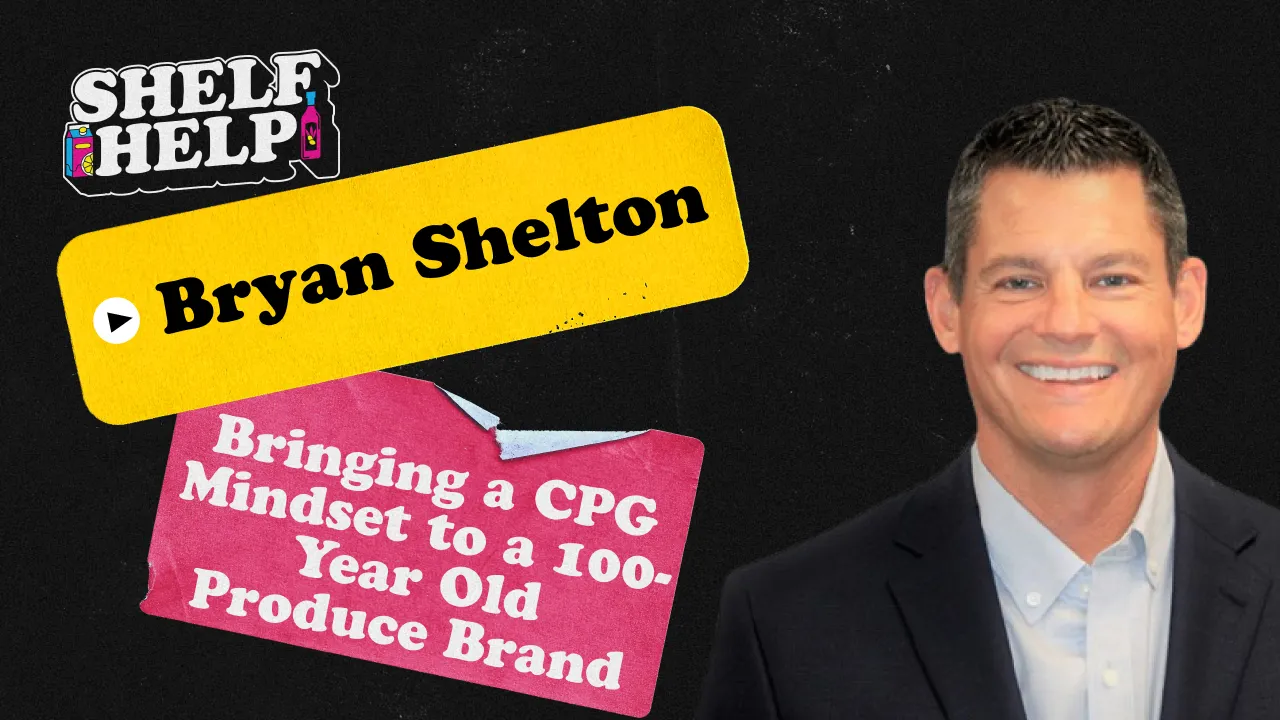
Bringing a CPG Mindset to a 100-Year Old Produce Brand | Bryan Shelton, Giorgio Fresh



On this episode, we’re joined by Bryan Shelton, the VP of Sales & Marketing at Giorgio Fresh — the largest grower, shipper, distributor of fresh mushrooms.
Before joining Giorgio, Bryan held senior sales roles at legacy CPG companies like Del Monte, Pinnacle Foods, and Kellogg. At Giorgio, he’s leading a modern transformation of a nearly 100-year-old company, pushing mushrooms into the spotlight with value-added innovations like stuffed mushrooms, savory sauté kits, and new grill-friendly formats.
We dive into how Bryan’s background in frozen and shelf-stable CPG informs his strategy in fresh produce, the challenges of building a brand around what’s often seen as a commodity, and how Giorgio is repositioning mushrooms as the ultimate superfood.
Bryan shares lessons on launching new SKUs with limited shelf life, how to avoid landmines in the foodservice channel, the tradeoffs of packaging refreshes, and why being great at the fundamentals — quality, service, relationships — still wins in produce.
—---------------
Episode Highlights:
🍄 The 100-year story of Giorgio and its global reach
📦 Building brand equity in a category most people consider unbranded
🛠️ Why packaging form factor matters more than you think in produce
🧑🌾 How shelf life, QA, and crop cycles change how you sell
📈 “Yes, if…” — Bryan’s philosophy for navigating retail requests
🚚 What goes wrong when brands scale too early
🍴 Why foodservice is a low-barrier brand flywheel
🧠 The product launch framework Giorgio uses
🧃 The origin story of Giorgio’s global bottling business
⚖️ Why your best work won’t always show up in your year-end numbers
—---------------
Table of Contents:
00:00 – Bryan’s background and Giorgio overview
04:00 – Key differences between CPG and produce
07:00 – Brand-building in commodity-driven categories
10:00 – Shelf life, retail strategy & e-comm influence
14:00 – Product innovation, testing, and scale challenges
20:00 – Packaging design: visibility, structure & sustainability
25:00 – Foodservice vs. retail: how to think about each
30:00 – Mistakes, mentorship & leadership lessons
34:00 – Why mushrooms are the world’s most underrated superfood
—---------------
Links:
Giorgio Fresh – https://www.giorgiofresh.com
Follow Bryan on LinkedIn – https://www.linkedin.com/in/bryan-shelton-14b45413/
Follow Adam on LinkedIn – https://www.linkedin.com/in/adam-martin-steinberg
For help with CPG production design - packaging and label design, product renders, POS assets, retail media assets, quick-turn sales and marketing assets and all the other work that bogs down creative teams - check out KitPrint.
Episode Transcript
Adam Steinberg (00:00)
All right. Welcome to Shelf Help Today we're speaking with Bryan Shelton, who's joining us from Rogers, Arkansas, which is right outside of Bentonville, Walmart's home base. And Bryan heads up all things sales marketing at Giorgio Fresh which is the retail and food service division of Giorgio Companies, which is mushroom farm that started in 1920 and has since become one of the largest edible mushroom cultivators and marketers in the world. And before jumping on board with Giorgio Fresh.
Bryan held a various sales leadership roles at some pretty big names like Del Monte, Pinnacle Foods, Kellogg, et cetera. so yeah, with that, let's get into it. So Bryan, first off, just for the listeners that maybe are not as familiar with Giorgio Fresh, just maybe just give us a quick lay of the land in terms of origin story, kind of the why behind the brand, core products you offer, and maybe just a few examples of where the listeners can get their hands on them.
Bryan Shelton (00:55)
Yeah, thanks Adam. No, I appreciate it. No, it's a great story. I've been here almost coming up on three years and not to correct you, but our hundredth birthday will be 19. We started in 1928, so we're we're three years away from our 100 year anniversary and we're third generation owned. Peter Georgie is our single shareholder. He is the great grandson of Petro and his father Fred passed it on to him and we started in Blandon, Pennsylvania.
Adam Steinberg (01:06)
Okay, that was close.
Bryan Shelton (01:23)
as a mushroom farm and mushroom growing operation. And since expanded, right? We started, you know, obviously growing fresh mushrooms, then we went into canned mushrooms, then we converted from canned mushrooms into largely fresh, but we are vertically integrated where we have the canning operation and all of our own growing operations, but we also are diversified uniquely in that we own a domestic can manufacturing company. We have two different facilities under a different,
a company outside of Giorgio, but it's under the Giorgio group of companies, which is Can Corp. And then we also own a global bottling and canning manufacturing company that's in 17 different countries. And that is called Can Pack. So Peter is the single shareholder over all those businesses, which really makes it fun because quick decision making, we're somewhat insulated from global economic, you know,
Adam Steinberg (02:06)
wow.
Bryan Shelton (02:18)
stress because we are pretty diversified. And the beauty is, know, Peter just reinvest in the business aggressively, which really makes us unique and makes it fun, right? As we're reinventing the mushroom industry as it speaks, because it is a hundred years old. We do everything from fresh produce to canned products. And now we're leaning in into innovation along the value add space. So whether that be our stuffed mushrooms, our savory saute,
We're actually stuffing peppers now. We're coming out with something new called grill packs, just trying to make mushrooms more exciting and convenient. And you can find our mushrooms at many of the larger regional and national grocers, whether that be in the Giorgio label or within the customer's private label. So yeah, we're pretty easy to be found. Our value add items are all under the Giorgio label. So they're usually the easiest to find.
Adam Steinberg (03:14)
Man, it's really cool. didn't know it was that much of a dynamic business. almost, when you said like the canning and the bottling divisions, it almost made me think of, think when Jeff Bezos, I think he always talked about it at Amazon, whenever they saw they had like an internal cost center, they would say, how can we turn this into a profit center?" It sounds like it might be something similar or obviously CPG companies have a packaging cost. And you're yeah, why don't we turn that into a profit center and we can start selling bottles and cans to other companies too.
Bryan Shelton (03:39)
Yeah.
Well, the canning company actually started, they got frustrated back in the day when Peter's dad was running the company of the can prices from the can manufacturers. And they're like, you know what, let's figure it out ourselves and we'll start doing that. And then our first acquisition was from the country of Poland to get into bottling from the government. And then we just expanded from there. it's really an...
Adam Steinberg (03:55)
Yeah.
Bryan Shelton (04:05)
Like I said, I'm scratching the surface on those businesses, but it's pretty cool to get access and learn from all global different companies.
Adam Steinberg (04:08)
Yeah.
Yeah, totally.
You I spent a fair amount of time, as I mentioned in beginning with, you know, and what a lot of my people might think of as traditional CPG, like, you know, snacks, frozen meals, et cetera, and also a lot of time in the broader, I guess you can tell if I'm defining is wrong, like the produce category was, you know, fruits and veggies at Del Monte, now mushrooms at Giorgio. And I was just curious, like,
As you've been in both of those worlds for so long, what are just some of the biggest differences between the two in terms of the way that you approach sales and marketing? know that's a broad question, but I'll let you speak to whoever you want.
Bryan Shelton (04:46)
Yeah.
No, I didn't. So on the Del Monte side, I was on the package goods side. So on the can side thing. So we had a produce side of the division. It was in the little cups in the refrigerated section, but I'd never really, this is my first foray into straight produce. And there are a couple of things that were kind of blew my mind initially. And number one is shelf life, right? We have about 14 days of shelf life when we pick fresh.
Adam Steinberg (04:53)
Okay.
Bryan Shelton (05:14)
to get through the entire supply chain into our customers' cupboards for consumption in their refrigerators, I guess, not the cupboards. And that changes the dynamic of decision-making, of how we transport our items into the stores, to the food service. So I would say that the shelf life drove a lot of different decisions and how we go to market. I also laughed that in my entire 20 years before this,
I never heard of a QA manager ruining my day from a customer. And then right away you realize the gatekeeper is a QA manager in the produce space. So, you know, being able to, you know, they're investing and really taking a look and inspecting your product. So to make sure we're bringing the best possible product to their customer's shelves every day. So that was an interesting dynamic. I think the other thing, Adam, the one that I've really enjoyed is
Adam Steinberg (05:46)
Thank you.
Bryan Shelton (06:10)
In the produce space, we're all growers at heart. So there's a relationship there and an understanding from our customers that can be a little bit more of a relationship dynamic because come visit our farm, you'll see how we're growing these mushrooms. And it's not just flipping the mushroom machine on at a higher speed to produce faster. So there's an understanding that mother nature causes some calamities in the crop, et cetera.
So I really appreciate that there's value in many years of relationships and trust because of the growing aspect of the process.
Adam Steinberg (06:44)
Yeah. And that, that that's interesting. mean, think in traditional CPG,
building long-term brand equity is, part of the core strategy and in produce, seems like it can be a bit more of a commodity driven, at least to a certain extent, probably some categories more than others. And I'm curious like how you think about brand building differently, if you do it all, across these two worlds
Bryan Shelton (07:08)
Yeah, I mean, the branding efforts are definitely fewer in the produce space. Some have done them extremely well. There's examples all over the place, but it's all about product, some form of product differentiation, whether it's in the product, whether it's in the packaging, whether it's in the benefits that allow you to brand something versus being commoditized. Hence our value add line. do, we were the first, we do it really well. We feel like we do it the best.
So that is the one segment of our business that is 100 % Giorgio branded. But I really think it's all about differentiation that allows you to brand things and develop that brand, especially in the produce space. And it's a little more challenging, right? Because there's fewer opportunities to do that at its core. So it's evolving. And I think as we reinvent ways to engage the consumer within the mushroom category,
convenience, appeal, things like that, will allow us to further build our brand. But at its core, a base mushroom is a base mushroom is a base mushroom, right? It's hard to differentiate at this point in the game.
Adam Steinberg (08:13)
Yeah, that totally makes sense. And on a similar track, this is much more of a kind of a tactical question from a retail standpoint. What are some of the core tools that a brand in this category typically have in their tool belt to pitch buyers and achieve sustained success at retail? I'm just talking about, you know, things might be considered pretty typical, whether it's sales decks, sales sheets, one-pagers for pitching buyers when you're on the shelf, like shelf talkers,
aisle violators, which some stuff it's pretty standard in like, you know, the package category, but I'm curious, what do those tools look like? And is it pretty similar to traditional CPG or are there things, some things that are fairly different to a certain extent?
Bryan Shelton (08:53)
Yeah, some are, it was a good summary. Some are similar, right? Your pitch deck, why, how's this new item going to grow the category? It's less data driven in the produce space. But at the same point, it's being able to say what you, know, deliver on what you said you were going to do. The number one focus in produce is quality and service. If we can't supply you quality product and deliver it on time,
to your customers needs and it doesn't matter how great this item is. And I think that is much more of a given on CPG because it's not necessarily coming out of the ground. could be, you know, it's running through a factory. So it's easy to make boxes of snacks, if you will, or cereal versus growing mushrooms. So I think you really, it's your stamp of quality and service, the range, range true. And people have long memories in produce space. So it's.
Hence, the connection and the relationships work both ways, right? You're kind of giving your seal of approval on things. So you're going to do everything possible to meet those customers' needs. Once it's on shelf, we're trying to be more creative to drive some of that engagement with the consumer. Whether it's, your point earlier, shelf talkers, it's digital interaction, right? Where customers, e-commerce,
And we're really trying to invest in the customer's platforms so we can engage the consumer before they get in front of the shelf. Our challenge in mushrooms is getting to the younger consumer and adding it to the basket. we know many of the shopping habits for the younger consumer are different. They're not necessarily walking each aisle of the store. They're using their phone and they're selecting here. So we need to get them before they start placing their order.
you know, on social media and other vehicles.
Adam Steinberg (10:40)
And on a similar track, this is not necessarily specific to produce, this is just all of your experience in CPG in general, I'm curious what your thought is, I think it seems like the more a brand's retail distribution footprint expands, and we see this a lot in my production design agency. We work with a lot of brands that have a pretty large distribution footprint. And it seems like the more that retail distribution footprint expands, the more one-off requests a brand can get from specific retailers, whether it's like...
Costco might be the typical one they want to, they're asking you to launch a specific SKU for them, or maybe it's even Kroger or Safeway or Albertsons or something. They're asking, Hey, can you launch a specific SKU for us?" Or we want to do specific collaboration or something like, um, or maybe it's just retail specific media, media and ads, that kind of stuff. I'm just curious, like how should brands think about balancing the need to go above and beyond for retailers, especially some of the bigger ones versus, maintaining margins. Cause I assume the more you take on those one-off requests, you know,
adds to cost, from a labor standpoint, any specific packaging stuff. Like, does that question kind of make sense?
If so, how do you kind of think about that?
Bryan Shelton (11:44)
Yeah, yeah, does, Adam. And I think, you know, working on with smaller brands that were earlier in my career that were built from scratch in the frozen space, you need to invest in order to build the business. Unless you have the greatest innovation, it's really hard to say, I'm going to give me full distribution and I want to make sure it's margin of creative to the rest of my portfolio. Those are unicorns. Those rarely, rarely happen through.
throughout the year. So I think you need to invest to build a business. And then once you have the business, you can find ways to build some profitability in it. And then to your question about one-offs from retailers, my philosophy and one of my mentors over the years said, it's never no when a retailer comes to you. It's yes, if. So typically, if they're asking you to invest in one of their platforms, there's a trade-off there.
Yes, we can do that if we can get some greater distribution in this region. Would you like create a unique item for us so we have the initial runway? Yes, but can you also support us here? And I think the goal of elevating some of those partnerships allow you to have those trade-offs. So it's not necessarily a zero-sum game where you feel like you're just, you're putting all the work into the relationship. There's a balance there. So.
That's usually been some of the best partnerships have led to that yes if and there's a win win for both parties.
Adam Steinberg (13:11)
I think that's a great way look at it. Shifting gears a little bit, talking about innovation, formulation, new product development, commercialization, that kind of stuff in this produce category. I'm curious what this looks like in the produce category for some of the biggest brands. And as an example, how do you test and scale something like a new saute kit, like stuffed mushroom flavor, for example?
Bryan Shelton (13:32)
Traditional CPG, a lot of it is heavy consumer testing to understand the white space. And then within the white space, you start figuring out what's an item that will deliver within that white space. And then you bring it to the marketplace. I'd say in produce, from the overall innovation investment dollars aren't necessarily there. So I think it's more customer driven, a little bit of consumer driven where you're
We do a lot of reading, you walk the aisles of the store, you understand what's hot, and then it's capability driven. What can we do within our existing asset or co-packer base that delivers in what the customer just said they're looking for and what we know the consumer is skating towards? So it's a little bit of a mix there between those three versus traditional CPG. And we do a lot of,
Adam Steinberg (14:18)
Yeah.
Bryan Shelton (14:22)
The one challenge in produce, because very rarely in produce do you have, like a national customer says, Giorgio, you're going to supply every one of our DCs nationally. Largely, it's really hard to happen. So you're going to have a portion of the DCs. So to scale things is really challenging. So it's typically a softer launch with commitment from one of your larger customers to get it on its feet.
And then we start doing the selling and the scaling. It's been the one challenge as we've become more innovation driven at Giorgio is how do we scale quicker and faster with some of these new item launches, knowing the dynamic of the produce space.
Adam Steinberg (15:04)
Yeah, no, that makes a lot of sense. on a similar track of
commercialization, innovation, talking about packaging design,
my sense is that opportunities to stand out via packaging design may be a bit more limited in the produce compared to traditional CPG, but could also maybe potentially be a way to really stand out if brands explore different packaging form factors and not just like design applications and the aesthetics of the packaging form factor.
Does it sound right or am I way off your?
Bryan Shelton (15:32)
No, I think you're right. think for a while, produce space was, we are what we are. We might've tried something in the past, it wasn't ready and consumers weren't ready for it. But as the consumers change and the demographics change, I think the need for packaging innovation is there. Whether it's product visibility, packaging that allows to see the freshness.
packaging that allows you to do some billboard advertising, you know, when it's on shelf and impact on shelf. And also it's the long-term sustainability aspect of it. While consumers say it's important to them, I don't know if they want to, it's not proven that they want to spend extra for it, but it's important long-term that you have a plan that your packaging is sustainable for the long-term. And I think uniquely we've realized that many of the packaging trends start over in Europe.
Adam Steinberg (16:17)
Yeah.
Hmm.
Bryan Shelton (16:23)
And,
you know, understanding what's going on there. Many times it kind of crosses the pond over here and understanding what's going on there, why, the whys and what's, and that's been interesting to understand what that looks like.
Adam Steinberg (16:38)
Let's just say hypothetically, I came to you and I told you, "Hey Bryan, I'm getting ready to launch a new brand in the produce space. It's some sort of branded produce brand and I'm about to kick off packaging design", What are a few things or like frameworks or tips that you'd give me or on the opposite side, things to watch out for that could trip me up?
Bryan Shelton (16:57)
Yeah, no, I think first and foremost, you want something that's shoppable on shelf and then meets the parameters of your larger customers, whether it's a push shelf or whether it sits in the well. How does that product present itself to the customer? And then from a shop ability, you know, really explaining the benefits of what you're selling. And I think the big watch out is you could have the greatest innovation.
of packaging innovation as you could dream up. But if it doesn't hold up, it doesn't extend or meet the shelf life requirements of the old packaging or extend it or allow the really the quality of the product to be protected, it doesn't matter. So you really have to remember at its core is can you protect the quality of the product and protect the shelf life of it? Because if not, then it's just not worth it in the produce.
Adam Steinberg (17:50)
Let's say I was a brand leader at a produce focused brand and I'm already in the market and I
told you, "hey, we're considering a packaging refresh." Uh, what questions might you ask me to help me confirm if this is even the right strategy in the first place?
Bryan Shelton (18:08)
Yeah, I mean, it's funny. We're working a little bit on a brand refresh ourselves that comes in part and parcel with packaging. I think it's really understanding what is the core core value of your brand and packaging delivers and understanding that what it is today, right? What is the value proposition that your brand and packaging delivers today? Then once you understand that, think it allows you to then adjust to more aspirational
values that you're going to be trying to achieve with your change. But if you don't understand what it looks like to begin with, you could make unnecessary changes that could be negative to your existing business. So I think understanding where you play and where you sit. then I think aspirationally, where are you trying to go with your brand or your packaging? Who's the consumer that you're going after?
And once you make a lean in and make a decision, there's a certain form of testing that you need to go through. In my previous world on the CPG space, we did a brand refresh and we misunderstood where the equity lied in the eyes of the consumer. We thought it was in the logo of the brand, but in reality, it was the color behind the brand as it sat in shelf. And it was an expensive, painful lesson to learn.
when we just not understanding where the equity truly lies in the eyes of the consumer.
Adam Steinberg (19:39)
Yeah. And how do you, Giorgio is probably a good example of this. said you guys were going through a potential brand refresh because it's been around for so long. How do you balance that need for a fresh look? Obviously that's part of the goal of doing a brand refresh. Also with
that importance of keeping those
legacy brand elements for those existing customers so they'd recognize it still on the shelf when they're walking by?
Bryan Shelton (20:02)
That's a million dollar question. And that's what we're trying to balance right now, Adam. I'll tell you, for me, it's understanding, like I said earlier, if you're understanding the value proposition that you currently have, and then is there a logical and believable story that links to your refresh that the consumer says, still little Georgio, but I see it. It's just a little refreshed versus if I think if it's too drastic of a change, it could say, wait,
Adam Steinberg (20:05)
Yeah.
Bryan Shelton (20:28)
So does that mean you're not the Giorgio, you're trying to distance yourself from the Giorgio brand that we've known for the last 50 years? So I think that's the benefit. There's always the instinct to say, let's be bold. Let's make a big difference. Let's make a change, right? But you have to be careful. And I think for me is if I can logically link the old brand to a refreshed option, that makes sense.
I think that's the key to success.
Adam Steinberg (21:00)
Yeah, yeah, I know it's a delicate balance for sure. Shifting gears like a little bit, I know you own the food service channel as well. And I think this, for whatever reason, this seems to be a pretty big topic of discussion these days, like more than it has been in the past few years for a variety of reasons might be, you know, better margins. You don't have to give away as much as retail. I'm not exactly sure what it is. Can you maybe speak to that too, but at just the high level from your point of view, like what are the...
the pros and cons of the food service channel and maybe in comparison to traditional retail channels?
Bryan Shelton (21:32)
Yeah. good question. I'd say, you know, it's a low barrier to entry in food service, right? It's usually an item and a price. It doesn't have to be a million different items, special packaging. It's usually an item or two and a price that gets you in the door. So it makes it very competitive. And sometimes it can be more price driven than, than, than I'd like. And, and, some of the differentiation that you bring to the retail channel isn't necessarily as valued as much. it allows.
more folks to play in that space. On the upside, it does allow you to, you can scale pretty quickly on a certain item. So you can, you whether it's white mushrooms, cremini mushrooms, you can scale up pretty quickly because of the scope of the food service. there's potentially the packaging costs, et cetera, are more simplified. So it's a nice option in the portfolio and it's nice to have a healthy balance.
Adam Steinberg (22:25)
Yeah. And it seems like I have to imagine not every product line or product format makes the most sense in food service. When you think about that category or that channel, what, what characteristics make a product a strong fit versus ones that may not be that good of a fit for food service?
Bryan Shelton (22:45)
Yeah, mean, so much is like the many of this food service, the larger ones, the Cisco US foods, they're gatekeepers, right? And it's their operators that really make the decision. So you got to make sure what you're bringing to the table, the end user, the operator thinks is beneficial. So I think engaging with them, making sure you're linked up that the whether the packaging format, the product format is.
usable and convenient for them and holds up for their operations. So there are opportunities for innovation, but you have to be more thoughtful, right? And we're actually working on that. Like how do we scale up some of our innovations to meet this channel? And there's just a little bit more heavy thought to upsize the package count and et cetera. So something that works while not breaking the
cold chain, right, the supply chain, because it is produce.
Adam Steinberg (23:42)
Yeah, no, that's that that that seems totally logical. And maybe for an earlier stage brand that has not that is not in this channel yet. And they're thinking about, it feels like they feel like their brand could make a lot of sense. What should their strategy look like in terms of opening up this channel and then growing the channel from there once they've kind of found product market fit in the in this channel?
Bryan Shelton (24:04)
Yeah, you know, I think it's a really good channel to test innovation. Understand if the consumer is going to respond to it. Right about the time I started with Giorgio, we had a great product called pulled pork. And it was a, it was like the replacement for pulled pork, but it was portabellas. Great sauce and seasoning. And we started it in the retail channel, but we didn't, we don't really have the investment dollars to put it on.
and tell everybody where it is and when they're walking the stores to understand what it is, how to apply it. So I think if we could do it all over again, we would have started with food service, proven it at restaurants to say, oh, wow, I had this great pulled pork sandwich at the restaurant X or Y. I'd love to see if I could get it in store. And we could have had more proof of concept and that the consumers respond.
and then bring it to the retail channel. So I think there's definite value in that, especially if you're doing something unique. And like I said, you don't necessarily have the investment to make this monstrous launch to scale up and then communicate to the consumer how to use it and all those good things.
Adam Steinberg (25:18)
Yeah, it's not, it's, I think I've heard you talk about food service as, being a brand building flywheel. sounds like this is exactly kind of what you're talking about.
Bryan Shelton (25:27)
Absolutely, Proof of concept, you gain some momentum, people have interest. how do we, where else can we find it? Let's bring it into the retail space. And yeah, and then it just, it kind of feeds itself. Yep.
Adam Steinberg (25:39)
Yeah. And how can brands get tripped up in this food service channel and maybe how can they plan ahead to avoid some of the potential most obvious or maybe not so obvious landmines that they might walk over?
Bryan Shelton (25:55)
Yeah, I think you have to be aware that it is from a financial perspective, it is a low barrier of entry. So you're going to have to have a sharp price point most times. And that's why it's a good balance with all the other channels because it's very competitive. So I think you just need to be aware. There's typically annual RFPs within this space. if you don't keep your eye on the ball,
and you're looking to whether an increased margin, et cetera, you know someone's always right behind you because the barrier of entry is a little bit lower than if you were going to do an extreme exotic item on shelf that's an exotic blend with fancy packaging and branding. Well, the barrier of entry for something like that is much, much more challenging.
Adam Steinberg (26:40)
Yeah. Yeah. That's, that's a good call out. shifting gears a little bit. often like to ask about the balancing, balancing the focus between velocity and distribution points. Cause it seems like it's a thing that earlier stage operators sometimes think, "hey, I want to get into as many retail
points as fast as possible." And that may not always be the smartest route to go. So I'm just curious for, for the up and coming, especially first time CPG operators,
maybe just help them understand, assuming you agree with this statement, why they should focus on velocity more than expanding distribution points just as fast as possible.
Bryan Shelton (27:15)
Yeah, no, that's a great point, Adam. And it is a balance. have to prove that you have, I think it's proof that you have a winner first and understanding. And I think the other key is when you go into, depending on what department, what are the expected velocities within that category where you're placed? There's proliferation of like health and wellness brands across all the different categories. So you got to understand where you're being placed.
by the retailer? Are you in the conventional space where the velocity benchmarks are up here or is it health and wellness where velocity benchmarks are a little bit lower because it is bringing innovation driven and driving trial? But yeah, driving initial velocity. And I think it allows you to focus. All right. Do we have the right trial driving investment, know, digital online in store? Is it properly placed on shelf so the consumer can see it?
Is it priced right? are we do we have the right promotional strategy? Once you have that down and you have a winner, it's much easier to scale than scaling right away, guessing. And when you don't have a lot of that stuff figured out. Granted, though, a lot of the P &L drives so many decisions and and and you know, the most efficient way is to scale immediately for something that you're investing innovation dollars for. But yeah.
I do think establishing a winner, the parameters of why it won, what makes it successful makes it lot easier and long-term sustainable success when you scale.
Adam Steinberg (28:43)
When will they know it's the right time to focus on retail expansion as well?
Bryan Shelton (28:50)
You know, that's a really good point when you know, think traditionally if you're going to, I'll say on the produce space, there's a lot of, there's a ton of produce shows and within the space. So you can show a new offering and you get a lot of initial feedback. I'd love that. That's a winner. Where can I get that? And you do that at CPG as well, but I think you get the concept and you show the
you know, some of the velocities, how it's performing, and you get some head nods in front of other customers, then I think you realize it's time to scale. You get some of those soft yeses, go, if I can get my hands on that, absolutely, I would take it. So that's how I would do it, which is a little bit more on, you know, old school, right? Getting the product in front of folks, getting some of the data, understanding if we have some soft yeses, and if you feel like you got enough, then I think you just, you make the jump to scale up a little.
Adam Steinberg (29:45)
Yeah, totally. Yeah, Bryan, mean, it's clear you've got a fair amount of wins under your belt and your career at this point. I think, however, some of the best learning experiences often come from failures or in times when things didn't necessarily go as expected. I'm curious, what's something that jumps out that took you a while to learn or internalize, but before that light bulb went off and then it was all of sudden like, man, this totally makes sense?
Bryan Shelton (30:10)
Yeah, no, that's a really good one. did. So I'll answer this. I'll try to be succinct. You know, the one is you separate results-driven world. But I will say, till the day I die, some of my best years results-wise weren't necessarily the best work I did. And some of the years where I had the worst results, I did the best work because you're scrapping and crawling.
to save a business or to overcome an obstacle that was super challenging. So while you did all this heavy lifting, it didn't necessarily result in these great year end numbers, et cetera. So being able to understand that the value of the work and the results and having a healthy balance there, I think was something that was hard for me to initially grasp. Then I think engaging with customers.
younger on younger in my career and so much to say and probably filibustered instead of just taking a step back asking a lot of questions and it's amazing they'll lead you to the answer so taking a step back breathing asking some some questions and then lastly it was a mentor of mine whether it's internal public speaking presenting to a customer you name it you want everything to go perfect
And you could be, you could stumble because you said a word different or pause and you realize that they didn't know what you were trying to say. So just own it, right? Move on. Nobody else knew you wanted to say it this way versus that way. So say it with confidence, move on and everything's going to be okay. ⁓ So those are some of the, those are some of the, the, the, I think the,
Adam Steinberg (31:55)
Yeah.
Bryan Shelton (32:02)
the key learnings and lessons, you know, and then I think you said as you work your way up, what was something, you know, that as you work your way up into greater roles and responsibilities, right? I think that was a question you had sent earlier and that one resonated with me. Another one where it's an old, my old baseball coach adage, fake it till you make it, right? You're there for a reason. No one's questioning your background.
Adam Steinberg (32:14)
Yeah.
Bryan Shelton (32:28)
when you're in that role. So be confident, be assertive and make decisions because you're going to learn whether it's the right decision or not. You make a decision, you learn and move on. If you get caught in assumptions and indecision and you're not being assertive, nothing good happens from that. kind of take, you know, let it rip, be confident and then just move on and learn from it.
Adam Steinberg (32:54)
Yeah, those are, those are super helpful. I think those would be motivational for a lot of people that are growing in their roles. Last question for you, any brands or trends in general in the CPG space, whether it's, you know, produce or not that you're like particularly excited about any trends you wish you would have jumped on earlier thinking back now?
Bryan Shelton (33:16)
Yeah, no, it's funny. So a little plug for the mushroom space, right? I've eaten mushrooms my entire life, two and a half years with Giorgio. I had no idea how many tailwinds mushrooms have with what consumers are looking for. The sustainable growing process, The water, it's just circular. We really waste nothing from the growing of the compost to the hand picking, and then all the health benefits of it.
Many of those are coming out where people are taking the micro doses of Lion's Mane, et cetera, that are out there. There is a great story in the mushroom space. We just haven't been able to link the fresh mushrooms with all of those other benefits. So that's what we're really trying to unlock. And I think there's so many health benefits and it meets a lot of the consumer's needs that I think that's our next.
It's really the ultimate superfood. And how do we do a better job telling our story? I laughed when I first started. like, man, mushrooms have this amazing story, but we kept it secret amongst all the mushroom growers. How do we tell it to the broader landscape? So that's what I would say. I think there's a lot of growth there just because it's such an easy story to tell. We just haven't necessarily done a great job telling it or I think maybe making it easier for...
folks to consume mushrooms. think sometimes people need to use their brains when they buy mushrooms. What am I going to use it with? And we really need to remove that barrier. We want it to be mindless. I got my mushrooms and I have 9,000 ways to consume it because I know they're healthy and they're really tasty.
Adam Steinberg (34:54)
Yeah, that's that. I feel like that's super powerful. Well, yeah, Bryan, this has been, I it's been really awesome. I think you shared a lot of really valuable insights. I think, yeah, listeners can get a lot of value to this. So where, where can people find you, follow along with you, and then also where's the best place to follow along with Georgio as well?
Bryan Shelton (35:12)
Yeah, so LinkedIn is a great way. You can find me on LinkedIn and it's just Bryan with a Y and then Giorgio Fresh has a LinkedIn page and you can also find Giorgio Fresh on Instagram and Facebook and we're also on our website and we're in the midst of redoing our website to make it easier to find and maneuver. So those would be the areas you could find us.
Adam Steinberg (35:35)
All right, perfect. Awesome, thanks, Bryan. I really appreciate it and hope you have a good
.svg)