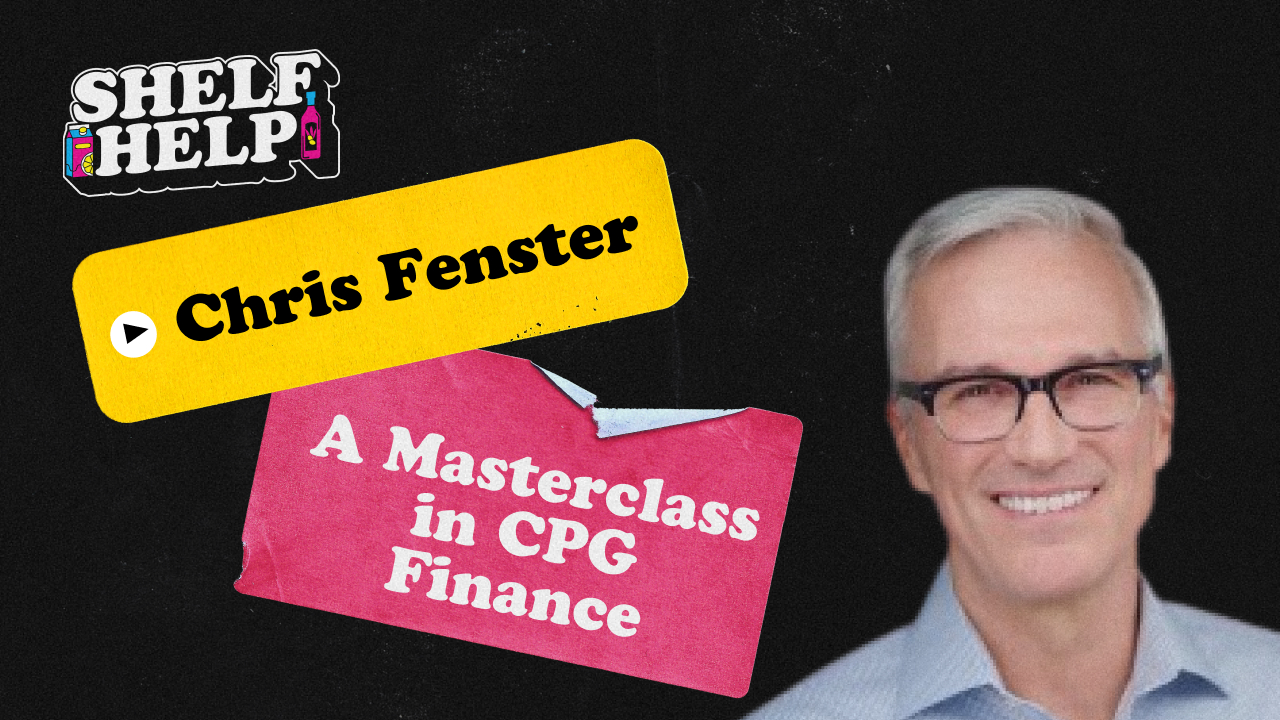



On this episode, we're joined by Chris Fenster, Founder and Executive Chairman of Propeller Industries - the embedded finance and accounting partner behind some of the most iconic emerging consumer brands of the last 18 years.
Propeller has served more than 1,000 companies, including over a dozen unicorns, with a team of 250+ across three continents.
Chris breaks down why the 40% margin founders pitch often lands closer to 12 to 18% once promos, slotting, and trade deductions come out of revenue, and why margins counterintuitively fall before they rise as brands push from natural into grocery and club.
We get into the working capital death spiral, the gap between paying your co-packer and getting paid by the retailer, and the two failure modes Chris sees most: founders who size their raise off the P&L and forget the balance sheet, and brands that sprawl across too many SKUs and channels. He walks through the focus question every founder should ask, when to fund losses with equity versus layer on debt, and how to handle vendors when cash gets tight.
Chris also shares the Billion Dollar Beverage Blueprint behind Olipop, Poppi, and Liquid Death, the four stages of finance hires from zero to 100 million, why the independent board member is an underused secret weapon, and what changes after a 100 million dollar raise.
---------------
Episode Highlights:
🚲 From bike shops to founding Propeller in 2008
📉 The 40% gross margin myth (and the real number)
🔀 Why CPG margins fall before they rise
💸 The working capital death spiral, explained
🎯 Focus vs sprawl ($20M one SKU vs $30M many)
🏦 Funding losses: equity first, then debt
🧱 The "back against the wall" efficiency mindset
🥤 The Billion Dollar Beverage Blueprint (Olipop, Poppi, Liquid Death)
🪜 The four stages of finance hires (0 to $100M)
🤝 Why the independent board member is a secret weapon
⚠️ What really changes after a $100M raise
🛏️ The Casper cautionary tale and the risk ratchet
---------------
Table of Contents:
00:00 – Intro
01:19 – The accidental path to founding Propeller
06:43 – The 40% gross margin myth
09:36 – Why CPG margins fall before they rise
13:06 – The working capital death spiral
16:01 – Focus vs sprawl ($20M one SKU vs $30M many)
19:33 – What to do when cash gets tight
22:03 – Funding losses: debt vs equity
23:51 – The 'back against the wall' mindset
25:24 – The Billion Dollar Beverage Blueprint
32:10 – The four stages of finance hires
38:43 – Founder and CFO fit, and when it breaks
44:00 – Minimum financial literacy for founders
46:38 – The independent board member secret weapon
47:50 – What changes after a $100M raise
52:10 – The Casper cautionary tale
56:34 – Why Chris speaks up now, and where to find him
---------------
Links:
Propeller Industries – https://www.propellerindustries.com/
Follow Chris on LinkedIn – https://www.linkedin.com/in/chrisfenster/
Follow Propeller Industries on LinkedIn – https://www.linkedin.com/company/propeller-industries/
Follow me on LinkedIn – https://www.linkedin.com/in/adam-martin-steinberg/
For help with CPG production design - packaging and label design, product renders, POS assets, retail media assets, quick-turn sales and marketing assets and all the other work that bogs down creative teams - check out https://www.kitprint.co/.
Shout out to my friends over at Glimpse, the go-to partner for automating retail-related back-office operations and unlocking margin trapped in invalid fees and manual processes.
Episode Transcript
Speaker 1: 00:00
Welcome to Shelf Help. Today we're speaking with Chris Fenster, founder and CEO of Propeller Industries, the embedded finance and accounting partner to really some of the most iconic emerging consumer brands of the last 18 years or so. Chris started Propeller, I think, back in 2008, after spending a good chunk of timing 13 years or so, as a both a co-owner and a CFO of a series of businesses, some of which exited to some significant category leaders. Start to finish was one, which is just the one that jumped out to me. It's was a leading independent bike shop chain that was actually, I think, started in my hometown in Marin County, California. So that one immediately jumped out to me. Yeah, the propeller team, I think it's uh a little over 250 people across three continents. They've served close to 1,500 venture and growth stage companies, including 24 unicorns. So Chris and the team has definitely seen a lot. So very excited to dive into it. Yeah, Chris, maybe it's kind of first off for listeners, maybe for the ones that aren't that familiar with propeller, love it just get a quick lay of the land just in terms of kind of the origin story, the why behind starting propeller way back in 2008. And then maybe just kind of high level what the keynote team does actually do for emerging consumer brands in terms of fractional CFO, controller accounting, FPA, trade spin, all that kind of stuff. And then uh we'll go from there.
Speaker: 01:20
Sounds good. First of all, thanks for having me. I'm uh they say, like, you know, big fan, longtime listener. I sort of stumbled into this. Like I did not set out to start a company or be the CEO. I I'm kind of more of a working in the background comfort level person. And um so I was the first finance hire at four startups, and the first one was the cycling business that you talked about in San Francisco. That was I thought that was going to be like a pit stop on the way to sort of going back to business school. Like I just was looking for something entrepreneurial to do to talk about and interviews and just really fell in love with the business. And I think part of it was just like having impact and business building. And you know, I spent a couple years before that in consulting. Like my first job out of school was at a consulting firm. And and I learned a lot, but I I didn't build anything that anybody would notice, you know, nothing that would like outlast me. And and uh so I just I had the bug and I I uh was was interested in doing something more entrepreneurial before B school and and sort of stumbled into this cycling business and just wound up falling in love with it. And and I love the impact that I could have and it was really dynamic. And when I s really started to think about it, I'm not much of a school person. Like I I was okay at it. I wasn't great at school. So just sort of felt like, okay, I'm gonna stay here and and learn more and and see what we can do with it. And so I I scrounged up some money from friends and family and and invested and became partners with the guy that hired me. And and we just we busted our asses and made every mistake in the book and but also wound up selling the company to Trek a couple years later. And you know, I was like 26 and we had this, you know, it wasn't a huge business, but but it was solid and and you know, you'd heard about it. You like it was really well known in the area. I think it was the second largest independent bicycle dealer in the country at the time. And uh I sort of felt like the man, you know, it was a it was a cool thing to do, and it was uh, you know, it was sort of addictive. I it was like a dopamine hit, I think, to feel like I could make a difference somewhere, especially after consulting. You know, I was just like another kid in a suit. And you know, it wasn't like a life-changing financial exit, uh, but it was definitely life-changing in terms of like direction and and passion. So um what I didn't know was how hard it is to actually do what you know what we had done. And so I I um I partnered with another guy who'd built an apparel business. And um, you know, we we spent six years trying to do the same thing and just ultimately couldn't do it. We wound up selling the company, but you know, I left with I left with debt. And um, you know, it was just it was it was an unsatisfying outcome for me and for all of our investors. And you know, it was I just I learned a lot in the process, right? So I after that, I was the first finance hire at two more startups, and neither one of those really amounted to anything. But you know, I think what I've sort of finally figured out is that I I really love the work and I can't help myself. Like I love getting into early stage companies, and I love the exercise of figuring stuff out, and I'm nerdy and I'm determined and and I'm sort of stubborn and I'll I'll stick with something until I really get it right. And that was it was a good role for me. But I was a little gun shy and I didn't want I really didn't want to start a company. So I was looking for somebody else to hire me to be like the startup CFO person inside a bigger company. And I talked to a bunch of other firms in San Francisco that had like part-time CFO people, and none of them focused on startups, which I just thought was really weird. And so it was, I was just sort of like, you know what? I think I know how to do this. And after that second company, I had I was looking for a rebound job because I, you know, I needed a paycheck because I hadn't gotten a paycheck in a while. And and I stumbled into this nonprofit that handled finance and accounting for 300 other nonprofits. It was, it's still there, it's down in the Presidio in San Francisco. And that turned out to be the perfect model for what would eventually be Propeller. And so when I started Propeller in 2008, I had this crystal clear picture of you know of what it would look like because I'd learned it, this nonprofit, like I'd done it, and it turned out to be really timely. It was, you know, it was a little bit of foresight. And um, I had the right DNA for the job because I was, I was really determined to do the job. I was really passionate about it. And if those three companies in a row hadn't failed, I never would have started it. But, you know, when when things everything went digital, everything in the finance stack went from analog to digital, and everything went from on-premise to cloud, and those were just both massive tailwinds. And, you know, today almost everybody does things the way that, you know, we started to do them in 2008. So now the firm's a lot bigger. It's not a startup, it's you know, it's 18 years, and but it really all came out of that first experience working in the bicycle business that you mentioned.
Speaker 1: 06:42
There's a number of every C CPG pitch deck, which I'm sure you see plenty of that says, you know, our gross margin is 40%, let's say. But then by the time you stack the distributor margin, retail or margin, some of the promos, some of the deductions and billback slotting fees, that 40% ends up looking closer to, I don't know, 12 to 18, 12 to 15% or so. Assuming that you know resonates with you, I guess. Like what when you walk into a new CPG brand that propeller's working with and you ask for what the true contribution margin is by SKU and by channel, what do you kind of typically find versus what the team thinks the number is?
Speaker: 07:18
Yeah, it's a good question. And and the answer has evolved over time. Because I think if we're talking about propeller 18 years ago or 15 years ago, we were working with really small companies. Our incoming clients was basically anybody that would hire us. Um I mean, seriously, and you know, we and we didn't know what we didn't know. I had worked at a CPG company previously, so I had some experience, you know, working at one CPG company, but like definitely didn't have the reps that I do now. And so we would see all kinds of stuff, and it would look a lot like what you're describing. Companies come in and and they don't actually know that all their trade deductions are supposed to come out of revenue. And so, you know, margins are overstated on sort of a gap level. You know, the bottom line number is is more or less right, but the the gross profit number is is wrong. And, you know, we could we could fix that pretty easily and it would shake out more or less the way that you described it. These days, the incoming clients are are just bigger. So now they're there are a lot of and bookkeeping firms have gotten a lot better. So companies don't really need us at that stage. And and at this point, the companies that come to us are, you know, are often doing five or 10 million in revenue, and they've been working with a capable bookkeeping firm, or maybe they've got a fractional CFO person. So the the numbers are generally in good shape. Um I think um there is an evolution of margins over time. Um and that's something that I think we've gotten a lot more clarity on, you know, as as the business has grown and we've gotten more reps and we've worked with larger and larger companies. Um so you know, I think that's that's it it maybe it's it's a different question than the one that you asked. Um you know, those those smallish companies with a with a 12 to 18 margins, like a lot of them just aren't gonna make it. Sure, sure. Right? Like they they just never get funded or they die before they get to propeller. Um you know, the the good ones will will figure it out. And then, you know, if if we're lucky enough to work with them, um, you know, there's a whole sort of evolution that happens after that as they go into like these different stages and they get you know different amounts of funding. So I'm happy to chat about that if it's helpful. Yeah, yeah, go for it. There's a couple different sectors that you can look at, like between five and 10 million, and I've got, you know, we've got we've got a lot of companies in this data set, like between five and ten million, like typical margins in CPG, when they're accounted for properly, are like 40 to 45, or maybe they they think they're 45. When we get the numbers right, they're really maybe 30 to 40. You know, by the time we get like accruals and slotting and everything sort of properly reported. The weird thing is that gross margins usually go down before they go up. So I know that seems sort of counterintuitive because of like if you think they're at 12 and you know, 12 or 18, like, well, there's no, there's nowhere to go. You can't go down from there, right? And survive. But you know, when the companies come in at like 35 to 40, like they'll typically decrease down to about 30% at like 80 million, and then they'll tick back up, you know, to maybe 40% at 180 million, and and and then they actually start to accelerate a little bit. So like 45% at 200 million is is is you know, is pretty standard across the board. So the question is like, why is that happening? And a lot of it is channel expansion. Um, because when you're in natural, you just have more pricing flexibility. A lot of companies are starting out, you know, or a lot of our clients are starting out in the in the natural channel. And you just have a little more pricing power there. But over time, you get uh A funded, right? So, you know, at a certain point, somebody writes you a growth check and you've got 10 million bucks in your bank account and a mandate to, you know, go turn 10 million into 50 million or whatever it's gonna be. Um, so that drives a you know a bunch of investment. Like those dollars are there to be spent, and a lot of that investment goes into, you know, slotting and more competitive pricing. And you start to also see channel expansion into grocery where you know pricing is just a lot more competitive. And then you can also see category expansion, you know, into new areas where you know maybe you've got a bunch of new products, but the volume is lower. So the margins are lower because you haven't actually hit scale yet. So the combination of those three things, like channel expansion, product expansion, and then just you know, the more money you have, the more money you're gonna spend is part of what actually drives those margins down. Trust me, nobody puts this in their forecast, right? Nobody comes in saying, oh, our margins are gonna go, you know, from like 40 down to 35, but like that's what the data says. Yeah. So it makes sense. Yeah, it is, it's sort of just how it is. It's just interesting to be able to actually see the data across a whole bunch of companies.
Speaker 1: 12:43
Yeah, I'm sure.
Speaker: 12:43
Because for a long time it was like, wait, I think this is what happens, but I'm not really sure.
Speaker 1: 12:49
Yeah, I'm sure as you guys got more of that data set, the more clients you get, probably the more value valuable you are to clients because you have that data set to say, here's the patterns we see, we're gonna help you avoid it. Yeah, it's exactly right. When it comes to cash conversion, seen some stat, and you can correct me if I'm wrong, you're gonna know much better than I drive. I've seen some stat that it's uh, you know, 85% of new brands that fail in the first year, or that they do fail in the first year. And the reason it is is just often because cash just kind of dries up during that gap between when you're paying your co-packer and actually getting paid back by the retailer. Um, assuming that's G you're J on the same page, like from your seat, what does the, I guess kind of want to call it working capital death spiral actually look like? And then is there a certain revenue or kind of gross stage where it typically hits, like where you were just talking about where you gotten up to that much larger size, 80 million where gross margin drops a bit? I imagine that's not where this happens, but yeah, where would you is there kind of a pattern where you see at what revenue or kind of gross stage where this really starts to hit and where companies can start to stumble and potentially fail?
Speaker: 13:55
Yeah. So look, let's let's call out like two different failure modes for the death spy spiral. There's an early failure mode, and a lot of that is unforced error, you know, where founders figure out how much capital to ask for by looking at the losses that show up on their financial projections, like on their PL. So they they figure out like how much money are we going to lose over the next, you know, 18 months. And and of course, they always sort of underestimate it because there's a bunch of costs that aren't in there that should be in there. But a lot of them just completely forget to think about the balance sheet. It's just like it's uh and it happens a little bit less frequently, I think, for our, you know, our clients now that we engage a little bit later, but sure, you know, inventory, 60 days of inventory and you know, 60 days of accounts receivable, you know, minus maybe a little bit of accounts payable. Like that's the number. And in a lot of cases, whatever the number is on the PL, it's it's double that, is what you really need. And so they just they wind up not raising enough money and running out of cash before they've sort of hit the you know, the proof point or or the the threshold to be able to raise more money at a higher valuation. It's just completely because they weren't, you know, properly forecasting. They weren't thinking about the working capital needs of the business. So so that's the that's the first failure mode. And you know, that and that's one that we it's it's preventable, you know, but not if you don't have the right resources around you. And by the way, like your bookkeeper is often not thinking about this, or even if they are thinking about it, you know, they just may not have the sort of career confidence to get in your face and tell you.
Speaker 1: 15:46
Totally. Right.
Speaker: 15:48
So, you know, put people around you that will, you know, have the hard conversation, I think. The middle failure mode is a little bit different, and this it's it relates to what we were talking about before with margins. So, you know, you brought that up, and I think it's a good point. Like this is more about focus and channel discipline, product category. Like, I'll ask you, so would you rather have a $20 million a year business with a single product in a single channel or a $30 million a year business with a dozen products in natural grocery club and Shopify? Like 30 million or 20 million?
Speaker 1: 16:32
The 20 million with one SKU, because it's a lot easier to manage, a lot less inventory risk. Like you're not, you're inevitably not going to be sitting on one SKU that's selling slower than you thought.
Speaker: 16:42
Well, you also that I think that's the right instinct. And this starts to get into another piece of it, which is sort of what do what do you want? Or what do you and I want? And like what do our investors want? What does the cap table want? $20 million business with a single product and a single channel is beautiful. It is, and for the reasons you mentioned, it's simple and it's like the it is um it's way more efficient, it's way more capital efficient. And at least as it relates to sort of working capital failure mode, like every time you expand your product, you've got to get you know minimum order quantities for inventory. You've got to load up a channel.
Speaker 1: 17:21
Yep.
Speaker: 17:22
You know, you've got to load up the distribution centers, and then you know, you've got a bunch of receivables, and then you're ramping up the distribution in those new channels. And so what do you're doing a ton of trade spending? So every every invoice for a dollar actually, you know, comes back with 50 cents on it because of all the trade deductions. Like it's horrible for working capital. And and again, like people just aren't a lot of times, they aren't thinking about it. And, you know, even if they are thinking about it, like some investor gives you, you know, five million bucks to go expand your business and um you know, you get out there and start doing it. And if you underperform in any one of those four areas, you know, you might have several million dollars in working capital tied up in the in the channel. And then one of them maybe doesn't work. And it's like, okay, 30 million, you know, in across the higher risk factors in that, in that bigger business, just it creates a lot more ways to fail. And by the way, you had to take a bunch of dilution to get that extra capital.
Speaker 1: 18:28
True.
Speaker: 18:28
So, like this, you know, the value of the equity that you have in that $20 million business that hasn't had the dilution of a fundraise versus the value of the equity that you have in that $30 million business that had to take dilution. Like, you know, you're either average or maybe slightly above average in a in a couple channels, maybe not all of them, or you're killing it one. Like stay focused. You know what I mean? Yeah.
Speaker 1: 18:53
When and for let's just say it's gonna be a two-part question. Like if for brands that are sitting on, you know, they've got a brand that, you know, the revenue is growing, the growth is looking good, but the cash position is getting tighter. What's like, I don't know, maybe just call out like two or one to three like top-level things that's like they should focus on that could have the biggest impact in terms of getting them in a in a better position. Whether this second part is related or not, when does it make sense to take out inventory or AR financing versus just raising more equity?
Speaker: 19:22
Yeah, gotcha. Okay. So let me let me hit the the first part first. So like if they're not related, you can separate them. Well, they yeah, they're definitely related, but it's there's some complexity in it. But I I think I I think I can unpack this. So like, you know, when you're when you're running low on cash, obviously this depends on your runway. So it depends on your runway and sort of your like how resilient your business is. You know, are you within spitting distance of profitability? Is your are you um I forget who coined this thing, but like, are you default alive or default dead?
Speaker 1: 20:00
Oh, I think it was day, I think it would SACS, yeah.
Speaker: 20:02
Yeah, yeah. That sounds like a like sounds like a SACS thing. Um so, you know, if if if you can get to some position of stable cash flow and that buys you time to go execute, even if your revenue has to decrease a little bit, right? So if you're spending a bunch of money on growth, I mean, this is sort of the lever that a lot of companies have pulled over the last couple of years. Like you're spending a ton of money on growth and you're doing it inefficiently. And and maybe some of that was subsidized by, you know, investors that that you know back the truck up and put a bunch of money in your business. I've seen extraordinary things from companies that just have like unhealthy, inefficient marketing spending, like becoming efficient because they just didn't have a choice. It's amazing what you can do when your back's against the wall. And sometimes it just makes you wonder like, why don't I just keep my back mostly against the wall all the time? Because it's just it is so much more consistently, you know, efficient. So, you know, obviously, look, if if you can get to profitability, get to profitability. There's all sorts of things that we could talk about that would probably get me in trouble in terms of, you know, how do you get your inventor, your, uh, your vendors to be patient? Because for a lot of companies, you know, the the cost of goods sold is the single business biggest expense, you know, besides payroll, or sometimes, you know, it's even bigger than payroll. And so I've definitely seen people get creative in terms of going back to vendors, like uh, you know, their manufacturers and and being transparent with them, you know, about the challenge. Like if you can see a pathway to get to a fundraise, you know, you might be able to just negotiate something with them. Maybe they'll take some equity because they're already investors, right? They're they're just not getting upside. Like their investment is basically the receivables that they're taking on. You know what I mean? So it's like they're stakeholders in your business. And I've I've seen people make really good partners out of them. But you got to be transparent. Like, you know, it it it's just a high integrity approach usually, usually wins there. On the on the debt, like I think the right answer on debt is almost always debt and equity. Because the reality is like a healthy business hasn't has a nice ratio of these things. Like there is no substitute for permanent capital. And operating losses almost always need to be funded almost entirely with permanent capital, which just means equity. It could be, you know, a safe note, convertible notes, like all fall into that sort of permanent capital bucket. You just need a certain amount to it's like the lifeblood of the business, basically. But then it's super healthy to have some debt on top of that. And the right ratio will be different for, you know, for each business, like in a really heavily working capital dependent business that has a fair amount of equity. 80% of receivables and and you know, maybe 40 or 50% of inventory can often be um leveraged into asset-based lending. And sometimes it makes sense to layer on a little bit of venture debt on top of that, depending on a situation. But generally speaking, you should you should think of this as like a healthy ratio that you know will evolve over time, like across stages. And at a certain point, you know, you can you can do a ton of debt. They're like private, private debt lenders. You're 100 million in revenue, you know, probably profitable at that point, but you just need to fund working capital.
Speaker 1: 23:36
Right.
Speaker: 23:37
All sorts of options on the table at that point. But I think it's it's obviously trickier for the smaller businesses, you know, especially the ones that aren't within spitting distance of profitability.
Speaker 1: 23:45
Yeah. It's it's totally funny. It's kind of off topic, but not to throw us off. But you you talked about why don't businesses just always operate like their back is against the wall. And uh, I think it was, I can't remember which of his companies, I'm pretty sure it was Tesla, and I think it was their president or COO or something. It would talk about in some story that even at their level where they were doing, you know, tens or hundreds of billions of dollars of revenue, Elon still forced the company to only be operating a few weeks of cash in the bank at all times. So he like forced the company, everyone on the team, even at that size, to have that mindset of we actually our back always is against the wall, which is I thought was crazy at that size.
Speaker: 24:22
Yeah, I mean, there's there's just nothing like not having a choice to like, you know, force you to figure out how to be efficient.
Speaker 1: 24:29
Right, totally.
Speaker: 24:30
And it's interesting too, because I like most of our clients are pretty well capitalized, but there's a decent number of them that that bootstrapped or just raised a really small amount of money. And like I've seen some unbelievably good efficiency out of those businesses. And in I think in probably most of those cases, the founders would tell you that like they just didn't it never occurred to them to that they could spend a bunch of money to sort of buy the revenue.
Speaker 2: 25:02
Right.
Speaker: 25:02
They just they just had to be clever, they had to be creative because they they just they didn't know people that were rich. Or totally I mean it's it's and it's you know, it does. I mean, it it gets to your point. Um like I think keeping companies a little bit hungry is usually a good idea.
Speaker 1: 25:21
Let's talk about this thing called the the billion-dollar beverage blueprint for a second. I think you published this piece on this and wrote down what Olipop, Poppy, Liquid Death have all kind of had in common from a financial standpoint. And it seemed kind of like the I don't know if you want to call it the punchline, kind of seemed to be the all three transition from a past to accrual at some points, built trade spend system that similar scale, hired finance teams at kind of predictable milestones. I'm not exactly sure what it is, but yeah, can you kind of walk me through the blueprint of patterns that you've you've seen across those?
Speaker: 25:53
Yeah, sure. I I think there's a couple components here. I think the to to give all the companies credit and just sort of state the obvious, um like the product is the business, market timing, reading the tea leaves and the trends. And, you know, certainly for Olipop and Poppy, it was, I would say that it's sort of less like prebiotics or gut health and more just healthy soda. I mean, that was the thing I think that the you know, the investors and and you know, probably even like Ben and David at Olipop were were most excited about. Like, yeah, great, gut health, you know, adds this functional benefit to it. But, you know, in this case, like I don't know that those would be the you know, the market-sized opportunities that they are if it wasn't really appealing to somebody that doesn't care that much about gut health. Like it just tastes really good. And yeah, it does. You know, it's not it's not full of sugar. And so the, you know, between Olipop and Poppy, I think it was it was a little different. Like, you know, Ben and David at Ollypop had literally built a similar business before. So, and and you know, I don't think it was sort of a great outcome for them. So by the way, it's super remarkable that that those two decided to work together again, because like that never happens. Like, I don't I don't know if you've had a like a business with a co-founder, but like when when my second company went sideways, it was like it's just it's really tough. Like, you know, me and me and Tim are really good friends today, but like it's tough to stay together and let alone to decide to start, you know, within a couple years a similar business.
Speaker 1: 27:35
Like, yeah.
Speaker: 27:36
So I think you know, the they really knew what they wanted to build. They had real clarity around it. Um, you know, in the case of of um Poppy, founders had started a it was a different business, you know, it was a like a vinegar, uh like.
Speaker 1: 27:52
Yeah, remember when they went a Shark Tank, it was like a mother's something or yeah, yeah, yeah, mothers, exactly. Yeah, yeah.
Speaker: 27:58
And then yeah, Rohan invested and like, you know, they made a decision to sort of pivot into the category. And like, and that was a remarkably good decision. And you know, for liquid death, it's obviously that is a just phenomenal brand and so much just crazy creativity. But it's also it's just it's a giant market, right? And so I think the the thing there about sort of like you know, market size and market timing. You know, you want to get a billion dollar outcome, you like you got to pick a billion dollar market. And in the case of prebiotic soda, not a billion-dollar market, right? Like that's uh was probably a five million dollar market, maybe maybe not even that when they started these businesses. But you know, that wasn't it. Like the market, I would say, is just healthy beverages, it's healthy soda. So I think that was the first thing. And it's probably worth saying that, like, yeah, you need to be properly capitalized. And, you know, the least of it is just getting some level of of you know professional financial help in there. And and um, you know, we worked with both um Ollipop and Poppy, and and so we don't we don't have anybody on cash basis financials, like because you just you can't sort of do the strategic piece of the work that you know we're really meant to do without clean data. So at least getting them on scalable systems that are stage appropriate is I think the important piece there. The other thing I would say is just like competition as advantage is probably worth calling out, and especially in this case because Olipop and and Poppy are direct competitors. Like, and as I'm sure has been said before, like, you know, nothing like a great rivalry to make both companies better, whether it's like pro sports or I don't know, even like you think about like Feder and Nadal just like pushing each other constantly. Like we could see that sort of between the two businesses. Like there's a super healthy rivalry, but like the other piece of it is is when customers walk into the store, it's not just one brand, it's like an entire wall, you know, or just like the big stack in the cooler. And you know, now it's like, wait, what what are all these probiotics? It just it really helped, I think, speed adoption. I think each company, maybe without knowing it, really push the other. Uh and um, and that for sure helped the category. And look at it now. I mean, it's just it's you know, it's going nuts. And then the the I think the last thing is just financial support, or even you know, this this is true of all the operating disciplines, like support that can scale. Like, I think the only thing you can be certain of, you know, in in getting a company to a unicorn valuation is that you are you're gonna have to break and rebuild everything over and over again. And, you know, it's hard. You kind of have to build for the stage that you're at. Sure. Like in most cases, you can't overbuild, or even if you could, that would be a super bad idea. But it it just means that you have to build with flexibility in mind. Like you've got to know that, hey, the the person that gets me to this stage is not gonna get me to the next stage. And and you just gotta be willing to do that. Honestly, that's that's an area where you know, having a partner that can sort of provide continuity across the different stages. It just gives you a lot of flexibility. And and in each of these cases, like, you know, almost every company we work with that's had great success has gone through a bunch of people, except maybe groons, which just did it so fast. That was really like a remarkable and but different story. But like, you know, there's there's some collateral damage that comes from, you know, that level of dynamic growth. And, you know, the nice thing about a hybrid team or a you know, a team that's like a combination of W-2 plus, you know, some partnership is that the you know, the partners can provide some continuity through the change, which in most cases is inevitable.
Speaker 1: 31:58
Yeah. On that topic, a brand that's going from zero to a few hundred million. I think you told me when we chatted a few weeks ago, you told me that typically those brands will go through four different heads of finance some kind of along the way. Um, what changes about that finance job where different people, different skill sets need to come in? It let's just say at that, you know, I don't know, two to twenty-five million, and then you know, up to the next is like, you know, 25 to 50, 50 to 100, and then, you know, getting that larger stage, 100 million, 100 million plus.
Speaker: 32:28
Yeah. So that's a tricky one. I mean, there's there's sort of um, I think there are really four distinct stages. Let's call it between zero and and a hundred million. And um, and it's really hard to skip one. Like you kind of have to go through all of them, which is sort of frustrating. Um, but it kind of creates this paradox where if you the more you optimize for the stage that you're in, the less capable that person or team is of surviving to the next stage. So, and I might break it down with like the first sort of hire or the first need, let's like call it the earliest, sort of zero to five million. Like you said, zero to two, but I think this happens, you know, across sort of a pretty broad window. Like the first hire needs to be a survivor. Like it just needs to be somebody who can do everything, sort of a Swiss Army knife role. And look, maybe you've got like a bookkeeping firm and you've got a part-time CFO, and you know, a lot of companies are just they're just surviving it, right? And the reality is like your finances aren't that important in that earliest stage. Like, I know.
Speaker 1: 33:43
And they're probably pretty simple too. Yeah.
Speaker: 33:45
It's so simple. Yeah. And I I feel bad saying this because like this is supposed to be the thing that I care about most in the world. But like, dude, nobody wants to be, you know, the company with unbelievable bookkeeping and a mediocre product, right? Or like not great customers. And honestly, the bookkeeping is not going to get you to the next stage. So like, you know, be cheap and you know, don't be irresponsible, don't get thrown in jail, but like survive, right? You just get to the next stage. So that sort of describes the the, you know, the kind of mindset that you need. If you assume that, then the next stage is this sort of traction stage. So like let's call it five to 25 million. Like, you know, it's a lot of breadth, but you know, it's clear that you need to professionalize, you know, the the finance function and and you know, what does that mean? That's like, you know, it's it's cash to accrual, and it's let's make sure the trade deductions, like your numbers just need to be right and they need to be consistent. They need to tell a story. A lot of times the founders need somebody who can kind of be a translator. Like, what are the numbers telling us? You know, and and what does it mean? Like, what should we do differently? Are we healthy or are we unhealthy? Or, or, you know, what are the nuances in there? And and you know, you have a lot of Swiss Army knife type people in that zone. And um, and that's relatively easy to hire for. Like, there are a lot of sort of finance directors in that zone. Like, there's some finance VPs, but they're they're not like a company that size doesn't really need a VP. And like, even if it did need one, it's hard to recruit great talent because most people that are really VPs know that the job kind of sucks at that stage. It's just a ton of controllership. So it's like, you know, the conundrum in this stage is like, you know, maybe you want a VP, but like the person that's gonna take the job is probably more of a director, right? Or maybe it's a controller and they get so you wind up like the failure modes for this are like over-titling. You hire somebody in in that stage, you're gonna outgrow them really quickly, you know, if you have any level of success. And then you're gonna be stuck with somebody that has a title that they haven't yet had a chance to grow into. And, you know, we see this a lot because we have a lot of companies in that, you know, in that sort of traction stage.
Speaker 1: 36:07
Yeah.
Speaker: 36:08
The next one after that is sort of like an awkward phase because you've you finally get things working pretty well in the traction stage. And like maybe you're in QuickBooks and you, you know, you've got your inventory tools and you've got your EDI and your trade deduction stuff is like going okay. And now, you know, somebody backs up a truck and puts 10 million bucks into your business, and now you're going into that margin stuff we talked about before, and you've got a whole bunch of slotting. Like, slotting is like half a percent when you're you know super small. But like, you know, in that sort of like 20 to 80 million range, there's a lot of dollars coming in. You're you know, your channels are expanding, and slotting goes up to like three and a half percent. And and you know, and that's part of what's driving that margin down. Like that's a that's a difficult it usually it helps to have some pattern recognition in there. Like, is it working? Because you know, three and a half percent of of you know fifty or eighty million dollars is a big number. You know, you hope that you have good people in your, you know, in your sales team, but like it's really helpful to have a finance leader. The finance leader at at 25 million, like probably doesn't have that skill set unless you could convince somebody to come down from a much bigger business. It's so few of the companies actually make it from 5 million to 50 million that like a lot of them aren't willing to take that job. So you see what I mean? Like there's this, like it it just gets so tricky to move from stage to stage. And then eventually, like if you're lucky enough to get into that, you know, $7,500 million range, like, okay, that's a business that's like, you know, in most cases clearly exitable, you know, if it has growth, you can attract somebody from a much bigger business to kind of come down market. That person's gonna have the resources to, you know, hire a head of FPA and and like just do the things that you can do at the bigger business. And so usually that's kind of where you start to find people that you know can actually survive, you know, to 200 or 300 million. And we've definitely seen that, you know, in our businesses.
Speaker 1: 38:15
In terms of um the founder and finance leader, what have you found a healthy founder and CFO relationship looks like? And maybe it's a another way to answer it when the relationship breaks, like what's the most common reason?
Speaker: 38:31
Yeah. That the question really resonates for me because in those, you know, four roles where I was a CFO at a startup, I I felt like my job was to sort of fill in gaps for the founder, for the for the CEO. And, you know, in every case, like the founders I was working with were really, really smart and in many cases just had a ton of creativity. And I'm sort of a structure, like I'm more of sort of a back office. Like I probably more comfortable working in a windowless room than like, you know, going on a podcast. Um, but that made me a good partner for them. Like, you know, they were out with, you know, selling or figuring out product, and I was in the windowless room trying to make one system talk to a different system or you know, figure out what story the numbers were telling. So I feel like every founder should be hiring the, you know, the finance relationship for their gaps. And like a founder that went to Wharton, you know, or used to work at, you know, Goldman Sachs is probably not gonna need, you know, a high horsepower FPA CFO. So, you know, that might free them up to hire for domain experience. And maybe they don't need a finance VP, maybe they need a controller. And and, you know, that is really the you just it's an opportunity, filling that, you know, finance leadership role is an opportunity to create like a healthy balance between the leadership. So, you know, you want some overlap, but not too much.
Speaker 2: 40:08
Yeah.
Speaker: 40:10
The most common break is is just growth. I think it goes back to that talent paradox thing that I was talking about before. Like success breaks things. And, you know, maybe one of the unforced errors around this is just hiring too early. So like we we see we have a growth stage practice area now that was sort of, you know, we we built that like three years ago because we just had more and more companies that were larger. And and, you know, they were sort of graduating. They would, they would, you know, they'd get to $30 million or something. You know, we'd always told them like you'll get to a certain size where you should just bring it in-house and you hire W-2 people and you know, companies were they were doing that. But then, you know, maybe the growth slows and and um, you know, the business um, you know, it it's not quite at a point where it can get to the next level. And then they're trying to save money and they're realizing they're spending too much. So they would come back to us. And we, you know, we eventually realized that um we were losing our healthiest companies. So we we built this um sort of a different product. It's like a different service model for companies in like call it 30 to 300 million range. And now we've, you know, we've got like dozens of nine-figure businesses in that thing. It's not really what we're known for, but it's sort of, you know, we're doing unsexy, right, you know, behind the scenes kind of work. You know, part of what we were um solving for there was the failure of early hires. So, you know, somebody brings in a director um, you know, at 10 million, they outgrow a bookkeeping firm at five million, and then they just assume, well, we, you know, we should just hire a W-2. So who can we afford and who can we attract? Well, it's a director level person who comes from a good company. You know, you get somebody in that business, but then the business triples in size in 18 months and like the person's not gonna make it. And you're also not really at the point where you know you can hire for the talent that you need. So some of those companies would come back to us. And that's uh that is preventable. Because I think the thing is when you outgrow your bookkeeper, it's not that like you've outgrown, you know, a uh um, you know, a fractional model. I don't want to use that word because like we don't really call ourselves fractional anymore because it just you know it feels like a part-time thing. Build me a financial model and then bail. Like that's not what we do. Right. So we like we call ourselves embedded now. Like, you know, we'll start early in some of these cases, like with good culture, we we've been in that business almost as long as like Jesse, the founder, you know. So we we think about it a little bit differently. But I think, you know, part of it is that failure mode around hiring too early, um, you know, or like the talent paradox where you're you have this conundrum about, you know, hiring for the stage or hiring for scale. So I think you just have to accept that like, you know, sometimes like breaks are just part of the deal. And planning for it is probably a good idea. You know, making making sure that things are documented and you know, that that the knowledge doesn't walk out of the room, you know, when somebody gets recruited by a different company or you have to make a, you know, a leadership change.
Speaker 1: 43:19
For the founders that are let's just say they have more of a brand sales background lens versus ones that you know had a finance background, maybe they went to Penn as an example. Um, especially those founders that their things are really starting to take off, uh, they're starting to get to some level of scale. What's kind of the minimum financial literacy that you feel like they need to have to one to be dangerous and two the minimum they need to have to not I don't know, have things blow up in their face?
Speaker: 43:52
Oh, that's an interesting question. I think for a lot of people, you know, it's weird. Like some folks are Takes it takes all takes all kinds, right? We've worked with 1400 founders. I've probably worked with like a hundred founders like closely enough to to feel like I I got them. And every everybody's just wired in a different way. Like some people are really detail oriented and really want to have an understanding, you know, or like just wired to ask questions, you know, until they get to a comfort level. And then other people like really don't want to go there. Like really don't want to talk about the balance sheet and really don't want to talk about the cap table. Do you know what I mean? And and I think that part of the job you know, it's funny, like I've been doing this for 18 years, and so the way that I show up today is a lot different than the way I showed up 18 years ago. Like, you know, I think part of the job is to um if somebody doesn't ask me the question, but I think something's important, like I I I will, you know, prescriptively ask the question or introduce it. So like I've I've had, I can think of a can think of a bunch of conversations I've had over the last year where I just went to somebody who wasn't asking for my advice with something that I thought they should do, that I thought was important. And you know, some of that has to do with career confidence. A lot of that has to do with like having not made that observation or not made that comment for a previous business and then regretted it, like seeing the consequences of the action not taken and feeling responsible, honestly. Like there was a bunch of like really difficult things that I could have prevented if I had spoken up earlier, right? I think it's important for founders to find a person who will do that. And it doesn't necessarily need to be the financial person. You might already have somebody like that. It you know, it could be somebody on your board, it could be your spouse, like it's just somebody you know who sort of understands the domains that are important, whether it's you know, it's finance or strategy or marketing or whatever, and is like gonna get in your face a little bit if there's something you should be doing that you're not doing.
Speaker 1: 46:26
Yeah. And that totally makes sense.
Speaker: 46:28
And by the way, sorry to interrupt. Now you're good. You're good. Okay. One super underutilized way to do that is the independent board member. Like I've I've just come to believe that the independent board member is a secret weapon. We just don't see that many of them. You kind of get somebody with your series A, and then you get somebody else with your, you know, series B or Series C, and then you've kind of got like, you know, two founders and a couple investors. And but at a certain point, the later stage companies always get an independent, right? Maybe it's at the Series C the investors, you know, they get a seat and then they, you know, they negotiate for like an independent board member seat. I think doing it early is is a total secret weapon. Like I know a couple of folks that have, you know, had early, early independent board member seats. And I've seen it in our own board uh, you know, for for propeller. And it's great because those independent board members, like the good independent board members, it's it's I think they they feel rightfully so that it's their mandate to like get in there and and you know tell you maybe what you you know, have the uncomfortable conversation.
Speaker 1: 47:40
In terms of fundraising, a lot of brands are raising capital right now. It seems like the market is is definitely been been heating up lately. When we chat a little while back, you basically said to me, quote, once you've raised 100 million, there's really only one path forward at that point. Um what changes structurally about the business after the $100 million raise and in terms of what you mean by that?
Speaker: 48:06
Yeah, so there's a um it's a it's a systemic problem. Um a lot of things change when you've put that much money into a business. And they're not that many that have raised, you know, hundreds of millions in CPG. I mean, the the three unicorns that we talked about before, um, you know, have have all raised, I think they've all yeah, they've all raised well over 100 million. Like every every dollar that you put into a business has to come out of the business before the founders see a dime. Like, unless the when the company goes public, like there's sort of a different situation there because it all gets converted into common. But like when, when you take that money, it creates a there's a systemic split that occurs because the the investors deploying the capital have a different set of interests um than the founders do. They're gonna get paid first. Their job is to actually put other people's money to work. Um and and their job is to return the fund, right? You raise a $100 million fund, like you're making a $10 million investment. You want you expect to be able to get a lot of money out of that investment. You might even put more in later, right? So once you've got $100 million into a brand, it it's not enough to have, you know, a hundred million dollar exit. Like nobody makes money in that, right? Right. And even a $200 million exit is like not what the investors were looking for in most cases, right? In in in private equity, like that's you know, that's probably a decent outcome. You know, if it happens in six months, it's a great outcome. But if it happens in six years, it's like really not great. That's going to drag your numbers down. So what's happening around those decisions is I think where things become problematic. So there's there's this sort of systemic misalignment that occurs sometimes between the common stockholders, the founders, and the institutional investors, you know, who need to get a big exit. They need you to take risks in order to be able to get that outcome. If you're a first-time founder, like every every time you set the bar higher, it just creates more risk. Like it is objectively much more difficult to build a $150 million business than a $100 million business, right? Or a $300 million exit. You know, when you get to the point where you've got a, you're talking about the TAM and the market size, it it's just adding a ton of risk. It's often true that the founders just don't fully appreciate that in the moment. You know, I'm I'm running out of money and I need to get this investment. And this investor came to me and they gave me a term sheet for a bunch of money, and it's a great valuation. You're not thinking in that moment that if you take that money at that valuation, you're obligated to spend that money to create a business that, you know, has a much higher valuation than it would if you didn't take that money, or if you took that same money at a lower valuation. So there's, you know, we we can call that sort of the risk ratchet. Like every time you take more money, the risk ratchets up. It creates pressure on you to build an extraordinary business just to get your money back versus like maybe a really good business that could do really well for you. And this stuff just happens, it happens slowly. You know, you're you're chasing this higher risk profile and you're hiring new people and you're spending a lot more money, and the complexity of the business increases. And next thing you know, like you're just over your skis. You're over your skis as a leader. A business that you might have been perfectly capable of building, you know, with a small amount of money, you know, without a lot of institutional support is now really hard. You know, you're you're using all that capital to launch new SKUs into new channels, and now your working capital is ratcheting up and you've got to hire a new CFO. And it's like all this is incremental complexity versus what you might have had to do if you were just building a really good business with a lot less money. So I think that's sort of the conundrum. Um, and we've seen some examples of that. Um, you know, I think the like one of the best known ones, which has been talked about a lot, so I won't, you know, I won't feel badly talking about is Casper, the mattress company. Yeah. You're I'm sure you're familiar with them. Like very familiar. E-commerce darling, right? They were early after Warby Parker, and you know, it was and they're credited, I think, with like inventing the mattress in a box category. But yeah, you know, that was a that was a it was an amazing business. I mean, and and we, you know, we got in pretty early. I didn't know then what I knew now for sure. So we got to see it from its earliest days, and it was, you know, they did like a million bucks in revenue their first month, and then they did it again their second month. And again, all this has been like publicly disclosed. So, um, and it was a really healthy business. They raised a couple million dollars in a seed round and and like didn't spend that much of it because their working capital situation was really good, you know, consumer direct business, so they get paid right away, and then they had terms from their suppliers. So like they didn't even spend that much of the money that they had raised. And they did like a, I think it was a $13 million Series A, maybe five or six months after they launched. Business was really healthy up to that point, and and they continued to grow like crazy for another year or so. And then they did, I think it was a like a $50 million Series B. And I forget who came in in that round, but they really started investing heavily in growth at that point. You know, what I don't think we knew then that we know now is that like direct-to-consumer businesses sort of can reach a threshold pretty early. You're only going to reach so many people and it looks really healthy and looks like it's got you know tech growth. And and so they were getting tech multiples, and then all of a sudden, like you kind of reach this glass ceiling where it's like, hey, there you've you've got all the online customers. And by the way, like people aren't there's no sort of LTV on a mattress. Like people buy a mattress, and then that's kind of it. And if you don't have first order profitability, you know, it like you can really get yourself into trouble.
Speaker 1: 54:23
Yep, totally.
Speaker: 54:24
We can know all those things in hindsight because of what happened there. But like, you know, the footnote in that story is they wound up raising like $350 million and then, you know, eventually managed to IPO. I think they just barely got out.
Speaker 1: 54:41
Yeah.
Speaker: 54:41
And even at the IPO price, like the IPO price was basically the amount of capital they raised. Yeah. It's like, you know, investing 350 million bucks into a company in order to get 350 million bucks out of it, you know, is not a great outcome. The early investors probably did fine because that's the scenario where, you know, in an IPO everybody converts to common and the early investors, you know, probably got like a decent return. But, you know, these guys had turned down an offer from Target for almost a billion dollars. And and, you know, I think this shows you, and by the way, these are some of the smartest entrepreneurs I've ever worked with. Like, I want to say Neil was like building like rockets for NASA or something. He's building robots for NASA. And, you know, Philip had built a similar business before and exit, like really, really smart guys. So, like, my point is this can happen to anybody. And it's it's like this sort of systemic problem. Um, and you know, we have the benefit obviously of having learned from their experience, but you know, I still see this happening inside businesses. Like the investors want to put capital to work, and you know, smart founders get, you know, caught up in it. And and, you know, nobody wants to be the person to say, like, hey, you're not worth this valuation, right? And, you know, but you can see how that would would lead to like it's almost like it's like boiling a frog, right? You make a series of decisions that, you know, individually don't kill you, but which collectively, you know, compound and and create a situation where a business actually can't afford to be good any longer. And its only option is to chase this sort of unicorn outcome. And and you know, I think that's an example of what happens. Look, we we all in the community, I think, have some obligation now to just talk about it. So I'm sure I'm you know, it's and again, it's a thing that I I wouldn't have felt comfortable doing, you know, you know, probably even five years ago. But yeah, you know, now I just feel like, okay, it's it's you know, I'm I'm sort of too old to not say anything about it. Like, and I'm I'm not the CEO anymore. Like I recruited a great CEO a couple years ago, and so now I'm a chairman and I kind of I just feel like I have a little more flexibility to shoot from the hip a little more? Yeah, a little bit. It's you know, I've got enough gray hair now where I, you know, it's like, okay, what's gonna happen? You know, totally, totally.
Speaker 1: 57:13
Well, yeah, Chris, this has been uh this has been awesome. I think this is gonna be incredibly valuable for a lot of the up-and-founders that are building brands and other finance and mops leaders that are listening to. So really appreciate the time. What's the best place for people to kind of follow along with you? I think you've got a like a blog or website or something and you're on LinkedIn too. What's the best place for people to follow along with you and call all your expertise?
Speaker: 57:32
Yeah, I'd like LinkedIn. I think LinkedIn is probably good. I've got a Substack. I've I've written a couple things on Substack that didn't feel quite right for Propeller. So those are those are probably the two places.
Speaker 1: 57:46
Perfect. Awesome post. Well, appreciate the time. I think uh I think that's the pod.
.svg)