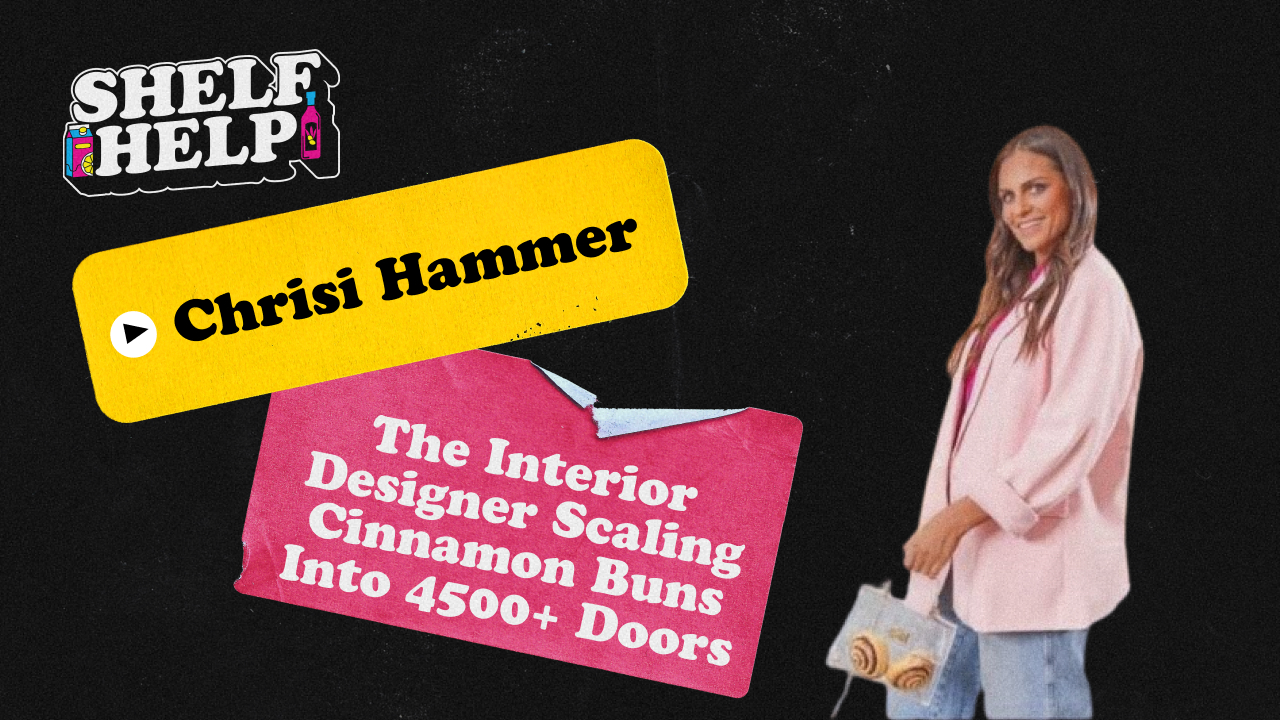
The Interior Designer Scaling Cinnamon Buns Into 4500+ Doors | Chrisi Hammer, Sunshine Buns



On this episode, we're joined by Chrisi Hammer, Co-founder and CEO of Sunshine Buns, the frozen cinnamon roll brand built upon a family recipe her mom started perfecting in the late 1970s.
Chrisi brings an interior design background to CPG, and it shows up in everything from the packaging to the trade show booths.
We get into how Sunshine Buns went from home deliveries out of Chrisi's kitchen thousands of doors in under two years, and why owning a commercial kitchen and storefront first gave them hundreds of hours to perfect the product. Chrisi breaks down the packaging journey, how she rebuilt the entire pack into a box that fits the frozen breakfast set while keeping the hero image consistent after being told at ExpoWest they were a breakfast product not a bread.
We dig into the shelf strategy putting them on track for roughly 4,500 doors by year end how their broker at Critical Mass Group reverse-engineered a mass-market price so the product could actually move, and hiring fractional operators from bigger brands early.
---------------
Episode Highlights:
🌅 The family recipe born from a 1970s cinnamon roll
🚪 From 750 doors to 4,500 by year end
🏠 Home kitchen to commercial to co-packer
🧪 Why cinnamon roll dough is so finicky
🎨 Bringing an interior design eye to the brand
📦 The rebrand from bread bags to breakfast box
🛒 Owning one spot on the shelf before expanding
💰 Pricing for volume instead of chasing margin
🏬 Using the retail store as live R&D
🧊 Why frozen is hard and worth it
🎪 The Expo West booth that stopped traffic
👀 The brands reinventing the frozen aisle
---------------
Table of Contents:
00:00 – Intro
00:59 – Origin story: Mema's recipe
03:33 – The parking lot decision to start the business
04:48 – From 750 doors to 4,500 by year end
05:45 – Home kitchen to co-packer and the science of the dough
09:39 – Building the brand with an interior design eye
11:40 – Bags to boxes: the packaging rebrand
14:20 – Keeping the pack simple: no oven, ready fast
15:51 – Advice: own one spot on the shelf first
17:51 – Pricing strategy for the frozen set
19:36 – Reverse-engineering price with their broker
21:52 – The Orem storefront as R&D
24:56 – The corporate store playbook
26:22 – Convenience as the differentiator
28:31 – Why frozen is hard and worth it
30:09 – LinkedIn, influencers, and Hummingbirds
32:57 – The Expo West booth that stopped traffic
37:19 – Building the team and fractional hires
---------------
Links:
Sunshine Buns – https://www.sunshinebuns.com/
Follow Chrisi on LinkedIn – https://www.linkedin.com/in/chrisi-hammer-b7b954326/
Sunshine Buns on LinkedIn – https://www.linkedin.com/company/sunshine-buns/
Follow me on LinkedIn – https://www.linkedin.com/in/adam-martin-steinberg/
For help with CPG production design - packaging and label design, product renders, POS assets, retail media assets, quick-turn sales and marketing assets and all the other work that bogs down creative teams - check out KitPrint.
Shout out to my friends over at Glimpse, the go-to partner for automating retail-related back-office operations and unlocking margin trapped in invalid fees and manual processes.
Are you in the market for a new flexible packaging partner? Check out HD Packaging. Third-generation, family-owned and built for the needs of category leaders like Newman’s Own and A Dozen Cousins. Faster launches, lower costs, and no artwork fees.
Episode Transcript
Speaker 2: 00:00
Welcome to Shelf Help. Today we're speaking with Chrissy Hammer, co-founder, CEO of Sunshine Buns, the cinnamon roll brand built on a 40-year-old family recipe that I believe is on track to be in close to 4,500 doors by year end. Sunshine Buns was started with Chrissy's mom baking buns, I think, for church fundraisers and community events in California. And then Chrissy and her friend eventually turned the recipe into a business, I think fall of 2022, with some home baking and just deliveries out of Chrissy's kitchen, eventually opening up a brick and mortar location in 2024, and kind of the rest is history from there. But we'll definitely dive into the journey a bit more here in a second. So yeah. First off, for listeners that aren't as familiar with the Sunshine Bonds, I'd love to just get a quick lay of the land, just in terms of kind of the origin story, why behind the brand, core products in the lineup, and then uh we'll take it from there.
Speaker: 01:00
For sure. Well, first of all, I was telling for the listeners, I was telling Adam before he pushed record that Shelf Help is one of my favorite podcasts ever in existence. So if this is the first you're hearing of it, do yourself a really quick favor and download and listen to every single episode. It's fantastic. I was really pumped when I got the DM on LinkedIn. Hey, you want to be on the pod? I'm like, of course I do. So super pumped about it. So anyway, you're doing a great job. Umrigin story of Sunshine Bun started back in 1978. So before I was born. My mom, she's sort of like uh Martha Stewart. There's like nothing that she can't do well from a homemaking standpoint. She is like the picture perfect boomer homemaker. She is so fantastic in the home. So everything she makes in the kitchen is so fantastic. So she had her first experience with the cinnamon roll actually in Salt Lake City when she was traveling with my dad back in the 1970s. Just a quick tidbit history of cinnamon rolls is they're not huge in the United States until about the 1970s. So it was sort of like if you saw one, it was sort of a rare thing. And then Cinnamon exploded in the 80s. But before that, it was sort of like, what is this? So that's an interesting tidbit. So she had her first cinnamon roll, she couldn't believe it. She was like, This is so good. Went home and took about five years to develop like a really, really good dough. She was like, I'm going to master this. This is going to be the thing that I'm I do and I do well, and I'm going to own it. And her and her best friend started selling them for fundraising events and local charities. Anytime someone needed money, my mom was like, I'm going to sell sunshine buns and give it back to the community. So it's a really cool, you know, full of heart starts sort of origin that I'm not full of heart. This is a for-profit business at this point. But uh that was kind of the origin of it. And, you know, they had come up with the idea of sunshine buns back in the 1970s. And when we were deciding if we were going to keep that name or not, it was like, absolutely, we'll keep that name. It's fantastic. It's got great origin and so much that you can do with the branding there. So that's sort of the origin around Sunshine Buns. And then for about 10 years, I wanted to turn this into a business. I had my own interior design business that I was doing at the same time. So it wasn't really a good time. And then one day I'm with my best friend. We're on a double date, and my husband and her and her husband, and we were like, Can you believe Mima doesn't want to do a business? Because she's so marketable that I'm always like, what could I sell that my mom does? And I just couldn't believe that she didn't want to turn it into a business with me because I had approached her and she's like absolutely not zero interested in creating any sort of brand or business or anything like that. She's was approaching 80 and was like not interested. So I was griping with my friends about it. And I it was sort of like I looked at Cass and Cass looked at me, and we were outside this theater before a play, and and it was this cosmic moment where we were like, we're gonna do this. And our husbands are rolling their eyes and we're like, okay, let's do this. Now she has no idea how to bake. She comes from an entirely different home than I do, you know, working mom, not baking in the kitchen. She has no idea how to bake, but she's like, Yes, I'm in. Let's start a cinnamon roll company. And right then and there in the parking lot, we bought the GoDaddy site for $33. We opened up the Instagram page and we told our husbands, you have six days to get the back end in order because we're going to start selling these from our house. And that's exactly what we did. So it's pretty cool. You know, fast forward to today. Um, we're currently in about 750 doors. And as you said, we're gonna be in about 4,500 doors by the end of this year, which is absolutely insane. Some of our most recent wins are uh Town and Country in the Pacific Northwest, Albertsons United out of Texas, Lunds and Byerleys in the Midwest, and then some big national retailers. Uh so you'll pretty much be able to get your hands on them everywhere by the end of the year.
Speaker 2: 05:18
You mentioned that it took your mom like five years. I'm sure it was kind of a slow methodical thing of kind of developing the dough, but in terms of reminding back to some of those early days of taking the recipe from that home kitchen to more commercial scale production, what were some of those kind of key variables and things you you played around with in terms of from that first version to you feel like, okay, this is a version that we feel like we can actually bring to commercial scale?
Speaker: 05:43
Yeah. Uh she was really methodical, as you said, in making sure that this was A, as simple as possible, and B, could freeze really well. So those were two things that we were lucky enough to sort of just already be adopted into the business when we took it. You know, people spend years and hundreds of thousands of dollars in RD. And I had had four years already of my mom really perfecting this recipe. And then another element is that you touched on this briefly, and I and I know we'll get into it more, is that we opened up a brick and mortar uh where we live locally. So we didn't go just straight from like home kitchen to copac. We went home kitchen to commercial kitchen to co-pack. So it was really lucky that we were able to do small tweaks to get to commercial. And then from commercial to copac, again, a couple small tweaks. So really, uh, the the majority of the tweaking that took place was from home to commercial. And there was so much freedom in that because we had our own location. So, like hundreds of hours we were able to spend in our retail location really perfecting the commercial side before we took that to a copac. Of course, you don't have that luxury when you're going, usually when you're going to a copac, you're not like, hey, can I work on this for three months? Like that's typically not something that you're able to do. So yeah, I know we'll get into that a little bit more, but uh the tweaking happened sort of incrementally as we moved through this business. And my mom is still alive and very much a part of this business. I'm sure she's kicking herself because she doesn't have any equity. Of course, we'll take care of her. But my mom spends so much time in both the brick and mortar and at the co-packers. She is constantly there, like helping quality control and having them understand like what's acceptable and what's not. Um so that's that's really critical is to have like the actual expert working on it day in and day out.
Speaker 2: 07:44
Yeah, totally. Go texture for cinnamon rolls is the keys you've kind of uncovered to be able to make sure that you can kind of maintain that important texture as you've gone up from that home kitchen to commercial to co-packing scale.
Speaker: 07:57
Yeah, bread is so interesting, especially uh baked cinnamon rolls. It's a double, it's a double rise. So when you make your dough, it has to rise. And then you roll your dough and it has to rise. And then it's essentially rising again in the oven. So it's almost like three rises. So it's very, very, very finicky. Like it's all about chemistry and balance and fermentation and heat. And again, we're so lucky that we had 40 years. My mom can essentially do this in her sleep. That was so critical in really understanding the science behind it and making sure that what she produced, you know, in the 90s and 2000s and 80s was the same thing that we were gonna get out of the kitchen. And it really was just like hours after hours after hours of like making sure that it's exactly perfect. And from a from like a secret standpoint, I don't actually know. My mom will always be like, you know, will say, like, oh, we don't want to give the recipe away. And she's like, why? You should tape it on the bag. They're not gonna be able to do it because it's so it is so filled with like gut instinct. And if you've ever made cinnamon rolls at home, I'm sure unless you're like an expert, nine times out of ten, it's like that wasn't what I wanted it to be. We really have this like true expert in our pocket, and that's kind of our secret sauce, it's MIMA. I wish everyone had a MIMO in their business because she's so critical, but brand identity, packaging design.
Speaker 2: 09:30
What were some of the you know key variables that were top of mind for you as you were building out the brand identity, positioning, voice, look and feel of the brand?
Speaker: 09:38
Yeah, of course. Luckily, I have an interior design background, and I think that has been super critical in our success for the brand. Although it's not like packaging design, when you're designing, you know, a 15,000 square foot home, it has to be so cohesive, even down to like the door stops. I'm choosing the door stops and like the window trim and all these things that are like people don't understand how complex interior design is. And so I was really able to understand that design isn't just like this one element, but it's really like an entire universe.
Speaker 1: 10:14
Totally.
Speaker: 10:15
And I, you know, when we were originally coming up with the concept of the font and the design and everything, we wanted it to feel nostalgic because that's what a cinnamon roll at its heart really is. Like it's Mima's recipe. We want it to feel like it's coming from, you know, the the 1970s, but we also wanted a modern twist on it. So it was really just about pairing modern with retro and like making sure that that was a great marriage between the two. And again, I have so much patience in understanding like slight tweaks and variations in that because of my design background, that I was able to articulate well what was in my brain to our designers. And I think that's kind of a hard part. The founders, you can see it in your brain, but you're like, how do I articulate exactly what I want this to look like? And I think we were lucky that I have this background. Um, and we purposefully didn't choose someone that has designed CPG packaging. Like I was like, I don't want this to look like every other thing that's on the shelf. And so I'm not going to choose someone that has designed a million packages. I mean, unless it was Red Heart, but we didn't have that.
Speaker 2: 11:25
So we've pretty awesome.
Speaker: 11:27
So I was like, I'm not going to do that. I want this to really be very different. And that's kind of been our entire brand identity from the beginning is like, how can we make this feel different from like Pillsbury or Annie's?
Speaker 1: 11:40
Yeah.
Speaker: 11:40
And then when we originally went to market, it was very much like the retailers didn't know where to put us because traditionally speaking, a cinnamon roll has never been fully baked before in the grocery store. From, you know, you can get that in the deli, but not in the actual packaged branded spot.
Speaker 1: 11:58
Yeah.
Speaker: 11:58
And so I think that they thought that we were a bread. And so we originally followed the bread brands, which are in bags. So we go to market in bread bags and took, you know, a really long time to develop the bag, and it was so stinking cute. And then we went to Expo, and all the big box retailers are like, You're not a bread, you're a breakfast, and this needs to fit in the breakfast sets. So hurry and go home and redo this entire packaging to represent a waffle box that will fit easier in ourselves. So, you know, that was kind of the the reasoning behind the rebrand was from go to bread to the breakfast set, you know. And I and I think we've we finally are in the packaging that that we need to be in.
Speaker 2: 12:43
How did you balance that new look and form factor with still maintaining some of that existing look? So the existing fans and customers when they were walking down the aisle, you know, one could feel like it resonated with them, still felt familiar and two, could actually was was familiar enough that they could actually, you know, immediately be able to continue to recognize it and know what they're looking for so they don't get lost in the aisle and say where'd sunshine buns go?
Speaker: 13:06
Absolutely. Yeah. I think the imaging is super critical. Like if you're going through a rebrand, you and it's a, I mean, it's a completely different, like you said, it's a completely different pack. We went from bags to boxes. And so Evan, our graphic designer, was like, I need to keep this as cohesive as it was. You know, I need people to understand immediately, like, oh, this is sunshine buds, it's just in a different pack. And I think the way that we came about was making sure that the hero image was the same from bag to box. You know, I know some people redo their hero image and that costs, you know, like Tropicana, that literally tanked their entire business because they changed their hero image. Of course, we're not like as far down the road as Tropicana, so it wasn't as critical. But Evan was really uh, you know, his task was really like, how do I make this feel so different and fun and fresh and unique and different in the breakfast set?
Speaker 1: 14:06
Yeah.
Speaker: 14:06
And still maintain that Sunshine Buns ethos. And I think by really keeping the hero product as large and big, as powerful as the bag in the box, that was sort of, and then everything sort of just fell into place from there. And we were really um intentional and making it as simple as possible. Like there's not a million call-outs on the bag. You know, we were like, no oven required, ready in 45 seconds, and then the hero image, you know, like I really took into like what speaks to me as a consumer and how can I, I think two founders like really overcomplicate it. It needs to be beautiful packaging, it needs to say what it is through an image, and then there needs to be very few like call outs, you know, especially in the freezer. You've got like a split second to to capture that person. So I mean, our our buns have naturally eight grams of protein in them. And we were people have been like, why didn't you put that on there? And I don't like um, it's not a better for you product. And I think too many, too many like CPG brands are like, Oh, we're better for you because we have eight grams of protein. You're not better for me. I think too many people get lost in the trend of that, where it's like, what do you do? What do you do well, and call that out. We yeah, we do convenience well and we do product well. So those are the two things. It was like call out convenience and show what the product is, and they'll turn it around and see, like, oh, there's eight grams of proteins, how how fun. You know, so yeah.
Speaker 2: 15:33
For some other brand leaders that are a year or so behind you that are that are listening, thinking back, going through this packaging redesign. What's the one thing you might tell the tell them to keep top of mind that that could help them, I don't know, do it better or avoid some of the pitfalls and things that you might have stumbled into.
Speaker: 15:52
Uh I think really understanding, like I had said previously, how to keep it as simple as possible. And don't go to market with living in multiple places within the grocery store. Go to market with one location, own that location, that real estate, develop SKUs from that spot. And then, as you can see, the velocity and sell-through rate of that real estate that you own, then talk about, you know, bringing other SKUs to market. We were super intentional. We have 12 flavors, which I know we're gonna get into. We only went to market with two. We're just now introducing our third. One of the national retailers gets a limited time offer. So that's gonna be our fourth. Uh, and we didn't rush immediately to 12 SKUs. Yeah. And we have some that can live in dessert, some that can live in breakfast, some that can live in bread. Um, we have like a bread pudding. Where does that go? It's not in breakfast. That's in dessert. But we don't want, we don't want to stretch ourselves too thin from a real estate perspective until people are like, I know sunshine buns. And that way, you know, a year from now, when they're walking in Target and they're like, oh my gosh, they have a bread pudding in the dessert that's gonna slap because I know their buns slap. So it's like, keep it simple, own one or two skews in your real estate, print out your packaging and go and freaking tape it to an ego box if you're in the breakfast set or like a if you're in the ravioli set, go tape it to Bertoli. Like, go tape it to where you are because what you think looks good on the computer maybe doesn't actually look good in in real time. That's another thing I've learned about interior design. Like you have to be able to test your flooring in nine different spots of the house before you commit to a flooring. And it's the same with brand packaging. Like, yeah, it's so it's so visual. You have to make sure that it looks good in the right set.
Speaker 2: 17:51
In terms of the pricing, when you're going to to retail, what did your strategy process look like for nailing down what your go-to-market retail price was was gonna be?
Speaker: 18:01
I think because we're in this white space that has potential to, you know, the breakfast the frozen breakfast set is worth billions and billions and billions of dollars. So I think you have to have like a 50,000-foot view of what your category is. Like if you're selling kitty cat balls that go around their collar, it's probably not going to be as impactful as a company that's selling frozen cinnamon rolls, right? Like, so you you have to have that first. Okay, like can this be potentially national and can it be potentially take a little market share out of the billions and not millions? And you're like, okay, yes, it can. Great. Now you're like, if I'm going to be competing with brands like Ego and Annie's and Pillsbury, I need to have a market price that Susan in Kansas will pay for and Marlene in LA will pay for. You know, two totally different people, but can they both pay for it? Will they both pay for it? Okay, so you've answered both those questions. Yes, I need that. Then it's what is my gross margin? Well, I would like it to be 30%. It's not going to be 30% if I need to hit all of those things. If I'm going to take market share from Ago, if I want Susan and Marlene both to buy it, and if I want, I'm not going to be able to get my gross margin on that. So I think when we first started, we really had no idea. And when we went to market, we were like $12.99 because I was like, I've got to hit my margin. And then once we signed our broker, which we'll get into Critical Mass Group, Dan Morad. If you don't know him and if you haven't met him, you should know Dan. He's fantastic. He's he's the founder of Critical Mass Group, and he also has a fund called Terpsy. They they uh invest in in uh CPG brands. But he really sat down with us and was like, if you want this, if you want to take market share, you have to be at the price that everyone can get you at. And so he really kind of reverse engineered for us and was like, you have to be in the volume game, and you're not gonna get there if your price is $12.99. So he was like, trust me, you're going to get volume because you are in this white space that does, you know, I hate the word like disruptive, because that is exactly what this is. But this is such a like everyone knows what a cinnamon rule is. We're just giving it, we just solved a problem, like getting it to them faster than they would. So anyway, he said, you don't know how bad you're getting taken advantage of from like freight and packaging and co-packs. Like you're just a new brand, you don't understand. But the volume is gonna get you in a spot of leverage where you can really like say, listen, this isn't a story about like, can you do 50,000 buns? It's like, I'm going to make hundreds of millions of buns. How do you fit into this? You know, and I think you can't get to that unless you're priced in a way where people can afford you and it will fly off the shelf. So I think some people spend too much money or too much time worrying about gross margin off the bat. Like you're not ever going to hit your gross margin, at least in Frozen, there's just no way you're gonna hit that gross margin. I I don't know anyone that would hit that. When you're talking about a strategic acquisition, which is what we want to accomplish in five, six, seven years, we're not gonna be at the margin that we want at acquisition right now. So, how can we get margin? It's through like velocity and volume. So I think we started high and then we had that conversation with Dan, and he's like, let's get this to mass price. And that was really how we came to that. And I don't listen to anyone else that tells me that we need to be hitting our gross margin right now because yeah, that totally makes sense.
Speaker 2: 21:51
In terms of the go to market side of things, I know you launched initially delivery model out of your kitchen, but then you eventually open up the physical storefront in. In Oram, the brick and mortar location, I think, is in August 2024. What was the thought process of opening the storefront versus keeping the delivery model going until you're ready to jump to wholesales?
Speaker: 22:10
Yeah. When we originally started, we were baking out of our house. And I know I touched on this a little bit, but baking cinnamon rolls in residential kitchens is really difficult. Commercial, commercial kitchens have way more ability to bake and bake quickly, especially a cinnamon roll. You know, they have like proofers. Those are things that we don't have in our homes. So, you know, we're spending six to eight hours a day baking 18 dozen cinnamon rolls. We're at the shop that would take, that takes an hour, you know. So being able to say, like, okay, we can't sustain this anymore. I have a business. My founder, my co-founder had a business. Like, we just couldn't keep up with the demand and the scale. It was like we would sell out and the orders had to be in by two. And, you know, it was just way too complicated.
Speaker 1: 23:00
Yeah.
Speaker: 23:01
Because when we originally started this business, we were gonna go the franchise route. Um, and it wasn't until we opened the doors that we started having people request, why isn't this in the grocery store? Or people, gas stations, local gas stations, saying, Hey, I want this in wholesale. And we're like, oh my gosh, this should be in grocery stores. This would be so much easier to scale quickly if we went that route. I mean, easier in air quotes, because it's freaking hard.
Speaker 2: 23:26
Nothing's easy, but yeah, yeah, totally.
Speaker: 23:27
But yeah, but easier than opening, you know, like if we're gonna be in 4,000 doors by the end of this year, there's no way we would have been able to open up 4,000 locations in less than two years. So having that unlock, we'd already signed the lease, we already had the kitchen. And then it just became like, oh my gosh, this is now like our RD. We still, you know, we have a business. Like every single day, people can walk in, they get the fresh, we do catering and you know, collegiate sponsorships, and we're with Real Salt Lake. You know, there's a lot that we do from the fresh store, but it wasn't so sort of all accidental, you know, like let's get into a commercial kitchen so that it's easier to than it is at home. Then we got in the commercial kitchen and it was like, this is so much easier than at home. And then it was crap, let's go wholesale, let's literally redo our entire business. And then it became more of an RD. It's really great because we own this data from like real-time customers that come in every day.
Speaker 1: 24:28
Yeah.
Speaker: 24:28
And we're able to pressure test different SKUs, you know, like how well does this flavor do with these consumers? So we have immediate data that we're able to take to the retailers and say, listen, this does the best in the store. It's probably gonna do the best in retail. Um, so that was really helpful.
Speaker 2: 24:46
Is there thought to open up, I don't know, two or three handful more of kind of these flagship ones and key locations, or eventually just got it.
Speaker: 24:55
I think it's you know, Cinnabon is sort of the only cinnamon roll company out there that's in mass, and they're awesome. What they built was great. And this is no shade to Cinnabon, but I think the market could use a little bit something different. Uh, and so I think our philosophy going into having more corporate stores is sort of following what Cinnabon has done, you know, high traffic areas like airports and malls where they're sort of trapped and they smell that cinnamon roll and they're like, ah, I have to get a cinnamon roll. And then we will do locations that make sense, you know, Manhattan, Vegas, places like that where it does make sense, but that's way down the road once we've really captured the hearts of America and that when we we feel confident that when we open it, they're gonna be like, we know exactly that this is gonna do well on this market because it has, you know, from the retail perspective.
Speaker 2: 25:51
Jumping forward a little bit into the retail side of things, you mentioned you guys decided to just launch with the two SKUs versus the 12 of brick and mortar, which totally makes sense just from an inventory planning perspective, inventory risk perspective, it's just a lot less complex. Beyond that, in terms of when you were in some of those initial meetings with buyers and how you're continuing to position the brand, like you called out the Pillsberries and whatnot, how are you positioning sunshine buds to really stand out in the frozen aisle standing next to some of these other established brands?
Speaker: 26:21
Yeah, I think our biggest feature because a cinnamon roll, like you can make a Pillsbury cinnamon roll and it's freaking good. So it's not like they're terrible, they're good. I think they could be better. And I think our cinnamon rolls our are better. They are better than what's currently in the retail landscape. Um, and in addition to that, it is convenient. We are truly the first that's fully baked that you don't have to use an oven. Like I, you know, I know Roro Rose, and I think she was on your show.
Speaker 1: 26:55
Yeah. A while ago.
Speaker: 26:57
Awesome, and they've got this awesome product, and it's so delicious, but it still does require an oven. And it's not single serve. So we were like, what smokers did for PBJ, we want to do for cinnamon rolls. So they're individually wrapped, they're in a box, they can thaw on shelf, you can have one at a time, you can have one in under a minute. Like it speaks across generations and it speaks across convenience. So I think that is our biggest convenience is absolutely king, especially in today's day and age. Like so many people are just don't know, even use their oven. They're like, I can't, I'm not using my oven. Like, I don't, I don't want to turn this on, you know? So, and if you want a cinnamon roll, it's like I either have to get in my car and drive to my local bakery, which I'm sure has incredible cinnamon rolls, or I have to sit here and bake this for like an hour or two hours. And we were like, that is a problem. Like, if you want a cinnamon roll, everyone else has made getting indulgent treats accessible. Why is this not accessible? So that was really our bread and butter is convenience and and product. It's really delicious.
Speaker 2: 28:04
For some other founders that are in the process of growing andor launching a new brand into the frozen aisle within retail, what's like one thing you tell them to keep top of mind?
Speaker: 28:17
Just hold on. It's frozen is so hard. Yeah, but it's such an untapped you know, I know you've had like some serious frozen people on here. Frozen is hot right now. Yeah, like people are like wait, we kind of forgot about the freezer aisle, but it holds inventory. It's not a big space, like it's really and you are competing. I think yesterday I was at Smith's and Ego has four doors in the frozen four, one, two, three, four in my local Smiths. I'm like, that is why why is Ago owning so much of the breakfast set? Because people are afraid to get into frozen. And I think it is challenging, but I always say, like, if you can, if you can beat the challenge, then the you know, the point of entry is so difficult that people just don't go in the space. They're like frozen so hard. I'm not gonna tackle that, I'm not gonna worry about logistics and freight and you know, frozen.
Speaker 2: 29:19
Cold chain is no problem.
Speaker: 29:20
Yeah, like it's so hard, but if you can nail it, oh my gosh, it's just begging to be reinvented right now. And I think, you know, with Rippy and Smearcase and Frozen One and Fruit Riot and Evergreen, and I mean, there's just so many brands right now that are re-imagining what frozen could be that it's like it's such a fun time. So if you can do it, you should do it. Just know don't be defeated because it's very easy to get, you know, have a defeated mindset. It's yeah, a tackle one day at a time, you know, one step at a time.
Speaker 2: 29:56
From a marketing perspective, what's you finding having the most impact in terms of what's resonating most of the people actually have an impact from driving, you know, incremental foot traffic to your retail partners? Yeah, what's what do you feel like is having the biggest impact right now?
Speaker: 30:09
Well, I think LinkedIn is like a really slept-on platform, and I'm not exactly sure why not. Every founder's on LinkedIn posting every single day. I have made such great connections on LinkedIn, and I am very much leaning into like I'm very open. What you see is what you get, and I'm just giving it all on LinkedIn. Like, this freaking sucked. This was freaking cool. Go freaking buy the buns. And I think that has made an impact, you know, from buyers and retailers. Like they're on LinkedIn and they watch and they listen and they're observing what the brands are doing. And then from like a retail consumer, we're huge on Instagram. We just barely started on TikTok. We need to get better on that. And then we've partnered with a ton of influencers. And I think my co-founder has half a million followers on Instagram. So that we are in a good spot, we are in a good spot because she has such a great audience. Now, that being said, it's not, it's a really international audience. She's was in Zumba headquarters corporate for years and years and years. So she has not necessarily like buying people, so many people in Brazil and Europe and Asia. They're not really in the US. But it really, we do understand because she is an influencer, like how to market that. And in addition to that, we've partnered with hummingbirds, and I don't know if you're familiar with them, but they I definitely heard of them for sure. They're amazing. They have like a their business works on micro and macro influencers, which I think you need to really understand in today's landscape is that like sometimes you can work with, you know, and I know this from Interior Design. I would work with influencers that had half a million followers, and I would get no customers from that because they have built this, it's so big that they don't have like loyal customers. Where I think micro and macro influencers with 5,000, 10,000 followers are their communities are so invested in them that they have huge return. And so Hummingbirds works with these types of these types of influencers all across the country. And so when we're opening up a new market, we open up a hummingbirds campaign and they go and they shoot content, we own the content, we repurpose the content. So working in your brand, right? Voice through Instagram and TikTok is vital, but it's that it's only gonna take you so far. You need people to be out there buying your product, showing that they're buying your product, how they use their product, how they taste their product. Uh and and that can't be, you have to go in with a social strategy. And we're very much like all in on social on every platform. But people should look at the hunting birds.
Speaker 2: 32:55
It sounds like you guys had a pretty successful expo. What what impact did it have on you? What's looking back now, what do you feel like what led you to have so much success there this year?
Speaker: 33:05
Yeah, I mean, it really started with Fancy Fair in January. We launched November retail November of 2025. So this is like we're new. And it was our first show. And back to me being an interior designer, I was like, I'll be damned if I show up on a floor with like a piece of plastic. I just I could I was like, no way. So my husband and another contractor built our whole booth. It weighs 3,500 pounds. It's not like, I don't know if you've seen it, but it's not light, and it's like it looks like a home, like a like an actual storefront.
Speaker 1: 33:40
Yeah.
Speaker: 33:40
And I was like, I care about color, I care about saturation, I care about light fixture. Like those are things that I really care about just because I'm an interior designer. So when I brought this booth to Fancy Fair, I don't think that I understood how impactful our booth was gonna be because I just assumed like I'd never been to a show before. So I just thought like this is what people do. They have beautiful booths. You know, I was on Pinterest and I'm like, these aren't super great, but I can do it myself. So, you know, we created this big booth and we brought it. And I, Adam, it was so crazy. Like five, six, seven layers deep of people like, what is this? You know, it's like bright and pink and beautiful and orange and blue, and we're a new brand, but we were acting like we were a legacy brand because of how we showed up with these materials. And it's not like they were incredibly expensive. You know, people came up to me and they're like, Who designed your booth? I'm like, I did, but I encourage you to find like a local interior designer that will maybe give you something different than like a creative briefs designer.
Speaker 1: 34:48
Yeah, totally.
Speaker: 34:48
Um, and then even looking into, you know, so Expo went and we got a 20 by 10 space instead of a 10 by 10 space. We brought seven other women. We called ourselves the bun babes. Like, I was really intentional. I it's like I created a creative brief before I sent it to our graphics team. Like, this is the story we're telling at Expo West. Mima's gonna come, she's gonna have her own chair. There's neon signs. Like, I spent hours, weeks, days, months, like building this universe at Expo West that goes beyond just like a 10 by 20 or 10 by 10 space. And I think founders should really be looking at that time as like, how can I get the buyers to like think about me after they leave the show instead of just five seconds after they walk past my booth? Yeah. And that is through a story, and it has to encapsulate so much more than just the product and the founder. It needs to be down to your shoes. Like everything has to be telling a story. And I think that's sort of something we've done and done well is create stories through the show. And then, you know, looking in, and people will say, Well, that's not realistic. You can't drive like a 3,000-pound. You're right. So fancy fair is coming up in New York. We have an entirely new concept, but it it is so fun. I can't wait to show it on on LinkedIn, Instagram. But it's not like what everybody else has, but it is portable and it costs probably less than what others are spending on. Again, the plastic click. You just need to think outside the box and be really creative. Uh, and I would tap into people that design space outside of just CPG, you know, like really utilize local contractors. Like, hey, what what what looks like MDF but is actual foam? Like the creative agencies that are building these booths don't necessarily like it's all IKEA type click and clack, whatever. So tapping into like outside resources is super vital and making sure that you are telling a freaking story when you go.
Speaker 2: 37:03
You guys recently hired a CFO, COO team is obviously growing. You're gonna be in almost $5,000 by the end of the year. How did you know it was it was time for those two big hires? And what were you looking for? And where are you what are you thinking about the next big hires and where the team needs to go from here?
Speaker: 37:19
Yeah, uh, Critical Mass Group was our sales team. They're national, so they're incredible. They're really exclusive. They only have 45 brands, but they sell about like two and a half billion. So they're they have some really impressive brands under their banner. And that means your product is gonna move and it's gonna move fast. So, you know, we did a fundraise in October of last year before we launched retail, and we thought, oh my gosh, $1.6 million, that's so much money. And it is, and it got us far. But when you're talking frozen, when you're talking about national, we could spend $1.6 million on the Target rollout alone, let alone Costco, Kroger, Unify, Kahee, the thousands of doors across the country that we're gonna be in. It's really expensive. So Critical Mass came on, you know, January, huge success after Fancy Fair. Expo West was wild, you know, national meetings, everyone wants us, UNFI, Kahee, fully on board. And then it's like, holy crap, we need so much more money than what we thought we needed. So we need to be able to tell a financial story that articulates exactly what we need. And unfortunately, none of us possess that. And so at Expo West, we were approached by a group. Uh, his name's Bill, uh, he's with Everest, and they have financial services. And he was the CFO at General Mills. And so he was like, I know exactly what you guys need. I'm super interested. Want to come on board fractionally, because there's absolutely no way we could afford him other than that. Uh so he took over that element, and then he was like, You need an operator that understands scale. So we found um Dalen, he's local out of Utah. He was like number 10 at Traeger and number 30 at Skull Candy. So came in and like operationally exploded both of those brands. But I think what's really great, and what founders should be doing when they're hiring super important people like this across sales, operations, and financials is that when you say, I want to sell my company to a strategic for hundreds of millions of dollars, and you're a new brand, and they shake their heads and say, Yeah, that's I can see that. That's a great, that's a great beginning of the conversation. If you're having conversations with their people, with these people and they're like, slow down, you don't know what you're doing, you know, that's too big of a goal. Those people aren't going to be the ones that can take you to 50 million, 100 million, 150 million in revenue. So I think making sure that you're aligned, because we had plenty of conversations with people that are like, you guys are you have no idea what you're doing. This isn't going to scale to that. And we're like, okay, those aren't the right partners for us. But Critical Mass Group and Bill and Dalen were all in alignment on like, yeah, this this has that potential. How can we get the revenue and build the business around that goal in mind? And I think it sort of evolved from there. We were intentional in hiring people that didn't weren't just going to get us to 2 million, 5, 10, but that could get us to 100. And I would I would encourage founders to be looking for fractional people at that stage because they're going to come from these big banners and brands that have deep understanding of how to operate at that level, even early on. Like spend money on these guys, they're going to be more expensive than you want to spend, but so critical in getting you to that next spot.
Speaker 2: 40:53
I think that's a great place to close it, Chrissy. What's the best place for people to follow along with you and all your expertise and everything you're learning on a day-to-day basis, building this brand? And then best place for people to follow along with the brand these days as well.
Speaker: 41:06
Yeah, for sure. Follow us on TikTok because we're trying to get better, bigger on there. We're just tiny, but our a ton, ton of socials on Instagram, and it's just Sunshine Buns on Instagram, and then TikTok same Sunshine Buns. And then as far as following me, you can follow my Instagram. That's Chrissy Hammer. I'm not as I don't post as much on there as I do on LinkedIn. Now, LinkedIn, you want the ins and outs. I'm giving you the good, the bad, the dirty, the ugly, the beautiful. It's all on LinkedIn. I post every single day. So you can find me there, just Chrissy Hammer. And that's us. You can find us, you can find our hot buttons anywhere.
Speaker 2: 41:46
Awesome. Love it. Thanks, Chris. I think that's.
.svg)