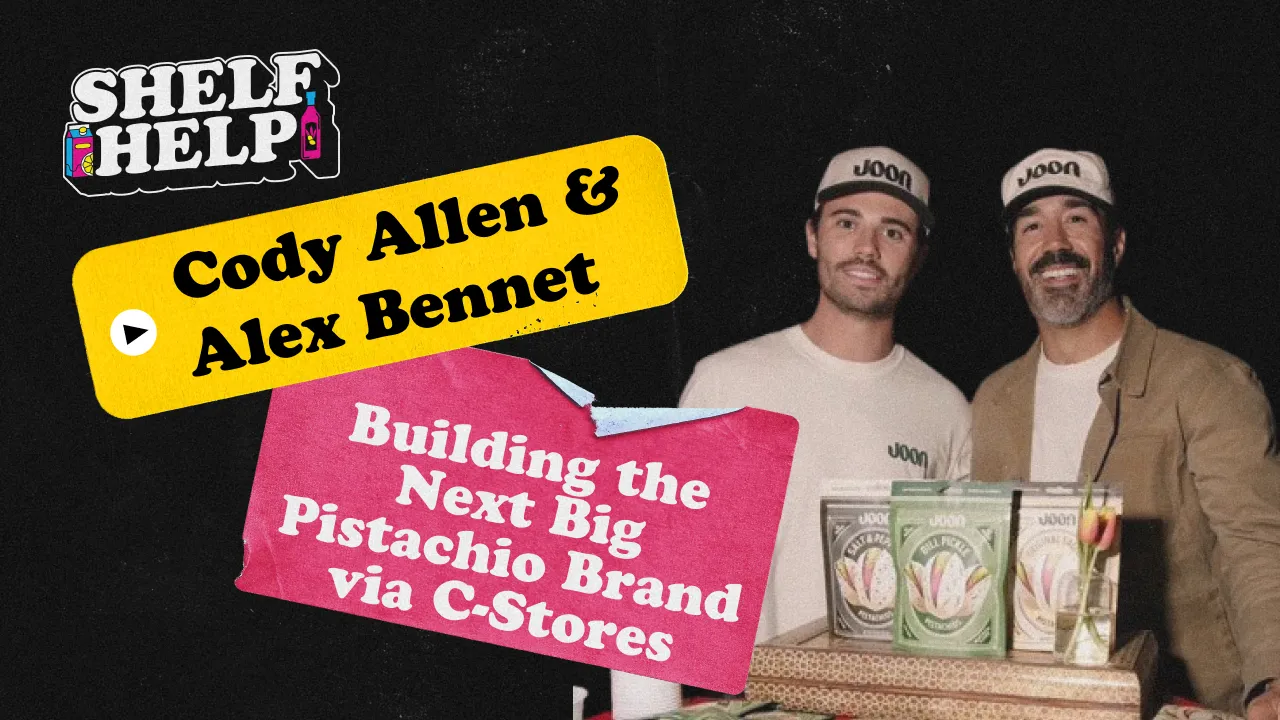
Building the Next Big Pistachio Brand via C-Stores | Cody Allen & Alex Bennet, Joon



On this episode, we’re joined by Cody Allen and Alex Bennet, Co-Founders of Joon Foods, the award-winning pistachio brand that’s gone from zero to roughly 1,500 doors in just seven months.
Built on a 300-year-old family recipe and a modern, flavor-forward approach, Joon is showing consumers what pistachios “really taste like”.
We get into the realities of formulation and R&D, how they approached finding the right manufacturing partner for a unique cooking process, and why they chose to start with just three flavors instead of chasing constant innovation.
They also unpack their go-to-market strategy - from leaning into C-stores early (thanks to Cody’s family distribution background) to using Faire as both a revenue driver and an unexpected marketing engine. We talk pricing, velocity versus door count, grocery delivery platforms like Thrive and Hungryroot, and how they think about scaling without getting ahead of themselves.
This is a tactical, in-the-weeds conversation about building a modern snack brand the hard way through distribution, data, and discipline.
---------------
Episode Highlights:
🥜 Turning a 300-year-old family recipe into a modern CPG brand
🚀 Growing to ~1,500 doors in seven months via C-stores
🏭 Formulation, R&D, and finding the right manufacturing partner
🌿 Clean-label flavor strategy (no seed oils, no artificial flavors)
🎨 Brand identity, naming, and award-winning packaging design
💰 Pricing a premium product across channels
📦 Lessons from multi-generation food distribution
🛒 Using Faire as both a sales and marketing engine
📊 Velocity vs distribution and avoiding overexpansion
🔍 Snack brands and trends Alex and Cody are watching
---------------
Table of Contents:
00:00 – Intro
01:06 – Origin story
04:05 – Formulation and R&D
07:08 – Finding and partnering with a co-packer
08:45 – Flavor strategy
12:49 – Brand identity, naming, and packaging design
19:49 – Pricing
22:52 – Lessons from Cody’s family distribution business
25:22 – Starting with C-stores
28:26 – Faire
29:15 – Grocery delivery
30:22 – Velocity vs distribution, Faire
41:02 – Brands and trends Alex and Cody are watching
---------------
Links:
Joon Foods – https://eatjoonfoods.com/
Follow Cody on LinkedIn – https://www.linkedin.com/in/codyallen24/
Follow Alex on LinkedIn – https://www.linkedin.com/in/al
Follow me on LinkedIn – https://www.linkedin.com/in/adam-martin-steinberg/
For help with CPG production design - packaging and label design, product renders, POS assets, retail media assets, quick-turn sales and marketing assets and all the other work that bogs down creative teams - check out KitPrint.
Episode Transcript
Speaker 2: 00:00
Welcome to Shelf Help. Today we're speaking with Cody Allen and Alex Bennett, co-founders of June Foods, the pistachio focused brand built around a 300-year-old family recipe passed down through Alex's family that produces a pretty uniquely creamy and crunchy experience, which we're going to dive into. Um they both got some pretty rich history in food. Cody grew up uh working for his family's third generation food food distribution business that I think distributes to 20,000 if she stores around the country uh before some a stint in ad tech before eventually coming back to food with Le June. And uh Alex similarly, you know, grew up around his family's pistachio farm, spent time focused on the food service channel for a bit, helped scale a cold press juice brand for before teaming up. So definitely got a lot of great experience in CPG. Excited to get into it. First off, for the listeners that just aren't that familiar with June, Alex or Cody, I'll let you, whichever you guys want to take this one, give us just kind of quick lay of the land in terms of origin story, why behind the brand, core products in the lineup currently, and then maybe just a few places that that people can get their hands on them and then uh we'll go from there.
Speaker 1: 01:07
Yeah, absolutely. So, you know, quick kind of, and by the way, we're coming off of a trade show. We just did this uh seven times in 15 minute meetings. All right. Yeah, one hit after another. So hopefully I still have that fresh off the mind and off the top. But, you know, general high level. So we started June as a flavored pistachio company conceptually about two and a half years ago through research and development and branding and whatnot, but officially got the product off the ground about seven months ago. Based here in LA, Cody and myself. Cody just moved out here a couple months ago. I've been here for about two and a half years, you know, building the brand in that time with Cody. But about the product itself, we are, as I mentioned, an elevated pistachio product. We have three flavors right now: a salt and pepper, excuse me, salt and pepper, original salted, and then a dill pickle. All of our products are have no seed oils, no natural flavors, no artificial flavors, and uh tend to use, you know, ingredients that we all know and understand. So the basis behind this company and why we started it is as you mentioned earlier, my family are pistachio farmers overseas. They have pistachio farms in Iran and have been pistachio farmers for three centuries. So I grew up with amazing pistachios my whole life. I had incredibly uh creamy, crunchy, tasty pistachios that my mom would smuggle in, I kind of say. Like, I don't know if she was supposed to be bringing back pistachios from Iran, but that's all right. You know, everyone's safe, everyone's good. And she'd bring these over, I'd have them, I'd I'd indulge, I'd only, I'd always be like, these are incredible. It's not what I was used to here in the States. And, you know, about two years ago, I had an opportunity to, you know, pitch this idea to Cody, who's a friend of mine from college. Cody loved the idea. Cody's family was in food distribution, so he had been around it, as you mentioned, and um, it's been a blast. So we launched about seven months ago. Uh again, the core product line is that dill pickle, salted pepper, original salted. And right now we're in about 1800 doors across the United States. Our primary distributors that we work with are really in the Northeast, with one larger distributor in Northern California. So notable grocers that you may know would be ShopRite, Happier Grocer, Pop-Up Grocer. I think uh Sendix in Wisconsin is fantastic, and then buy right out in San Francisco, or maybe some of the ones that you might be more familiar with. And then uh I think for anyone listening that is in the space, we are available on Thrive, Misfits Market, Hungry Root, and Purple Carrots. So, and GoPu. So the online e-commerce space has been incredible for us. And um, maybe we'll talk about that a little bit later. But it's been um it's been a really fun journey launching the company, and we've had some really good early success and feedback from from consumers.
Speaker 2: 03:46
As a side note, you talk about the the uh e-commerce stuff. I've been here, I read a tweet or two, I think the past few days, that someone had kind of gotten under the hood in terms of what the numbers look like at uh Thrive. And he was saying, like, the numbers are kind of mind-blowing how big some brands have gotten just through Thrive. So, anyways, I'm sure we'll dive into some of that stuff. Yeah. I think I heard you say that people didn't know what pistachios really taste like. So let's just kind of rewind back to those early days of formulation and RD for a minute where I assume the goal was to show consumers what pistachios really taste like. Did it take a while to dial things in and find a formulation and kind of process that that work, or is it pretty quick because the core aspects of the process or what your family's been doing for three centuries?
Speaker 1: 04:29
That's uh dude, it's a great question. And the short answer is no, it took a long time. It took incredible kind of uh precision from an RD group that we ended up partnering with. But to rewind it, right, we have this family recipe and it's been tried and true three centuries. It's incredible. I think it's older than that. We could only really trace it back to three centuries, right? So the short answer there is that you cannot take that way that we cook it back in Iran and use it here in the United States for a kind of multitude of reasons. Um, whether that be FDA compliance, but really just scaling. And it's not a very scalable thing. We kind of joke about it. It's it's a recipe that my 250-year-old uncle, who like has been alive for three centuries somehow, he came up with this. He's, you know, it's a really, really old school style of cooking. So we like to say that it's inspired by the 300-year-old family recipe. So what we do use are some of the ingredients, which there's a specific ingredient in there that's not so trade secret because it is on the pack. It's called Verju, it's a sour grape juice. But really getting to that point, I think one of the best pieces of advice that we ever got was from Cody's father. When we had the idea of starting the company, he said, if you guys are gonna do this, you need to make the best product possible. And we partner with an RD company out of San Francisco that had some incredible wins under their belt. They came highly recommended by someone in the space, and they are incredible. They came up with a cooking process that was unique, that paid homage to the family recipe. And uh, that being said, it's also something that's not it's unique to pistachios, it's not unique to cooking. So that for us was huge as far as we needed to create something that can scale right on operational front. And um, the bulk of getting this to like shelf ready on a product that is ready to rock really came down to tastings that I I don't even know how many tastings we did. Cody couldn't eat pepper for like a month or two after the salt and pepper tastings because we were eating that many. Listen, what size of the you know, kernel? What size, all of that stuff matters so much in production? So I would say that the process, you know, took half the time, but the other half of the time was like which version of the of the same product that was going to be the one that we wanted to launch with.
Speaker 2: 06:48
So you work with this RD group out of San Francisco, assuming that's different than the actual production partner, co-pack or you guys working with, what was it hard to find a co-packer that you could really trust with this family kind of family trade secret, or just is this kind of really unique process and kind of what did that process look like to finally find one that was going to be getting?
Speaker: 07:07
Yeah, I think uh for us in the beginning, we kind of said to ourselves, like, what are our key strengths and what are our key weaknesses? And you know, one of our weaknesses is I don't know how to cook. So for us, you know, we could have gone the route of, you know, uh, you know, renting out, you know, a commercial kitchen and trying to kind of scale um in a really small way, right? Uh or going out and trying to find copackers on our own when we did have some of those initial conversations. Oh, there's there's so much terminology and so many things we don't know about or didn't know about that space, still many things we're learning as we go. R D group also helped source a copacker for us as well. Nice. And uh, you know, I think for us that was like one of the best decisions that we've made as a company.
Speaker 2: 07:54
Yeah.
Speaker: 07:54
So, you know, while we worked, you know, hand in glove with them on, you know, kind of flavor profiles and you know, that RD company also led a lot of like the how long do you cook for, what temperatures do you cook it for, all of that. They also helped us to find a copacker and you know, go out and site with that copacker, dial in the machinery, right? Um, and we did a pretty big far and wide search, you know, based on what certifications do we want, um, and you know, what what's critical uh to working with that copacker. And I think, you know, like I said, it was one of the more um impactful decisions that we made. And that really allowed Alex and I early days while we were working with our food scientist or our RD group and Copacker on kind of getting everything up and running, it freed up some extra time for Alex and I to focus on branding and retail strategy and kind of do all of that in parallel.
Speaker 2: 08:45
From uh a flavor standpoint, when we spoke a week or two ago, um, you talked about how you originally thought about focusing on some more unique flavors, but then you like somewhat quickly learned that consumers really just respond to familiar flavors, but in kind of a an adjacent format. So I guess yeah, tell me a bit about that journey and kind of what what made you guys realize, you know, more familiar flavors were the way to go.
Speaker: 09:11
Yeah, I mean, I I think in the beginning, you know, our original salted pistachios were the family recipe, which are uh the sour grape juice, lime juice, and some salt. Um and that gives them a little bit of a unique taste in and of itself, right? Um, we say it competes with like a plain roasted salted pistachio, but really it does have a little bit of flavor. It's a little tangy um and tastes a little different. And so um, you know, from there we we kind of looked at data and we said, you know, what are the biggest selling uh pistachio flavors in the U.S. Martin? Uh a close second was salt and pepper. And so, you know, for us, we said, let's go with a couple that are kind of familiar, right? We know they're already big sellers in the market. People love, you know, a simpler flavor, they love salt and pepper. And then let's come up with something that is entirely unique to us and also really hitting on a lot of the trends in today's market. And honestly, we we had tested so many things. We tested spicy, we tested all kinds of different flavors of sweet and salty. Um, and our RD group one day just kind of sent us a dill pickle in the mail and said, try this. It's it's a hot flavor, we think it tastes great. Um, and we were like, huh, you know, and and we tried it and we loved it. And that's kind of what we ended up making as our third flavor. And then we kind of put put the others in our back pocket for later. Um, you know, I think through this journey, you know, part of part of the reason um that I think these three flavors have worked for us in these early days is, you know, the large majority of pistachio consumers and nut consumers as a whole in the US are over the age of 45 and um they like flavors that are a little more familiar to them, I think. We are focused on kind of that as our foundation, right? Of target consumers. But uh, we want to get hyper focused on that kind of 18, 30-year-old demographic as well. Uh, and dill pickle has been a huge standout flavor for us in that demo. A lot of dill pickle things. You have grillos out there right now. I think pickle flavored things was like flavor of the year um on one report we read recently.
Speaker 1: 11:23
Yeah.
Speaker: 11:24
And and so, you know, for us looking forward, like the as you mentioned before, we kind of said in the beginning we want to be flavor differentiators. Now we're saying we want to be kind of flavor elevators too, where it's, you know, create something that isn't so unique that people look at it and kind of scratch their head and say, I'm not really interested. I don't know what that is, right? But finding the balance between what people know and, you know, something that's a little new. And I think finding that balance is is challenging. And it's something we're kind of working on now for next year, and hopefully we'll come out with some new flavors kind of kind of mid-next year. Um in the in the beginning, just on the on the flavor part, we uh we went into the RD group's test kitchen the first day and did a ton of sampling. And over time, we we did a bunch of iterations over a period of probably like six or seven months, and they'd ship them out to Alex and I's, you know, houses, and we just have friends try them and family try them and send them to people. And, you know, that was so helpful seeing kind of just how people reacted. You know, it's built, you know, through that and just kind of so we surveyed over like 250 people, sent it to everyone we possibly could. Flavor profiles, do you want in shell, out of shell, right? The list goes on of of the millions of questions that we asked them, and it and it really helped, you know, that data on the internet, and then just anecdotally is really what kind of helped shape all of that.
Speaker 2: 12:50
Let's talk about brand identity and and packaging design for a minute, because I know you guys have gotten an award or two. I think it's 80, like 80% of pistachios are consumed by 45 people that are 45 plus, and I think that you guys thought that there was a big opportunity to kind of speak to underserved 20% or being being the younger crowd. Assuming I got that right, like considering that, what were some of the kind of key variables that were top of mind for you when you guys were building out the brand identity, positioning, and and voice for the brand?
Speaker 1: 13:21
Yeah, I mean, you nail that. So listen, taking great you know, notes and whatnot when we're chatting, and I I wouldn't expect nothing less from you, Adam. Um listen, a huge shout out to Patty Gilligan and governess. Um, it's pretty, it's it's out there, right? They won the die line for this. They did incredible work on the packaging. We gave them incredibly hard briefs where we said we want to focus on a younger demographic that's being underserved. However, we also want to make sure that we're not alienating 80% of the market, right? You don't want to go in there. So I mean, at least for us, I think everyone can have a different strategy of how they want to go and attack the market. We were, I think, I think we were very honest in saying, like, yeah, of course we want to go out and build the cart size, but like, would we love to go and have the older consumers? And older, like I'm approaching, I'm not that close, but I say older. A lot of my friends are 45 years old and they're like, hey, let's like tone it on calling me old. But, you know, we gave them a brief of saying we want to create something that speaks to the young consumer that doesn't alienate, right? So for us to simplify it, because we can we can go super wide on how the brand identity was built, but to simplify it was create something that had a retro old nostalgic vibe to it, but that felt elevated, right? So elevated is a word that we use a lot um in brand identity and in how we create merchandise and how we create new products, right? So for us, what was the most important part in creating brand identity was like communicating an elevated look and then communicating what the product is. Um and I I give Cody a lot of credit for that, having not come from the food industry prior to his family food, you know, being in the food business and whatnot. But um, if I had it my way about two and a half years ago, I'm like very aesthetic focused, right? So like I would have loved like a clean bag with like a little tiny thing in the corner that just said June, and through a ton of back and forth through friends and family, you know, giving us feedback and whatnot. Communication, like we decided very early on, we're we're a retail brand. Are we gonna have a social strategy in 2026? Use TikTok shop to get product out there, absolutely. But, you know, we wanted to win at retail. And for us, the first important step of retail is making sure the consumer knows what it is. So big pistachio in the middle, callouts right on the front of pack, you know, aligning with that younger generation while using colors that are a little bit more familiar with the older consumer, created something that we felt was speaking to multiple generations. And that's a huge part of that brand identity.
Speaker 2: 15:58
Naming, I feel like, is such a obviously it's such an important part, but it also is feeling like it's a really ambiguous and can be kind of challenging process where you don't know where to go and what direction to go. What what did that process look like for you that ultimately landed you guys on June?
Speaker 1: 16:12
It was, I'll I'll keep it quick. It was always June. It was I don't think we had any other. I know when I send samples out to him, I had written June out. And and the reason being fairly simple. If you have any Persian um consumers or listeners, or if you know anyone that's Persian or friend to friend, June is like a huge part of our culture. It's a word in Farsi, it's a term of endearment. So it me it it's literal transate translation would be like life, like to more life and whatnot. But in Farsi, when you're growing up in a household again, it it was always like I was Alex June, Cody June, Adam June. It's a term of endearment. It's like saying honey, sweetheart, my love. It just looks great on paper. It it hit a lot of different areas for us. It's summary with obviously we spell it J-O-O-N, but you know, June is something that US consumers can pronounce, they understand, and it's it's been really fun to tell the story. Again, like leaning in a little bit more on a family heritage, to be like, what's June? And we are all June in a way. Very, very corny, but like we are all June.
Speaker 2: 17:26
Love that. Some other, you know, earlier stage founders that are a bit behind where you guys are. I came to you and kind of told you, hey, I'm I'm watching a new CBG brand. I'm about to kick off brand and packaging design. Any tips or andor potential pitfalls for someone that's about to kick off brand packaging design?
Speaker 1: 17:46
Yeah, absolutely. I think um I'll give you one in Podi, I'm sure you'll have a few here as well. Um for me, one of the biggest tips that I have is is again communication. People need to know what it is. That's the number one most important piece that I have for any founder coming out into the market is there may be ego on aesthetic that you're like, I want to be really, you know, sexy and clean and fun and all these things, but people need to know on front of pack, like what is your product? So communication of what the product is for me is absolutely buying for number one.
Speaker: 18:22
Yeah, and I would also, I I'd also add to that, find an Alex because Alex has like a good eye for that stuff. And you know, I no, but on a serious note, you know, beyond that, I also think that, you know, we we kind of looked at data too, right? Like what are the to Alex's point about communication? Like, I don't know if this all might might get a little blurry, but we put a really big pistachio right on the front of the bag. So when you're walking around the grocery store aisle, you can't miss it, right? You don't need to read a thing. But if you do want to read and you are more curious, then uh, you know, it says right on the front, no seed oils, six grams of protein, no uh artificial flavors, non-GML, right? So we have that, but we tried to not put too many words at the same time uh to not overwhelm, because I think when there's kind of data overload, sometimes people just move on. So I think that was part of it. And then, you know, we looked also like a lot of just kind of other brands that we thought were awesome, right? And incorporated a lot of what they had going on. We looked at fashion brands, we were looking at old advertisements from non-consumables, all kinds of stuff. And it helped a mix between kind of data. We had a big Pinterest inspiration board, um, and mostly Alex and and Patty and governess's brains and not much of mine because it's uh it's not my jam. We ended up coming up with something that that we loved.
Speaker 2: 19:49
Shifting gears a little bit from a go-to-market standpoint. What did your strategy and and or process look like that helped you guys ultimately nail down your your go-to-market price?
Speaker: 19:59
Yeah, yeah. Pricing was such a like we went back and forth on pricing for probably nine months trying to figure it out. And, you know, we're fortunate that one of our good friends he serves as our fractional CFO, and um, you know, he helped us kind of sort through it. And that that's another thing I'd kind of recommend. Um, you know, like find find the fractional CFO, someone um, you know, who can help with the numbers too in the early days and and help make sense of it. It was not my strong suit. Um, you know, and and so it was just super helpful having somebody there to kind of figure out the unit economics behind all of it. But um, you know, it's so hard early days, like before launch, trying to figure out and and and price like how much do I think packaging is gonna cost, or pistachios, or raw ingredients, or uh shipping. And uh, you know, through just reaching out to every single person in our network and probably annoying them a thousand times and bothering them and asking them a million questions, we just, you know, kind of kept refining that unit economic model of all of those costs, um, projected costs at the time. Uh, and then we started to kind of get a little further with our command search, right? And get some real pricing back. And we've met some freight brokers and ran some kind of scenarios for how much freight might cost and things like that. And so over the course of kind of nine months, we just compiled everything together. Um, you know, for us, we didn't want to have an extremely expensive product, right? We wanted something that was obtainable. We say premium, but inviting, right? Something that we we we're very transparent. Like we won't beat some of the other brands on price every single time. But where we try to make up for that is value with clean ingredients, bigger pistachios, because of the way we cook, they're super, super crunchy. And flavor, of course, right, is number one. And so, you know, I think trying to kind of figure out, you know, how high can we go, how high is too high, right? Or or how low can we go, you know, while still making a sufficient margin was tough. And Ultimately, it kind of got to a point where we just said, okay, we think this number is right. Let's try it. Um and, you know, we we ended up, you know, like it gets adjusted by market too, right? Like some retailers in New York City are going to sell it for a different price than a retailer in, you know, a state in the Midwest, or it's not in a city. Um, and so um, you know, that kind of shifts things too. Um and so I I think, you know, for us, we just wanted to kind of make sure that this product, especially in these early days, as we're trying to kind of gain customers, not that we're gonna hike the price on everybody, uh, for anyone listening, but especially in these early days, it's like you, you know, you want something that people are willing to trial, right? It's new. Um, and you know, it needs to be at a price point people are willing to kind of test it out at. Um so yeah.
Speaker 2: 22:53
Cody, what what lessons were top of mind for you, just based on all you learned internalized over the years at your family's distribution business as you guys launched into the market?
Speaker: 23:03
Yeah, so so a little bit more context from the family distribution business. My my great-grandfather started it in 1910. Dad was third generation growing up. They exclusively sell to or used to exclusively sell to C Store. Now a lot of like college and university, food service, but not grocery. Growing up from when I was like 13 until I was 20 and got my first internship out of college, I worked in the warehouse loading trucks. You know, I always kind of saw things from the back end, like logistics side of the house. Uh but until this, you know, working on June with Alex, I hadn't seen the retail side much at all. Um, unfortunately, Alex had been in the space for a number of years before we get going and and you know knows a ton about the retail space, which was super helpful for me as I kind of got caught up to speed and still getting caught up to speed um in this journey. But I think probably like the biggest lesson I learned is just seeing brands come through the warehouse and how much like logistical effort and movement of packaging, which comes with shipping costs and understanding kind of how distributors charge brands uh was super helpful, whether it's temporary price reduction, everyday low prices, they want you know, marketing and merchandising spend. Um, and then the store also wants that as well, too. And so keeping that in mind, and your question about pricing is we we tried to kind of come up with a number of like, okay, you know, every channel kind of has its own costs of doing business, right? Some distributors and retailers want, you know, TPRs four times a year, others don't. And they might just want you to go into their marketing calendar for $500 or $1,000 over the holidays, whatever it may be. And it's really hard early days kind of preparing for all of that when we don't even know exactly where our brand is going to land. And so we kind of just came up with a number that we thought was conservative to kind of put in our unit economics, and it just says like merchandising and promo spend to kind of capture all of that, and we embedded that into our cost model to account for it. Yeah. So I think being able to see all of that was just really helpful at a young age. And like being able to hear my dad and family always talking about the distribution space was was was tremendously helpful too.
Speaker 2: 25:22
Because of that obviously unique access to your family distribution business, your guys' gun market strategy was somewhat unconventional, I guess, in this day and age, where I think I believe like C stores were kind of your your beach head, then you hit grocery, then you launch D2C. How has this pro approach been, you know, looking back now, I guess, in the you know, the the first whatever months in the market, how has found this approach to be more advantageous for the brand than maybe more conventional paths?
Speaker: 25:50
Yeah, yeah, no, for sure. I mean, I think the more time we spend in the space, you know, a lot of people are like, huh, you went into C-Store first. That's kind of backwards, right? Look, we we had, you know, an opportunity, of course, to kind of launch into my family business and we took it. Um, I think one thing that Alex and I always made sure to keep top of mind is that this business was not built just for Seastore, right? And so everything we did was with grocery in mind and more of the natural channel as well, but also with Seastore. And so, you know, for us from our packaging size, Sea Store like single serve, right? Uh, we have a multi-serve pack. So, you know, they're not really selling, you know, five, six serving size bags at Sea Store, but groceries. So we tried to kind of find like a package that worked for both, um, and that's our two and a half serving, four and a half ounce bags. Back to your question though, you know, I think for us, what's what's been really interesting about entering the Sea Store space is you can get a lot of door count um quickly. It is a very expensive space to play in, uh, and a little bit, it can be a little bit lower margins. You know, you're not necessarily getting into those really, you know, sexy, trendy grocers that everyone's talking about and and knows and is posting on Instagram. But I think the most kind of interesting thing for us was um, you know, you sit down in this space when we go to these buying shows. Alex and I were just at you know a C-Store show last week, and we talked to a lot of store owners directly, right? You get a lot of FaceTime with uh folks who might own one store, they might own 20 Sea stores, and they really understand their buyers so, so well. Uh uh because they're owners, operators, they're behind the cashier register, a lot of them too. And we talked to them, and you know, I think kind of an aha moment for for Alex and I and Sea Store is it kind of actually happened last week when we were at this show, is you know, kind of them believing in what we're doing and seeing this and saying, I think my customers are gonna love this in an industry where they don't have as much shelf space as a grocery store, right? Sometimes they're a little less willing to take those risks. It was kind of like an aha moment for us, and and and we were super excited to kind of see all of the interest. But but but kind of beyond C-Store is uh grocery and grocery delivery for us. So, you know, we kind of had C-Store kind of setting the foundation. We were able to get a couple production runs under our belt, get some product out there, get some feedback. Then from there, we said, okay, let's start talking to some grocery stores. And for us, the best way to do that was fair.com, direct to retail. Huge recommendation for any kind of brands that are starting out. Fair has just been an absolutely incredible platform for us. It's allowed for us to get uh our brand and and product on shelf with hundreds of uh kind of mom and pop and specialty stores across the country and some chains as well. Um so we kind of that was like outside of C Store first entry into grocery and specialty, and then from there we use that data story from C Store from fair.com and the Velocities and to get into a couple uh other regional distributors in grocery and um just kind of build from there. You know, so far it's it's it's been really well received and it's been a lot of fun for us. Um and the grocery, the grocery delivery thing kind of just came about. Uh uh a friend had a had a contact at a at a grocery delivery company. He's like, Do you want to make an intro? And we started kind of looking at the space and we were like, wow, like a ton of our target consumers, right, in these grocery delivery companies, like they want healthier products, they're willing to try all new stuff. They're also shopping in conventional stores like Sea Stores and grocery stores too, and allowed for us to kind of have a little bit of an omnichannel approach uh with our consumers. And so, um, and you can sell indirect to a lot of the gross delivery companies too, um, and make make some different margins. Um, that's kind of what we've been, you know, we're seven and a half months in now. We're still sorting through all of it, but um yeah, it's it's been a it's been a kind of fun journey, and we're we're really excited for 2026 because we just finished a lot of the planograms with a lot of the Sea Store retailers and setting up kind of a lot of our merchandising calendar and plan. You know, with Thrive, Misfits, Hungry Root, Purple Carrot, a lot of the grocery delivery players, um, and and we're just really excited for a really big push in 2026.
Speaker 2: 30:23
You got into a lot of doors pretty quickly. Well, we're in those, especially in those, I mean it still really is, you know, seven months in. What's been kind of the key to, you know, getting in that many doors that quickly while still maintaining and maximizing velocity, hitting the numbers that you you want to hit in order to stay on the shelf, grow grow within those doors and not have any ri have any risk of having those numbers drop too low?
Speaker: 30:44
Yeah, definitely. It's a good question. And Alex and I talk about it often. It's like we always talk about we want to put our foot on the gas as hard as we can without breaking the machine, right, of the company and not biting off more than we can chew because you know, you get on a retail shelf, you go out of stock right away as a new brand. It's it's it's not going to be easy to get back on sometimes. And so, you know, for us, we we kind of treat every channel a little differently in terms of how we strategize about it, in terms of how we look at unit economics, and in terms of how we operationalize behind it, um, and try to kind of balance all of that at the same time. You know, it's we uh took an approach that while we're in 2000 stores, you know, those 2,000 stores are distributed to by three distributors. And um, we've kind of taken an approach of baby steps as we go, where we said, let's work with some smaller regional distributors, as I was kind of mentioning before, that are um, you know, more manageable to work with, where we can get out on the street and do ride-along with their sales teams and you know, kind of chip away at it over time before we kind of go for a really big push into like a national chain. So that's kind of been just just how we how we've kind of thought about it and and approached it. And I think trying to kind of balance out also from like a production standpoint, balance out, you know, not going out of stock with making, you know, with also trying to scale with making sure we're kind of putting our merchandising dollars in the right buckets with each distribution channel. You know, we've made some mistakes, of course, um, and and we're kind of learning as we go, you know, it it's it's a really big upfront investment, right? When you turn on, you know, activate with a new distributor or a new grocery delivery company. Uh, you know, you're spending thousands of dollars to do buy to get ones and price reductions and things like that to get on shelf in the beginning. You know, we just try to make sure we're kind of doing a mix between what feels right and what we think makes sense, and then also, you know, what what the numbers tell us is possible. And, you know, I think I think that balance is something, you know, we talk about it every day of like making sure, like, are you know, are do we have the right balance here? Like, can we spend more over here? Should we spend less there? And, you know, we're figuring it out as we go, but it's been uh so far, it it seems to be uh it seems to be working so far.
Speaker 2: 33:07
On the topic of grocery deliveries, what do you guys have is found as kind of key to success and winning in these channels?
Speaker 1: 33:14
I think um first and foremost, we we talked about it right when we started, right? Is that like the velocity on these channels are definitely mind-blowing, out of control, out of control. Don't even make sense to me. It's crazy because you can talk to some, you might talk to 10 people that in California that have never heard of Hungry Root, right? And they're just dominating it, right? Where and then a lot of people Thrive is one of the big, you know, bigger, more well-known ones, but these companies are doing such a fantastic job of getting product out there. I think the key to success within these platforms, almost much like anything, is to like kind of just shut up and listen when you're when you're sitting in meetings with them because they know their platforms better than anyone else. And you know, Jesse from Misfits, for example, who is a legend and unbelievable, and and I think everyone knows her. I know you're smiling because you probably have met her at at trade shows. And if not, definitely, you know, happy to make an introduction there. But she literally told us, like, this is how you're gonna succeed on platform, and this is how much money you're gonna spend. And Cody and I were like, holy shit, that's a lot of money. But we realized quickly, like, oh, that's the type of money that it's gonna take to succeed. Here's how much you can expect back on that. They're very, they're, you know, your return on spend in platform is pretty dialed in to the to the T. Like they're pretty much like, yeah, if you do this, you're gonna see an uplift of this amount to this amount. And if you do this auto ship program, so you know, much of that go-to-market strategy that Cody was talking about earlier is uh, we try to stay true to it, is like just invest in your partners, invest in your platforms, invest in the stuff that might be quote unquote boring. Like it might not be the big influencer package, which hopefully in 2026 we're gonna start to work with, affiliates and whatnot, but in platform, investing in those TPRs, bundles, auto ship programs, all of these things are just fantastic. Um, and they are cash intensive. Like there's no way around it. But Cody mentioned it earlier, like these channels also have a little bit of a different margin strategy. If you are going direct with them, you may have a little bit more to you know work with because you have a direct relationship. That is also one thing I know as we talk about all of this for anyone that might be listening that's a new founder is currently and and is and is working through any of their you know kind of business aches, is like building enough cushion in your pricing for those type of market spend, that type of market spend, as like a line item. Like just being like, yeah, no, we're going to spend 15% a year on this. So I might as well just put that into my cost of goods because it's it's a must-have.
Speaker 2: 35:56
At least it's helps you plan ahead if you know what that number is gonna be, I guess at least.
Speaker 1: 36:00
Yeah. And then you double, and then you double the number. Whatever you think it's gonna be, pass it to the next person.
Speaker 2: 36:05
Just keep going. You mentioned you see you mentioned fair a bit. We talked about, we were talking about fair a bit a week where we were chatting, and it seemed like it's had a really big impact. Yeah, what's more specifically, what's what kind of impact has fair had on the business so far?
Speaker 1: 36:19
Brand Builder, first and foremost, um, puts you in those cute, sexy shops. Cody, Cody was first to kind of pick up on this. I managed a lot of the Fair Business relationship with the team at Fair, and Cody was the first one to really kind of notice that um these are shops that are well known, well-beloved in their communities that have uh thir 15,000 followers, 20,000 followers, 5,000 followers, whatever it may be, but they're the ones out there creating awesome content, letting people know, like, hey, back in stock, just released, whatever it may be. And it's an incredible avenue for brand exploration, right? Like people finding new brands and us allowing to like build within those communities. That was the first piece. Now it's just genuine, like it's a business driver for us. We're doing awesome numbers on fair. Um, a lot of that has to do with leveraging the platform as you would leverage a website, I think. I think, you know, not to get too in the weeds about it, but like treating it like, you know, SEOs, updating pictures, all of that, that's how you can succeed on platform. And we've seen it as an awesome opportunity for us to build direct relationships candidly between us and anyone who listens to this. So it's not very secretive, but like we use them as a payment processor sometimes, right? If we have a direct relationship with someone and um it creates an opportunity for us to just say, you know what, we want to just start getting product off the ground, get product in your store, use our fair direct link, and you know, that allows us to work off of 0% commissions that they offer. Yeah, it's been awesome. And again, I I definitely always come back. Like I didn't have this mindset years or years ago. I was always really on brand and marketing and sales, and now working as closely as possible as I can with Cody on the operational side, despite him handling the majority of this, is you do have the operational mindset on productions, in which you think to yourself, what happens if this partner, I don't want you anymore? What happened if this partner, what if all five of your major partners come up to you and say, I don't want to care anymore. I just decided. Like, listen, crazier shit has happened, right? To brands that that's tough. For us, fair is a moment for us on production planning where we're like, you know what? I'm gonna sell this amount on fair in the next six months. I know it. So if all else fails, like that's Cody and I will always think to ourselves, like, do we have a direct uh relationship with all of these companies through the platform? Are we servicing them correctly? Are they reordering? You know, what's your reorder rate? How much are we doing a sell through? What's your sell-through rate on people visiting? Great. If you have all of those, you're keeping top shop, you're keeping up with all of their automations that they offer, then yeah, you know what? This massive truckload that we just, you know, uh produced last week, like we'll sell that in the next couple of months if all else burns, you know? So it's think finding that fine line of how much time and money do you invest in this platform? I would say invest more than than people anticipate. And uh, you know, we've had some pretty awesome brands approach us that are way bigger than us, that friends of you know, founders of uh like friends of the brand, right? That have incredible companies and they're like, hey, we've been hearing you guys love fair, and I'm always sitting there coaching them up as much as possible. I'm like, you guys will rip on this. And then they double our sales in a month, and I'm like, fuck. Like, damn, I shouldn't have maybe given all that all that hype, but no, it we all win, you know, when these platforms all all the all uh ships rise for sure.
Speaker: 39:55
I would just add to that, like there are so many opportunities now. You know, Alex and I have just tried to be as scrappy as we possibly can, with you know, there's the traditional route of traditional brick and mortar distribution. That's where you're getting a ton of volume, right? Um, and you know, it takes time and there's a long lead time to get into distributors to get into some of those bigger retailers. Uh, it's more expensive. There's more kind of T's and C's essentially. It's just more complex. There are so many platforms, fairer, uh, you know, the grocery delivery platforms and so many kind of in between now that give brand new companies like us the ability to immediately and directly connect with retailers. And I think that that for Alex and I has been um has been kind of one of the biggest uh like impacts to the business is just leveraging um as many of those platforms as we possibly can, uh, manage at one time um from from the get-go.
Speaker 2: 40:52
Last question for you guys any kind of brands or just trends in general in the space that you guys have been kind of just tracking for fun or things that have been kind of piquing your interest personally at all?
Speaker 1: 41:03
Yeah, I mean, there's a couple brands off the top of my mind that I like just really admire. It's you know what's funny is like as you go into the space, it becomes like envy of like I want to be like that brand, it becomes more into admiration, I think, because you just get a concept of like what it takes to do what they're doing, right? When they launch in 4,500 targets or whatever it may be, it's just like your your head in the background, you're just like that is crazy, you know? And then you find out that it's two people doing it or two people and an operator. So as far as like brands that I really admire what they're doing, I think um Good Girl Snacks, right? Uh Pickles, like they're just like they're getting brand of the year, like they're just across the board crazy. Specifically, the fact that they're creating content one piece a day for 365 days, grew their platform from zero to a hundred thousand followers in that time. Like, I'll be honest, Cody and I have been saying that for six months, you know, like hey, let's do it. And then we don't do it because we have all this other shit, and I know that they're doing all the other stuff, so that's like super impressive. We will do it soon. I got it, we got the little plan. But then Mercado, I think, does uh Iberico ham, and I just love their brand, it's super impressive. Mescala is obviously awesome bar company, um, doing some incredible stuff. Love their branding, love their flavors. Newer brand that I think is really dope is High Q. His name is escaping me right now, which I'm very embarrassed about. But they're doing like a you know electrolyte hydration play spin-off of like a healthier version of Gatorade. Tastes incredible. He was at Liquid, I or he was at Liquid Death for a minute. And then companies like Cadence and Leisure Hydration, the hydration space, actually, as we're saying that is really interesting. It's really interesting. Like, are we it's like evolving the way that we think about hydration, right? At first it was just water, and now I've always thought, and I'll I'll let Cody, because I know Cody may have a couple of like insights on this too. And I love this because you know, active and training and do whatever it is, but 10 years ago, the idea of having this much sodium was like that's crazy. Like, yo, like, and now everybody and their mother is like, yeah, did you have electrolytes today? You know? And it's it's crazy how we evolve our consumer habits and like whether what's the good, what's the bad from it. I think these companies are doing a great job of it because they're not going. Listen, cadence is like crazy. They're like, they're literally cadence drinks are like, don't drink us unless you are actually working out. Like it's not good for you unless you are a legit athlete. Um, but they're rolling out into Target, you know? So they're gonna be adjusting, I'm sure, formulations and whatnot to be the incredible and and yeah, so the the hydration space is really, really um. And you know, it takes us out of a moment in the snack space. And I think my beverage background, I'm always kind of also their volume's always crazy. So I'm always looking at them like, oh, that's cool.
Speaker 2: 44:10
Totally. Yeah. Never thought they never knew the hydration space should be this big and this many brands that are all doing well. It's kind of wild. Yeah. Awesome. Cody, and any any things that jump out at you at all?
Speaker: 44:19
Yeah, I mean, I I think one of the one of the brands from like our earliest days that we got connected to were uh Troy and Winston, who are the co-founders of Saz uh pasta sauce, and they're just crushing it and in thousands and thousands and thousands of doors, and they're just great human beings. But I I you know beyond that, I remember we got we got connected through through a mutual and we were kind of talking to them and you know they were kind of telling us about Saws. They were maybe a year, year and a half in at that point. Had just an idea. This was like two and a half, two, two and a half years ago we got connected. Um, and I just loved what they were doing in this space. They were just kind of disrupting a traditionally stale category. And as we kind of got talking, they were like, that's also what we're trying to do too, right? And with different, more relevant branding and flavors and all of that. And so, you know, it's always just kind of stuck with me and kind of watching their journey and how much they've grown is just so damn impressive. And and so they're one that that massively sticks out to me. Fishwife too, kind of similar idea in the respect that you know sardines canned fish, right? It's not it's not a net new um, you know, idea similar to pistachios. They've been around, right? But they're doing it in a different way, in a way that's kind of resonating with consumers, and they have awesome branding as well. Super fun brand. So I think for us, we we look at them a lot um and and kind of just pay attention to what they're doing because we think it's super inspiring and and super cool.
Speaker 2: 45:52
Well, cool, that's been great. Um again, really appreciate the time. I think there's a lot of really valuable insights here. What's um what's the best place to follow along with with you guys personally? And then what's the the best place you want to direct people to follow along with the brand these days as well?
Speaker 1: 46:05
I think uh right now, for for us personally, listen, LinkedIn is fantastic. We post on there. Um if you want to follow the socials, you can find us through our Instagram page. Um both public on there, but best is eTunefoods. uh eTunefoods.com for our website at eTunefoods on Instagram and TikTok. TikTok is is empty for us at the moment as we're building out the entire strategy of it. Cody and I are just too old. We we're just too old. And we want to, we want, we have incredible people in our network that are like, this is how you're doing it. So we're building this content bucket and it's gonna be great, and I know it's gonna resonate. But, you know, I see companies like Prind, if you've ever seen them, they're a Parmesan like Ryan Snack, really new. And then is someone I've talked to over at Dirty Gut. These kids are in college and they're just ripping. And I'm just like, damn, you know what? For age-old generations and generations to to come, it'll be after us and before us. It used to always be, you know, the young people that don't want to work. They don't want to work. Uh no, let me tell you, people, these people are hustlers, they're grinding out, and they're really, really impressive. Anyways, side rant. Eatjunefoods.com at eatjunefoods place a follow. And um, we look forward to connecting with you guys, you know, hopefully if you if you give us a listen. Yeah, yeah, for sure.
Speaker: 47:25
I would just also add to that like, feel free to drop us an email to uh hello at eatjune foods. June is spelled J O O N for anybody listening.
Speaker 2: 47:34
Perfect. Awesome guys, appreciate the time. I think that's the pod.
.svg)