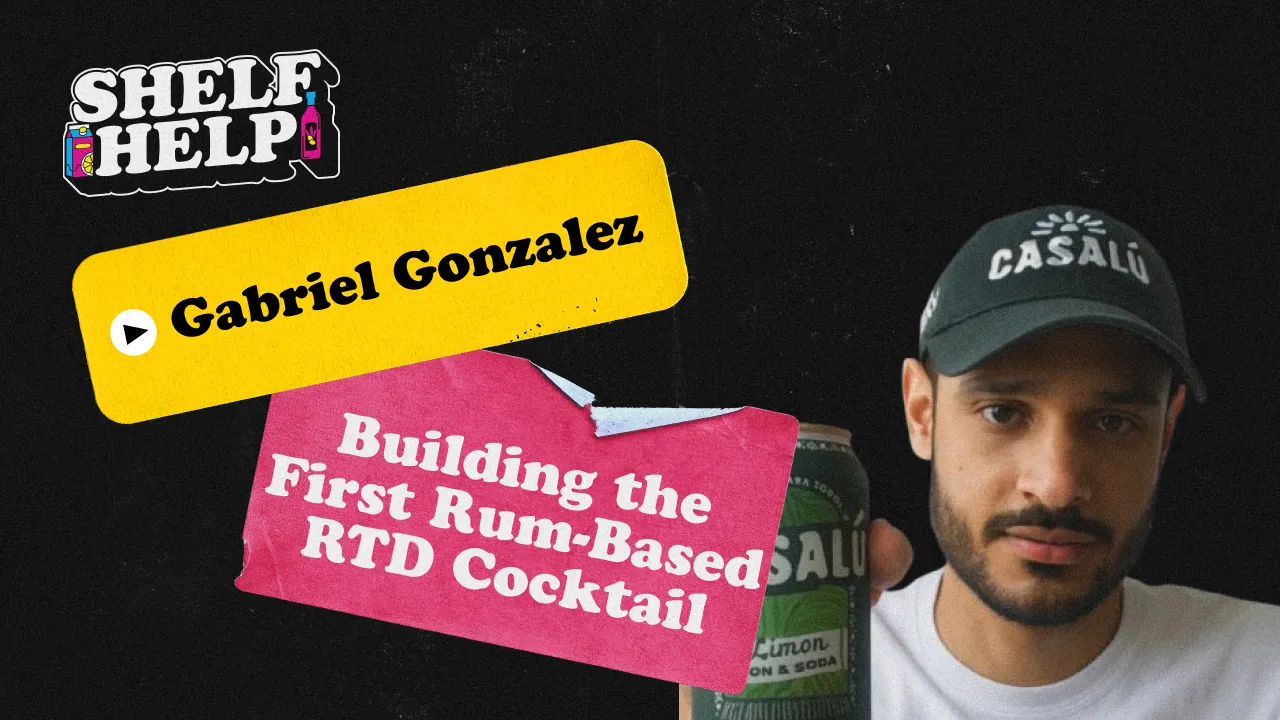



On this episode, we’re joined by Gabriel González, Co-Founder and Co-CEO of Casalú, the rum-based RTD cocktail brand.
In Gabriel’s own words, his goal is to build the Red Bull of Latino culture.
We dive into the initial insight that rum was missing from the hard seltzer boom, and the broader cultural shift that made a Latino-first brand not just viable, but necessary. Gabriel shares how Casalú was built for their own community first, and why Latin culture becoming pop culture fundamentally changed the opportunity.
We also dig into early formulation and R&D decisions, including painful product failures and fermentation issues that forced production shutdowns and hard resets. Gabriel walks through what those moments taught them about liquid development, co-packers, and knowing when to rethink both product and process.
We talk candidly about starting with self-managed distribution, learning the hard way how to actually drive velocity, and what it really takes to succeed with major retailers like Walmart. Gabriel also breaks down Casalú’s recent brand refresh, why clarity at shelf matters more than just being “cool,” and how they’re thinking about culture, community, and scale heading into 2026.
---------------
Episode Highlights:
🍋 Why rum was missing from the hard seltzer boom
🧪 Early formulation and R&D lessons
🏭 What they learned working with co-packers
⚠️ Product failures that shut down production
🎶 Building the Red Bull of Latino culture
📈 Growing a following from nothing
🚚 Starting with self-managed distribution
⚡ Tactics for driving real retail velocity
🏪 Getting in the door and succeeding at Walmart
🎨 The strategy behind the Casalú brand refresh
🎯 2026 goals and what’s next
---------------
Table of Contents:
00:00 – Intro
00:51 – Origin story
02:55 – Formulation and R&D
05:20 – Co-packers
10:22 – Formulation challenges and failed product
12:32 – Building the Red Bull of Latino culture
19:07 – Building a following from nothing
22:21 – Starting with self-managed distribution
25:40 – Tactics for driving velocity
29:48 – Getting in the door and succeeding at Walmart
32:30 – The what and why of the Casalú brand refresh
40:46 – 2026 goals
---------------
Links:
Casalú – https://casalu.com/
Follow Gabriel on LinkedIn – https://www.linkedin.com/in/gabrielgonzalezorta/
Follow me on LinkedIn – https://www.linkedin.com/in/adam-martin-steinberg/
For help with CPG production design - packaging and label design, product renders, POS assets, retail media assets, quick-turn sales and marketing assets and all the other work that bogs down creative teams - check out KitPrint.
Episode Transcript
Speaker 1: 00:00
All right, welcome to Shelf Help. Today we're speaking with Gabriel Gonzalez, co-founder, co-CEO of Casalou, Latin-inspired rum-based seltzer brand that's scaling pretty rapidly in big name retailers like Walmart, like Whole Foods, Walmart, et cetera. Founded by three South American immigrants, Gabriel and team are pretty dead set on building the Red Bull of Latino culture, which we're definitely going to dive into, but really just a brand that shows up in all the main places that uh you know surrounds culture, music, fashion, sports, not just on the shelf. So building something really cool. Excited to get into it. First off, Gabriel, just for listeners that aren't that familiar with with Casaloo, just give us kind of quick lay of the land, just in terms of kind of the origin story, eye behind the brand, our products in the lineup, and then maybe just throw out a few places that people can get their hands on them, and then uh we'll go from there.
Speaker: 00:51
Absolutely. Adam, thank you. Look, Casaloo is um a representation of our culture. We felt that our culture was at a place where we as kids lived it with black culture, where we were becoming pop culture, right? I grew up with Kanye with Jay, with MTV, NBA, like really leading what was going on in terms of global culture. And now kids are growing up to Bad Bunny and Lionel Messi at the MLS. And what you see there is just a clear cultural evolution of Latin culture just being beyond just Latinos for Latinos, but Latinos for the world. And we saw that, and we really believe we needed a brand that represented us in parallel to that. And the reason why we are in this category is because my co-founder and I we we love beer moments, and I love beer, but he didn't. He was always the guy who would not necessarily drink beer uh and wasn't the biggest fan. And he said, Look, I love beer moments, I just wish I had something that tasted slightly different for me personally. Um, and that was at the moment where we were seeing the rise of high noon white claw during the pandemic, and he said, Why isn't there one made for Latinos or with Latin culture at its core? And why isn't there one made with rum? And we are Venezuelans and we grew up with rum, really. And we saw we saw that not only in Venezuela and the Caribbean, but if you really think about it from Mexico down to Argentina, rum has a strong presence throughout Central America and South America. And it really clicked for us that we could create something at the intersection of Latin culture and our consumer habits that were shifting that was authentic and that could really capture our generation. And uh that's where our name comes from, Casa. It's our home, it's our heritage and salute, which is an open door to share Latin culture with everybody. And that's what we want to do in this category, which we feel is massively underserves Latinos. And despite that, you know, we see an amazing opportunity and we are building it ourselves.
Speaker 1: 02:55
Thinking back to the early days of formulation and RD for a minute, uh I imagine like most product development journeys, it took a while to dial things in, find the formulation process that that worked and kind of curious, you know, without giving it away, giving away too many secrets, or some of those key variables you played around with or kind of two key key tweaks you made along the way that between that first, maybe that first version you made to the final version where you s where you guys all said, Yeah, this is right, we feel great about bringing this to market.
Speaker: 03:21
Yeah, I mean, if you think about the the the early days, it all started in the summer of 2020, actually. And started with my co-founder with that question of um fundamentally how to think about a seltzer or rum seltzer that was for ourselves. There were a couple key uh constraints, you know, to build the box where we were gonna build the product. And the first one was we wanted it to have dark age rum. And back home in Venezuela, for you to be able to call something rum, it has to be aged two years. So we were already starting with a high quality base for the drink, and fundamentally it was water juice and a little bit of agavacera. And we started simply with a lemon lime concoction and from a soda stream, which is where it all started in the kitchen, uh, it evolved to a keg and then it evolved to working with a partner that could help us develop an industrial level formula. And and it hasn't stopped, you know, like that early RD has evolved all the way from that initial flavor profile that we created to insights that have taken us to the flavors that we have right now, which we have four flavors in the market three years later. And we can dig into it, but that's sort of the context in the early days. And we started none of us came from alcohol or beverage or honestly CPG. We were fully ignorant of what we were getting into, which most likely was a blessing because if we had known, maybe we had we would have avoided it and we just went full blown. No route to market, really knowledge of what we were doing except for knocking on doors and seeing the response of the people and of the retailers that we were able to get into. And so then it became and it evolved to landing a distributor, it's called Breakthrough out in South Florida, or well, actually covers all Florida for us, and getting into Total Wine towards the evolution from going from one flavor to two flavors to four and a lot of pitfalls and learnings throughout that journey over the past three years.
Speaker 1: 05:20
In terms of commercialization, scaling up manufacturing and copackers, um, assuming you guys weren't you aren't still making this in your in your in your kitchen, but uh kind of at what time at what point during that formulation process did you guys start engaging with copackers and how'd you guys kind of go about finding a beverage copacker that you felt like was gonna be the right one for you guys?
Speaker: 05:40
So it starts with what we knew. And so when we when we went from the kitchen to a keg, which is what a lot of us to test it in the market, we took it to Miami. It was us, the founder, sleeping in the same bait horizontally because we had moved from different parts of the US to give it out to people for them to try it, get feedback, and it helped us tweak the initial formula accordingly. We then said, okay, you know, we have a real shot. We were lucky to be able to raise a little bit of money because none of us came from the background or had capital that we could invest, being immigrant, the three of us. And that initial C capital was used towards finding those partners and trying to learn who could help us create the formula. You know, we were with some people that claimed things that could be delivered and they were not at all. So we learned that pretty quickly. And we started with a copking facility, a small distillery called Siami in Hollywood, Florida, because one of the things we knew is that we wanted to launch in South Florida, in Miami. And the reason we wanted to do that, besides the obvious of the Caribbean and Hispanic highly dense population, was that the bet that we took was about this is probably the hardest market we could ever go. Why? If you're going down 95, you're gonna see absolute vodka marketing in Spanish, like everybody's trying to go towards this consumer, right? Where it's evidently not a separate white space that you can get into. It's just simply like who can capture this consumer. If we can do that, then I think we have a really strong foundation than to go elsewhere where we think we can even have more appeal uh across the US and be able to capture that consumer because the foundation has already been built. So knowing that, we chose this uh distillery in Hollywood. They were great to work with and make our first initial products. And then we've grown from that to now we use a co-backing facility in the west side of the state that better fits our capacity and demand. And eventually from that, I guess you know, we'll keep growing and probably use a couple throughout the throughout the country.
Speaker 1: 07:42
Yeah. When you're searching for those copackers, having conversations with them, was it hard to find one that was willing to take a chance on an upstart brand?
Speaker: 07:49
No, absolutely. And surprisingly, to a lot of people, Florida doesn't necessarily have established too many established um high-level call it uh co-packers that may work with smaller MOQs as can be seen in other parts of the country. And that made a challenge because it basically meant you either work with the brewery at a smaller level or a small distillery, or you try to go to these higher um requirement co-packers, and there really wasn't anything in the middle, you know, let's call it to professionalize that ramp up. So we ended up deciding to go with the smaller distillery that through conversations was simply open to doing it, and they had a mobile canning facility, they were starting to do this, so there was a lot of learning through it. Luckily, that initial formula that we had was bulletproof for those conditions, but it's not always the case. So it's definitely something for founders to be careful with.
Speaker 1: 08:51
Any recommendations you might have for some up-and-coming beverage founders that are just kind of starting that process of searching for the right copacker and one down?
Speaker: 09:02
Totally. I think we all focus on who can make my thing for the cheapest and the fastest. And I can't emphasize how much quality assurance is important because having a product that goes bad out in the market could most certainly kill your the company for any potential capital that you have. So I think understanding the variables that go into your drink, specifically if we talk about drinks. So, for example, juices could get fermented based on their pH or bricks, and what are the variables that really go into the drink? And how could they get affected by the conditions? Where do they get created? And because we had it happen to us, we had a passion fruit SKU that fermented, and because it was made in a beer facility, and those two just didn't go hand in hand, even after being pasteurized, even after we us trying like what if we put preservatives, like even after trying that, it just didn't um came out to be what we expected it to be, and we had to pivot from that product. And I think understanding the variables is the homework that that needs to get done, and if you can produce the least amount possible just to see how it's taken by the market and also how the product functions, whether it breaks or not, optimize for that, even if it's a little bit more expensive, because in the long run um can pay off.
Speaker 1: 10:22
I guess double clicking that because I was gonna ask you about the that passion fruit skew, which I think you mentioned like quickly became a hero skew, but then also quickly became sort of had some formulation production challenges. Like, is I guess is there I guess yeah, maybe looking back now, any like big things that you would have done differently in regards to kind of rolling out this passion fruit skew in terms of the formulation and kind of RD process now looking back.
Speaker: 10:43
Yeah, I think it was a very tough one to catch. Um, because we caught it after it was in the market and we talked to a lot of professionals and everybody was like, I don't know how these happened, but we did work with Boyle brands. Shout out to the Boyle team, pretty famous in the CPG space, to help us take a look at the challenge because it it wasn't evident, and they were the ones who helped us find like this SAU simply cannot be produced in a place where there's a beer because yeast will fly no matter how clean the tank is, and eventually get into it. And if it's not properly mixed, which is already challenging, um, you guys fundamentally create a unicorn of a product and those two just don't go together. And if you want to make this in the same way, you're gonna have to find a facility that does not touch beer. Yeah. If we think about advice, right? It would be there are three that really come to mind. So the first one is use a third party to validate or to check. Maybe you'll get an answer, maybe you won't, but at least you give yourself a chance to catch something before producing it. Number two, make it in the least amount possible so you can see if it will really get basically move as fast as in the market. Luckily, we knew that this was harmless for the consumer, so there weren't safety concerns. It was more about basically it was turning into kombucha. And it's like, hey, I bought an RTD, a rum RTD, I didn't buy kombucha, right? Like it's just a different product. So it it and I've heard a lot of different founders go through the same thing. Uh, we weren't the only ones. And the specific one would be be careful if you're making something with juice, do not go full on in a beer making facility because it may get affected. And be careful with it and make it do your homework before you decide to do it and take all the safety precautions you can.
Speaker 1: 12:31
Totally. That's really helpful. Well, on the bright side of me, right before we we we jumped on here at Rest Record, I was asking you about uh what what you guys are doing with Art Basil, and you're telling me how you got so much inbound interest, and like even you guys got an inbound interest from Nike and you got this like a partnership where you the cop blue logo was sitting right next to Nike, which is amazing at the stage you guys are at. So, in terms of kind of brand identity and packaging design, first off, just in terms of thinking back to those early days, what were some of the key things that are kind of top of mind for you when you guys were building out the brand identity uh positioning and voice for look, I think it is since day one.
Speaker: 13:06
I think when we started this podcast, right? Um, you know, and and you you hit a note on it. Our goal has always been to be what Red Bull was to stream athletic culture, you know, stream sports. We want it to be for you the young Latino generation. So what we meant by that was okay, how do we express the way we are as founders, especially Ricardo and I, I'm very big into music, he's very big into fashion. Like we can tell you the next bad bunny 10 years ahead of it, just because we live in there. How do we build a brand that resonates with that generation? The ones that are pushing culture forward, the one that is really looking to make their mark. And since the beginning, even with the name, we said, look at Red Bull, right? Like Red Bull, if I ask you, you might tell me it's an energy drink. If I ask someone else, they might tell you it's an F1 team. The beauty of it is can we have a name that resonates with Casalou Football Club, Casalo Productions? Like, does it stand with the ethos of very clearly what we're doing here is elevating Latino culture? So we work with Latino creators, Latino talent. We give them a platform for them to create. And I think that in the beginning resonated a lot. Every time we've engaged with Latinos that we think have a lot of talent, we simply ask them, hey, what would you want to do? What did you dream of that no other brand would take a bet on? And that just opens their brain completely to be like, hey, we could do something and culturally it resonates. So I'll give you an example. Our passion fruit was going bad. One of our investors, Tom Baker, founder of Mr. Black, was like, you just need to kill it. Uh and that was his advice. So we said, okay, let's do a funeral. And what we did was we worked with actors and writers that we knew, they're really good, they're really famous sketch personalities on TikTok and Instagram. We said, instead of us bringing Passion Fruit to your sketches, TikToks, etc., to basically publicize that these SKU is no longer around and we have new ones coming. How about we let you write for an imaginary character and you guys act and we'll build a production around that to tell the story that passion fruit is dead, but we're gonna cry them out, and then new flavors are coming. Which for a lot of people would be ridiculous because you're basically making an advertisement for a product that is no longer around that was your top-selling product. And we did it, uh, and just the impact that it's had from the respect, the level of respect there is for Casalu, which is like, my god, like you guys did something that no brand would think of doing, and you did it all surrounded by 100% Latino talent producer, actors, writers, and yourselves as a brand. It just like completely changes the level of respect that they have for Casalu as a brand or the world has for Casalu as a brand, and um you know, even getting a for that piece of content, which is not typical. Doing that repeatedly and thinking that way repeatedly since we were very early, it's what has put us in the map to get the respect of other big brands to say, okay, yeah, you're the company I would like to work with because I like how you think, and and I know you're pushing uh you're just pushing the boundaries.
Speaker 1: 16:11
From a the visual identity packaging design standpoint, how you wanted to actually convey this from a visual standpoint, like what were what was top of mind for you guys?
Speaker: 16:20
Yeah, I mean, I could show you the early drawings. Luckily, it was an amazing experience because we worked with uh a friend of ours from college actually to build um our packaging and and and the design of the cans directed by with all the creative direction from Ricardo, my co-founder. And the takeaway was the exercise was we were working with a a friend from North Carolina who, you know, we would be describing designs and we would be like, hey, this needs a little bit more of Bad Bunny on this side. And that's how we would communicate, and then that forced us to like, oh my God, no one's gonna understand that. Like, we need to translate what we're trying to say. How does that look visually? And that was such a challenge in the beginning. It was the most useful exercise for brand creation that we could have gotten because it helped us be more specific about what we were looking at. So if you look at the can, we can go there all day long because it all starts with the gold top, the topper, for example. And for us, that was an homage to vintage Hispanic beers on one side, and on the other side, it was if you have a celebration, an older person in the group, the grandpa, uhuelo, is might have like a gold watch or some kind of bling that represents the heritage of that family. And it was like, okay, cool, that has to be part of our branding. Um, the arch in the front, it's a window, it's a door opening towards Latin culture. The texture on the back is the same as a fabric of your grandma's uh sort of where where you eat the uh tablecloth. The palm trees are just an homage to uh a tropical feeling that it was, you know, it all started because in college I had I went to a party, and this is in the back of the can. This is the story that's in the back of the can. I go to a party in early 2012. I was just an immigrant coming from Venezuela, and a friend comes to me and says, Hey, are you feeling tropical yet? Ya, that's tropical. And what that meant was like, oh my God, like I'm in Boston, so far away from my family and from everything that I've known, but I'm in the right moment and with the people I need to be at. And that's a big part of modern culture. It's like we find a way to enjoy, no matter how far away we are from home, and and we always find an excuse to celebrate the moment. And I turned that into a playlist that I call Tropicalization. And then years later, when Ricardo made the first concoction of Casaloo, he was calling it that Tropicalization. And I was like, this is such a like it's not only through music, it's not only through a moment, like there are other ways of sharing this feeling, and that's the feeling we are trying to communicate. Just like Red Bull communicates adrenaline, like this is a feeling, this core part of Latin culture. This is what we're trying to communicate, this is where we're trying to make everybody feel, and and that's what Casaldu is all about. So that's been part of the brand since they begin.
Speaker 1: 19:08
From a uh go-to-market standpoint, um, especially these days, of just how like busy the world is, how many different types of companies and businesses are buying for consumers' attention, how easily people get distracted these days. What did you guys kind of find was most effective in terms of capturing the market's attention and securing kind of a place in people's minds in the early days when the brand was virtually unknown?
Speaker: 19:29
Yeah. We were lucky of launching in Miami. Uh, in a sense, uh, that helped us a ton because you know, we moved to the city and uh it's funny, it was the co-founders living all in the same apartment with our loved ones. Uh I was married at the time and still am, uh not with a kid. And gladly our significant others support us. Um, we got roped in into the music industry pretty quickly. And what that meant was a lot of the right people trying the product very early on. But within three months of launching the brand, you would have Fade drinking it, you know, top 10 stream artists in the world, tiny, the most important producer in the history of Latin music, Rao Alejandro, top five artists in the world. So that happened very, very fast. And it doesn't translate necessarily into sales. And I think that's something that other founders just gotta be careful, right? Like not chasing the shiny object. We did not search this or try to get this by design, but it led to what helped us a ton, which was events and like concerts, for example, where we absolutely crush. Like, I don't think we've ever been beaten in the category if we've decided to do a Latin concert. Um and just a couple weeks ago we did Cabel, which he which he's a Spanish singer, and um, and we absolutely blew any other category of the water just because it clicks and and it's having the right product at the right moment. And it's all about those two things together. Early in the day, I think that paid off because we were just planting seeds in what would lead to the right moment of consumption. Yeah. And that's how we went about it in the beginning. Obviously, doing in-store tastings and other initiatives, but primarily I attribute a lot to that. We also going back to the point of who we are as a brand about giving chances to people or serving as a platform where we can collaborate. I was telling you about those actors who wrote the piece for uh for the Maracuya advertisement we did recently. But if you look two years earlier, we were the first brand they ever worked with. So we were the first brand deal, if you can call it that way, very cheap for us to do it. But there's a famous white combinator line that maybe you don't remember all of your investors, but you definitely remember the first one. And being first at supporting up and coming talent, you know, if you can stay in the game long enough, you it really pays off. So we were doing A lot of Instagram content with with that group and and had their loyalty and they were and they now turned down deals that are five times bigger than we are just because we were the first ones who took a bet on them. And that's really paid off. So working with content has really been a differentiator for us, and being in music is is a key aspect as well.
Speaker 1: 22:21
Pretty sure you guys broke into the market through a self-managed distribution, starting with the 3PL that had just a liquor permit, which I think I've heard, I think I've heard you say was a terrible way to go about it. Tell me a bit about why what that why that was so terrible and look for us, yeah.
Speaker: 22:36
For us, horrible. I would, if you are at least an RTD founder listening to this, alcohol is different to traditional CPG, so take it with a grain of salt. For us specifically, for Casaloo, choosing a 3PL was a terrible decision. We also, to be frank, we looked smart because we were doing it consciously, but we didn't necessarily have an alternative on the table. So um, why was it terrible? Because uh the way it worked is they were fixed monthly fees we needed to pay. And then the retailers, so if you think about a gas station or an open market like Miami, where as long as you're under 6%, you qualify under beer uh or wine and beer licenses, which means you can sell to anybody pretty much that sells alcohol. And we would try to sell them, and then normally they would not have an account register with that third-party logistics company. And that would mean we would open that account for them. We're already paying a monthly fee, but then we needed to do the sale and we needed to pick up the check. And if that check is not picked up quickly enough, they get listed, which means they can't receive alcohol from anybody else. So we were on the hook for making our clients lose clients in a three people team. And that was like such a dumb decision. Hindsight 2020, we didn't necessarily have an alternative, just so just not a fit. If you're in a more like craft product that you can take your time, super high margin, low velocity necessarily, like maybe that that's a better choice. But for us, it didn't make sense. When we switched through, when we switched to breakthrough, then it became a much easier game. Because normally, as long as they're selling wine, breakthrough is typically a wine distributor would normally have an account in the mainstream market. However, what we found, and here's the lesson, two years into the market that I would give to other that we found two years into the market that I would give to other founders. Not that we did not try this, but for us selling to Latinos as our core initial demographic, well, the density of stores and accounts in Latino neighborhoods are dominated by beer players. So that would be the right choice if I look back, at least for us, because of that reason, where we are not necessarily opening new accounts for our distributor, we are just going to the ones that you already have and proving that we can sell there. And so we've gone from definitely not do it to preferably not do it, to then, you know, in the future we're looking more at the beer network as a way to scale, because that's the right approach for us specifically, and is what you know we'll we plan on doing. And that's just something to understand. And again, if you look at the beer network, for example, for RTD players, if you look at who's succeeding, um, you know, Carly, SurfSide, like they're go play that game, they've done it right, they've chosen the right approach or switch to the right approach early on because they're used to low margin, high volume. And so aligning incentives is very important if you're going into food and bath, especially if you're using a distributor.
Speaker 1: 25:41
Fast forward a bit, I think you guys now you've locked down shelf space at you know, some pretty big name retailers, Whole Foods, Walmart, Total Wine. What are um what have you guys found are some of the kind of core tools, tactics you found that have the most impact in terms of driving velocity across those doors you're in thus far? And these could be like, you know, demos that you got running shelf talkers, I have lators, like innovative promo strategy, merchandising, maybe just big music partnerships that are driving traffic. Yeah, like what have you found is has the most important thing.
Speaker: 26:09
I think I think the key, it all starts with the basics, right? So if you think about succeeding, at least from our perspective, is I tried something, I liked it, where can I find it, where can I buy it? Do I ever go to that store? And sure, there's discovery happening in the stores, but ideally you're educating a consumer that already goes to a store where they can find your product, right? And the rest then is converting someone who was already gonna go somewhere for a different product. Now, you hear me say product, that is the evolution of what we've seen. We've listened to our customer for a long time, and I think we were stubborn at to what we wanted to create. But if you think about it, fundamentally the hypothesis of why Casaloo exists as a product is if you look at the American mainstream market, it started with sparkling waters. Your lacro, your spindrifts, then you know Mark Anthony Bryant was genius enough to say, hey, let's add some alcohol to it, why claw was born. And then Hainun said, look, we can make a higher quality product, let's put actual liquor into it. And a whole market was created. If you look at the Latino, the problem is from beer to sparkling waters, that never really happened. And so the evolution has been different. I think in the beginning, our hypothesis was about let's do a sparkling water with rum and that you know that'll be consumed because it's a normal progression from your rum and coke to your rum and sparkling water and lime, but it wasn't enough. They were looking really for an innovative product that could combine what they enjoy from low calorie with what they already drink, different teas, different uh types of cocktails, but in a format that was easy to consume, full flavor, and just convenient. And I think that brings us to okay, where does that product make sense? And for us, when we look at those retailers that you were mentioning, we are seeing different levels of traction in different um chains, extremely surprised about how we are performing in Whole Foods as our brand being built right now there. Complete surprised. I would say I was ignorant to the possibility that it would work for us. Um, and so sort of a new thing. Um, but from a strategy perspective has been okay, where does our consumer who shops here where they go? Where are the areas that they attend? How do we we educate their mass market samplings, which are those concerts basically, and then being present, readily available, and visible in those stores. So your shelf talkers, your stacks, your different assets that educate are very important. I think the last piece to that is we previously had a package that was beautiful, sort of low-key, and it just was not explicit enough and it would get lost on the shelf. Very dark, hidden, talking specifically about the box that we used to have. So we changed from green to pink, light pink to make it stand out with very explicit call-out of what's the drink, what's in this box, and sort of the key call-outs for who's looking for that, you know, low alcohol, low sugar, low carb. And that's accelerated our our velocity. And um, those are all been learning from being in the market. And yeah, I I I engaged with a very sophisticated, amazing investor in the CPG world, and he said this is a war of attrition. So stay long enough in the business and learn long enough and move fast to put those learnings into action, and those are typically the people who win.
Speaker 1: 29:38
Yeah, it's a 10-year marathon, is what I hear a lot.
unknown: 29:41
Right.
Speaker 1: 29:42
Another retailer, which I thought I'd touch on, you know, Walmart is because you're out there. Tell me a bit about just the journey of actually getting on shelf there in terms of just getting that buyer meeting, getting the commitment. And then once you got the yes, like all those kind of steps leading up to actually getting on shelf and having a successful launch.
Speaker: 29:59
Look, I really think that Walmart has changed um a lot in terms of, I think for my early generation, you know, Target was like the cool uh hit place to find stuff. And for Gen C is definitely Walmart. My sincerest, you know, I have so much respect for Walmart after going there. The way it happened is we signed up to this platform called Range Me, which I definitely recommend. And we apply for the golden ticket, Open Call. And Open Call is fundamentally once a year bringing products that are made in America to um Arkansas and you know, flight eventon bill if you get selected, and then thousands of applications, 400 get to go, and then out of those 400, 40 or 50 get a golden ticket, which is an opportunity to sell in Walmart. Lucky enough, last year we got the opportunity to go. Um it's insane. I mean, for someone like me, I I remember when I was a kid and I visited the US, I used to buy my jackets and my toys at Walmart, and then being there is such a full circle moment. And you have a few minutes to pitch a buyer, and uh then they'll decide right there whether you're in or not. And we did that, and we got our golden ticket, you know, a test specifically for us what's called a license to hunt, which is a permission to go and pitch the stores for them to bring you in as a way to test whether Castle would work in their retail in their retailers in certain areas, and then from there you get to pitch again and see if you can expand, whether it's regionally or statewide or multi-state. For us, that is a process that took about a year from the yes to actually being activated to sell in the store. So we've recently deployed in a few stores in the South Florida uh area. And and right now it's holiday season, so we're gonna see the results of that. But um, you know, I can't say enough about how amazing really am I, I just have nothing but respect to it after talking to the guys at Athletic Brewing and other brands that were really built in Walmart or scaled up in Walmart is pretty cool because you would think about that as the last step you take. And that may not be the case for everybody. I really have seen and saw some founders in in the open call that clearly could do an amazing job in Walmart and and it could be the retailer way where they build a brand. So for Casaloo, I think it's a it's a great place uh to get in front of our specifically our audience or our our Latino uh consumer in the Florida.
Speaker 1: 32:30
I think you kind of touched on this in the context of of Whole Foods a bit a few minutes ago, but I think after uh getting on the shelf, getting some market feedback, you guys did a packaging and refresh, you felt like that was needed. Maybe just expand on that a little bit in terms of kind of like the why behind that, and just maybe like, you know, looking back, if you had done if you had done some things differently, things a chance you kind of would have got it right right the first time, and what would that have looked like?
Speaker: 32:51
So what we did specifically uh starts with our soccer jersey. About a year ago, we had a conversation, Ricardo and I, and I was telling him, look, I I'm going to retailer. Some of them, their lighting is not great. We need to figure it out. Like since the beginning, since day one, we've known that green is our color, right? Like you have to, in our opinion, marry to a color. So if I ask you what color is Bud Light, what color is Budweiser, you're gonna know the answer. And if you can do that and own a color, then you're on to something. In our case, we knew green was that, but I don't think we were giving green a chance to really stand out. And I think that triggereth on what with some of the designers. And then the first put into practice that we had with it was for a soccer jersey that he had been designing. Uh, he just wanted to do a drop and and give it to certain people, and we sold it actually. So we did a hundred people pre-order. Uh, you had to get on the list to even get it, and it just looped really well. It made the cream stand out while serving as a contrast and and and really feeling just as a complementary color that that would work. Because before we had used like cream or white, which were good, but almost like too soft for the brand that we were trying to build. And when we got out and we got we we just got a lot of recognition, soccer Bible posted about our jersey and like how it spoke to Latin Heritage, and and it just got picked up by people that we would have never imagined would get picked up. And we saw the jersey out there, then we said, Okay, cool, maybe this would work in retail. And we talked to Lauren, our partner for the CPG side of design, and we said, Hey, can you put this into practice? So we went back and forth for three months on how this could potentially look like, and we ended up with the pink as the background, green as the center, and took inspiration from other brands like Barrow on how they split their can, and we did something similar with a little twist, and it worked out pretty well. So now, you know, you really can't miss Casaloo on the shelf, and you can't miss what it is. Totally. Yeah, it looks great. Because it happened to me once that I was at a store and uh lady picks up uh the laundry, and I'll tell this to the laundry guys, but turns it around, looks at it, calls, puts it back, you know, the blue box, and goes to the cashier and he says, Hey, I'm looking for a gin RTD. And I was like, What? And then the guy gave her 10 crate. And I was like, You had it in your hand, and I saw this happen in front of me. That's so fun. So I was like, Oh my god, like uh, we need to call out rum somewhere, right? Because I mean, maybe, maybe not, right? Like at the end of the day, you just want the brand to be the brand. But I literally had this conversation also with Brad over at Beatbox, same thing. So it's like the consumer just wants simplicity and get to the point really quickly. I think that's the other challenge when you're building a brand. Like, it's important to build this whole world, but I think for us in our category specifically, where it's not a bottle that you read over you know, 10 minutes, you need to get to a point really quickly, like if you were doing um you know, uh a water or a juice. So it's kind of weird because it plays in these two worlds of liquor and almost like a soda, right? Totally. And I think to do it differently in the beginning, you know, I think we tried and um we tried to do it in the beginning. I think if you have the cash to go with someone who's built brands that have been successful on the shelf. I no shame on saying that because it's not about it being pretty, it's about it getting the job done. And we were not great at that. We we really wanted something that you know where was attached to the brand, but eventually you need to get to something that a design that communicates not only not only that pops on the shelf, but the one that communicates what you're doing. Look at a brand like Harbeless, simple, yeah. Maybe you're not a big fan of their design, but they're selling a lot. And it's not only flavor, they know how to find it, they know what it is that is also important. So if you can find both, and depends on the brand you're trying to build, I think um I think that's key. And the earlier you do it, the better. So for us, if I went back in time, I would, with all respect, obviously, to our partner in the CPG side of design, I would go to um a larger, more established company that could deliver a design that could win on the shelf. Totally.
Speaker 1: 37:06
Yeah, those are all really great points. More recently, you guys launched this four-flavor variety pack. I think you mentioned to me like you thought this really was gonna be this use, really kind of gonna be a tipping point for the brand. Tell me a bit about that and how it's been going so far.
Speaker: 37:19
Proving to be, I think, you know, we look back at it, Hansen 2020. Usually uh we approached the market a bit different, sorry with one flavor. And we've always been confident about what what we've built, but the taste profile, I think, for the initial audience that we were going into versus the one that was more educated on the hard seltzer market, those were just different. So we needed to really create a variety of flavors where you could take a drink home, a brand that you love and share it with people you love, and that everybody would say it wasn't about I like it or I don't like it, it was about which one do I like. And that's a massive shift that I think is very particular to our category. Uh, because if I was doing beer, you know, what we said, I would just do a top pack of limon, that's my favorite flavor, and then I'll be good. Uh, it doesn't apply, I think, in RTD space right now. So I, you know, we we thought about what are Latinos drinking and what flavors do they like, and how do we marry the concept of casaloo with some of those flavors that we feel are authentic to the palate of our consumers. So if you look at the lineup, you got the lemon lime, which is limon, so it's a graduation of that ramen coke, right? Getting the coke replaced by something that's like like sparkling water. So that's our base. But then we have three flavors mandarina, which is tangerine, very common. If you look at jarritos, fanta, like those are core aspects of something that's drank all across South America in different ways. And we want to make sure we have one of those mainly as a replacement to passion fruit in the short term. We have a Moscow Mule, which is a mule flavor, and the reason we call it Moscow Mule is a rum mule. We create that Bad Bon's opening song in Venosin Tea, which is his most successful album, but partly because it's it's a drink that uh it's very famous and has been on the time in Latin America. And then we have peach tea, and the reason we put a peach tea in there, um, you know, we there's a brand called Nesty, Nestle, but we drank a lot of it uh back at home in Venezuela, and we were seeing our audience really just gravitate towards that flavor profile. And um, we've always said there's lemon or lime tea, and then there's peach tea in our culture. And for some reason, the people who are attached to peach tea they take it very, very seriously. So we decided on that one, and man, it's just like the response is insane. It's insane. I think it's like, you know, we would get stuff like you guys have built the coolest brand, we love your brand, we want to work with you guys, but I don't like your liquid, and that was very tough to hear as a founder. And you have to decide do you keep doing it or do you change or do you find somewhere in the middle? And I think what we what we realized was there are things that we like in our culture that could definitely be part of Casal. Let's just bring it in. And the shift in just you know three weeks has been massive. That's awesome. And and we're very happy about what it's generating. And yeah, I think if you hadn't done that, maybe the brand dies. But now that we've done it, I think it's the key to their success. It all starts with product and the context for the product.
Speaker 1: 40:33
Love that. Well, that's awesome. It sounds like you guys are kind of um ending the year, ending the year on a high note. You guys are probably in you know, definitely some level of deep 2026 planning mode. You have to hit all your goals next year. What does the business roughly look like by the end of the year?
Speaker: 40:49
Yeah, I mean, for next year, I think a deeper expansion within Florida. Um, and we've signed expansions as well in the state of Georgia and North Carolina. You know, I think we'll 10x where we're selling right now. And yeah, now it's putting fuel in the tank and and and growing. I think the expansion that we're gonna see in Florida next year is gonna be very powerful. And we're gonna go deeper and deeper into the market. Right now we have only 300 points of distribution. I think we can hit hit just in Florida, we can hit 3,000 next year. That's without counting what we're doing in Georgia.
Speaker 1: 41:23
That's great. Um definitely rooting for you guys. This has been awesome, Gabriel. Really appreciate the time and so many great insights here. Yeah, what's the best place for people to follow along with you specifically? And then best place for people to follow along with uh with the brand these days.
Speaker: 41:36
Yeah, so for me, just look me up on LinkedIn. If you put in Castlewoo, probably I'll show up and let's connect there. That's where I spend a lot of time, whether it's something sharing something, and most times just doom scrolling uh and connecting with amazing people. So please connect, let's talk. And if you care about Latino culture, then let's chat. And for the brand, uh, Instagram is a place to be for us because how we approach content. Yep. It's at drinkcastaloo, C A S A L U. Give us a follow, check what we're doing, and hopefully I'm sure it'll resonate.
Speaker 1: 42:09
Yeah, awesome.
Speaker: 42:10
Well, appreciate the time, Gabriel. It's been awesome. I think that's the pod.
.svg)