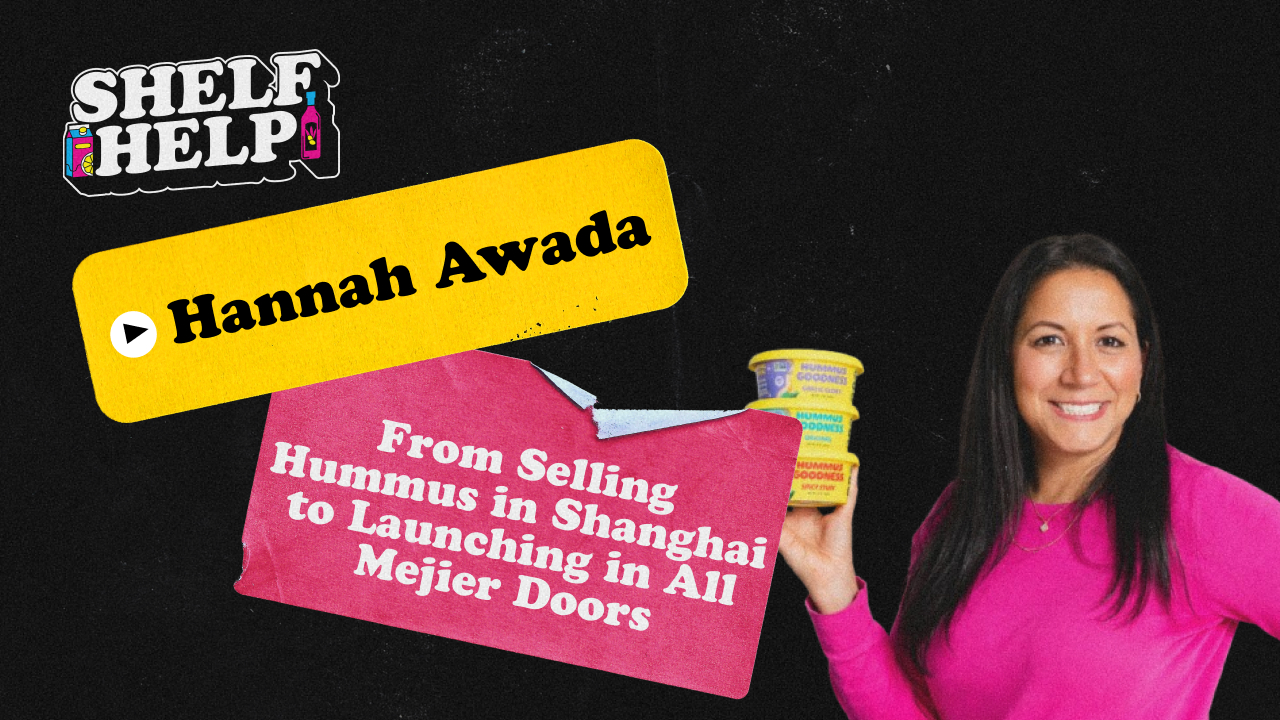
From Selling Hummus in Shanghai via WeChat to Launching in All Mejier Doors | Hannah Awada, Hummus Goodness



On this episode, we're joined by Hannah Awada, Co-founder and CEO of Hummus Goodness - the Michigan-based brand making authentic, clean-label Lebanese-style hummus with real ingredients and zero preservatives.
We talk about selling hummus out of her kitchen window in Shanghai to expats on WeChat, to re-launching Hummus Goodness in a church kitchen in Michigan in 2019. Hannah walks through the formulation decisions that keep the product authentic - olive oil over soybean oil, fresh lemon juice, no citric acid - and how a made-to-order production model protects cash and margin.
A big part of the conversation focuses on the Meijer relationship - how a competitor recall opened the door, how Hannah grew from 3 local format stores to all 278 Meijer locations, and why in-store demos remain her number one velocity driver.
Hannah also breaks down the brand's major packaging refresh, going from a clear cup with a white lid to bold, personality-driven packaging with playful flavor names like Garlic Glory and The Big Dill.
We also get into the anchor account strategy Hannah uses for new market expansion, bootstrapping for five years before a pre-seed round with Michigan Rise, and the tight-knit Michigan CPG founder community she leans on.
---------------
Episode Highlights:
🏠 Origin story: selling hummus out of a kitchen window in Shanghai
🧪 Formulation: olive oil, fresh lemon, and zero preservatives
⏱️ Made-to-order production (not made-to-stock)
⛪ From a church kitchen to a 7,000 cups/week operation
🏭 Finding a manufacturing partner through family connections
🛒 How a competitor recall opened the door at Meijer
📈 Growing from 3 local format stores to all 278 Meijer locations
🎯 In-store demos as the #1 velocity driver
🎨 The packaging rebrand that matched the brand's personality
✈️ Food service channel (Delta Sky Lounges, universities)
💸 Bootstrapping for 5 years before a pre-seed round
🤝 The Michigan CPG founder community
👀 "Kitchen Couture" and the rise of beautiful packaging
---------------
Table of Contents:
00:00 – Intro
00:48 – Origin story: Shanghai to Michigan
03:30 – Lessons from selling hummus in Shanghai
05:08 – Formulation and shelf life without preservatives
07:10 – Church kitchen to own facility
09:36 – Scaling from 700 to 7,000 cups a week for Meijer
11:00 – Finding a manufacturing partner
13:17 – Co-packer relationship advice
15:00 – How a competitor recall opened the door at Meijer
17:03 – Growing to all 278 Meijer stores
19:29 – Bootstrapping for five years
22:07 – Anchor account strategy for new markets
25:20 – Driving velocity at retail
27:02 – The packaging rebrand
31:13 – Rebrand rollout lessons
33:10 – Food service as a channel
36:13 – Michigan CPG founder community
38:18 – Kitchen Couture and trends to watch
---------------
Links:
Hummus Goodness – https://www.hummusgoodness.com/
Follow Hannah on LinkedIn – https://www.linkedin.com/in/hanadyawada/
Follow Hummus Goodness on LinkedIn – https://www.linkedin.com/company/hummus-goodness/
Follow me on LinkedIn – https://www.linkedin.com/in/adam-martin-steinberg/
For help with CPG production design - packaging and label design, product renders, POS assets, retail media assets, quick-turn sales and marketing assets and all the other work that bogs down creative teams - check out https://www.kitprint.co/
Shout out to my friends over at Glimpse, the go-to partner for automating retail-related back-office operations and unlocking margin trapped in invalid fees and manual processes.
Episode Transcript
Speaker: 00:00
Today we're speaking with Hannah Awada, founder and CEO of Hummus Goodness, Michigan-based brain making authentic Lebanese style clean label hummus. Started the company in a in a church kitchen actually in 2019, I believe. Since has scaled into close to 1,500 stores nationwide, including some pretty big names like Meyer, Natural Grocers, Kink Supers, uh a number of more. Um, so yeah, really excited to get into it. And first off, for the listeners that maybe are not as familiar with Helmet's Goodness, love to just get a quick lay of the land, just in terms of kind of the origin story, why behind the brand, core products in the lineup, because I know it's a it's a pretty solid lineup. And then if you want to just call out, there's any like new retailers that you just got into that you want to call out that you can maybe drive some people to, and then uh we'll go from there.
Speaker 1: 00:47
That'd be great. So thank you so much for this introduction, Adam. I'm excited to speak to you today. So, yep, I'm Hannah Wada. I am the founder of Hummus Goodness. And while I did start hummus goodness in 2019 in Michigan, I actually started my little hummus empire or hummus dream when I was living in Shanghai, China, with my husband and three kids. Uh, we were there for his career. One day went at the time, I was a stay-at-home mom, part-time substitute teacher. And one day I went to a party. I took hummus with me. Everybody loved it, told me to sell it. So I did. I started selling hummus literally out of my kitchen window, called the company Hummus House, and I sold it to expats like you and I. One of the coolest things I did there during that time was I developed different flavors of hummus. Because as a Lebanese girl, I mean, hummus comes in one flavor. It's the original. But I grew up in a very traditional Lebanese household where there was always hummus. Yet I always found myself like gearing towards like, ooh, French onion dip, ooh, guacamole, ooh, queso. So I started adding some really fun flavors to the hummus that I would eat it, but I quickly found out that everybody loved the flavors. So I did that in Shanghai for nine months before my husband's job repatriated us back to Michigan, which is the Middle Eastern capital of America. Adam, you you could get good hummus at a gas station around here.
Speaker: 02:02
Wow, really?
Speaker 1: 02:03
Yes, yes, you can. So when I went to another party here in Michigan, and of course, being Lebanese, mom always says you never walk into a party empty-handed, it's rude. I brought a tray of hummus with me, and I really didn't think much of it, other than like, people will enjoy this. So I took the hummus to the party, everybody loved it and said, Hannah, you should really sell this. And I was like, I don't think so. Shanghai was a supply and demand thing. That's not a problem here in the US. So my friends challenged me to go to a store and buy hummus and see what I thought about it. Up until this day, I had never bought store-bought hummus in my life. So I went to the store and I picked up lots of hummus, and I was really excited to try them all and proved them all wrong that we don't need more hummus. But I, when I opened up all the containers, I started trying different flavors. I was like, this is this is not the hummus that I grew up with. Like Lebanese hummus is like, it's happy. It makes you smile. It's delicious. It's made with love. And what I got in these cups was just something that tasted ultra processed and just not special. I started hummus, and well, then I looked at the label and then I understood why it didn't taste like my mom makes it. And that's because brands were using soybean oil, sunflower oil, citric acid, sodium benzoite, like all things that don't belong in hummus. So started hummus goodness with a very simple idea and mission of making really good, clean, authentic Lebanese-style hummus that not only I would be proud to serve my family and friends, but that my children would be proud to serve their family and friends.
Speaker: 03:31
Yeah, now that you've been back in the US building the business here, any things that in those first, I think you said like eight or nine months or so that running the business via delivery business and you know via WeChat, where I'm sure you had a lot of conversations with customers or whatnot, anything that you brought back to the US that really has kind of helped you ever since?
Speaker 1: 03:49
Yeah, uh three things. Number one, the flavors. I realized in Shanghai I had, I was like the Baskin Robbins of hummus. I had like 30 different flavors and it was on a rotation. Every week it would change. I learned to hone in on flavors. Like, for example, Thanksgiving, I made a pumpkin pie flavored hummus. The Americans loved it, the Europeans wouldn't touch it. So then the week next week, I made a uh savory pumpkin hummus. The Europeans loved it, the Americans didn't like it at all. Uh so I really learned how to hone in on different flavors and profiles that worked well for people. Number one. Uh number two, customer service. It was people put their order in on WeChat the same way, if you're like at a big WhatsApp group, imagine like a WhatsApp group with everybody throwing their orders at you and giving you their opinions and what they want. So you definitely learn customer service and how to just go with the flow and not to read into things too much. And the last thing was logistics and the importance of setting up strong distribution. I was selling 500 containers a week because I had like nine different distribution warehouses, like houses, not warehouses, but distribution houses around Shanghai. And that's how I mean it was great. The first week it was like one neighborhood. The second week there was another neighborhood. Then by the fifth week, like there was like nine neighborhoods buying hummus from me. So I learned logistics very quickly there.
Speaker: 05:06
You really focused on building a really authentic Lebanese style hummus with only real ingredients, olive oil instead of sovian oil, fresh lemon juice instead of citric acid, fresh garlic and whatnot, without you know giving away any too many trade secrets. Like, were what were some of the key things that you felt like you really had to get right in the formulation to make sure it tasted like what you grew up eating, not just I don't know, a cleaner version of what you can already find on shelf. And then while still while doing that, also optimizing for what was really you felt needed from a um shelf stability standpoint as well.
Speaker 1: 05:39
Yeah. So when I started the company, we had like a seven-day shelf life. That was it.
Speaker: 05:44
Yeah.
Speaker 1: 05:44
Um, and then had it tested and realized, oh, we actually have a 21-day shelf life. So that was awesome. Um and kept making it the same Lebanese way with the really clean ingredients. What I realized was there were different things that we could change and do to help increase our shelf life while also staying authentic. So, you know, a little bit of extra lemon juice, the olive oil helps, like even things like garlic do help with your shelf life. So the ingredients within the hummus themselves do contain like natural preservatives, which does definitely help with your shelf life. We've also perfected like time temperature controls to help extend our shelf life. Our current cup has like an oxygen barrier in it, which does help us as well. It gives us a few extra days. But one of the biggest things that threw this was in order to stay authentic, we had to be a made-to-order company, not a made to stock. So when our retailers, our distributors put an order in with us, we're not pulling them off the warehouse. Our team is making it that week. We're then palletizing it and shipping it. We have built a structure in our within our own organization that will allow us to continue to scale that way without any issues. And for us, that is the way that we could stay authentic because it's it is hard. It is, I mean, it's very tempting some days that you don't just, you know, throw some sodium benzo away and they'll get extra 20 days out of it. But I can't do that. And so there's harder things that we have to do that makes it easier to get a better shelf life.
Speaker: 07:10
Kind of started in this church kitchen and then eventually when you were back in the States, moved in your own facility, and then eventually you transitioned to it to a co-packer. What did that journey look like in terms of what when and what were the key decision points along the way when you eventually went into your own kitchen? And then that second decision point would be said, okay, we're outgrowing this. We need them, we need to find a co-packer.
Speaker 1: 07:31
Yeah, absolutely. So I started the when I was in China, I made the hummus in my house. When I moved to Michigan, and I could no longer do that.
Speaker: 07:38
Yeah.
Speaker 1: 07:38
It's not legal. It's a it's not a cottage food law, a cottage food item here. So I had to find a space. So I went to a local church kitchen and we rented out space there. There, they had a nice kitchen and somebody had just left. So we were able to take over that space to produce the hummus. And we stayed there from April of, or I think we started in August there. August of 2019. And we remained there until 2020, where we then moved to a manufacturing partner. And the reason we left the church was we just got too big. There wasn't enough, you're gonna hear this from me a couple of times. There wasn't enough refrigerator space. Um, and so once we ran out of refrigerator space, we had to make a decision. If we really wanted to grow and scale this business the right way, we got to get out of the church. Need a uh, you know, we needed someplace that had a loading deck, you know, because up until then, I was like handing boxes to the delivery guy to put up on the that you can't run a business that way. So for us, that was the inflection point, and it was a really risky move. We were in the middle of COVID when we made this decision. We really thought when COVID happened that we'd probably go out of business, but we actually grew and expanded because retailers couldn't get hummus from the big brands because they didn't have trucks and workers and we were delivering from the back of our truck. So it was fine. Um, but so for us, that was when we decided to move to our own space. And at that point, we rented a facility and did a build-out in Southfield, Michigan, and we thought we were gonna be here for 10 years. We landed in there on Martin Luther King Day, January 2021, and we were excited, and everything was going great. We were able to maintain our bills paid for the overhead, everything was going really well. We were producing a couple days a week, doing about 700, 800 cups a week. We were in a great spot. Things trucked along very nicely until uh, and I know we're gonna touch upon this shortly, so I won't tell too much of this part of the story, but you know, we did get into a major retailer in April of 2022, uh, where we went from making 700 cups a week to like over 7,000 cups a week. I could not handle it. Um, and so we ran out of refrigerator space again, and we had to find a manufacturing partner, but it was the right time for us to do so. And I mean, we really took baby steps to get to that point. And we waited until we were literally busting out of the seams to make any changes.
Speaker: 09:57
That first big order from from Myers, 11,000 cups or so, which your point was, I think, X or so weekly opacity with a 14-day turnaround. So I my question was were you were you able to somehow pump those 7,000 cups out within 14 days in your own facility, or you got that order and then I can't imagine you were able to somehow find a co-packer that quickly, have them turn it on and then turn around. Imagine you still had to just figure out how to turn that around yourself.
Speaker 1: 10:23
Adam, I'm scrappy and I am resourceful. And our refrigerator was not going to hold 7,000 cups, but we had a neighbor next door that was in the process of going out of business, and he had two walk-in coolers that were being not utilized that were. I've never seen coolers that big in my life. Well, now I have. But up until this point, I mean, they were the size of like a room, they were massive. Um, and so we rented space from him to use his building, uh, to use his refrigeration, and that held us over until we found a co-packer. So that worked out really, really well for us. Yeah, that's great.
Speaker: 10:57
Okay, so Bench, you you decided, okay, it's time for a co-packer. Once you made that mentally in your mindset, okay, we need to now make this switch. How did you, what would that, what did that process look like in terms of actually finding the right co-packer that was going to be a good fit for you? What were the key variables and factors that were top of mind for you in terms of when you were, you know, diligenting and and kind of comparing your options?
Speaker 1: 11:20
Yeah, so up until that point to to fulfill the Meyer order, we were working like 14 days straight. We worked all day, every day to get their orders done for them. I got lucky, to be very honest with you. I grew up in a very Lebanese traditional household in Toledo. And my dad was very well connected with a lot of friends. And he had a friend who owned a hummus manufacturing company. And I remember being a little kid and sitting on the floor eating like hummus and babagan noose that he had just made, and it was amazing. And I remained in contact with him when I started my business and getting some advice from him as we were scaling and growing, just advice, friendly advice. And when we got into Meyer, I called him and I said, Hey, you know, you've always been so helpful and you've been so generous with your time. And I have this opportunity to get into to expand and grow in Meyer, but I can't fulfill the orders. He said to me, Are you willing to work for this? And I was like, I'll do whatever you need me to do. I don't care. Like, whatever. He's like, Okay, I can do this for you. We can do this together. And so we went over to this manufacturing partner, and his company would produce his hummus in the daytime. And then we would go in at four o'clock at night in the afternoon, four afternoon, and we would work until about two o'clock in the morning to produce the hummus.
Speaker: 12:36
Wow.
Speaker 1: 12:37
And he has been an amazing partner for us. We could not be more blessed. And we do call him a partner. He is not our co-packer. Yeah, so it's such an informal like process. This is a very, very family feeling, you know, way that we do our products even till today with him. Um, and he's really helped us. He's allowed me to work on the business, not work in the business anymore. So it was just a matter of luck and knowing the right person who really, really took a chance on us and has been amazing.
Speaker: 13:08
That's that's amazing. That's awesome. For other brands that are um are have gotten or about to feeling like they're getting to that inflection point, but they're just really nervous about handing things off to a co-packer, which is, you know, totally makes sense. What are, I don't know, a few things they should keep top of mind.
Speaker 1: 13:27
Honestly, it's it's all in communication and it's all in their eagerness, but also a little bit of apprehension of helping. I think they need to have a little apprehension. If they're overly eager, I don't know. When we started with our manufacturing partner, he was very supportive of how we want of the process that we want to maintain. Uh, we also learned a lot from him. But I would really say your number one thing is you want to make sure that they have good communication and that they are there, that they really want you there and that they want you to grow. Our manufacturing partner, we work on a dedicated line with a dedicated staff that only works exclusively on our line. So it's the same like five people. We ended up hiring a director of operations who oversees all of our production today so that we can make sure that all of the products are made right, made on time and in full, like every single time. And so there's a lot of co-packers out there that won't allow you to do that, but there are some who will and who actually invite it. And our manufacturing partner invited us when we had this, we said, hey, we could bring you directive operations who can really help, you know, keep an eye on our brand so you can still focus on your brand. And that was a great, it was a great opportunity for us. So again, it was always all about key communication with him, letting him know what we have in the pipeline, what we what we got, what we didn't get, so that he knew how to help us grow and scale. But that is all it's all about good communication with a co-packer.
Speaker: 14:49
Totally. Uh yeah, you're not the first person that I've heard that from. Circling back to the the Meyer story, which I think is pretty awesome. I think you told me that a competitor went through a pretty big product recall, which kind of opened the door for you. And then that sounds like pretty quickly you went from 100 and I think 150 or so to some of their local stir locations to all of their plus big Meyer super centers. Yeah, just diving into more detail on that front, maybe just walk me through kind of how that relationship started and evolved and how you were able to take advantage of that situation and make the most of it.
Speaker 1: 15:26
Absolutely. So in 20, uh, I think early 2020, before COVID happened, I went and I pitched to a Meyer local format store called Woodward Corner Market. If you're if you guys are not familiar with a local format store, they have a more of a boutique touch and they're only focused on food, but they have the authority to purchase directly from people without going through all the Meyer um obstacles to do so.
Speaker: 15:50
Okay.
Speaker 1: 15:51
We I pitched to my first buyer, her name was Natalie, and I showed her the hummus, and I thought for sure she'd say yes. And she said, you know, honey, I am Armenian. I know good hummus. This is good hummus. But the answer is no. You are not, you are not ready for a Meyer store, even a local format. At this point, I was printing labels on my home computer. We had no seals. I mean, it was it was a different kind of a different day for us for sure. Um, and so we I she said, but I'm gonna give you some advice. My advice to you is get some printed labels, get a seal on your cup, go get into some more retailers and come back and see me. And I did just that. I took all of her advice. I went back and saw her about August of 2020, and she brought me into her local store. I also got into a couple of the other Meyer Local format stores. At the time, there were three of them. We got into all three. And we were, we were so excited to be there. And it's it's it's from a place of sincerity. I love doing demos. So anytime they asked for demos, we were there doing demos pretty much every weekend, supporting the stores, just being a really good partner, shopping there on a regular basis, keeping an eye on my inventory, refilling the shelves when needed, rotating product for them. And and they noticed. And in uh 2022, we had this, you know, that we have this facility, we want to grow our business a little bit. So I had gone to the local uh to this to Natalie, and I said, Hey Natalie, I think we'd like to try getting into a few local stores in the area. Would you be open to that? And um as we were we were trying to help fill the shelf space with the product recall, we thought we'd get a couple of stores out of it. She was like, Well, actually, you guys have been an amazing brand for us, and we could not be more proud our local format team has nominated you to go into super centers.
unknown: 17:37
Wow.
Speaker 1: 17:37
So you will be receiving a call from your buyer from the buyer very soon. I had no idea what I was gonna get, what I got myself into. Honest to God. I thought three or four stores, you know. Um, but she, our buyer was amazing. They brought us into 150 Meyer locations, which is all we wanted at the time. We did not want to take all stores and fail. Uh, so we took what we could chew, what we we bit off what we could chew, which we thought was 150 stores. That was also a lot for us. Um and even at that time, we continued to be a good uh good brand for Meyer, uh, still supporting their stores with demos, even the local format stores. I remember one day I was doing a demo at this Woodward Corner store after getting into Meyer, and uh some another brand saw me there and was like, girl, you're in Meyer now. What are you doing here doing these demos? And I was like, business does not this, the work does not stop when you get into the store. That's when it just starts. And so we continued being a good brand for Meyer, supporting their local events, speaking at different um opportunities with them, uh, where we got to like showcase our story and how we grew with Meyer. So that was all great, but we assumed that as soon as soon as the competitor was able to get their production back in order and get back on the shelf, that Meyer would probably say, Hey, it's been fun, it's time to go. But they didn't. It was amazing. We actually expanded at that time from 150 Meyer stores to 273, I think it's 278 now, 278 stores. So we are now chain-wide, all Meyer stores. This took us from being a cute little boutique brand that could sell at like, you know, your beautiful plum markets and your bushes and your hynans to a retail to a brand that could also be sold in conventional.
Speaker: 19:18
You got into all those super centers pretty quickly. Pretty big purchase orders probably started coming in the door pretty quickly as well. Um, you know, we never really talked about you know what if you've done any raised any capital at all or not, or what at what point, but how are you able to, how did you figure out how to fund those, those, I imagine, pretty big purchase orders coming in in rapid succession to be able to actually fulfill those?
Speaker 1: 19:42
They were very big purchase orders, to be honest with you, for for us at the time. It was like um uh we every penny that we were making in the business, we were putting right back in the business. I was not pulling a salary, my business partner was not pulling a salary. So keeping that model, we did not have to um, we did not have to raise capital at that time. So that was really good for us. Be honest, Meyer has great payment terms as well. So we were being paid very, very quickly. And the reorders were coming in on a weekly basis. And so that was very, very helpful. I mean, that was that's really how we did it. We just kept it lean, kept it careful, pay our bills on time on the due date. But that was the that was really how we did it at that at the early days.
Speaker: 20:28
You told me that you felt like that Mayer relationship has been almost like like a marriage. And now that you're in a number of other, you know, bigger retailers, what have you found is is unique about working in with and I guess succeeding in in Meyer compared to other ones?
Speaker 1: 20:44
Yeah, I think so. There's you know, there's a lot of talk about emerging brands and how how do retailers support emerging brands. Um, and you know, I've gone to many conferences and I've been on panels and I've spoken and I've I've listened to all these different people talking about how retailers are going to help these emerging brands. Meyer is a retailer that is helping their emerging brands. They really, really are looking for those success stories and they aren't just it's not just talk. It's not just, you know, pretty little headlines for LinkedIn. They're really, they're really doing their best to support their brands who are emerging. They, you know, once there is we are at the point now where they do treat us like a regular brand. So now we're no longer considered their emerging brand. But up until that point, they really, they really help you. They give you people who you can work with to go into like a sounding board. We've worked with Carla Hendon, Travis, Kelsey, everybody over there has been really, really helpful. I'm sorry, Casey.
Speaker: 21:39
I was gonna say Travis Kelsey. There's another one who works in.
Speaker 1: 21:41
Sorry, sorry, Travis Kelsey. No, Travis and Casey, who have been really great about helping us grow in with Meyer. So that's what I would definitely say. And we are seeing support with Kroger. Kroger gives us support with King Supers. Natural Grocers gives us support as well. I'm not downplaying anybody at all, but Meyer, I think also, because we are. In their backyard. There's that special like relationship with them.
Speaker: 22:03
Yeah, of course. And that was the first big one too. It totally makes sense. At this point, you're in a pretty broad, wide range of retailers from Meyer to Bristol Farms to others. How do you think about which retailers to go after and focus on and it and in what order?
Speaker 1: 22:19
Yeah. I think early in our days, we were like, anybody that will take us. We're so excited. Anybody, anybody. And we opened up DCs that we had no business opening up without anchor accounts. So today we we're doing it the opposite way that we did it at Meyer. At Meyer, we started with local retailers and then got an anchor account, which was Meyer. Now we are doing it the opposite way. So we are expanding, we are opening into the Northeast for the first time, which is very exciting in about a week from now with giant suits. So we have taken that approach as well, where we are looking for our anchor account and then we are building our system around there. We love our independent retailers. Um and we are where we are today because of independent retailers. So, but we we have learned the hard way that you really need that anchor account so that the independent retailer and you can also be successful.
Speaker: 23:08
For other up-and-coming brands that are maybe a few years behind you, anything, anything come to mind in terms of mistakes that you made looking back now? Obviously, hindsight is 2020 that you made in kind of the early days of retail expansion that some of those other up and coming operators could could maybe learn from and and avoid.
Speaker 1: 23:25
Yeah, I would definitely say make sure you understand exactly what you're getting yourself into with the retailers as well as with the distributors. Understand what you signed and the paperwork and the cost is the cost associated. And I know everybody's talked about this, like, oh, you know, how expensive it can be to work with the the big bohemoths. And there's so much truth to that. But there are ways to mitigate that, and that is by finding that anchor account and making sure that they are the one that you want to work with and that want to work with you as well.
Speaker: 23:50
Right, totally.
Speaker 1: 23:52
Like my my number one advice to you and to anybody out there looking. And that was a mistake that we made in the beginning was that we just went anywhere we could and didn't build up that ecosystem of like retailers who wanted to support us. Yeah. I think the other thing I know we're gonna touch on a little bit was to step back when you get on those shelves and take a look at yourself and the set and make sure that you're standing out properly.
Speaker: 24:13
How are you thinking about continued national expansion from here?
Speaker 1: 24:17
So we definitely have this dream of world hummus domination. So early, you know, local hummus domination for today. Right now, or in the next 12 to 18 months, I mean, we're we are talking to all the big retailers that everybody wants to talk to, obviously, but we are also concentrating on picking up more independent retailers, more mom and pop shops, retailers that have 10, 15, 20 stores where where we belong. And so that is one of our big things in the next 12 to 18 months is to really build out along the um the giant foods where giant foods is located with those retailers, continuing building out with the where we are with King Supers and natural grocers in that area. That's where we're really focusing our energy on. I think a lot of brands, they they go too wide uh and too big too fast. And you really can't support that without raising a ton of capital. And so while we're happy to raise a ton of capital, we want to make sure that when we do so, we are spending it wisely. And so we're all about building up where we are, which is Midwest, Northeast, Rockies, and slowly into California.
Speaker: 25:16
From a velocity and retail tactics standpoint, I mean you're you're competing in in a you know section of the store against some you know fairly established brands. I think I don't know, Sabra is probably the one that comes top of mind first. Like, what have you found are some of the core tools and most impactful tactics you found that have really yeah, the biggest impact in terms of driving velocity at retail?
Speaker 1: 25:38
Demos. Demos. I think at this point, look at Sabra did something amazing. Sabra taught everybody what is hummus. So for the most part, like 80% of the people you're gonna sample to know what hummus is. What we're doing now is showing people like what real hummus should actually taste like. And we always tell them like, our goal is this. Our goal is that you go to your favorite Lebanese friend's house or Lebanese restaurant, you try the world's best hummus, and then you come and try hummus goodness, and you say, wow, that's almost as good as what my sister-in-law made for us last week. Um, and the best way to do that is demos and getting it into people's mouths. So we spend a lot of our resources and our time. I to this day I still do demos. Um, not as much, thank God, but because it was a lot. Uh, but we do still do a lot of demos. We focus on the demos, uh, community engagement events. I mean, we're we're moms and we are advertised, we are marketing to moms. We know who our customer is. It's the mom who's looking to make her life easier. She wants to buy her kids better for you, healthier for you products without having to question if they're going to like it. Because how often do you buy something for the kids and your kids are like, you know, like we don't get that. And so demos, community engagements, and we do social media. Uh, we have a great social media um manager. She's been doing a really great job for her account. And then the packaging. The packaging change has really helped us. If we're not there, it's speaking our story to the customer when we're not there today.
Speaker: 27:03
You went through, I think, a pretty major rebrand last year, going from I think what you described to me as a standard clear cup with a white lid to the current, you know, really bold, colorful, personality-driven packaging. So I guess where I just wanted to start with was first was just like the start with why, meaning like what led to the decision to go to that, uh, go through that big refresh in the first place.
Speaker 1: 27:25
Absolutely. So I thought our packaging was good. Thought it was nice. It was cute, adorable, you know, it was good. I was invited to a marketing event to be a speaker at an event with a col with a friend of mine. And I met the best marketers I've ever met in my life there. I mean, geniuses, honestly. And I told them all my story. I'm social, I like talking to people. So I tell everybody my story and hummus goodness. And the next day, I would say three or four people came up to me and they were like, we have a question for you. And I'm like, yes. And they're like, Why doesn't your packaging match your personality? And I was like, huh? They're like, Yeah, your packaging does not match your personality. You are like sunshine and bubbles, and your packaging is just cute. And it was in that moment that I started looking at our packaging in a different light, and I was like, Okay, we do make outside your mom's the world's best hummus. Like when it comes to a packaged cup. It is delicious, it is amazing, but it wasn't talking to the customer and it wasn't showing our personality.
Speaker: 28:23
Yeah.
Speaker 1: 28:24
I mean, I would stand at Meijer sometimes, Adam, and I'd be like, Where's hummus goodness? Where's hummus goodness? You know, you don't want to do that with your brand.
Speaker: 28:32
No, you know.
Speaker 1: 28:33
So we made a massive decision, which was not only to rebrand, but it was to completely overhaul the look of our hummus and how that would impact the set look as well. So we went from a standard cup to something when I saw the packaging design that our company did, shout out to crew marketing, you guys were amazing. A little plug for them. I cried. I I was at a loss. And I am never at a loss for words, but I cried and I was at a loss for words. And I was like, this is like me on a package. Like, this is amazing. And really, really, I think at that moment, and with our new retailers and looking at our sales at Meyer previous into the sales that we have today, our branding speaks when I'm not there. It says the story of hummus goodness when we cannot tell you the story. And I was, gosh, I wish I did this like a year ago, two years ago. We weren't ready for it two years ago, honestly. But I wish we did it two years ago because I could only imagine where we would be today.
Speaker: 29:32
Thinking back when you were going through the brand refresh process, were there any decision points along the way that you recall being notably contentious and and uh like required a lot of debate?
Speaker 1: 29:46
There was a okay, there's one. So before before COVID, all of our hummus had fun names. The beet hummus was called like the notorious RBG, roasted beet goodness. The spicy was called uh raging bull. So everything had a cute name. Uh but during COVID, I realized that people were not taking their time to linger at the shelf. They wanted to get what they needed and they wanted out. So we changed our names to classic, you know, spicy, garlic, very simple. So when we did this rebranding, um, the first one that they showed me was the beats, and they spelled it with a Z. And I was like, there's a typo. I'm a teacher. So I caught the typo. And they're like, it's not a typo. And I'm like, no, there's a typo. Beats ends with an S. And they're like, we want to match your energy. And I was really unsure of like these interesting names, like that we called the pickle the big dill, the garlic is garlic glory. So there's still like a little remember, you know, you can still understand what the names are very simply. But I was very nervous about these name changes. And then they looked at me and they were like, Are you happy with the packaging? I'm like, I am. And they're like, just trust us on this. Just trust us. We got you. And I am very glad that I let it go. Trusted the process, as they say, because the the names are super cute. And when we're doing demos, people are like, I love that name, Taco. Oh, that's so cute, you know. And ooh, garlic glory. Like the names are fun and interesting. And it adds a little bit of, it adds a little bit of fun and color to a set that has been very beige uh the last 30 years.
Speaker: 31:13
Yeah. How are you thinking about balancing the need for obviously a, you know, a need for a fresh look. That's why you're doing it in the first place, while keeping some of those familiar elements for the people that had been and probably are still to this day, you know, really loyal customers of the brand and buyers of the brand, so that when they walked down the aisle after the new brand refresh rolled out, you know, it still felt familiar to them, didn't feel like it was totally a foreign brand, and also just felt familiar enough so that they're walking down the aisle again, they could find it right away and not feel feel like lost. I go, Where'd my brand go that I always buy?
Speaker 1: 31:45
I'll be transparent. We probably should have done a better job on that. I think that you we lived in a bubble, in our own a bubble of our own minds, where we thought, oh, people will know. We'll put it on Instagram, people will know. We'll talk about it, we'll send a newsletter, people will know, it'll be fine. But we did something dramatically different than what we had before.
Speaker: 32:03
Yeah.
Speaker 1: 32:03
And so once we realized, no, people don't really know that we've changed our brand, that's where we started doing a lot more social media on it, as well as Instagram, uh, Instacart ads uh showing the old versus the new and more in-store demos. And so I think my biggest takeaway from a rebrand, if you are going to overhaul your rebrand so your branding so much, make sure don't step over dollars to pick up pennies. So we probably should have immediately brought on our marketing agency or our branding agency to execute that um launch for us. We're like, oh no, we can do it ourselves. They are now our marketing agency of record, so that helps. But that was that's my number one advice to anybody undergoing a massive rebrand is to make sure that you make sure that everybody knows. And as much as you think you're seeing it, like I think we posted like 50 times about this rebrand. People still didn't know. You got to post it over and over and over again. Really, really have a good plan, which we did at the end, but we probably lost a little bit of time.
Speaker: 33:08
You've got a pretty decent food service channel, which I think your business partner runs. So I know you're probably not as in the weeds in this as much as other things. Um, but I think you guys are in, you know, various universities, some of the Delta Sky Lounges, or at least the Delta Sky Lounge at the at the Detroit Metro Airport. How do you kind of think about food service as a channel alongside retail, how they kind of complement each other?
Speaker 1: 33:33
So food service has been a really fun channel for us to play and to potenti and to grow in, actually. With hummus, it's not like a bag of chips. So it's an unbrand there are a lot of them are unbranded opportunities. And so you have to like weigh in what that does to your company. It does help to build up like your production and it keeps the team busy with making lots and lots of buckets for uh all these different accounts. Um, but but the majority of them are unbranded. So uh we do have to work with these um people, whether it's chartwells, delta sky lounge, et cetera, to get a little branding in there. There are some, but there are some cool things that happen out of it. I was at an event one day, it was a pickleball event, and uh I was talking to somebody and they were like, you know who has really good hummus? And I'm like, who? And they're like, the Delta Sky Lounge in Detroit. That's good hummus. We're not branded up there. And I was like, that's us. He's like, there's no way. I'm like, no, that's really us. He's like, that red pepper hummus is something else up there. So we see it as an opportunity to get more people to try our product, but what we're working on now is to get a little bit more of some recognition out there so that people know where to get it from afterwards. Food service is a really good way to supplement your business, especially when you're looking to increase your capacity uh and to fill the lines up.
Speaker: 34:47
Yeah.
Speaker 1: 34:48
There's so much more we can do in it, and it's been a very, very fun, exciting journey for us so far.
Speaker: 34:53
You boots out the business for five years or so, which is super impressive. And then I think you eventually took a pre you did a pre-seed round with uh Michigan Rise. How did you think about kind of the timing of of when and how to take outside capital? And then what how are you thinking about what that looks like into the future?
Speaker 1: 35:11
So we started taking outside capital when we realized that we don't have a product that's very expensive. And so the margins are not, and the margins are healthy, but they're not huge numbers because a product itself is not that expensive.
Speaker: 35:22
Right.
Speaker 1: 35:23
And we really wanted to increase our brand awareness out there, get our message out, do the rebrand. And it was at that point that we were like, I mean, we can, I mean, we're still not paying ourselves at that point. And it's like, you know, there's no more money that we could bring in to pay for a rebrand than they're not cheap. There's no more money. I mean, demos cost money, in-store sampling events cost money, packs for retailers cost money. And it was at that point that we saw these opportunities for growth. We saw, you know, Meyer brought us into all the stores. We got a yes from natural crochets that we were like, okay, we are leaving our backyard now where we can control things. We're gonna need to bring in some money to help us make sure that we are successful once we get on the shelf. And it was at that point we decided to speak with Michigan Rice and then a couple of like family and friends.
Speaker: 36:11
You mentioned to me that you've got a pretty solid network of other, I think, majority Michigan-based CPG founders that you lean on. How important has community been for you in general as kind of a founder in building this company? And I guess what does that support look like in practice that maybe other founders can can kind of seek out?
Speaker 1: 36:32
Being an entrepreneur is very lonely. And it can be very lonely. I'm sure you've heard that before. And I am lucky enough to have a business partner. Her name is Laura Lozier. She's absolutely amazing. She runs all the food service of our business and the back office support, keeps the engines going and the checks coming out. But if you don't have a business partner like I do, even with a business partner, it can be lonely. We don't know everything. Neither Laura nor I went to school to be hummus makers. You know, Lau came from Oracle, so she understands big business, big world, spreadsheets, budgets, all that stuff. I was a teacher. So I learned very early that there are people out there who can help us avoid the bumps along the way. And they're generally other brands, and you meet them doing demos. I have a uh my little brother owns a company called Midwest Juicery. So he's a it's a really good, clean juice line. And he gave me a lot of resources early on that avoided me from stumbling. And then within the state of Michigan, you know, you go to these demos at, you know, your local stores and you meet other brands, and you get together for coffee like every now and then. In the summer months, we all get together for like cocktails. It's really nice. Um, but and everybody has something that you can learn from. We have one person in our group who's huge in food service. And so they provide us like an unlimited amount of free resources of information. Um person is really good at TikTok and they give us advice on TikTok. And, you know, we're good at being hustlers, and we give good advice on being hustlers and focusing on moms and and stuff like that. Michigan is really unique. I don't think people realize how many brands come out of Michigan. You know, you got Pop Daddy Popcorn, they're amazing, chunk nibbles, Midwest Juicery, Manos Authentic, Great Lakes, uh chips. There's so many great brands, and we everybody's always very excited to help the other person.
Speaker: 38:16
Last question for you. Any um any brands that you just specific brands or just trends in general across CPG? It doesn't have to be in kind of the the hummus world, but just in general, the things have kind of just piqued your interest, things you've been watching closely as of late.
Speaker 1: 38:32
Honestly, there's a lot. I think back like, you know, five years ago, you look, you go to the grocery store, everything looks pretty much the same. I go to the grocery store now to see what's pretty out there. I love, they're calling it kitchen couture. I'm just I am in love with all kitchen couture items, items that I probably wouldn't ordinarily buy, like fish wife, for example. Like, I mean, I ordinarily would not buy fishwife um because it's not something that I would eat, but I bought it because it's so pretty. Um so I I have a serious appreciation for really pretty items. I am looking for anything that's not on the ordinary personally, things that are seed oil-free, uh, when they need to be seed oil free. I mean, I'm not looking for seed oil free for everything, but really it's just I am looking at all the pretty things out there. I went to Expo West for the first time, walked the show. It was a lot of fun. And I was just in awe with the beautifulness of like products today.
Speaker: 39:27
I totally agree with that. 100%. Yeah, people, everyone has kind of raised the bar across the board, it feels like.
Speaker 1: 39:33
100%. So it's been fun to like go on on like a little treasure hunts.
Speaker: 39:37
Totally. Um yeah, Hannah, this has been awesome. What's um what's the best place for people to follow along with you specifically and all your expertise that you've gained over the years? And then what's the best place for people to follow along with the brand as well?
Speaker 1: 39:51
Yeah, absolutely. So LinkedIn, I'm under LinkedIn. I go by Hanati, which is my Lebanese name, uh with parentheses of Hannah Awata. You can find me on LinkedIn. Our website is hummusgoodness.com. We are very active on social media, as I mentioned. So please feel free to follow us for giveaways and recipe ideas and inspiration and new stores. And then if you are shopping at Meyer, King Supers, Giant Foods in a couple days, Bristol Farms, please uh swing by, grab some of our hummus, give it a try, let us know what you think.
Speaker: 40:21
Perfect. Awesome, Pan. This has been great. Really appreciate the time. I think uh I think that's the pod.
.svg)