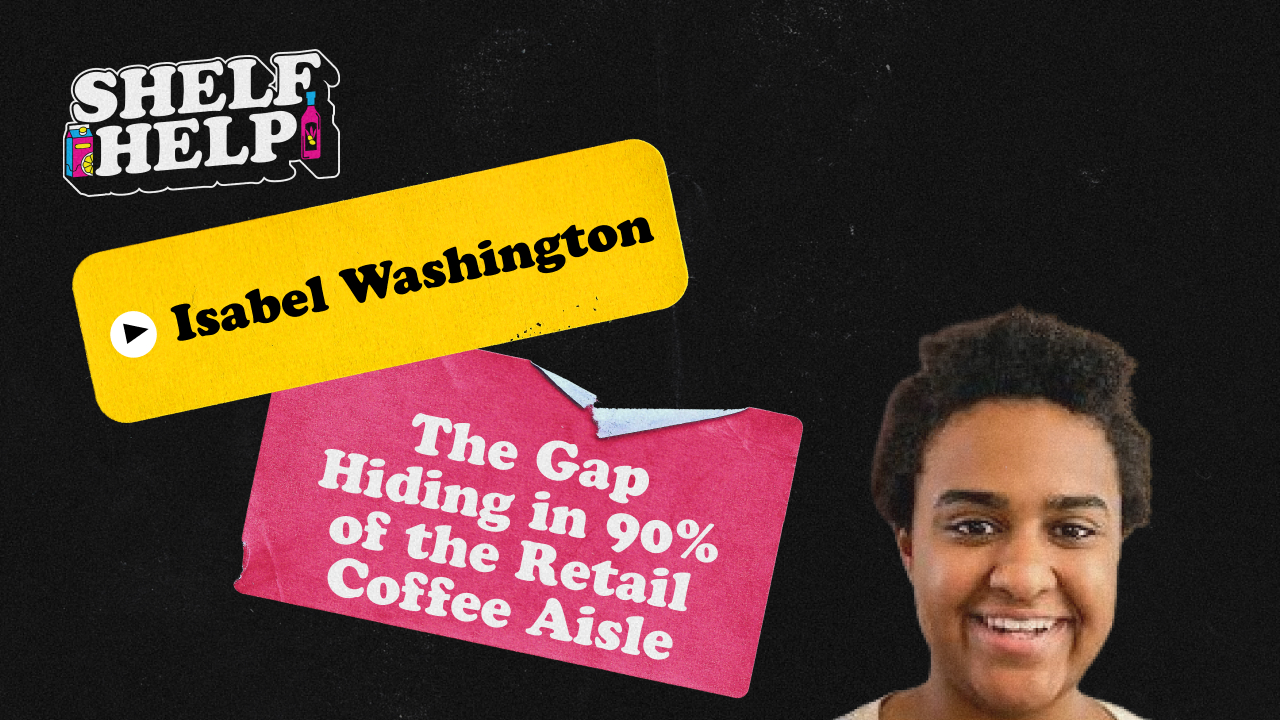



On this episode, we're joined by Isabel Washington, Founder & CEO of Laurel's - the canned latte brand made, built for people who actually look forward to their RTD coffee.
Isabel spotted the gap while working at McKinsey, noticing that roughly 90% of the RTD coffee aisle was non-dairy, ultimately leaving in early 2024 to build the dairy-forward latte she wanted to see on the shelf.
We get into formulation, why decaf was the wrong white space, why every can lands at 80mg of caffeine instead of the category's usual 200, and why she bet that taste, not convenience, was the real gap in RTD coffee.
We also dig into the realities of an A2 dairy supply chain, the white can and cow on the front that made people think it was canned milk, and why the most important job of a label is communicating one attribute clearly, not ten.
Isabel shares how Laurel's got into Erewhon, what buyers really want (incrementality and a real promo plan), how UNFI Up Next and KeHE Elevate help young brands, pricing strategy, and the investor catch-22 that comes with scaling.
---------------
Episode Highlights:
☕ Spotting the gap: 90% of RTD coffee is non-dairy
🥛 Why 100% A2 dairy, and what makes it gut-friendly
⚡ Building for 80mg caffeine, not 200
🏭 From kitchen espresso shots to a real co-packer
🐄 A2 supply chain risk and the Alec's Ice Cream drama
🎨 Why the can is white (people thought it was canned milk)
📦 Packaging advice: nail the one attribute that matters
🚀 Just launch, then iterate (40 demos in her first 40 days at Erewhon)
💰 The category price ceiling and making the unit economics work
🛒 How Laurel's got into Erewhon (they just applied online)
📊 What buyers want: incrementality, not another me-too SKU
🚚 UNFI Up Next and KeHE Elevate for emerging brands
👀 Brands Isabel is watching right now
---------------
Table of Contents:
00:00 – Intro
01:05 – Origin story: from McKinsey to the RTD coffee gap
05:21 – Early R&D and why decaf was the wrong bet
07:36 – Why 80mg caffeine, and taste vs convenience
09:11 – From kitchen espresso shots to a co-packer
10:30 – A2 dairy supply chain and the Alec's drama
14:07 – Why the can is white
17:00 – Packaging advice: the one attribute that matters
18:36 – Just launch, then iterate
22:33 – Pricing and the category price ceiling
25:55 – How Laurel's got into Erewhon
26:48 – What buyers want: incrementality and support
29:25 – Distributors: UNFI Up Next and KeHE Elevate
32:30 – Being a true partner to your distributor
36:52 – Velocity vs expanding distribution
40:53 – National vs regional, and the investor catch-22
42:24 – Brands Isabel is watching
45:42 – Where to find Isabel and Laurel's
---------------
Links:
Laurel's – https://drinklaurels.com/
Follow Isabel on LinkedIn – https://www.linkedin.com/in/isabeldwashington/
Laurel's on LinkedIn – https://www.linkedin.com/company/drinklaurels/
Follow me on LinkedIn – https://www.linkedin.com/in/adam-martin-steinberg/
For help with CPG production design - packaging and label design, product renders, POS assets, retail media assets, quick-turn sales and marketing assets and all the other work that bogs down creative teams - check out https://www.kitprint.co/.
Shout out to my friends over at Glimpse, the go-to partner for automating retail-related back-office operations and unlocking margin trapped in invalid fees and manual processes.
Episode Transcript
Speaker 2: 00:00
Welcome to Shelf Help. Today we're speaking with Isabel Washington, founder, CEO of Laurel's Coffee, RTD A2 Dairy Coffee Latte, brand that launched at Erwan, I think in fall of 2024, has been pretty much blown up ever since. You've probably seen them in headlines here and there. Isabel grew up in Southern California and went to USC, started her career at McKin and McKinsey in the consumer practice before leaving early 2024 to build laurels. Think, you know, she'll obviously dive into it here a bit more, but spotted a gap in the RTD coffee aisle. I think roughly like 90% of the products were non-dairy. Dairy options were full of seed oils and questionable ingredients, let's say. So I think she set out to kind of build the first can latte made with the 100% A2 dairy. So yeah, super excited to dive into it. Isabel, just first off, maybe for the probably some limited listeners in the CPG world that aren't that familiar with laurels, love it to just start by just getting, you know, quick lay of the land, just in terms of kind of the origin story building upon obviously what I kind of touched on briefly, why behind the brand, and then kind of core products in the lineup today, and then uh we'll go from there.
Speaker 3: 01:18
Yeah. So you said all of it beautifully. Grew up in LA, very early adopter of a lot of brands that have since gone on to be billion-dollar brands. I was drinking Olipop in high school. Um, a lot of it being the fact that I was kind of of the generation who was growing up when soda kind of started becoming bad, moved because of the sugar content and the calories, moved to like a LaCroix. I remember drinking a ton of LaCroix and bubbly. And then I remember when Olipop came out. I literally remember the strawberry vanilla in the cooler at Whole Foods, the first time I ever saw it. And being like, oh, interesting. This is soda, but it's, and I mean, nothing is as good as a Coke or a Diet Coke. Um, but it's like 80% of the way there. You can drink it every day, and it's like, you know, 35, 45 calories. Like, this is awesome. So that with many other brands. Um, obviously went to USC, which is very biased, is where a lot of culture starts in a way. I was similarly very early wearing Mad Happy. I remember when those founders came and spoke on the panel. It was my sophomore year, and they had just graduated from UMichigan. And the brand was very, very new. They didn't even have a storefront yet. Golden Goose Deluxe brand started, like started, but like kind of got a lot of emotion very early at USC. So it's it's always funny kind of seeing these people wearing these brands that like I have already kind of cycled through. All of that to say, um, have always kind of loved and had a pulse on what's new and what's next. Went to McKinsey, worked with a lot of really great consumer brands, everything from tech and wearables to fitness studios, and really got an understanding, especially post-pandemic, of how people thought about health and wellness. Everything from where their fitness studio fits into their daily routine, especially now that so many people are going to work every day. It's become more social. We have whoops and auras and even the toilet one that can scan your poop for you and tell you the quality of your poop. So there's just a lot more curiosity and excitement. Of course, there's brand building components, poppy and the brand that they've built. So kind of all of those things culminated into what Laurel's is today and inspired a lot of the why behind the brands because there was a ton of innovation. I mean, obviously, soda, most notably, Goodles is doing a fantastic job in the mac and cheese category, but there's really not one brand that is kind of, for lack of a better term, pioneering brand in coffee. It's historically always been Starbucks has their 20 trillion brick and mortars. So why would they not have an RTD? And why would people not buy it? Because they know Starbucks. Same with Duncan, same with Lockhalom, even to an extent. There hasn't really been anyone whose mission has been to like create a coffee product and to think about the experience of the RTD coffee product. So that's really kind of what brought a lot of inspiration to the brand. It's it's ritualistic, it's habitual. It's only growing in consumption as people work harder, work longer, travel more, and there's just a clear opportunity for me there.
Speaker 2: 04:43
Yeah, totally. That story totally makes sense. Maybe diving into the weeds a bit more, rewinding back to some of those early days when you were working on the product and formulation and going through some of that RD process. You'd mentioned Olipop. It's funny. I think I thought I had seen you read or somewhere you had said that something along the lines of you wanted to be the poppy of RTD coffee, which is funny you mentioned Olipop. Assuming I got that right. Whether or not, I guess in terms of the first version that you made uh all the way to that last version, you said, okay, this is right. I feel like this is ready to go to market. Like, what were some of those kind of key variables you played around with between that first version and that and that and that final version?
Speaker 3: 05:19
Yeah, so when I had kind of very initially started ideity on the brands, it was actually decaf RTD, which continues to be a white space. There's Tranquila, which you might have heard of.
Speaker 1: 05:33
Yeah.
Speaker 3: 05:33
Eric's great.
Speaker 2: 05:34
Yeah, he's awesome.
Speaker 3: 05:36
They did a really good job with the practice the packaging on that. But when I was talking to Alex Michelson from Leisure, who has been and continues to be a very strong mentor, he was like, people are looking for products to do something. Like it's different when you kind of go to an art, like when you go to a coffee shop and you're getting a decaf latte or a half-caf latte for that matter, because the experience is going to the coffee shop. It's being in that space. Maybe you're meeting friends and maybe it's the afternoon, so you don't want a full calf. Like there's some justification, for lack of a better term, behind getting that. But it's hard to kind of go into a grocery store and buy something that is decafed, that does absolutely nothing for you. I'm excited for Eric to change the narrative. I think, again, he's doing a fantastic job, but that was what was shared with me. Um, that, and you know, maybe there's like Landine you can put it into it. Obviously, the next month is mushroom coffee that energizes in its own different types of way. But generally speaking, people are looking like a beverage needs a use case. You drink a leisure any time of the day, but you can drink it at lunch. You can drink it at dinner, you can drink it hungover. Um, you drink coffee to get energy, you drink energy drinks to feel energy. So there always needs to kind of be a use case. Um and especially with how expensive coffee is it and how expensive I mean beverage is, it would be hard to be like put a decaf RTD on the shelf that does nothing for you for $4.99. So that was what kind of moved us away from that. Um and then it became various forms of like caffeinated coffee. I don't drink a ton. I mean, in college, I would go, I'd probably drink a thousand milligrams of coffee a day. Like I had my time, I would go from Celsius to Starbucks to Starbucks again to Celsius again, like all in a day's work. I have significantly decreased my caffeine content. So a lot of it is like building a brand for people who look at the shelf and they're like, why does everything have 200 milligrams of caffeine in it? Um, all of the worlds have 80 grams, 80 milligrams of caffeine in it, which is actually closer to what you would get at a coffee shop latte. But it was really thinking about like, what do I where's the gap? Like, why do I continue to go to coffee shops instead of buying the RTD coffee on the shelf? Despite the like despite the coffee shop costing eight or nine dollars, it's the creaminess, it's the sugar, it's the flavor profiles, it's the seasonal flavors, um, the variety, like it's the taste experience. RTD coffee is largely built around convenience, not taste. So that was kind of the opportunity that I saw in the category was like no one is going to bed dreaming of their canned coffee. I wanted to build so that people would. I mean, again, dreaming about food is like way out there nonetheless when you're going to sleep, but like no one's ever, it's it's always like, oh, I'm in a pinch. Oh, I have to get this, oh, there's nothing else. Like it's never like, oh, I'm actually like adding this to my whole foods market online order because I look forward to having it.
Speaker 2: 08:36
In terms of commercializing the product, tell me a bit about that journey from you know, making lattes in in your kitchen or wherever you're kind of doing in those early days to sourcing and engaging copackers, ultimately finding one you you started working with and felt like it was gonna be right fit to, you know, scaling up production in terms of kind of what that journey and and timeline looked like.
Speaker 3: 08:59
Yeah. So I had started, I mean, again, with they always say that not knowing is a superpower and building a brand because then you don't know how everything can go wrong.
Speaker 1: 09:10
Yep.
Speaker 3: 09:12
So I literally went to William Sonoma and bought like the $1,000, you know, Breville espresso machine and was like pulling shots in my kitchen and like full, like pouring all of these maple syrup, sugar, this, that, the other, like trying to get the taste profile right. Um, and then I quickly learned that's actually not how there's not some like massive espresso machine out at some Copacker, like pulling shots all day and and getting the ratios right. So I think very quickly, like this was probably so I left McKinsey in January of 24.
Speaker 1: 09:46
Okay.
Speaker 3: 09:47
Um and then I started working with the Copacker in March. So pretty quickly, I guess, but also not. It was the only path forward. I mean, at the time it was $3,800 a month.
Speaker 1: 10:00
Yeah.
Speaker 3: 10:01
And I was like, oh my gosh, this is a lot of money. Like, I don't know. But it was kind of a commitment and taking the next step forward towards building the brands.
Speaker 1: 10:10
Yeah.
Speaker 3: 10:11
He used to work at Starbucks and was there through the evolution acquisition, was very familiar with RTDs. So when I essentially was like, make that, but with less sugar and less calories, it was pretty it was pretty easy for him to do.
Speaker 2: 10:27
A2 dairy is is um a more uh narrow, is maybe a good word to use supply chain than conventional milk. It seemed like there's probably less suppliers, that's probably more concentrated market. Like how do you I guess maybe now it's not much of a risk now, maybe it already is, but how are you kind of thinking about I don't know, uh mitigating supply chain risk where there's limited suppliers for a core ingredient in your product as you continue to scale up and you need more and more of it?
Speaker 3: 10:58
Yeah, so this is actually interesting because I was on the fund. Uh I was on the call of the fund earlier who asked me a very similar question. And I think that a lot of it is coming off of the press that Alex ice cream has gotten recently.
Speaker 1: 11:12
Okay. Yeah.
Speaker 3: 11:12
And everyone in the CPG space, well, everyone's relative, but a lot of people kind of seeing that news. It's less, I mean, it's there's a lot of farmers who have been making A2 for 10 years. I just met one like a week and a half ago, and I met another one at Fancy Foods back in January. They, it's important to them as farmers. Like they find the value in their milk. The people that buy milk from men find value in it. It's not like they don't go through the rigorous testing and they're not importing sperm from Europe the same way that Alexander Family Farms is. We talked to a very, very large dairy operation here in California who has like 5,500 cows, all of who are A2 cows. They've been doing the transition for like 20 years to transitioning their entire herd to A2. It's not like certified. So that's, I mean, they know that it's A2 milk, but they haven't like tested all 5,500 cows. But there's a lot of operations like that. Really, I mean, the farm we buy from now, really great family farmers out in Virginia. So I think that there are, I mean, to the Alex drama, not that you asked, but like to that point, um, there's a very, very restricted supply of organic regenerative A2. Like that is stacking. I mean, yeah, like it's it's stacking certification on top of certification. Regenerative inherently means that there can only be like 200 cows. Like, especially with their farm here in California. There's not an abundance of land to go out and build more grass fields for cows to herd on so you can rotationally crop. Um there are, and again, it just depends on what's important to you and your consumer. Like, there are farms who don't have, you know, USDA certified organic operations, but are like they do use and farm organically. They just don't have that seal to to kind of prove that they do everything right. It's really expensive for them to get a certification and maintain it. And they're really small farms, so they don't do it. So that's kind of where the challenge is. Um again, like I don't know to speak about someone else's product. I don't know if ice cream needs to be organic. I think it's a nice to have. I don't know if it's a need to have. Similarly, with like RTD coffee. I mean, we can't actually be organic for other reasons, but it's less, much less. There's a lot of farms selling ATML who don't advertise it. I'll put it that way.
Speaker 2: 13:51
Okay, that's good to know. Totally shifting gears from a visual identity packaging standpoint, thinking back to when you're building on kind of the brand identity, voice, positioning, look and feel. What were the things that were top of mind for you?
Speaker 3: 14:05
Yeah. So I think for me, I wanted it to be white. I wanted our cans and sleeves to be white. Again, very kind of opposite to how you would think about coffee branding. Pretty much, I mean, I guess it's not pop and bottle is pink and green and blue and all the colors. But generally speaking, if you want to associate coffee in someone's mind, it's gonna be brown and maybe blacks and a milky kind of brown color. Uh but I wanted to leave with dairy and milk, and that this was like a milk-containing product. The reason for that being one of two things, one, because literally everything else is not that color. There's not a single, I mean, I guess la cologne kind of is, but nothing is that color really in the category. And then the other piece of it is I want people to look at it. I mean, for a long time when we first launched, and people probably still do, they literally thought it was canned milk. Like they literally were like, oh, this is like a canned milk product. But I wanted people to see that and with the cow on the front and be like, milk, dairy, milk containing product. I mean, it has almost 50% milk literally in the product's makeup, but also creamy, indulgent, sweet, like all of the qualities that you would associate with milk because it's a latte product. For that reason, we can probably never launch like a cold brew. I mean that we could do black sleeves or something, like because it has such that strong milk affinity in the packaging, apparently. But I wanted that to be the association. Because again, like you look at canned coffee, it's thin, watery, it's alternative milks that maybe they're thick because they use a canola oil. Like it's not naturally creamy, despite that being like one of the main affiliations that people have when they think when they go to coffee shops. Like you get your 400-calorie latte, you're thinking about how creamy it is, how sweet it is, how silky it is, like all of that. I wanted to build that visual association into the product with the understanding that it was literally coming from cow's milk and that we're the only ones, one of like three in the category who are actually using milk from the cow.
Speaker 2: 16:17
Thinking back to that process you went through. Obviously, I think you've probably learned so much even since then. You know, I think there's probably a lot of aspiring founders out there that are um, you know, looking to launch an RTD beverage brand. They're about to kick off kind of brand packaging design. What's one thing you you'd tell them to I don't know, keep top of mind or or watch out for that could potentially trip them up along the way?
Speaker 3: 16:42
I also just realized I spelt my name wrong, which is really funny. Did you notice that?
Speaker 2: 16:45
I'll we'll edit in later though. Don't worry.
Speaker 3: 16:48
I was like, wait, why is my name wrong? I would say for those founders that there is a lot of information. And when consumers are standing in a store, you need to figure out what is the most important attribute that needs to be communicated. So for us, white sleeves, cow on the front, okay, it's it contains milk. You have some help from the category around you, like being between pop and bottle, the consumer can be like, okay, this is coffee. There is visual cues and category cues that people can use, but I'll see products that will have call-outs on the front, you know, GLP enhancer, 10 grams of protein, six grams of fiber, 130 calories, you know, this, that, and the other, all on the front of the packaging. And it just like overwhelms the consumer. And that's the most important piece of it is like why, and a lot of this will come from launching a product and actually spending time with your consumers and getting feedback, which is how I know that people used to think that we were canned coffee or canned milk anyway, is understanding why people are actually buying your product. 10 grams of protein, generally speaking, isn't enough to move the meat the needle. But zero added sugar could be like that, could be the call out that makes the most sense.
Speaker: 18:10
Right.
Speaker 3: 18:11
Fiber could be, like, but it what the combination of all of those attributes generally are not gonna get people to buy the product. It's probably gonna confuse them and they don't have time to spend, you know, five minutes in store trying to figure out what all of the macronutrients in your product are.
Speaker 1: 18:26
Yep.
Speaker 3: 18:28
So I think that was first and foremost for us, kind of along similar lines, which would more just be advice for founders, but is to launch, just launch the product, which kind of sounds counterintuitive to a lot of what you would read on LinkedIn, but we've changed our packaging a thousand times. I mean, not rebrands by any means. Like we've made things bigger, made things smaller, changed colors a thousand times. We've changed the product a thousand times. We used to have 15 grams of sugar, now we have 10. We've changed food scientists, we've changed co-packers. We were just did a Costco Road show and spent probably talked to 400 people a day about the product and got to kind of learn what their feedback was. Everything from, I mean, none of it's conclusive. It's too much calories, too little, too much sugar, not enough. Um, so nothing hard to draw in the kind of one trend there. Um, but like get I I was actually talking to a foundry about this probably like a month ago. He was going to do a production run of like a hundred thousand cans for his first production run. And I said, wait a minute, don't do that. Like, go find some co-packers somewhere else, because that was like this copacker's MOQ. Go find a copacker. Maybe it'll cost, maybe it'll be so upside down on the unit economics. Like maybe you'll have $5 cogs or something.
Speaker: 19:48
Right.
Speaker 3: 19:49
But you'll be able to actually take it to Expo, take it to BevNet, get feedback, launch in three grocery stores, launch in Erwan, even if you're in LA, and spend time in retail understanding what's important to people, and then you can iterate off of that. Um that's what we did. I mean, we launched there's a folk tale that I spent like 40 days in Erwan the first for 40 demos the first 30 days that we launched, um, which is honestly like directionally true in a lot of ways, but there's so much learning that you can have. And I think at this point we made like 8,000 cans. So we really weren't on the hook for much. It was very easy for us to go back to our designer and change a few things based on what we heard. So I think that's the most valuable thing that people can do, especially. I mean, in this industry, there's so much like Expo S and BevNet and fancy foods and all of that. Getting feedback from the people in the industry is very important, but there is genuinely no feedback greater than your products being on shelf and someone buys it or not.
Speaker 1: 20:52
Yep. Totally.
Speaker 3: 20:54
There's nothing more valuable. Like we were 1999 at Costco. We were right next to a Lawney New, which was like $16.49. $4 is like a lot of money, especially at Costco, where it adds up.
Speaker 1: 21:06
Yeah. Yeah.
Speaker 3: 21:07
And people are like, you know what, this is great. I'm gonna go buy my Alani New. This is great. I'm gonna go buy like sometimes it just comes down to price, sometimes it comes down to brand, familiarity, whatever it is. But there's no greater feedback than that. So that would be my biggest learning, which I still do. I mean, we're still learning. And as you enter different retail channels, again, Whole Foods, packaging works, price works, we're seeing week over week growth there. Costco, not so much. Different consumer, cares about different things, cares about price more than the people at Whole Foods will.
Speaker: 21:38
Sure.
Speaker 3: 21:39
And the price has to be better than you know, the Kirkland coffee that they would, or you know, their product has to be better for them to spend more money than the Kirkland Cold Brew is. So there'll always be learnings, it'll always be an iterative process. But that's probably just launch, is always what it's at.
Speaker 2: 21:55
Yeah, most finders I talk to, they say, you know, the product is never done, all components of whether it's Formulation packaging price. It's an ongoing product that's always evolving.
Speaker 3: 22:04
There's some um there's some interview that Ellsworth did where they said that every single production when they did, it got sweeter.
Speaker 2: 22:11
Wow. Interesting.
Speaker 3: 22:13
Every single one. Because that was always the feedback. People want it to be closer and closer and closer to soda.
Speaker 2: 22:19
Interesting.
Speaker 3: 22:20
Which I believe I tried. Popping was actually sampling at Costco. It was like sickeningly sweet. So I much sweeter than I remember it. So I believe them. But it's it's never ever done.
Speaker 2: 22:31
Yeah. Yeah, that's interesting. You touched on pricing a few times. What, especially with your McKinsey background, I imagine you had a fairly good process strategy mind how you're gonna push pricing. Like what did your strategy and process look like for nailing down your go-to-market price initially?
Speaker 3: 22:47
So there's a price ceiling generally for what people will pay for your product. And as much as people, I think now especially founders love to be like, oh, but mine is premium. Oh, but mine is organic. Like they're trying to like the premiumization of like commodities is becoming an issue. There's a price ceiling. Um, and maybe there's like again, like for pasta sauce, for example, like there's many players in that kind of premium space. There's Saws, there's Carbone, there's Rayos, there's there's a premium category within the category. But like, I don't know, 12 years ago, if you told like my dad, like, hey, pasta sauce is $12 now, pasta sauce is $10, he'd be like, what do you mean? Like Prego's literally right there. So I think that there is like some piece to it. Like, some there's actually a lot of a lot of investors, a lot of buyers who I'll talk to can be like Laurel, like Laurel's could be a dollar more. Like it could be we're $3.99 at Whole Foods. Like, it could be $4.99 or like $549. But I'm like, there's we're gonna like your velocity's gonna go down. I mean, you're a new brand, a new entrant.
Speaker 1: 24:04
Yeah.
Speaker 3: 24:05
La Columb's right there. La Columb's like three, three dollars.
Speaker 1: 24:08
Right.
Speaker 3: 24:09
Um pop in bottles, $3.50. I just think it's an uphill battle. The other side of it though is that the economics of the business have to make sense. So, like if your if your cogs are four dollars, then by no means, please do not sell your products for $3.99. But I think I always think that my job, like the price is the price. The price is where it needs to be. My job is to make the unit economics work so the price can be the price. And again, we're at the point where we're in like over a thousand doors. We're launching 2,500 more this year. Like we have very small economies of scale, much more than when we first started. So our cogs have gone down, I mean, oh, well over a dollar. Our cogs were like almost $3 when we first launched. So, like, this is not necessarily day one advice, but you're gonna get priced out of the market if if you can't be price competitive and no no brand attribute is gonna save you. But that's that's my that's my I mean, especially when there's products like again with the protein thing, like especially when there's products like David Barr, which are like $2. Like you can't beat the macros on that, and it's $2. So there's no bar that you can launch that that, oh, we have 30 grams of protein or $4, not gonna save you.
Speaker 2: 25:32
Yeah, totally. You touched on Erwan too, but a minute or two ago as well. Obviously, the aspir aspirational retailer for a lot of brands. How did you actually kind of go about, I guess, getting that first meeting with the buyer and getting that commitment? What did that pitch look like? What did it take to actually secure shelf space?
Speaker 3: 25:51
Yeah, so Airwan's always an interesting one for us because everyone always says that, but we literally just applied on the website and got in. I think, I mean, I'm sure it's become, I mean, it's always been competitive, obviously. I'm sure it only gets more competitive by the day. Um, especially as they kind of tighten their ingredient standards even more. I know that they've kind of like brought the hammer down on like yogurt needs to be organic certified, and like pickles need to be organic certified. Like they are kind of tightening up the requirements. I think honestly, to kind of weed out a lot of people and a lot of brands that are kind of popping up. But I think that generally, probably, and actually, Michael from Keto and IQ was just on a podcast that I listened to and he talked about this. But all retailers care about at the end of the day, like, yes, your product's great, it needs to be different than anything else. It can't just be like another Me Too brand or product. They need to tell the buyer two things. One, it's gonna bring incremental customers to this category.
Speaker 1: 26:51
Yeah, totally.
Speaker 3: 26:52
So for us, our dirty chai latte, which is my least favorite skew, um, is actually our best seller at Whole Foods of our product offerings, and is number two in incrementality in the category. Meaning that it's not people who are choosing between la colombe and ban, like la colombe and laurels or pop bottle and laurels, it's people who historically have not purchased anything from the category before and they're buying laurels. Very kind of easy to back into. I mean more dollars through the registers in the category, like it's a pretty easy calculation. So I mean the same SKU count, which generally, like anytime a new brand comes in, one goes out. So pretty easy math on the back end to calculate that.
Speaker 1: 27:38
Yeah.
Speaker 3: 27:38
But the other piece of it is how you're gonna support your retailers and how you're going to what promo plans you're gonna put together now in the day of like virality. Like, are you gonna create content around their brands? We just posted, I think, our seventh Costco video. We recently hired the creative director from Jacob Bar to do content for us. Nice. So he came with us to Texas, he filmed the roadshow. We're filming kind of a bit on tomorrow, actually, about laurel supply, about how they opened up an entire store to carry laurels. So just creating content around that are really like the two main pillars. Because they make money. I mean, obviously there's money off your brand, but they make money off promos. They make money every time you buy a display, they make money every time you run ads. Like they, at the end of the day, they just need to make money for their store and their category to do good at their job.
Speaker: 28:29
Right.
Speaker 3: 28:30
So how you can communicate and articulate that you're going to help them do that is paramount to anything else. And sometimes it is being like, hey, lock alone goes on on promo 16 weeks, we'll give you 20. Like sometimes it really is as simple as that.
Speaker 2: 28:47
You mentioned thousand doors, getting a 2500 more this year. I imagine distributors are becoming more and more and more and more an important piece of the puzzle. And I think uh from what I read, you're gotten um UNFI's like up next broad market access programs that kind of help expand beyond Whole Foods into Bristol Farms and some of the other natural channel. Um I don't know much about that program, but for listeners who haven't heard of that Up Next BMA program, give me kind of the quick lowdown. Like, what is it? Who's it for? How did you actually get in?
Speaker 3: 29:25
Yeah, so Up Next is the UNFI kind of program. KHE has an equivalent one called Elevate. Essentially, those programs are for younger brands. There's very specific requirements that are on the website, but I think generally it's like brands who are new to UNFI or KHE. Um, they don't um I think it's probably like a $1 million threshold, is kind of when you graduate from the program. So you're kind of in that program until you do a million dollars in revenue and through UNFI specifically. And there's a variety of benefits. One, we have like monthly meetings with our account rep at UNFI, who's fantastic. Her name's Anna. Um, we'll go through everything as small as like what programs and shows they have coming up, to like what makes sense for our retailer roadmap, what are category reviews, like who are the account managers for these stores, what DC should we open up next? What DC does Hagen's pull from? All of these kinds of questions you can route through her. She's incredibly responsive, genuinely responds within like an hour to most inquiries.
Speaker 1: 30:31
Yeah.
Speaker 3: 30:31
So it's really great to kind of like have a person in the big conglomerate that is UNFI, and to if it makes it feel a lot smaller than it really is. The other kind of benefit, they're very lenient on deductions. So I think we have like a 98% compliance rate. Like 90% of our invoices are paid in full, which is pretty crazy.
Speaker: 30:54
Yeah, that's great.
Speaker 3: 30:55
But you pay quarterly into one of their programs. I think it's like 0.03% a quarter or something, so very small amount. That kind of helps fund the program so that things like this can exist. But it's been really great, especially for a really long time. I was like, I'm gonna build through DSDs. I'm terrified of UNFI. All I hear is billbacks and deductions, and like I don't want to deal with that. So it's been great to kind of have to be in this program. Definitely gonna miss it when when we're when we graduate from it. But it's great. And then broad market access on the other side is kind of highlighting diverse suppliers within their network. Yeah. So there's some similarly like fees that you don't have to pay.
Speaker 1: 31:44
Yeah.
Speaker 3: 31:45
When a contact, special kind of brunches and events, special ad space that they send to their vendors. Both really great programs. I always tell people anytime they're like, hey, is well launching Whole Foods or I'm launching, you know, I guess yeah, H E B or Central Marketer, any of these like larger retailers that pull up from Unify or Kahi, I'm always like, please go right now apply to the Up Next program or the Elevate program. They're a really great team. Honestly, it's passionate. Not even not even sponsored, obviously, or plug, but just like really great people over there.
Speaker 2: 32:20
That's awesome. Just stepping back, excuse me, stepping back in terms of distributors in general, people are pretty polarizing views, a lot of frustrations about them, but you know, on the other side, I think brands probably have to act like a true partner to be true partner to their distributor to get the attention they want and and actually have a productive relationship. How would you say what have you found so far in terms of how you can kind of best efforts of holding distributors accountable as a smaller-ish brand? And then on the other side, how do you how do you act as a true partner to your distributor and make their lives easier and make them want to give you the attention that you want?
Speaker 3: 32:57
Yeah, so I always think of well, first and foremost, from the people business, which I feel like people, brand owners especially, tend to forget because all we see is deductions and denials, and like there's so much, like we're always at we always get the short stick, like literally 100% of the time. So I'll give an example. Our distributor in LA is high touch, and they brought us on August 24. They were delivering, I mean, our POs at that time were probably, you know, 1200 bucks. Like we were only selling to Erwan. Um, and really sold the story. They liked the products, always tried to be to keep them updated, probably text them a few too many times, asking them questions. And I kind of think like when we're launching Whole Foods and talking about our route to market, I was like, I want to, for like a better term, reward high touch and give them the Whole Foods to their California business because they've done such a great job with our account. I mean, now they do Bristol Farms and Gelson's and Lazy Acres and Mother's Market. And we send them like Laurel's t-shirts. And we always like they've always been great partners to us. I can pick up the phone and call any of them right now and they'd answer.
Speaker 1: 34:21
That's right.
Speaker 3: 34:22
Um, despite having like hundreds, if not thousands, of brands of much bigger size under them. So I think that it has to be like when people are doing good jobs, you continue to give them more business, meaning more money. Same thing with our NorCal distributors. Like they do Whole Foods for us because they did such a great job.
Speaker: 34:42
Right.
Speaker 3: 34:43
We didn't open the UNFI NORCAL DC for the longest. We held off for as long as we could. We got into Rayleigh's, so we had to open it, but I didn't want to open that despite the growth it might have had for our business, because people would probably start ordering from UNFI instead of from them. So I think that, and you know, I gave them a heads up when we were opening the district, like the NorthCal DC. I told them why. I said, I wish you guys went to Rayleigh's, all the things. But it has to be like at the end of the day, I wish customers would remember this when they email me angry things, but it's a person on the other side of the email. It's someone who also needs their back scratched, is trying to make their ends meet. So you have to think about like how can I make it worthwhile for them.
Speaker: 35:30
Totally.
Speaker 3: 35:31
And they're also jaded. Like at the end of the day, they've seen 25 trillion coffee brands come through and sell them the story. So they're also like, you know, like sometimes you're just you just have to find your believers within organizations, though. Um, it does suck. Like our distributor on the East Coast for Whole Foods is being a pain in my ass, for lack of a better term. And we're trying to open up more distribution with them, and they're just like not responding. So I think we're just gonna go switch it to UNFI. So I think that also kind of has to be the other side of it. Like, yeah, not everyone's going to believe in you. Not everyone's gonna want to have like you can put in as much effort as you want into it's like a relationship, you know? You can put as much effort as you want, but if it's not gonna work, it's not gonna work. And there are plenty of partners you can find who will want to be true partners to your brand, your business.
Speaker 1: 36:25
Yeah.
Speaker 3: 36:26
But you also just have to be honest, there's something sure you're putting in the effort to.
Speaker 2: 36:30
A lot of the seasoned CBG operators I speak with investors as well, just focus on this talk track, focus on velocity versus expanding distribution points. How do you think about that balance between yeah, really driving and continue to driving consistent high velocity versus expanding from thousand to 50,000 doors over the next few years?
Speaker 3: 36:51
Yeah, it's it's always a tough balance, right? Because with one point or with one side of the coin, it's like, well, we're in a volume business. And as much as Erwan is great, as much as Bristol Farms is great, like you're not gonna sell a million dollars of coffee through those two doors. And you're never gonna have cogs that make the business work in those two doors. Uh and our previous broker, we've since changed brokers, but our previous broker was like, you should put, and honestly, our our current broker probably has the same mentality in a lot of ways, but like you need to fish where the fish are. And sometimes the fish aren't at your local retailer. Like, I mean, I'm in LA, so they are. But like sometimes, you know, they're the product that you're making isn't resonating with as many people as it could. I I think it's largely true. Like, you can't be getting discontinued from stores while launching new ones that'll catch up to you.
Speaker: 37:47
Yeah.
Speaker 3: 37:47
You need to make sure, I mean, even us, like there's for a long time it was just me. We've since grown the team, which makes the growth that we're having more sustainable. We just actually brought on our fractional VP of sales, who's previously at Jesse and Ben's, okay, who grew that business. I mean, that business had crazy growth over the last 20, 20 years, over the last two years to more closely meet with every single retailer, make sure you have every single promo plan. But something that we admittedly did over the last eight months was we focused on Whole Foods because that's our biggest fish. And then our smallest fish kind of started starving. We put a lot of our resources into Whole Foods and stopped doing demos at Bristol Farms, stopped doing demos at Nugget because demos are $200 and I need to make Whole Foods happy. So, and money is not infinite. That's kind of the trade-off, I think. Definitely has been, I mean, not disco anywhere. The velocity is still growing, but like honestly, with Nate joining has really put into a lot of perspective. He's like, Oh, do you have a promo plan for Mother's Market? I'm like, why would I have a promo plan for another mother's market? But I can tell you the whole food's one. I can tell you our our target, we're launching Target in August. Like, I can tell you our target one. So that's probably like the biggest thing. Now we're thinking about alternative channels.
Speaker 1: 39:18
Yeah.
Speaker 3: 39:18
Uh like like hotels and food service. That hopefully kind of have a halo effect with everything else going on. But it can really genuinely be a lot to to kind of bite off into. But I also think with our products, like to kind of bring it back to leisure, they built in LA for two years, but they could also, like, a lot of that was sandwich shops. And, you know, like a lot of those places don't work for our products. Like, Giada is not gonna sell laurels.
Speaker: 39:48
Right.
Speaker 3: 39:50
A lot of these places are you know, all of these fun coffee shops and trendy places, like they they're not gonna sell another coffee. So that was the other piece of it as well. Like, we kind of maxed out on the LA retail that makes sense that we could have and do outside of like gas stations and and sea store formats. The other side of that though, which was our thinking, like when we were talking to the Whole Foods buyer 18 months ago now, we'll call it. He was like, Well, do you want to want to launch nationally or regionally? And I was like, Well, nationally sounds really scary. At that point, we were four months old as a brand.
Speaker: 40:25
Right, totally.
Speaker 3: 40:28
But our products, like, this might not be innovative next time the review comes around. They don't even have an RTD coffee review this year. So we couldn't have even expanded our distribution this year. So that was kind of the other piece of it. Like he was really excited about A2, it was fun, the flavors, like all of those things. But fortunately there's not. But there could have been another A2 Dairy RTD doing the exact same thing.
Speaker 1: 40:52
Yeah. True.
Speaker 3: 40:53
Chamberlain Coffee was supposed to launch in Target, but they with actually matcha and dirty chai, funny enough, but they killed their RTD set or their RTD line anyway. So Target called us and was like, hey, do you want to launch it instead? Wasn't gonna say no. So it's it's a lot of a lot of times there's decisions like that that have to be made. Of course, it depends on your economic situation. Like there's a variety of things that are much more nuanced than just saying do or don't, which LinkedIn never likes to get into, but there's not one right way. In fact, there's seemingly like every day there's a different way to launch a brand. So totally.
Speaker 2: 41:34
Yeah. Talking points are easy, but you know, actually being in the business on the ground, everything is kind of a case-by-case thing. Everything is different. So I I totally hear what you're saying.
Speaker 3: 41:43
Well, and the other side of it is that, like, especially when investors say that, the same investors will then go and say they don't invest sub one, two, three, four million dollars in revenue. So it's like, well, how am I supposed to get to one million dollars in revenue by selling airwatch in my backyard?
Speaker 2: 41:57
Right. Yeah, totally, totally. Well, yeah, last question for you, Isabel. You've been definitely been in this CPG world for a long time. Not just say outside of RTD coffee, any just brands specifically, or just kind of trends in general in the CPG space right now that are intriguing you, things you're starting to follow just for the for the sake of it because they're interesting and fun. Anything kind of jumps out at all?
Speaker 3: 42:21
There's a brand called I think it's called Bad Cow.
Speaker: 42:27
Okay.
Speaker 3: 42:29
And it's actually a really good idea, and something that we've talked about launching as like our own product line at Laurel's. Not to say me so won't, actually, because if if someone else is thinking of it, that must mean it's a good idea. But essentially it's like flavored milk. So, like literally like strawberry. Oh, I guess strawberry milk exists, but more, and I don't have it in front of me, but like more the packaging is like all fun and cute, like really just kind of trying to bring a new life into the milk category, which I think is super interesting. Um, so that brand is super top of mind.
Speaker: 43:08
Yeah, that sounds interesting.
Speaker 3: 43:11
I'm trying to think. I have so many brands in my house and in my fridge. Oh, Honeymoon. Have you seen Honeymoon?
Speaker 2: 43:18
I don't think so.
Speaker 3: 43:20
Okay, so Honeymoon. Honeymoo, the packaging's incredible. It's actually started by like, I I know who started it, but it's a secret because they have a full-time job actually right now. But they it's a like an ice cream, like a popsicle company. Is that what they is that what you call them? Like chocolate covered popsicles. Yeah, like it's popsicle.
Speaker 2: 43:41
Frozen dessert company. I have frozen dessert on a stick. I don't know.
Speaker 3: 43:44
Yeah, like it's popsicle, but popsicle sounds fruity to me, but it's like it's like vanilla ice cream. Really, you have to go to Whole Foods and try it.
Speaker 1: 43:51
Okay.
Speaker 3: 43:52
It's an insane product. They it's chocolate covered. I think they have vanilla, pistachio, and coffee flavored. It's sweetened only with honey and a lot of honey. Like it literally tastes like you're eating frozen honey ice cream. It's incredible. Cogs must be insane, but really, really good. That's one that's been super top of mind.
Speaker 2: 44:14
Definitely have to check that one out for sure.
Speaker 3: 44:16
Yeah, really, really good. And then probably a third to round it out. Let's actually leave it at two. Proda, proda actually is really good. Proda. Have you seen Proda?
Speaker 2: 44:27
Uh, is that the protein soda one?
Speaker 3: 44:30
Yes, the one that Jeff Church started.
Speaker 2: 44:32
Yeah, yeah, yeah, yeah.
Speaker 3: 44:34
Really, really good. We drink a lot of protein soda as much as I hate the protein trend. We drink a lot of protein soda in our house. Like protein pop, and like they they do taste kind of like milky in a way. They and really, really frothy. Like, I mean, they have whey in them. So, like, you know, it just kind of gives it that like milky flavor.
Speaker 1: 44:56
Yeah.
Speaker 3: 44:57
Yeah. Insane flavor profile. None of the milkiness, none of the, it's at Sprouts on the animation set. None of the milkiness, the flavor profile, like the flavors are great. I think they have like five SKUs. Really, like, honestly, better than some like prebiotic sodas. Like, just a really, really good product. It was formulated beautiful.
Speaker 2: 45:16
Yeah, I haven't tried it yet. I've seen it around, but you're you're uh convincing me to try it.
Speaker 3: 45:19
It's really good. So, first get in your car, go to Sprouts, get Proda, and then go to uh Whole Foods and get Honeymoon, and you'll just get high now.
Speaker 2: 45:29
Yeah, for sure.
Speaker 3: 45:29
I mean, it's so good. It's unbelievable. It's nationwide at Whole Foods.
Speaker 2: 45:33
Okay, perfect. I'm gonna go try that in the next few days. Well, cool, Isabel. This has been awesome. I appreciate the time. I think this is super helpful for a lot of people that are uh listening. What's the best place to follow along with you and all your expertise? And then where's the best place for people to follow along with laurels these days as well?
Speaker 3: 45:52
I am always on LinkedIn.
unknown: 45:55
Perfect.
Speaker 3: 45:55
So Isel Washington, so where you can find me. Um Drink Laurels on Instagram. We're starting to post a lot more content there. We have a really fun summer ahead with some really fun stuff planned all over the country. So definitely keep an eye out for that. Um and then always Isabel at drinklaurels.com. I try to be responsive, um, but sometimes I just have a lot going on. But I always do try to help people because I would be nothing without the people who helped me. So I always try to pay for that.
Speaker 2: 46:30
That's pretty much everyone. Well, awesome, Isabel. Appreciate the time. I think that's uh I think that's the pod.
.svg)