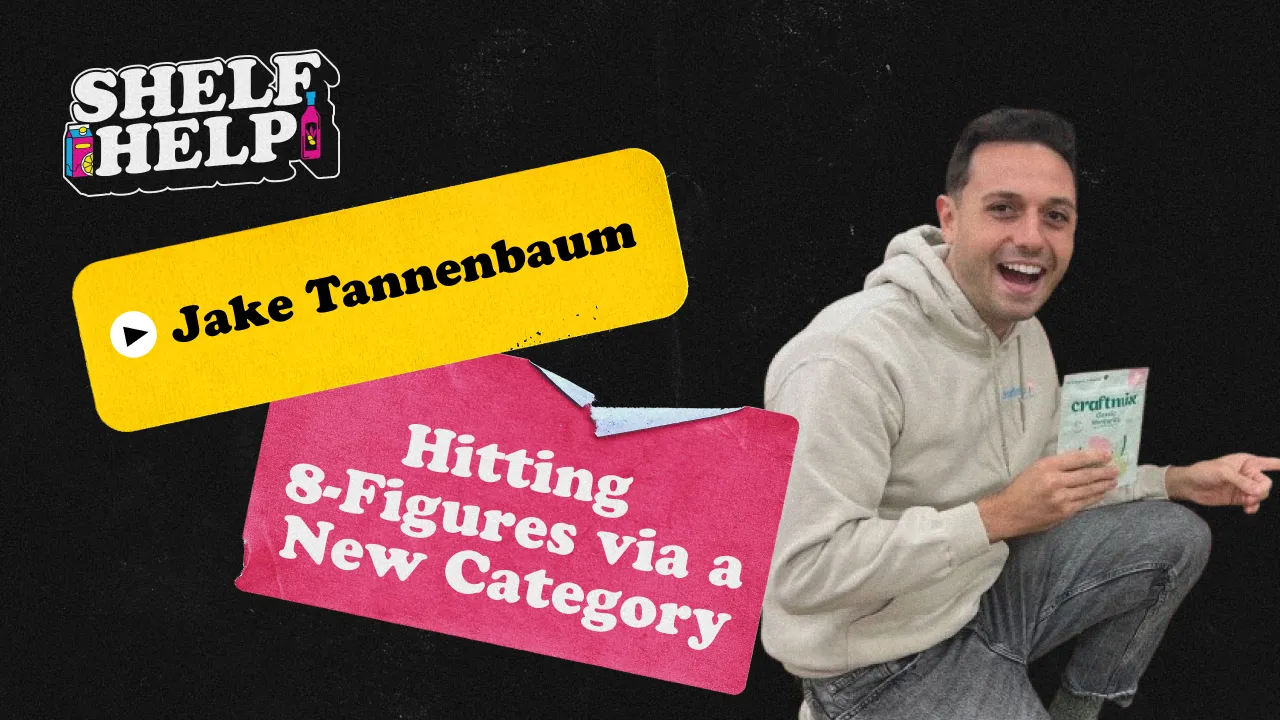



On this episode, we’re joined by Jake Tannenbaum, Founder & CEO of Craftmix - the instant cocktail (and other things) mixer brand built for people who want better drinks without the mess, prep, or sugar bombs.
Jake started Craftmix after years of bartending and realizing that even he couldn’t make a decent cocktail at friends’ houses with what they actually had on hand. That insight turned into a new product format - single-serve powdered mixers - and eventually an entirely new product category.
We get into the early days of Craftmix, from six months of kitchen R&D and roommates spitting out bad iterations, to the “brownie mix” insight that explains why a little bit of participation makes products more fun.
Jake breaks down the decision to move from DIY production to co-packers, what founders consistently underestimate about formulation and scale, and how building a brand is very different from building a product category.
We also dig into demand planning lessons from selling out multiple times, how brand identity and packaging design impact shelf clarity and velocity, why the target demographic ended up being different than expected, and what it really took to win on Amazon before expanding into retail.
We cover Kroger learnings, corporate gifting as a legitimate channel, how QVC works behind the scenes, and what’s next on Craftmix’s product roadmap.
---------------
Episode Highlights:
🍸 Bartender-to-founder origin story and the real problem Craftmix solves
🧪 Formulation and R&D lessons from early kitchen experiments
🧁 The “brownie mix” variable and why interaction matters
🏭 When and how to transition to a co-packer
📦 Building a brand while educating consumers on a new category
📊 Demand planning, inventory risk, and avoiding stockouts
🎨 Brand identity and packaging design in a cluttered aisle
🎯 How and why the target demo shifted
🏆 Winning on Amazon before expanding into retail
🏪 Retail velocity, Kroger learnings, and category education
🎁 Corporate gifting as a real, scalable channel
📺 QVC: live selling, pressure, and unexpected upside
🧭 Product roadmap and trends JT is watching
---------------
Table of Contents:
00:00 - Intro
00:00 - Origin story
02:37 - Formulation and R&D
03:43 - The “brownie mix” variable
05:13 - Transitioning to a copacker
10:34 - Building a brand AND a product category
12:10 - Demand planning
14:43 - Brand identity and packaging design
16:43 - Target demo
17:51 - Winning on Amazon
21:11 - Breaking into retail
26:23 - Brand awareness and product category drive velocity
27:19 - Winning in Kroger
28:16 - Corporate gifting is a real channel
29:26 - QVC
31:41 - Product roadmap
32:21 - Trends JT is watching
---------------
Links:
Craftmix – https://www.craftmix.com/
Follow Jake on LinkedIn – https://www.linkedin.com/in/jake-tannenbaum-a21876128/
Follow me on LinkedIn – https://www.linkedin.com/in/adam-martin-steinberg/
For help with CPG production design - packaging and label design, product renders, POS assets, retail media assets, quick-turn sales and marketing assets and all the other work that bogs down creative teams - check out KitPrint.
Episode Transcript
Speaker: 00:00
Um, all right. Welcome to Shelf Help. Today we're speaking with the Jake Tannenbaum, founder and CEO of Craft Mix Better For You, Instant Cocktail and Mocktail Mixers. That's I think on track to hit eight figures this year. Jake launched the I think Jake launched his first business in eighth grade, is what I read. I think it was like a platform that enabled buying, selling, trading a street wear, and has kind of had the real bug ever since. Um so yeah, excited to get into it. I guess first off, uh Jake, versus the listeners that aren't that familiar with Craft Mix, just give us a quick lay of the land in terms of kind of origin story, why behind the brand, core products in the lineup, and then maybe just throw out a few places that people can get their hands in them and then uh we'll go from there.
Speaker 1: 00:43
Sure. Hi everyone. My name is JT. I'm the founder of Craft Mix origin story. I've been an entrepreneur my entire life. Started buying and selling streetwear when I was a kid, created a platform, and was lucky enough to get a scholarship to study entrepreneurship here in Los Angeles. I graduated top of my class, valedictorian of the program, all the accolades, but I didn't want to give up on my dream of being an entrepreneur. So I did what everyone does in LA when they've got a dream, and I went and I became a bartender. And that's why I fell in love with making drinks. My friends, they'd always asked me to make drinks, but they never had any of the ingredients, and all the mixers on the market were just absolute garbage. So I figured there had to be a better way. I was tired of drinking warm vodka with coke. It's disgusting. And that's when I came and figured, wait, why don't we just take all the ingredients you need and put it into one small packet? And that's when Craft Mix was born. I spent about six months getting drunk, testing every single flavor combination you could imagine. And then finally in 2020 is when we launched for the products that you see today. So this is a cocktail or a mocktail for mocktail. You just pour it into water, sparkling water for a cocktail. You then add a little bit of liquor. You stir it up, takes about 30 seconds, add some ice, and just like that, in 30 seconds, you have a bar fresh tasting cocktail. All of our products are low sugar, low calorie, gluten-free, soy free, dairy-free, keto, paleo, vegetarian, vegan. We really tried to hit the mark when it came to every single diet and being very diet-inclusive. And our products are more sustainable than traditional mixers. They taste like really freaking good bar fresh cocktails for about a dollar. Someone tell me where you can get a cocktail for a dollar. Launched in 2020. Now it's uh December 2025. It's been five years exactly. And we've worked with some partners like Walmart, Target, JetBlue, Amtrak, QVC. The list goes on.
Speaker: 02:33
The list goes on. I'll give you, I'll stop right there because that sounds like spent a fair amount of time experimenting, getting drunk night after night, without giving it away too many trade secrets or anything. What were like some of the key variables that you guys played around with or kind of key tweaks you made along the way between that first version or two to that last version where you guys said, okay, this is right, I'm ready to bring this to market. I feel great about this.
Speaker 1: 02:56
Yeah, great question. Since we didn't want any artificial ingredients in the products, that made it a whole lot more difficult because you're working with powders that are concentrated. So if I were to make this with just straight sugar, the pouch would be this big and no one wants to carry around a pouch that's this big that defeats the purpose of it being small and convenient. So this most difficult part was creating the sweetener system to make it sweet, but not too much sugar. And that took a long time to get right. And one thing I forgot to mention is now we don't only do cocktails and mocktails, we're also branching out. We came out with a line of lemonades this year and a hot chocolate that's sold out almost everywhere except for our own website. We've got a little bit of stock left. But man, that hot chocolate is damn good.
Speaker: 03:39
That's awesome. I think I've heard you reference in some other podcasts or interview or something. You referenced the like the brownie mix story from I think way back in the day when I can't remember what brand it was, where I think it's initially they made it so easy to make the brownies with just mix and water that you know, people at home didn't feel like they were doing enough. And then they added another step, which was basically egg and sales jumped because Kumansumers felt like they were actually baking and weren't just being lazy or whatnot. So it sounds like you guys apply the similar philosophy at craft mix. Can you like speak a bit about how you're about your kind of approach here and how it, I don't know, might apply to some other similar CPT categories, maybe?
Speaker 1: 04:14
Yeah, absolutely. I think the perceived value of like a can of seltzer is similar to a can of beer versus when you're making a drink with one of our drinks, you're actually making it, you're crafting it, and that's where it becomes like an actual cocktail, especially if you dress it up with a nice glass. Sorry if there's some sirens in the background, live next to the hospital. But yeah, I think because you have to add your own alcohol and you get to choose. That's the magic of our product is you know, this is a blood orange my type, but if you don't drink rum, it tastes just as great with vodka. You get to choose your spirit, you get to choose how strong or how not strong it is. You get to choose how sweet or not sweet it is based on how much water you put in. So you have a little more autonomy with one of these compared to a seltzer, and I think that's another reason why we sell really well.
Speaker: 05:00
Pretty sure you guys, you made an order of, I think it was like, I think I read it was 3,000 units or so in your kitchen, and that was kind of the final straw that broke the camel's back. And you were like, all right, this is this is not gonna work anymore. And you started searching for a copacker. How did you go about finding a copacker and how did you know who was the right one after that search?
Speaker 1: 05:19
Yeah, great question. We did make thousands, it was somewhere in the range of three to five thousand drinks in our kitchen. Watched every movie in the history of movies while doing that. We still to this day remember the exact net weight in the we had the seal and cut. I was on seal and cut. My friend was on weigh and fill, weigh and fill. Oh my god, we'd make them in these big tubs. I don't know if you've ever seen like a recycling container. We'd make it in a big tub, shake it around, shake it around, shake it around because we had so much powder and then just weigh them out, fill, oh my God, it was a disaster. So after spending like, I think our output was a hundred packets an hour, we started looking for manufacturers to mass produce this. And we have gone through quite a few manufacturers. First, we did our own research, but I think for any founder out there that's gonna be talking or working with or starting a consumer package goods company, the best advice you can get or the best way that you might be able to establish your supply chain is asking people with similar products for their recommendation. You know, if someone came up to me and said, Hey, I'm I'm very interested in creating a packaged, I don't know, coffee bottle or nah, that's still beverage. Someone that said, Hey, I'm interested in putting potatoes in bags. Do you know a copacker? I probably don't because that's not necessarily what I do. We do sachets and powder, dry and flexible films. We don't do crates of potatoes. So ask someone or ask someone a company that you look up to. It's really as easy as just reaching out. I had someone reach out yesterday saying, Hey, I want to start this company, an orange juice company. And I was like, cool, let's chat. Like, I'm more than happy to help you out because I work in beverage. They're not like my best friend in the entire world, at least not yet, but still, I think it's the entrepreneur's code, at least my entrepreneur's code, is I'm willing to help people out because I wish I had people like myself when I was in that stage.
Speaker: 07:13
Yeah, totally. Did you have to, when you transitioned out of from your kitchen to a copacco, did you have to make any key formulation changes as you transitioned from self-manufacturing to scaled automated production? Or was it a pretty easy transition?
Speaker 1: 07:27
No, so we did have to make changes, and that's another funny thing about our product is we probably looked at and uh worked with maybe 15 or so different formulators once we were done with our kitchen versions and we brought them hey, we want to create a mass producible formula that we can send to a manufacturer to mass produce these. And out of the 15, 14 of them were undrinkably bad. I was flying over the whole United States, going to a conference room at 9 a.m. and drinking 12 drinks before noon and falling asleep by 12.05. It was rough, it was so rough. But out of the four 15, let's say 15 or so that we had, 14 of them were undrinkably garbage because again, what we do is really hard with concentrated powders to make them actually taste fresh. And one of them was decent, and we worked with that one for another six months to then get the formula for mass production right. So, yeah, it is different when you're making something in your own kitchen versus when you're making something mass producible.
Speaker: 08:29
Yeah. Once you started to get to like a certain scale, how did you like navigate those switches and like periods and transition while avoiding stock outs and having like huge interruptions to the business and like continued sales and supplying all your retailers?
Speaker 1: 08:44
Yeah, what I will say, what I will always say is no matter what company you have, especially when you're a startup, you're always, always gonna sell out. All right, well, I guess that's the best case scenario, but in your peak period, you're always gonna sell out. That's happened to me. That I've even happened today with our hot chocolate, is it's selling, you know, thousands and thousands and thousands of dollars, thousands of units every day with one skew on, you know, online, and we're like, damn, now it's sold out. That's the one that we didn't overstock because we weren't sure if it was gonna go crazy. That's the one that's sold out, and we're kicking ourselves in the foot. No matter how you know small or big you are, you're gonna deal with stockouts, which is really frustrating. You just got to tell yourself you did the best you can do, and you put yourself in that position before, so you can put yourself in that position again. You can't change the past, you can only prepare for the future. So you though you can be pissed and like, ah, we would have made so much more money had it been in stock. You just, you know, you roll with the punches and know it's not the end of the world and know it's a good problem to have, even though it's very frustrating.
Speaker: 09:42
Looking back now, anything you would have done differently or just tips you might have for earlier stage operators when they start when it comes to sourcing and kind of engaging and vetting co-packers in the early days?
Speaker 1: 09:53
When it comes to co-packers, it depends on your product. I've always negotiated very hard with co-packers and you know, made sure to find the people that we want, the people that we can trust. And we found a really good stack and now we have really good fundamentals. We're based or sorry, we're built on really strong fundamentals. So that hasn't been an issue for me. I know for some people that have more difficult products to work with, that co-packing can be more of an issue for ours, though the formula is insanely complex and impossible to replicate. That's why, you know, we still have the best tasting drink that exists. The co-packing is luckily very simple. But the biggest advice I would give to new founders when it comes to, I guess, deciding on what type of product to do, of course, pick what you have a passion for. But above that, what I got wrong as an entrepreneur is I thought entrepreneurs were people who that invented things, that created things that were brand new to market that didn't exist before. I created a product that did not exist before. Powdered cocktails, maybe there's someone who created a very long time ago, but commercially, nationally, there was not a category leader for dry mixed cocktails. When you go into a category that you're creating, it's exponentially more difficult because you have to re-educate the customer what the product is versus everyone knows what a cookie is. You put it in your mouth and you eat it. It's so much more simple to create something that already exists, and it's easier to get a big piece, or it's not easier, but it's more manageable to make a million-dollar company out of something that's already a commodity that people are buying all the time. It's much harder to build a billion-dollar business out of a commodity that people already know because it's so saturated, there's so much competition. It's more difficult for us to get on our feet with a brand new concept. But if you really hit the product market fit, then the ceiling is endless. There is no ceiling because you have established yourself as the category leader. But that's one thing I think back all the time is I did pick the most difficult thing to do. Creating a brand is always extremely difficult. And then creating a new category is always extremely difficult too.
Speaker: 11:58
So that's always greener, I guess, right? That's how it stinks how the world goes.
Speaker 1: 12:04
I love that saying. I love that saying because it's so true.
Speaker: 12:08
Yeah, it's it's pretty much true in everything. Like you've got a pretty robust product set, I think, in the range of 15-ish SKUs. And I'm not sure how many you launched with or you know went to market with and then pretty quickly launched, but as an earlier stage, seems to be pretty fast going brand. Like, what's what have you found has been key from a demand planning standpoint with that many SKUs that that early?
Speaker 1: 12:29
Yeah, so we're now five years in and we do have about 15 or so flavors, which is a lot to manage. Demand planning is still one thing we're trying to get right because when you're a very underfunded business like ourselves, we have so little funding for how big we're getting and how profitable we are that demand planning is always extremely tight because you're always by the skin of your teeth based on how fast you're growing. That's something we're still trying to figure out. We work off of averages, we work off of seasonality, we look at previous years and look out at growth percentages and then decide. But overall, that's a very, very, very difficult and tricky part of running a business.
Speaker: 13:08
Yeah.
Speaker 1: 13:08
But when we did start, we only launched with four flavors. That was a whole lot more manageable. That's one thing I would definitely like to share with anyone who's starting their own business. Start small. You don't, I got that mistake. I made that mistake terribly wrong when I started my previous. I don't know if I'd call it a company. Well, small company that I don't even know what to call it, but I built a mobile app. It took me, I wanted to build the perfect mobile app for what my vision was. And we built an app that was way, way, way, way, way too complex for what it should have been to start with leaderboards and video sharing and you know, with uh messaging included and you know, daily stats and things like that and archives. When you're building any company, regardless of what sector it's in, build your most simple version first. I think that's so important. So, you know, we wouldn't have been able to support launching with 15 flavors out the gate. We launched with four, which was ambitious enough, and then slowly one or two a year added flavors on. But yeah, I that's that's my huge advice. No matter what you think your vision is, cut it in a quarter, launch with something small first because you're gonna learn more from that and start building traction, which is the most important part of starting a business, is you need to build traction as soon as possible. Otherwise, you're gonna drive yourself insane. That app, it took me a year and a half to build. By the time we launched it, it was too confusing. And I had already spent a year and a half of my life trying to build the perfect product. You're always gonna iterate. So start small and scale from there.
Speaker: 14:42
Yeah, great advice. Shifting gears a bit, let's talk brand identity and packaging design for a minute. Like what were some of the key thinking back that earlier days? What were those kind of key variables that were top of mind for you when you were building out the brand identity and the look and feel of the packaging and what you want it to look like?
Speaker 1: 14:57
Yeah. So when you go into a mixer aisle, you see a lot of gender biased packaging and a lot of really ugly packaging from the 1980s. You see the stuff that's like, you know, pentagram, devil, shotgun, whiskey, and you see stuff like skinny pink bitch, gold glimmer, sparkle. And it's like I wanted to create something that was very applicable to everyone. So we went with for our you know our hero skew, which is this variety pack. We went with just a neutral blue. We went with very clear, crisp imagery of or sorry, illustrations of what the flavors inside would be, and just tried to create an extremely friendly, welcoming, and fun and bright packaging that would stand off the shelf. And I think we're pretty successful now. We get a lot of compliments on our packaging.
Speaker: 15:45
Yeah, it looks great. Looks great. Thank you. Naming is is uh such an important but ambiguous and pretty challenging process. What did that process look like for you that ultimately landed you on craft mix?
Speaker 1: 15:56
I was really just in my car driving and thinking all my best ideas come in the shower while I'm driving. I I love traffic. I say that all the time. I love traffic. It's the one everyone hates traffic in LA and gets so angry all the time. Get me out of this. I love traffic because it's the one time I can sit in semi-piece. People still call me and text me, and there's urgent shit all the time. But I was just driving and I was trying to think of different names for a cocktail and mocktail mix. And craft means high quality, mix means mix, and it was really as simple as that. I I checked to see if there's any, you know, any trademarks, and there wasn't. And it just seems to make complete sense. It was as simple as that. I I didn't overthink it, I didn't go through a thousand different names in my car, came up with and that was the end of that.
Speaker: 16:42
Nailed it. That's awesome. That's great. Initially, you you had thought that your core demo was gonna be college age students, which doesn't surprise me, but you quickly learned that it ended up being more women that were you know 26 to like like 50 or 55. So maybe I got that right. Like, did you figure this out before or after you went through the brand identity and packaging design process?
Speaker 1: 17:04
I would say after, which is really funny. I thought I was creating a product for myself because hey, I love I love our products. I drink them every day. I drink them even with just water. I already had two today just with water because they taste that good. What I didn't know is that, or you know, now what I know now is that probably two-thirds to three three-quarters of our customers are are women, and two-thirds to three-quarters are in the age of yeah, 25 to 50. And when I started this business, I was neither a woman nor 25 to 50. So you it's so funny how you think you're creating something for yourself and your buddies, and my buddies love it just as much as me, but it's funny when it turns out to be a complete, you know, 180 from what you imagine. And it happens all the time.
Speaker: 17:49
Yeah, not in common at all. From a go-to-market standpoint, I'm pretty sure you initially put a big focus on Amazon and had a fair amount of success there. I think eventually taking the top spot for cocktail mixers, which is awesome. What's been what is the key to winning in a beverage category on Amazon?
Speaker 1: 18:06
Yeah. So another instance of what I was talking about earlier is when I started, I looked at the mixer category and I remember the category leader was maybe doing 20,000 a month on Amazon. Now, you know, we've had months where we're a hundred times that on Amazon because we grew the category. So I identify the reason why I started craft mix, I had a lot of different ideas for a lot of different powdered beverages. But what I saw was that this is an underutilized category. Everyone's drinking all the time. All my friends, every single, well, back when you know I was finishing up college, you know, every night we're drinking cocktail, well, not cocktails, vodka with coke or vodka with cranberry, but nothing ever any good. And that's when I was like, this is a really underutilized category because we hated the Jose Cuervo big jugs that just taste like crap and are horrible for you and make you feel terrible the next day after. And that's where I saw such an opportunity. And I figured with a name like Craft Mix, eventually we can make it any type of drink that's high quality, any type of mix that's high quality. But I saw such an opportunity, especially on Amazon, where wow, not that many people are selling in this category. So there's two things you can do is you can go after a category that doesn't have any really good players and try and grow that category. That's what we did. Again, that ends up being the more difficult way, or you can go after a very popular and hot selling category and just start and do start to do the motions, optimize your listings, get good imagery, do you know a listing analysis on what you need to do, start running, you know, sponsored product ads, start generating, you know, your first reviews from your customers, so on and so forth, and really just grow it from there.
Speaker: 19:42
Yeah. You mentioned setting up your listings and whatnot. From from what I know, making sure you get your listings set up correctly, including all the back-end components the first time is super important. I think they can be pretty challenging to go back and fix issues later. What's kind of the key things a brand should watch out for is they're setting up their listings and kind of get their brand set up in Amazon so they don't have challenges down the line.
Speaker 1: 20:03
You'll always have challenges down the line. We still have challenges with Amazon to this day. Still, you know, asking them to get back to me on so many different things. And it's no, they're you're gonna have challenges no matter what. That's just the the nature of owning a business. If you have the capital, hire someone, hire an agency to help you get your listing started. I didn't have the capital at the time. I had no capital at the time, so I spent an entire, I think, watching 80 hours worth of videos, taking notes and just really letting it sink in. Then when I went back, I knew exactly which video. If I needed had a question, I could go and rewatch. But yeah, I watched so freaking many videos just to understand. That's that's the beauty of the world we live in, is the entire universe's knowledge is at our fingertips.
Speaker: 20:50
Totally. What's the number one Amazon KPI a brand should be focused on if you had to pick one?
Speaker 1: 20:56
I would say sales and total ACOS. So what are your are your sales growing? Is your total ACOS manageable? And if it's not, can you afford to lose or can you afford a loss for the next X amount of months until it starts taking off? Those are two ones sales, total ACOS.
Speaker: 21:12
Eventually you uh you're ready to open the retail channel in terms of the data that you use to kind of make your case to retailers, and um was it those two data points you just mentioned that you like focus on in terms of positioning the data to make it sound the most intriguing and getting retailers excited? Or if not, what were some of the key kind of data points you used from DDC and Amazon to make your case?
Speaker 1: 21:32
So the funny thing is I've only ever owned one consumer goods company, I've only ever worked in one category. So when people ask me, they're like, Oh yeah, what what what data did you show to get into Walmart? Or what what data did you show? Because the first retailer that we ever got into, and admittedly way too early, was Kroger. They're like, Oh, you know what? You got into 800 stores with Kroger within whatever six months of launching the business. What did you do? And I didn't show them any data. Maybe I'm not sure if it's because me and my sales director or my sales director, me and my sales director are very good at pitching and just they buy it up and I don't need to show the Nielsen data or anything like that. I've never subscribed to Nielsen ever, and we're in Walmart. I don't know if it's that. I don't know if it's if our category is so garbage in its velocities on shelf that they're looking for any type of innovation, regardless of the data. But now at this point that we've talked to Kroger, Walmart, Wegmans, Sprouts, we've talked to all of these, we've we've worked with all these retailers. We've talked to Costco, talking to Target, working with Total Wine, talk to GoPuff and Bevmo. We've talked to all the big retailers and worked with them in some capacity for whatever couple week promotion or this or that, whatever. Not once have, you know, and we don't have the best retail data in the world. I'm I'm first to admit that. We're in a very slow category, which is a or not a very slow, but a moderately slow category. We're not in a hot category like protein shakes, or we're not in a hot category like energy drinks. Those are very hot categories where the category leader could sell 30 units per store per week. We're not necessarily in a hot category like that. The category leader in ours sells seven, maybe eight units per store per week and a crappy store four. So I don't have the best retail data in the world. There are people that sell more than me, but that's never been the anchor to the make or break into the retailer. It's always been me and the pitch and our on-timeness and our high margins. And that's what's always sold the product. So yeah, makes sense. In my opinion, the data is not the buyer sell, it's it's what can you do for them and do they like you?
Speaker: 23:40
Totally. Yeah, leaning your strengths. I like it. Thinking back to maybe the first big retail chain, I don't know who it was, whether it was you know Target or whatnot. And once you got that commitment and say, Yeah, we're gonna put you on the shelf. What are those kind of key steps leading up to that successful launch?
Speaker 1: 23:55
Yeah, I would my number one advice is just don't because if you're at the stage where I was at when you go into retail, you're way too early. We have now on socials gotten over five, or I think we're over 500,000 followers. We've gotten over 300 million views this year alone. And we're now, you know, we've generated, we've sold probably 20 to 25 million drinks all time, something around there, maybe a little more. Uh maybe 20 to 30 million drinks, let's say. Still, a lot of people don't know what our product is when they see it for the first time. If you, Adam, if you were to go up to the next person you saw, say, Hey, you ever heard of this? They'd say, Nope, what is it? If you're too early, you you don't, unless you're unlimitedly funded, you're going to have to buy your sales in retail if no one knows what your product is. And that means you're going to be extremely unprofitable. If you go into retail with no brand awareness, you have to demo, you have to roll back prices, you have to give incentives to the retailers, and then you end up losing all of your money and going out of business unless you're unlimitedly funded. We're finally just trying starting to turn the corner on velocity with Walmart now doing seven to eight units store per store per week, which is for Walmart, that's really good. We're just starting to turn the corner and still we know we have retailers that don't do those velocities. We have retailers that are three units per store per week. We worked with Kroger way too early and we got kicked out. We were at, I think, 0.75 units per store per week. Also, whatever your product is, if you're on Amazon, that's a whole different merchandising set than when you're in a retailer. We went into Kroger with our 12 packs at $14.99. And then we went to the mixer aisle and saw every product in that aisle was $699 to $11.99. We're the newest and the most expensive in a conventional retailer. So you make so many mistakes in retail. And yeah, you can make a little bit of money, but that's not your goal, is to make a little bit of money. It's about having a repeat customer for life, and you won't get there until you have enough brand awareness. So that is that's my retail suggestion to most new founders is just don't because you're gonna be disappointed, you're gonna lose a lot of money, and that puts you in the wrong direction and you're gonna get kicked out most of the time.
Speaker: 26:12
In terms of maximizing velocity, what's kind of some of the core tools and tactics you found that have the most impact, whether it's like demos and shelf talkers, isolators, or promo strategy merchandising, that kind of stuff.
Speaker 1: 26:24
Yeah. Category is the number one seller. If you're in a really hot category, you're gonna do better. So that's why I always say think about the product that you're starting. Are you starting cookies or you're starting a brand new thing that no one's ever heard of before and creating a category? The other biggest velocity pusher for a startup is brand awareness. I'm sorry. You can demo at a store, you can sell 25 in a day, and then the next day you're gonna sell one again, or not even you're gonna sell zero the next day. You can say, you know, demo for an entire week, sell 200 units in the week, and then the next week you're gonna sell two. Yeah. So it's unsustainable because if you're demoing every day, you're likely paying someone $250 a day, which is outweighing the amount of money you're making because you're already giving a discount and you're giving wholesale pricing and maybe distributor margin and chargebacks. So doing it that way is unsustainable unless you have unlimited funding. Brand awareness is the top velocity driver. You need to create the demand for your product.
Speaker: 27:18
Eventually you landed in the in the Kroger network. You're thinking about Kroger specifically compared to some of the other retailers that you work with. What have you found is unique about working and working with and kind of succeeding in the Kroger network that maybe is yeah, unique or different compared to other retailers?
Speaker 1: 27:34
Kroger was honestly great. They paid on time, they've cut the purchase orders, we shipped them to their warehouses. Kroger was great. We didn't work with them for too long. We worked with them for about a year. We had the wrong product in there, we didn't have great velocity. It was six months after we initially launched the product. So, but I've got all respect for Kroger. I really enjoyed working with them. We'll probably once our velocities are good enough, once we expand more, we'll probably take another crack at Kroger. It's been what four years now or something like that. We were what in 2021 compared to now.
Speaker: 28:07
Yeah, totally.
Speaker 1: 28:08
25 you know, 25 times the size of the business that we were back then.
Speaker: 28:14
Teleshipping gears a little bit. I I'm pretty sure I read that corporate gifting has become a somewhat sizable channel for you guys. Assuming I assuming I got that right. Like, what's what have you learned about this channel? And I guess kind of what's what's the key to building it into an actual like material channel for the brand.
Speaker 1: 28:30
Yeah, corporate gifting used to be absolutely massive during the COVID years for us, 21, 22, maybe even a little 23. It's definitely calmed down now that people are going back to office. We still love to work with corporate gifting distributors. What I will say is it is very, very relationship driven. They think of their old boys, they don't think of the new guys. So even though you go to their office, you give a nice presentation, you liquor everyone up and get them smiling and having fun, still, they're not going to think of you in the future, which is frustrating. But there are a couple gifting platforms that we use that are like D2C gifting platforms and also Snack Magic, which is one big one for us. I think we're the number one beverage and the number one pantry item right now on Snack Magic, which is really freaking cool.
Speaker: 29:15
That's great.
Speaker 1: 29:16
So yeah, I think it makes sense because it's a product that it's low cost, it's low space, and it's a lot of fun and it tastes good.
Speaker: 29:24
Love that. You also have been, I think you've had some success on QVC before, which I haven't talked to many people these lately that have even gotten in QVC channel or even like tested it. Tell me yeah, tell me a bit about what that's been like about that journey.
Speaker 1: 29:37
Yeah, man, it's so much fun. I like it is live television. So when I say live, there are it's there are no second chances. Yeah, you go and you just ramble, and if you can't think of something, you make something up. So when they bring the table in front of you, they already have the camera on you, and you see the countdown of when it's gonna go live, and it says six, five, and they're still putting the ice cubes in their glass, four, three, they put one more ice cube and then they duck out two, one, and then you start. They cut it so close to where you're on edge, where you're like, man, are we gonna make it? Or there is their head gonna be in the shot? And they exit right perfect timing, and it is a mad dash. It used to be, I started doing it on Zoom, and it used to be a whole lot of fun because we would zoom in, and during the pandemic, sales were wild. Sales were wild, you know, doing 80, 90, 100,000 in just six minutes, and I'd be blown away. And uh then we started going in, and I would go and I would fly to my see my mom in New Jersey and then drive to Westchester, Pennsylvania. And you show up, you get dressed, you talk to some of the guys and gals in the waiting room or uh the green room where you chat about your sales and your products, and everyone gives each other samples. So that's a whole lot of fun. And then you hop on stage and we watch each other from backstage, and sometimes you see people that are so nervous and we crack up, and it's almost like you know, going to the races because they'll be calling out, oh, there's only 500 you know, oh, there's only 200 units left. 50 units left. Oh, everybody were sold out, too bad. I would say though, QVC has calmed down a whole lot since the pandemic. I think people were shopping at home a whole lot more when they didn't have anything to do, and everyone was stuck at home watching TV. We have a big QVC event coming up on the 31st where we're debuting our hot chocolate with QVC. That's very exciting. I'm excited for that one. But it's a little too laborious for me to go back to West Chester, Westchester, Pennsylvania all the time. So nowadays I just uh I take I send a backup for me and she does a fantastic job.
Speaker: 31:41
Nice. Anything exciting in the product roadmap you're you're able to talk about?
Speaker 1: 31:45
Yes, we have some functional beverages coming out next year. All right, I'll leave it at that. We we're very successful with functional beverages, our espresso martini because it's caffeinated, our zero sugar, zero carb, zero calorie margarita, very successful too. And uh we're also very successful with our line extensions, our lemonade and our hot chocolates. So leads us to believe that with a really strong brand with really great tasting products that are better for you at an affordable price and more sustainable, that we have a lot, a lot of runway to get into functional beverages as well and just be a go-to brand for anything, anything powerful. Love that.
Speaker: 32:21
Last question for you. You're definitely clearly pretty plugged into the CBG space in general. Any brands or just trends in general outside of your particular vertical that just can't even gotten excited about?
Speaker 1: 32:33
I think the functional space is absolutely exploding. It it blows my mind the volumes that people do online with such simple products that may or may not work. Who knows? I don't know if some I like see some brands that are like become 3x smarter overnight with brain powder. I I'm just making that up. I don't think brain powder if exists, but if it does, let's see, brain. If it does, I'm sorry, brain powder, whoever you are. I was just making something up. But yeah, I see some that have wild claims. Yeah, like like unlock your inner genius, and it blows my mind how well these things sell. So I see that, and I see some hot categories, but I am not currently in any of them yet. But we're also still working on, even though we we're cementing ourselves as the absolute unrivaled category leader in cocktail mixers. I think we've done it online, but I think we need to start doing it in store. But to do that, we need to raise more capital, so that's definitely a major focus.
Speaker: 33:39
Makes sense. Yeah, this has been awesome, JT. You got some of the great insights here. What's um well, clearly you guys have a lot of followers. What's the best place for people to follow along with you? And then best place or places to follow along with the brand.
Speaker 1: 33:50
Sure. If you look us up online, Instagram, TikTok, Facebook, LinkedIn, YouTube, just at craft mix c R-A-F-T-M-I-X, just like you know, as it's no no periods, no nothing, just craft mix, find us there. And then if you ever want to DM me, my Instagram is jacket like the clothing piece dot tan t a n.
Speaker: 34:12
So awesome gay. We'll really appreciate the time. This is great. I think that's the part.
Speaker 1: 34:16
Sweet. Good luck, everyone.
.svg)