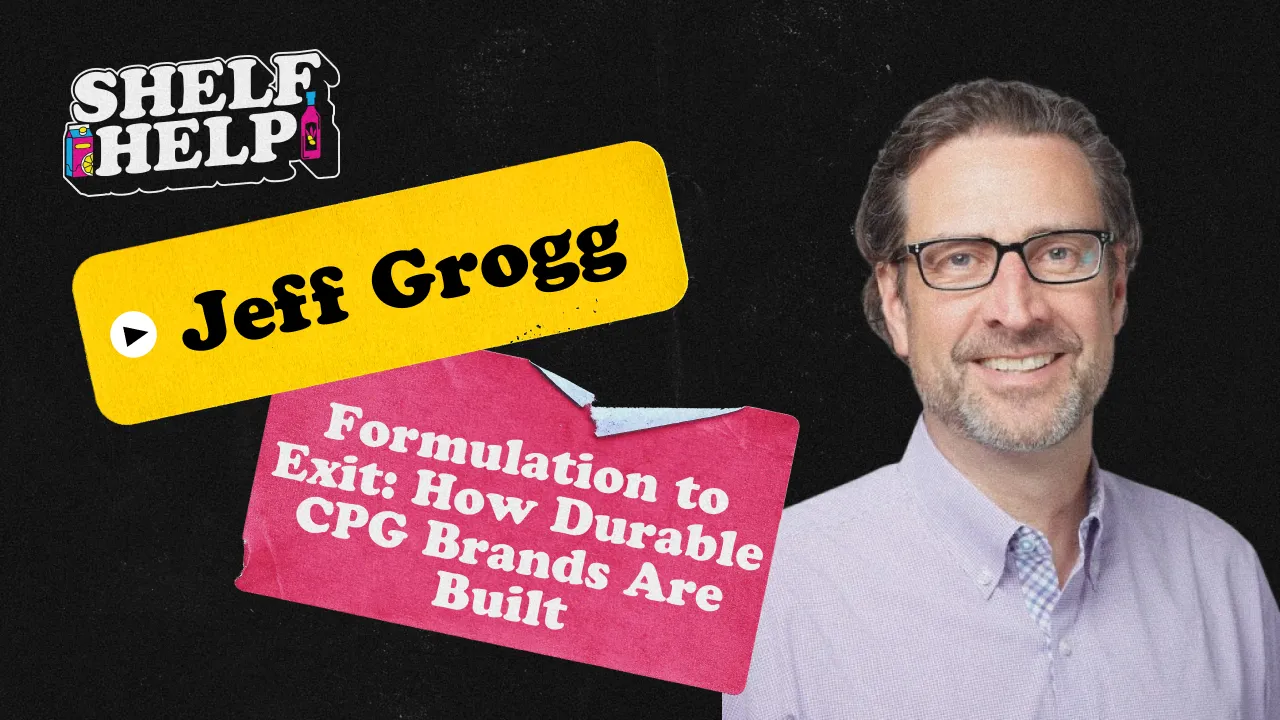
Formulation to Exit: How Durable CPG Brands Are Built | Jeff Grogg, JPG Resources



On this episode, we’re joined by Jeff Grogg, Founder & Managing Director of JPG Resources - one of the most influential food and beverage innovation and operations platforms in CPG. He's also a Co-founder of RCV Frontline Ventures.
Jeff has spent decades building, scaling, and advising brands across every stage of growth - from early formulation through commercialization, scale, and exit.
Before founding JPG Resources, Jeff held senior R&D and innovation roles at Kellogg and Kashi during its hypergrowth years. Since then, he’s worked alongside hundreds of emerging and established brands.
Jeff breaks down the current state of innovation in food and beverage, where founders are quietly taking on the biggest risks without realizing it, how to build a true culture of innovation, when product portfolio expansion makes sense (and when it absolutely doesn’t), and how brands can launch products on time and on budget without blowing up margins.
Jeff also shares hard-earned insights on convenience as a growth driver, reducing COGS without sacrificing quality, navigating co-manufacturer relationships, the difference between chasing microtrends versus building around durable macro shifts, and how brands should think about preparing for an exit.
---------------
Episode Highlights:
🥦 Scaling Caulipower into a nine-figure brand
🧠 The current reset happening in CPG innovation
⚠️ The biggest hidden risks founders take with innovation
🏗️ Building a real culture of innovation
📊 When product portfolio expansion is justified
⏱️ Launching products on time and on budget
🛒 Why convenience drives repeat and scale
💰 Practical ways to reduce COGS
🏭 How to work with co-manufacturers strategically
🌊 Macro vs. micro trends in food & beverage
🔮 Where Jeff sees the biggest opportunities ahead
🚪 What it really takes to prepare for an exit
---------------
Table of Contents:
00:00 – Intro
00:55 – Origin story, JPG Resources services & venture investing
03:10 – Scaling Caulipower to nine figures
04:10 – The state of innovation in CPG
07:46 – One of the biggest risks to innovation
10:09 – Building a culture of innovation
12:43 – Justifying product portfolio expansion
14:53 – Launching products on time and on budget
17:19 – The importance of convenience
20:48 – Reducing COGS
24:21 – Co-manufacturers
29:10 – Macro vs. micro trends
31:06 – Trends and opportunities
33:40 – Getting ready for an exit
---------------
Links:
JPG Resources – https://www.jpgresources.com
Follow Jeff on LinkedIn – https://www.linkedin.com/in/jeffgrogg/
Follow me on LinkedIn – https://www.linkedin.com/in/adam-martin-steinberg/
For help with CPG production design - packaging and label design, product renders, POS assets, retail media assets, quick-turn sales and marketing assets and all the other work that bogs down creative teams - check out KitPrint.
Episode Transcript
Speaker: 00:00
Welcome to Shelf Help. Today we're speaking with Jeff Grog, founder and managing director of JPG Resources, 70 Person Strong and Food and Beverage Innovation and Commercialization Partner that's worked with some pretty big brands like Cali Power Power, just to name a few. I think brought, you know, over 2,500 products to market with across a bunch of clients. Jeff spent a bunch of years at Kellogg and Cashey, among others, really just kind of honing his RD innovation commercialization shops. And I think in addition to guiding JPG, Jeff also runs a CPG-focused venture fund, really integrated within the space. So excited to get into it. Jeff, maybe just first off, for the group of listeners that aren't that familiar with JPG, maybe just kind of give us a quick lay of the land just in terms of kind of the origin story and why behind the company and when you started it, core services you guys offer, and then maybe you can kind of close that part out with just kind of a quick overview of the of the venture fund that you guys have run as well.
Speaker 1: 00:56
Absolutely. Thanks for having me on, Adam. Uh yeah, as far as JPG, our background really spawned out of my experience in Kellogg and Kashi and really not being completely happy with the consulting options that were available. You know, everybody wanted to work on the fuzzy front end and want to do ideas and prototypes, but didn't really want to have to think about are these products viable in market? Can they ever make money? Can they be manufactured at scale? So, you know, our promise has always been that no matter what kind of fuzzy state we start in, we're gonna always have the end in mind and we're gonna know that at some point that value, innovation does not have value until it's on the shelf and on the shelf in a way that you can be profitable. So that's the way we think and the way we operate. And so all of our team, whether they're in the ideation stage or in production or manufacturing, or if they're in the development team, they're all thinking about how to put all of that together, make the concept work, make the consumer promise work, and make it work in a way that creates a real business. So that's JPG in a nutshell. We do have all of those services end-to-end from the from the ideation end and the strategy through product design and development with culinary and uh food science folks. And then we uh do a lot of contract manufacture search and relationship building, and then we can manage the back end uh for people too with uh helping run their supply chain. Um so it's been fun to build this system and to have kind of the only really comprehensive partnership available to the industry. And then, you know, coming out of that, also we had people asking me over a few years, so why do you not have an investment fund? And uh, you know, kind of eventually found the right partner. So Andrew Reynolds is my uh GP partner in RCV frontline, and we invest in early stage brands, usually uh, you know, a couple million in revenue. So there's a little bit of proof of concept, and the founders learned a little and knows what works or doesn't work in their business. And then, you know, we we invest to help them double down on what's good about what they're doing and build from there.
Speaker: 02:55
In terms of getting a bit more of context, just some few examples, some other brands and kind of projects you've worked on. Um tell me just a a bit about that the journey with with Cali Power Power, where I believe you guys partnered with the founders basically from inception all the way to you know pretty significant scale.
Speaker 1: 03:10
Yeah, yeah. I mean, Gail came to us before she started Bacala Power and um worked with Pete and our team to kind of frame up the idea and make sure it was going to be commercially viable. We helped design the commercial product that you know translate what she had done in her kitchen to uh something that could be made at scale and uh helped find a manufacturer and and bring that, you know. We had to help source equipment and and design the process at scale to make that work and and then really just worked with her and that team, you know, over a decade uh since. And so that's been a great partnership the whole way. You know, we did similar things with Health Warrior, uh, you know, when when Catterton bought vans and it was a mess, it was a big turnaround effort, we got deeply involved there and worked with that team both on operations first and then on innovation. So we've got a a long history of kind of being an integrated partner with brands um for you know a period of growth until uh you know until sale or uh until some level of maturity that that if they end up running on their own.
Speaker: 04:10
I was listening to another podcast you were on, I think a while back, and you're talking about innovation needs a bit of a reset, and that disruptive innovation has kind of become a bit of a diluted buzzword to a certain extent. Can you just maybe just kind of expand on that a bit to start?
Speaker 1: 04:24
Yeah, I mean, I think there's not that much that's been done in the last decade that's truly disruptive. You know, and a lot of it um at bigger companies they have disruptive innovation departments, but they, you know, when you're constrained to innovate within the brands that you already own, or or you know, you put other kind of artificial constraints on, or you want something to be big right away, it's hard to actually be disruptive. So there's some of that that happens. You know, we worked on the Kraft Heinz, um, it's called remix project, where it's the kind of freestyle of the sauce category where you can customize sauces. Uh, that was that was cool and fun, and it was it's been successful, but it's rolled out very, very slowly. Kraft Heinz being a large company. It's it could be disruptive, but you know, it's not moving at the base of disruption, I would say, you know, in the market. And so even some of those things, it all has to come together. And I think disruptive innovation, you know, sometimes is just a kind of an idea. Um, you know, you look at a brand like Liquid Death zero product work, right? There's nothing interesting about their products, but you know, just changing the way people think about water and what they hold in their how do they feel about what they hold in their hand? Um, you know, sometimes the disruption comes from just that nuance or that understanding of consumer behavior or psychology. Yeah. You know, so I think you know, we can get carried away with trying to be too disruptive. A lot of times scale is in the incremental. Um, you know, you look at, you know, back to honesty, or you look at um even even the liquid death example, it doesn't require much from the consumer to make that little shift and you can get scale there. So a lot of the more disruptive stuff also sometimes takes a long time to actually disrupt or to actually emerge into disruption.
Speaker: 06:11
Yeah, that makes a lot of sense. Would it be fair to say that what you see is like some of the most impactful disruption can often come more from operation side versus kind of the brand marketing side in the form of you know, like process innovation or supply chain innovation or figuring out a new way to make something rather than actually that new like product form factor way that you position it, I guess, if that makes sense?
Speaker 1: 06:34
Yeah, I mean it can come from anywhere. And that's part of why I think also you have to be really thoughtful about what your innovation machine looks like for company by company and what you can leverage. I think of a product like Uncrustables, it's you know, it's a peanut butter and jelly sandwich at its core, right? By sealing it, by freezing it, by making it convenient and easy, it's a massive, massive success, right? It's a huge business. And now the the protection for uncrustables is largely that who else is going to invest at scale to make a competitive product that that can that can go head to head. So, you know, their their disruption was largely in the product format. And the long-term value proposition is largely protected by the by the asset, the the literal physical asset of how you make this thing. So there's a lot of ways to create disruption or to create that that one step extra that that is the value versus, you know, if somebody was just doing frozen PPJ, it's nothing, uh, but making it into a sealed pocket sandwich is enormous. Totally.
Speaker: 07:38
Yeah, and I think along that front, that's a great example. You know, obviously Incrustibles, they figure out a way from like an operational standpoint to be able to produce millions of those. And I think I heard you I've heard you say something along the lines that one of the business biggest risks is not bad ideas, but focusing on ones that that don't that scale pretty poorly. If assuming I got that right, how do you go about validating innovation changes like these can can actually scale before you invest a lot in it and you know realize this is actually not something that can actually work once you actually try to commercialize it?
Speaker 1: 08:06
Yeah, you know, I think a lot of that comes down to you need to work with people who know and who understand what this can look like going forward. And you it either means you as a founder need to go talk to a lot of manufacturers, even if you're making it yourself, or you need to work with somebody who's knowledgeable in the industry who can help you envision how to manufacture at scale. We just see so many products that are designed in-house or even at a tiny command where there might be a lot of handwork or other kind of specialty behaviors that are just not scalable or or that limit your, you know, as you scale, you would hope that when you go from a thousand units to a hundred thousand units to a million units, that you can drive costs out of the system. But if you have a poorly designed process, yeah, you'll never get that efficiency and you can never really leverage the scale of being bigger. So, you know, those are the kind of things we we want to work with brands to think about as well, if you're gonna be if you're gonna build a hundred million dollar brand, you know, you can start by selling that thing for eight bucks a unit. But chances are at some point, you know, for that to reach mass mass appeal, it needs to be four or five bucks a unit to to you know reach the potential of that idea. And if you can't gain some economies of scale as you grow, you know, most companies don't grow uh to that point. You know, they they become a premium niche specialty item, which is fine. That can be great. I think there's a lot of those kind of businesses that are wonderful businesses, but that may also not be something that you can get investors to back or that investors are gonna be happy with. You know, you need to know if you're building a $10 million profitable lifestyle brand, so to speak. And there's nothing wrong with that. Those are great businesses. That's different than building a hundred million dollar brand, you're gonna exit to a strategic. Right. And you know, I think that in the last decade of the, you know, lots of money flowing in and everything else, too many people didn't understand which they were actually building.
Speaker: 10:02
Yeah, that's a great point. Culture innovation isn't is important, especially as a company grows and things can get more bureaucratic and whatnot. In your experience working with so many brands, how can a founder instill this kind of culture into their company from the start and then really kind of probably what's the harder part is maintain it as the company scales?
Speaker 1: 10:19
Yeah, and it it requires different skill sets as you grow and it requires evolution. Uh, you know, in the early days, I think, and the one durable piece is you need to value input from anywhere, you need to value ideas from anywhere, and the best companies do that. You know, the best companies don't care where the idea generated, if it's internal, external marketing or the shop floor. If it's a good idea, you want to get after it. Um, you know, so that's one. And I think that that having that requires humility uh from your leadership. Um, so that is, I think, one common theme. The other is you have to have intense belief in what you're doing, and you want to have a team that not only believes in what you're doing, but trusts each other so that you put each other's ideas to the test. You know, I mean, when I was at Kashi, we grew insanely fast. We went 30x in eight years, so 25 to 750 in eight years, and we fought all the time. Uh, you know, we we had a very intense environment, and it was, and when I say we fought, I mean uh in good ways, like in very productive. We had if we were in a meeting, that meeting we had it out, and then but we trusted each other so we could talk very bluntly to each other, and then we could go and execute based on the consensus and you know, knowing that we were making each other better, and there wasn't politics and there wasn't you know land grabs going on or anything else, it was just wanting to get the best product out. You know, so those things I think are like the the kind of culture you want, where there's radical honesty, where there's really aligned vision, but everybody is willing to speak their mind and you know just try and get the best outcome. Having said that, you know, I think along that period of growth, and we went through this at Kashi and I have within JPG or the other business that I've built, you have to add structure as you go. You have to add some process as you go. You know, a lot of times as innovators, we we feel constrained by process, but you need good process, helps you innovate better and helps you ensure that that innovation lands again at a profitable, sustainable product. You know, I I think we we sometimes undervalue uh process in growth companies.
Speaker: 12:30
Yeah, when it comes to product portfolio expansion, it should be a fairly high bar to justify the product, if the process of all everything it takes to actually bring a new product or new SKU to market. Um, from your perspective, what should the the journey or process look like that leads just to the decision to get to that decision that says yes, you know, this is justified to bring this new SKU to market?
Speaker 1: 12:54
Yeah, that's a great question because we do find that most companies overinnovate. We actually turn down a lot of work by when people contact us and they say, we want to do a new launch, we want to launch a new line. And our response is you have no business launching a new line, you need to sell more of what you're doing now, unless you're telling me you're gonna pivot your company. If it's not working, fine. But you know, when you're at two million, you don't need innovation usually. You you need to grow. And so, you know, and you look at um putting the bar category, kind and quest or beverage, you know, these brands are 100 million, 200 million, and they only do one thing. You know, they don't have innovations all over the place. So I think that's the first question is why are you innovating? And does this help your business or does this just complicate your business? And too many young companies are way too prone to innovation, and you're at two million, you've got 14 SKUs across three sections of the store, is crazy. Those brands almost never make it, they're too they're too cumbersome to work. So that's one. And then I think two is you need to understand what the market wants? Does this fit my brand? Does this fit my ability to deliver? You know, too often we see people doing really disconnected stuff. You know, you want if you are at a point where you should be doing innovation that's beyond just, I mean, one is flavor line extension, and that's a fairly easy kind of does the is the trade asking you for a fourth skew? Is is there a clear place for that to go? Can you do something that's minimizes your cannibalization of your own and takes something, you know, adds incremental volume, you know, but when you're talking about like adding a new product line, you really need to weigh your ability to execute that. And uh ideally it's still somewhere you can leverage your same sales team, leverage your buyer relationships. When you're jumping aisles in the store, you're essentially not exactly, but you're you're starting to create another company. You're certainly creating a new reality that you have to operate in that's far more complicated.
Speaker: 14:54
What have you found is is key to a new product, new SKU launch that's successful from an on-time perspective and on budget perspective?
Speaker 1: 15:03
That's a really good question, too, because this is where founders often struggle. And you know, I mean big companies too, but I think this comes down to process. You know, this is where I think we've built a machine that works really well at JPG to work through this tension. Because, you know, my point of view is the best product briefs are often a little bit impossible at the beginning, but you want to work against that high bar and you want to test that and you want to let let's shoot high, let's aim high for what we think we can do. But then somewhere along the line, you have to go, well, I can't make the taste and the nutrition and the margin and the package and everything else that I want. I can't make it work. So something's got to give, and you have to understand your hierarchy when you do that. Like what's most important for this consumer proposition, for my company, for my concept. Where am I gonna give to make this work and make it be viable? You know, manufacturable, right margin, all that stuff. So, you know, I I believe it's healthy to start from a place that may be a little bit unreasonable. Uh, that's okay, but you have to have a process then to bring that together to something that is reasonable and is scalable. Yeah. And so that that requires you doing these cycles of, okay, we're gonna lean in on the consumer understanding, we're gonna design something that we feel like is the ultimate delivery against the problem we want to solve. And then you have to go, okay, but I have to surround that with the right price point in market and all the other pieces. And so you iterate between creativity and these cycles of you know, what's the next round of product look like and how does it get better and better? And at the same time, you know, you're bringing in the how do I land the cost right? How do I make sure this is manufacturable at scale? Um, you know, and you just have to keep, you know, rubbing those sticks against each other to create the fire that that ultimately can can you know lift the company. So I think that's the kind of challenge is that you have to be good at both sides. Most individuals left to their own device are either too too willing to just wing it and hope that'll work out, or they're too constrained. So, you know, having partnership and process, I think unlocks that uh ability to end up in the best spot.
Speaker: 17:19
Yeah, that's a great point. One thing I've heard you talk about, which I thought was interesting, is that consumers just overwhelmingly value convenience even more than brands may think. I think I heard you reference rice crispy treats being a good example as like such a simple thing, but clearly they've had a lot of success. Can you kind of expand on what you've kind of, I guess, gleaned over the years around this kind of importance of convenience and reduced friction and whatnot?
Speaker 1: 17:40
Yeah, I mean, I will say my personality, if I get it wrong, I remember it a lot more than what I get right. And uh when I was at Kellogg and we were starting to work on a packaged rice crispy treats, I remember saying, why would anybody need this? It takes like four minutes that anybody with a stove and an arm can make. You know, you stir stuff together. But it was so wrong. Like as soon as we launched that, Kellogg could not keep up. We actually took like a full-page ad in the USA today, like we're doing the best we can. We're trying to make more. Um, and we went, we built one line at a comment, and within a year, year and a half, we had five lines running at full tilt. You know, I was like, that was way, you know, like fully settled into me, like, never underestimate the laziness of the American consumer. We want easy. We want it to be, we want it to be just I want it now, I want it simple. And we've got most many households, most households have two working people, everybody's on the go. Everybody wants to would rather invest in leisure time than food prep time. And you know, so all of those things I think just come into play that our society is built for speed, um, you know, and and where there's no slowing it down. So, you know, we we have to recognize that reality. And, you know, not to say there's nothing that people take a moment to sit down and slow down and enjoy. There is ritual around tea or coffee or other things, beer, you know, whatever. But there are, but by and large, like for the most part, people want easy and people want just plugins that work for them. Yeah. So, you know, I I think it's again really understanding your product. And if you think your product is something that's going to buck that convenience trend, you better really know why and how and and it needs to be built for that. But for the most part, easy is the way.
Speaker: 19:26
Either people want convenience for the day-to-day stuff, or it's like on the other side, it's like people and they have the free time like making sourdough bread at home when it's a lot of process, but it's like part of their hobby. If it's not like on either side of the barbell, in between, it's probably not gonna work.
Speaker 1: 19:39
Yeah, I mean, sourdough, I think, you know, this trend, uh, this baking trend that's been amazing since um since COVID, you know, really people, one, it's it's soothing. Baking is soothing, it's very like elemental, and you and you have to do it right, so you have to pay attention, it takes your mind into the process. You know, by the sourdough also like now you've joined a tribe, right? You've joined a club, you're you're part of something. So I think that that baking uh activity ticks a lot of those boxes for what people are looking like looking from. And you're not baking that bread because you need it necessarily. You know, you're still you're probably not making sandwiches out of that to feed your kids in their lunchbox, right? So it's there's all those other things. And so, yeah, I agree. I I think um, you know, being on the board at King Arthur, like seeing this trend and seeing how people have embraced this is like taking that food making art and craft into a different kind of space. Yeah. That's way different from why people buy most of their groceries. Yeah, totally.
Speaker: 20:44
In terms of optimizing supply chains, what are you seeing today? Like, what are the biggest opportunities in today's environment when it comes to reducing cogs?
Speaker 1: 20:53
It's hard. I mean, right now there's so many moving pieces. I think you really have to be thoughtful about what you're going to chase. I think one, you know, on the tariff front, which everybody's talked about a lot the last year, we're seeing it settle down. It's a little more of a sense of predictability. So now people are understanding well, should I be changing my supply chain to account for tariffs or not? So that's one that that's kind of nibbling around the edges. I think the big pieces are what's your manufacturing look like? And between you and your manufacturer, whether you own it or whether you outsource it, how can you do better? You know, how do you work with your manufacturer to squeeze out some more efficiency? How do you reduce waste? How do you reduce overweights? So many products in their early part of their life cycle are very poorly designed for manufacturing. And a lot of founders just sort of delegate that to their co-man. The co man is not that incentivized to make it better. They're happy just to get through it every day and you know, send the product out to the customer. Um, so you know, a collaboration with your manufacturing, I think, is where there's a lot of opportunity. You can, you know, labor. Costs are way up if you can reduce headcount by making your product run better. If you can get 10% more per shift out, you know, those things add up and matter a lot. Um, you know, optimizing your truckloads uh are is your pallet configuration right? And if you can get 10 or 20% more on a pallet, you just shrunk your your freight cost by 10 or 20%. You know, so some of this stuff is actually like very simple from a math standpoint. Most founders are not that good at it. Most founders are not operationally minded, they're sales and marketing minded, they're creativity minded. So, you know, that that's where I think there's opportunity. And the other piece is not really on too many people think, well, as I get bigger, I'm just going to squeeze my suppliers and I'm going to get better pricing. In packaging, you get a lot of leverage from scale. On your ingredient side, you don't get that much leverage from scale. Um, or at least like it's way different magnitude. Um, you know, if you're a two million dollar company worrying about sourcing better is probably a waste of time. But if you can formulate better and you can formulate in a more sophisticated way, and you can reduce your cost of formulation, or you can reduce, you know, 19 ingredients to 15, those kind of things end up paying off. So I think it takes a product-by-product manufacturing process by process kind of look. But there's certainly most small companies are leaving dollars on the table on the on the operation side. And too many brands, they look at their command transactionally, and then they'll just say, Hey, I want a lower price, you know, and they make it the commands problem. And most commands are not that motivated, special if you're a startup, to go do that work. But if you go to them and say, look, how do I partner with you? What do we need to do collectively to make your plant run better? How can, you know, instead of implying that, hey, uh, Mr. Coman, I want to take money out of your pocket to put in my pocket, which is where a lot of people start, is this hard-headed negotiation of I win, you lose, or whatever, and you go, I don't want you to make any less money. How can we both make more money? And if you can get more product out per hour, the coman is going to do better and you should get a price reduction. You know, so I think that there's just not enough focus on emerging brands, on true actual partnership and working together with your manufacturer and your suppliers to find ways to uh to do better.
Speaker: 24:20
Yeah, I think that's a great, great way to put it. In terms of finding the right contract manufacturing partner and getting production off the ground, when you're it sounds like you know, you do a lot of this kind of search and building relationship with co-packers and making recommendations for your clients. Like, what's what should a kind of a co-packer kind of diligence checklist look like, or maybe just another way to put it, what are just the most important variables or factors to consider?
Speaker 1: 24:42
Yeah, um, it's it's interesting too because at JPG, like I've started, in addition to running JPG and launching brands and other stuff, I've started and operated two contract manufacturers. My head of co-mand used to run his manufacturing plant. That's how I got to know him. He was one of my co-mans at Kashi. So we under we see both sides of the table. And I think that's I'll start with that is that when you're trying to find a partner, if you don't understand what they do and what's important to them and how they're motivated, it's very tough to have a partnership. So I think there's one is just taking the time to get to know each other a little bit. Hopefully, you're making something that has more than one place in the world that can make it. Um, and if so, then you need to find that best relationship. So that's partly all the all the basics of can they do it? Can they do it at a reasonable price? Do they have capacity? Is it the right fit? Also, just that relationship piece that we we don't we see a lot of folks shortcut that or again look at it as too transactional. So, you know, I think the the diligence needs to be both what are your MOQs and what kind of upside can I expect. If I 10X my business, can I work with you? Uh or am I gonna outgrow you? It's also understanding that if you do 10x or 100x where you start with, you're probably not gonna be at the same command, right? Like this whole idea that you're gonna have a command for life from when you first get married. Like I used to say, you should not want to be a child bride. You know, like you are you are a very young nascent company. This is not your forever partner here. You're not getting married for life. You're gonna have a good relationship for hopefully two to five years, and then hopefully you outgrow them, you go somewhere else. Like that's what success looks like. And you want to make that relationship as productive as possible during that time. So, you know, understanding those parameters on volume, understanding cost, and then, you know, how do you put together a contract that's fair and equitable and clear so that everybody knows how to behave?
Speaker: 26:37
On that topic, what's what's a red flag in a manufacturing, you know, Copac or contract that maybe a good amount of founders may miss that could get them in trouble later down the line?
Speaker 1: 26:47
I mean, one big one is who owns the formula, who owns the IP. You know, you you as the founder of the brand, you need to own that. If you take the shortcut route and you have your manufacturer develop your product for you, they're probably gonna own that IP. That might be okay. Almost every solution can be okay if you do the things around it right. So, but if you're gonna go that route, you need to know what your buyout of that IP is. And either after so many units you own it, or after so many months or years you own it. There needs to be a pathway to ownership because, like I said, at some point you're gonna outgrow that partner. Bluntly, almost everybody who's giving you free RD on the front end, they're charging you a lot for that RD and the cost of your product. And at some point, you're gonna come to us or some other competent ops team and they're gonna say, I can save you 40%, but we need to move you somewhere else. And if you don't own the formula, it's much harder to do that. Uh, it costs you more paying us to reformulate it. So I think that's one is IP rights are are really big, and investors really don't like when you don't have your IP rights. Beyond that, I think it comes down to transparency. Like you should not have a two-page command contract. That's woefully inadequate. You need something that's much more explicit in spelling out your rights, your responsibilities, and the same with theirs. Um because what we see is that a lot of contracts are just fine when everything goes perfectly. And then when something goes wrong, it all hits the fan and there's not clarity of who's at fault and how it works. And those are when brands often feel abused because the command's not going to just step in front of the bus when they don't have to. So you need a good contract that delineates if if something's out of spec, then what happens, if there's a recall, then what happens? What do you have the right to reject or not? All those sort of things need to be clear. So it does take some intensity to have a good contract.
Speaker: 28:40
Yeah, that's really helpful. You work with a lot of brands across like all aspects of CPG, and in my sense is you definitely got a pretty good grasp of all things trends. And I think one thing I've heard you talk about is how is kind of macro versus micro trends and how founders and operators should really focus on on the macro. Can you kind of expand on this and maybe kind of an examples of what this with macro examples and maybe micro examples that maybe would not be something that's worth pursuing?
Speaker 1: 29:06
Well, uh I'll yes, we'll talk about that. I'll I'll start by also saying I think this is where it's important to understand. Are you building a $10 million profitable company or are you building a company you want to build and to scale and exit? And that's when you need to know the difference on if you're in a micro trend or macro, right? So if you want to build a hundred million dollar company, you need to be operating in a market that's billions of dollars because only 10% of a market is usually something you're not going to achieve, right? So you need to be looking at a market that's very, very that that can be very, very large. So one, I think that means again, you look at am I going too far? Am I trying to solve too many problems at once? Or can I just say, look, we're about high quality protein, or we're about protein and fiber, which makes it GLP one friendly, or we're about the benefits of mushrooms, or whatever it may be, but something that you believe has scale and that the market says has scale. It's not just your belief. There's some reason to believe in the scale. And then uh, you know, building building toward that with simplicity and with focus. Otherwise, you know, look, there's a lot of good brands and good companies out there that are 10 or 20 million bucks that are really built on much more niche kind of positionings. Sure. So that to me is the big question is the micro trend can be very sustainable, maybe very highly ownable, but it may not scale ever or for 20 years. So it's really being honest with we see people give us ridiculous TAMs with some very esoteric product, and they're like, Yeah, but this could be two billion dollars. Like, you can't show me a four million dollar market today. You know, come on. So, you know, like thinking about what your true TAM is and not some outrageous thing. But if you're if you're selling a product with that's very complex and nearly a medical food, well, chances are you're in that micro trend space. And you know, you need to just understand that when you start.
Speaker: 31:01
What categories are do you feel like are especially maybe ripe for disruption right now, or maybe another way to put it, if you were to go start your your own brand this year, what category or maybe categories would you consider going after?
Speaker 1: 31:13
You know, I mean, I think right now, obviously protein and everything is a big trend, but uh it's it's happening all over. I don't know that if I was if I'm launching a new brand, I'm probably not going into that maelstrom. You know, I I think fiber and more sophisticated approaches to fiber is interesting. I think there's an opportunity, and this is where there's a lot of nuance. So we'll see how it unfolds. Like, do you want to be a GLP one focused brand or not? It's a giant trend. Uh, it's only going to get bigger as those drugs become oral instead of injectable and they become affordable. You know, I think there's opportunity to be GLP1 friendly, and that means a lot of different things. There's there's a nutritional aspect, there's a right size aspect, there's uh, you know, meeting meeting the needs in different ways. And so far, there's not been, there's been a lot of people kind of danced around the edges, but there's not been very many brands that go right after it. So that'll be interesting to watch. Gut health is another aspect of that that I think continues to grow. And then the gut-brain kind of connection and brain health. So we were seeing in some ways there there's a lot of trends right now that are actually kind of coming together. Um, you know, and then you know, greens fees are you gotta be clean label, you gotta be something that that makes sense. I mean, if you're really medical, if you're really technical, maybe you can get by with being a little more, you know, the miracle of food science kind of thing. But you know, for most brands that are probably, you know, that are engaging broadly against the industry, you know, you have to design from simple and then you have to just really figure out which of these consumer needs you want to nail. But I would say, you know, I would caution on you don't want to be an arms race brand, right? You don't want to be just like, I have one more gram of protein. Well, somebody else will one up you. You want to be something that people rapidly affiliate with and understand and you know feel like they need it in their life. You know, uh you want to hit that bullseye. You want to have a clear bullseye and you want to hit it, and you want to hit it very, very tightly and over and over again. All your messaging, communication, where you are on shelf, all of that needs to hold together. Um, and you need to be working on that emotional hook to your consumer more so than just being structure function kind of uh position.
Speaker: 33:28
Totally for the brands out there that they've struck lighting in a bottle or it's been a you know 10-year overnight success uh somewhere in between, and they're or will soon to be in a place where they can seriously start looking at an exit. What should founders have top of mind as they're getting the business ready for sale and to market to potential acquirers?
Speaker 1: 33:47
You know, I I think this is also you really need to understand what you're selling. And you know, if you're selling a really high growth brand and you've got really high growth and there's a reason that's going to continue, you don't need to be as profit focused, you know, because everybody talks about profit these days, but it's very hard to get profit below 10 million. And then even for larger brands, you need to know what you're about. And you know, you not necessarily everything, even 100 million, you're probably not 50 margin and 50% growth. And you know, like those brands are really rare. So are you still like zooming to growth with a pathway to profitability or better profitability? Or are you like, hey, look, we've proven we can turn out really solid margin and profitability and still grow 25% a year. Like that's also viable. But you know, so I think that we'll start with that is we see brands, sophisticated brands, sometimes with what you would think would be sophisticated advisors that still don't know what they're selling. You know, at a 60 or 100 million, like you should know exactly what your proposition is and then what they're buying into. And depending on what that is, you also need to then have the um rationale for, well, what's our innovation pipeline going forward or what's our next lever toward profitability? You know, how does a sale add value to the company? You know, how do you help the strategic acquirer understand how they make it even better than it is today? So, you know, I think that there's this similar to what I said about commands before, you need to think about what that buyer is looking at. What value proposition are you giving them? Are you giving them growth that they can't get otherwise? Are you giving them a business that's a maybe a little bit more mature, that's profitable and really solid, but still has legs that they can see how they can go expand the growth? They can get you into channels you can't get in. Um, you know, so thinking about, well, if I had the wherewithal of Pepsi or MRs or whoever the acquirer might be, what should happen with this business and laying it out for them so they can see it. And you know, big companies like that, they're gonna they're gonna look pretty hard at your brand and your proposition and see if they think they believe in it or not. So you're way beyond the point of selling some irrational promise. Uh you need to actually have something that they look at and go, yeah, I buy into that. And in the back, in the back of their mind, they usually have some other twists that they think they can apply to to make it even better. So those are the deals that get done.
Speaker: 36:11
Cool. That makes sense. That's really powerful. Well, yeah, Jeff, this has been awesome. Really appreciate the time. I think this has been really valuable for for a lot of people that are going to be listening. What's the best place for people to follow along with you and all in all the knowledge you've got, and then best place to follow along with with uh everything going on at JPG these days?
Speaker 1: 36:27
Yeah, I mean, we'll be updating our website some more, and there'll be content coming on there at times. So it's JPGresources.com and then also um you know JPG Resources on uh on LinkedIn. Our Colonel X team also does a really nice job on LinkedIn and and you know, talking about food and more of a culinary uh perspective. Um, and I'm on LinkedIn at at uh as well. So, you know, we don't do too much other social. So for the most part, LinkedIn and our website are where you're gonna find us. And then at events, you know, I'm speaking this week at uh at Fancy Foods and where we participate in all the big shows and happy to meet people in person. Cool. Awesome. Well, appreciate the time, Jeff. This has been awesome.
.svg)