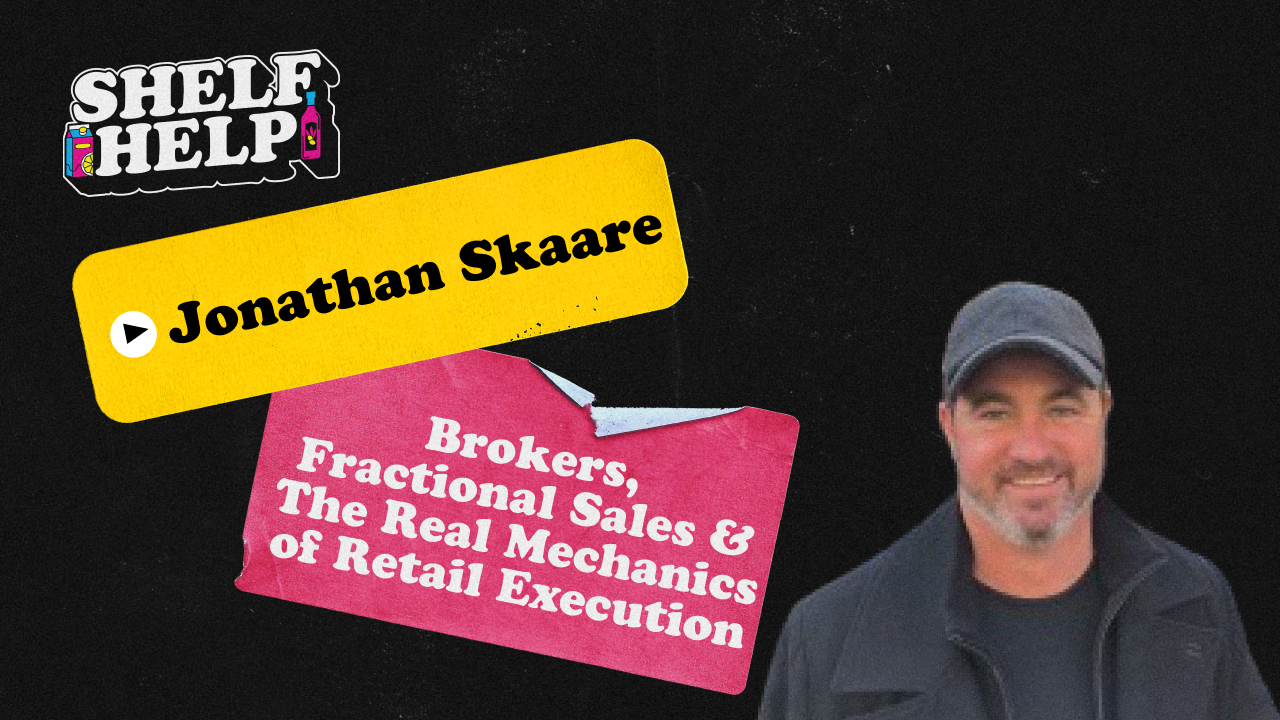
Brokers, Fractional Sales & the Real Mechanics of Retail Execution | Jonathan Skaare, Scout CPG



On this episode, we're joined by Jonathan Skaare, Founder & CEO of Scout CPG - the fractional sales and channel support firm built specifically for better-for-you CPG brands.
Jonathan spent over 20 years in sales leadership roles at Kellogg's, Annie's, Vital Farms, and Acme Provisions before channeling all of that experience into helping emerging brands scale smarter without breaking the bank.
We dig into the real mechanics of how emerging brands should think about sales infrastructure - when to use a broker, when to go fractional, and when to bring someone in-house. Jonathan breaks down why the broker model isn't actually broken, but that most brands don't understand what brokers can and can't do, and why that misalignment is where things fall apart.
We get into retail execution, distributor velocity thresholds, and why getting on the shelf is only step one - getting off the shelf is the real work. Jonathan walks through his preferred approach to the natural-to-conventional transition, why he likes retailer-specific and regional brokers at early stage, and how Scout builds a financial model for every account before a brand sells into it to make sure the numbers actually pencil out.
We also cover what a dialed-in buyer presentation looks like (hint: five to six pages, not thirty), the most common mistakes brands make in buyer meetings, and how Scout's "customer plan" captures everything from COGS to promo vs. non-promo percent of sales.
---------------
Episode Highlights:
🏗️ Why Jonathan built Scout CPG after 20+ years in sales leadership
🤝 Why the broker model isn't broken - brands just misunderstand it
💰 Broker compensation structures (retainer, commission, and hybrids)
🚀 Fractional sales vs. broker vs. full-time hire - how to decide
🛒 Why retailer-specific and regional brokers shine at early stage
📦 Mile wide vs. mile deep - why distribution strategy matters more than door count
📊 Velocity is king - the first 90 days on shelf
🎯 How to transition from natural/specialty to conventional retail
📝 What a great buyer deck actually looks like (5-6 pages max)
💸 Scout's "customer planner" - modeling profitability before selling in
⚠️ Common mistakes brands make in buyer meetings
👀 Why you should visit the store before you pitch the buyer
---------------
Table of Contents:
00:00 – Intro
00:44 – Origin story and the why behind Scout CPG
03:05 – How Scout differs from a traditional broker
05:55 – Why the broker model isn't broken
07:16 – Broker compensation structures
10:05 – How Scout's financial model works differently
12:28 – Fractional sales vs. broker vs. full-time hire
17:00 – Regional vs. national vs. retailer-specific brokers
20:58 – Choosing the right channel and region first
23:42 – Retail execution: good ideas, bad implementation
25:44 – Going a mile wide vs. a mile deep
28:19 – The first 90 days on shelf
32:20 – Natural to conventional transition
35:33 – Building a buyer presentation that works
39:07 – The customer planner: financial modeling before selling in
42:13 – Where to follow Jonathan and Scout CPG
---------------
Links:
Scout CPG – https://www.scout-cpg.com/
Follow Jonathan on LinkedIn – https://www.linkedin.com/in/jonathan-skaare-b9126922/
Follow me on LinkedIn – https://www.linkedin.com/in/adam-martin-steinberg/
For help with CPG production design - packaging and label design, product renders, POS assets, retail media assets, quick-turn sales and marketing assets and all the other work that bogs down creative teams - check out https://www.kitprint.co/
Episode Transcript
Speaker: 00:00
Welcome to Shelf Health. Today we're speaking with Jonathan Scar, founder and CEO at Scout CPG, fractional sales and channel support firm. Really specifically built for better for you CPG brands. Before launching Scout, Jonathan spent over 20 years in sales leadership roles at some of the most well-known brands in the space Kellogg's, Annie's, Equipment Provisions, Vital Farms, just to name a few. And now he's just really channeling all that experience to help other emerging brands really scale smarter with without really breaking the bank. So yeah, really excited to get into it. Jonathan, maybe just kind of first off for the listeners that aren't that familiar with Scout CPG, love to just kind of get a quick lay of the land in terms of origin story and the why behind Scout CPG core services and what makes Scout different than I just, I don't know, let's just say a traditional broker as an example or maybe sales agency. And then um, if you just want to throw out, you know, uh a um the kind of the types of brands you typically work with and and where they are in their journey, and then uh we'll go from there. Yeah, great.
Speaker 1: 01:00
Uh and thanks for having me. Uh, appreciate the opportunity to talk about Scut CPG and the people that work with me are outstanding and we couldn't be happier with the brands that we work with today. Scut CPG, you know, oftentimes businesses are built before there's true intention and understanding of what's happening in the market, and we sort of took a different approach after 20 ish, 25 years ish uh experience now in CPG from everything from bagging groceries in a grocery store to being part of some great acquisitions and some, well, seemingly everything in between for working for giant billion-dollar companies a year and and pre-revenue businesses. And one of the things that we found that we we felt is the biggest pain point for brands as they grow is the financial investment and the managing of expectations to bring a product to market. And what I've found through my own experience, as well as the people that work with me here at Scout, is that brands as they come to market may or may not have the right expectations of what their business can and cannot do, whether that's driven by operations, whether that's financials, whether that's the support structure, whether that's the organization of the brand itself. And so there's lots of amazing out there that come up with these amazing ideas and they've got great branding and they've hired great designers, but they might not have the price architecture correct. They may not know the route to market, they may not know how to work with distributors. And I think often people get advice that hey, you've got to have a broker. And I think that in some cases that's true, and in others it's not. And so what I what I found is the biggest gap is actually understanding the overall business acumen that is needed to actually bring a brand to CPG. And we built Scout CPG to help with just that. And so the stages at which we tend to work best with, we have some pre-revenue, we have some that have been in market for a year or two, and sometimes five, with brands that may have some distribution, may have ADC, may have a new leadership team, may have a different need to bring a market, to bring the product to market in a way that is sensible and not just fully scalable. And so oftentimes brokers, uh, the difference between us and brokers is a handful of things. Brokers are good at the right stage. There's lots of great people out there, there's lots of great companies, there's lots of regionals, there's lots of nationals. There's all kinds of great brokers that do great work, but you have to understand what their role is. Their role is not to build your strategy, it's not to help you understand pricing. In some instances, they don't understand the cash flow of the business and they don't understand the true, true work that takes behind building a real ground up forecast and actually helping you build a production model as such. And so that typically comes with a sales leader that you have in your organization. But unfortunately, to get that level of experience, that tends to come with a pretty high price tag. And so, and oftentimes they hire someone who maybe doesn't understand part of it. As someone who came from big CPG, I made a switch from big CPG to a very small business, and I will tell you firsthand that struggle is hard. And the things that you don't know, you really don't know. And so we built Scout CBG with the brand in mind first, essentially saying, what does the brand need? And so what we traditionally do is run an assessment in partnership with the brand to understand the job functions and where some of the real hurdles are, whether that's in experience, whether that's understanding how they bring something to be. It could be as simple as what do I do when I get a PO? How do I fill out this UNFI paperwork? Do I check the free fill box? Like, what are the elements of it? Can I negotiate terms? What are the DCs to get into? What are the next DCs to get into? And there's different people out there doing different things to help brands. There are some master brokers out there that may be quasi-defractional that help a lot of brands get into anchor accounts. There are traditional brokers that are helping you at ground level regionally. There are national brands that want to scale you maybe faster than you can for a number of reasons, whether it's product availability, operational understanding, the cash flow that's actually needed to finance that sort of a sort of scaling moment. And we try to help our brands understand where is the point at which you can run. And so we traditionally start with understanding operations, understanding their finances, understanding their cogs build, understanding their price ladder to bring it to market, and then actually building a strategy that they can afford to do at a pace that they can afford to do it at.
Speaker: 05:54
Where is the room for improvement with their traditional broker model for emerging CP?
Speaker 1: 05:59
I do say the broker model isn't broken if you're the broker. And and what I mean by that is the expectations when when you are the broker, they feel that they're articulating their services and the cost for that service in a meaningful and impactful way. Right. And so they don't feel that it's broken. Brands often come into the conversation, not truly understanding how to manage a broker, how to utilize them, how to understand what they can do and what they can't do. And so a lot of brands come to us like, oh, we've hired this broker, it didn't work out. And we tend to ask them questions like so what do your assets look like? What were the directions? Was there a scorecard? How did you communicate with them? How often did you communicate with them? And so there's a different way to manage that conversation. And I think that a lot of brands come into CPG with this grand expectation that brokers are going to solve all of your problems. And unfortunately, that's not really their role. And so managing expectations for you as a brand, as well as having a clear communication with the broker as to what their role is, is really the key. And that's often the driver for when people say the broker model is broken. Not really. I think that people just don't come to the table understanding exactly what each other is supposed to do hand in hand.
Speaker: 07:15
Can you kind of walk through that kind of standard broker compensation structure, whether it's some mix of retainer commission and maybe just at least from your perspective or or and or just what you hear from other brands that you speak with, where you feel like maybe there's some misalignment between the incentives that the broker has and what the brand actually needs?
Speaker 1: 07:34
Yeah. First, I think the conversation starts with you're both trying to run a business. And I think it needs to be grounded in that and understanding that that's what it is. You can get emotional about the connectivity, but the reality is you're both running a business. And so both sides need to understand that at hello. And so if you can get past that point, understanding what the compensation model for brokers is is a wide array of options. Yeah. And it, you know, it could be in some instances, you're great, a great regional broker in NorCal, and it's a relatively small retainer, and maybe it's and or commission. Not that everybody understands how that gets funded, because it's that it's retainer and or commission every month. Some people believe you come off commission, you get on the commission, you stay on commission. That isn't always the case. To help you have someone in the market bring your product, in some cases, in the front door. There are other brokers who give you a national agreement and sort of tend to do the same thing. That retainer is built to help cover their sort of operating expense of people, their SGA on their own PS. And understanding how many people they've got on salary, they need to cover those pieces. And then the commission may or may not benefit different people. There's everybody has a different bonus structure, every broker's different, and how they incentivize their people, which is fine. That's their business, not mine. But what it tends to do is put you in a sort of Rolodex of brands for category Bs. And brands often don't understand what that means. And I can see and understand why. You're paying a broker a amount of money a month and you are expecting them to work on your business at or better than the rate in which you are paying them. That isn't always true because there are busier times of the year based on your category and review calendar than there are others. And so there's ebbs and flows of workflow and connectivity and communication. And what you're trying to accomplish when you hire a broker is to actually get into their book so that you can utilize their relationship to go talk to a retailer. That may or may not be today. That may or may not be in two or three months. Yeah, it might be in six or nine months. And I think what often happens to brands is they don't ask the broker the question of does my count what is reviewed? When is the right time to start with you? And so oftentimes people will sign up too early with brokers to help them get into a market that isn't readily available or reviewing the category. And so there's a lot of wasted time and energy and money, which isn't the broker's fault. And oftentimes it's the brand's fault. And I think that's sort of where like someone like Scout CPG comes in. We we sort of build and scale with you and we we we financially take incentives to sort of go with that. We we literally build a plan with you based on where you're going, based on the timing, based on the urgency of the business, rather than hey, we're just gonna kind of put you into a hook and we're gonna bring you to a category review and we're gonna get you a meeting, and they're very good at that. Um so it's just a different approach in terms of how brands actually view the urgency. Now, I'll say this every brand and every early stage founder I've ever met, every day is urgent, and every day is important. And every day we want to feel like we're making progress. And as someone who's been part of many of those early starts, I feel and empathize with people who look at it that way. You have to find a way to make progress every day in fractional sales. And as a broker, that isn't always the case. Now, in some instances, people can have, you know, 50, 100, sometimes 200 brands on their desk across multiple categories and multiple temp states. And their primary function is focus on the thing that's being reviewed today. And you can't knock them because that's the way to do it. That's important for the brand and it's important for their efficiency. Our our model of compensation works slightly different than that in terms of how our team is paid and incentivized, and how we actually build our financial relationship with each brand, where it isn't always a retainer, it isn't always a commission. Sometimes it's a smaller retainer and a commission, sometimes it's a commission at a different rate, sometimes it's just a straight retainer, really varies by brand. And I like to tell folks like I don't know that any two contracts here at Scout CPG are the same. Yeah. And that's intentional because no two brands are the same, and no two brands have the same bank account and the same category and the same velocity. There are things here that sell at one unit of store a week. There are some things here that sell at 10 units of store a week. There's a great divide between those. We have some brands that sell amazing in the Southwest region, over 100 units of store a week, and then they're in the Pac Northwest and they sell five, right? And so there's a huge disconnect and an assumption made that the business is going to perform the same way everywhere. And I think you have to be aware of that as you go into a relationship with a brand to help them understand exactly what's needed to make the Pac Northwest maybe move quicker. But then even tell the story of a brand that's in the Southwest that's actually doing amazing. Yeah, that makes total sense.
Speaker: 12:29
For those founders who are listening that are actively trying to just figure out at the stage that they're at whether they need a fractional sales leader, fractional head of sales that I think is kind of what Sky CPG really is, versus bringing an in-house full-time VP of sales versus a traditional broker, or maybe it's a combination of all or some of these. How should they be kind of thinking about that decision and what's going to be right for them?
Speaker 1: 12:56
Yeah, it's uh that is uh that is an intersection that a lot of brands stumble upon and don't have a clear understanding of what it is. We have brands here at Scout that have brokers and we manage the brand as a fractional head of sales and we manage all the brokers. We have brands that want to have brokers, and so we will act on the brand's behalf and and actually go out and interview and negotiate and try to find the best connection for them. Understanding whether you should have a broker, whether you should have a fractional sales team is sort of part of the assessment we do for you. There's no obligation to work with us long time. Um, long term, I should say. We we want to understand what's the right fit for you. Maybe that's us, maybe that's not. There are some categories we don't have a lot of experience in. Our business is built different, that we don't, we don't actually hire people until we have brands. So you it it is not often that you just come into the business and we just say, hey, we can get you on board in two weeks or 30 days. Sometimes we want to find the right mix. Sometimes we have someone who has experience in that category and sometimes we don't. And so helping brands understand what is the need of their business today and actually give them an honest, well, tends to be my honest opinion on like where you are in the stage of growth and what you should use. Sometimes that's not us. And and you've heard me say this in the past. Like, we are not amazing at brokering businesses. And we are true fractional salespeople. We have some brokering relationships. They tend to be friends of friends or sometimes even personal friends of ours that were trying to help at a pace that makes sense for them, but we're not great at it. We're not great at it because we don't have 200 brands and we don't have five or six brands in a category and a category manager at pick any retailer in the US wants to talk to us about five brands in one meeting. And that's where brokers tend to shine best. They get your brand in a small environment, a one-pager and a quick two or three-page deck in front of a buyer, they spend 10 minutes on it, they flip the page and they go to the next brand. We don't have that many brands in the same category. In fact, we we tend to have a non-compete. So, meaning, if if you're our salsa company, we don't have another salsa company. We have a frozen entree business and we aren't going to sell any frozen entrees be beyond that business. And so we stay very loyal and dedicated to the brands that we have partnerships with. And so that's just a unique understanding of what brokers can do. And I think one of the things that brands tend to miss, and I think it's a struggle for a lot of brands, is a lot of the big brokerage houses have competitive brands on their desk. We have a handful of them that we actually manage, and they have a competitive brand that's much, much bigger than us, also on the same broker's desk. And understanding like what are the challenges there and how to communicate that becomes a real, a real key. It's also really challenging for maybe a founder-led business that might understand the intricacies of making both things work. And so understanding all of those dynamics to help a brand say, hey, maybe you want to do this. Maybe maybe you take this structure and we do fractional sales, and then over time you want to bring your own salesperson in, and maybe we help you staff that too. Um, it's not about protecting our business. It doesn't start with us, it starts with the brand. We always have to remind ourselves of that. We're here to help the brand succeed and in their success, should so should ours. But we don't put ourselves first in any of those conversations. Running an assessment, we're running one tomorrow on a brand with a few people on our team to actually help a brand understand what they need. One of the things that I found, and the reason that we do that, I didn't always do it. Um, and I I owned a consulting business before that was just me. And it was easier to understand what brands needed when it was just me, because it was either I could do it or I could not. And now there's a whole team of people, that's not the same case, right? And so we didn't always run an assessment. We do today to help brands understand where is the challenge in their business and what's the right scope and agreement that you should financially sign yourself up to to bring your product to market. Signing a national broker deal if you only want to be in the state of Florida is a bad idea. Right. Signing a national deal when you can't actually scale because your product can't scale, you don't have the packaging, you don't have the financing, you're going through a redesign, all the different things that are happening today and you expect to happen the next three to five years actually play into whether you can scale with a broker or even with a fractional sales team. Now we've taken a frozen entree business, Blue Zone's Kitchen, from zero cases and built with Scott and Abby and the team a very consistent flow of information and a scaling sales force. It started with me and then it added, we added Jen to our team, and then we added Luke to our team, and then we added Kathleen into our team. And we continue to add resources onto that business as it scales to help it actually come to market at the pace that it can go and at the financial financial investment that it can afford to do based on how it's scaling. That's a very different model than anything I've ever seen, and it's exactly what we intend to do.
Speaker: 18:08
Yeah. Um, you mentioned you just mentioned how it's probably not a good idea if you know it's a small brand going to national broker, if they're just focused on you know one specific area. And I'm a similar question. Do you think it makes more sense? Or it might be just situational, but does it make more sense to use multiple brokers and that each one has their own specific um specific brand within a specific retail group? I know there's based out here in Minneapolis, I know at least of one broker that's obviously a lot of them are former target employees, and they're really focused just on working with target specifically. Like, does that also seem like it makes more sense um than going with one general one that focuses on everything?
Speaker 1: 18:52
Yeah, I um I say this a lot, and I've said it for a long time. No fractional sales, no broker is good everywhere all the time. Doesn't exist. We have aspirations to be that. The reality is we're just not. And in my experience, there is a weaker link in the chain everywhere in everybody's business. And I think we're constantly trying to address that and make it stronger. That's part of running your own business, right? Identify your weakness and try to, you know, eliminate and maximize and improve that. Understood that. Um, I personally like big retailer-specific brokers who are specialties on those businesses, especially at early stage. Um my personal experience. I've seen it go a lot of different ways, but I tend to like that more. Your example of Target, um, we have a group that we tend to work with a little bit here more than other brands. Ex-Target buyer, office across the street, you know, looks out the window and is looking at like there's a lot to say about the connectivity to Target in that manner. And I've worked with other ones that have the same sort of piece. I feel the same way about Kroger, I feel the same way about Publix, where it gets a little bit more interesting. And the reason that I think that exists is there is a there is a language, there is a portal, there is a review calendar. There are there are hardships for a brand if you didn't actually know how to do that. Big brokers tend to have that. But people who work there tend to understand how the building actually works. And so I do like that in those big pieces, first and foremost, if you have the scalability. But I think before you get to how do I call in Target and how do I call in Walmart, you have to ask yourself, what store, what channel do you want to be in first? Yeah. And if you're thinking about, hey, I want to be in Northern California, in all of the independence, and maybe some mid-sized strong regional players, maybe your best bet there is a NORCAL broker who actually knows all those buyers by first name and can essentially walk in the front door at any moment in time. And maybe that's maybe that's not the case for a big broker, maybe it is. And there's variability across every one of them, right?
Speaker: 20:58
Yeah.
Speaker 1: 20:59
Um, if you want to be in the Northeast and you want to start there, well, you have to understand there's a there's a lot of big chains. So it's heavily, heavily saturated by hold banners and stop and shop. Then there's Wake Fern with all the buying groups. There's a number of more conventional retailers in that market. And there's some Whole Foods, but there's really no sprouts. There's moms, and that's a whole different game. And so, you know, how do you communicate with this? Well, it starts with which which retailers, which channel do you want to be on, and who's gonna service that? Now, over time, and this has happened to many, many brands, regional brokers start and grow a business. And then as the business grows, it becomes, I would say, focused on growth, but also a little bit risk adverse. They tend to make a change to a national broker because it's less points of contact, there's less variability, like there's efficiencies in communication and being able to drive strategy across one company instead of 10. But I I really like if you have the ability and you've got someone who can do it, you know, a patch. Work of brokers early stage is a great idea. And there's some really, really, really amazing regional brokers and some really, really, really great retailer-specific brokers who can help you do the right thing and have your intentions in mind. Costco's the same way. There's a lot of great Costco, like Costco specific brokers out there. I met another one at Expo I I never even met. And there's a whole family. Dad is three kids, and I couldn't believe it. I was like, this is this is actually a great group of people. They were wonderful. They knew exactly what they were talking about. And I never heard of them. So like I want to take that card because I there are brands that ask us for things all the time. Totally. And so I want to know that that's an option for people and where do they go and how do they do it? I have someone that calls on like our Boozle Kitchen business today. He's wonderful. He reps a few other scout brands as well in Costco. He's amazing. We're very fortunate to know him. But sometimes there will be a conflict on his desk with something else. And so it's good to just know and be able to have those conversations with the regional and the retailer-specific brokers to know what it is you need and not just have them provide a service that you may not understand, know how to work with, or even find value in.
Speaker: 23:07
Yeah.
Speaker 1: 23:08
There's a lot of reporting. People that talk about data and how much of it do you need and who has it? And I think big brokers tend to have some level of data. We at Scout CB won't, we don't buy any, right? If you are, if you're buying data, we'll tell you how to do it, we'll work it, navigate it, we'll help you understand what it is, we'll read it for you, we'll use it to our advantage, we'll sell against it and utilize it.
unknown: 23:28
Yeah.
Speaker 1: 23:29
But we don't buy any. And big brokers tend to. And so are you a brand that needs that? I don't know. Are you a brand that wants a target-specific broker? I don't know. We just don't know until we actually get in the leads with you and understand what your business needs.
Speaker: 23:42
Let's talk about uh retail execution a bit. And you you a month or two ago when we chatted, you said something to me that that stuck with me. And you said a lot of lots of brands have really good ideas, but have really bad implementation. From your you know, 20 plus years selling into retail, now working with emerging brands. What does retail execution actually actually look like? I know that can be a bit of a broad question, so I'll let you take it however you feel like is the most helpful.
Speaker 1: 24:09
Sure. Um every every brand's example of that is different. And I don't mean that to sound my original same is not to sound negative that brands don't know how to execute. But if you've if you've come from tech and you come to CPG, it's a different world. If you were a lawyer and you come to CPG, it's a different world. You have a great idea, but how you execute in CPG is specific to CPG. And there's lots of ways to do it, right? And so building a strategy that makes sense and that you can execute with the people you have, the resources you have, the finances you have, is where execution tends to go wrong. I have found a handful of brands in my life where they found themselves in a retailer in every DC across the country. So they've got one person that's opened UNFI Rockland, and they've got another person that opened Key Portland, and they've got someone who opened Kahee Dallas, and someone who opened UNFI like Hudson Valley. Sure. And there were these anchor accounts to get it, but but they can't market across the whole country because they don't have the infrastructure to do that. So you did the first step, which is to get on shelf, but how do you get off shelf? And that's part of the execution, right? And so knowing when you can go far and wide versus going a mile deep is is actually really critical to the true execution of the business. And there are struggles with distributors. You have a velocity by DC by SKU that you have to stay on, or the distributor will sort of happily exit you out because they're also running a business and they need it to be efficient. And so when you find yourself with a bit of a shotgun approach all across the country, which for some brands works, let's be honest. It works if you're funded to do so and you have the resources, you can do that. Um, if you don't, that's a big struggle. And what often happens is brands will come to us and say, I'm in all these places and I'm losing my shirt on frayed, and we're doing this and we're doing that, and we're delivering, but we're not on time, but we have all these lumper fees and we have all these things, and the sales team like got us in, the broker got us in, or maybe even sometimes the the old fractional salesperson got us in here, but now we don't know the category manager. We're not selling as well as we'd like, and we don't know which levers to pull. And so understanding that element of there's a distributor who needs to make money. I think most people in the industry know that the distributors don't make a whole lot of money selling product to retailers. And so there's an idea that you need to support that. Uh, there's, I think, some fun and interesting ways to have real honest conversations about that. But executing doesn't just start with putting it on shelf, it's about having a real strategy that starts here and extends through with multiple checkpoints and a real need to monitor that business. Unfortunately, for some brands, they get on shelf and they forget about it and they move on to the next step. And that's that's terrifying because you can easily find yourself off the shelf. And if you don't talk to the category manager every once in a while, let's say email them every week. In fact, I'd strongly advise brands not to email your buyers once a week. But to find the right cadence of information and be a value ad, that helps in your execution. I think that's a big struggle that people find themselves in today because they get a little over their skis and there's ways to manage it back, but understanding how to do that can be tricky. And if you've been part of early stage brands, there's price increases, there's case back change, there's design changes, there's flow through, there's markdown in certain retailers, there's all these things that sort of surprise you if you're not understanding what it takes to actually do a price change and a pack change. What are the what's the timing on that? How does it flow? Does it create a new item code? Does it not? Where does that fit in your overall strategy? And sometimes, even though you may feel pressured to take that, you might not be able to.
Speaker: 27:59
Yeah.
Speaker 1: 28:00
For a variety of reasons. And the distributor might have promotions in place and you can't change it until that's over. And there's you may have to cover the price difference and all these different things. Execution starts with strategy and not the other way around. And I feel like we we often don't have a good strategy for what the brand wants to do in the order in which it can do it.
Speaker: 28:19
Right. When a brand gets on shelf in into retailer, actually having a clear plan in place and not getting kicked off the shelf after a while, like what should the the first 90 days-ish look like from an execution standpoint if the brand is doing things right and kind of what should they be measuring? I mean, velocity is king.
Speaker 1: 28:37
I think everyone's always said the same thing. Understanding what that is and what the guardrails did around your category specifically by retailer is is significantly important. You need to know what you're supposed to be selling. Are you expected to be a unique product and therefore your velocity expectations are not the highest of like a private label skew? Are you competing against a big brand? Understanding velocity and what that expectation is early stage, and is it growing is step one. I think everyone will tell you the same thing. But but how do you do that? Right. And so coming from Big C BG, there was it's always been like the hey, let's put it on shelf for 30 days, let's not touch price. There's there's a strategy. Let's get it on for 30 days, let's make sure it's on shelf, let's make sure the reset's actually done. The retailers, they have people and people calling sick, and so sometimes those things don't happen according to plan. And I worked in a grocery store for a long time, so that that happens, that's real. Um, so maybe you don't you want to get on the shelf on Tuesday, and maybe it doesn't get on shelf till Thursday. So you don't want to be on sale if the product's not on the shelf. And there's lots of different retailers that are using some sort of computer assisted ordering, right? And so there's no baseline for your business. So if you go on sale, it doesn't know how to order for you. And so then you're sort of reliant on people in store. And there are regional retailers who are excellent at that, and then there's larger retailers who are not. And so there's it just depends on the infrastructure, what they do. Generally, we say get on shelf for 30 days, promotion or demo, depending on what the strategy of the business is. By making a dip that's sort of like other dips, but maybe has a different variant as a start. You may want to focus on getting it into people's mouths, right? Because they may know that they're buying the same old dip they've always bought, but you need to get them to buy yours. And price may not be enough, right? Because it's a high taste category. And then there's things like even in commodities, sometimes price can be a factor. So is that what drives the consumption in that category? And so, you know, is it a dollar off? Is it two dollars off? Is it buy one, get one free? Is it buy one, get free? It depends on the category and the brand to say, like, what is that? But there should be some 90, six months, nine months, twelve month check-in for like how you're actually doing by retailer to look at it. Now, if you buy data, you're gonna probably buy it every month. You could buy it every week. I don't know why you would do that, but you can. You can buy it every month and you can check on those things for the people that report. For the people that don't, sometimes it's easier just to ask the category manager at the retailer. It's in their interest to sell more stuff. And so they want to do that. And so by having a clear understanding of their time and their needs, and maybe just simply shooting an email, hey, see, we're using our distributor piece says we haven't really shipped a lot of cases. Like, what can we do better? How can we partner? They're gonna have some ideas. Like they want to sell more product. Now, there are giant retailers who may not answer you, right? Because they've got thousands of brands and thousands of people, and they're a big ship and they got 2,000 stores, and they may not have the time to talk to you about your individual needs. And in those instances, you might see in some like a fractional sales and maybe even a broker. But knowing like where you're going, what you're starting. I mean, if you're starting at Jimbo's in SoCal, amazing people, love the stores. If you haven't met a sandwich in Jimbo's, go to this, go to Delhi, order a sandwich, amazing. I'm in, I love everything about it. But it's a handful of stores and you can get into them, right? You can get in and see how it's doing. And the people who work there are very communicative. Center market here in Texas, same thing. Get in the store, see how it's selling, talk to the people, educate them, you know, do some demos, get some troupe buds in people's hands, like drive some trial organically and through a little bit of a grassroots movement. If you're in Target, that's not gonna happen. If you're in Wegmans, you're not doing a demo there either. Right. So the the way you do it is really contingent on where you went on shelf and how to actually understand what the guardrails are for 90-day success.
Speaker: 32:19
Yeah. On the topic of retailers, how does a brand know? How should they think about when and how to make that jump from natural specialty to conventional? And you know what signals tell you that that a brand is ready to make that jump?
Speaker 1: 32:33
Yeah. What a great question. And the probably a hundred ways to answer it. Um, I'll tell you what my preferred path is to do that. Um, if you are a highly indexing natural channel product, you're in Sprouts, you're in Whole Foods, you know, you're in mom's, you probably figured out natural grocers, and maybe you're still working on NCG because it takes a little longer and infra, and you've got a really high-indexing product there. Will you survive in a Albert sense? Maybe, maybe not. I think you have to look at the price architecture for what's there and understand the brands and the pricing. Are you going to be two and three dollars more on shelf? That that may not work. It might, that may not work. Is there like minded brands in that chain? So do you have four or five brands that you idolize? Are they in there? What I prefer to do is find a smaller regional, more conventional indexing retailer and test it out.
Speaker: 33:29
Okay.
Speaker 1: 33:30
Don't go big and sign with someone gigantic. Find a good, like, regional, conventional-facing retailer who you can have real clear communication with and hopefully has a buyer that wants to like understand that you you may need to overinvest here because you don't know what you're doing. Um, this may not be the greatest financial reward for you short term, but it's going to teach you a lot of life lessons about what your brand needs to do when it isn't in, you know, in a high a retailer with a higher basket ring and people who are less conscious about the price of things. When you get to those places, you know, start small. Test with a retailer that has that person walking in the door. And don't put yourself in a predicament where you're paying two, three, sometimes four cases a store in slotting to figure out if it's going to work. That's a long return on slotting, if any at all. If you're selling one or two units a store a week, it's probably not paying out for the year, and maybe not in two years, depending on the category. That's our preferred method. Find the right retailer, test the waters, understand if you need to change pricing, understand if you're ready to run digital coupons. Are you ready to do in-store theater? There's a lot of retail media now that is happening more in conventional retailer than I've ever seen. I think there's people in the natural channel doing it pretty well too, but the conventional retailers certainly has a, well, traditionally a bigger footprint of store. And so they have an opportunity to leverage that a little bit faster than other folks. And are you ready to do that? And can you invest there? And those marketing programs are very expensive. And can you afford to do that? And do you want to do it? I we say, you know, if you're a natural indexing product, do you want to be in the fuel program where people buy this, this, and this and save 10 cents on gas? Those programs work incredibly well for a lot of brands. Yeah. Incredibly, but they can be very expensive. And do you want to be associated with that? That's what it takes to work there, and you're not willing to participate in it. Is that the right place for you? Right. Yeah. Oh, that's really helpful.
Speaker: 35:32
What uh what does a really dialed-in kind of uh buyer presentation and meeting look like? And then on the flip side, what are some of the most common ways you see brands really shooting themselves in the foot during a buyer meeting?
Speaker 1: 35:45
Okay. Two, there's two really two questions there. One, a 30-page deck is never needed. If you have one and you want to send it to somebody, save yourself a lot of time and effort. You've got a 30-minute meeting. You can't talk to about one page in one minute and ever ask a question. Five to six pages is generally enough. What I often find, and there's a lot of, there's a number of people out there talking about this in LinkedIn and all of our social media about what does it really take? Understanding what the retailer is looking for and how you fit into the category should really be the start of what you're doing. Now, I say that, but if you're a brand no one's ever heard of, you need to you need to put a stick in the ground and say, this is what my brand is, this is why it exists, and this is what we want to become. And hopefully you've understood that that's what the retailer also wants to do or is willing to take a risk on that. And because every facing matters, every brand matters, then they have to believe that you can do it. Yeah. But making sure that like there's a page on the story and you sort of get through that well, oftentimes early stage entrepreneurs and founders will spend too much time on the backstory and not enough time on the product fit and why it makes sense. And you need to demonstrate that you, first of all, if you've never presented to a retailer, you've never been in their store, that's a really bad starting place. So someone needs to like actually have gone in the store and walked a set and maybe talk to the store manager and like do a little bit of groundwork before you're just like, hey, I'm pitching a mom's, and I've never been at a mom's, like, that's a bad idea. Don't do that. Right. Right. Um, you've never been to center market, you don't know how busy it is, you don't know what it looks like, you don't know that they have an in-house design team in every store and they're doing so. If you've never seen that and you don't know how they come to market, it's gonna be very hard for you to articulate how to be successful. And so understanding that and then building your deck around how do I fit in? Why is it incremental? What am I gonna bring to the table that's different? And making sure that's that's at the forefront of it. Now, there's two ways to build decks. You can do what some big CPGs do, and the first page is the ask. It works, people are trained to do that. Um, the more traditional way is to tell a little bit of a story, one page on your brand, one page on like maybe two about like where the data is and what the white space is, some page on activation and a thank you. Like four, five, six pages is enough with an ask at the back end. And if you're a new and emerging brand and you don't have significant funding to put on the first page, I'm gonna do a million dollars, I'm gonna pay you four hundred thousand dollars, and here's how I'm gonna do it. Some brands can do that, most brands can't. And so just understanding what you can actually do and what they want to do, and then I'll give you like a sneaky little hint. There's MCBs, there's OI, and there's scans. Some retailers can take all three, some retailers don't. Some retailers have minimum levels of investment in one of those three buckets, and sometimes a combination of that. If you don't know that, don't put it on the side. The worst thing you can do is make an assumption about how they're gonna take your investment and then a buyer, and I've seen this happen, is like, we we don't do MCBs. Like we only do scans. This OI, we're actually not gonna get it. So understanding those elements to like how the retailer wants to engage with you is I think is critical and something we strongly advise to all of our clients.
Speaker: 39:05
Yeah, totally. Very helpful. Last question for I know we're coming up on time, but want to cover this one in terms of I think up between yeah, trade spend, margins, broker fees, slotting. Yeah. Brands just find growing retail distribution profitably or even just break even in the early days is is really difficult. And I think at Scout, one of the things you do is you kind of run up a pretty detailed financial model for each account before a brand sells into it. What does this look like that helps kind of ensure that the the numbers make sense?
Speaker 1: 39:32
Yeah. Um, built out of necessity back when it was just me and I had a handful of new brands, and I asked the question, are we gonna make any money here? And I I don't, I think I was the only one in the room asking that question. I thought when I asked it, lots of people like, yeah, are we gonna make any money? We build a customer, we call it a customer planner. It probably could have a different name and it could sound really cool, but that's what it's called. Um, we do that in advance of actually building a deck. And so what we want to do is capture your cogs, a rate of velocity, number of stores, any and all ad fee, TPR fees. We cover your cash discounts, we understand what the distributor fees are, any and all the things that are coming in. We capture whether or not we're shipping it, if it's picked up, we understand landed costs, we understand retail, margin to the retailer, depth of discount on the retailer. We actually get a bit of like promo, non-promo percent of sales to help guide whether or not we're actually gonna be a sustainable business long term. We do that on a one, essentially a year two look to help you understand, as I would say, we can make bad decisions, and by bad I mean financially unsound, if it's a gateway to something else, but we have to know. Yeah, we shouldn't make a decision if we don't know what we're doing. And so if we're gonna overinvest because someone is like three cases of sodding instead of one or two cases instead of one, and there's a velocity measure, which is the biggest variable in a customer planner. I mean, I always tell folks like if you put in 1.1 and 1.2, it's 10% different. So you just called your business up pretty fast without doing anything besides changing a decimal point. Right. And that's incredibly impactful. So understanding what you're gonna do when you go in is I think is the big key. Can we make money in year one? What is our trade rate? What is our gross? What is our net? What is our actual penny profit on this business? And we can build it with or without your operating expense and your SGA. We can do a bunch of different things for you to actually tell you where does this go? And we actually have a pretty good pulse in the top line. So we've got a pretty good forecast, we've got a pretty good bottom line, and we know the things that we're expected to do. And then if we can afford to do those things, that sort of transends and transitions into a promotional plan to support that retailer. What can happen, and I would say for many brands, it's probably one in five, maybe, maybe sometimes two, two out of five times, is actually not sustainable. And so we don't submit because we won't sell that well. And we, although love that store, we can't do it. It's just not a sustainable business in year one. We're not making money in year two. Um none of us want to be out of business in year three. So when you start with the brand in mind and you help them understand their investment level, it makes for a better relationship, I think, long-term and short term for everybody.
Speaker: 42:13
Well yeah, Jonathan, this is awesome. Really appreciate the time. What's the best place to follow along with you? You've got so much, so much great uh insight into this world. And then what's the best place for people to follow along with anything that that's going on with Scout as well?
Speaker 1: 42:25
Yeah, I mean, LinkedIn obviously is there, and you can find me uh at Jonathan Scar. And then I'm I'm not a very I don't I don't boast myself well on social media. I don't post a lot on Instagram or Facebook or any of those things. You can go to scout-cpg.com, check out our website, that'll look you right to us. You can kind of get a feel for how we're trying to modernize the CPG fractional sales business and be a true partner first. That's probably the best way. I'm at almost every trade show. We as scout, we do that for our clients. So we're not just at the show, we're behind the booth. You've seen that yourself to help people like to be to be in, we're in the trenches with our brands. You can always email me at uh jonathan at uh scout-cpg.com. Happily take calls. We give we give a lot of advice for free, right? And so part of what we do is give people an idea of is this a good thing for you or not? And it's not about whether it's building our scout CPG business. We really just want the business to move forward together. And I honestly want other founders to really be successful, and that's why we built it. Not happily give people my time. We're we're pretty busy, but I like to talk to new people about new things and new challenges. And maybe we never work together, but I hope that you're successful all the same. Totally. That's great. That's a great way to close it. Well, appreciate it, John. Isn't it great? I think that's the pod.
.svg)