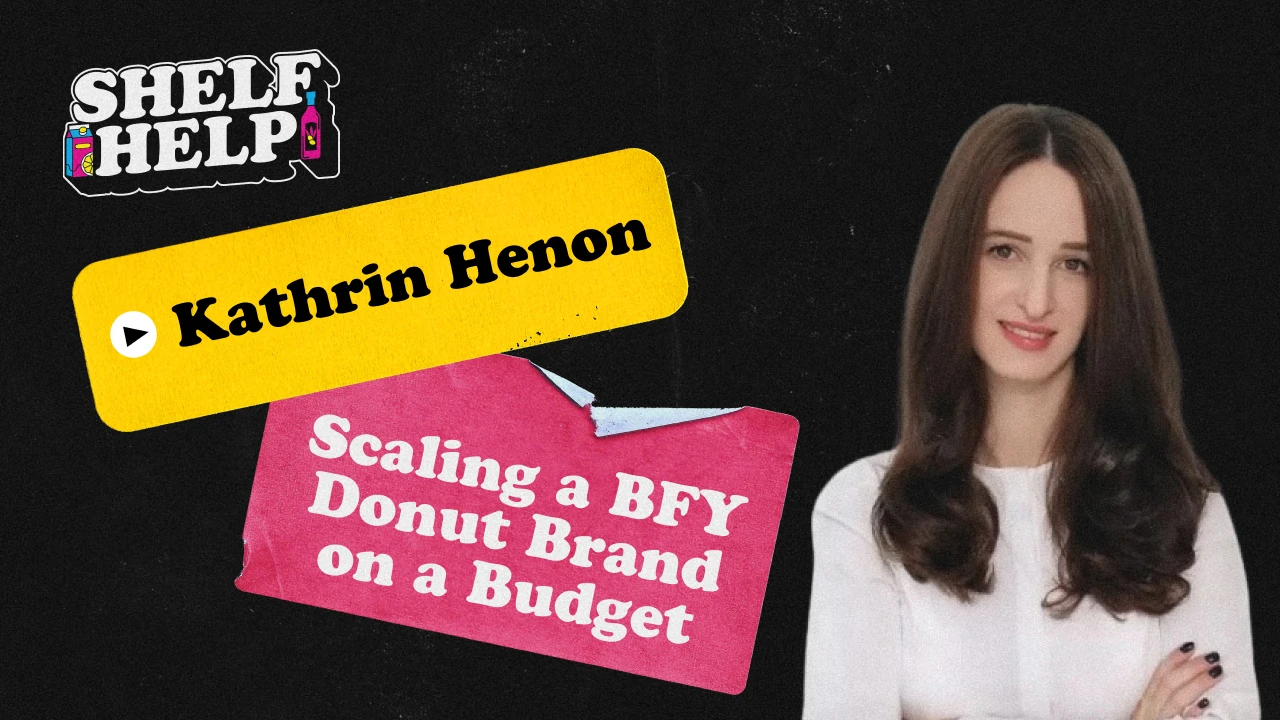



On this episode, we’re joined by Kathrin Henon, Founder & CEO of Planet Bake - the better-for-you donut brand making sugar-free, low-carb, gluten-free, plant-based donuts that actually taste indulgent.
Kathrin shares her journey from a design and fashion background to building Planet Bake during the pandemic, driven by a desire to solve real problems around sugar, metabolic health, and access to healthier indulgences. Growing up in Germany shaped her perspective on food quality and sugar consumption, and that lens heavily influences how she thinks about formulation, branding, and product strategy today.
We get deep into the tactical side of building an early-stage CPG brand. Kathrin walks through brand identity and packaging decisions, early formulation and R&D challenges, how Planet Bake explored different sweeteners before landing on the right solution, and what it takes to find and work with co-packers early on.
A big part of the conversation focuses on early-stage financial pressure: managing cash when vendors want upfront payment, tools that can help bridge cash gaps, and why fundraising, banking, and credit are especially broken for emerging CPG brands.
---------------
Episode Highlights:
🍩 Building a better-for-you donut brand from scratch
🇩🇪 How Kathrin’s German upbringing shaped Planet Bake
🎨 Brand identity and packaging design decisions
🧪 Formulation, R&D, and sweetener exploration
🏭 Finding and working with co-packers early
💸 Cash flow challenges most founders underestimate
🧰 Tools that help relieve early-stage cash crunch
🤝 Fundraising and financial support for early brands
📦 Velocity vs. distribution in the early days
👥 Building demo collectives to drive sell-through
🚚 Distributors, brokers, and retail strategy
🚀 2026 goals and trends Kathrin is watching
---------------
Table of Contents:
00:00 – Intro
00:48 – Origin story
02:57 – Kathrin’s German upbringing
04:22 – Brand identity and packaging design
06:31 – Formulation and R&D
09:36 – Sweetener exploration
11:52 – Product roadmap
12:29 – Co-packers
15:56 – Cash flow challenges
17:52 – Tools to help with the cash crunch
20:08 – Fundraising at the early stage
21:54 – Support communities for early-stage founders
24:04 – Velocity vs. distribution in the early days
25:41 – Building a demo “collective” to drive sell-through
26:42 – Distributors and brokers
29:18 – 2026 goals, Sprouts
29:54 – Trends Kathrin is watching
---------------
Links:
Planet Bake – https://planet-bake.com/
Follow Kathrin on LinkedIn – https://www.linkedin.com/in/kathrinhenon/
Follow me on LinkedIn – https://www.linkedin.com/in/adam-martin-steinberg/
For help with CPG production design - packaging and label design, product renders, POS assets, retail media assets, quick-turn sales and marketing assets and all the other work that bogs down creative teams - check out KitPrint.
Episode Transcript
Speaker 1: 00:00
Welcome to Shelf Help. Today we're speaking with Catherine Hennan, founder and CEO of Planted Bake, New York-based brand that makes sugar-free, vegan, gluten-free donuts that actually taste like really good donuts. Born and raised in Germany, Catherine spent a fair amount of time in the fashion industry before having a bit of a wake-up call during COVID, which kind of led her to realize how much sugar people consume and how few truly healthy dessert options exist in the market. I mean, that's kind of what led her to where we are today. So yeah, excited to get into it. Catherine, just first off, for the listeners that aren't that familiar with Planet Bake, just give us just a quick lay of the land, just in terms of kind of origin story, why behind the brand, core products you got currently in the lineup, and then maybe just throw out a few places that people can get their hands on them, and then uh we'll go from there.
Speaker: 00:49
Yeah, sounds great. Thank you so much. Um yeah, I, you know, as I grew up in Germany, my favorite day wasn't just a holiday or my birthday in general, it was actually Tuesdays, because on Tuesdays we went to my grandmother's house and where she baked donuts for me and all of my cousins. And so it became a ritual that makes, you know, it just felt magical at that time. You know, we would get together, all come together and really like sharing this specific moment. And so later on throughout the years, and that happening every week or day of the week. Sorry, every every week, so baking became harder for her. And so we, the cousins, took it on ourselves to really keep that moment of choose day donuts alive.
Speaker 1: 01:34
Love that.
Speaker: 01:35
Yeah. And so, you know, that's this is actually how Planet Big was born in 2021, based on this origin story. Um, as we all know, fried donuts are loaded with sugar and provide no nutritional value. Um, and so I had a family history um with chronic inflammation, diabetes, and colon cancer. Um, so I really wanted to create something that is truly good for you and provides essential nutrition that the body needs, you know, on a daily basis. So our product, our donut is not a protein donut. Um, it is really focused on real ingredients, super simple. We use flaxseed, arrowroot, almonds, fascillium has, real ground spices, cacao, cocoa, avocado oil only, and then we use allulose sweetener. And so currently we sell four skews, meaning four flavors in the market, which is dark chocolate, cinnamon, vanilla, and blueberry. And product can be uh found across the East Coast, really, in key retailers. We just recently launched with Shopride. We are in a lot of the independent in the city in New York City, as well as, you know, a couple of stores in California, where you can find a product at Barclay Bowls or in San Diego Windmill Farms, and then uh, you know, out on Long Island in like uh North Shore Farms or Wild by Nature.
Speaker 1: 02:57
Do you think that your German upbringing has influenced the way you view the US food system compared to the European one, which I know people often have a lot of comments about, and or just the way you approach entrepreneurship in general?
Speaker: 03:11
I would say within the food landscape, yes, definitely, based on the ingredients and what's possible in America, what's not possible in the EU. You know, people are speaking out much more than they used to about those differences. I I, as a consumer, I don't buy anything specifically in the US that number one, I don't know what it is, I don't understand it, or I know it's harmful. So this is just where I draw the lines, and this is actually how I wanted, you know, to create Planet Bake as a stepping stone into the right direction and just avoiding all the crap, no gums, no artificials, no anything that can really harm you. And I know allulose, there's not too much research out there yet, but I believe that it has great potential, and there has never been a bad article or research study about it. A lot of trust into the ingredient itself and what it can do for the human body. And so I believe, yeah, I think the EU guidelines definitely have its advantages in in many ways.
Speaker 1: 04:19
Yeah, totally. I would agree with that. Well, yeah, let's rewind back to, I think it was probably 2020-ish when you were working on the brand identity, initial packaging design, thinking back to those a few years back. What do you remember were kind of the key variables that were top of mind for you when you're building out the brand identity and kind of positioning and voice for Planet Big?
Speaker: 04:40
Yeah, I actually, because I have a fashion design background, I started the graphic designs background, I started developing the packaging myself.
Speaker 1: 04:48
Nice.
Speaker: 04:49
And based on that experience, it's constantly evolving. And that's also due to um, you know, FDA regulations. My goal was always to make the product sustainable, um, which makes it really hard, especially in the United States, um, because the food regulations are so specific where you're not allowed to use basically X amount or this material versus another. You really have to use, like, there's only one way in the industry currently, like the, you know, all the wrappers that everybody really uses, it's very limited. So there's not a lot of innovations around that unless you come to a specific scale where you might be able to uh make a corner and get out of that and you know, utilize a different, more sustainable material.
Speaker 1: 05:43
Yeah. No, that makes total sense. Naming is always such like an it's such an important part, but it feels really ambiguous and can feels like it can be a challenging process where people can get kind of lost. Yeah, thinking back to those early days, what did that naming process look like for you that ultimately landed you on Planet Bake?
Speaker: 06:01
I mean, I experimented with different names, different options. I came to Planet Bake because it just felt right for the brand and the planet. So I always wanted it to be focused on the people and the planet, not just either or. I always needed to them to be as a whole combined. So the early slogan actually was good nutrition is our mission. And I've always stood by this years over the years as I have been building out the packaging, the branding, the marketing, the sales, the brand itself.
Speaker 1: 06:31
Formulation RD standpoint, I imagine it probably took a little while to dial things in and kind of find the formulation process that really worked. I'm not sure if you started in a home kitchen and then kind of evolved out of there. But yeah, without giving in away any trade secrets, what were some of those kind of key factors that and variables that you played around with or key tweaks you made along the way between, let's just say, the first version of the donut that you made to the point where the final version that you said, okay, I know this is right. I feel great about this, I'm ready to bring this to market. And were there any kind of must-haves and andor non-starters, let's say?
Speaker: 07:06
I would say it's constantly involving, especially since, you know, trends are changing or regulations are changing. Yeah. Um, or you want to enhance the flavor of a product versus, you know, based on feedback or consumer outreach and studies. So at the very early stages, I mean, it took me nine months to develop the recipe myself. I did not have any third party involved in that process. Um, I took my sweet time with this. There was lots of obstacles, especially if you're looking in the simple ingredients, like how to keep them all together and make them come out in a certain way and also last. Um, so the the very early product, you know, it was molding really quickly. And so we had to adjust over time to figure out what is the sweet spot on ingredients that we have to use. And this is actually why we used ingredients to amount as well. They're all natural, there's no preservatives. So the ratio really matters. And I had to learn it a little bit the hard way. Going into market, not knowing all the details could sometimes be challenging. But overall, I mean, as I said, I think the recipe is always involving. You always want to improve and make it better and take the most important lesson everybody should learn is listen to your consumer because they're the one consuming and purchasing the product, and that's the ultimate business goal. Yeah. So from that perspective, I mean, it was lots of hits and misses, right? A lot of RD, a lot of testing. We worked with a lab for Shelf Life Studies. Actually, it was Cornell University for me. Um, I always trusted him. Pricing was efficient, and so it was just uh, yeah, it's a process and it's still involving today.
Speaker 1: 08:51
Right. It's an evolving thing. The product is never done, right?
Speaker: 08:53
Exactly.
Speaker 1: 08:54
Was there one thing that really stands out in terms of was like the biggest challenge to get to the formulation that you felt like was the one that you were happy with?
Speaker: 09:04
Uh yeah. So when I did the product in my commercial kitchen, the last final tweaks was really the chocolate on top.
Speaker 1: 09:12
Okay.
Speaker: 09:13
Like I needed it to be sweet enough, but not too sweet, because you know, Alielos, it's expensive. You know, it has its own uh contributions to the product, I would say. And so yeah, it was just the final piece that finally came together, and then moving that into scalability, like moving into a combacker was the next final step.
Speaker 1: 09:36
You touched on Al Al Al I now I can't say allulose uh was a sweetener that you ultimately decided upon. Did you explore other options like whether I don't know stevia, monk fruit, probably not circrolose? Um yeah, any other options that you tried? And then I'm kind of curious what were the kind of decision factors that ultimately led you to say I feel like allulose is is the one I want to go with. This is the best one for me.
Speaker: 10:02
I discovered allulose really early on. Um and so that was really in 2020 when the FDA finally called it out on the ingredients label for what it actually is. So you didn't have to list it under the carbohydrates as a total anymore. You would have to call it out below the sugar. So it was into the carbohydrates, but it was not a sugar. So that gave a little bit of a transparency, I would say, to the customer.
Speaker 1: 10:27
Sure.
Speaker: 10:28
Um, I know a lot of brands today, they don't even call out the the grams that are inside in regards to allulose, but we at Planet Bake, we do because we want to be fully transparent. It is our number one ingredient, and so I think people should know how much is in there and what they're eating. I think it's just, you know, important to know anybody who is making a health cautious decision. Um, I am always for full transparency in that regard. But allulose, you know, I started with it immediately. I did my research on it, I read like all the studies, all research studies that were out there. I know how it's composed, I know that it's converted, I know the chemical structure of allulose inside and out. And so, you know, just from that understanding versus other sweeteners in the market, I did not want to use Stevia, I did not want to use MonkFront because of the aftertaste and what consumer brought back to me that they really hated. And they don't enjoy it and it's it's declining. I feel like a little bit altogether in the market currently, which wasn't the case in 2021-22. And so erythritol was another sweetener that I looked into that seemed interesting, but I decided ultimately against it at a certain time when some of the not so great studies came out.
Speaker 1: 11:51
Right, totally. That doesn't surprise me. Anything that you're able to talk to in terms of anything that's next on the product roadmap?
Speaker: 11:58
So right now, nothing is in the pipeline. I have experimented with many products in the market. Sure. I mean, when we first started Planet Big, I have released cheesecake, I have released cookies just for the consumer testing and how the feedback and what they like, what they don't like. I mean, there's so many different ways. Some of our competitors are coming out with muffins. And so it really depends on like what roadmap and what direction the company will go, um, which is not determined at this time.
Speaker 1: 12:29
I think when we spoke a few weeks back, we we talked about copackers a bit. So just double-clicking on that a bit. Uh I guess first off, was it pretty challenging for you to find a copacker that was gonna be a best a good fit for you just from a the product standpoint in terms of what the ingredients are in the formulation? It's obviously not a normal donut. It's pretty specific in terms of the formulation and and kind of the the ingredient makeup list. Like, what was that process like for you?
Speaker: 12:55
Yeah, I would say based on the recipe, uh it has been super challenging. And there's not many uh um co-packers out there. Number one, small scale volume. Yeah. They're still technically handmade today, even with the co-packer, because it's such a delicate process, I would say. Um so based on the ingredients, you know, it has nuts. So that makes it challenging to find the right partner.
Speaker 1: 13:19
Sure.
Speaker: 13:20
Does not contain gluten, so it's not your typical bakery who has all the processes because of X, Y, and Z, they do milk processing and dairy processing, which even like you know, it's just something that we stand for and that I want to um not not take away from.
Speaker 1: 13:40
Sure.
Speaker: 13:41
And so allergens in general has been an issue. And then from the recipe itself, it is not a regular donut dough. It is not a regular cake batter. So it's something in between. So the processing of this is, you know, you have to get used to, you have to train the team. It takes a lot of energy and time and and resources to put into that specific process. Finding a co-packer in general, um, I would only say it's your life partner, technically. You speak to them on a sometimes daily, sometimes weekly basis. And finding the right partner is essential to number one, scale the business and to even survive in today's environment. So if your margins don't add up, you don't get X mindset, they're not responsive, that's a red, that's a red flag. And I know a lot of, I'm saying this because I know a lot of founders who have so many challenges, especially since there's so many new brands out there. I feel like a lot of co-packers are taking taking advantage of that.
Speaker 1: 14:43
Interesting.
Speaker: 14:44
Like pushing pressure, you know, delivering product late for two, three months or not responding to emails and calls at all.
Speaker 1: 14:50
That's not true.
Speaker: 14:51
We have seen that a lot in my community itself.
Speaker 1: 14:53
What did you find was the best way to kind of get them to, I guess, take you seriously as as a new brand and ultimately getting them to say, yes, I'm gonna give you a shot and let's let's uh let's go down this road together.
Speaker: 15:04
I think transparency and being very open and communicative about where the business is and where do you see it going? I think that's number one. If you don't have a plan in mind, and you know, you have to convince them that it's an external, they don't know anything about you. So why would they give you a shot? It's technically like pitching to an investor or to a buyer.
Speaker 1: 15:28
Yeah.
Speaker: 15:28
It's a it's the same approach. So you need to make sure they know you have some leverage. And then mostly at the very beginning, if you're just coming out of a commercial kitchen to a copacker, I would say that's very challenging. I mean, you still need to show some sort of a roadmap, but it's more like uh because they're probably on smaller scale. But if you once you go to that next level, I feel like copackers are more open to having a real conversation.
Speaker 1: 15:57
As an early stage founder, I think when we talked, you were kind of talking about, and I've heard this from you're not the only one I've heard from this from, is how it can be difficult in the early days, was just in that a lot of vendors, whether it's co-packers or it's you know, ingredient suppliers, packaging suppliers, or whatnot, a lot of them asked for pretty significant upfront payments or deposits just because I guess you know the vendors see the risk that the brand could be buy out of business as a new business, but you know, it's kind of like the chicken or the egg thing. It's like, you know, one of the things that increases the chances of an early stage brand having cash crunch challenges is because of all these upfront payments. From your experience, have you found any ways to kind of navigate around this?
Speaker: 16:35
Yeah, I mean, I think it comes back to the same uh concept of having an open communication and talking to the vendors and partners. So let's say you work with a vendor for a year, right, and you have paid them constantly upfront for a net 30, and then going out of your way, since you have built this relationship to say, hey, you know, we are sitting on this ingredients for six months. And because we buy large volumes, but even as an early brand, we don't move as much as somebody who's selling currently in Walmart, and we understand that. But would you be open to uh giving us like a six month term, for example? And just like having that open communication and then being like, you know, if cash flow is struggling, just being up front, like in five months, say, hey, you know, can we push out another 30 days? I know I have this sum coming in, and this is you know when I'm gonna pay you. Yeah. And then, you know, I mean, distribution companies in general, they're also not on on perfect target with their payments as well. So it makes it even more challenging, especially if you're having a big PO or something.
Speaker 1: 17:37
Right.
Speaker: 17:37
Financing doesn't really always work out in the way we would like to. Even if you have invoice financing or PO financing, they still want their money. And if somebody in the chain is late, it's gonna throw everything off.
Speaker 1: 17:52
Right. You also mentioned when you were talking, you highlighted just like a few tools that you'd thrown out there that are pretty supportive and helpful for early stage brands. I think to you you had mentioned was Spring Cash and Waveflyer just being two. Any other ones that early stage operators should should know about and other ones that you found to be really helpful?
Speaker: 18:10
Yeah, I mean, overall, I think funding in general is tough, right? So if you're talking to a Waveflyer or a Spring Cash um age company, they can be helpful in a certain way, but you really have to have know like what are you using the capital for and why do you need it. Wayflyer, for example, is especially in regards to um cash flow in regards to inventory specifically, which can be very helpful, but you you still have to produce the cash to pay them back on a monthly basis or bi-weekly.
Speaker 1: 18:40
Yeah.
Speaker: 18:42
Spring Cash is more of like a bigger PO that they want to cover and give you upfront terms. Other than that, I think it's really important for early founders to look into grants because it's free money.
Speaker 1: 18:54
Yeah, totally.
Speaker: 18:56
I am in the community of and choose foundation, which has been really helpful for female founders specifically. They always have different grants, marketing, Amazon, you know, there's different opportunities out there. And that those are not the only, this is not the only organization who's offering this. Yeah. So the most important thing is just keep the keep the eyes open and keep looking for these opportunities online. And one of the current ones is actually who has just been released is ShelfMate, which is another great community for early founders who are really at the early stages of, you know, maybe 250,000 revenue, but now they need to scale to half a million or even a million in revenue. So there's nothing in regards to funding in between, and it's really hard for founders at this stage. It's easy to get maybe a line of credit, but beyond that, it's very tough. Even an SBA loan or whatever is really hard if you just want to rely on the business credit credentials solely.
Speaker 1: 19:59
You chose the bootstrap from the outset, and then I think you started approaching investors at some point, and I think you kind of shared a challenge, which is not the first time I've heard, is that there's kind of a you kind of started to see a gap in the ecosystem for call it pre-Series A CPG brands in terms of investors that are willing to take take a chance at that stage. Um, what has this experience been like for you and any kind of solutions or investors or investor groups you found that have been supportive and andor helpful at that early stage?
Speaker: 20:32
I would say so Planet Big received early funding at the within the first couple of months. So we were approached, we were approached by a local firm here in New York City, and we we did a strategic partnership. The money was used for scale, so we launched into all the choose press stores, scale operation, commercial kitchen, in order to then move to a co-manufactur, co-manufacturing facility. Um that process itself was easy because they approached me. But after that, I would say as funding got harder and harder, and with AI coming in and all the other industries, tech specifically, I feel like the consumer space has been left out of the picture. And everybody's talking about it today, how you know how challenging it is. But I would say there's still consumer angel investment groups out there that every founder should be talking to, even not maybe right now to pitch, but just to have a conversation, just you know, opening the doors, having the conversation, being transparent of where the business is, you know, where it could potentially go, just handing out some samples, and then when the time is right, you know, just submit an application on the website and and see what happens.
Speaker 1: 21:55
Being a founder can be pretty lonely at times. I feel pretty lonely at times. And one thing that you told Me was that you wish you had known known about or had found communities and community resources earlier. Like ShelfMate is one great example. Outside of that one, what kind of kinds of things in this realm have you found to be most helpful?
Speaker: 22:13
Yeah, I would say. So when I started the company, I used to tell my um boyfriend that I'm business lonely. So he was really the only one I kept talking to. And that was twenty twenty-one, twenty twenty-two, like real pandemics. And then kind of when it opened up a little bit, I started going out to uh um naturally new New York events. Um and they're all across the name the country. Startup CPG is another one. And what I have found in the last, I would say, two years is there's a lot more experience-based community building, especially in New York and probably other bigger cities, where it's more like founder focused and wellness focused. So those are the two things combined that they're bringing together. There's come one of my friends, she is doing um her company's called Shanti House. So it's always yoga with some information or wellness, inspiration, tech, what health tech, whatever that looks like in the environment or consumer. Um, and really just like bringing those two worlds together, especially with mental health and whatnot. Then another friend of mine is too is running a club here in New York City called Girls Who Meet. So she brings together these girls' groups every week, twice, who are just doing these fun activities together. And I feel like this is how you what I'm trying to say is these communities are popping up everywhere. It's not just those two. They're like literally anywhere. And this is really great for founders. Number one, to talk to people about the challenging they're having, but secondary, distribute your product, get feedback, try, give it and get it into people's hands, and then just connect on a personal level or see who can you partner with, who else is out there. So those are just different ways that I've approached it, and also in regards to brand awareness.
Speaker 1: 24:05
Shifting gears a little bit, talking about go-to-market growth, retail, distribution, and everything in that realm. Um, I think especially in the early days, there's kind of a delicate balance that has to be struck between expanding door count and maximizing velocity and making sure you're going to stay on the shelf, the doors that you get into. What's been your approach here in terms of managing that delicate balance?
Speaker: 24:26
So since I started Planet Big and I opened most of the doors myself at the very early stages, is you know, just going door to door and doing demos in person. That has always been the number one um success. When we first started, I would say during the pandemic, it was really easy to sell into stores because the big companies couldn't deliver. So I opened like 10 stores every week as I'm, you know, doing demos twice a week just to get the product into people's hands. And these independent stores in New York City specifically, they didn't really care. They just needed business and they knew the customer needs, they still need groceries and they're operating. So that was really, I would say, easy. And what I've learned like maybe one, two years ago, is it's getting harder and harder. So we really need to convince the buyers in regards to retail, like why you should be on the shelf and what are your benefits. They love to take back in back in 2021, 2022, I did not give any free fills. People were happy to pay for the product full price. Today, if I go out, everybody wants free product. So that has kind of shifted from pandemic versus after pandemic. I actually came together with a female group here in New York City, and we're trying to build our out our own female-founded demo group. So, number one, we don't want to rely on outside partners who are not delivering. They just hire random people, you don't know the performance, you can't control what's happening at that level. You're just getting charged a $250 fee, and you don't really see much um happening. So we we said, okay, let's just come together and do that ourselves, and we will recruit and train and then you know move from there. Yeah, I think another great tool in general is just uh advertising online. There's Instacart, there's meta ads, geo-targeted ads. That has always helped me personally as a woman as a single person running the show. Has um yeah, it's just helped me like get the word out and tell people, hey, this is where you can buy the product, go try it out.
Speaker 1: 26:43
From a distributor standpoint, I'm not sure at what level you started working with distributors, but yeah, from that standpoint, from your experience, that I guess the first question, like at what stage looking back now, would you say a business or a brand should start thinking about engaging a distributor?
Speaker: 27:02
So I always approached it that way where I wanted to start with somebody small. So I had a small distribution company in 2023 in Philadelphia, and so they distributed a product on behalf of me, which was great at the early stages. But then at some point, because they were small, it stalls, and this is the only like they're the only accounts, and this is just how it's going. So you need to think about the next growth stage. So I was adding a second distribution company and a third, but they were all really small, so it kind of like stalls again, and then you have to think about the next step. So last year I made the decision to move to rainforest distribution.
Speaker 1: 27:42
Okay.
Speaker: 27:44
And they're covering the entire northeast right now for Planet Big, and we're planning to move down southeast as well.
Speaker 1: 27:53
That's great. That's exciting. That's awesome. What do you feel like founders maybe misunderstand or approach the wrong way when it comes to distributor relationships and really maximizing that relationship to optimize for success with that distributor?
Speaker: 28:09
It's a lot of work. It's a lot of work managing the relationships. Uh you still have to sell into the accounts. You cannot rely on a distributor to do that. Right. So I've always put a so I have a salesperson on the team who calls literally every store of the distribution company, like maybe four times a year, just to check in, see if there's anything we can do, or even just like pitching the product, just letting them know it exists. Because even if the distributor walks in, they have a portfolio of let's say 200 plus brands, and you're probably not top of mind unless you engage with this rap and you make them, you know, think about you, dream about you, your brand, like they have to fall in love with you. And if this is not the case, which 99% it's probably not, you still have to go completely out of your way to figure out um how to manage the direct retailer relationships.
Speaker 1: 29:07
Are you working with brokers yet?
Speaker: 29:10
We had a broker in the past. We moved away from that model for a little bit, and now we are thinking about adding one for the next year.
Speaker 1: 29:18
Any specific big goals you're kind of focused on for 2026 from a distribution standpoint?
Speaker: 29:23
Potentially, yes. I did an Expo East, which is the last one in 2023, and I got approached by Sprouts.
Speaker 1: 29:36
Nice.
Speaker: 29:37
We have had this conversation. I pushed back for two years now. So I finally went down there and said, okay, we're ready to make this happen. But we'll see. We get a decision in a couple of days.
Speaker 1: 29:51
Nice. All right. Fingers crossed. Last question, and then anything else you want to share. But outside of Planet Bake specifically, obviously you're ingrained in the CPG world, you're probably in stores a lot, just following a lot of trends. Any brands outside of Planet Bake or kind of trends in general in the CPG space that's gotten you kind of particularly excited about, or you've been kind of following along just for fun?
Speaker: 30:14
Yeah, so what I always keep my eye on, so Planet Bake is sold in the refrigerated space. So I've heard some rumors that big retailers are expanding that entire grab and go refrigerated category. Nice. And one of them is Sprouts, who's, I think, thinking about this move. And so that's what I'm excited about is like anybody's who's building out this category as you know, as it's growing and the consumer is really drawn to that section. It's just convenient, it's better for you, you know, all of the above. And so I'm excited about seeing this, how it plays out. Another super large retailer is thinking about adding an entire new food wellness category.
Speaker 1: 30:58
Wow, nice.
Speaker: 31:00
And it will take some time because they're so large, but just hearing that is exciting and we're moving the right direction.
Speaker 1: 31:07
Totally.
Speaker: 31:08
Um, other than that, I mean, I'm always rooting for brands who are super clean, super healthy, better for you, and just, you know, combined, I feel like we can make a real impact.
Speaker 1: 31:19
Well, yeah, that's something great, Catherine. So many great insights here. I think this is really helpful for other founders. Great to learn about Planet Bake. What's the best place for people to follow along with you and the journey that you're on in building Planet Bake? And then what's the best place for people to follow along with the brand as well?
Speaker: 31:34
Yeah, you can follow us on Instagram at planetbake.us or connect with us on LinkedIn. And then obviously we're on our website. And yeah, feel free to reach out.
Speaker 1: 31:45
Cool. Awesome. Sounds good. Listen to great, Catherine. Really appreciate the time.
Speaker: 31:48
Thank you so much, Adam. Thanks for having me.
.svg)