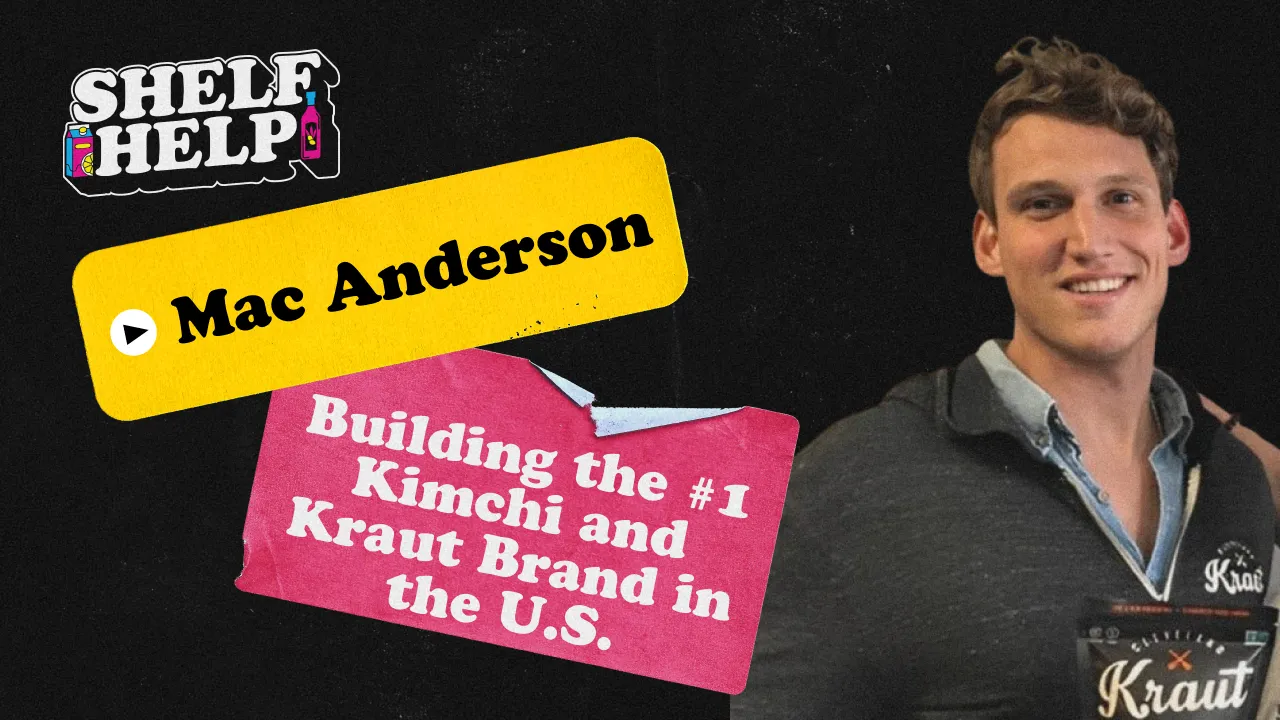
Building the #1 Kimchi and Kraut Brand in the U.S. | Mac Anderson, Cleveland Kitchen



On this episode, we’re joined by Mac Anderson, Co-Founder & Chief Commercial Officer of Cleveland Kitchen (formerly Cleveland Kraut) - the #1 kimchi and kraut brand in the U.S.
Mac, his brother Drew, and their brother-in-law Luke built the company from Saturday farmer’s markets into a national fermented-foods platform spanning kraut, kimchi, pickles, and more, now sitting at roughly 15,000 doors.
We get into the real mechanics of building in the fermented category. Mac breaks down how farmer’s markets became their most valuable feedback engine, what finally gave him the confidence to leave his day job, and how they approached formulation and R&D when “fermented” is both a flavor and a process.
Mac also walks through what it takes to scale without losing quality - minimizing batch variance, deciding when to go vertical with in-house manufacturing, and how a cold-chain, time-based product fundamentally changes the business model.
We dig into brand identity and packaging decisions that help Cleveland Kitchen win on shelf, how they think about defending territory as the category leader, and what they learned from acquiring Sonoma Brinery.
---------------
Episode Highlights:
🥬 Building Cleveland Kitchen with family
🧺 Why farmer’s markets are the best real-world product lab in CPG
🚪 When it actually makes sense to leave your full-time job
🧪 Formulation & R&D in a process-driven category
📉 Minimizing batch variance as you scale
🏭 Going vertical: when in-house manufacturing becomes the edge
🧬 The fermentation business model (time, cold chain, inventory)
🎨 Brand identity & packaging decisions that drive velocity
📈 Scaling into ~15,000 doors
🛡️ Defending territory as the market leader
🤝 Lessons from acquiring Sonoma Brinery
🔭 Trends and brands Mac is watching right now
---------------
Table of Contents:
00:00 - Intro
00:47 - Cleveland Kitchen origin story, building with family
05:54 - Farmer’s Market learning lessons
07:34 - When to leave your full-time job
10:01 - Formulation and R&D
12:29 - Minimizing batch variance at scale
14:06 - Going vertical (in-house manufacturing)
17:26 - The fermentation business
19:59 - Brand identity and packaging design
22:48 - Scaling into 15,000 doors
26:52 - Defending territory as the market leader
29:59 - Acquiring Sonoma Brinery
34:06 - Trends and brands Mac is watching
---------------
Links:
Cleveland Kitchen – https://www.clevelandkitchen.com/
Follow Mac on LinkedIn – https://www.linkedin.com/in/mac-anderson-98500973/
Follow me on LinkedIn – https://www.linkedin.com/in/adam-martin-steinberg/
For help with CPG production design - packaging and label design, product renders, POS assets, retail media assets, quick-turn sales and marketing assets and all the other work that bogs down creative teams - check out KitPrint.
Episode Transcript
Speaker 1: 00:00
All right. Welcome to Shelf Help. Today we're speaking with Mac Anderson, co-founder, chief commercial commercial officer of Cleveland Kitchen, believe number one kimchi crowd brand, I think the number four refrigerated pickle brand in the U.S. as well. Born out of kind of an upbringing centered around the farmer's market, his mom started. So really cool journey. Definitely excited to get into it. Mac, just first off, for the listeners that that maybe aren't that familiar with with Cleveland Kitchen, maybe just give us a quick lay of the land in terms of kind of origin story, why behind the brand, core products in the lineup, and then me guys at a bunch of places and maybe throw out a few kind of core plates as people can get their hands on them and then uh we'll go from there.
Speaker: 00:42
Yeah, absolutely. And thanks so much for having me on, Adam. Excited to chat through our story here today. Um so essentially, you know, my brothers and I started the business at Farmers Markets, as you know, you alluded to in 2014, first as a side hustle. But we like to say our story started well before that. My mother actually founded the network of nonprofit farmers markets here in Cleveland. She just actually retired after 30 years this year. So she's living the good life, but has built that up to now, you know, about 14 markets throughout the city and throughout the seasons. But um, you know, we we we very much built a passion and an understanding. I think most family businesses, whether you're for-profit or nonprofit, will probably kind of resonate with this. But child labor laws tend to go out the window, and you're very much a part of that business from the early days. So for me, it was basically, you know, four years old on. My brother was seven or eight, our older sister, uh, you know, 10, 10, 11, or 12. And uh we were all out there schlepping produce, working with farmers, helping set up these markets from, you know, the very first one all the way through, you know, despite having various finance internships in college, we'd be managing the markets on the weekends. You know, that afforded us a great respect for small businesses, uh, for growers and producers. I think for the local food system, whether that was just consumers coming and seeking better for you natural products well before we had anything like a Whole Foods in Cleveland, or just seeing that farm to table movement grow here, where chefs were really able to develop menus, work with those farmers, forge those relationships, and bring a better food scene to Cleveland. So that had a huge, tremendous impact on us. And of course, as we were getting older and managing those markets, we started to really see what made a great food product, how those were being packaged, you know, especially with the advent of social media, how these brands were engaging with consumers and building out their brand. And we really took notice when a few of these brands would end up on local grocery store shelves. So I think that always stuck with us. And um, you know, as my brother was living in the southeast in Virginia, kind of uh in banking after school, he was missing that traditional Cleveland fare, which is very Eastern European. It's not necessarily our background, but if you're from Cleveland, you know, poys, killbasa, pierogi, sauerkraut, all those things are kind of comfort food. And so he was just finding a nice respite and break from his banking days by chopping up fresh vegetables and fermenting on the weekends. And then he really loved the, not only the flavor and the depth of flavor, but the way it made him feel with those gut health benefits. Um, fast forward, he moved back to Cleveland to work for Key Bank, met my sister's fiance, Luke Visnick, at the time, who was an architect, but was also kind of fermenting as a hobby. So he, you know, his grandmother was always fermenting kraut when he was a kid, so he'd kind of taken that recipe, and they were just getting to know each other over a beer, snacking on each other's varieties of krauts, and just realized um, you know, they had a better product than they'd seen on the grocery store shelves. Theirs was front, fresh, crunchy, delicious. It wasn't pasteurized, so you get those gut health benefits. And of course, they taught me how to ferment one weekend when I was back home from school. So my buddies were wondering what the heck was going on in our kitchen. But, you know, we we again realized we had a delicious, albeit strange, hobby on our hands. And from there, you know, we kind of just kept developing recipes and uh did what we'd seen dozens of times before and and brought our brand and those products to the farmer's market to continue iterating and tweaking and get that you know direct consumer feedback.
Speaker 1: 04:17
I feel like there's oftentimes pretty kind of polarizing views about building business with family.
Speaker: 04:22
Yeah, no, absolutely. I think I think any co-founder relationship, you're going through so many, you know, crests and troughs together. There's gonna be challengers, there's gonna be huge wins. So that always needs to be a very special relationship and can be challenging at times. But, you know, I grew up, my brother was my hero, my mentor. So that was kind of an easy working relationship. And it is unique in the sense that like we can have a you know, we're screaming argument. Rarely happens, but it happens. And then, you know, 20 minutes later the next day, we're we're looking to grab a beer or hanging out. And so I think the bounce back on that was has been very helpful. You know, you're in the trenches with someone that you trust and have known your whole life. I think with Luke, getting to use, you know, my brother and I work together very well. We have similar outlooks and working styles. Luke being from an architecture background, you know, more rigidity, things like that. He had to get used to our working style, we had to get used to his. But again, you know, we're all gathering around the family dinner table on Sundays still. We we get together all the time. You know, I look first and foremost, he's a phenomenal husband and father and a great business partner. So I think it adds a layer to your co-founder relationship that, you know, means more than maybe a good friend or someone that you might have been paired with or had a similar idea. So I think there is a ton of benefits, but there's always going to be those challenges and those things you need to work through.
Speaker 1: 05:54
Your younger years. Um Did you guys learn? Feel like like looking back, any like big lessons you guys felt like you learned about consumer behavior during all those years that kind of drove some of the decisions you guys made and continue to make at Cleveland Kitchen?
Speaker: 06:08
Yeah, I think that direct consumer feedback early on is invaluable. I mean, obviously at a farmer's market, you know, you do have folks that are they're coming there with an open mind. They're more willing to try new things, they're probably much more conditioned to be seeking out, you know, healthier, better for you options. You know, they're there to spend money and fill up their fridge or pantry. So I think that definitely helps. It's also, you know, a time where you can truly engage, get flavor profile feedback. And, you know, it's one of the few places, I think, especially in those early days of RD, where you can truly get you know great consumer feedback and they are paying for it. So that was invaluable. We also, as I made that point earlier, chefs, you know, Doug Katz comes to mind, the team at Spice, Ben Bevanroth here in Cleveland. Like these chefs were building their restaurants on the backs of those farmers' markets and that access being available. So we were able to get direct feedback from James Beard award-winning now chefs who know flavor profiles, and we could tweak those recipes. It also drove, you know, just in those conversations, hey, what are you using on this? This is what I love to use it on. You know, what are those touch points in your pitch that are really kind of driving that consumption? Uh it truly, uh truly is, I think, invaluable in those early days as you're doing the pitch.
Speaker 1: 07:31
You guys all had full-time jobs when you started Cleveland Kitchen for just some of those kind of earlier stage operators out there that are just starting to get some real traction with something that they're building, but they've got you know full-time jobs as well. Like when did you guys pull the ripcord and quit your J jobs to go in? And did you guys have kind of like a predefined checklist? Like, okay, when we get to these certain milestones, it's gonna be time to take a leap, or just kind of a he has all agreed at some point, this just feels like right, let's let's do it.
Speaker: 07:57
Yeah, I think you know, for me, I was working in corporate finance at John's Day for the first year, and then I had I had left to manage portfolios. So that was a much more flexible job, kind of building a financial planning business, which allowed me to go and call on grocers and retailers. So that kind of extended potentially my runway to keep working. You know, Luke being that architecture background, you know, I think that lended itself so well to build building out our first facility, to putting those processes in place. And then Drew leaving the bank. And for a while, he was actually the general manager at the initial kind of shared kitchen that we started at so that he could have some income in. You know, I think it was a little different for each of us. Now, that first year and a half while we were testing, iterating before we launched into retail in late 2015. We'd leave our office jobs, we'd get to the commercial kitchen at 7 p.m. We'd change out of our suits and work till two or three in the morning, and then sell as much as we could on the weekends. And, you know, it definitely was a lot of hustle, less sleep, but it um really allowed us to, I think the variety really helped. So it didn't feel like so much work at the time. It was fun. We were on our new adventure and we could keep putting cat not pulling cash out of the business. And then for me, I was able to move back in with my mom. I didn't have a 401k to cash out. Um Luke and my sister ended up for six months doing that. And even when we decided to quit, you know, I think we wanted to have our first small capital raise in place, be selling in retail, and devote all of our time. But for those first, you know, year and a half, we paid ourselves 200 bucks a month. All of our production employees, where we're oftentimes, if not every day, on the line next to them, we're making far more than us. So that's, I think, the caveat you have to and the sacrifice you have to be willing to make. Like it's going to be very lean times. And if you can plan for that, if you've kind of had an established career and you've been thinking about that, you know, it helps a little better more to have those savings. But if you don't have them and you're young, I think it makes it a lot easier in my case to just be flexible and say, hey, I'm gonna go crash on mom's couch for a while.
Speaker 1: 10:01
Rebinding back to some of those early days of formulation, RD, obviously without giving anyway, you know, too many trade secrets. Like, what were some of the kind of key variables you got playing around with or kind of key tweaks you made along the way? Be kind of like the first, the first versions that you kind of played around to the point maybe that that last one you said, okay, this is right. We feel like we were confident of bringing this, bringing this to market.
Speaker: 10:22
So in the initial trials, Luke and and Drew made, I think, 30 different batches, flavor profiles. And then we kind of honed in on, of course, we want to have that classic, of course, we want to have you know a few flavor differentiations. But again, those early farmers market days were so invaluable. I think also being at the shared kitchen and also having you know a lot of chef relationships where we could ask them, hey, what flavor profile would this go into? But we were getting direct feedback from consumers on our you know, early hero skew was the narnar. It was a very spicy, gnarly kraut. And you know, we just see some consumers be like, wow, this is way too spicy for me. While others were, you know, very excited about it coming back, asking what we put in there to make it so addictive. So we kind of had to find that middle ground. Well, of course it's gonna have some heat. And you know, if you don't like spicy, don't eat the spicy thing. But, you know, specifically our beet bread, right? That had sugar initially, so it's called the sweet beet. And we just noticed that healthier early adapter consumer didn't want as much added sugar in there. So, how can we add carrots and beets into this rather than just being red cabbage to add that natural sweetness and to really get a flavor profile that worked, but also kind of met the needs of the consumer. So there were a lot of little tweaks like that. And still, I mean, we continue to develop our products. You know, it's naming conventions. We started with the classic caraway. Just a year and a half ago, we switched that to the classic sauerkraut and we saw a 30% increase on those velocities simply because maybe the average consumer who is new to sauerkraut and is like, hey, I really want to try this for gut health, or I want to throw this on my hot dog or Ruben might not know what caraway truly is, even though it is in pretty much every traditional Bavarian-style sauerkraut. So it's just making those little consumer tweaks, working with those consumer inputs to always be iterating and improving. But I think in those early days, it was truly invaluable to have both direct consumer feedback, but also work with great chefs on the flavor profiles.
Speaker 1: 12:29
What's been kind of key to minimizing batch variants as you guys have gotten to the point where you're processing, I imagine, you know, tens of millions of pounds of cabbage and cucumbers and whatnot.
Speaker: 12:40
Yeah, so I mean that's that's definitely been a process scaling up. Um but making sure that we have the same quality and consistency from our product is always, always been important. I think, you know, where we typically merchandise, especially in conventional grocery, is produce. And we're actually able to help those produce departments and those retailers over-index on their e-commerce sales. You know, I don't know about you, but I still am very hesitant to have, you know, a DoorDash shopper or Instacart shopper that does they do great. But, you know, do I want them picking out my avocados or my fresh greens? Are they going to take the same amount of care? But items like ours that are consistent from batch to batch and are the same every time you get them, that that is something that the consumer is very comfortable with. So that's of the most priority to us. So it was really about you know, how can we make sure the ratios are correct? How can we make sure every step change we take to producing, you know, tens of millions of this pounds of this from you know our humble beginnings is is that same flavor profile. So there's been a lot of science into that, and then just the process updating what machinery are we using to, you know, take those first batches and that consistency and quality up in terms of forms of factor.
Speaker 1: 13:58
Heard you say you touched on your brother-in-law architect, he is super invaluable bringing on building out the production facility. And I think I'd read that you guys one of the main reasons you guys decided to do that was just you didn't feel like there were any co-packers out there that can really make the product to your spec. I guess my question would be if if that had if that was different, that had changed, um, and or maybe now you discover that there were one or a few that actually could do that, like do you think you guys still would have built out an in-house facility if this something popped up? You think you guys would make a transition now, or you guys feel like that was really the right decision?
Speaker: 14:28
I mean, it it was definitely a tough decision and has been challenging to build manufacturing. For us, we simply couldn't find the quality, the texture from someone who was willing to give us line time at all. And I, you know, obviously selfishly still don't think there's anyone matching that from us. But I think it's it's proven invaluable. It has definitely added value to the business. We control everything from not only our quality, which is paramount, but our service levels. You know, 99% plus is our metric, and we never go below 99% on time and in full. And if you're working with a third party, you can't always control from that. It does tend to add more complexity to your supply chain. But it is a great way to get out to market fast. And I think in those early days, if we could have had that partner, I think we we might have. It would have allowed us to scale quicker and just focus on the sales and marketing. But again, especially, you know, in the post you know COVID era, I think what we all saw when supply chain was tight, those brands that didn't have you know enough buying power were off to the wayside. You know, they weren't able to get runs for several months. People were focused on keeping things in stock or their core items. So I feel like you lose a little bit of control on your own destiny. And then in terms of enterprise value, I I do firmly believe that you know, we we've driven a lot, but it has taken a lot of capital expenditure. Obviously, you know, we've got almost 150 employees today, and you know, 90 of those are on our production floor and and our team members there. You know, for me and us as Cleveland boys, it's it's really rewarding to have that kind of workforce and be able to provide those jobs, but it is definitely. I think today we've gotten to a place where our asset is phenomenal. We're SQF certified, we've got a state-of-the-art facility, 70,000 square feet here in Cleveland. And it also offers us the opportunity to only with strategic partners, you know, maybe look at private labeling for some retailers. And we have done so in the past and we currently do, and that affords us a more strategic relationship with select retailers. You know, we wouldn't go out and start private labeling for a competitive brand. But yeah, if if someone were to say, today we can we can do all the things that you can do, would you come with us? We wouldn't, we wouldn't. Now you're also giving out margin. But in new product innovation, we had uh in when we early launched our pickles uh with Walmart, we needed to have a co-packer. So we found a very quality partner uh out of New Jersey and we had a great relationship with them. But as soon as we could bring all that in-house through our acquisition and build out of our facility, we did so. And it's the same with our sauces. You know, until we prove something out in retail, it doesn't make sense for us to put in, you know, a $10 million sauce packing line just yet. But we still are making uh considerable amount of those inputs, and we've got a great partner there. So it just depends, I think, on the product line and the lifecycle.
Speaker 1: 17:26
I feel like fermentation is a unique process for for maybe some other operators that are in kind of very early stage of building out a CPG brand that's focused around fermentation. Any kind of recommendations for things that they should keep top of mind or like pitfalls to avoid?
Speaker: 17:41
Yeah, no, a hundred percent. I think keeping the kind of your your facility, there's so much that can affect fermentation from temperature to you know what is in the air can affect your quality. We learned that kind of the hardware early on. We were in that shared kitchen and there was a kombucha producer in that same shared kitchen, and we ferment at a considerably lower temperature than does kombucha. So they were kind of leaving and jacking up the the overall temp of the building, and that would kind of cause our like we lost several runs of our, you know, it was only a thousand, two thousand pounds at the time, but for us it was very meaningful, and we had to throw that away and and restart. I think ensuring that your environment as much as possible is is you know very much controlled. And then, you know, I think it offers a it's one of the most food-safe processes you can run. Does naturally just kill off any pathogens and creates much better shelf life and a very safe product. So I think that is an advantage versus a lot of other food products that you have safety kind of built into your product and to the identity of the product. But you made an earlier point about scaling. You know, how do you make that jump? And I think that's where you know you go around the country, you go to different regions of Whole Foods. The Midwest is going to have a different, smaller, you know, premium sauerkraand and purveyor than Will Florida or Will SoCal. And that's because, you know, it's certainly not easy. Everything is is challenging, but scaling from you know zero to a million bucks is a much different animal than to, you know, mid-da mid-A figures, high, high nine figures, whatever you're at. But really scaling that is challenging to keep that quality and consistency. So it's just how can you best scale that process while ensuring though those flavors and those qualities are the same. But I think uh it's a great space. I think, you know, luckily and obviously the American consumer is very much more aware of what fermentation can do for your body, can do for flavor, and I think we're just getting started there. So it's a great category.
Speaker 1: 19:59
Thinking back to when you guys are building out brand identity, visual identity, packaging design, what were kind of some of the key variables that were top of mind for you in your building out kind of the brand identity positioning voice for the brand.
Speaker: 20:11
Yeah, no, 100%. I think that's another thing that's ever evolving for us. You know, we started, and the Cleveland name, obviously, here was very easy for us to get and gain notoriety for us to get into those early retail stores. But, you know, that definitely presented challenges as we scaled. So early on, we were lucky enough there was a a much larger business and a man who had exited an engineering firm that came out with Cleveland whiskey. And he had a very unique process where he essentially was kind of compressing the barrel through the barrel in very unique to really quickly create a barrel-aged whiskey. I can't say it's my favorite whiskey, but what he did was invest significantly into market research and was very kind to share that with uh actually our first whiskey deal that contained Cleveland whiskey. Shared that with us. And you know, Cleveland meant across all the major cities LA, New York, Chicago, Miami. It resonated in the sense that it kind of identified with a hardworking mentality, a blue-collar, trustworthy place. I think it it stood for something, certainly for us. You know, we're we're putting our city on our back. It's always often overlooked. It's a great place to be, especially as kind of we discussed before this between uh May and October, your best time to be in Cleveland. But we took a lot of pride in that. And I think it certainly helped us have that identity, but we've continued to evolve on what that means to us, what our brand voice is. We've always kind of had this, you know, fun, playful, but very hardworking, slightly gritty edge to our brand. And, you know, marrying that up with who our consumer truly is, looking for these fresh, delicious fermented foods has been, you know, an evolving piece. But our director of marketing, Amanda Shoemaker, has been phenomenal in that process over the last two years, and you can see it reflected in our brand refresh. Where we've actually brought Cleveland much larger in the logo because that is ownable versus kitchen. But yeah, I mean, like, Giant Eagle's a great example. We were crushing it in Ohio and Indiana, and I was speaking with the buyer, and he was like, I'm just very hesitant to bring you into Pittsburgh. You know, we're sports rivals and this and that. And I was like, if you just give me the opportunity, like authorize my SKUs, I will go store by store and sell it in. Can you let me do that? And he said, I'll let you do that. And it was, I don't know, four months later at a fancy food show, he comes up to me with his hand extended. He just said, I'm so sorry I ever doubted you. You guys are knocking it out of the park. And we've just seen, hey, we make it in New York, we make it in LA, we make it in Pittsburgh. Uh, we also realized when we were doing demos that nobody in Pittsburgh really cares about us as a sports team because we're not very good. But uh it was a fun learning.
Speaker 1: 22:48
From a go-to-market retail perspective, I think you can correct me if I'm wrong, but I think today the brand is sold in like roughly 15,000-ish doors. What were the keys, like thinking back to going from scaling from a hundred to a thousand doors? And then were there any like big differences in terms of scaling from a thousand to ten thousand in terms of what your approach needed to look like?
Speaker: 23:11
Yeah, yeah, definitely. Um I think even those first 24 doors being Heinan's our you know first local retail partner, you know, I was calling on that guy for what felt like months and months. We were seeing so much success in the farmer's market scene at at you know local one-off independence and getting write-ups, working with key chefs in Cleveland. But he kind of said, hey, I have a local sauerkraut, like I don't think I need another one. Uh, but I finally convinced him to take that meeting, you know, within 15 minutes. He not only loved the quality and and the flavor profile, but I think we were also entering at not an ultra premium price point. We were certainly more premium than you know your traditional bagged mushy pasteurized sauerkraut, but we were still very accessible, and that's always been critically important for us. But, you know, a month or two later, I was going in to sell him a couple additional SKUs. He just told me, he was like, What are you guys doing? I mean, of course, we were hustling, we were spreading the word through social at every farmer's market, hey, you can buy us at Einand's. We were doing as many demos every day as we possibly could. But he's like, if you took, if you would have told me you'd be selling this much sauerkraut, I wouldn't have believed you. Like, what are you doing? And he flipped his monitor around and showed me the data. And we were not only beating every national competitor, but we were adding so many incremental sales to the category and just being data-driven as we were from our prior lives. I just kind of asked him, I said, Hey, listen, will you send me that screenshot right there? And I think it's also critical, those first retail partners that take you in do feel a lot of ownership on your brand. They feel like they helped get you their start, and they totally did. And you can leverage that. You can use them as true partners. And he was willing to share that with me. And we took that data, incorporated into our deck, showed the incremental sales. Heinans, you know, luckily for us, was a very well-respected retailer nationally, and that definitely helped us get into the wagmans of the world, you know, get into new distributors in New York and continue to expand. But I think there was a lot more scrappiness in those first, you know, zero to one thousand stores, you know, doing doing as many store visits as you can, scouring LinkedIn to find buyers, sending cold emails, popping up at stores, as much sampling and demoing and ride alongs with distributors as you can possibly do. You know, again, I was lucky to sleep on friends' couches in in New York and Chicago and just build the market. And I'd try and leave the place cleaner, buy some beer, and you know, have some fun. But it was a lot more scrappy. That next stage as you're starting to speak to you know the much larger retailers is really about getting data-driven, understanding what man what matters to both the retail partner as a whole as well as to that category manager. You know, they're incented on category growth margin. So, how can you tell that story to them of, hey, we're gonna be adding incremental sales, we're gonna help your overall category grow, and it's at a great margin and an accessible price point. We're also gonna build out a robust promotional schedule. So it's all those little learnings. I mean, we didn't know what we didn't know, but we were lucky enough to learn very quickly and surround ourselves with you know great friends in the space as well as investors and advisors that you know had kind of been there, done that, more than willing to help advise. As we can continue to scale, it's it's being strategic around exactly that. How are we driving basket growth that matters to the overall retailer? How are we truly impacting the category and taking leadership? What consumers are we helping them unlock? You know, Walmart's very focused on that premium shopper, and that's exactly who we bring in. So it's all of those pieces as you continue to scale and learn that really level up your selling story and your approach.
Speaker 1: 26:52
Now that you guys own the number one spot for kimchi and craut, does your has your strategy started to differ at all now that you're kind of defending territory, trying to make the gap between you and number two, number three, et cetera, bigger versus when you guys are trying to break into the the top five?
Speaker: 27:12
Yeah, I mean the the strategy definitely has changed, you know, a little bit of that that I didn't necessarily mention was, you know, we were we were three kids from Cleveland, which is not necessarily hasn't been yet a bevy of emerging brands and and food service, food business startups. So, you know, we had to pay bills, we had to keep this thing running. I was almost like any store that's got a pulse, I'm gonna go try and sell our like products into and wherever they want to merchandise it. But that has certainly evolved. You know, we had an early unlock of produce being a great fit for us, and we were able to really build that out as a beachhead. We saw same store sales double in our local Whole Foods when they ran out of space in dairy and shifted our set just to produce, and we took that to Giant Eagle and built out a whole produce programming, and that has always been our focus, especially for conventional, because you get those more premium, healthy shoppers, whether you're shopping at a Walmart, a Target, or a Whole Foods. If you're stopping in the produce section, you're cooking at home and you're seeking out the healthiest ingredients you possibly can get. And that also frames up in the consumer's mind the usage so it can go on salads and wraps and really be seen as that fresh, crunchy vegetable rather than you know, next to hot dogs. It might be more seen as just, oh, I'm gonna throw this on my brot or hot dog a few times a season. So we built that out. We're definitely seeing some followers trying to get in. So we're playing a little defense there, I'd say, but we're, you know, where I see the biggest opportunity for us and all fermented, and you know, I think kimchi had established itself, especially kind of the heritage brands that hail directly from Korea as well as the great Asian American brands here. They had landed on produce and we saw that and and built around them. But what we saw was all ships rose. You know, we bring new consumers into that category specifically, much more attuned to the American census versus simply hitting those Asian American consumers that are so used to the product. And we saw them grow double digits whenever we entered. So all ships are rising. I think our big opportunity is on offense. You know, we have such an opportunity to educate the American consumer, show them how great, delicious, fresh, and crunchy fermented vegetables can be. And that's really the opportunity, I think. Of course, we want to continue to be number one and win out, and we will do that. But I think all shifts will continue to rise as we really educate. And our greater category is, you know, processed vegetables, a $12 billion category that's value-added and offers convenience to the consumer who wants to still have home cooked meals and that great nutritional benefit. And with ours, they they literally have to do no work. They open up a pouch, they pop the top of one of our pickled vegetable items, and there they go.
Speaker 1: 29:59
You guys acquired Sonoma Brinery in 2022. Tell me, like, you know, the highlights, bullets, like tell me a bit about that journey and kind of what led to that and how that went.
Speaker: 30:08
Yeah, yeah. Obviously, our first acquisition, you know, Sonoma, Dave Aerith was a great founder. We felt that he had, you know, the highest quality and best flavored pickles on the market. They were mostly West Coast natural, uh, but he built a healthy little business and kind of in passing, tongue in cheek, he'd mentioned a few years before this discussion all started hey, if you guys ever want to buy a pickle manufacturer, let me know. You know, through the pandemic and supply chain issues afterwards, we had several customers just noting how while we were doing maintaining our service levels, not taking cost. And specifically, Walmart asked us to accelerate our innovation pipeline around pickles a couple of years and say, hey, you know, competitive set in this category is not meeting, you know, anywhere close your service levels. Can you do this for us? And I said, you know, absolutely, you've been great partners. Give me a couple thousand doors and a couple SKUs, and we'll go out and build it. Um, so we initially started on that process, but we knew we wanted to own manufacturing, and we knew that Sonoma had a number one, just a great team, great awareness and understanding. I think what's also was very helpful was, you know, not only the science and process, but the grower relationships that they had uh on the cucumbers was critical. So we were very excited to uh you know start that process. Uh, you know, integrating, we we've since brought that entirely back to Cleveland and we operate out of our standalone facility here in Cleveland, Ohio. That was not the original intent. Uh, you know, we we did build out a very nice facility in Santa Rosa, but you know, there's some challenges there, and um it just we kind of forced to do that, but it's it's net net worked out extremely well for us, I will say. You know, the integration is always going to be tough, especially on a manufacturing team, but kind of pushing your culture over and ensuring you're all going marching to the same drum. And we were really after continuing to support and push the Cleveland Kitchen brand. So that was critical to have that strategy out of the gate.
Speaker 1: 32:18
Totally. If I came to you, gave you a call tomorrow and said, I've been running a CPG brand for a while, I told you, hey, I'm about to acquire you know, a similar business, kind of a similar uh scenario, um, any kind of recommendations you give me or things to keep top of mind.
Speaker: 32:34
Yeah, I I think I'd I'd make sure, you know, fully understanding, especially when you're buying, you know, smaller brands are not as sophisticated, like truly diving into what their sales relationships are, what the data is, you know, are if you've got a new launch and it looks like products are are doing quite well, and I'll give you an example. Like Trader Joe's had taken the Sonoma Manhattans, which are a half sour, they're an excellent half sour pickle. And we felt from the data that they're doing quite well, those were discontinued a year after, but we had actually put a lot in place around the manufacturing of those. So really understanding, you know, is this product truly sticking around and a key retailer you're building around? Also, you know, ensuring that there's not too much cannibalization that would come from like it fits, it works with your greater portfolio. You know, these are consumers that you might not have reached, or they are the same consumer and you can even continue to grow their basket uh if they haven't met your brand. But how can this be a one plus one equals three type of deal is critical. And I think you know, we had a lot of learnings. NetNet, it worked out quite well for us, but there's definitely things that I would go back and better understand so that we could, you know, maybe build that deal a little differently.
Speaker 1: 33:52
Sure, totally. Last question for you, uh, Mac. I know you're so in ingrained in Cleveland Kitchen, but any any brands or just trends kind of in general in the CPG space overall that you've been kind of just tracking on the side for fun or things that didn't kind of piquing your interest at all?
Speaker: 34:07
Yeah, no, absolutely. I think there's there's so many greater macro trends we're seeing. Uh productivity, protein, international flavors, definitely one of my most uh one of my favorites. Just kind of opening up the American palate to new flavors and the American consumer really seeking that out. I definitely some great selfishly that I both uh advise on or invest in or just love the teams. But um, you know, Magic Mind, it our office runs on that that stuff. It's it's fantastic productivity shot, and William's a good friend in that space. But on the beverage side, I really love Bowie uh Agua Fresca. Victor's a great founder, and that juice is is so good. I'm an iced tea fan, so I love Hafta as well. Kind of getting that fix in, that nostalgia flavor, but not sacrificing uh on too much sugar and also helping out with some fiber. I really love you know, brownie pasta, those guys are crushing it. Uh, we've been great friends with Aaron and the whole team there for a long time. And just that story of just continued iteration and finally finding a product unlocked that really it's just on fire right now. And it's so good. I actually made some of their pasta last night, has been fantastic. And then, you know, one of my favorites in the frozen aisle is Lauban. So their dumplings are killer, and uh those bao buns. I mean, when you're when you're on the run and you have one minute literally, throw one of those in the microwave and you got amazing flavor. And you know, Chef Tim Ma over there is phenomenal. His restaurants are just unbelievable, and he brings that to the frozen shelf. And and Patrick Coin, the CEO, is a is a good friend, and and they've just been on a great tear kind of uplifting that whole Asian frozen set. And I think uh what they're doing is pretty special. So I could probably name about 500 more, but it's good stuff. I'm uh the fro the frozen section is definitely having a moment right now for sure.
Speaker 1: 36:07
Absolutely.
Speaker: 36:08
Absolutely.
Speaker 1: 36:09
Well, yeah, Mac, this has been awesome. What's um you had so many great insights. What's the best place for people to follow along with you? And then best place these days to follow along with the brand.
Speaker: 36:18
Yeah, no, absolutely. Um, you know, definitely to merge your brands or founders. You can find me on LinkedIn and then uh, you know, Cleveland Kitchen, check us out on social media. We're doing some fun things every day in ClevelandKitchen.com. But you know, you can find our products everywhere from you know Walmart, Target, Kroger, Publix to Whole Foods, Sprouts, and every independent and great retailer in between. Love it. Awesome, man. Awesome, Matt. Appreciate the time. This is great. I think that's the pod. All right. Thanks, Adam.
.svg)