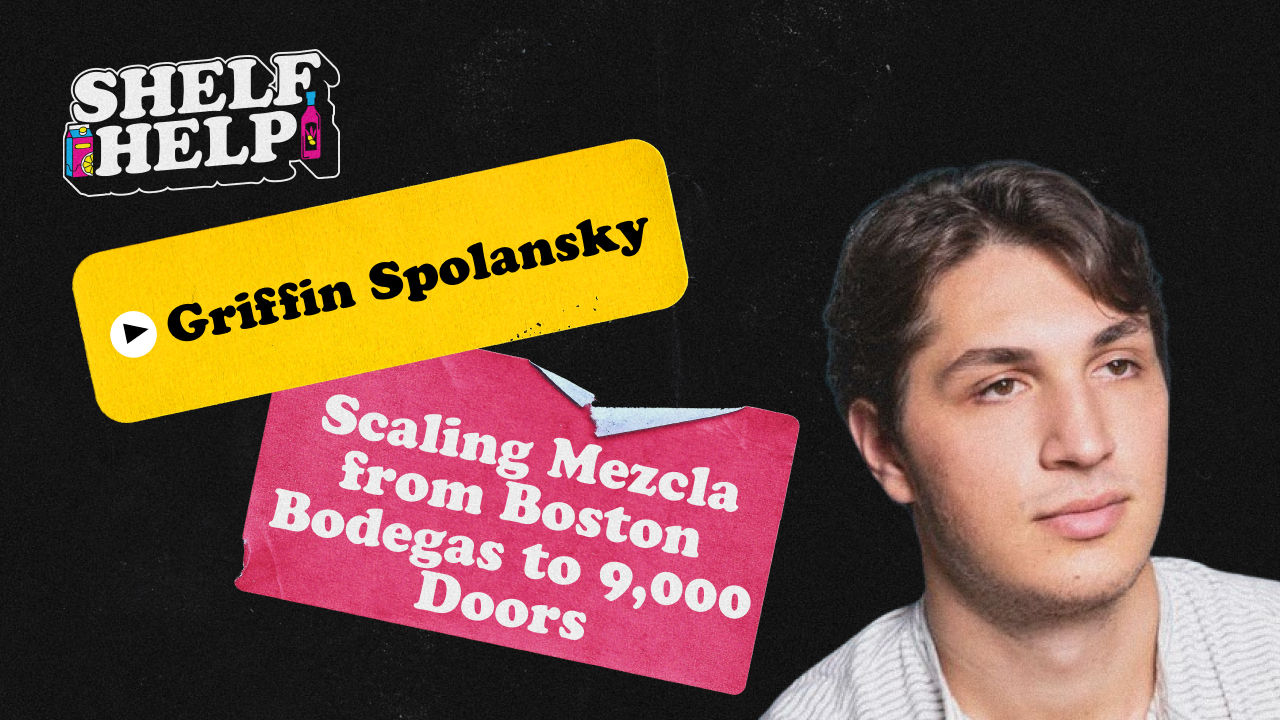



On this episode, we're joined by Griffin Spolansky, Co-Founder & CEO of Mezcla - the plant-based puff crispy protein bar brand that's gone from Boston bodegas to 9,000+ doors and $17M raised.
We dive into how Griffin started iterating in a co-founder's kitchen at 20 years old, how they landed on the puff crispy format, and the gut-driven flavor decisions behind their launch lineup.
Griffin shares hard-earned advice on formulation, finding co-packers, and why keeping things simple beats trying to look sophisticated.
We also get into the real mechanics of scaling from 50,000 bars in year one to a target of 20-30 million this year, why they stripped country qualifiers from flavor names to unlock supply chain flexibility, how their rebrand was driven by shelf clarity needs in mass conventional and club, and the door-to-door hustle that got them into their first 50 Boston bodegas before cracking Costco.
Griffin also breaks down his profitability-first approach to growth, how he evaluates demos and secondary displays against trade spend budgets, and why he believes a founder's job is to create FOMO.
---------------
Episode Highlights:
🍫 Origin story: creating a protein bar that's actually fun to eat
🧪 Formulation R&D and why they chose the puff crispy format
🏭 Finding co-packers and keeping your co-man honest
🚚 Supply chain shifts (removing country qualifiers to scale)
🎨 Packaging rebrand for shelf clarity in mass retail
🛒 Door-to-door in Boston bodegas and cracking the distributor code
💰 Growth with profitability: unit economics as the foundation
🎯 Getting into Costco through Expo West
🛍️ In-store demos, secondary displays, and trade spend math
💸 Raising $17M total and the Series B journey
🔥 Why a founder's job is to create FOMO
👀 Brands to watch: Coconut Cult and Fish Wife
---------------
Table of Contents:
00:00 – Intro
00:37 – Origin story and the idea behind Mezcla
02:10 – Formulation, R&D, and choosing the puff crispy format
05:04 – Advice for up-and-coming CPG founders
06:44 – Finding and working with co-packers
09:07 – Supply chain and raw material sourcing at scale
10:36 – Packaging design and building brand identity
12:01 – The rebrand and designing for shelf clarity
15:09 – Go-to-market: door-to-door in Boston and New York
15:57 – Distributors, DSDs, and the chicken-and-egg problem
17:48 – Growth with profitability and unit economics
19:55 – Building out the board
20:51 – Pricing strategy on shelf
21:50 – Getting into Costco
23:41 – In-store demos, secondary displays, and trade spend
27:02 – Fundraising and the Series B
29:22 – Creating FOMO and the Boshon's model
32:40 – Brands and trends to watch
---------------
Links:
Mezcla – https://eatmezcla.com/
Follow Griffin on LinkedIn – https://www.linkedin.com/in/griffinspolansky/
Follow me on LinkedIn – https://www.linkedin.com/in/adam-martin-steinberg/
For help with CPG production design - packaging and label design, product renders, POS assets, retail media assets, quick-turn sales and marketing assets and all the other work that bogs down creative teams, check out https://www.kitprint.co/.
Episode Transcript
Speaker: 00:00
Welcome to Shelf Help. Today we're speaking with Griffin Spolanski, co-founder, CEO of Mescla plant-based Puff Crispy Protein Bar that's gone from I think door-to-door sales in Boston bodegas to 9,000 plus retail outlets. Last time I checked, probably a more at this point. Griffin's a I think UVA grad, former Walker on the cross player, ended up uh on the 2019 national championship team. Griffin, just first off, for the maybe the small amount of listeners in the CPT world that maybe are not as familiar with Mezcla. Love to just get quick lay of the land, just in terms of kind of the origin story, why behind the brand, core products in the lineup, and then uh we'll take it from there.
Speaker 1: 00:44
Yeah, well, first off, Adam, thank you for having me. Really appreciate it. And for those that are not aware, Mezcla is essentially a functional treat. So we sit between high protein bars that are dense and chalky, have some have a lot of functionality but aren't enjoyable to eat, and then snack bars that have no functionality and don't really do much for you. So we really sit right in that in-between space. And this started. I was an athlete in college. I was surrounded by protein bars after practice. And I thought the options were boring. They were generic from a flavor standpoint. They were, like I mentioned before, dense and chalky and just unenjoyable from an eating experience standpoint. And I really wanted to create something different. I thought there was white space because I wanted something different myself. And I knew that my friends and family would want something different as well. So that's what I went after, right? And it was how could I create a bar that was light and airy and left you feeling good, but something that felt like it was made thoughtfully, something that had unique flavors and different textures. And that was really the impetus behind Mezcla. I met a lady named Coco Satello. She's actually from Mexico. And we started literally making recipes and testing ideas out in her kitchen. And that's what we called the Mezcla, means mixture in Spanish. And it was all about the mixture of flavors and ingredients and textures that went into the bar. So that was in uh in 2019 that we started working on it. And then we officially launched in August of 2020.
Speaker: 02:00
We're running back to some of those early days with your co-founder, Coco. You guys are starting to test recipes in the kitchen. And then I think it sounds like I think you ran into some obstacles along the way, led you to start working with a food scientist to kind of hone in from a formulation RD standpoint. But um that was one question had was I think one thing that I love about the Mescal bars is just that they're, like you said, they're not some of that more dense protein format. It's more that puff crispy format. Did you know you wanted to go with that format right from the beginning, or were you guys testing a bunch of different kind of textures, formats before you eventually honed in on that specific?
Speaker 1: 02:35
Yeah, I mean, we tested so many different textures and formats. We tested everything from like bars to chips, right? Like we were literally testing everything we could. The whole idea was just like the snacking market feels really generic and feels very mass market, and we wanted to create something that felt more thoughtful. So again, like we tested so many different things. When it came down to bars, our perspective is that we wanted something that consumers could see when they were eating, as opposed to just like a blended mix of everything and they kind of didn't really know what was in it. So we like the idea of having you know pea crisps, and initially we had amaranth in there, and we had like all these ingredients that people actually see and feel and taste, and that's what carried over to what Mescal is today.
Speaker: 03:13
That really resonates in terms of everything blended together, don't want to know what you're eating. For sure. That definitely resonates.
Speaker 1: 03:18
For sure. And then too, it just like it just doesn't feel like real food when it's like blended to that, right? So I think that was my issue as well when I had so many bars was just I was eating these bars for functionality, but I wasn't eating them for the experience. And to me, just like that that equation didn't make sense, right? It's like, why can't you have functionality but also have that experience? And the eating experience to me is one where you typically right like see what you're eating and like taste those different textures in bars like you didn't really have that.
Speaker: 03:44
There's so many of those protein bars over the years that the only way I could eat them is when I was drinking them with water so I could force it down, force it down easier. But um, how'd you guys decide what flavors you guys were gonna launch with first?
Speaker 1: 03:57
I mean, I for the record, I was 21 when I started the brand, or maybe 20. Uh, so I had no idea what I was doing. And you know, I'm I'm I've learned a lot. I still don't fully know what I'm doing, but uh, I don't think anyone really does. But I would say for me, it was it was all gut. Like our first three flavors were peanut butter, chocolate, hot chocolate, and matcha vanilla. Peanut butter chocolate was just obvious, right? Like there has to be a peanut butter skew on shelf. I think that just like inherently made sense. Matcha vanilla was one that was just a passion project for me. I always loved matcha growing up. And I was like, wow, like there's no, again, like going back to the whole premise. We want to make bars fun and exciting. We want to make the flavor story fun and exciting. And there were no matcha bars in the market. I was like, why, right? Like they're they're very well could and should be. So that was that was really important for me. And then we had a hot chocolate that was kind of simulated to Mexican hot chocolate, and that was really a collaboration between me and Coco trying to think through like what would be really interesting and unique that isn't out there already.
Speaker: 04:52
Yeah, the Mexican hot chocolate flavor is probably my my favorite protein bar out there in the market. It's it's amazing.
Speaker 1: 04:57
Yeah, it's it's a it's a really good flavor.
Speaker: 05:00
For some other up-and-coming founders that are just really in the kind of early phases, they're just about to start formulating a just say the kind of a better-for-you bar today in 2026. What's I don't know, what a few things that come top of mind that like recommendations you'd have for them or things that kind of tell them to watch out for that might trip them up along the way.
Speaker 1: 05:19
Number one, don't do it because we don't want more competition. But uh, but yeah, I I think I think what I would really say to anyone starting, any any brand, right, in the in the food space, not just bars, is and I said this, I was I was speaking on a panel a few days ago, and I said this, right? Like, number one, well, I'm not gonna go in any particular order, but like number one is when you talk with your investors, do what you say and say what you do. I think there are a lot of people that promise really big things early on and get themselves into a lot of trouble, slash like aren't able to raise in the future. So that's like one really important thing. Two is just keep it simple. I think a lot of people try and make things so complex and so sophisticated because they think that's the smarter way of doing it. I would argue the best operators do things the simplest. Um three is unit economics matter, right? Like margins are really, really important. And like economies of scale do help slightly um as you scale. But in the end of the day, like having a really poor margin, just expecting one day that that's gonna flip with due to economies of scale is a bad strategy, in my opinion. And then number four, like just create a product that people want and a product that's really good. Again, like it's really simple. The equation is really simple. Like, you need a product that people want to buy and you need a product that can make money, right? And then like the middle part is like how do you get it from like your warehouse to them in a very efficient way. So like that's kind of how I think about it.
Speaker: 06:32
Simple but not easy. From a commercialization standpoint, like fast forwarding a little bit out from those early days, testing different formulations and doing that kind of bench top RD. At some point, I assume you got to the point, you nailed down the formulation, and then you started searching for co-packers, finding the right one, finding it's gonna be a good fit for you. What did that process look like in terms of starting that search for co-packers, transitioning to one and really scaling up with co-packers? What did that look like?
Speaker 1: 07:00
I mean, shameless plug for for keychain now, but I think it's much easier to do it now than it was in the past. So go to Keychain and find a co-man that way. If uh if you're in search of one, that's what I would say I would do now if I were starting a new CBG brand. But in the past, I mean, I was just literally hitting people up on LinkedIn. Hey, like, do you know any good bar co-mans? Um, hey, do you know any like good co-mans in general that could connect me to bar co-mans, right? So, like it was all about just connecting. It was also on social media too, in terms of like Instagram, not really Facebook, I guess anymore, but like Instagram, right? Like hitting these people up and just literally asking them for help. I think that was the biggest unlock for me is realizing how receptive people in the CBG industry are to helping. Um, so I would definitely push that that angle for sure very hard. And by the way, like we're we're still, how do I put this diplomatically? Like, it's never easy to find the perfect co-man, right? You're never gonna find the perfect co-man. So I I would say in general, it's important to find a really good co-wan that you can scale with, but it's also important to always have conversations, and we're still having those conversations with other co-mans. Yeah. So I think that's really important. A to like, you know, keep your co-man honest and b to understand what else is out there.
Speaker: 08:01
Yeah. Once you found that one, then you bet you found was it gonna be a great fit, um, at least for that, you know, phase of the company. Was it hard to uh convince or I guess get that co-packer excited about some new brand not proven in the market? I would see some some some young founders and and assuming that was the case. Uh what you feel like got them excited and kind of got them on the on the same page as you.
Speaker 1: 08:26
Yeah, I mean, it's super hard. I went down, had this whole presentation ready to go for them. It was clear that I was very thoughtful about you know what I put on paper. So I think that was really helpful and scored points for me for sure. I also know that they were looking for business because one of their big customers was just acquired and went to a new co-man. So that was really helpful for us as well. But yeah, it's it's very hard. You have to sell yourself, you have to sell the idea. It's always helpful when you show that you've raised some money as well because they know you have some backing. But yeah, I mean, everything, everything in life is a sales job, in my opinion. You know, whether you're selling your co-man, whether you're selling the company, whether you're trying to raise money, whether you're trying to sell to a buyer. So yeah, just another, another aspect of sales. And this time you're, you know, you're selling yourself and the dream.
Speaker: 09:07
Yep, totally. On the same topic of kind of supply chain production side of things, I think I saw recently you posted on on LinkedIn asking for dice pistachio supplier recommendations, which kind of just got me thinking like, what does the supply chain look like for Mesclays as much as you're willing to share? And kind of how have things like raw material sourcing changed as you scaled up? For sure.
Speaker 1: 09:29
Well, what I'll say is it's a few things. Number one, when we initially launched the brand, we always had a country qualifier in front of our flavor name. So, for example, we had like Japanese matcha vanilla. We had Italian pistachio chocolate, and we had to source all those ingredients from that country. So that actually really restricted our supply chain. For example, Italian pistachios, right? Like if there's a drought one year or there's an issue with the crop one year, it's very hard to get pistachios from Italy. And by the way, like Italy is not one of the top two or three producers of pistachios in general. So, like, off the bat, even if the even if there's a good year for Italy, right? As you scale, it gets harder and harder to get supply of pistachios. So we removed the country name because that was really constricting our supply chain. And now what we've done is two things. One, try and lock in annual contracts to make sure that we have the supply there. And two, have secondary and tertiary suppliers to make sure that if there's an issue with our primary, we can move on to that secondary and tertiary option. So I would say like that's the biggest thing for us. And to your point, we went from producing 50,000 bars a year one to, you know, producing hopefully 20 to 30 million bars this year, right? So, like that, that obviously equation changed a lot as you continue to scale.
Speaker: 10:35
In terms of uh brand identity, packaging design side of things, thinking back to way those early days, what were some of those kind of key variables or most important things that were top of mind for you when you were building out the brand identity, positioning, voice, packaging design for the brand, and maybe another way to put it, like what do you remember was kind of key items that you put top of mind in the brief for whoever agency design or whatever you were working with?
Speaker 1: 10:57
Well, again, like what I did and what I would do are two separate things. We'll take both of those. I do want to be very clear on that. I think early on, I tried to be very sophisticated in terms of how we were showing up on shelf. So very high-end look, very high-end feel, very, and this is redundant. I hate when people say very unique because it doesn't make sense, but I'm still gonna say it, like, you know, very unique flavor names, just trying to be really differentiated. And I think that almost hurt us in some ways because when you're so differentiated, I think it's almost confusing to the consumer, and you need to actually spend money to educate the consumer. So for us, what we tried to do was just be a little bit more clear. And it's not like necessarily like an issue with being sophisticated or an issue with being unique, but I think it's an issue with not being clear enough on who you are. And I think that is ultimately what it boils down to for us now is we need to be extremely clear on our value proposition and on why the consumer needs to buy us. If you're not extremely clear on those two things, you lose people in the in-between.
Speaker: 11:58
Led to my my next question. You guys did a a fairly large, fairly significant rebrand and packaging design, I think like a year or two. I think it was in 2024. What was the what was the why behind the rebrand?
Speaker 1: 12:10
Timely question. You may be seeing some updates coming again soon. Oh nice. But uh, but yeah, I mean, for for us, the trajectory has been online, then to natural, then to like mass conventional and the club. And what we've realized is the packaging that works online and in natural isn't always the same packaging that's going to work in mass conventional and club. So for us, the big thing is, and it goes back to what I was saying before, like how do we even be more clear on shelf? And that's what we're trying to do, and that's what we were trying to do with that updated branding was like, how do we have more clarity? You know, when the consumer's walking by the shelf and they look at your brand for two seconds, like how do they exactly like immediately know what you are and what you stand for? And that's what we were trying to do, like before our flavor names were smaller, before our calories and protein collars were smaller. So we just tried to like make everything a little bit more clear and a little bit more effective in communication.
Speaker: 13:02
How I know you, you know, the brand wasn't 10 years old at that point, but it was still, I mean, it definitely had a strong, fairly strong brand present at the market, definitely had some loyal following, loyal fans, I imagine. When you decided to go through this rebrand and going through the process, how are you thinking about balancing that need for a fresh look? Obviously, there's a reason to doing the rebrand in the first place, the redesign in the first place, versus keeping some of those legacy familiar brand elements to those existing, you know, loyal fans when they're walking down the aisle in the store, you know, one can be able to find it right away, and two, just feel like it's still what they kind of know and love to a certain extent, if that makes sense.
Speaker 1: 13:41
Well, yeah, I think I think there are two things here. Number one is we did a soft changeover. So basically what we did is we had all the boxes on shelf that were old. And then as we had new boxes come into market, the new box would be sitting right next to the old boxes. So it'd be very clear hey, like this is still mezcla, right? This is just a different, an updated version of mezcla. You would have called like an old Mexican hot chocolate flavor next to a new hot chocolate flavor. So people were very clearly understood, like, this is the same brand. So that was number one was really helpful for us. Outside of that, we still kept core elements of what we were doing before. So, for example, the product showing up really large on the front of the pack is really important for us. The brand name showing up very clearly on the front of the pack is really important for us. The flavor names, by and large, saying the same is really important for us. So they were improvements and updates. It wasn't like we went from, you know, Mezcla with this big bar in the front with this Mexican chocolate flavor to, you know, a different name or even Mezcla with like different flavors and not showing the bar in the front, right? So we still had a lot of consistency between the two packaging formats. And that was really helpful for us as well. Look, I think there's a happy medium, right? If you're if you're shifting things too frequently, I do think you run into issues. And I think I've been a culprit of that, honestly, in the past. But I think if you're not changing things based off of clear direct feedback and clear direct signals, like, for example, like velocity signals or Amazon reviews, whatever it is, right? Like whatever you're looking at, then I also think that you're you're stagnating. So I think that's an issue.
Speaker: 15:05
Yeah. From a go-to-market retail standpoint, started going door to door in Boston, selling into bodegas up there. Ultimately, I think getting into, I don't know, 50, 75 doors before you landed with a a distributor in the northeast, which I imagine started scaling up doors more rapidly. Rest is history at this point. Might just be obvious we're already living in the area, but why Boston specifically is as the starting point?
Speaker 1: 15:32
It's a great question. It was really New York and Boston. Boston made sense because one of my friends, Will Bernicke, was actually working for us part-time and he lived out of Boston. So he was literally like going door to door, hitting all these places, talking to a few distributors in the area. So it made a ton of sense. Whereas I was in the city, I didn't have as much time to go door to door because I was focused on so many other things in the business. So that was like more of a natural market for us, just given the personnel that we had at the time.
Speaker: 15:57
The chicken or the egg problem when it comes to distributors is you need accounts to land distributors, and you need distributors to land accounts. Like, how did you figure out how to climb over that wall, let's say?
Speaker 1: 16:07
I mean, my perspective on this is if you can accumulate call like 30 to 50 accounts in a large city in the US, call like like for this example, like Boston or New York, right? Because that's where we were, and you start to make it much easier. And by the way, like those accounts need to go, need to work with one distributor, right? Or need to at least work with the same distributor, let me put it that way. So for example, if you can get 30 accounts that work with Rainforest in New York City, right? Or 30 accounts that work with checks in uh in the Boston area, right? Like then it's easy to go to the checks or to go to Rainforest and say, hey, look, like we're already selling into 30 to 50 of your accounts. Why not just take us in? And at that point they know they're gonna be getting cash because it's a decent, not large, but at least it's a decent business. So like that's kind of the way we did it. And then we got a small distributor on board. And then for the larger distributors, like the UNFI and the K's of the world, you really need to get one of their anchor accounts. So you need to get a Whole Foods or a Sprouts or a Fresh Market, and that's how we went that angle. Now, if you had to ask me, like, would I go about doing it the same way again, I would probably say no. I would actually probably I would focus geographically and I would focus channel specifically, but I think I'd go after a larger retailer in the beginning. I'd start e-comm and then I'd go after larger retailers from there and then build out the smaller retailers after that. Just because it's a very expensive and difficult game to play, and it's not very high dollars, but it is good for visibility. So there's a trade-off.
Speaker: 17:26
What should brands understand about DSDs that maybe some don't and how they differ between those, you know, those bigger guys like the UNFIs and the KGs?
Speaker 1: 17:35
Be careful with DSDs. That's the one thing I'll say. I mean, they they can be really great, but they're expensive and the contracts can lock you in. So just be careful. That's all I would say.
Speaker: 17:44
Cool. That's super helpful. I've definitely seen you talk about getting growth, but with a a really focus with a big focus on profitability, which seems obvious, but maybe not as obvious to some people, but definitely respect that approach. And seeing you talk about how you're saying, you know, you say no to accounts if you don't think you're gonna be able to hit profitability fairly quickly. What does that actually look like in practice? Can you share an example of an account you decide to say no to because the metrics or whatever data you're looking at indicated to you that you were where you were not going to be able to hit profitability fairly quickly?
Speaker 1: 18:16
So to me, it's more like broad PL-based, if you will. So for example, I think that sometimes bringing on accounts that will help the business grow a lot can maybe justify if they're not profitable in the first call, like six months to a year. Of course, there needs to be profitability on the horizon. But what I would say is the way I think about it is it's number one, profitability, but it's also a function of how much cash you have as well. But like there is this balancing act between growing and being profitable, especially in the beginning. Like if you want to push growth harder, sometimes that means you need to invest more, which obviously in the end of the day means you're probably going to be less profitable. If you want to grow a little bit slower, that's okay. You invest less and EBITDA is a little bit higher, right? So, like there is that balancing act. So for me, like it really is a function of cash and like our plan. Basically, my goal has been like, how do we about 2x year over year? And how do we do that with being as profitable as possible? And again, like if cash in the bank is really high, then we can talk to our board of directors and say, hey, like maybe we're gonna push a little bit more aggressively and it'll be a little bit less profitable, but instead of two X single, three X, and then vice versa, if cash in the bank is a little bit lower, then maybe we pull back and say we're only gonna one and a half X this year, but profitability is gonna be a little bit higher. But the one that I will say, like by and large, the most important thing, I said this earlier in the conversation, is unit economics need to be in a good place. Because if that's the case, you can pull back on spend pretty quickly. And again, like it does depend on the top by numbers. Like typically, like get to a decent place profitability-wise. If unit economics are a mess, it doesn't matter. Like you're kind of just like on a hamster wheel raising money, you're never gonna get to a point where you can actually be profitable, or at least it'll be very, very, very difficult.
Speaker: 19:50
You talked about going to your board, kind of brought up a question for me in terms of um how did you go about building out your board? I assume you know some of the board members are just part of what their what their terms were to it to invest, I imagine. Uh yeah, how'd you go about building out your board and what's like a what have you found to be uh I don't know the best way to put this good, effective board dynamics, let's say?
Speaker 1: 20:14
Yeah, for sure. So right now, our board is technically five people. It is me, is Steve Flyde, who's one of our advisors, and he's incredible. He's been with us now for about two years as an advisor. And then we have three of our largest investors. So that is the board composition. Inherently, the board, the largest investors typically take seats on the board. So that's how that worked out. Steve is someone I felt really comfortable adding to the board. He is really thoughtful, really smart. And I think he's a really good presence on the board. So to me, like it made a lot of sense to add him. I have one person I can elect to the board and made a lot of sense to choose him as that uh electee.
Speaker: 20:49
Yeah, makes sense. Um, from a pricing standpoint, in those early days and where it looks today, how did you think about pricing mescally in the market compared to you know what the bar market looked like? And has that evolved over time since it's hard.
Speaker 1: 21:05
I mean, there there are like two ways that I think about it. One way is what makes sense for us from a margin standpoint and a union economic standpoint. And then two is like what makes sense on shelf. And sometimes those like those two pieces of the pie like don't actually like create a whole pie, if you will. Um, so there is some, there is some, you know, some nuance to that, to say the least. But yeah, that's the way I look at it. One is like, what margin do we need to have in the end of the day to build a really strong business? And then number two is like where do we need to sit on shelf? And we're like even playing with that right now because in some places, you know, the consumer is more price sensitive, in some places the consumer's less price sensitive. So what does that look like, you know, as we build the business? So I guess the hard and fast rule for me is there isn't a hard and fast rule, but you do need to look at like your unit economics, number one, and then what the shelf looks like and try and find that like that middle ground that makes sense for both.
Speaker: 21:51
That's helpful. Let's talk about caught Costco for a second. Always a big milestone for brands getting into Costco. What did that journey look like for you guys in terms of getting that first buy? Meeting, getting the commitment, and then once you got that commitment, all the steps leading up to a success successful launch in the Northeast region.
Speaker 1: 22:08
Yeah, I mean to me early on, the idea of getting into Costco was unfathomable. Even the operations behind it was like a such a like strenuous thought for me to think through. Um, just like building a brand like truly like mass scale. But we actually met our point buyer last year at Expo West. He is incredible, a huge brand advocate, and he's a great person to work with. And we essentially like worked through what the pack was going to look like with him, the pack size, what the offering was gonna look like from a pricing standpoint. And you know, he made it much easier to figure out, you know, the maze that is club retail, if you will. And that was a really big unlock for us. On top of that, we did bring on a broker as well who had a lot of expertise with Costco because when you're launching into Costco with no previous Costco experience, like I mentioned before, there's a lot of nuance that goes into it. And there are a lot of costly mistakes that you can make if you don't have the right people in the right places to help support you. So, you know, the way we thought about it was like, we need support from a great buyer, which we have. We need support from a great broker, and then we also need internal support. And we have an incredible VP of sales and and director of sales underneath her, who uh who helped really drive the ship there. And then the last thing I'll say too is like all that is great, and you can get a huge order from Costco, but you also need to be able to make good product. You need to be able to deliver a product on time and in full. You need to make sure that pallets are in good shape. So our ops team also does an incredible job just keeping up with that demand as well.
Speaker: 23:36
Outside of Costco, just retail in general, from a velocity merchandising tactics standpoint. Pretty sure I've heard you say that in-store demos educating the consumer and you know where to buy are really how you've kind of overcome, I think you called it subprime shelf space, and you really push pretty hard on secondary displays as well. On the demo side of things, what is a what have you found is what a well-executed demo program looks like?
Speaker 1: 24:03
For sure. So a few things. Number one, before we kind of go into like the metrics of how we think about success from a demo standpoint, you need to have great product. Like if you don't have really good product that people actually enjoy eating with good retention, which you can easily see online, then I would say avoid demos at all costs because they are really expensive. Number two is I would also say that demos are very different per retailer. So I think that's really important, right? A Costco demo is very different than a Whole Foods demo, which is very different than a Target demo. So I think that's like really important contests to go into it with. Now, what I'll say for demos is typically the ROI is not there in the short term because they are expensive. But what I think is important to think through is that LTV of the customer, right? The retention of the customer. And then also like how you're just building general brand awareness. And then the last thing I'll say too is a lot of buyers appreciate you getting in the stores and working with the stores to actually push product. So that's another like intangible way of, you know, kind of thinking through the importance of demos. But, you know, I think everyone has their own equation and how they think through success of a demo. But to me, it's like, what is the price of the demo all in, including your cost of goods? Because obviously you have to sample some of your product. You know, what is the return on that look like? How many units are you selling essentially? And then from there, what do you think LTV is and how is that gonna essentially like push to velocity lift on shelf?
Speaker: 25:18
The second thing I mentioned, whichever you talk about secondary displays, like how do you go about securing that space, like especially as a up-and-coming Challenger brand? When I imagine some of the bigger, well-capitalized brands are trying to box every other competitor out. And then, you know, in the top on the topic of you really focusing on growth with a profitability mindset, what's the kind of cost versus trade spend math that you use to kind of decide when a secondary display opportunity is is gonna be worth it?
Speaker 1: 25:46
I mean, look, so I think I think a lot of that boils down to your annual trade spend budget. So for example, let's say you're budgeting 15% trade spend, you know, what I would say is display opportunities are really can be really great. They need to be the right opportunities. And sometimes the right, like you can get a display and the increase in velocity can counteract how much you end up paying for the display, right? Typically there's a promotion layer into it as well. So like it doesn't, that's obviously not always the case, but sometimes that that could be the case where you actually are net profitable on the display, so that's a different story. But by and large, for us, it's like the more displays we can get the better. You know, if they are not net profitable, then how do they fit into that like trade spend budget, if you will? And that's really the way that we that we think about it. And again, like especially in newer retailers, it doesn't, it it typically does not work out this way. But the goal is like if you're launching with a newer retailer and you're more of that like up-and-coming brand, I think it's really important to at least push for a display on launch. Again, like oftentimes that does not happen, but I would always push for that because I do think you know, you're launching at Target for the first time, no one knows who you are in Target, or whatever. Let's say out of 100 buyers, 10 know who you are. It's really important for you to get that NCAP or secondary display opportunity right off the bat. So you expose yourself to people very quickly.
Speaker: 27:00
You guys closed a little less than 10 million bucks in in March as a Series B total of raised, I think, on just a little under 17 million so far. Just kind of zooming out on that fundraising capital journey, just for a kind of a first-time CPG founder, which is what what you were as well, getting ready to raise their first institutional round in today's market. What's just a few things that you tell them to focus on and keep top in mind and giving the best chance at success?
Speaker 1: 27:26
So you do do you say number one, like, you know, we raised, so our two largest investors have collectively put in eight or nine million dollars into the business. So, like literally half of what we've raised has come from two investors. And both of those investors put less than $300,000 into the business in total between the two of them the first time they invested. And the reason they kept doubling down on their investments is because every time we told them that you were gonna do something, we did it. And again, like that won't always be the case, right? There will be years where there are down years. There'll be years where you don't do as well as you expect to do fine. But by and large, it's really important that you hit the numbers that you're projecting, or at least get close to them. And I see a lot of founders pitch going from zero to 100 in three years when they know that's not going to be the case because they want to get money in quickly. And I think short term, actually, that can help you raise money sometimes at a faster clip. But I think long term it gets much harder to raise capital when you don't say what you do and do what you say. So to me, that's really important. And again, I do want to like qualify. Not every year is going to be the year that you expect it to be. And there will be some years that you don't have those numbers, and that is okay. That shouldn't be a year after year thing where you're like basically saying that you're going to do X and you end up doing, you know, X minus 30% or 40%.
Speaker: 28:37
Yeah. And I would imagine, at least, at least in my experience, in those years where it's not even going nearly as expected, is like one of the really important things is being totally upfront and honest and keeping communication lines open rather than the opposite of uh, you know, the investors getting surprised at some point where things are not going as they should be or expected, let's say.
Speaker 1: 28:58
Completely agreed. Yeah. Honesty. Um that's the thing I was saying before. Like it's so simple when you boil it down, right? But it's like be an honest person is one of those things, right? Like, sure, you can try and lie your way out of things, you're going to get caught at some point, and it's not going to work out for you. So agreed.
Speaker: 29:13
Yeah. You're on Allison Kane's podcast not too long ago, and um I heard you say something that that jumped out to me. You talked about you said a founder's job, part of a founder's job, is to create FOMO. What do you mean by that?
Speaker 1: 29:27
I don't know exactly what I said, but I I really do believe that. And to be honest, it actually kind of frustrates me. I wish, especially on the investing side, I wish that more investors were just rational with their decision making. And this is not how to dig at any investors, but I think a lot of investors get really excited about momentum and hype, and they do have fear of missing out. So they really want to be in that like cool brand. And a lot of times, not even a lot of times, but sometimes those cool brands may not actually be great brands at their core. And then sometimes you have really great brands that are more boring in terms of how they approach things, but you know, investors aren't excited because there isn't as much FOMA built up. So the what the thing that I probably said, which I do 100% believe, is when it comes to fundraising and just in general, you need to create a bit of FOMO and a bit of excitement around your brand. Of course, on the retail side, that's not even a question, but like more on the business side, just because people want what they can't have and people want the the new shiny object. And again, I kind of hate that it is that way on the business side, but I do think that's a really important thing for founders to know is like how do you create FOMO when it comes to raising money specifically?
Speaker: 30:30
The other thing I heard you say was that uh you had pointed to Boshans and Justin Gill as I think you said that quote, the the model of how to build it right today. Can you talk more about what you meant by that?
Speaker 1: 30:41
Yeah, I mean, look, I just think that they did a really nice job. They stayed really narrow in their product focus and they built year after year very consistently with great talent and obviously had a really successful exit. Um and then the top, on top of that, like I said earlier, they had delicious product. So I mean, I think that they just they they they did things the right way from the outside looking in. Of course, I don't understand the intricacies or pretend to know the intricacies of the business itself, but from the outside looking in, I think they did a really nice job. Um, it's interesting though, right? Like, let's say botchons didn't sell, and let's say Botchons ran the business for another Justin ran the business for another two years, right? And for some reason they just had a downturn and like it just didn't end up with this like picture perfect story. I wonder if people would still point to it as such like a success story, right? So that's always the funny thing that I talk about is just like there's literally one degree where it goes from like this was a home run to like this is just another another business, right? Again, clearly they crush it because they sold at the right time. But it is we I I obviously played the cross in college and we always talk about this where it can be a tie game and you go into overtime. And if you win, you're like, wow, like we just did things right, like we're we're preparing the right way, like we know exactly what you're doing, we're doing. And then if you lose, you're like, oh, we need to reevaluate things, right? And it really is such a small degree of difference between winning and losing when it gets to that level. So just something interesting to think about for sure.
Speaker: 32:00
No, it's so it's funny you said that. I saw someone post something on LinkedIn this morning, and they were basically saying, like, did groons sell too early? And I was like, I mean, sure, you can probably make that case, but would you have turned dad down after three years? I don't think that's absolutely not.
Speaker 1: 32:13
No, I think they they crushed it. Absolutely.
Speaker: 32:15
So last question for you. I think you're just you know, super knee deep in the CPG space. Outside of Mesclub, maybe let's just even say outside of the bar category in general. Any specific brands or and or just kind of trends in general in the CPG world that have just been kind of piquing your interest slightly, things you've been tracking. Not that something you'd necessarily like pursue or related to Mesclub, but just something that just piqued your interest in general.
Speaker 1: 32:40
I mean, I think I think Coconut Cult's a pretty incredible brand, definitely a brand that I I admire. I think Fishwife is a pretty incredible brand, a brand that I admire. Yeah. So those are two brands that like, you know, we're we are not competitive with them at all, and I don't plan to ever be competitive with them, but just two brands that I think are doing a really great job and building the right way. There are obviously a lot more, but those are two that just come to mind pretty quickly.
Speaker: 32:59
I agree with those, both those. Uh oh yeah, Griffin has been awesome. Um, what's the best place for people to follow along with you specifically? And then what's the best place for people to follow along with what's going on with the brand these days as well?
Speaker 1: 33:09
For sure. Well, more importantly, Mezcla, follow us at eatmezcla.com. You can buy us uh at retailers from Whole Foods and Sprouts to uh target and select Costco's, as well as obviously online on our website and on Amazon. I would say for me, people can follow me, Griffin's plant's got Instagram. I am trying to build my TikTok account, but it's pretty brutal right now. So that's gonna take a little little time to uh figure out. But uh, but yeah, most importantly, Mezcla, buy Mezcla. I think you're gonna love it if you haven't tried it before. And uh, if you want to follow me, obviously you know where to find me and LinkedIn too.
Speaker: 33:39
So perfect. Awesome. Thanks, Griffin. That's a pod.
.svg)