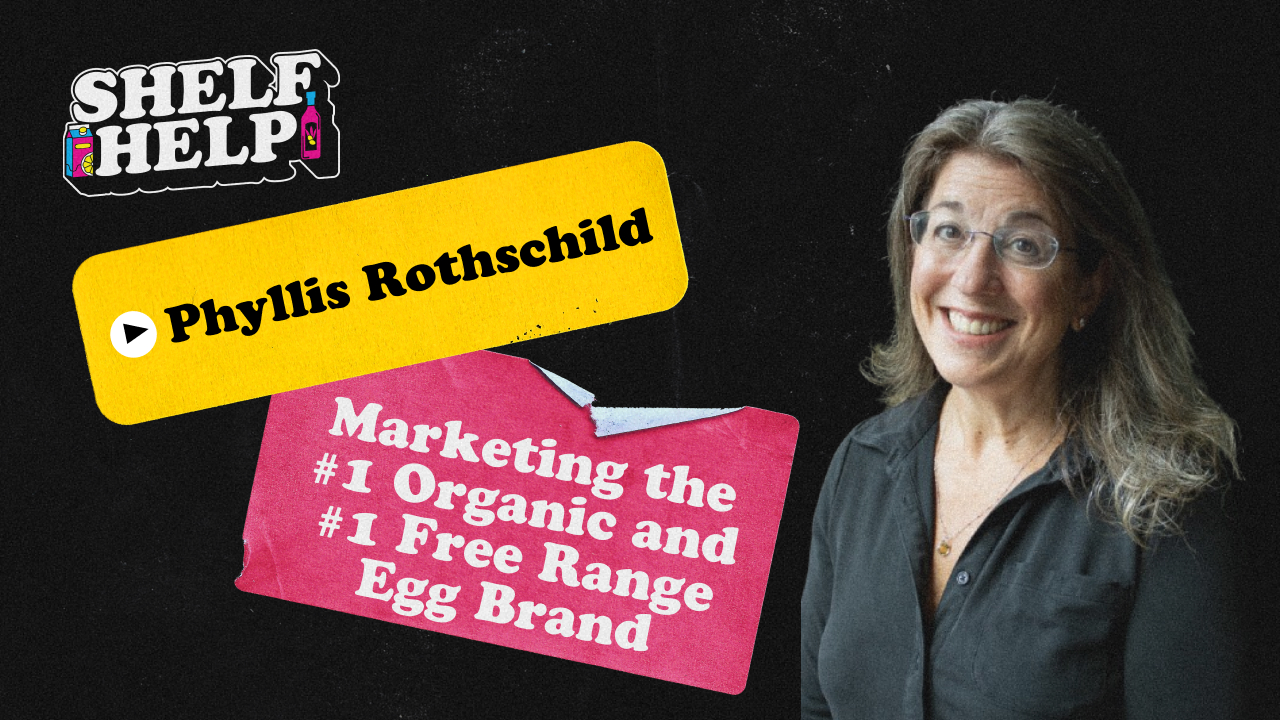
Marketing the #1 Organic and #1 Free Range Egg Brand | Phyllis Rothschild, Pete & Gerry's



On this episode, we're joined by Phyllis Rothschild, CMO of Pete & Gerry's Organics - the #1 organic egg brand and #1 free range egg brand in the U.S.
Phyllis spent nearly 30 years in consulting at firms like McKinsey and Oliver Wyman before making the jump in-house to lead marketing.
Phyllis breaks down the "word soup" problem in the egg aisle - where terms like cage free, free range, organic, and pasture raised all blur together - and the education-first strategy the team uses to cut through it, including brand-agnostic shelf signage created with retail partners.
Phyllis walks through how the team manages two distinct brands in the same category, with consumer personas like "Ellie the Egg" for Nellie's Free Range and "Heather the Hen Hugger" for Pete & Gerry's pasture raised.
She shares how the avian flu crisis created a trial opportunity when commodity prices surged and Pete & Gerry's held prices flat, and what the team did to retain those new-to-brand buyers once the gap widened again.
We also dig into the packaging refresh across both brands, the color blocking strategy (navy for organic, bright yellow for pasture raised, sky blue for pasture raised organic), and in-store tactics in a category where 75% of purchase decisions are made at shelf.
---------------
Episode Highlights:
🥚 Why Phyllis left McKinsey for the egg aisle
📊 Data-backed decision-making from 30 years in consulting
🛒 The "word soup" problem in the egg aisle (cage free, free range, organic, pasture raised)
📖 Education-first strategy with brand-agnostic shelf signage
👥 Consumer segmentation: Ellie, Beth, and Heather
🐔 The distributed family farm model (350+ farms) and supply chain resilience
💰 Holding prices flat during avian flu while commodity prices surged 59%
🎨 Packaging color blocking: navy, yellow, sky blue
📦 The "Sacred Ribbon" and why on-shelf side panel cues matter
🏪 75% of egg brand decisions are made at shelf
📜 Cage-free legislation and the 7x free range volume lift in legislated states
🔍 Whole food sources and clean protein as a category tailwind
---------------
Table of Contents:
00:00 – Intro
00:42 – Pete & Gerry's overview and brand portfolio
02:10 – Why Phyllis left consulting for Pete & Gerry's
03:56 – Transitioning from consulting to in-house
05:48 – How a consulting background shapes CPG marketing
07:45 – The "word soup" problem in the egg aisle
09:54 – Education as a growth driver
11:53 – Metrics for measuring consumer knowledge
13:24 – Managing two brands in the same category
17:28 – Consumer segmentation and price pack architecture
19:11 – Navigating the avian flu crisis
23:12 – Trial, retention, and new-to-brand metrics
25:46 – The packaging refresh and pasture raised launch
30:50 – Lessons from redesigning both brands
34:36 – In-store strategy and shelf set optimization
39:06 – Cage-free legislation and its impact on premium
42:02 – Trends: whole food sources and clean protein
---------------
Links:
Pete & Gerry's – https://www.peteandgerrys.com/
Follow Phyllis on LinkedIn – https://www.linkedin.com/in/phyllisrothschild/
Follow me on LinkedIn – https://www.linkedin.com/in/adam-martin-steinberg/
For help with CPG production design - packaging and label design, product renders, POS assets, retail media assets, quick-turn sales and marketing assets and all the other work that bogs down creative teams - check out https://www.kitprint.co/
Episode Transcript
Speaker: 00:00
Welcome to Shelf Help. Today we're speaking with Phyllis Rothschild, Chief Marketing Officer of Pete and Jerry's Organics, the number one organic egg brand, and the number one free range egg brand in the U.S. Before coming into coming in-house, Phyllis spent, I think, 30 years or so as a consultant at some of the big names like McKinsey, Oliver Wyman, Profit as well. So a lot of really good experience and excited to get into it. First off, Phyllis, for the listeners, probably a fairly small group of listeners in the CPG world that aren't that familiar with Pete and Jerry's. Love to get a quick lay of the land just in terms of kind of the origin story and the why behind the brand, core products in the lineup, and uh we'll go from there.
Speaker 1: 00:42
Yeah, thank you. Well, thank you for having me. Appreciate it. Always love talking about our wonderful eggs. So Pete and Jerry's is uh, as you said, the largest premium egg provider in the United States. We are very much a purpose-backed brand. Our mission is to um commit to animal welfare, family farms, and sustainable farming, as well as to one another. So very much focused on those core principles. We uh are nationwide, so distributed nationwide. We do have some national distribution in places like Walmart and Whole Foods, and then in all the major grocery retailers, we're in BJs as well, recently into Costco on the West Coast. So have great distribution. Um, and we have two primary brands within our portfolio. We have the Pete and Jerry's brand, which is sort of our uh heritage brand that the company was founded on about 30 so or so years ago, right when I got started in consulting, Adam, as you pointed out. And then we also, and that is our sort of premium top shelf higher-end brand, really focusing on the health and wellness space with organic and pasture-raised. And then we also have our Nelly's Free Range brand, which is more of our gateway to premium. And both of them are really strong in doing well.
Speaker: 02:09
You touch on the consulting stuff too. You you know, you spent a lot of years in in that role before in, I think it was in 2023 you made the jump to run marketing in-house at Pete and Jerry's your first in-house role after so long. What was it about Pete and Jerry specifically that was finally that was the one that that made you take the leap in-house?
Speaker 1: 02:27
It got me. I would say that first and foremost, I really did find a lot of passion in the notion of being purpose-driven. Every time uh for 30 years in consulting, it always helped me when I would talk to my kids to say what I do. And particularly I did marketing and branding strategy consulting. Um, it always helped to connect them to the reality of what I do. When I would work for purpose-driven or purpose-backed brands, it always felt very rewarding to me. I also was really keen on finding brands that have room to grow. I really wanted to go in and work with a team and shape the growth trajectory and the contribution to the overall business growth. And Pete and Jerry's certainly has a long runway and opportunity for growth. Food and beverage is a passion of mine as well. It's always nice to know that you're believing in something that you're putting in your body, actually. Yeah. And who doesn't love eggs? I personally love eggs, and we can talk all about all the our favorite egg dishes, but that was great. It's local to me. I live in the Massachusetts area, and Pete and Jerry's is based in New Hampshire. So it's nice to interact with people on a regular basis live sometimes after many years of being remote. I think all of those things were huge contributors to the decision, and it's a fantastic leadership team, too, as well. And just the growth that the team has been able to drive over the past three to five years has been phenomenal, and it was nice to get on that moving train.
Speaker: 03:56
What was that transition like? And I I guess really what was thinking back, what was the thing that's or a few things that surprised you the most?
Speaker 1: 04:05
That's a great question. I think that um first you hear a lot of people say when they're in consulting, they don't get to see the impact of the work that they do and they don't get to live or actually make those decisions. That's not entirely true of having spent so long in the space. And I'd had some really long-term clients that I I did get to work closely with and see the fruition of our work. Um, but I think in more so is the day-to-day, the scrappiness, the roll up your sleeves side of it, that and decisions at the minute level that you're making. You know, you're not sort of big picture, big sky every day. Even at the C-suite level, you're not. You have to, in order, especially in a company that's of our size and we're somewhat lean, you really do get down into the weeds sometimes and you're making decisions on how to allocate shopper marketing dollars or whether or not to make an investment in a particular campaign allocation in a particular region with a particular platform. And that's the kind of stuff that just requires a different level of focus and collaboration with the team. So that took a little getting used to and working with the team on that. And then, you know, I think having come from some of the bigger consulting firms, as you mentioned, I do have a lean team. And so it is really figuring out how to best allocate resources. It's not that you could snap your fingers in the McKinsey days and get analysis, but you do have to be more efficient and smart about it's not just let's boil the ocean and do all this analysis and figure out what it's telling us. It's really like, here are my hypotheses and the questions I have. Let's do some real targeted analysis and figure out what the answer is so that we're not wasting a lot of effort.
Speaker: 05:49
How do you think about your consulting background that that's so extensive has kind of shaped how you approach making decisions when it comes to everything marketing, everything that you own that may be different than someone that's come up through the traditional, you know, CPG brand manager path through the, you know, the crafts of the world or something along those lines?
Speaker 1: 06:10
You know, I don't know whether one path is better than the other. I would say that in my case, it was leaning heavily into the analysis and the data back. I mean from a consulting background, you always wanted to have data back uh recommendations and being able to say, here's what the data says, and here's what we think the impact is going to be. And so I think really emphasizing the notion of analysis and data and measurement was something that was almost, you know, first principle for me when I started. And I think that that's not always the case in marketing traditionally, going, you know, especially rising up through the ranks. It doesn't mean I don't lean into the right brain side and also love the creative aspect. And sometimes you do have to go with your gut on some of the creative side. But I think that healthy balance is what I was able to employ when I was in consulting. And then it certainly applied when I got to Pete and Jerry's. And then I think this the pace, right? Because we are in CPG, as you know, is so fast-paced today. There's always something changing. The trends are crazy, and you're always trying to keep up with what the latest is. And that is true in consulting, very much so. You don't have the time to sit back because sometimes you're on a you're on the clock with the client and you have to be able to show impact and prove that you're what you're doing is worth your while. So I had that mentality, I think, when I came in, which is let's have some impact early on. Let's show what marketing can do uh for the business and for the brands, and let's measure that. So I think that helped.
Speaker: 07:45
Totally shifting gears. I've I've heard you talk about how there's just historically been a fair amount of confusion in the egg aisle, whether it's cage fruit rearrange, organic pasture raised. It does seem fairly confusing at times. And I think that you'd said that the research that shows that the consumers that are more educated really understand the differences are more likely to buy premium. How did we get to like where we are at this level of confusion? Was this intentional? What's your take on that?
Speaker 1: 08:12
I laugh when I you use the word intentional because I do think some of it was intentional, right? Particularly at the large industrial egg producers didn't necessarily want consumers to know how those hens live their lives. And so using a little bit of phrasing like farm fresh or natural, like why would your egg not be natural? Which is right, but that those that's the kind of language that I do I do think creates confusion. Even cage-free creates confusion. There's a lot of misperception out there that cage free means that the hens are running around in pastures and they're absolutely not. They barely see the light of day. So the fact that there's a lot of confusion when people are walking in the aisle and seeing all these phrases, and even the phrases that do mean something like organic or free range or pasture-raised, kind of get lost in that word soup.
Speaker: 09:06
Yeah.
Speaker 1: 09:07
And we have to really try hard to sort of hone in on what matters and get that consumer to know that free range hens go outside. Cay tree hens do not. Like very simple distinctions. Pasture-raised hens not only go outside but have lots more space to be on the pasture. They eat bugs and worms. That means they're out. So just simple things that in the consumer's mind helps them know that they're actually outside, enjoying sunshine, fresh air, fresh snacks. That's the kind of thing that we really have to emphasize. But it's hard, as you said. I mean, the aisles are crowded and they're getting more crowded by the day. And some of the phrasing purposely drives that kind of headcock of like, wait, what does that mean?
Speaker: 09:52
Right. Totally. Being in the number one spot, how important do you think has this somewhat of an education-driven approach has contributed to reaching that top spot?
Speaker 1: 10:02
We take them role very seriously as a thought leader and authority in the egg space. And Pete and Jerry's is a pioneer in premium and eggs, it was the first company to launch a branded organic item. It's first company to be B Corp certified, first company, company to be humane certified. We take it very seriously, and we really do want to take that position of the more you know, the more you'll make a better decision. So we do try to create very simple graphics, for instance, around what we call education. Um, and so we do say, here's what it means to be cage free, here's what it means to be free range, here's what in literally one sentence, like one phrase, not even a sentence, and then imagery that's associated with that. And we actually have created signage that's uh brand agnostic and worked with some of our retail partners to put those strips on shelves so that people can automatically have a cue that says, oh, okay, now I get what this means. Organic means they're fed organic feed and as opposed to conventional feed. And so it's just very simple and straightforward how the hen lives, what the hen eats, um, to get people to choose the premium space, because I think most consumers, if they saw their hens, the images of the hens either crammed into a cage or crammed into a building, which is what cage and cage-free is, they probably, a lot of them, would choose to move up. We do know that roughly two-thirds of consumers value animal welfare in what they choose today for their food through their protein sources. So if you do value that, then it behooves you to do a little bit of homework to see what that true all those phrases truly mean.
Speaker: 11:52
Yeah. What metrics are you measuring in terms of gauging the impact of how this education is is having on consumers?
Speaker 1: 12:01
Well, we so we both look at the macro environment and see what the shifting is from commodity. We include cage and cage-free in commodity, so from commodity to premium. So we'll look at numerator data and sarcana data to see on a net basis are we seeing increase and growth in the volume of purchases, not just dollars, but volume of units being sold in the premium space. Then we also look at the net impact even in our own brands, because what it's one thing to get people to shift up, it's another thing to get them to choose our brands within the premium space. But we do look at those metrics and we look at conversion rates from commodity to premium. And then we just and we look at um consumer knowledge of those phrases. So we'll do consumer research periodically, and we'll literally define those different categories and then have people match the definition to the phrase and measure how well people are improving in that process. And then we ask them how confident are you in your answer? So we're tracking that over time to see, and granted, you know, we have a smaller megaphone than some of the big industrial players, but we're just tracking over time to see how much smarter consumers are getting during that communication phase.
Speaker: 13:23
You have the P and Jerry's brand, and then also you mentioned Nelly's free arranged sitting right next to each other on retail shelves. How did you and the team think about managing like the two distinct brands in the same category, same retailer?
Speaker 1: 13:35
Sure. So grounded in data, grounded in analysis, we did some segmentation and understood that the premium egg buyer does fall into a couple different segments. There's clearly overlaps and things that they care about, like animal welfare and quality and value. But when you take it down a level, you can see that there is a consumer who really does like to tick all the boxes. She tends she and tends to be a she. She tends to be more family-oriented, price, a little more price sensitive, but really cares about animal welfare, the planet, people being kind to each other, companies doing what they say, health for her family. And so that tends to be the free-range buyer, someone who wants to step up a little bit and have something a little more special for her family, but doesn't necessarily have the financial flexibility to go all the way into a more premium brand. And so we call her Ellie, the egg involved, and we very much talk to her directly with the Nelly's product and the Brunelli's brand. It's a very kind, inclusive, nurturing brand, and we use that voice and imagery. We have a lot of illustrations of a little cartoon Nelly chicken walking around. There's a little girl on the package holding a chicken. It's uh it's very funny when we've done research. There's so many people say the purple carton with the little girl. Like that is how what Nelly's is associated with. And so we very much and we keep our pricing according to that particular consumer. So as I said, it's our gateway to premium. It's the most accessible brand and the most accessible product. Then when you move into a little bit more of a premium higher-end level of the premium egg shopper, we have the organic buyer. And this cuts across categories, but people who tend to choose organic, for them, it's a shortcut to health and wellness. They truly believe that there's no gunk in there and I don't want to put anything that's not organic into my body. And so you have someone who really emphasizes whether it's clean protein, the nutrients and vitamins that are in eggs, the fact that there's GMO-free and antibiotic-free, just those types of claims. And we emphasize those on PAC. And as you know, in our Pete and Jerry's organic package, it says organic in really big letters, because that is the cue for that shopper. And we call her Beth, the better for you eggers. Like she's very focused on that piece. When you talk about the pasture-raised consumer, that is someone that is what we call Heather the hen hugger. She really truly believes in this notion of animal welfare, caring for them. She wants to know that the hens are well taken care of, they're wet, well fed, they get to go outside and frolic in the pastures. And she knows the stat that on pasture-raised farms, hens get 108 square feet per hen of outdoor space. She has that number memorized. So we prominently display on the pasture-raised carton 108 square feet per hen outdoor space. And some of our pasture-raised competitors do the same. But we know that both Heather and then even a step up, which is pasture-raised organic. So they both live the pasture life, but also get organic feed, are just very much focused on the top tier. And so that's how we create the distinction. And then we use price pack architecture. I mean, we make sure that our pricing is according to that step up so that it's clear when they're sitting on shelf next to each other, not just, you know, hey, these packages are different colors or what's going on, but they're priced according to where they are in that graduation. You do have two brands in a category that, hey, traditionally is commodity. So it's even harder to create some distinction between them. I think, first of all, is from a product perspective, understanding who your target is and what the claims are that matter to them and the things that the decision process that goes into purchasing that product, I think is really important to emphasize. You can eat see that on our cartons, you see that in our communications. It's very targeted to the needs and wants and priorities of those different segments. And then the brand voice, you want to create some distinction between them so that there is clarity. And that's important with brand guidelines and making sure our team, not just in the brand management side of the thing, but our social team too, has to speak with two different voices when we're posting in social or sending emails or just communicating and broadly with consumers. So it's really important to keep that distinction from a corporate portfolio perspective. So that's a fine line to balance, right? Is how do you particularly when it's tiered, you don't want the top tier brand to in any way, shape, or form say things that are denigrating to the lower tier brand. And so that's an important message to have to be done as well. You're not saying one's better than the other necessarily. You're saying this is for this consumer, this is what matters to them. And here's that's why I'm going to communicate it.
Speaker: 19:10
Yeah, that makes total sense. The avian flu crisis it has had a pretty big impact. And probably correct me if I'm wrong if my research is off here, but I think prices increase, you know, I don't know, 50 to 90 percent. Shelves were empty at some point, and they've obviously come back, you know, at this point. But I think for Pete and Jerry's, the because of your distributed family farm model, you're able to keep prices fairly flat for that really um volatile time while commodity prices were going all over the place and exploding. Um, assuming I got that right, and you guys are able to kind of maintain that well within that volatility. How did you guys really kind of leverage this opportunity from a marketing trials perspective and anything else related to this kind of unique opportunity?
Speaker 1: 19:52
Yeah, last year was a tough one for the egg industry broadly with HPAI or high path avian influenza. I think that, you know, if you look at the statistics and the data, tens of millions of hens were put down because of avian flu, and they 99.9% of them were in the caged and cage-free segments. So I think it was fortunate for a lot of the premium producers to not have been personally affected. But as you point out, we were all affected because of what happened with pricing, what happened with shortages on the shelf. And so we made a commitment at the very beginning of last year that we were not gonna raise prices in that environment, which is not true of everyone, even in the premium space. And so we we said, we're not gonna raise prices, we're going to stay true to who we are and what we stand for, but we are gonna do a ton of communicating. We are gonna be transparent, we are gonna be authentic to our voice to our brands and talk about and take the position, as I talked about before, of Pete and Jerry's being a leader in the space and share very openly with consumers what's happening. So we literally created the Where Are My Eggs website. We created a microsite and we were very open and we did weekly tracking of where is HPAI hitting, how many birds are is it affecting what's happening on the shelf, and just to just give people information so that there wasn't as much confusion and people are pointing fingers and saying, hey, it's the greedy egg producers that are making this happen. Um, and so it was an opportunity that you could have either sort of been more secluded and say, hey, we've got to tighten things up, we can't communicate too much, there's too much volatility, or you could be open and say, here's exactly what's happening. Now, granted, we had the advantage to be open because we had positive things to share about our brand. Our distributed farm model is a much more resilient supply chain, if you will. So we have over 350 farmer uh family owned farms. That we partner with exclusively. You know, knock on wood, they all experienced a good solid year last year, but it was not easy. And you had to exercise, you know, significant biosecurity measures. We didn't have anybody going on farms that didn't belong there or didn't need to be there, I should say. Um, we kept our as much as possible from a distribution and logistics perspective, kept our shelves as full as we possibly could, and just made sure that we were partnering both with retailers and with consumers during what could very easily have been called a crisis in the space.
Speaker: 22:38
Sure, totally. Yeah, it must have been a wild, a wild time.
Speaker 1: 22:42
It was a very wild time.
Speaker: 22:44
Prices raised significantly, those, you know, 59%. You guys kept prices the same. I imagine the prices all became a bit more uh similar across the board. I have to imagine the people that had consumers that had been buying um, yeah, the cage, cage-free ones where those prices increase. I imagine you saw at least somewhat of a a good amount of those consumers shift over and say, well, these are the same price. I might as well now buy Pete and Jerry's. Assuming I got that right, after prices went down, did you see some of those consumers that had transitioned over continue to stick around once they realized, wow, the quality here is different and I feel better about buying these and all those things?
Speaker 1: 23:23
Yeah, you know, I mean, some cases I think it's the lots of brands' dreams, right? How do I create trial? Right? What is what's a circumstance that can create trial? So it definitely created trial. We had a lot of, in terms of what you talked about before metrics, we measured new to brand, and we always do, but we had some good new to brand numbers last year. And because of the gap closure between commodity egg pricing and premium egg pricing, and in particular our pricing, people were certainly trading up from up to a premium egg, even though they didn't have to trade up price-wise. Um, and so, yes, we we did see a lot of that. And to your point, the goal is to how to make that sticky and keep them there. We have found that once people do trade up, they do stay because they see the higher quality, the yolks are creamier and darker, they the shells are harder and sturdier, the whites are more viscous and what we call proud on the plate, and they just taste better. So the experience, the product experience delivers when people do test it. I think that uh then the question is is to your point, do they go back down when the price gap widens significantly? Sure, some do, but to your point, we we measure net flow. So we try to say, yes, there's some movement back and forth. But overall, if you look at the data on a net basis, there is upward movement and not a lot of downward movement. So what what we try to do is make sure that once someone is in the family, we make the experience, whether it is the product or the brand experience, as strong and as pleasant as possible so that they're gonna stay with us.
Speaker: 25:04
It sounded like it was for all the all the volatility, it sounded like it was probably a um a good opportunity for you guys.
Speaker 1: 25:11
Yeah, it was a wild ride. And now to your point, we've got the this year is a little bit of the opposite because what happened last year is lots of businesses and companies in the egg space did what we call put on hands. So they bought more and more chicks to replace the ones that were put down. And so you're seeing more of an egg surplus in 2026. And so now it's uh it's really where the competition comes out. You have to say, okay, if people are having a lot more choices now, they're not facing empty shelves anymore. How do we make sure they stay stay with our brands?
Speaker: 25:45
Yeah, totally. You guys did a pretty significant packaging refresh, I believe, across both organic and the new pasture raise lines.
Speaker 1: 25:53
I just want to start with was just the question of why the company was launching the pasture raise line, Pete and Jerry's pasture raise in our bright yellow box. And the decision was even uh even if you take a few steps back before that launch, was a little bit of who who has permission, Nelly's or Pete and Jerry's, to deliver against a pasture raised line because of its step up in premium and the communication around the lifestyle of the hens. And we did a fair amount of consumer research and understood that Pete and Jerry's does have that permission to move into that space and talk very credibly about the lifestyle of the hen, even if it wasn't necessarily an organic product, which was a big insight. Once that decision was made, we had to obviously create a carton that tapped into the legacy and some of the assets visually and communication-wise of Pete and Jerry's. It was a premium brand and the things that mattered to consumers, but also had a little bit of differentiation from our sort of main brand, which was the Pete and Jerry's organic free-range egg. So the decision was understood about what again, what matters to that pasture-raised buyer versus that organic buyer. What are the um sort of cues from a color perspective, from an imagery perspective, from a claims perspective? So all of those things were taken into account very much so. So not only did we redesign the Pete and Jerry's organic free range, but we had to create a brand new package, which was the pasture raised. First and foremost, we wanted people to know about pasture. And what do you think of when you think of pasture? You think of sunlight. It's the bright yellow color. Um, we wanted to then infuse the whole sort of level of brightness and happiness. Pete and Jerry's think prior to 23 was a little bit of a serious, more clinical brand from the organic side. And we wanted to give it a just a little more personality and infuse a little bit more of frivolity into it. Um, and so that's why we ended up taking if the original package had actually a picture of a farmer and decided we learned through research and decided that we didn't necessarily need a farmer, an actual farmer on the carton for people to believe that. So we replaced it with illustration. We also were uh clear about the heritage color of Pete and Jerry's organic, which was navy. So we created that navy, sort of more um saturated type carton for the Pete and Jerry's organic one, so that you could start to do some color blocking because we knew in the future we were going to be launching pasture-raised organic, so we had to create some color association. So navy was more sort of health and wellness and organic, yellow, sunshine, pasture raised. And then we ultimately last year launched pasture raised organic, which is blue skies. So it's a sky blue carton, bright blue carton. And then what we call the sacred ribbon, which is the side panel that everyone sees when they're shopping. That part you had to make sure that there was big writing and something that was that automatic cue for the consumer. So you can see on the Pete and Jerry's organic one, it says in big, bright white letters organic. Um, and then little small letters says free range underneath it because that consumer didn't care as much about that piece. Whereas the yellow carton, it says in big, bright blue letters pasture. So that consumer could automatically reach for it and know that that's what matters to them is the pasture raised. And as I mentioned before, it also had the little 108 square feet stamp on it. So that was what went into the thinking and the why behind it. And we had to support that. You can't just assume that you're gonna throw those things on the shelf and replace the other ones, and it's automatically going to. So a lot of communications, a lot of collaboration with our retail partners just to give people the heads up that this was happening and that we were growing in that space. And we are now the fastest growing pasture raise brand. That's awesome.
Speaker: 30:14
Amazing. For um, let's just say I was a brand leader at another brand, maybe not also introducing new lines, but just going to you know a packaging and refresh in general, or maybe a combination of the two. How do you balance? How do you think about balancing the need for obviously there's you're creating a fresh look and doing a packaging refresh for for a particular reason while also keeping some of those familiar legacy brand elements for existing customers? So when they're walking down the aisle, they still recognize the brand right away, can find it right away, and not, and then it's not so different looking that they can't even find it anymore or don't know what they're what they're looking at anymore.
Speaker 1: 30:52
It's such a hot topic now, especially what happened last year with some logo redesigns that will go unmentioned. But I think that it is it's really important and sounds so basic, but know who you're talking to, know who your consumer is and what matters to them. And make sure you're sort of bringing along your legacy, sort of diehard loyalists, but also determining how you attract a new buyer so that you're growing, ultimately growing the franchise at some point. And so what you can't do is 100% abandonment of what got you to where you are and recognizing that, but then also knowing if I want to modernize, if I want to freshen, if I want to appeal to a new consumer, what's going to matter to them? So striking that balance is really, really important. And we definitely did that with both Pete and Jerry's and Nelly's because we also relaunched Nellie's in 2024 with a packaging redesign. And it was very funny because at the time I wanted to create more linkage between Pete and Jerry's and Nelly's so that we could speak to our family of brands. So there is a little egg button on the Nellie's package that says part of the Pete and Jerry's family. It's honestly not that noticeable. So we're working to figure out to create that linkage even more. But even the illustrations have some commonality, whether it's tufts of grass or the sunlight. We were going to go completely illustration with Nellie's the same way we did with Pete and Jerry's, but we found that our loyalists, as I mentioned before, are so attached to the little girl. And when we turned her into an illustration, there was such outrage from the testing. So people saying, What did you do to the little girl? Um, and so it's things like that that you sort of say, okay, the purples, people love the purple, but could we bring some color elements from Pete and Jerry's, like the marigold yellow? And so there are nods to creating some linkage, the tufts of grass, as I said, the blue skies, but can we sharpen up the little girl a little bit, clean up the background? So there were things that we did to freshen it up and modernize it. Even the font is a little bit more fun and playful, just to again honor who got us to where we are and continue to welcome them, but then also to appeal to a new audience too.
Speaker: 33:18
Looking back now, any big learning lessons from the process that jump out that could be helpful for other CPG leaders that uh are about to go through a similar process and anything you think you might have done, done differently at all?
Speaker 1: 33:32
I mean, I think communication is so important and making sure that you're teasing it with your audience. You have your die hard loyalist fans on social and on your email list. So making sure that they're brought into the loop and are waiting for it and creating some excitement. I think honestly, we probably could have done that even more. I think, you know, creating that anticipation and honoring that launch in a more sort of significant way could have been something we worked on, but you can't under-communicate a change like that. Um, and I think even a lot of brands fall into the trap that they're sick of it, therefore everybody else must be sick of it. And that's not true. You just have to keep messaging and communicating it because, you know, again, there's so much noise out there. People are hearing messaging from brands constantly. And so you have to figure out how you're just continuing to hammer home something and be so deliberate about making sure it gets across because small percentage of it actually probably reaches someone's inner brain.
Speaker: 34:36
In terms of the in-store side of things, a lot of categories in CPG, I think my sense in the egg aisles is a category where a good percentage of the purchase decisions are made at shelf. And I think especially in the kind of the refrigerated frozen aisle, you know, kind of you know, in-store, you know, signage and shelf talkers and that kind of stuff. There's it can be even a bit more challenging just because you're sitting behind a glass door or whatnot. And you mentioned you've worked, you did some stuff with some retailers, non-branded, like you know, kind of strips explaining the differences between the categories or whatnot. But yeah, what does your kind of in-store strategy kind of look like and what have you found actually has the biggest impact from a velocity and trial standpoint?
Speaker 1: 35:17
Yeah, that's a great question. So I have to say, Adam, one of the biggest daunting statistics that I heard when I joined Pete and Jerry's was 75% of the decision from which egg brand to buy is made at shelf. And that's daunting for a marketer, right? Because you're like, hey, I don't get to communicate with them along the way. There's no consumer journey. They're just standing there and making a decision. And so we had I had to tease that apart when I got here and said, well, what about a premium? What about a branded chopper? What about, and so we've done a fair amount of research and conversations with consumers and walk-alongs and shop-alongs and things like that to truly tear, like tease that out. And yes, a majority of the decision is still made at shelf. There are a lot of different things that factor into that. And then there is still, as you know, in the marketing world, there is still a journey that someone goes through when you are permeating their inner soul at some point along that journey, not just, you know, snap when they're at the shelf. So the truth is that the premium buyer, it is a lower number, that there is a little more intentionality when they go shopping, that they know I'm gonna look at this particular category or this segment within the category. And then the branded buyer is even more so. So that's one. Two, when we do a little bit of consumer journey mapping, yes, the number one bar on what made you aware of this brand or what influenced you is still I saw it on the shelf. But when you add up all the other things, like I saw it in an ad, I read about it online, I saw it on social media, I follow them on social media. A friend referred me. All of those little bars add up to a higher, a bigger bar than I saw it on shelf. So immediately we were like, okay, marketing can help. Um, and so that's one thing that we really didn't want to just say, okay, only focus on in store or online. Then, two, to your point, what do we do in store? Sure, we have the strips, that's helped a lot. Um, you're only so dependent on, only so good as you can get them to execute that in store. And no offense to 16-year-olds, but oftentimes you have a 16-year-old who's sort of, you know, just putting the eggs wherever they go on the shelf and not necessarily keeping them where you want them to be. So we do a lot of partnering with our retailers around shelf sets and what's an ideal shelf set and how consumers' eyes go across or vertically, and where do you want to put the premiums and do you want to keep all the organics together? So we've done a lot of consumer analysis to look at that, and then we share that information with our retail partners. So we help them actually create the merchandising asset for them. Um, and then, yeah, tags. We do a fair amount of when we can inserts around, you know, whether it's just uh disruptors, things that say whether it's new item or new price, or even some education things that have images of like what's behind me of hens on grass. You'd be surprised at how much people are influenced by actually seeing a hen on grass. And so you'll have a sort of a small disruptor with that image there, and then our brands. So all of the above is kind of where we go from that. We've explored things like um digital signage and Whole Foods, for instance. That helps uh uh, you know, in those particular activations, floor decals, door decals for the partners who do have the eggs behind doors. And so all of that we've been exploring and try to measure as much as we can.
Speaker: 39:04
Yeah, that will make sense. Um I think Kate, like cage for your legislation is rolling out across more states recently. Where do you think the premium egg category kind of goes from here? And yeah, where how do you think that impacts and where do you feel like this just this general kind of trend is going?
Speaker 1: 39:21
Yes, we've been looking at that very closely, um, starting with California and Massachusetts back in 2022 were the first two states to legislate against caged pens. Um, and now we have seven states that are what we call cage-free legislated. And, you know, it slowed down a little bit last year because of avian flu, and people were just saying we just need any eggs. Um, but I think it'll start to pick up again. And so what we did is some analysis to look at what happens the year after. So, not surprisingly, there's this massive shift from cage to cage-free in those states because they can't buy cage anymore. But what we also saw was that in the year after that happened, there was a very significant increase to free range. So, because I think consumers were saying, well, now cage-free is the bottom of the barrel. This is all sitting here at the bottom. So I'm the bottom bunk, we call it. So now I'm gonna step up one level and go to free range. And so the volume in the states that get legislated is seven times higher for free range than it is in the non-umlegislated states. So we very much keep a close eye on what's happening and actually double down in those states when there's legislation about to come to make sure that our Nelly's brand is um out there and ready to receive all its welcome with open arms, all our new buyers. And then the other thing that we look at is um, you know, how much education we can do in those states and partnering with the retailers to emphasize what this means for them. And, you know, the thing that also is a really good piece of information for the retailers is just the basket size that they get, or the dollar basket size that they get when consumers are purchasing more premiums. So it's in their best interest to see to continue to encourage that premium buy. Uh and so there's still lots of room to grow. Um, but annoyingly and shockingly, the caged egg is still the majority of purchases across the United States. But we do think that in the next five years, maybe three to five years, it will shift below 50%. And that would be awesome. And so there's um the pie's getting bigger, and so we're just gonna continue to ride that wave and then obviously encourage more and more into our brand, as I talked about before. So it's not just riding the wave, but it's also getting people to come over to our surfboard, I guess.
unknown: 41:58
Right.
Speaker 1: 41:59
Totally than the analogy.
Speaker: 42:01
Last question before you fill us, you definitely have a a great pulse in the CPG space in general, outside of Pete and Jerry's any particular brands, or just kind of trends outside of egg space that you've gotten kind of particularly excited about, or you've just been kind of keeping your eye on just because it's piqued your interest.
Speaker 1: 42:19
I think that the trend that I love and particularly toward what helps us as a tailwind is this notion of whole food sources and that people are starting to get smarter about the ingredients in their food products. And so, you know, you can't get something pure and cleaner as a protein than than eggs, and it actually is the number one absorbable pre-protein across all protein sources. Um, we we refer to it as nature's perfect protein bar, and it truly is. I mean, it it's it's got not only so much protein packed in it, um, but it also has tons of nutrients and vitamins and things that can help promote health. That is something that I I love to see, and I think more and more brands and companies are talking about clean ingredients and simple ingredients and minimal ingredients. And, you know, if you look at some of the protein bars today, first of all, you can't even pronounce all the ingredients that are in there, but you also um, you know, you run out of space on the package to list them all. So I think that is a trend that I love to see. I try to incorporate it into my own diet. It's not always easy, but I think they'll just they they move away from processed and multi-ingredient products is is something that's a great trend.
Speaker: 43:39
Totally.
Speaker 1: 43:40
So I'm excited about that one.
Speaker: 43:42
Yep, I agree with that. Well, yeah, Phyllis, this has been awesome. Um, what's the what's the best place for people to follow along with you and all your expertise? And then what's the best place for people to follow along with Pete and Jerry's and Nelly's these days as well?
Speaker 1: 43:56
For me, it's on LinkedIn, so please come visit Phyllis Rothschild. And then Pete and Jerry's and Nelly's. We have wonderful social content across the different platforms, Instagram, TikTok. And so we'd love to see you come visit us there. Um, it's a lot of fun. The content is both enjoyable. We do a lot of recipes, a lot of partnerships with some fun influencers and recipe developers. But we also do educational content as well and sharing um where our our food comes from, where the hens live, what the content is of an egg. And so it's uh, I think it's an enjoyable, worthwhile way to spend time.
Speaker: 44:35
Perfect. Love it. Awesome, Phil. I think that's great. I think that's I think that's a pod.
.svg)