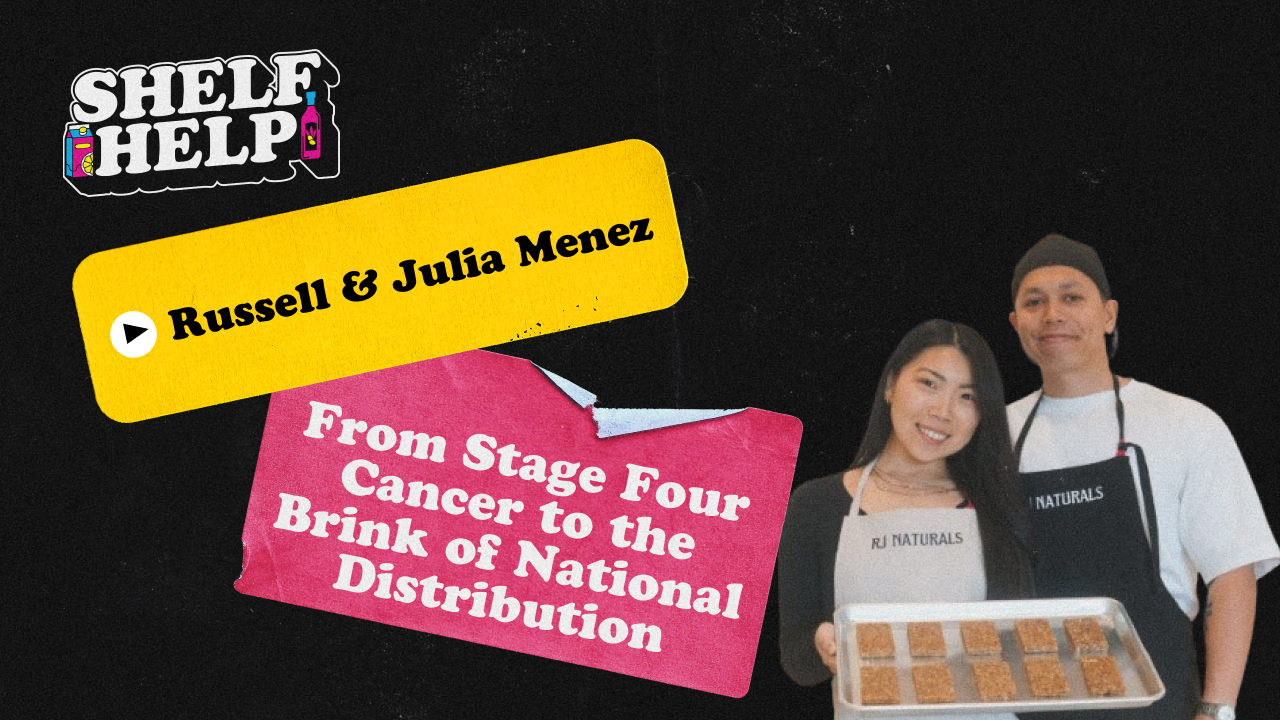
From Stage Four Cancer to the Brink of National Distribution | Russell & Julia Menez, Cozy



On this episode, we're joined by Russell and Julia Menez, husband-and-wife Co-Founders of RJ Naturals, makers of Nature's Candy Bar, the refrigerated, organic, whole-food snack bar made with grass-fed butter.
The brand was born out of Russell's stage 4 cancer journey, when Julia started making bars from scratch to support his recovery.
We dive into how those homemade bars turned into a SoCal brand now in some of most iconic retailers in the region, including Mother's Market, Lassen's Natural Foods, Clark's Nutrition, Fermentation Farm, as well as a growing presence on the East Coast.
Russell and Julia break down the formulation behind a bar built on dates, sprouted oats, grass-fed butter, coconut, raw honey, cinnamon, vanilla, and sea salt, why they chose Deglet Noor dates over Medjool, and why most co-manufacturers resist butter.
Julia also walks through the role of coffee shops, gyms, and wellness studios in building community, and how a single networking event landed their anchor retailer and first distributor in the same afternoon.
---------------
Episode Highlights:
🩺 The cancer journey that started the brand
🧈 Why grass-fed butter is the hero ingredient
🌴 Deglet Noor vs Medjool dates (and why it matters)
🥶 Why most bar brands won't go refrigerated
🍠 The next flavor in the pipeline (hint: ube)
🏭 Interviewing over 20 co-packers to find the right one
✋ Going from 600 bars a day by hand to thousands per run
🎨 Evolving from RJ Naturals to Nature's Candy Bar
🛒 Landing Mother's Market and a distributor in one room
☕ Why gyms, coffee shops, and wellness studios still matter
📣 Demos plus social as the velocity engine
🚦 Saying no to shiny objects as you scale
🎯 The Q4 Whole Foods regional plan
---------------
Table of Contents:
00:00 – Intro
01:13 – Origin story and the stage 4 cancer journey
04:38 – Formulation and R&D
06:30 – Why grass-fed butter
08:00 – Deglet Noor vs Medjool dates
08:46 – Flavor pipeline and the ube hint
10:22 – Refrigerated by design, not by default
12:49 – Home kitchen to commercial kitchen
13:41 – Moving to a co-packer
15:38 – Interviewing 20+ co-manufacturers
18:09 – Sticking to the formulation at scale
21:31 – Evolving the brand from RJ Naturals to Nature's Candy Bar
25:11 – Landing Mother's Market and a distributor in one room
26:43 – Coffee shops, gyms, and wellness studios as the community layer
27:30 – Demos and social as the velocity engine
28:53 – Saying no as you scale
30:50 – Biggest risks and opportunities
31:32 – Q4 Whole Foods regional launch
32:30 – Trends and brands they're watching
---------------
Links:
RJ Naturals – https://rjnaturals.us/
Follow Russell on LinkedIn – https://www.linkedin.com/in/russellmenez/
Follow Julia on LinkedIn – https://www.linkedin.com/in/juliahsuh/
Follow RJ Naturals on LinkedIn – https://www.linkedin.com/company/rjnaturals/
Follow me on LinkedIn – https://www.linkedin.com/in/adam-martin-steinberg/
For help with CPG production design - packaging and label design, product renders, POS assets, retail media assets, quick-turn sales and marketing assets and all the other work that bogs down creative teams - check out https://www.kitprint.co/.
Shout out to my friends over at Glimpse, the go-to partner for automating retail-related back-office operations and unlocking margin trapped in invalid fees and manual processes.
Episode Transcript
Speaker: 00:00
Welcome to Shelf Help. Today we're speaking with Russell and Julia Menez, humbling husband and wife co-founder of RJ Naturals, makers of Nature's Candy Bar, Refrigerated, Organic, Whole Food Snack Bar. Brands have grown pretty rapidly in Southern California thus far. They have some secure shelf space in some of the iconic retailers in the area, like Mother's Market, Lassen's Natural Food, just to name a few, I think, as well as a pretty growing network of a lot of independent uh locations like coffee shops, gyms, wellness studios, that kind of stuff. So yeah, really cool brand, really cool product they're building. So we're just gonna dive straight into the to the backstory. Love to just get quick lay of the land, just in terms of the origin story and the why behind the brand, core products in the lineup today. And then if any, there's new tutors, new retailers you guys got in recently that you want to call out and try to drive people to those places, you can get you can call those out too. And then uh yeah, we'll go from there.
Speaker 1: 00:57
Yeah, well, first of all, Adam, thank you for having us on this on your podcast. Uh, this is the first talk Julia and I are doing a podcast episode together. So this is really awesome. Yeah. Awesome. So yeah, RJ Naturals, Russell and Julia, that's our brand. Uh three years ago, I was actually battling stage four cancer, and during that time, we totally switched our diets to whole foods only, and we were being very intentional about what we were putting in our body, and we realized that all the snacks that we were eating and everything that we thought was healthy for us were not that healthy at all, or at least things we didn't want to put in our body. So Julia got in the kitchen, started making everything from scratch, including our bars that we sell today. And long story short, those bars really helped me out during treatment, recovery. And when I hit remission, we had the idea to share it with the community. That's how the brand was born. Fast forward today to today. We are in 50 stores, just growing super fast on a mission to make healthier snacks more accessible and bring that, bring that real food sense of comfort to people everywhere.
Speaker 3: 02:10
And so our product is called Nature's Candy Bar. It's a uh refrigerated snack bar made with grass-fed butter. We have two flavors. We have our original, which is like a cinnamon roll, and then we also have our matcha. And we are based, oh yeah, you want to show we have some samples here. This is what they look like.
Speaker 2: 02:27
Love it.
Speaker 3: 02:27
Um, we're based in Orange County, and you can find us at Mother's Market, Fermentation Farm, Lassen's, Clark's Nutrition. And then we also have a few stores on the East Coast, um, like Happier Grocery in New York as well.
Speaker: 02:39
Nice. Awesome. Julie, you're making these in the kitchen. And then at some point there, that decision was made. Hey, we should maybe actually share this with people and make make this a real thing. I was kind of curious, like what I guess, what did that conversation look like? Or was there like a looking back, was there a specific moment, or I don't know, maybe a specific piece of feedback you got from friends or family, and they were like, you should really turn this into a real thing? Or what, yeah, what was like that special moment looking back and that would kind of like we want it, we should turn this into a real thing.
Speaker 1: 03:07
Well, I guess looking back, I don't know if there was a specific moment, but I felt like every moment where I felt like it was helping me out and just the taste from it too, was just uh, you know, whoa, I think we really have something special. It was really supporting me during treatment and recovery on my health journey on hers too. And both of us, we come from an entrepreneurship background. You know, we we were always thinking about how to solve problems and how to, you know, bring things into the market that can help other people. And yeah, we just once we started sharing with community after remission, people were like, you gotta sell these. And we were like, Yeah, we know this these bars can help a lot of people. So that's just really how it started.
Speaker 3: 03:51
Yeah, I feel like so. Russell is like, he's a visionary. He see he has so many ideas. He was a Capricorn. So every time like there's something, he's like, Oh, we gotta do this, we gotta do that. So, of course, like when we had this, you know, when I was making these bars, he had this idea of like, we need to share it with the world. Like, this is what people need, you know. We people want real food that's comforting, that's nourishing, that's real. And so he kind of led that, what led this in the beginning. And I was like, Okay, let's do it. Like, I'm down. And so it kind of just like, yeah, just started really organically. I have a wellness brand and I was hosting a lot of events in Orange County. And so we kind of tested it out too, with you know, bringing these bars to these events, like handing them out, sampling them, getting feedback, and kind of just like testing out on the market too, which then led us to, you know, get into our first coffee shop and then just like little by little, just like kind of grew from there.
Speaker: 04:38
In terms of those early days of formulation and RD, you know, clearly the bar is about as clean as you can get. I think it's yeah, dates, sprouted oats, grass-fed butter, coconut, raw honey, cinnamon, vanilla, sea salt, which is about as clean as you can get. In terms of um those key variables that you played around with or key factors that were important to you as you were tweaking things, like yeah, what were some of the the key kind of changes, tweaks you made along the way between that first version you made in the kitchen, Julia, to that final version where you're like, okay, we're ready to bring this, we're bring the ready to bring this to market and take it big time?
Speaker 3: 05:13
Yeah. I mean, we actually haven't strayed too far away from the original recipe, which is amazing. Yeah. We're able to really just keep that foundation of what I made originally. But I think as we, you know, brought it to market and you know, we're doing a lot of testing, a lot of RD, we were just playing around with the different ratios, I would say, like the amount of salt, the amount of oats, so like those type of things. And, you know, as we enter the food space, we really were learning that like there is a there is a science to food. Like there is so much things of ratios of shelf life, water activity, like all of those components really are important when you're building a product. And that's something that we didn't really, you know, realize in the beginning because that was just creating this like at home for us. So that was like a big learning curve for us. But yeah, in terms of RD, we, you know, because we were able to just share it with our community and kind of start locally first, we were able to do tweaks along the way. So if someone said, Oh, it was a little bit too, you know, too sweet for me, that we maybe would like test it out and like lessen the amount of dates or too salty, things like that, just played around with that. But we kept the ingredients all the same ever since the beginning.
Speaker: 06:16
What kind of led you to decide to focus on grass-fed butter and then what is that, what is in that, what has that enabled from a differentiated taste, texture, or something else standpoint?
Speaker 1: 06:28
Yeah, so ever since going through treatment and going through our whole cancer journey, we became really big real food nerds. So everything we were putting in our body was grass-fed, everything, organic. So uh when she was making these bars, she experimented with grass-fed butter at first. And I think ever since then, we just stuck with it because it has this like creamy, soft texture to it that you can't find in any other bars. Uh, we're currently the only grass-fed, refrigerated snack bar on the market. So that's really cool too. And from a nutrition standpoint, grass-fed butter has so many benefits to it. We see it as a superfood, I feel like in the past 20 years or so, but has had a bad rep to it. But I think that's just because butter out there is processed, but ours is, you know, grass-fed and our superfood.
Speaker: 07:17
Why do you think no other brands are using it? Is it more hard, more challenging to use and for some reason or another?
Speaker 1: 07:23
Yeah, I think it's very challenging actually. As we were onboarding with our co-man a few months ago, we realized that a lot of manufacturers don't like to deal with butter just because it messes with their machines or it's harder to make. And then from a uh shelf life point of view, the shelf life decreases the or the butter decreases the shelf life of your product. So we treat the refrigerator as our preservative. So that helps us to not compromise with the butter and the ingredients that we have in our bars. So that's also why we are a refrigerated stack bar.
Speaker: 07:55
And then the other thing I I read into was you guys use some, I never heard of these other type of dates. So you can probably totally butchering the name, but degle orb dates. If I got that all close versus the typical material ones, like what's the uh why those ones versus the more common ones?
Speaker 3: 08:10
For us, it was more of a personal preference. We personally like Deglit dates more. They're smaller and they're less sweet as medul dates. So, like most traditional bars on the market, they do use medul dates, which is like the most common one. But us personally, we just really like the Douglet ones. And you know, we wanted to create something that was sweet but not too sweet. So that's why we chose Deglit.
Speaker 1: 08:29
Yeah, medule dates are all right. Medul dates are great and everything, but we even experienced experimented using those two, but it just didn't taste the same with our bars.
Speaker: 08:38
Yeah, makes sense. Anything else that's coming on the down on the product of roadmap next?
unknown: 08:44
Yeah.
Speaker 3: 08:45
We have a well, we definitely want to expand our flavors with our bars. We have like a lot of really yummy flavors that we're already, you know, experimenting with. Um, we won't say the flavors yet, but they're just really good.
Speaker 1: 08:58
We can hit one.
Speaker 3: 08:59
You can hit one? Okay.
Speaker 1: 09:00
Well, I'm Filipino, so you know we had to experiment making a Ube flavor, so that's in the works.
Speaker 2: 09:06
All right.
Speaker 3: 09:06
So Ube is one of the flavors.
Speaker 1: 09:08
It feels like good timing. Ube is all the rage these days. It feels a good timing.
Speaker 3: 09:11
Everyone loves Ube.
Speaker 1: 09:12
Yeah, and I'm actually Filipino, so I feel like I have the rights.
Speaker 3: 09:15
Yeah, we have to.
Speaker: 09:17
My wife's been buying these uh Ube uh pancakes.
Speaker 3: 09:22
Wow. That sounds delicious. Where does she get it from?
Speaker: 09:24
That's a good question. I think it was Trader Joe's, maybe.
Speaker 3: 09:30
Oh, okay, yeah.
Speaker: 09:30
I think it was Trader Joe's. Trader Joe's has a lot of people.
Speaker 3: 09:32
Yeah, Trader Joe's does really well with their like cleavers.
Speaker: 09:34
They do. Well, for maybe some other founders that are, you know, a little bit behind you that are really focused and committed to building just a really ultra clean snack. Any just I don't know, tips you tell them or things you tell them to kind of keep top of mind as they're going through the RD formulation process. Right.
Speaker 3: 09:53
Yeah, I think like, you know, the biggest thing is remembering that like being clean is great, but also it's not it's not enough. Like you also have to have a product that tastes good. Like there's a lot of products out there that are clean and maybe ultra clean too, but they might not have that taste factor that'll keep you coming back for more. Um, and I think that is what is lacking in the market, and that's where we kind of fill that void where yes, we are ultra clean, but we also taste really, really good. Where once you try it, like you're instantly hooked.
Speaker: 10:22
Most bars are obviously shelf stable. You guys are in the refrigerated aisle. Was there ever like a conversation where you tried to at some point engineer a shelf-stable bar, or was just refrigerated like the plan from day one? That's what you're making at home. You're like, we want to, we're committed to this formulation, how good this is. We don't care, it has to be refrigerated. We know that that's what it needs to be.
Speaker 1: 10:42
Yeah, I feel like since day one, we never wanted to compromise. So our vision has always been on the refrigerator. But in the beginning, we also did have a vegan option, which was made with coconut oil instead of grass-fed butter. And we tested that out for a little bit too, and people loved it as well, but it wasn't the same wow factor as the grass-fed butter bars. So, yeah, since day one, we've just always wanted to uh get into the refrigerated category and not compromise on any of our ingredients. And we feel like if we were to be in a shelf stable category with all the other shelf stable bars, we would have to, you know, add a bunch of fillers that we we don't really believe in.
Speaker: 11:24
Yep, totally. Is there a fair amount of like education that was required to kind of show why this is refrigerated to maintain such a great product quality? Are they kind of open to it right away? Or what did that look like?
Speaker 3: 11:33
No, not really buyers were pretty receptive to our bar. Yeah, I think like the bar category and the refrigeration category is growing. So there wasn't that much education that we really needed to do. I think like because there's so much opportunity, you know, the buyers are really open to trying us out and you know, building that set. And I think because our product is so innovative, too, they're really excited. So, like the feet the buyer feedback has been incredible. Every bar we've talked to thus far has just been like, whoa, like I've never seen anything like this before. Like, yes, like we need this in our store.
Speaker 1: 12:03
Yeah, and I think we were very fortunate and blessed that we created a brand in a time where people are shifting towards real connection. And I feel like we fill that void with real food, you know, especially with AI and technology and everything feeling so unreal nowadays and everything being processed out there, engineered. You know, people are just looking for that real sense of comfort, and that's what we provide through our bars and through our mission.
Speaker: 12:30
For sure. Yeah, love that. Well, yeah, shifting gears a little bit. I think when we talked, I think it was a week or two ago, you guys definitely made a point to say that you really wanted to do everything by the book from day one, getting the right permits, doing the kits and conditions properly, all the really unsexy, boring, nitty-gritty compliance-related stuff. Yeah, tell me about that journey from going from home kitchen to commercial kitchen. And now I think you guys are in the process of launching with with the copacker as well.
Speaker 3: 12:58
Yes.
Speaker: 12:58
Yeah.
Speaker 3: 12:59
Yeah. So, like with food, you know, there's so much regulation, there's so many requirements and like rules you have to follow. So we definitely wanted to, you know, do everything by the book in the right way because obviously we're bringing food to market. And, you know, we started in the home kitchen, which is where the product was first born. And then we moved to a commercial kitchen, which was honestly just like a bigger scale of our home kitchen. You know, it had more space, more equipment, and it was just like a really great starting point for us to really just grow in our community. And then as the demand started growing, we realized that we just can't make enough bars physically ourselves. And so that's been the conversation. Yeah, exactly. Yeah. So the conversation started to come up of like, okay, I think we need to, you know, we're ready for a copacker, especially with all like these meetings with buyers and big box stores. You know, we have to be able to meet those demands. And, you know, making it by hand in our commercial kitchen just was not efficient enough. So that's kind of where, yeah, where we started and kind of where we're at.
Speaker 1: 13:55
Yeah, our hands are hurt.
Speaker 3: 13:58
Yeah, it's definitely a labor of love. Like literally, Russell has like a cyst on his hand now, like an internal one, like molding the bars. Yeah, like it's crazy.
Speaker 1: 14:08
I want to show y'all.
Speaker 3: 14:09
This is like true under labor of love proof.
Speaker 1: 14:12
Yeah. That's wild. So in the kitchen, in our commercial kitchen, we are making uh just Julia and I, we'd make about 600 bars a day in like six hours. And with our new co-man, we're making thousands in a day now.
Speaker 3: 14:27
Yeah, like hundreds of thousands. The capacity is like insane.
Speaker 1: 14:29
Yeah, it's insane. So yeah, it's been a blessing to finally be able to rest our hands.
Speaker 3: 14:35
Yeah, but also like I think that it's important. Like, I think that was part of our journey too, of doing it ourselves and making it ourselves because we have the control. We're able to really, you know, test everything out. And that's, you know, you know, going straight to a copacker can be like advantageous for some people, but I think for us, for our journey, it was really important for us because yeah, like we were able to just get, you know, get get down to the nitty-gritty and just like really get in there. And then that helps us on board with the command too, so that we can communicate, you know, what the process is like, like you know, little tweaks here and there and just really communicate that.
Speaker: 15:09
Yeah, and on the on on that, on that point, in terms of you guys are now transitioned to a copacker, thinking back a little bit away is when you you were in that commercial kitchen and you you guys made that decision or call, okay, this is we can't do this anymore. We gotta move to a co-packer. How'd you actually go about is what did that search look like to find the right copacker? How'd you find about going the right one? What did the search process look like? And yeah, what else can you share that maybe be helpful for some other people that are about to go through a similar journey?
Speaker 1: 15:38
Yeah, finding a copacker was oh my gosh, it was very challenging. It was a lot of work. I think we interviewed over 20 copackers. Insane because uh it is it's really hard to find a bar manufacturer, especially in California. And after interviewing a bunch, we aligned with uh two companies, and the one that we are working with today, uh, we really love them. We feel like we were aligned since the beginning. They took the time to look into our story before we all started collaborating together. Uh they were collaborating on ideas, how we can make this work and not compromise on anything else. And their facility is all kosher, gluten-free. It was everything we were all about. They make natural products. So we were really blessed to find them. And yeah, it's just it was really challenging because I was like Googling uh a bunch of co-manufacturers, and then we were having video calls and all of that. And with a lot of these manufacturers, they really it seemed like they didn't really care what we were making as long as we met the minimums and you know had all of the requirements that they they wanted from us. But uh, I think another challenging part was the butter factor too. Yeah, it was really hard to find a manufacturer that would mess with our or you know, actually use butter with their machines. Yeah.
Speaker 3: 17:02
And then also have like frozen capabilities and cold storage too. That was a big challenge as well.
Speaker 1: 17:07
Totally. Yeah, so we would find some co manufacturers that could make robar, but then they didn't have cold storage. So it's like, oh no.
Speaker 3: 17:13
And yeah.
unknown: 17:14
Yeah.
Speaker 3: 17:14
So was that like just like a process just going through, like just you know, interviewing different co manufacturers to see like which one was would be the best fit for us. But then also like once we found those ones, then it was like diving deeper to be like, can we trust this person? Can we work with this team in the long run to really just produce our product with integrity?
Speaker: 17:32
Yeah, yeah. Did you you guys are obviously so committed to the formulation? I you know, I talked to a lot of brands, and oftentimes when they're making that tradition to a Copac or they're going from making you know, 600 bars a day to you know, 60,000 bars a day, eventually there's oftentimes they have to make some trade-offs or or sacrifices to be able from a formulation tweak standpoint to be able to actually optimize to be able to scale up that that much. Obviously, you mentioned the butter factor being one thing, but have you been able to pretty much stick to your guns, or did you have to make any small tweaks along the way to kind of accommodate for your co-packer to be able to produce at a much larger scale?
Speaker 3: 18:15
Yeah, for the most part, yeah, we pretty much you know stuck to our guns. We were very strong and we don't want to compromise um anything. Um, I think like the biggest challenge was sourcing ingredients. So with co-manufacturers, of course, like they have their own relationships. They source from different vendors. They're they're already approved. And so with us, when we were onboarding, it was a bit of a challenge to find like a one-to-one, you know, exact comparison of a product if they weren't gonna be able to source from our vendors. But, you know, luckily it, you know, it just it just takes time. You just have to be able to do your due diligence, your research to find, you know, the right ingredient had that has the right specs. So, you know, our co manufacturer also is really great. They have really high standards. Like every ingredient has to go through a super intensive review, which is great. It has to be like kosher, gluten-free, organic, all of those requirements. And so that was a bit of a challenge for us that took more time than we expected, but it's worth it because we didn't want to just change, you know, different ingredients. Because now some of you might know that, like, you know, with um cinnamon, there's like so many different variants of cinnamon. With honey, there's so many different variants of honey, and that could totally alter and change the taste. And so with us, we were really very adamant on finding exactly the right, like, you know, strain of honey and the you know, the exact flavor profiling so that we could keep the you know scalable production the same as what we currently make.
Speaker: 19:34
Spot on.
Speaker 3: 19:35
Yeah.
Speaker: 19:36
Yeah. One thing that comes to top of mind, maybe avoid getting tripped up along the way.
Speaker 1: 19:41
I would just say follow your gut when it comes to these co manufacturers, and and you know, this is a relationship that you're getting into as well. The cool thing about our manufacturer, too, is that they allow us to watch over every production run, which is amazing because uh with a lot of other co-manufacturers that we interviewed, they didn't want us near their facility at all, which was crazy.
unknown: 20:05
Yeah.
Speaker 1: 20:06
So yeah, yeah. And uh just, you know, being able to collaborate with them in that way has just been amazing. And I feel like when you're looking for a co-manufacturer, that's definitely one of the plus signs that you should look for.
Speaker 3: 20:21
Yeah, yeah. I feel like, you know, when we got off the call with our, you know, our now co-manufacturer, we both like looked at each other and we're just like, wow, I think like this is the one. Like when you have that feeling, yeah, when you have that feeling of like, okay, these people like they get it and they care, like that's so important for us because you know, we are creating a product that is made from love and it has so much integrity. We have so you know, we have such a personal connection to it. And to like feel that you know, our team at the Copackers, like they also feel that too, and that they're in on this journey with us, like really felt like okay, we can trust them to like build this for us and like work with them for the long term.
Speaker 1: 20:57
Yeah, and also uh a piece of advice for people looking for a co-man too, like once you land one as well. I feel like you should also have a backup plan because stuff does happen. Nothing bad has happened with our current co-man, but we do have a backup plan just in case you know you start growing really fast, and then the comman that you currently have, you know, has a little hiccup and can't meet you know, due dates and and uh stuff like that. You you want to be able to have a backup plan to be able to make your product.
Speaker: 21:28
You guys are going through a pretty comprehensive rebrand right now. Original R natural, RG Naturals identity was you know something you guys put together pretty quickly, get to market, get some feedback. Now, with you know, a year and a half or so with some actual real world data, customer feedback, you feel like you had enough data to actually do a brand identity process, brand design process properly. So, yeah, tell me now about this kind of rebrand strategy as you're thinking about it. What clarity did you guys gain in the past you know 18 months or so that's now kind of driving? Driving the brief and what you've kind of given to whoever you're working with to actually bring this to life.
Speaker 3: 22:06
Yeah. I mean, over like the past 18 months, like we've had so much clarity because we were able to really test the market. You know, when we first started RJ Naturals, that, you know, the brand name and the the branding, it kind of was just like we just did it and just to get us started. You know, like we weren't married to the brand name, weren't married to the packaging, but we were like, we just need to get the product out there and just see like how it does and you know, build that. And like it was such a great starting point, I feel like, because it taught us so much just about the business and just like, you know, was proof that we actually have a business and we have a brand that we can create and scale. And now that we're at that point where we are scaling, we're like we knew we had to shift. And with that clarity has brought us to a new brand name that has new packaging, new colors, like a new vibe. But at the same time, it still has the same exact product and the same mission. It's just a new like outer.
unknown: 22:57
Yeah.
Speaker 1: 22:57
Yeah. And with this rebrand, it'll allow us to expand into different categories outside the refrigerated section, like into frozen, into snacks that are shelf stable and all of that. And yeah, our mission is very big, and we feel like to accomplish that we need uh a new rebrand like the one we have right now.
Speaker 2: 23:16
Yeah.
Speaker 1: 23:17
But it's funny too, because when we started with RJ Naturals, Julia was like, I don't even like this name. Like, who are Lives? Yeah, I did not like it.
Speaker 3: 23:25
I was like, no, like I don't want our names in it.
Speaker 1: 23:27
Like it's you know, and just getting a lot of feedback from mentors and people in the community. Uh, we kept hearing that acronyms like RJ is not memorable at all, and it's really hard to, I guess, scale with an acronym. So we all we've always been thinking of what can we turn this brand into or what can we evolve into? It's not necessarily a rebrand, but more of an evolution.
Speaker 3: 23:49
So the name will be changing, the packaging, the, you know, the branding. So it's like the colors and you know, the vibe and like the the messaging, but also like our mission is exactly the same. You know, our mission is to make healthier stacks more accessible. Our product is exactly the same. It just has like a little facelift, essentially.
Speaker: 24:08
I like that.
Speaker 3: 24:08
Yeah.
Speaker: 24:09
Walk me through to read your retail strategy and why you started where you did, where you're thinking where where the next few steps are from here.
Speaker 1: 24:16
Yeah, so uh we don't want to scale too fast. I feel like we can go national right now if we wanted to, but that just wouldn't make any sense for us to do that. Uh, what we're trying to do right now is pretty much just take over our backyard, brand awareness, and just share real food comfort with people in California. And we've been doing that, and now we're getting retail buyer interest from other states now, and uh just just putting all the pieces together slowly to our capabilities and just going from there. We're in no rush to producing millions of bars right now. We just want to take it one step at a time because this is our first rodeo in the food CPG games. Uh, we want to do everything right from getting all the correct permits to having the right command to, you know, just scaling at uh a level where we can accomplish our mission.
Speaker: 25:09
Tell me about that first independent retailer commitment, what that first conversation looked like. How'd you get to actually get the meeting with the buyer? And yeah, what did that look like to actually get that first commitment?
Speaker 3: 25:18
That's a fun story. Yeah. So Mother's Market was actually our first retailer that we landed. And at the same time, that was also when we landed our first distributor as well, Foundation Foods. And it's funny, it was kind of like a chicken and the egg situation. So we went to a networking event. So we go to like a ton of networking events where there's like buyers, distributors, everyone, and we kind of just, you know, just hold pitch to people. And we were having a conversation with the there's buyer, and it went really well. And he loved us, he loved our product, and he was like, Okay, yeah, like let's get you in the store, but I would like to see you with a distributor. And we're like, Okay, no worries, like we're on it. And so, like the distributor was across the room. Yeah, we went over there. We're like, okay, like we would love to be with you. Like, this is our whole spiel. And he was like, Okay, love it, but I would love to see you with an anchor store, like someone like mothers. And we're like, Oh, actually, we just spoke with the mothers. So can you guys like connect and like make it happen? And so that's kind of like how we got that, you know, got it all rolling, yeah. So it was just interesting how like, yeah, when you're first starting off, like you do need, you know, both elements, both pieces together in order to start. But yeah, Mother's Market has been an incredible partner. We love them so much. And you know, they're in our backyard, they're all around OC. So we're able to go to like literally all the stores, see our product there. We've done so many demos there, getting connected with them. And Mother's Market is such a great retailer because they value innovation and they also value local brands as well. So that was a plus for us.
Speaker: 26:43
These uh, I guess I'll call them non-traditional accounts like the gyms, coffee shops, wellness studios. How do you see this channel as you scale up?
Speaker 3: 26:52
Yeah, like I definitely think that, you know, independent stores and coffee shops and wellness studios, they are so important in terms of like community building and getting your product out there, feedback and just, you know, meeting your your customers where they're at and being in those spaces are really important, especially for us as a brand. I think that this channel is still very, very strong for us and it helps us to be able to transition into bigger retailers, you know, because these are where our customers are at, this is where the demand is coming from, and that helps us really move into those stores.
Speaker 1: 27:23
Yeah, and I feel like with the customers that get our product from these non-traditional accounts, uh, these independent stores, coffee shop gyms, we really implement ourselves in their daily routine, which is amazing. And I feel like that just drives everything towards the big box retailers. So yeah, the the small shops are very important to us.
Speaker: 27:41
From an actual tactical standpoint, what have you found? You mentioned doing a lot of demos. I imagine you might say that's been the biggest impactful thing. But yeah, I'm kind of curious what all the tools you guys have been using, whether it's demos or you know, merchandising, point of sale assets, that kind of stuff. Anything else? What have you found has been the most impactful in terms of actually driving velocity at retail?
Speaker 1: 28:03
Demos, like you said, yeah. Sure, yeah. Uh I feel like just demos with uh the founders of the company really play a big factor. We're able to share our story, tap in with the community. I feel like we've made so many amazing new friends through demos too. And I wouldn't trade it for the world, these relationships that we have built with people in the community. And other than demos, I feel like we're really good at social media marketing. Just driving uh social media audiences towards the retailers is the other big factor that or the big strategy that we use when it comes to uh from a technical standpoint.
Speaker: 28:46
When we talked last week, I think Julie, you kind of mentioned this. Uh when you you're you're starting out um almost saying yes to almost everything as you grow, uh time becomes more limited. You know, all those type of things, you're having to start to say you learn to say more no more. Um what kind of like opportunities are I don't wanna know if you want to call them shiny objects. Do you guys feel like you were saying yes to more in the earlier days that now you're having to say no more?
Speaker 3: 29:19
Yeah. I mean, when you're you know a startup brand, there's just so many opportunities that are, you know, constantly coming at you. Like literally, you can do anything when you're just starting out because it's a vision. And so I think a lot of, you know, in the beginning, there are a lot of also there's a lot of people that have businesses that can help your business. And so in the beginning, there's a lot of people that want to help you grow, they want to be a part of it, and which is great. And so we took, we said a lot of yeses to take a lot of meetings with people who wanted to be a part of our journey, whether that be through their services or their, you know, platforms or systems and things like that. And so we we spent a lot of time in the very beginning taking a ton of meetings and calls with like demos and just like anyone that we could talk to, which honestly was really great for that time because it was so helpful for us to learn more about the industry, learn more about what's out there and be able to compare different things. But now in our current like position, I think that we are so much we're so much more knowledgeable about what we need and we have more clarity so that we're able to kind of say no to some conversations because we've already kind of experienced all of those in the very beginning.
Speaker: 30:25
Yeah. Yeah, yeah, yeah. That makes total sense.
Speaker 3: 30:28
Yeah. Yeah, because you know, time, time is everything. You know, we can't be non-Zoom calls for, you know, the whole day and then not lead to anything. So we're definitely more intentional about like the calls that we take, the meetings that we take, the people we speak to.
Speaker: 30:40
For sure. Totally. At this stage of the business where you guys are now, you know, 18 months in, I think, ish. What do you feel like are the the biggest uh risks to the business at this point? And what do you feel like are the biggest opportunities right now for the brand over the next to say over the next year or two?
Speaker 3: 30:57
I would definitely say like scaling is the biggest opportunity, but also could be the biggest challenge.
Speaker 1: 31:04
Yeah, and yeah, yeah, uh, it could be yeah, yeah. Right now we are facing a real opportunity right now to a much bigger national brand, especially now that we have uh a great com-man. We're also getting a lot of interest from a lot of retailers that we didn't expect to talk to so early, and we're now building those relationships. Uh by Q4, hopefully we are going to launch in Whole Foods regionally. So that's gonna be uh a really exciting time for us. That's what we're preparing for. And yeah, it's it's a big risk that we're taking, but we're also you know not scaling too fast by keeping everything regional here in California. We're gonna keep it in the LA Orange County area and just go from there.
Speaker: 31:52
Well, yeah, this has been awesome, guys. I guess the last question for you guys have been really heads down in the CPG world for a long time. You're in the store so much. Any particular brands or just kind of trends in CPG in general that have just been piquing your interest lately?
Speaker 1: 32:08
Oh, there are so many brands doing such amazing things. I'm so in love with the CPG industry, and it's just so inspiring to see a lot of new brands and current brands just coming up with new innovative products. And I just feel like it's very inspiring, especially now that we are, you know, at a time where there's this shift towards real food. And I feel like that's a white space or we have a white space that we can fill. So it's just really awesome to be, you know, part of an industry that has been open arms to us. And I feel like everybody wants to see each other win. And I feel like I've never been part of any other industry like that. I come from the music industry, she comes from the fashion and wellness industry too. It's a little cutthroat. CPG is cutthroat as well, but it's just amazing to see that, you know, a lot of these other founders and partners want to see you win.
Speaker: 32:58
For sure. Well, yeah, guys, this has been awesome. What's um a lot of exciting things going on with the brand? What's the best place to follow along with you guys individually? And then what's the best place for people to actually follow along with the brand itself these days as well?
Speaker 3: 33:11
Yeah, so our Instagram is rjnaturals.us, and that's also our website too. We also have our D2C channel as well. I'm on Instagram, Russell is a underscore rush with two H's, and I'm at Julia S. And then we also post on LinkedIn too. Russell is right really big on LinkedIn, actually. You did really well on there.
Speaker: 33:29
Oh yeah, I'm always on LinkedIn. Perfect. Love it. Awesome, guys. I appreciate the time. This has been awesome. I think that's the post.
.svg)