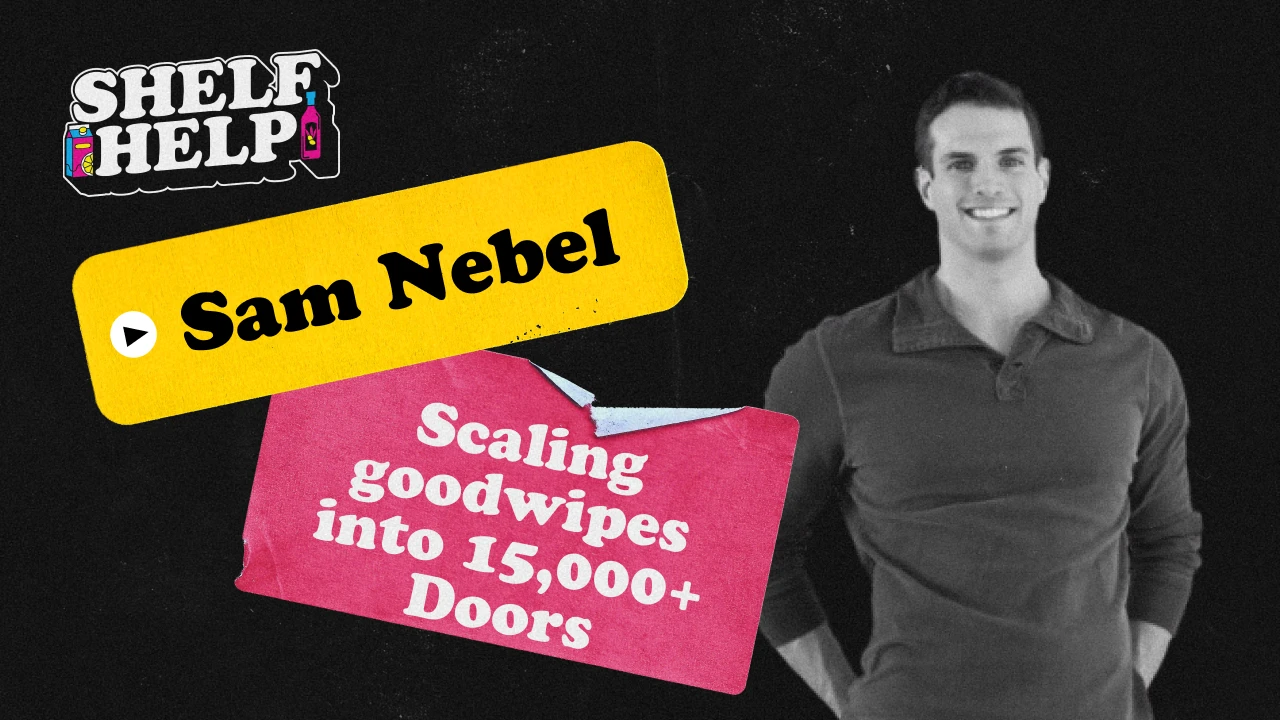



On this episode, we're joined by Sam Nebel, Co-Founder and Chief Commercial Officer at Goodwipes, a fast-growing eco-friendly wet wipes brand that's secured shelf space in pretty much every major retailer across the country.
In this episode, Sam shares the wild origin story of Goodwipes - which started with a bathroom conversation at a Florida State fraternity house - and breaks down how they've built a premium flushable wipes brand that's revolutionizing the restroom routine for millions of Americans.
We dive into their scrappy early days, the importance of bootstrapping and building on a budget, and how they navigated formulation challenges to create a product that truly stands out. Sam gets tactical on brand identity and packaging design, explaining why "in-home aesthetics" matter just as much as shelf appeal, and walks through the naming process that led to Goodwipes.
We also cover retail strategy at scale - what's unique about Walmart, Target, and Kroger, why placement in the toilet paper aisle vs personal care matters, and how they've successfully scaled into 10,000+ doors. Sam shares insights on the challenges of sampling wipes, their growing presence in airports, and what it takes to launch new products successfully.
---------------
Episode Highlights:
🚽 The fraternity house origin story
💪 Bootstrapping lessons from franchising and nightlife
🧪 Formulation R&D and product iteration
📦 Brand identity, packaging, and "in-home aesthetics"
✏️ The naming process and creating approachability
🛒 Walmart, Target, Kroger—what's different about each
📍 Why aisle placement matters (TP aisle vs personal care)
✈️ The airport channel opportunity
📈 Scaling from 100 to 1,000 to 10,000+ doors
🚀 New product development and hitting timelines
🎯 Risk and opportunity ahead
👀 Trends and brands Sam is watching
---------------
Table of Contents:
0:00 - Intro
0:47 - Origin story and goodwipes overview
3:21 - Lessons as a franchisee
5:22 - Lessons as a nightlife agency owner
7:59 - Building on a budget, fundraising
11:02 - Formulation and R&D
14:00 - Product roadmap and innovation
15:32 - Brand identity and packaging design
19:41 - The importance of in-home aesthetics
21:43 - The naming process
23:32 - Walmart, Target and Kroger and beyond
27:41 - Sampling wipes?
29:12 - Airports
31:10 - Scaling into 10K+ doors
32:28 - NPD decision process, getting it right
35:15 - Risk and opportunities
36:58 - Trends and brands Sam is watching
---------------
Links:
Goodwipes – https://www.goodwipes.com
Follow Sam on LinkedIn – https://www.linkedin.com/in/kingofwipes/
Follow me on LinkedIn – https://www.linkedin.com/in/adam-martin-steinberg/
For help with CPG production design - packaging and label design, product renders, POS assets, retail media assets, quick-turn sales and marketing assets and all the other work that bogs down creative teams - check out KitPrint.
Episode Transcript
Speaker: 00:00
Welcome to Shelf Help. Today we're speaking with Sam Niebel, co-founder, chief commercial officer at Goodwipes, fast-growing, eco-friendly wet wipes brand that's pretty much in secured shelf space in pretty much every major retailer across the country at this point. Before launching Goodwipes, I think more than 10-ish years ago, Sam was a franchisee of a health and wellness brand and then was also part of a founding team of a nightlife agency. I think the region he was responsible for scaled seven figures pretty quickly. So some interesting experience. But yeah, Sam, just first off, for listeners that maybe not as familiar with Goodwipes, just give us kind of quick lay of the land, just in kind of in terms of the origin story and kind of why behind the brand, core products in the lineup. And then it's pretty much can be found everywhere, but anywhere else, anywhere you want to specifically call out that people get their hands in them, maybe new doors you guys are in, and then we'll go from there.
Speaker 1: 00:48
Awesome. Adam, thanks so much for having me. Great to be here. I've been a fan of the pods on Shelf Help. Love the name that you've come up with there. So I was secretly hoping that you were gonna ask me to come on. That wasn't the only reason I was engaging and commenting, but I was thinking to myself, yeah, if he asked me, I would, I would say yes in a heartbeat. And I think I did it within five seconds. Yeah, good wipes. We are, we make premium actually flushable booty wipes for an actually clean bum. We launched the company about 12 and a half, 13 years ago almost now, based on this premise that we believe there's an opportunity to revolutionize the restroom routine of 330 million Americans. We started this. The idea really came from a Genesis story, meeting my co-founder, Charlie, at an upstairs bathroom of Florida State, our fraternity house, and we bonded over the fact that we were both wiping our booties with baby wipes. And it was so crazy to us. And so we said, hey, let's share it with all of our friends who initially thought we were super crazy. In 30 days, they would steal our wipes. They would come up to us at tailgates and parties and the library, asking for our baby wipes because they needed to feel clean. And so we recognized there was an opportunity to come up with something that was more approachable, smelled better, had better ingredients that was more modernized and cool to use and share. And so it was five years after college, or maybe six years after college, after those moments in freshman year, that we decided let's come up with this product, not just product, but a brand. And after many iterations, you're looking at the core lineup here where we focus on 90% of our business is flushable butt wipes with these act, these excellent ingredients powered by botanicals, aloe, vitamin E, purified water, extra large, bigger, softer, wetter, better than toilet paper, anything else you could find on the market. And you can find us listeners available on Amazon, now on TikTok Shop, now on the newly renovated goodwipes.com, all Walmart stores, all Target stores, all Kroger and Kroger banners, Safeway, Albertson's, H E B, Market Basket, ShopRite, Annaford, Rayleigh's. We're coming to a store near you, Hive, Meyer, a lot of fun distribution in the mix these days.
Speaker: 03:11
Love it. Get your wipes anywhere. That's what the people need. That's right. Uh before we dive into the good wipes stuff, I'm just kind of curious. Like, what um would you learn being a franchisee of complete nutrition and kind of like, I don't know, what mistakes, initiatives that are kind of a big time suck do you think you avoided by doing that business first?
Speaker 1: 03:30
So many learnings. I wish during that time I was in the mind frame of, hey, I'm here to learn, not, hey, we need to franchise and open stores as fast as possible. And I think I would have doubled my learnings, but I walked away with a few key learnings. The first one is there are models out there that exist where you're serving smaller markets in, let's say, middle America, even though these are big cities, Omaha, Nebraska, Amarillo, Texas, these kind of second-tier, third-tier cities that you can make massive million-dollar, multi-million dollar high profit businesses with actually an arbitrage. So they had this model that I was fascinated by where they would actually advertise on AMFM radio for very cheap, and they would own the airwaves and draw people in and get them on these massive $200 AOV kits that were 70 to 80% gross profit margin. So it was just this profit flywheel that they utilized. However, it only worked in markets that were those, you know, let's call mid-tier markets just by population size, nothing else. Whereas in Minneapolis or Denver or South Florida, the system failed because it was too expensive and there was less trust in the complete nutrition. It was a more competitive environment. That was the biggest learning. There was the plus and minus. The other was they were so focused on capturing and maximizing an AOV or the crow's profit when a customer came in that it would, it made retention drop off and it was really hard. You of course had your kind of super consumers that would spend multiple thousand dollars a year with complete nutrition supplements, but you also had people that would spend $500 on an order, everyone would get excited, they would see no results, and then they would never come back. And you just, you, you ruined the business model and you also ruined uh the consumer, and the consumer responded better to iterative approaches to changing their lifestyle. There's a number of other lessons, but those are two of the big ones that stand out.
Speaker: 05:22
What did the running the nightlife agency? I'm more curious than that front, like really teach you about consumers and kind of like what they care about, how to position brands in a way that truly resonates and like how building like a passion following where you know people are lining up outside the door for whatever thing you're event you're focused on or act you're focused on.
Speaker 1: 05:40
Yeah, I think it it was a few things. God, there were so many learnings there. It was really exciting. I think that's more so than any learning. Excuse me, Adam. It it was this bug, this itch that we got to scratch where we could provide value to our friend cohort. And this group of our friends would get excited about bringing Steve Ayoki or Wiz Khaliva or Mac Miller or Vichy R.I.P. or Benny Banassi or Tiesto and being able to not make money just like overprofiting off of them, but provide a service to our friends and peer group was a really cool feeling that we felt like we were this group galvanizing. And hey, we have a group of friends, but we could also bring them commercial value was really cool because we were also building that commerce, you know, scratching that entrepreneurial itch that we developed for ourselves. So it was really that intersection that was really fun and exciting for us. Some big learnings that we had were just reflecting. Hey, we brought Wiz Khalifa to Florida State University, and it was super cool seeing him or Mac Miller. And the first time we would bring them, it would, it did really well. And then the second time you'd bring them and there were so many people. And then the third time, it was thousands of people overflowing, tickets sold out two weeks in advance. It was super cool to watch their career trajectories grow. And they're a brand, right? They're a brand in it of in and of themselves. Totally. Every single one was really nice. Actually, funny story about Wiz Khalifa. I missed the party degree picture with Wiz Khalifa because I was doing what in the bathroom? Yes. Anyone guess? That's right. I was I was going number two, so I couldn't go. So that's just IBS, a day in the life of IBS for you. But it was really exciting. And the third lesson I would say is just because you think you have a home run does not mean you do. There's risk involved in any no-brainer. We brought Rick Ross to Miami with actually a bunch of IU kids at Indiana. Shout out to uh the Hoosiers, national champs. Yeah. And we brought Rick Ross, and it was like, hey, you we all need to pitch in, you know, two, three thousand dollars for this. You're gonna make $10,000. And we all lost our ass. And it was just funny. Like, we got to go on stage with them. It was just funny, though, being at a no-brainer, and we would go to people on the street and they'd be like, I don't give a shit. Like, I'm not going to your show. It's like, wait a second, Rick Ross is from Miami. Why isn't this working? So there's different people at different times. Like sometimes there's march market mismatches, and you never really know. You just have to go out and see what happens.
Speaker: 07:56
Interesting. Let's dive into the good wipes. Let's do it. First four years of business, I think you're pretty fairly bootstrapped, if not entirely, like you know, most founders in the early days using personal savings. And then I think you got EK investment as part of an accelerator, which is helpful, but not a huge chunk of cash. So I think for a lot of the other founders that are in a similar boat right now, any just kind of few pieces of advice you might have just in terms of just really how to kind of prioritize and allocate capital when you have a limited amount of capital and how to get things for cheap or free and kind of how to get those first sales and show traction where you've got minimal budget to spend.
Speaker 1: 08:30
For sure. It's really tough. You know, when you said over these questions, I was thinking long about that one because it is something where you have this mindset, this scrappy mindset. You have to be really careful not to piss people off. Vendors hate, imagine lawyers. They they hate it's like, hey, can I get a discount here? Can I do this for free? It's like you can't just make that ask all the time. So there is an element of believability, buy-in, and likability to it, whereby these vendors have to believe in you. And that's why I think it's really important to institutionalize yourself as much as possible. Have a vision, be clear, say, hey, this is my three and five-year roadmap. I know I'm at this early stage. I know we don't have any sales. This is what we're doing. I want to be really clear with this. I want to partner with you. We do need a little help. Is there some sort of arrangement that works for you that could help us not have to pay up front and pay as much up front where you reap more rewards in the back end? And that can allow for creativity to ensue whereby they become a collaborator or and a partner rather than someone who feels like they're getting hit up for a favor or pro bono work all the time. So I use lawyers as an example. It could be co-manufacturers, it could be vendors for anything, right? There's so many different opportunities that this actually comes into play.
Speaker: 09:46
Yeah.
Speaker 1: 09:46
Any advice for just founders that are that are raising for the first time? Jason Michael Burke likes to say, treat it as a process, not a wow, show and tell. That is my biggest learning lesson. I leaned a really hard on charisma my entire career. You see the tweets about, oh, charisma, you need charisma, blah, blah, blah. That is directed towards people that don't have charisma and need to work really hard on cultivating it, not someone who already naturally has charisma like me. You have to be organized, you have to be diligent, you have to have files ready, you need to respond to feedback, you need to have a feedback loop internally. You need to be able to respond to requests quickly because every time you fall behind in that process, you come to a place where everything else cascadingly falls behind. You need to come up with the appropriate responses. Say, hey, I'm gonna get these answers back to you by three days from now. Set yourself deadlines that then you could circle back to. Because anytime you drag your feet, they're gonna exponentially drag their feet because they have other things going on. Let's say these investors, angel or institutional, and that pushes their yes, no, or maybe out even further and just creates an elongated gray spurious, gray space that is almost impossible to get out of. And gray space just means you're losing momentum. So there is momentum involved with this.
Speaker: 11:02
Let's rewind back to some of those early days of kind of RD and formulation. I imagine it took a while to kind of dial things in and kind of get a product that you felt like really worked well, wasn't, I don't know, tearing in your hands or whatnot, that things can happen with wet wipes. It just, yeah, without giving it away any, you know, big trade secrets, what are some of those kind of key variables you guys were playing around with or kind of tweaking between that kind of first version and the final version? You said, yeah, this is this is right. This is something I'd be proud to sell and give to people.
Speaker 1: 11:29
Absolutely. It started with the idea that we went to, I think Publix that was local to us, as I said before our talk. We were living out of my parents' house in Orlando, Florida. We went to Publix and on Amazon for what Amazon was at the time, bought every wipe, not just flushable wipe, every single wipe. I had hundreds of packs of wipes all over my parents' house. And we would go through the back of the ingredients and we would pick out and research every ingredient that we saw. And we already had some ingredient background from Complete Nutrition. So we were already predisposed to caring about ingredients that people were putting in their body and on their skin. And we wanted to come up with a product that no one else had these ingredients and eliminated all the nose and the nasties. So alcohol-free and paraben-free was really important to us. Not having phenoxyethanol, not having methyl parabens, which were still present at that time 10 years ago, was really important for us to make sure that we didn't have an or-not use list. And then what we did have surrounding ourselves with these smooth, soothing botanicals, aloe, vitamin E, chamomile, lavender, kind of our quad pack that no one else has and uses that we know can resonates really well with consumers, making sure that the um the the soothing ingredients that we had, the surfactants, all the levels were to this level of our satisfacting, satisfaction. A lot of brands, a lot of wipes that are cheaper made on the market are overly soapy. We we despise that. Consumers hate that. It's laziness in the manufacturing process, it's cheap ingredients. So these are all things that we took into account and would tweak and make iterate iterations along the way over the past 10 years.
Speaker: 12:57
How many, if you had to guess, like how many uh batches or rounds from like the first one you guys were experimenting to ones you said that were ready to we're ready to sell this and pitch this to retailers. Was that like, you know, five, 10, 50, 1000? Like how many batches did it take?
Speaker 1: 13:12
No, I wouldn't say that many because we didn't have as enough money. So we had to really dial it in and get it right. Yeah. Packaging iterations. This is a repack we just did last year. Super cool, came out, excellent. Lots of it's it's that perfect mix of art and science that's really resonating with consumers now. I mean, this is probably our sixth packaging overhaul. Each time you do it, you feel like, my God, we've got it. We're set, we did it, we're the coolest brand on the shelf out of any category. Not true. Never true. You always are gonna have another iteration, maybe one, two, three years later. I feel like we're in a good place now, but you just you always get consumer response to then and then seeing what trends are out there. And then how can you craft that and alchemize that to make it your next level of your own where it doesn't look like everything else? Tough balance.
Speaker: 13:57
Totally. Now that you really kind of honed in this product, what's any anything I guess you're you're able to share in terms of things that are next on the roadmap?
Speaker 1: 14:04
You ask any entrepreneur and CPG, the innovation pipeline is gonna be a mile long, an inch deep. Yeah. What can you practically come up with that makes sense for the market at a given time? Is a much more narrow list. So we definitely have a lot of innovation that we're sitting on. I can't really talk about it. This year, two weeks from now. When is this gonna be released? End of uh or early February? Next, you know, three weeks, I would say. But yeah, big announcement launching. Okay. It's not necessarily, I don't want to say it's a groundbreaking innovation, but it's something our customers have been asking for for a couple years now that we're gonna be launching exclusively in Walmart. I can't wait. I'll just tell you right now, fragrance free, now available at all Walmarts. That's right. Fragrance free, you guys have been asking for it, bringing more consumers into our brand. We already bring the most incrementally. We have a few other fun innovations that are gonna be coming out this year. Most of our growth comes from core. That's the fun part. We don't have to do anything different. We just have to get better at optimizing the message for our core product line now. Totally. And balancing that with some newness that we're releasing this year that is going to blow people's minds and send people off the rails in what we've come up with. That doesn't, it's not too weird or crazy that it'll go over people's heads. It's gonna be right on the money. And I'm really excited for it to come out this year.
Speaker: 15:21
Amazing. Well, tweets iterated on the packaging quite a few times in terms of key variables that were top of mind for you guys in terms of building out the brand identity, positioning, and voice for goodbye, especially in a category that it is somewhat competitive and how you guys really wanted to stand out.
Speaker 1: 15:36
Yeah, premiumization was really important to us in doing it in an approachable way, not a an off-putting turn off X the highest price way. We we understand that doesn't work. And I'm not saying this category is super price sensitive because frankly, it's not. Most of actually, all of the growth in the category for the past three years has come from two premium brands. Private label brand, private label share is is declining. It just had happened to be first to market. People really want quality. People are entering the category because they know they need clean and sanitization. They're upgrading in the category or just coming, frankly, to this new premiumization component because they it's a self-care skin routine that we've developed and that we're bringing millions of Americans into, which is really exciting for us. Premiumization, like I said, is important. And really, we say peach, right? We're peachy. We're playful, we're empathetic, we're approachable, we're cheeky, we're honest. That's the brand tone that we wanted to bring. And what I'm about to say, I don't want to get misconstrued for ignore the quality of your product. I think this is what used to drive me mad about this. But we really wanted to build a brand world, an ecosystem, community-driven, entering communities, galvanizing people, interacting with our fans, making it approachable, like I said, and also a really good product. I feel like a lot of people say, well, Apple just build their brand with a logo. It's like, no, they didn't. They built it with a better computer processing system for half of America. The rest, like Dell's and whatever else, or Lenovo's. But other people, it's not just the sleekness of Apple. That's part of it. The other part is because it's a good product. And so we are, I would say almost equal weighted of an unmatched product with a really fun and memorable and shareable brand. And we wanted to make sure that that collision was always apparent and there was never a separation between brand and product quality.
Speaker: 17:27
That totally makes sense. What seems to be kind of the infamous book everyone reads in CPG Ramping Your Brand by James Richardson? He talks about how premium pricing really comes one crystal clear promise. What would you say is good why promise that you guys communicate above all else?
Speaker 1: 17:42
I would say that our and actually I I I just thought of an idea. Adam, do you mind if I go live on TikTok? Is that cool? Sure. Okay. They're not gonna hear you, they're only gonna hear me. And I just want to run an experiment if it works. Yeah, totally. Hold on one second. Live. Let's just see. Let's see if we get anyone. I think it's interesting. I'm I'm doing this silly thing where I'm, I don't want to say I'm becoming a content creator, but I am experimenting. Love it. Because of the launch of our TikTok shop. I think I have the book right here. Where is it? James Rich James Richardson, Dr. James Richardson, ramping your brand is my Bible. I read that thing three times, front to back. I have read every single blog by James Richardson. And I I compile them when we were strategizing, I think it was four years ago. I compiled them and set and referenced every single one to talk to the team and talk to my partner with them. Okay, well, what about this and this and this and this? Just so I could reference everything. I am obsessed with that book. For good wipes, because we're educating about the product, it is important, I find, that we do have some features and some benefits, but the brand side, so we say outcleans TP. That's important because we are doing consumer education. But it's also building the brand, like I was talking about before, right? It's this idea that it's not just outcleaning TP, it's how do you feel when you're in the bathroom when you leave. That's why we say we're a feel-good brand. That's why our purpose is empowering people to feel good, inspiring people to feel good. Whether you're watching one of our TikToks, whether you're on the toilet using a good wipe, you need to feel good. So we we wrap everything in this bow of feeling good in all of our media and all of our consumer touch points across our entire universe so that people resonate with it's not just any old wipe that's gonna sanitize me. It's this is a skincare routine. If I'm taking care of my face, if I'm washing my face, if I'm scrubbing my armpits with aloofah and soap, I'm also gonna take care of my butthole and wipe with a good wipe, right? That's what it is. So it's more tying it into that way.
Speaker: 19:42
Obviously, you want the brand to drive velocity in store, but you also put a focus on in-home aesthetics, meaning you wanted to make sure the product looks like it has a right to live on the counter or somewhere out in the open in the bathroom as an example versus hidden away in the cover. What does this mean to you in terms of what you conveyed in the brief or whatever design or agency you guys work with on the packaging design front to actually achieve that goal?
Speaker 1: 20:05
Love that you are asking about that. In-home aesthetic, and I love how you're phrasing it too. We always say it needs to look good in the back of your toilet. Yeah. In-home aesthetics. In-home aesthetics. That was a key pillar of what we were trying to achieve with this. It must be left out. People hate the private label. We did consumer studies, consumer panels, and anecdotes. They hate something that doesn't look good in their bathroom. They absolutely hate it. If it doesn't match, if it doesn't match the pattern of the bathroom, a lot of people have nudes. It's something that we're looking at, right? They have these different color palettes. If it doesn't look beautiful in the bathroom, they're not going to put it out. Brands that we look to that do a good job, method, hello oral care. We have to achieve that because it invokes, hey, I want to continue buying into this brand. If it's something they put under the cover, we know it's something that they'll eventually say, uh, do I need this brand? It has to be part of the lovable, memorable, shareable nature of the brand.
Speaker: 20:57
You mentioned method. Any other brands really stand out to you in your mind that other founders can kind of look to when you're thinking about if they want to achieve this in-home aesthetic as well.
Speaker 1: 21:05
I think method is the best example of cleanliness while this is the challenge, while still sharing those critical features and benefits to the consumer. Really difficult challenge. Our team, Meredith, Maria, Emily. By the way, Adam, you asked a question. I must correct you. You said in working with agencies, I think, or I made it up. We went to agencies to start. We realized quickly this is gonna be an all-in-house project. Can you believe that this was created by our team in-house? I can't believe it. Well, I can because our team is awesome. Clearly. All in-house, all in-house, and we're seeing it resonate with consumers.
Speaker: 21:43
That's awesome. Naming is such an important, but really ambiguous and often challenging process when you're building a brand and what you want to name it. What did that process look like for you?
Speaker 1: 21:52
Adam, there's a concept out there, which is how much do you really contribute? People tend to overvalue their contributions to life, work, partner. Partnerships, whatever. Sure. I like to think that I contribute a lot. I'm learning as time goes on that I actually contribute way less than the rest of my team. And that's okay. It's very liberating. However, if I die today and there was one thing that I get that I can feel good about, not take credit for, feel good about, is contributing is the name Good Wipes. Of course, agreed upon with Charlie and thought over for almost a year. It just kind of came to me. It came to us this idea that we had a name, good wipes, subtitle, hygiene group, blah, blah, blah, the Gaijin group, below the belt wipes. And when I remember we went to this pitch like 12 years ago, uh, entrepreneurs in Orlando, and they said, What the hell is the name of your company? And we're like, well, it's like this, this, and this. Like, no, it needs to be one. And so Charlie and I went back and said, which what do we pick? And we were like, let's stay with good wipes. It has that ring to it. And there were other parts of the process, including wipes have all a lot of times had a negative connotation, despite their meteoric rise, especially in the flushable wipes space, have had this negative connotation. And we just thought, hey, can we, can we have the brand name do the work for us? Yeah. And re and kind of label, reframe wipes as something that's good. And so it naturally came to us with good wipes. And it's become an incredibly critical part of our brand strategy where we really we have catchy one-liners, out cleans TP, the only way to wipe, butzes are better. But at the end of the day, we have an opportunity and we just say, hey, we're good wipes. That does 99% of the heavy lifting most of the time.
Speaker: 23:33
Let's talk about retail for a second. As you mentioned at the beginning, you've secured shell space and pretty much every major retailer. So talk about Target, Walmart, and Kroger specifically. What have you found are some of the just big major differences just in terms of how they kind of operate, what it takes to win, any kind of unique challenges that really stand out between one of those specifically?
Speaker 1: 23:52
I have a my per this is my personal passion, not just talking about for good wipes. I have a spot in my a special spot in my heart for each retail relationship. There's just something, there's something that you just, it's like an attachment where I get just as excited talking about or thinking about plans for Walmart as I do for Market Basket. And by the way, we are the number one brand, number one flushable wipe brand in Market Basket. We have more share than private label. We have like 40% share. And it isn't. We outpace, we crush it in that account. Yeah. But we all have to be realistic. Like there's 4,300 stores of Walmart, 88 of Market Basket. But when you talk about those to me, you're it's again, this is not a good wipes, this is a Sam thing, king of wipes thing. It feels like we're talking about an aunt or an uncle or a cousin or brother or sister or mom or dad that I love equally. It's just the way I can't live any other way. And and I would say if you could actually adopt that thinking, it'll allow for more fruitful partnerships. I feel like a lot of people in CPG, and I I never really went public for this because for a number of reasons, but I'm ready to do it now. It is a mistake. Go make relationships with chains of all sizes. Go above and beyond. Go outkick the weight of what that revenue can do for you and go do service for them and see what happens. You have no idea how big your category or your brand can get in that specific retailer. Yeah. If you, let's say you're working with a price chopper or topps or a Rayleigh's 100 and something stores. We have, I think, seven items in Rayleigh's now, one of our first flushable wipe accounts. And maybe it isn't, of course it's not going to be as large as Target. But what can happen? You can you can illustrate how the category can develop. Totally. There's so many learnings you could have. And they have customers too. You're gonna tell me, even if you do five units per store per week, or let's say we do 30 total, 30 or 40, you're gonna tell me you can't find more people that are walking in those stores that don't buy your product yet. That's bullshit. That's that's just how I think about it, right? Like, and I I'm sorry, I let a I let a French word slip out there. Now you're good. I'm gonna speak to English today. Maybe we could do a bleep on that. I'm trying to go the the Jim Gaffigan route less first.
Speaker: 25:58
We could do that. We could do that.
Speaker 1: 25:59
Yeah, I don't want to create too much work for you. Uh you're good. Sorry, my my TikTok live is asking, are we on a podcast? I'm on a podcast. Thank you. Sorry. Yeah, I'm focused here, Adam.
Speaker: 26:09
In terms of placement in the store, I've heard you talk about the importance of having a presence in the in the toilet paper aisle versus or and or the personal care aisle. Like why do you feel like this is so important for the brand? And I guess like anything the other brands should in, I guess, a similar category is keeping mind in terms of how they should think about where they should actually where they want and need to be placed in the store.
Speaker 1: 26:30
It's really tricky. We went FEM high first because that's just what we had ready for the market. That's what the market was ready to adopt. We had to wait our turn to get in the toilet paper aisle. But for us, our core, we knew our core growth and core business was gonna be MTT butt wipes, right? So we really wanted to make sure that we could get in there. And it's tough because you get locked out of the category, possibly, just depending on the growth and the where the retailers are at. And actually, I'm gonna answer that question with broadening and saying, hey, you actually should look at Amazon, direct to consumer, and TikTok shop for more immediate market feedback rather than just waiting for that category to open up. Because if you go in the wrong category in the store, that could actually tank you or be the incorrect place. You're still spending a bunch of resources, you're still spending a bunch of time. I'm sure with other categories, it's much more complicated. We're really lucky that we stick out on shelf. And yeah, when you're in the toilet paper aisle, you're primed for thinking this is a butt wipe. But heaven forbid we said we want to go hand wipes or whatever, any other wipes first. Like you have to focus, you have to be known for something to start, and even till you're $200, $500 million in sales, because even then you may not be a household name.
Speaker: 27:36
Totally. Great point. Great point. So another question you had, which was it's maybe more of a straightforward answer than I thought, but like it seems like, at least for a lot of food brands that my agency works with, you know, they always tell me like one of the best ways to get buyers on board and excited about your brand is getting them to try your product. And oftentimes they're dropping off samples of pretzels or cookies or something. Yeah. How does this work for your product? Like, do buyers willingly try and give you feedback and good wipes and like in detail, or like does it lead to some awkward conversations? How does that work?
Speaker 1: 28:03
It's funny. I I have been doing more store visits lately. So there's a Kroger out here in Atlanta, North Druid Hills, that I'm that I go to once a week, just check in, talk to the team there. And I was asking the inventory manager, and she's like, Are you asking me if I've used the product yet? And I'm like, Yeah. And she's a, I don't want to say stern woman, but she's a very business-oriented woman. She's not here for the nonsense or the or the craziness. She's playful, she's nice. And, you know, it kind of took a while to get into that conversation and talk about those habits. But we do, we want that to happen. But what we'll do really in the buyer presentation is, and this is when we know we're we're doing a good job, is we have them, you know, dispense perfect dispensing, and they'll start playing around with it and smell it, and they'll just hold it in their hands and they'll keep it in their hands for like 10 minutes. And we'll just kind of look around and we'll say, I think we got something there. I think we got, yeah, like like not like, oh god, I'm but just like, it's cool to see. And then they'll say, like, oh, this is soft. This smells good. And it's flushable because it breaks apart. Okay, great. So that's really how we do it, rather than saying, okay, we're gonna, you know, Ben put put you on a on a changing table and wipe you right now, right? You gotta you gotta play with with the realm that you're in.
Speaker: 29:13
I know you guys have a pretty strong placement in in airports, which makes sense. Um but yeah, I'm kind of curious what's what's unique about this channel compared to more traditional traditional retail. Glad you asked about airports.
Speaker 1: 29:23
Paradise Lagadair has been our longest running partner for eight years. We've been with Paradise, CNBC stores in most airports, 420 airports were in, uh I think, or sorry, what is it, 72 airports, 430 shops were in 95% of them. We're at the cash register, been a great business with us. Uh been a great business for us, done really well there. Yeah, it's definitely different. You have you go through a distributor, that distributor got acquired. We had relationships, you got to move it around. It's it's a different channel, right? You have to measure it. It costs money, there's placement fees, but it's worth it because it's an opportunity for your brand to get out there and for people to see you with millions of travelers traveling every day in just a few airports alone: Dallas, JFK, ATL, LAX, that get to see your product and then that might go see it on Amazon. So it's critical, it's worth every penny, it's worth that relationship. It's one that we continue to evolve and want to work with. We used to have three products at one point, all the all the different product segments have really focused. But I mean, we're honestly lucky to get two shelf spots there, right? Like you're talking about you're not just competing against other butt wipes or toil paper, you're competing against all of HBC. Oh, I have a runny nose, here's tissues. Oh, I need uh, you know, an anal suppository for hemorrhoids. Oh, like they have tweezers for my middle whatever, right? Like there's so many, my unibrow. There's so many different use cases there. So you really it is cutthroat and you have to be prepared and you have to be willing to pay up to play up. Yeah. But it is, it is one that I think is really worth it to get those in-roads and make those relationships. So thank you. Shout out to Parity's local Atlanta to Atlanta business. Appreciate it. Karen, you're the best.
Speaker: 30:58
Love it. Thanks, Karen. Thanks, Karen. In terms of uh kind of scaling from just operational standpoint, what are the big differences in terms of keys to without uh everything breaking keys to scaling from a hundred to a thousand doors versus going from a thousand to ten thousand?
Speaker 1: 31:18
Yeah, the keys of scaling from a hundred to a thousand and a thousand to ten, thousand stores, because we are in 15,000 stores now, is your focus. Well, number one, you're always it's gonna be exponentially more intense and focusing on operations as you scale to more stores. Inventory, you're watching those religiously. Shout out to Laura P, who's actually watching on our TikTok live right now. And you really have to monitor those things because if you get an uptick in sales, sales, whether it's promotion or because your velocities are naturally increasing, you have to be watching that like a hook. So it definitely makes more, I would say, fragility and agility required to go putting those emphasis points behind how you're managing the business. I mean, a hundred to a thousand, you're in survival mode. Let's face it, right? Like you're you're saying, how am I gonna factor this PO? How am I gonna factor this invoice? Whereas now you're and you have to have inventory. It's just, it's it's critical every point, right? You're never gonna feel you're never coasting, right? Because if you're trying to increase velocity, which actually becomes more important as you scale, because you need to have more reason to stay, more reason to grow, and that's what you're trying to do is get more household penetration and share, you have to be just more intense about monitoring those things. So it's almost like the just the system becomes more complex and intense for monitoring those things, right? That's super helpful.
Speaker: 32:32
From a product roadmap standpoint, I kind of asked like what's coming next, but in terms of just more process decision-wise, what's the journey or process look like internally with the team that actually leads to the decision to say, yeah, okay, we're, you know, we feel like we have enough conviction here to bring a new SKU to market.
Speaker 1: 32:47
We do the days of only making decisions by having an internal conversation with three to five people is over. Sure. We stress test with our consumers, we stress test with consumers that we don't know. We will utilize assets or networks that sometimes you do pay for to get surveys ran and compare that against your core consumers. So, hey, what are our super fans using that we know they fill out every survey of ours versus people that are new to the category, not in the category, we'll bring them into the category. So we kind of triangulate different consumer panels to understand it. And of course, you you infuse your own intuition in there, but you can't be married to it or religious to it, right? You have to triangulate and see. And that's how we know that we have something, we'll look at different data, we'll understand different trends. We like to look around the store, so you won't see us only talking about gut health or butt wipes. You'll start seeing some things where we're crossing categories for innovation work that we're really excited to share.
Speaker: 33:42
That makes total sense. What have you found are just the keys to a successful product launch, both from a budget and also actually hitting the timeline, the launch timeline that you originally set out, which I think is typically a pretty hard, hard date to hit.
Speaker 1: 33:54
I wish I could say that we have this magical process and that we have this innovation timeline where we're planning things one to two years out. The truth is, and I've been a more believer in this, I'm this believer in having a framework strategy, but allowing for these moments of magic to appear in your business as you scale. So it's kind of a fusion of both rigor and intuition. A lot of innovation coming out are from moments of magic of split hair conversations, requests from buyer, 20-minute ideation, mock it up, our amazing design team that did this in-house rebrand are then coming back with ideas, boom, stress test. Okay, does this look good? Bam! Really quickly. Those numbers and metrics insights. We we do it. I mean, we have come up with ideas in less than 24 hours, less than 12 hours of idea to stress test consumer panel to understanding how this lives with the retailer, to talking to potential partners, to checking our supply chain and when is it gonna launch on shelf? Literally less than 24 hours and made things happen. And it's crazy. And again, relying on our team to make things happen. It is unbelievable how fast we can do something when everyone is just in flow and focus. It is, it's that's why it's magic. It I swear to you, it's magic. And by the way, I'm not taking credit for this. This is my this is our team.
Speaker: 35:10
For sure.
Speaker 1: 35:11
I actually have not been in on those conversations. That's okay.
Speaker: 35:14
But I'm here to tell the legend and the tales about what do you feel like our risks to the business right now and biggest opportunities that you guys see over the next year, few years or so?
Speaker 1: 35:23
Biggest risks were the consumer perception for flushability, which the responsible flushing alliance, which I am a sitting board member, has done a great job. Our association INDA, the Association of Nonwoven Fabrics, has done an amazing job. And they have many other jobs besides caring about flushability and flushable legislation.
Speaker: 35:43
Sure.
Speaker 1: 35:44
They it it feels like you're the only priority, which is awesome. So shout out to INDA, Wes, Laura Weiss, Matt Osicki, that whole team has been a pleasure to work with. And they've done a great job working with wastewater agencies, CASA, in particular California, to craft education campaigns for consumers to make consumers aware that you can flush a flushable wipe as long as it passes proper regulations. And we're actually flushable. We actually meet that criteria, IWSFG, PAS3, which is super critical, GD4 as well. And by getting that education out there slowly but surely, it allows consumers to feel more comfortable. And that's why we're seeing the growth start to explode in the category of, you know, what, 20 plus percent K over the past several years. And so that is super important to us. And I would say that risk has turned into an opportunity for education. And that's why we have launched, shout out to Gianna, who's on here, our ambassador program, which they're not just focusing on that, but that's a question that comes up. They're at an event, they say, hey, try this wife, feels better, et cetera. And they go, is it flushable? Yeah, here's the backup. And so doing that on a daily basis consistently, amassed that over time, the next 12 years, we're gonna be as big as toilet paper. That's the plan. That's the vision.
Speaker: 36:56
Love that. Last question for you, Sam. Um you're just so ingrained in the CPG world. Any specific brands or just kind of trends in general within the personal care space, food beverage, anything that, you know, I'll let you take it however you want, anything that's kind of you're particularly excited about, or things you've been tracking closely at all?
Speaker 1: 37:12
Yeah, there's a few brands of people. I don't want to say I'm mentoring, like I'm the one. Like they're, you know, they do the work. You're probably one of 50 people that they come to, but there's a few brands and friends on the radar that Roxanne McBride, shout-out. She used to work at Goodwife's launching fiber bliss. Fiber is hot. Fiber helps reduce cholesterol, it helps with GLP ones, twos, and threes. People, 95% of the population is under-indexed on fiber, me included. And that little beautiful scoop helps you. I have friends that are launching, I don't want to put them out there because they are in stealth, but I do have friends that are launching really cool innovation that I'm excited to watch. It brings back fond and horrendous memories of those stages. And it's just so cool to see those entrepreneurs checking in every month. And it's like, yeah, here's where we're at now. I'm like, whoa, you did all that in a month. That's crazy. You're a mother of two kids, all et cetera, et cetera, is really encouraging. It's just humbling to see, right? You're all, it doesn't matter if you have a $200 million company or a $5,000 company. No one is better or worse than anyone else, right? Like it's it's all really, really hard. And that's what, you know, kind of trauma/slash accomplishment bonds everyone together and makes everyone in it. That's why I never root against any entrepreneurs. That's why I never talk shit about they're doing this. Like, let's just see what happens with the market. And if they fail, it's you know, whatever. It's not their fault, right? Like totally. It's a tough game. It's a tough, tough game to to play. Sure is.
Speaker: 38:31
Yeah, sure is. I commend anyone, anyone playing it. What's the best place for, I guess, people to follow along with you? And then I know you call that TikTok shop if you have other new places. What's what's uh places you want to call out for people to follow along with the brand these days?
Speaker 1: 38:42
If you want to connect with me, you're probably watching this or listening to this on LinkedIn, I'm imagining. LinkedIn, I change my name so often. I'm one of my things this year is to standardize it. LinkedIn is gonna be, who am I? Sam Nebel, S-A-M, Space, N noodles, E Elephant, B, E, L. You can find me there. Let's connect. I love making establishing connections there. Adam Steinberg is where I met, is who I met on LinkedIn. I met another guy yesterday, Matt Drake. You make connections for life on LinkedIn. Instagram, Sam Marcus1Forever, TikTok at GoodWipes underscore founder. That's all. At GoodWipes at everything else. G-O-O-D-W-I-P-E-S. Follow us on Instagram, follow us on TikTok, buy us in stores, Amazon, Kroger, Safeway, Albertson's, Target, Walmart, TikTok Shop, GoodWipes.com. Thank you. There we go. Love it.
Speaker: 39:29
Awesome, Sam. Appreciate it. This has been awesome. Appreciate the time. I think that's the pod.
.svg)