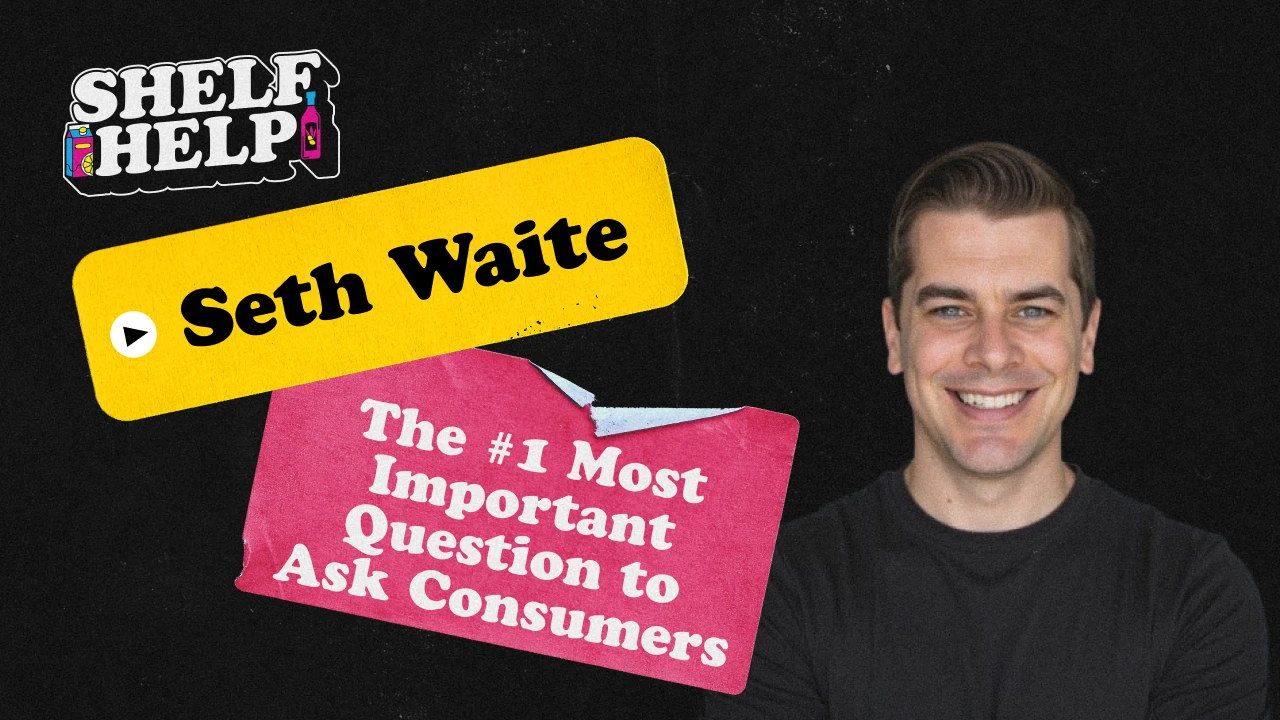



On this episode, we’re joined by Seth Waite, Partner at Schaefer, the buyer psychology firm that helps brands understand why people actually buy. Seth has spent his career building, advising, and investing in businesses at the intersection of CPG, ecommerce, and analytics, with a deep focus on turning consumer insight into commercial clarity.
Seth breaks down how Schaefer approaches buyer research, why brands routinely misdiagnose demand, and the lies teams tell themselves about customer behavior. He introduces the single highest-leverage question a brand can ask to uncover true motivation and walks through Schaefer’s core frameworks, including the Kingpin Strategy and the Why People Buy Pyramid.
We also get into the Marketing Efficiency Paradox, why functional benefits alone rarely create durable advantage, and how brands accidentally make shoppers do the work through over-messaging and feature overload. Seth brings the theory to life with real-world examples, from kale at Pizza Hut buffets to what French’s Mustard teaches us about focus, meaning, and growth across DTC and retail.
---------------
Episode Highlights:
🧠 How Schaefer studies buyer psychology
❌ The lies brands tell themselves about why customers buy
❓ The highest-leverage question in consumer research
🎳 The Kingpin Strategy and why focus beats expansion
📉 The Marketing Efficiency Paradox
🔺 The Why People Buy Pyramid
🥬 Kale at Pizza Hut buffets and what it proves
🛒 Why brands shouldn’t make shoppers do the work
🟡 Lessons from French’s Mustard
🏬 DTC vs. retail: what actually changes
📦 Why “functional” is rarely enough
🔮 Trends and brands Seth is watching
---------------
Table of Contents:
00:00 - Intro
00:47 - Schaefer breakdown
07:08 - Lies that brands tell themselves about why customers buy
09:20 - The highest leverage question a brand can ask
13:11 - The Kingpin Strategy
17:18 - The Marketing Efficiency Paradox
19:58 - The Why People Buy Pyramid
28:54 - Kale at Pizza Hut buffets and beyond
30:31 - Don’t make shoppers do the work
33:25 - What we can learn from French’s Mustard
37:42 - DTC vs Retail
42:43 - Functional this, functional that
45:00 - Brands and trends Seth is watching
---------------
Links:
Schaefer - https://schaefer.co/
Why People Buy - https://whypeoplebuy.com/
Follow Seth on LinkedIn - https://www.linkedin.com/in/sethwaite
Follow me on LinkedIn - https://www.linkedin.com/in/adam-martin-steinberg/
For help with CPG production design - packaging and label design, product renders, POS assets, retail media assets, quick-turn sales and marketing assets and all the other work that bogs down creative teams - check out KitPrint.
Episode Transcript
Speaker 1: 00:00
Welcome to Shelf Help. Today we're speaking with Seth Waite, partner at Schaefer, the buyer psychology firm that works with leading food and beverage brands around the industry. Before joining Schaefer, Seth, I think, founded andor played key leadership roles at a series of leading e-com and CPG-focused tech and analytics firms, went through a handful of acquisitions along the way, a lot of great experience. So really excited to get into it. Yeah, Seth, welcome on. First off, just for the listeners that aren't all that familiar with Schaefer, love to just kind of get a quick lay of the land, just in terms of kind of the origin story and kind of the why behind the company and kind of the model and kind of the core services you offer. And then maybe if you just want to throw out a few examples of a few brands you guys work with today or ones you've worked with in the past that stand out, and then uh we'll go from there.
Speaker: 00:48
No, that sounds great. So thanks for having me first off. Yeah. The opportunity to talk shop and get into buyer psychology. Schaefer is a business that's about seven years old. Uh so not super old, but in the world of entrepreneurship, right? There's always different stuff going on. Um, Sydney Schaefer, my business partner, is the one that actually started the firm. I was the first customer. So she built a really great product, really great service. I had a consumer brand, and I needed help and was like, hey, I don't want to go build out a team. And Sydney and I had worked together in the past, and what she was offering was just super different than what else, you know, I saw out there. So that's actually how I got connected into Schaefer was by being a customer for two years. Nice. The end of that process, my business was acquired. And when the gold handcuffs and all the things kind of came off, um, Sydney and I were like, that was a lot of fun. And the business grew ridiculously fast. And we're like, what if we we do that more often? So Schaefer really at the heart of it is focused on why do people make the purchases that they're making? We always come back to like, why, why people buy? That's the core question we're always driving. And what happens often, because we come from a marketing growth, sales kind of background, is there's a lot of data out there on like who customers are, getting to demographic information about age and gender and income and all those kind of things. And I think that's often the most like overused set of data. It's interesting and it's really important at the very end of the process for targeting, but it doesn't actually tell you much. Like you're not figuring out that because it's a millennial mom from a Chicago suburb that suddenly, instantly, she's gonna be interested in your product. Like if you took a hundred millennial moms in Chicago suburbs, they're gonna have wildly different interests. And so part of that is well, like you've got to know the behavioral data behind what they do. Like, how does that work? There are also, I think, good analytics in that area. Like you've got POS data, and if you're on Shopify and you're doing direct consumer, right? You've got data there. So you've got this behavioral data, and that gets you closer. But the big challenge and where Schaefer comes in and solves it is you're still missing the why component, which is motivations and values. Like, what's the job you're really trying to solve? And why do you care about this? So that's the heart of Schaefer's like point of view. That's what makes us different is when you can connect those three really interesting sources of data, you get a complete picture. And what you typically find out is that the reason why your funnel is performing like well, okay, maybe not at all, is because you don't have the right people coming in the top. And it's because your motivations are off. You're not connecting your message to their motivations, and that's creating problems. So, from a services standpoint, that's research. That's a big part of it, is let's go get you that data. Let's make that like approachable and easy and thoughtful, and let's layer that data on top of your who and your what data around behaviors. And all of that turns into segmentation, positioning strategy, as well as messaging. So oftentimes it's like I have all the right parts. I'm not sure what's the most important in the hierarchy. Like, what do I lead with? Do I lead with vegan? Or does that play a role later in the communication? So we do that strategic work. And then we'll also go tested. So because our background is heavy on the performance marketing side, in addition to the strategy, we'll come in and say, look, let's work with a creative partner, yours, ours, somebody. And then let's take this new positioning, new messaging hierarchy, or new strategy, really focused on your ideal and best customer segments. And let's go put it in the market and actually make sure that it's working. So we'll then go put it on paid social, paid search, you know, pick a channel. And it has to be the right channel to fit with that ideal customer. But we'll go test it so that at the end of this process, we didn't just hand over like a really attractive strategy and a really nice deck, but you're actually walking out going, oh, this is performing at a higher level than what I've got. And what most people will find is that it's not just incrementally better, it's massively better. So, like we just wrapped up uh a big project this last year over the holidays, premium beef brand. So we we actually do a lot in the protein space. And that includes like protein bars and then all the way through animal proteins as well. And so we we did this big project with them. As we were going through the process, they're like, oh, we know our customer. Like, we've got it. For some reason, the ad channels just aren't working the way they should. And, or, you know, it's always a website issue or some kind of problem. And what we found out is that they were focused on a fundamentally different customer than who was actually buying, like currently buying. And they were missing this monster market. So we repositioned them based on those motivations, found out that their demographic targeting was really off, like all the things. And they're a smart, sophisticated company. Like it wasn't like these people are just like novices, but in the process, over six months, they had a four times increase in sales across all their channels. And then during the holidays, they had an ADX increase. Like it was just massive change because they were focused on the right people with the right message in the right channels.
unknown: 06:48
Wow.
Speaker: 06:49
So that's impressive.
Speaker 1: 06:50
That's what we do. That's awesome. That's a great overview. That kind of you kind of led into the first question to have to a certain extent. You you kind of answered it a little bit throughout that, but um, maybe to kind of I guess double-click on it a bit. In all the experiences you've had and going through these projects with a lot of these brands, anything that kind of jumps out in terms of the most common lie or maybe a few lies that brands tell themselves about why people buy their products.
Speaker: 07:19
Yeah. Um, and there's probably like I could write an entire book on just like yeah, all of that. I often will call it like they're they're building all these beliefs on like me search. Like I went out and determined by talking to, you know, my friends, my mom, whatever, that this is true. Um, or I had that one really good review a year ago, and that's what I'm gonna base everything on. So I think I think that ties to this concept that most brands, and that's whether they're VC backed, private equity, yeah, big food, multi-billion dollar enterprises, like they believe they know their customer better than they do. And so much of it is that they're used to having these like cute and friendly little personas around who their customer is, and it fits nicely into a narrative that they like to tell themselves, they like to tell investors, and so they justify a whole bunch of decisions based on this idea of who they think the customer is. And the moment you start pressing and like pushing, it gets really squishy really fast. And you realize that that level of understanding about the customer is very rarely much deeper than demographics. And then the second they they get into demographics, it's like, now let's talk generational trends, right? Like our customers, all these things. And I'm like, okay, but what does that actually mean? What are you saying when you talk about the fact that your product is built for Gen Z? Because I know lots of people in the Gen Z generation and they're wildly different. So that I think is like that is the core belief that limits growth across companies of all sizes, whether you're emerging challenger brand, mid-market, or enterprise.
Speaker 1: 09:13
That makes a lot of sense. Yeah, that makes total sense. I've heard you say that in a podcast or uh your Substack or somewhere that one of or maybe not the single highest leverage research question a brand can ask is if our product disappeared tomorrow, what would you do instead? I'm just kind of curious, why do you feel like this question works so well? And kind of what's it, what does it uncover that other questions don't?
Speaker: 09:40
Yeah. So we do lots of interviews and a whole bunch of surveys, more surveys, you know, than interviews, but we're talking to people all the time and we're talking to them often on behalf of other people, right? Like it's not uncommon for me to have a blind taste test in an interview, and I'm having this conversation and they're trying this thing. And whether it's in a survey or an interview or a sensory test where we're trying to get taste and texture, people are always performing. So to that, I just mean like we're always a little bit on stage, and we want to give the answers oftentimes that are true and close to what we think you want to hear. Or some people are the opposite, which is like true and contrarian, right? Like, I'm not gonna give you the satisfaction of telling you what I think you want. And so, in the process of getting through this data, motivational data, especially, where you're trying to like really understand why people are doing these things, have to get layers into the conversation to start removing the performance, like to get them to start really talking where the answers aren't obvious, yeah. Where it's like, I'm, you know, I'm not leading you down a direction. So the replacement question, which is kind of what we just call it internally, it really is that concept, which is okay, if this protein bar suddenly wasn't available online and in every store you went to, it was gone. What are you gonna, what are you gonna do? And often it's pretty open-ended. Because for some people, they're like, I'll just stop eating protein bars. We've I've had people who will say, I would make my own. Wow. Because, and that's a beautiful, that's my one of my favorite questions or answers, because in that scenario, they're saying there's nothing on the market that meets this need. The worst thing you can hear is, oh, I'll just go get X. Right. In the protein bar space, one of the things we find all the time is that very few people are single brand protein bar suppliers. So, like in most cases, people have two or three different brands in their pantry. They've got some stuff they like in the mornings or the evenings or on the go, all of those kind of things. So it's also not great if you hear, cool, I'll just start buying more of this. Like there's no change, there's no shift. My behavior will stay largely the same. And I'm gonna be one of those little, like, that's interesting, move on. That means you have a really poor position in the market, and you're a commodity in the biggest sense. So we're constantly looking. And then what happens is you can start asking question after question after question, and you start moving down in depth, and pretty quickly you understand this is the values that influence my purchase in this area, and this is what I'm motivated by as I'm making decisions, and this is why I said I would make it myself because the flavor, the attributes, pick a thing. They're so hard to find that this is what I'm looking for. So that's a lot of depth, and I don't have to spend an hour trying to coax it out of you. It's almost instantaneous, like, cool, let we just cut through all the other survey questions or all the other interview questions and got right to the point, which is how much do you really value this?
Speaker 1: 13:12
What's the what is the the kingpin strategy? Why would you say it's a framework that that brands should kind of build their business around?
Speaker: 13:22
Yeah. Most people show up, I think, whether you're, again, emerging or anywhere in the process, and you have this core belief that everybody's your customer. Like if you walk into this retailer, you're my customer. Because somehow, again, like all Whole Food, Whole Foods customers are the same, all Costco, like you just you have this wild belief that you wouldn't believe in any other place. Like you wouldn't apply it anywhere else. But the moment your brand or your product is somewhere, you believe that nearly every person, except for those trolls out there, are gonna love your product. And it's just not true. Yeah, it's not for everyone. And brands that are the most successful, they learn that the quickest and find like, okay, who is it for? So the kingpin strategy, I'm not a I'm not an amazing bowler. Like, it's not like my jam where that's all I'm doing all the time, but it is built on this idea of bowling kind of strategy. And so when you're going for a strike in bowling, you've got all the pins lined up, the kingpin is the very first pin. And when you strike the kingpin with the ball with enough force in the right angle, what it will do is it'll actually start knocking down all the other pins in succession. If you hit the pins at almost any other angle, if you're trying to go for too much or any of those kind of areas, what ends up happening is you get something, but you don't get it all. Yeah. So if you're looking for that strike, like you want to be a brand that feels inevitable, like we're gonna be here 10 years from now, and 30, we're gonna hit a billion dollars, we're gonna do all those things, then you have to get the strike, you have to hit the kingpin. And the way we think about it is the kingpin is your initial best customer. So your best customer can come from a couple things. One of it is like fit around behaviors and motivations. And then the other part of that, so like if I was building kind of the matrix, you know, four quads, one is fit. So I'm looking for how good of a fit it is, the other is influence. So the other kind of magic component here is that there are people that are your best customer through motivations, through behaviors, and through targeting. And then you're looking for the people on top of that who also influence their peers and their friends and their community. And that's your kingpin. Like you go pursue those relationships. And at first you might feel like, I don't know if this scales as well as just throwing a bunch of dollars into Google's PMAX ad campaign or, you know, hoping that Meta's AI will just like magically go grab people and somehow get me a low enough cost to do it. And so what ends up happening is you go get these influencers, they connect with the next line, right? And because you've done segmentation work, ideally, right, you've come in and said, Who are my customers? Who's my very best? And then who's my next and my next and my next? You make the world feel very small and achievable. So rather than I've got to figure out how to make my product mass market appeal, instead it's like, I've got to just nail this one group. And then I'm I know who my second and my third and my fourth and my fifth are. And pretty soon you have a multi-year strategy and your life gets really simple because marketing no longer feels frantic. It no longer feels like I'm chasing every new retail door that I can find. I've got to just be spending more and more money, and I'm not exactly sure if it's working or not, but it just gives you incredible focus. And that focus leads to success. Totally. And it's so much easier to match here's who we say we are, with here's what you need. Right. And all of a sudden that customer brand connection is so much easier because you're not trying to say and, and, and with every single thing about you.
Speaker 1: 17:19
How does that relate to the marketing efficiency paradox, which I'm sure you've seen you write about as well?
Speaker: 17:25
Yeah, I mean, so we always go back to the fact that there is a really interesting relationship between efficiency and effectiveness when it comes to marketing. Like oftentimes marketers are trying to do both and they can sometimes conflict. And so what I mean by that is like efficiency is all about like we're talking ad spend or we're talking about, you know, promotions or pick a thing. We're trying to optimize them. Like I always use that idea of like, you know, we're tweaking, we're modifying. It's like, you know, if we go old school, or it's like it's the knob on the radio, we're trying to get it just right. And in the process of trying to get it just right, we can really quickly lose the point. And we can find ourselves optimizing on a smaller market than is real. Like, because you're like, in an effort to get to the lowest possible cost per acquisition, I'm now only focusing on the people that will buy it off of the one click or whatever that cost is. And so you're actually often shrinking your market and not in the healthy way of aligning, you know, values and motivations. But it's really just you're aligning some arbitrary goals that make your performance look better, not the business's actual growth. And so it's a really dangerous model that we see all the time. And that's why we go back to this idea of like oftentimes you're so focused on optimization that you miss the question on whether the right people are even in the funnel to begin with.
Speaker 1: 18:58
Yeah.
Speaker: 19:00
That's that effectiveness versus efficiency component. Yeah. You have to find a way to do both. But if I could only choose one, it would be effectiveness. At the end of the day, is this working? Are we growing with real customers who are repeat business and they're coming back? And are we getting trial? Like that's the other component here is often efficiency reduces trial because it's tightening up metrics. And instead, you're missing the opportunity for building a brand and creating discovery and first-time experiences, which they cost more than a repeat purchase and then retargeting, right? So your mix can get off, and pretty quickly you're gonna find yourself in a situation where your numbers look better than they've ever looked in your marketing performance, but your revenue and your growth numbers aren't improving.
Speaker 1: 19:57
Interesting. One of the big premises you you kind of frameworks you work around is is uh this thing called the I People Buy Pyramid. What are those kind of forky levels that are involved that create the complete pyramid?
Speaker: 20:09
Yeah. So when I talk about motivation and values, that feels really fluffy often. Like, what does that actually mean? Like, how does it show up? So, what we did is created a framework and a structure that allows us to talk about it, analyze it, and communicate and share. So, if you're familiar with Maslow's hierarchy of needs, um, you know, it's pretty like core philosophy around how do we make decisions subconsciously and consciously. And at the very bottom of that like pyramid or triangle that Maslow has is this foundational principle of like we build on safety and physiology and these really basic functional needs. Like, am I safe? Am I gonna live? Right? Like we elevate and move up layer by layer and decision by decision based on achieving these kind of core components until eventually you get to, and this is where Maslow's model has of some variation, is like until eventually you get to this like self-actualization space, and and there's a variety of opinions and thoughts around how that works. So while we didn't just come in and say, hey, we took that and put some new names on it, what we did is say, okay, what are the truths there? And how do we think about that from a motivational standpoint? Because purchasing considerations and decision making aren't that dissimilar psychologically from decision making and considerations we make in lots of areas. So the very bottom of our why people buy Pyramid is basic functional needs. And in like food and beverage, it's taste, it's texture, it's like freshness, availability, it's satiation. Like, do I actually feel full? Right. Like con candy really struggles there. It's not one of those things you walk out and you're like, man, I'm satisfied. About the most the most empty calories you could probably find. Totally. I mean, it's just it's air, basically. Um, doesn't mean it's not good, but um, you know, maybe there's a protein cotton candy out there or something. I don't know. But that's where we start and we go, look, as a brand, you don't have to satisfy everything. Cotton candy is a killer product out of a lot of situations, but it doesn't do everything on that basic list, but it does some of them. And the key is you're trying to do the right ones. And this is where business strategy and buyer psychology come together. Because what you're really trying to do is say, here's who we are. These are our strengths and our weaknesses as a brand, as a product, skew, pick a thing. Like this is this is where we are today, and this is probably where we're going to be in the future. Now, how do we use those advantages as much as possible in connection with how people make their choices? So you got these basic needs, and then what happens immediately after that is you you come up to the emotional value standpoint, which is like, how do I make choices based on how I feel about it? So nostalgia, really great one. And a lot of brands are pushing on that. Like, how do we take millennials back to the 90s? How do we, you know, how do we go backwards? And there's so much data around how nostalgia works. One of the things that I found really interesting as we do this work is that when nostalgia is connected with a place rather than just kind of a like a memory or like an object, the impact of nostalgia emotionally on buying decisions goes through the roof. It's huge. Yeah. So that's why it's like, you know, the stained glass windows at a Pizza Hut. Like it takes you back to this like Pizza Hut buffet from my childhood and all the, you know, after the baseball game. Like it connects all these feelings. It's the Oreo at the kitchen table with a little cup of milk and you're twisting and licking and dipping, right? It's connecting the dots to products, but it's it's connecting this place, this moment in time for you. So nostalgia is powerful, but there are lots of other ones like reward. So that's incredibly powerful for lots of brands, especially if you move into that like premium or other space. But there are a lot of nutrition and better for you brands that are pushing on reward as a core emotion. Totally. So they're coming in and saying, this is a guilt-free treat. Like you can have this and not feel like this is a reward without feeling bad about it. And so you've got other things too, like design aesthetic. So this is where challenger brands do really well. They show up and they've got beautiful packaging. And holy cow, does that make a difference? So they put time and energy into this, and this aesthetic draws this person in and helps them go, I just feel emotionally connected. So, Fishwife, if you're familiar with that brand, they have a beautiful aesthetic. It's different, it's illustrated, it's bright pinks and purples, it's feminine in a world, canned fish, in a world that is usually very masculine. So it's a lot of like navy blues and it's, you know, logos and pictures of like captains and anchors and this masculine. They came in and said, let's tell a different story. Let's tell a story about what happens once the fish arrives on shore and the fish wife behind it. So they're connecting these emotional dots and they're doing it with a beautiful aesthetic that's disruptive on the shelf and everywhere else. And then they also attach this other really interesting emotional component, which is appeal. So the question of how do I look when I buy this product? And how do I look when I have it in my cart? And one of the things that they've done, which is, I think, crazy awesome, is that they figured out how to help women in particular go, how do I look when I have a tin fish can in my clutch or purse? And so you're like, I've got a Louis Vuitton handbag, and in it I've got a little can of tin fish. And it says something about me and it connects me to these emotional components. And then from emotion, you have like personal growth or personal goals. This is where you see a lot of functional brands, they're really trying to hang their hat. They're coming in and saying, like, this is gonna help you lose weight. It's tied to GLP ones or whatever. This is tied to mental health and mood. And you kind of go through all those things and you're saying, okay, now that I've got this baseline emotional connection and it satisfies this basic need at the bottom, what's it gonna help me do? Because you don't usually answer that without those other things first. And you know emotion is so strong because we eat a lot of junk. Like we eat stuff we all know we shouldn't, but it's the emotional connection, right? It's the fact that when you go to the movies, you always get a coke or pick a thing, right? Like, and so that personal growth really is layered in on top. It is powerful. Fishwife solves this by saying fish is an incredible protein, it's super lean. Like, let's check all those boxes. And then the very top of the this kind of pyramid is ultimately like beyond self. Now that I'm personally like seeing all this fulfillment emotionally and through like personal goals that I have, let's also connect it to do I feel part of a culture, a community, some key moment, a charity, doing good. Fishwife has a campaign that is called Hot Girls Eat Tin Fish. And it crushes, like it just crushes because it pulls the thread on all of these things. Yeah the emotion, the appeal, the design aesthetic, and I feel part of a culture and a community. They sell merch. I mean, they sell a ton of merch. Women are wearing like I eat tin fish or I eat sardines or all this kind of stuff. They've basically created a brand new category of customers who didn't buy canned fish before. Yeah. And who are willing to spend more money on it than anyone else in the market because it's an entry point. They're like, oh, this is what it cost to buy tin fish, and I'm willing to make this because I got the connection with the brand. Like they're crushing it from the fish. Yeah, pretty much double the price of like other tin fish.
Speaker 1: 28:32
Yeah.
Speaker: 28:32
Yeah. And so they come in and they're they can do that because it's so much more than tin fish. And their product is good, but I don't know if it's twice as good at the basic functional level, right? Like I don't know if it's twice as tasty and twice as you know, good texture and all the things. Yeah, they're winning by layering and stacking all of these different psychological triggers.
Speaker 1: 28:55
Totally off topic, but you mentioned Pizza Hut in those old buffets way back when it was that long ago that they used kale as a decoration on their buffets, and now it's something that people eat, which I thought was really funny.
Speaker: 29:07
Kale has had a complete like rebrand, right? Like you look at how some of these cord products work, uh, pistachios, a killer rebrand. Like they're kind of in everything right now. Dubai chocolate, huge. They're all over the place. And 30, 40 years ago, they were something you only bought at gas stations or at ethnic markets. Right. And that's because they were all like stained red. Yep. They stained your fingers and your hands, and that was to cover up all the imperfections. Like nobody really touched them. They were a super niche product. And through the process of reinventing and connecting the emotion and the functions and all these other psychological and motivational components, now they're the rage. And there's a totally there's a massive market for it. Yeah. And in a 25-year period, everything has shifted for pistachios.
Speaker 1: 30:06
Totally. Yeah, that's a that's a great example, too. I'm sure you're probably familiar with it in the fairly infamous book Ramping Your Brand by James Richardson. Seems like pretty much everyone at CPG has read it at this point. You kind of harped in it at the beginning a little bit, but he, you know, he kind of talks about how premium pricing, premium positioning really comes from one just really crystal clear promise and not, I think he calls it featuritis. How is this kind of similar andor different to, I think you kind of call it your don't make shoppers do the work framework?
Speaker: 30:36
Yeah. Yeah. I mean, we we get this, and there's a balance on the don't make shoppers do the work. So what I will say is like the IKEA effect is a real thing. Like there's a time and a place for having customers do some work. But it should be the right work and it should be tied to their motivations. So in the world of making brownies or a cake, what they want to do is feel like they were part of the process, that they made something, right? Like they contributed in a meaningful way, and they can proudly show this cake to someone else and go, I made these. Not I bought these and I took the label off the, you know, the case and I changed the plate that I've got it on, and now I can present it, you know. So there's there's a pride component that's directly tied to some of that. The difference, though, is oftentimes we make them do work in all the wrong places. So in an effort to streamline our business, we add work to the customer. In an effort to, you know, check an emotional box that we have on how the package should look. We ask them to do all this work, right? Like we're constantly asking them to figure out who we are, asking them to figure out why we matter to them. We're asking them to figure out like how we meet their needs. And it's like, well, yeah, it's on the back of the package, or it's, you know, buried in our origin story somewhere on our website. And it's like, they're not doing that work. So instead, what happens is in the 14 seconds when they're in the aisle and they're turning and looking at their options, if it's not obvious, they're gonna grab the thing next to it and they're not gonna turn back unless they have a bad experience. So we just keep adding all these layers. We're always adding barriers to our own success by not understanding what they care about, customers, and making those things hard for them.
Speaker 1: 32:40
Yeah.
Speaker: 32:40
And again, hard doesn't always mean like, oh, geez, we're, you know, they've got to like put a password in to get access to our stuff. But it can just be that our information isn't obvious, that our brand looks beautiful, but isn't very functional. Like I see that happen a lot early in the process. There's a lot of copycatting. I want to look like, pick a brand. Yeah. And in the process, it's like, yeah, but this doesn't fit. And now your best customers don't think that your product is for them. And they've got to do all the work to go figure it out. And you're just praying that they try it once and fall in love with it.
Speaker 1: 33:20
Yeah, yeah, that's really interesting. You wrote about or you talked about it, maybe it's on a podcast or something that you talked about French's, the yellow mustard brand everyone knows, and the reason that they were able to sell to McCormick McCormick, I think they've been through a few acquisitions, but I think the one you call out was they sold to McCormick for four billion plus. You know, fairly simple brand, simple product. And I think you kind of were talking about how they're able to achieve that level of enterprise value because they they own the moment, is what you said. Can you kind of expand on this and kind of touch on how brands can kind of build their business and positioning to achieve a bit of a similar goal?
Speaker: 33:58
Yeah. So I think French just goes back to like they own the moment from the very first day that they came out into the market. So this wasn't like some brands, you fall into it, like over time you have this epiphany moment, and you're like, this is what we should be doing. They got it from the start, which I think is fascinating. Now, I'll say mustard isn't for everybody. But if it's, you know, but if it's something you love, like they own it. And the reason why is when they came out, they showed up at the World Fair. Like back in the day, the World Fair was, right? It was like South by Southwest. It was the biggest event out there. And it brought all these people who were more into discovering and trying and having experiences. And so all these people, hundreds of thousands of people, would descend on the city and they'd have all these opportunities. So when French is introduced itself, it wasn't demoing with a little bit of mustard in a small cup and saying, why don't you try this? And you can try it on anything you want. It's really good with, let me give you a big old list of things. And they weren't, they weren't leaving it up to you. This goes back to the like, don't make them do the work. They weren't leaving it up to the customer to figure out where French's mustard fit. And instead, what they did is they sold hot dogs with mustard on it. That was their moment. They're like, when you think of hot dogs, you're gonna think of French's. And they still own that moment today, which is like, it's for a lot now. This is where, again, this is where opinions get real sketch based on where you live in the country, you know. Like for some people, it's like ketchup never belongs on a hot dog, or you know, pick all the things. But the reality is for most Americans, you think about ketchup and mustard as core condiments that are part of your hot dog experience. And whether you like it or not, that's where your brain goes. And so French is just owns that opportunity. Can you put mustard on other things? Sure. Do people? I'm sure they do. But when you think about French's, you think about hot dogs. And so it's fascinating how successful they've been by getting you to think about another product. They don't sell the hot dogs, right? Like there's not here's French French's hot dogs and hot dog buns and this whole line of things. They're just saying every time you think about this staple, yeah, we're there.
Speaker 1: 36:33
Yeah. Yeah, that's really powerful. Super powerful.
Speaker: 36:36
And so it's kind of this tag-along component of we're always part of it. And I think, especially in the sauces and the condiments and things, things like that, sometimes you have the challenge too of like, you gotta be make sure that it's something that happens all the time. So there are some brands out there where I'm like, you can absolutely do that as Frenchist, but people might only do this once or twice a year. Totally. That's a problem for you. Yeah. If you're trying to break a loss.
Speaker 1: 37:06
Yeah, totally. That makes a lot of sense. Brands that initially focus on on D2C is kind of their beach head launch strategy, which I think is certainly common these days. It's seen, like definitely not every time, but it seems like it's it's not, I guess, all that uncommon for those brands to struggle to it to a certain extent or go through some growing pains, I guess, in terms of translating that same success they've had in the D2C channel into retail. Uh, assuming that resonates with you, I'm kind of curious from your take. Like, why do you think this is and how does it maybe relate to just kind of a misunderstanding about retail psychology?
Speaker: 37:45
I I think right now, I think it's really hard to go from D2C to retail. But I also don't think that it's much easier going the reverse because they're so different. And retail, when you go from direct to consumer, you have so much control. And I think the very best D2C brands, they're showing up and saying, we know our customer, we have tons of analytics, we can ask questions in real time, we've got an email list, like we have the ability to connect with and keep connecting with our customers. They're not at arm's length. Like, they're right there. I can call them, interview them, survey them, all the things. And I can test in real time. Like it's a speed component for them. Now, I think most direct-to-consumer brands that struggle in D2Cs, a huge part of it is just tied to how do I get profitable with direct-to-consumer. And so much of that is what is your product? Like, is it frozen? Is it refrigerated? Is it heavy? Is it huge? All that stuff. So what happens then is you've got this thing figured out. You're doing a ton of direct-to-consumer, you know, volume or you're growing there, and you feel so intimately connected with your customer. And then you transition to retail where you don't have any control components at all. Like you're fighting just to get on the shelf. You're you're often not in the place in the store that actually would be the best for you. So it's like my customer is thinking that I should be here in the store. And the only place I could convince them to put me was over there. Right. You want me in refrigerated, and I'm stuck down, you know, in the dry pasta aisle or pick a thing. And so that's a problem because now you have a disconnect between customer motivations and shopping experience.
Speaker 1: 39:36
Yeah.
Speaker: 39:36
And then even just the communication. Like, how do I reinforce those relationships? Retail is rental. That's how I always think about it. Like, retail is real estate. At the end of the day, you're negotiating with a brand to own a very small amount of square footage and you're renting it. And it can be changed at any time. And with it comes all these restrictions. And so your only other option then is like, well, I could do some shopper marketing and some like retail media. But that is not where you build your brand. Right. That's where when you have a brand and people are coming into the store, that's that final moment of like, hey, just don't forget to put that in your cart. It's a terrible medium for discovering a new brand and creating that connection. So I think that's a big part of the problem is like social plays such a big role often in direct to consumer. And that's where you're building brand and you're creating trial and opportunities. You have promotional opportunities, you have so much control. And then you go to retail and you're like, holy cow. Like I'm just hoping that this thing works. And I can and then the investments also become much bigger in totally new channels. Like demoing? I wasn't doing any of that before. And all of a sudden, you're like, I've got to be doing this in every store, in all these locations to build the reputation and the brands. When I outsource it, it often doesn't work very well. But when I do it myself, I have to be in Texas and Chicago and Boston and all these places. And that doesn't scale either. So it's a hard, it's a hard and brutal transition.
Speaker 1: 41:27
Yeah.
Speaker: 41:28
And it's something you totally can figure out. But you have to go back to, okay, within the lens of the data and the resources that I have, how do I create the right customer connection based on motivations in a retail space compared to to D2C. And I also would just say lots of people struggle with the fact that they believe they have to be, not just selling to everyone, but they have to be in every store. Right. There are some brands like retailers that are just not the right place for your brand. Yeah, totally. And some of that is they don't have the right customers, but the other part is sometimes they just aren't going to help you be successful.
Speaker 1: 42:10
Yeah.
Speaker: 42:11
And it could be the wrong category manager or buyer at that time. And everything else could be right. But getting put in the wrong place or not having the right partnership there, it'll kill you.
Speaker 1: 42:24
Yeah, totally. Yeah, that's a really that's a yeah, a really good uh, I don't know, what's the worst say to put it? I eye-opening reality check for what retail really means. Functional is uh definitely all the rage right now. Just based on what I've read about some other kind of takes you have, would it be accurate or fair to say or guess that you think kind of the importance of functional benefits may be a bit overrated? And if I got that right, why why am I right?
Speaker: 42:53
Yeah, there's a place for it, but I always go back to hierarchy. Like if I took the 10 things that made your brand great, it's not should functional be on the list. It's just where. I think I think you run the risk of you always have the trade-off of immediate growth and long-term brand building. And with that always comes, do I have the money to survive long term? Like, can I just get to two years from now? And so there's always immediate pressure. Like, I've got to go find revenue now, I've got to sell my product, I've got to do this stuff. But in the process, it becomes very short-sighted so that if you're not careful, you're just a protein version of pick a thing. And when that no longer is special, and hey, guess what? Protein is no longer special. Like, when that's the case, are you just now chasing the next function and the next? Like, it's now protein and fiber. Right. It's now protein, fiber, and pick the thing after that. So it becomes this issue. Where you lose all differentiation, it's super valuable for it a really small period of time. If you're an early adopter, not usually that helpful. Like there's a lot of brands that cared about protein that went out of business because it just wasn't the right time. No, the market didn't care about protein at the time. And so, and then the issue is if you're outside of that perfect little window, which exists usually for a very brief moment, by the time you can get your packaging and your production, all your other stuff, you might have already missed it. Then the issue is it's a me too scenario and you no longer have differentiation. So my take is that functional benefits should and can be a significant part of your product. They might be number two or three or four on your hierarchy, but you should build your business around more than the function. Your number one should always be something other than the function.
Speaker 1: 44:59
Last question for you, Seth. Any brands in particular or just kind of trends, categories, something along those lines in the CPG world that uh you've kind of particularly been tracking more closely these days or things you have your eyes on at all?
Speaker: 45:13
Yeah. Um two things. One, I try tons of products. So I always joke with people, my love language is food. That is kind of my model. I gotta work out a lot to manage that process, but I literally have a budget that I have every month, and it is just for trying food and beverages. So I get all the boxes. My family sometimes is like, oh geez, like, where are we gonna put this in the pantry or the fridge? And I'm like, we're gonna try it. Um and and we do a lot of at-home taste and texture testing and things like that. So I'm always trying it. There are so many good brands out there. I think that's one of the things we live in this like golden age of food CPG, because whatever you want, it exists. And there's somebody out there doing a really good job. And they're typically pretty thoughtful about the ingredients and how it's made and all of those kind of cool components. So, on one hand, I'll just call out like, it's a really wonderful time to be a consumer of CPG. And and yeah, and if and if someone listening has a product that they're like, I would like to hear his opinion, I typically will not only try the product, but I will shoot you my initial thoughts as part of it. But in addition to that, I think the other component is just there are some big things shifting that have been in the works for a long time. So, like a lot of people are talking about the USDA's updated, you know, pyramid and like like uh FDA and all these kind of things, right? Like, like food pyramid shifts, people are talking about what's happening in Better for You. They're talking about protein, they're talking about fiber. Fiber is like the next protein that a lot of people are saying. There's people out there talking about magnesium, and like you go down the list and everybody's got their thing. What I will just call out is that most trends, even the ones that feel like they just appeared overnight, have been happening for decades.
Speaker 1: 47:08
Yeah.
Speaker: 47:10
So I was talking to JW Wiseman, he's the founder and CEO of Curious Elixirs. And Curious Elixirs are the fastest growing private beverage company in the US. Wow. So they're doing great. Now, it's like, you know, the fastest story that's ever happened, right? It Inc. 5000 is interesting because when it measures that it only measures the last three years. So he's had an incredible three-year run on a 10-year business. And what he's talked about is a truth I think happens across the board, which is his product is why do I, if I don't want alcohol in a beverage, why do I have to trade down to a soda or a water or something boring? He's like, alcoholic drinks, there's so much like flavor and mix and interest, and not just like, I don't want just a mock tail, I want a drink designed to really create a great experience and to help me feel part of the social community that exists. And he's been talking about this for more than 10 years. Now, non-alcoholic right now is now like hitting trend and being popular and everyone talking about Gen Z and how they don't drink anymore and all the things. But his whole perspective is it's gonna take me 30 to 40 years for this to truly be mainstream as part of the process. And I think better for you is the same. It's a 30 to 40 year, 40-year journey to go from fringe to this is what big food is doing or big beverage.
Speaker 1: 48:50
Yeah.
Speaker: 48:52
And so I think you have to have a general connection of either we're gonna be a brand that's lightning in a bottle, we're gonna come in at the right moment and capture as much revenue and customer connection as possible, and then get out. And some people time that perfectly. Yeah. That's incredibly rare though. Yeah, hard to do. I mean I think most successful brands are saying they have to say, I'm committed to the next decade and we're gonna educate and we're gonna connect and build community, and we're gonna change culture, we're gonna be part of this shift. And what I care about, there isn't a risk that it's gonna be unfashionable in three years. So that's a huge part of how I think about like that CPG component is you gotta pick one or the other. The middle is really dangerous.
Speaker 1: 49:48
Yeah.
unknown: 49:49
Yeah.
Speaker 1: 49:49
The messy middle in a lot of things is the dangerous, the most dangerous place to be, I feel like.
Speaker: 49:53
Always, always you gotta make a hard decision and say no to everything else.
Speaker 1: 49:58
Yeah, totally. Well, yeah, Seth, this has been awesome. So many great insights here. I think um, yeah, people are gonna love this. What um what's the best place to follow along with you? I know you think you have a substack, and if you're thinking, what's the best place to follow along with you and all your kind of insights, and then best place to follow along with everything that's going on, that Schaefer as well.
Speaker: 50:17
Yeah, so the Substack, it's called it's literally whypeoplebuy.com. Super easy. Go there, sign up, it's totally free. We've got a podcast and share insights and perspectives. Um, and then in addition to that, LinkedIn is where I'm talking about this kind of stuff every single day. And so if you'll just find me there on LinkedIn, connects, happy to talk and direct messages and just chat through concepts and ideas and things that you disagree with that I talked about today as well. Love talking shop as part of the process and always available on LinkedIn. And then if you want to learn more about Schaefer, it's just schafer.co. So S C H A E F E R dot C L. Perfect.
Speaker 1: 51:05
Yeah, link to that one. We'll definitely link to the uh the Substack website as well. Awesome. Awesome, Seth, but this isn't great. Appreciate the time.
.svg)