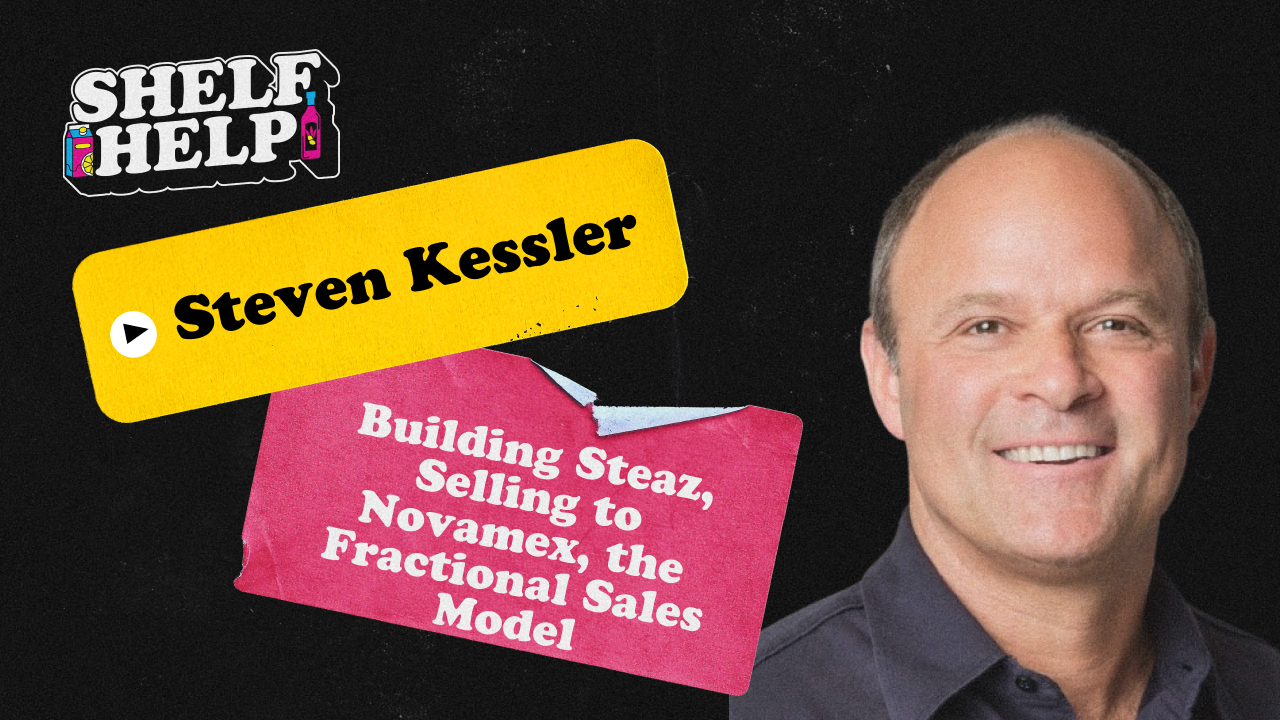
Building Steaz, Selling to Novamex, the Fractional Sales Model | Steven Kessler, Beyond Brands



On this episode, we're joined by Steven Kessler, Chief Sales Officer at Beyond Brands, the natural products consulting collective that acts as an outsourced management team for emerging CPG brands.
Steven co-founded Steaz, the organic green tea brand behind the first USDA Organic certified soda, and scaled it across the natural channel and into Costco and Target before a 2016 exit to Novamex.
We dig into the Steaz journey, from spotting that carbonated soft drinks were sliding and deciding to carbonate green tea, to landing early yes's from UNFI and Whole Foods because nobody had done it before. We walk through the pivot to cans after a Whole Foods buyer told him to get rid of the bubbles, and the freight and sustainability math that made the switch obvious.
Steven gets candid about the "top line, baby" years, when he and co-founder Eric Schnell chased quarterly numbers and handed out discounts to push purchase orders until their investors finally cut them off. We talk about the turn toward a path to profitability, why margin and EBITDA decided the exit, and what acquirers like Novamex actually look for: trajectory and profit, not just a great product.
On the Beyond Brands side, Steven breaks down the fractional sales model, the channel, geography, and money framework he uses to slow founders down, and how to think like a retailer who treats every inch of shelf as real estate. He also shares the brands and categories he's watching right now.
---------------
Episode Highlights:
🍵 Carbonating green tea to build a healthier soda
🏪 Why UNFI and Whole Foods said yes fast
🥫 Ditching glass bottles for cans (freight and sustainability)
📈 The "top line, baby" growth-at-all-costs trap
💸 When investors finally cut off the money
🧮 Turning toward margin, EBITDA, and profitability
🤝 Selling Steaz to Novamex in 2016
🎯 What acquirers really look for (trajectory and profit)
🧑🏫 Coming back to advise their own brand
🧭 The channel, geography, and money framework
🪑 Fractional sales vs hiring a $200K VP
🛒 Retail as a real estate game
👀 The brands and categories Steven is watching
---------------
Table of Contents:
00:00 – Intro
01:14 – What Beyond Brands does
03:38 – The Steaz origin story
05:17 – Creating a healthy green tea soda
08:19 – The pivot to cans with Whole Foods
10:27 – Top line obsession and when investors pulled back
14:24 – Turning toward a path to profitability
15:46 – Deciding to sell, and why Novamex
17:58 – Preparing for an exit and what acquirers look for
19:36 – Coming back to advise their own brand
22:55 – The Beyond Brands fractional model
24:59 – Channel, geography, and money
27:32 – Fractional sales vs hiring a broker
30:55 – Questions to ask a fractional partner
32:41 – Being a good distributor partner
34:23 – How retail buyers really decide
37:29 – Cracking an off-cycle category review
39:02 – Brands, trends, and where to follow
---------------
Links:
Beyond Brands – https://beyondbrands.org/
Follow Steven on LinkedIn – https://www.linkedin.com/in/steven-kessler-aa9b445/
Beyond Brands on LinkedIn – https://www.linkedin.com/company/beyondbrands/
Follow me on LinkedIn – https://www.linkedin.com/in/adam-martin-steinberg/
For help with CPG production design - packaging and label design, product renders, POS assets, retail media assets, quick-turn sales and marketing assets and all the other work that bogs down creative teams - check out https://www.kitprint.co/.
Shout out to my friends over at Glimpse, the go-to partner for automating retail-related back-office operations and unlocking margin trapped in invalid fees and manual processes.
Are you in the market for a new flexible packaging partner? Check out HD Packaging. Third-generation, family-owned and built for the needs of category leaders like Newman’s Own and A Dozen Cousins. Faster launches, lower costs, and no artwork fees.
Episode Transcript
Speaker 2: 00:00
Welcome to Shelf Help. Today we're speaking with Stephen Kessler, Chief Sales Officer at Beyond Brands, the natural products consulting collective behind I think some of the most iconic emerging CPG brands in the better for you space today. Steven brings a whole host of experience, uh over 30 years in CPG, co-founded Stees back in January 2003, which we're going to dive into scaled in the Costco, Target, and Natural Channel, eventually before being acquired by Novomex in 2016. And then even before Stees, Steven was a VP of sales at Movado, Country Life Vitamins, and then ran Iceland Springs and Natural Division, eventually all the US. So also launched a Mood 33, which is which was a THC sparkling beverage brand in California, which market I know very well. So bottom line, definitely knows the space very well, especially beverages. So super excited to uh to dive into things. Yeah, Steven, just first off, for listeners maybe that aren't that familiar with Beyond Brands, maybe just let's start just getting a quick lay of the land, just in terms of kind of the origin story, why I'm high launching Beyond Brands roughly a decade ago, and then you know what the firm kind of does for emerging CVG brands today, and then uh we'll go from there.
Speaker: 01:14
Great. Well, thank you very much for inviting me to be on your podcast. Looking forward to it. You know, it it Beyond Brands uh was started actually, uh we're now in our 11th, into our 11th year, and uh we started out with five or six people, and uh we're now up to a collective of 25 team members covering out we're an outsourced management organization providing entrepreneurs with conscious leadership and guidance in a responsible, smarter, safer, faster way. And the word response is probably the most important because most entrepreneurs like myself and you as well, we run fast. So we teach entrepreneurs to slow down because we have that entrepreneur's perspective. And after starting uh Stees back in technically in 2002, but launching it in January 2003, Eric Chanel, and I uh, over the over the 14-year run made every mistake in the entrepreneurial book, whether it be sales, operations, finance, mostly finance, and I think most entrepreneurs can say that. But over the time, uh we then realized once we sold stees that you know what we've amassed all this knowledge as entrepreneurs within our collective. Do we start another brand or do we provide the greater value, even greater value by working with entrepreneurs, especially in the natural food and beverage space and supplements, et cetera, which is still robust in a very big way, that you know, we realized let's share this knowledge so that these entrepreneurs don't make all the mistakes we did. Fortunately, we created such a great brand that in all reality, the consumer kept us in business while we were making all those mistakes. But over time and surrounding ourselves with the right people, both on the consultant end and on the investor end, we started listening. And with that, it then transferred into creating this collective that we now have called Beyond Brands to again provide entrepreneurs with hopefully the helping them realize their dreams in a smarter, safer, faster way.
Speaker 2: 03:38
Talking about the Stees journey, I'd love to just have kind of walk me through that journey, where you were in your career, what the original product thesis was and what the nights and weekends looked like in the early days before things really started to take off. And then once you really start to scale how things uh how things played out until that ultimate exit.
Speaker: 03:56
How long is this call for? Because that's a lot to unpack. But uh gosh, uh my co-founder Eric Chanel and I, um, we were both at Country Life Vitamins, and I was the VP of sales at Country Life Vitamins, and Eric started on the vitamin side and then was promoted to run the T division that we had that we owned. And then what happened was over some time I left and recruited was recruited by Iceland Spring to uh run their bottled water importing group. And eventually Eric reached out to me one day and said, Why don't you uh I'd like to sell water with you, so to speak. And uh so Eric came over to Iceland Spring with me. And the reason why um that's important, towards the Stees journey, is that was also the same time when carbonated soft drinks were sliding down. All right, sales were terrible, which what which is what then prompted Coke to spend 4.2 billion buying vitamin water. They knew that CSD wasn't gonna continue to accelerate at the rate they needed to. So what was the next billion-dollar category within beverage? Non-carbonated. Well, since Eric and I, you know, are geniuses, we thought that's crazy. Let's create a healthier beverage, a healthy soda. And fortunately for us in the entrepreneurial journey, timing is everything. So we thought, how do we create a healthy soda based on the ingredients without using the so uh excuse me, all of the artificial sweeteners that were out there at the time, sodium benzuit, and so on. So that's also when the organic policy was just initiated in 2002, right? Um and we thought, you know what, we've got something here. The new organic policy, like I said, was just initiated. Green tea was on the media radar at the time. It was all over the media with respect to slowing down the onset of cancerous tumors, et cetera, a great metabolizer, and so on. So we thought, wow, why not carbonate tea? And obviously use all the um natural ingredients within that, et cetera. So sweetener wise, and so on. So that's what we thought, hmm, let's use green tea as the hook and carbonate it. Fast forward green tea soda. We have something different. Nobody's done it because within the entrepreneurial world, it's all about what is your why? Why do you exist? Why does the brand exist? What as a brand are you bringing to a retailer for the retailer to say, that's different? Right? Because if we brought another soda to the shelf, it's just replacing another brand. And therefore, there's no incremental on volume or value financially to the retailer. Sure. So we thought, okay, great. And Stees, the name came from sparkling teas. Okay. So we went to all of our retailer friends, because we were in the natural food space already with Country Life Vitamins, that we knew all the people at UNFI and Whole Foods, that Adam legitimately everybody was saying yes. And the reason why is you know what? Green tea soda, never hurt. Nobody's ever done it. Let's give it a shot. And so that was a catalyst for us to, if you will, hit the green light and move forward. And like I had mentioned, the retailers were approving it, giving it a shot. And those glass bottles of raspberry, orange, all traditional flavors. So we were giving the consumer what they wanted at the time, but with a very, very clean ingredient deck and nutrition facts panel. And of course, with the logos of organic, fair trade certified, because social responsibility was just coming into play at the time from an awareness standpoint. So it was we were B Corp certified. So we checked all the boxes, and again, timing. And we made a great tasting beverage. And moving even moving forward, it wasn't until one uh one of our friends from Whole Foods came up to me at a trade show. We launched in 2000, January 2003, Expo S 2007, came up to me at a trade show and said, get rid of the bubbles. And we thought, okay, the the green tea sodas were doing the sparkling green teas, we we wound up changing it from um soda because that wasn't a good word anymore, to sparkling green tea. And they were doing well. They were doing well enough to get on shells. How well was it turning? It was doing okay. But by then we had built a relationship with all of our customers because we had something different. And at the same time, we realized with Whole Foods as our number one account, and them asking for non-carbonated, which we always wanted to get into. You know what? Now's the time. And so Whole Foods gave us a national approval in 16 ounce cans. And the reason why we went to cans is because there was a better environmental story to it. Right? You use less fuel to manufacture a can than a glass bottle. You let use less fuel to melt down, recycle a glass a metal can versus a glass bottle. You can't with with respect to freight, we were only able to get around 1,600 cases of glass bottle, pallets of glass bottles on a full truck, whereas cans, we were able to get 3,200 cases on a truck. So there were so many environmental efficiencies within the can. And oh, by the way, Whole Foods asked for the can, not the glass bottle. And that's what got us into the non-carbonated form of Stees. And from there, that's when the trajectory of growth happened even faster, leading to a successful exit. So that's what got us started. And uh it was, other than next to having kids, it was the most exciting and rewarding experience I've ever had in my life.
Speaker 2: 10:08
You told me a story that I feel like was helpful, would be helpful to call out for some other up-and-coming founders, where they basically told me the story about you were calling your friends at Unify saying, Hey, I'll give you another 10% off invoice just so we can hit our numbers for the quarter as you guys were scaling up the brand. And you kind of summed up this whole mindset as, you know, top line, baby, top line. Walk me through some of those kind of related learning lessons when investors basically started telling you, hey, I think you had quoted Papa Bear's not giving you more allowance anymore. Tell me about that journey that that time and uh what you and Eric did in those kind of 48 hours after that meeting with that investors to change the trajectory of things.
Speaker: 10:49
Yeah, yeah. Eric and I were superstar sales guys, right? And when we worked for other people, our goal is was to hit our quarterly numbers. Because where we hit our quarterly revenue numbers, we made our bonuses. And in full candor, we did whatever we could do to drive that number. Totally. Right? And after getting the approval from the company owners and financial wizards that ran that department, if they were to approve the extra discount, which in turn accelerated purchase orders, we'd make our number. Totally. And so we took that same mentality into running Stees initially because we felt we were going to be the next vitamin water. So we had to make, we had to make things happen fast. And we did that. And we would call when we knew that our the quarterly call with our investors, we had to make sure we made our numbers. Because in hindsight, now, if you're not as a brand and you brought in money and you don't hit your numbers that you presented to the investors, right, for them to give you the money, they're no longer friendly meetings. They're ugly meetings, they're not fun. And for those listening, please listen to me. All right, be responsible in how you manage the plan of growth and then execute in that plan. So, but what we did was after time of driving top line, and like I said earlier, the consumer kept us in business while we were making all of these silly, stupid mistakes, right? Of calling UNFI back to your question, all our friends at UNFI saying, you know, hey, do me a favor, all right? I know we're on a 15% OI right now, all right, but I need one more truck to make my number. I'll give you another 10%. At the time, we thought we were being smart to drive that top line number. And oh boy, did we. But think about what suffered, the bottom line number. So over the years, and it's like I said earlier, so when surrounding ourselves with these smarter people who were admittedly knocking us on the head, stop doing that at the early on. Come on, we're great. We're great sales guys. And finally, after a while, and you alluded to it before, when these smart business people, all right, throwing bricks at our head, I always let as I always say, said to us, we're done. All right, no more, no more money, figure it out on your own. And that's when it was a true dose of reality that we need to slow down and reevaluate how we're managing this business. And like I had referenced earlier, Adam, fortunately the consumer kept us in business because we made such a great product that still exists, that they kept on buying it, which obviously enabled us to go back to production because the purchase or the purchase orders were coming in from the distributor, so there was that cash flow, and we needed to learn how to manage that cash flow in a much more responsible way. And we did over time.
Speaker 2: 14:10
What did that transition actually look like to get off that that treadmill of just grow growth at all costs?
Speaker: 14:16
We were we we we got smart enough in listening to the people that we surrounded ourselves with to start managing a path to profitability versus top line revenue. Right? And that in a in the end was paramount when it came to the exit. Because be it investors when it comes to investing and or acquisition, it's all about that margin line, all right, and how well is it turning. Yeah. It was turning extremely well. We needed to improve the margin line, all right, and then the EBITDA line, even more importantly, actually, so that we had enough cash to continue to run our business responsibly. So it's tremendous, it was a tremendous learning lesson for Eric and myself, which in turn created two very responsible business people versus hot shit sales guys. Because we learned which which one is more sustainable. Totally.
Speaker 2: 15:22
Well, yeah, you guys obviously turned, you know, turned things around, eventually sold to Novamex in in 2016. Thinking back, you know, 10 years, just 10, about 10 years ago, what was that conversation like between you and Eric when you decided, okay, you know, it's time to sell, this makes sense, versus, hey, we're gonna go try to raise another round and and keep this train moving.
Speaker: 15:46
Yeah, it was a it was a big decision. And again, we had you know, there were we had people on the cap table that we also had to be mindful of, and also listening to these smart people. Our brand was accelerating at a rapid rate, all right, therefore, valuation was high. So we then had to evaluate the timing of then versus future. Um, we were at a path to profitability, which was therefore a great turnaround for us. So, in listening to these smart people and then internalizing what the future looks like for Eric and myself, we felt that it was the right time for Steve's to exit to a strategic. So at least we're putting our baby in the right hands within the beverage community to continue to grow the brand as effectively as we were.
Speaker 2: 16:36
On that topic of putting it in the right hands, what what did you guys like or what did you see in Novamex specifically that that got you excited?
Speaker: 16:46
Well, number one, they're a they're a beverage house. Novamex is the owner of the number one Mexican soda brand called Jaritos. It's a very strong nine-figure brand. They produce everything on their own. So they were avert, it's a vertically integrated operation. While at the same time, they had just started the natural division called, I'm excuse me, Nova Naturals. And in 2015, they purchased C2O Coconut Water, which was one of the fastest growing coconut waters at the time, and it's still doing extremely well. And they were looking to continue to expand and grow that division. And so, with that being said, we were introduced to them, and we felt that strategically it would make the most sense because the depth, the depth of the team they had within the Nova Naturals group, which really was taking these founders of C2O who grew who were growing a brand very responsibly, and then immersing Stees within that division, we felt the brand would be in very good hands moving forward, and then we would uh have a successful exit as well.
Speaker 2: 17:49
That makes sense. For founders that are, you know, thinking about their starting having conversations about an exit, it's looking like something, you know, there's a strong possibility that you know something is on the horizon and let's just say 12 to 18 months out. What's a few things that they should be doing right now to optimize for that outcome?
Speaker: 18:06
Yeah, if there's an exit on the horizon for a brand almost from the beginning, they first have to be able to look in the mirror, so to speak, and truly determine what they have created, and then is it of value to number one, the retail community and the consumer? Because if you can't say yes to either of those, then it's not there's your the likelihood of a successful exit um is not as great. Okay. So with that being said, the next components to determining whether or not you're going to have a successful exit are probably the two most important factors that an acquirer looks for is what's the trajectory of that of your brand, and also what is the profitability that you are bringing to the acquirer. Now, a group like Coke and some of the others, Pepsi's, doesn't matter how profitable your brand is, they're going to improve the operational efficiencies and economic efficiencies of your production and operation because of how saw the size that they're bringing into the um overall acquisition. But initially they do want to know the growth of the brand, the category the brand is in, uh, and is there still room for more even more growth once the purchase happens?
Speaker 2: 19:32
Right.
Speaker: 19:32
Totally.
Speaker 2: 19:33
Eight years after you after you and Eric exited the brand, you came back as consulting partners at Novomax. Yeah, a bit curious about how that comeback came about and what's it been what has it been like advising a brand that you built from scratch when someone else owned it owns it now?
Speaker: 19:50
Yeah, it's uh it's a fun story. We were at Expo West actually. I guess it was at this point 24. And uh we it's it's I'll make it quick, uh, but it's fun. Walked up to the Stees booth because I wanted uh I was thirsty. So I had asked for a a can of my one of our top two selling SKUs, blueberry pomegranate. And there was a uh demo girl at the counter at the Stees booth, and she said, Well, we're only giving out sampling cups. And I thought, you know what, let me give it a shot and say, if I could prove to you that I'm the co-founder of Stees, will you give me a can? And she looked at me like I had six heads, and she calls some guy over, and he looks at my badge, he looks at her, and he says, He's the co-founder. And uh, and he uh he uh is he is the VP of sales of both C2O and then did the division. So I don't know, my Alexis acting wonky here. How are you gonna worry? But anyway, so uh so we just started talking. And you know, as as well as they were doing with the brand, as co-founders, you know, those are that's our baby. And we're all gonna always gonna make sure, you know, you are you are your baby, how do you babysitting? Are you taken care of? And there were some things that we felt weren't happening the way we were doing it, and that's okay. That's always going to happen, but within our, you know, we everybody has an ego. And so we started, I started talking to them. His name's Adam, and we just started chatting. And, you know, he said, well, you know, we're this is going really well, and in in that area, I think we may need some help. And then I sh then shared with him, this is what we do now. This is what Eric and I do. All right. So, and to be able to come back as the co-founders, all right, and share with your team that like you just asked, Adam, what was the day one like? What was the the the green light or the catalyst, right, to initiate let's do this, that may be of help. Yeah. And so two or three months later, we all agreed, let's get together. And make this happen. And to answer your the other, the second part of your question, we're pinching ourselves, right? To now be able to work with a brand that is now all grown up. Think about it, January 2003. Right? So we're now in May 26. How many brands last one, two, three, four years? Yeah. So we're super proud of that. And at the same time, uh, it's been an amazing experience working with the Nova Naturals team and helping them fix things and also allowing us, Eric and I, to be immersed within their culture to work with them side by side as team members.
Speaker 2: 22:42
I love that. Yeah, my uh my agency, we work with Mike and Marissa and the team at Nova Naturals. They're uh they're awesome. They're such a great team to work with. Yeah. Great people. Well, yeah, shifting gears a little bit talking about beyond brand side of things. Uh definitely want to dive into the the fractional sales model a bit. Uh for some of those brands, I'm feeling like they, you know, they could they're starting to feel like they're getting a place they could use some help like this. Walk me through I don't know, to start just kind of like what week one, you know, week four and you know, month three in looks like when a brand onboards with with Beyond Brands and what the kind of what the playbook looks like for the first, yeah, just say 90 days or so.
Speaker: 23:19
Yeah. I guess the first thing I the my first response is it's not a static playbook. Fair. Because depending on the brand, you know, we work we work with brands from I have an idea, what do I do next, to a brand that's doing five million and they just can't get over the hump. Right? So incubating, a lot of incubating, but we also work with accelerating brands that need to get to the next level, either leading to an exit or they just want to continue growing. So, like I said, there is no static playbook within the incubating world. A lot of the time, it like I had referenced earlier, it's slowing down the entrepreneur. Okay, because, and even with an accelerator, it it all boils down to money and how well you manage the money. We as entrepreneurs are sarcastic and say, we're drug addicts, right? Every time there's a new idea, we think we should do that, right? Because we've got the best product, the best new line of bottled water. It deserves to be in every channel right away. And oh, nationally too, right? Yeah, of course. I'm gonna I I everybody, Target and CVS and Whole Foods and Sea Store and Food Service, but they forget how much it costs to drive down each of those roads. Because each of those roads, there's one road in front of you, which is called the channel. Right? And then the distance is called the geography. And how much money do you have to put that gas in the car to get from your point A to point B? And then if you start to stretch the channels, now you're going horizontal. So my first question is, how much money do you have? And that's not to scare you, because like I've said to you from the beginning, perspective entrepreneur, right? I've been there. And I'm not saying I'm smarter than you. This is probably Adam, the most important thing that we say. We sell honesty at Beyond Brands because we've been there. Right? It's not cocky. Yeah. But please trust me that it's better to build a story of success within what you can afford. Remember how you, when you were being raised, live within your means. You get your $5 a week allowance, $10, whatever. And then you when you blew it on gum and candy and all that, and you go back and say, Mom, dad, I need more money. And they said, No, we got mad. Same thing if you think about it.
Speaker 1: 26:05
Yeah.
Speaker: 26:06
Right? So we're all about maintaining the two most important pillars at the beginning. Let's talk about your geographic goals and let's talk about your channel goals. And then, based on those two answers, the next question is how much money do you have to effectively navigate those respective responsibilities? Geographic and channel.
Speaker 1: 26:32
Yeah.
Speaker: 26:33
And it's it's an eye-opener for entrepreneurs, and like I said earlier in our conversation, it was to us too.
Speaker 2: 26:40
Why do you feel like this fractional model is becoming more and more of a uh pivotal part of the CPG space?
Speaker: 26:49
I think there's a definitely an economic component to it, because within Beyond Brands, we provide outsource management services for four key management pillars, if you will. Operations, marketing, sales, and finance. On the sales side, which uh the chief sales officer of Beyond Brands, fancy title, and I have four key team members that do everything, exactly what I do. But at the same time, what we do say is that right now you can't afford a $200,000 year VP of sales plus benefits, et cetera, et cetera.
unknown: 27:28
Right.
Speaker: 27:31
So you're going to get me at a fraction of the cost, but I'm not a broker. Right. I am going to provide you for a fraction of the cost, everything within the job description of a sales manager. You just pay me a monthly retainer. Right? And then I will help guide you. And the value that I bring is my 30 plus years of experience. And fortunately, I do have a resume that provides the success that you would ask. So prove to me how successful you were so that I can trust you. And it's a very valid question. Or those are valid questions, right? But now that we get over that hurdle, allow me to guide you in a very responsible and as we say in Beyond Brands, conscious way. None of it's guaranteed, because in the very end, the consumer is going to, and they have to validate whether or not they like your product. As the head of your sales, building out your go-to-market strategies, hiring the broker groups around the country, going to, as my as I just shared with you earlier, going to the trade shows, right? Wearing your shirt, using your email address. So outward facing-wise, I am not Stephen at Beyond Brands, right? I am Stephen at naturalcatch.com, et cetera. So that I build that model that you're looking for, and hopefully the consumer pulls off the shelf so that eventually, over time, it could be year two or three, if we build this model successfully and you get the turn you're looking for, right, once we get on the shelves and implement the most effective promotional programming, et cetera, and even on the marketing side, when we bring on one of our marketing team members to then implement out-of-store marketing to build brand awareness, you'll then be able to go back out there with the data that you need, turn-wise, VPO volume pro outlet, to raise enough money to hire your own VP of sales three or four years from now, if not sooner. But in the meantime, you are going to learn so much from me and my respective team members to help you understand the most effective way to manage the sales process of a CPG brand.
Speaker 2: 30:14
Yeah. For the founders that have they've made that decision, we are we feel like a fractional VP model is the best fit for my brand right now. What's a question or two or a series of questions that they should be asking that other person on the other side of the table?
Speaker: 30:33
Yeah. First, I would certainly say, even though we referenced it already, what's your background? What's your experience? Yes, I saw it on LinkedIn and so on, but tell me about it, Stephen. Share with me. Right? I would say probably, you know, that's of utmost importance. And the other question is one that we ask brokers how many brands are you managing? How much time are you going to be able to give me? Remember, with what I do as an outsourced VP of sales, regional sales manager, head of sales, whatever you want to call me, and being very objective, I can only carry so many brands so that my time is not diluted per brand that you're not getting from me what you're expecting. All right. And I too learned that my on my own. When I first started out doing this, which has been an incredibly rewarding experience, similar to the what Eric and I did at the very beginning, you know, we were hot, hot shot sales guys. We could do anything. We're better than everybody, you know? And I basically adopted the same mentality on I can carry as many brands as good. And after a while, I realized that's it doesn't work that way. And actually, in in full candor, probably the brands didn't even realize it because they were getting, you know, nice guy Kessler, who's out there hustling and doing trade shows with them. But mentally, I wasn't able to, you know, just parcel my brain out to carry almost up to a you know dozen different brands. Yeah, totally. So that number has been trimmed down dramatically. So the value that they're they're getting from what they're paying me is definitely realized.
Speaker 2: 32:28
What's the best way for brands to actually hold their distributor accountable? But then the other side, how can a brand truly be the best partner to their distributor?
Speaker: 32:42
Effective communication, which applies to all facets of the business model, and also understanding what you as a brand can afford to do. Just because a distributor asks you, in certain cases, may require you to participate in program A, B, C, or D, it doesn't mean you have to say yes. That also raises the question maybe that distributor isn't right for you at this particular time. Based on, remember earlier on, your geographic strategy and your channel strategy. Right. Eventually, depending on the channel, there are certain distributors that we all you will all you will definitely wind up doing business with. Um, but understanding what you have in the bank and what you can afford at the time will also help you determine which distributors are the most logical to work with at that time. So that's number one. And number two, and I referenced it at the beginning of uh answering your question, communication. Speak to your, be it if it's UNFI, your UNFI SRM. All right. Whether they say yes or no, if you don't ask, you're not going to get. If you don't, even with a retailer, I can't afford that, but can we do this? Yeah. Things like that.
Speaker 1: 34:05
Yeah, totally. That's a great bench.
Speaker: 34:08
Any of these guys, you don't have to go national with any of these larger distributors right away. Work it regionally, which also then helps you manage your money more effectively.
Speaker 2: 34:19
What do founders and brands often get wrong or misunderstand when it comes to how retail buyers make decisions? I I can get myself into trouble.
Speaker: 34:28
Okay. Now, similar to the way I I answered your distributor question, communication with the buyers and so on. But in the end, a retail, number one, and most importantly, wants to know what's the why of your brand. And many times we as entrepreneurs have such egos about our brand. And the packaging is fantastic and it tastes wonderful. It and the functional ingredients. But number one, within the category that you're looking to launch your brand in, what's the keger like in that particular category? Is it growing? It is the category of value to the retailer. Entrepreneurs out there, please do your homework. I'm looking at the camera right now. Please do your homework before you get in front of a retailer. Okay. And number two, if you can mentally position yourselves as a retailer so that when you are pitching, if you could think like a retailer, think about how you would respond to what you're pitching. Right? Because again, the retail has so many decisions they need to make. So many brands are being pitched to them within the same category you're in. What is the value that you are bringing them? Remove the ego. But what is the value that your brand is bringing that retailer? Because in the end, everybody, retail is a real estate game. That's all it is. And whether the retailer owns the property or leases it, they st they need to make a profit on every inch of that property. And if your brand is not delivering that, don't be offended, don't be mad. They're gonna boot you.
Speaker 1: 36:18
Yeah.
Speaker: 36:18
From a business perspective, appreciate the job that they have to do. Yeah, totally. Before you set foot into that office or on the virtual office, prepare yourself effectively to share with them the why of your brand, how your brand fits a void. Like I referenced way earlier, even if it's bottled water, it's okay. The bottled water category is booming. And what are you bringing in to them within the liquid here that provides the slightest point of difference for the buyer to say, you know what? That's different. Or something that is even incremental. It doesn't have to be so dramatically different, but if it provides incremental value to an already fast growing category, you're still going to win and deliver the VPO's volume per outlet, the turn that the retailer is looking for. And oh, by the way, the distributors also want to see turn.
Speaker 2: 37:18
Right. On a bit of a similar track, if a retailer tells a brand, hey, we're not doing category reviews for another six months or so, what's the best way for brands to convince a retailer to do an off-cycle review and potentially open things up mid-cycle?
Speaker: 37:34
Some may disagree with me, but I it's a tough nut to crack. Right? The retailer, either they're open to off-cycles, and certainly the larger the retailer, like a Kroger or an Albertsons, Whole Foods, they're more than likely not going to have an off-cycle every once in a while, right? Unless it's a category that is just booming and they feel that yours, even though your category, your respective category, isn't for another three to six months, but the category that you're in is booming and you they feel that you will bring incremental value, then yes. And with that being said, if you don't ask, you'll even know they're gonna say yes. Okay. In the meantime, if nothing, if they say no, what I would still ask is, is it okay if I send you samples and pepper you every once in a while with the success that we are having?
Speaker 1: 38:31
Yeah.
Speaker: 38:32
Just so you stay on their radar until it is time for that category review period.
Speaker 2: 38:37
Last question for you. Uh you come across and work with so many different brands, see so many different trends and things happening in categories across the CBG space. Any particular brands that jump out to you or just trends in general that have got you particularly excited these days or things you're you're tracking especially closely?
Speaker: 38:57
I mean, yeah, I'm working with two of two brands in um very hot categories. One is Blobs. Blobs is uh the new better for you gummy, but we don't like to say better for you. It's candy. But we satisfy today's consumer with super low calorie, great ingredients, super low sugar, clean ingredient deck, but great tasting, soft, chewy gummies with a fun name Blobs. And the other category that's very hot right now is the premium canned fish category. Right. Yeah, and I'm working with an amazing brand called Natural Catch, which is a line of canned tuna, palm lie caught, very sustainable fishing story, a vertically integrated family operation that's been in the fishing business for the past 50 years. So those are two hot brands, self-serving, of course, but at the same time, high integrity. And I think, like I referenced earlier, the bottle water category continues to uh boom. And there are there are certainly functional aspects to it, but I think the the source of the bottled water, canned water is really big. We're working with a brand called Freebird Now, which is absolutely on fire. So there's a lot out there. And like I had referenced earlier, today's retailer is constantly looking for what's going to be of incremental value to that category, andor what can be one can create, what can create a new category that the retailer had never even thought of, like green tea soda back during the Stees days.
Speaker 2: 40:29
What's the best place for people to follow along with you and all your expertise, and then best place to follow along with all the expertise and things going on at Beyond Brands as well?
Speaker: 40:38
Yeah, I'm LinkedIn for sure as well. My email address is steven at beyondbrands.org. Perfect. And our website is beyondbrands.org. And uh in just in in parting, as a as a as an entrepreneur, slow down. Understand that it's a very responsible journey that you're about to embark on. But please uh respect the fact that the financial aspect of the diligence that you need to implement in supporting your new brand that you created. Remember, that brand is a child, and you need to nurture it as a child. It may sound hokey right now, but you'll realize the same thing as you're birthing a child. So please understand that you need to be responsible in how you manage the money to support it and the programs that you implement to help it grow. And lastly, effective communication. Just like when you raise a child, effective communication with your broker partners, your distributor partners, and your retailer partners. All of those components will help you succeed or not based on the value that the consumer in the end will determine whether or not you have something based on pull off the shelf.
Speaker 2: 42:02
That is a great way to close it. I think that's awesome. Thanks, Stephen. I appreciate it. I think that's the pod.
.svg)