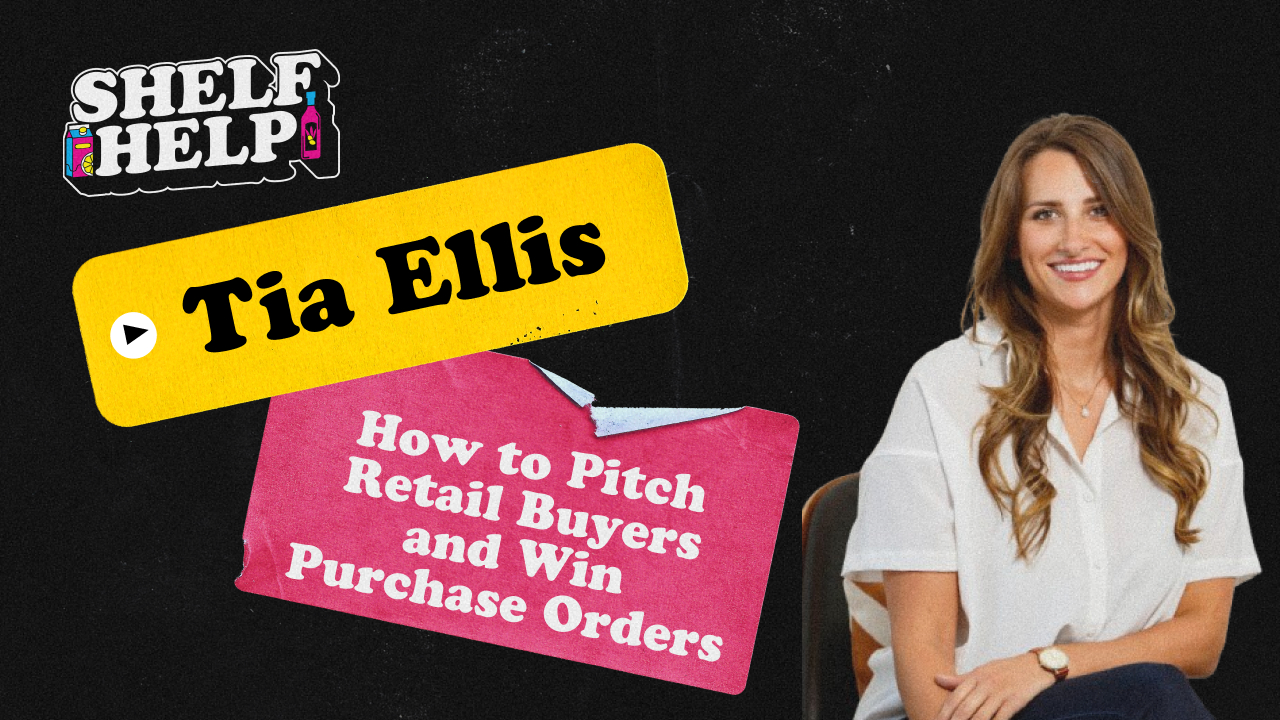
How to Pitch Retail Buyers and Win Purchase Orders | Tia Ellis, Wildflower Insight



On this episode, we're joined by Tia Ellis, Founder of Wildflower Insight - the retail strategy and education company that teaches CPG founders how to pitch buyers and win purchase orders.
Tia is a former broker who has helped brands sell well over $100 million worth of product into major U.S. retailers.
Tia walks through the buyer psychology that drives purchasing decisions, including why buyers care most about category performance and internal KPIs, not whether they personally like your product. We get into her winning pitch deck structure, including the critical "retailer fit" slide that should change for every single retailer you pitch.
We dive into the golden retail rule - a scaling framework Tia first heard from a Walmart buyer - that maps the path from local to regional to national retail.
She shares a cautionary story about a brand that skipped steps, landed a 3,000+ store global account, and couldn't support past the fifth purchase order because of 90-day payment terms and cash flow issues.
We also cover operational readiness, logistics gaps that trip up founders (FTL vs. LTL, carrier management, warehouse transitions), pricing strategy across different retailer types, when brokers actually make sense versus when founders should pitch themselves, and why starting with retailers that don't require a distributor can save early-stage brands real money.
---------------
Episode Highlights:
🏪 Brokers vs. pitching it yourself (and when each makes sense)
🧠 Buyer psychology - why buyers are not consumers
📊 The two pitch deck slides that matter most for data
🎨 The "retailer fit" slide (and why it changes every time)
🎯 The golden retail rule - local to regional to national
⚠️ The brand that couldn't support past purchase order #5
🚚 Operational readiness and the logistics gap founders miss
💸 Pricing strategy across Costco, Walmart, Sprouts, and specialty
🛒 Why starting with retailers that skip distributors saves money
🤝 Treating buyers like partners, not gatekeepers
🔬 Prebiotics and probiotics as the next protein trend
---------------
Table of Contents:
00:00 – Intro
00:46 – Origin story and why Tia started Wildflower Insight
03:09 – Two types of founders Wildflower serves
06:05 – When it makes sense to hire a broker
08:46 – Buyers are not consumers
09:10 – Three pitches every founder needs to master
12:00 – The role of data in buyer meetings
12:43 – Growth, trends, and the brand sales slides
14:16 – The pitch deck structure and retailer fit slide
18:07 – The golden retail rule explained
22:36 – Cautionary tale of skipping steps
26:29 – Operational readiness and being shelf-ready
27:22 – The logistics gap (FTL, LTL, carrier management)
28:46 – Pitching Costco vs. Walmart vs. specialty retailers
29:37 – Pricing strategy across retailer types
31:37 – Starting with retailers that don't require a distributor
33:52 – Trends Tia is watching (prebiotics and probiotics)
35:29 – Where to follow Tia and Wildflower Insight
---------------
Links:
Wildflower Insight – https://wildflowerinsight.com/
Follow Tia on LinkedIn – https://www.linkedin.com/in/tiaellis/
Follow Tia on Instagram – https://www.instagram.com/thetiaellis/
Follow me on LinkedIn – https://www.linkedin.com/in/adam-martin-steinberg/
For help with CPG production design - packaging and label design, product renders, POS assets, retail media assets, quick-turn sales and marketing assets and all the other work that bogs down creative teams - check out https://www.kitprint.co/
Episode Transcript
Speaker: 00:00
Welcome to Shelf Help. Today we're speaking with Tia Ellis, former broker, turned retail strategist and buyer meeting expert who has helped brands sell well over, I think, 100 million worth of products into some of the major U.S. retailers. So today she runs Wildflower Insight, which is an education retail strategy company really built to teach founders how to pitch buyers directly and effectively. And so she also created a program that basically gives founders kind of all the tools, templates, resources to really get ready for those buyer meetings and be able to deliver a really strong pitch and secure a place on the shelf and secure purchase orders without relying on some of those more ex what can be expensive brokers and middlemen. So really interesting thing that she's building. Yeah, first off, Tia, for the listeners that aren't all that familiar with Wildflower Insight, love to just get a quick lay of the land just in terms of kind of the origin story and the why behind starting Wildflower, what you kind of uh who you serve and kind of some of the core problems you solve. And then um, you know, maybe if you want to touch on like how your approach differs a bit from traditional brokers or consultants, and then uh we'll go from there.
Speaker 1: 01:10
Yeah, for sure. Well, I'm so honored to be here. Thank you for having me on, and I'm excited to get in and chat about all of these fun things in regards to retail and CPG and brokers and when you need them and when you don't. So uh just a little bit about me, my background. I started as a broker, right? So literally in this space for CPG brands, when you try to get into retail, for for those that don't know, there are these things called brokers. And essentially they are middlemen that usually own retail relationships and they are there to guide you and support you and kind of manage your retail relationship. And I was working for a brokerage company almost 10 years ago. And when I started my own company, we actually were wildflower the brokerage, and we realized very quickly that so many founders didn't actually need somebody to have the pitch for them and manage the retail account for them. They just needed to understand this game of retail and how to play, right? And I always say that getting on two shelves is not the hard part, but staying on is and navigating those initial conversations are some of the trickiest things you can do as a founder because as a founder, you've, you know, focused on your brand and you have focused on making whatever it is that that product fantastic, but there is so much pressure on these buyer meetings. And my whole mission with Wildflower is to teach founders how to pitch and win the purchase order themselves without having to rely on brokers or rely on middlemen to do it for them, because I think that it's something that everybody can do. And it's actually, if we're being honest, it's way more powerful when the founders do the pitching and can share the insight and their story and the reason why, because at the end of the day, buyers are humans, right? Like they're people and they want to invest in people that they believe in. And so, you know, I'm of the opinion that anybody can pitch and anybody can win. And that is what my goal is to teach founders how to do.
Speaker: 03:08
The founders that come to you are are probably in less than a handful of retailers when they reach out, they're really just kind of starting their journey into retail. So I'm just kind of curious what are kind of some of those most common scenarios or pain points or things that founders would get frustrated enough or struggling with to the point where they come to you and said, kind of throw their hands up and said, I need help with this?
Speaker 1: 03:30
Well, there are two, really there's two types of founders that we support. So there are the kind of more mature founders that have had wild success, whether it's on social media or they're on e-commerce somewhere, or you know, people buy online on their website directly and they've realized that they have success. They realize they have something that's really, really great, and then they want to get on those retail shelves. And so they have really one of two options. They can either try to do it themselves or they can hire somebody to do it for them. And those types of founders, by the time they come to us, they typically have exhausted the latter option. So they've hired somebody, whether it's a broker or a fractional sales team, or, you know, maybe they brought somebody on in-house as a, you know, C-suite role for sales and they haven't performed. And so they get really frustrated because there's thousands of dollars that are spent and very little ROI that comes out of it. And so then they come to us and they're like, all right, well, just teach me what it is because I feel like I can do this. I I'm I'm just frustrated. Like I don't want to spend time, I don't want to spend energy, I don't want to spend resources and waste them. I want to learn how to pitch and win so that I can do it myself and then train my team so that my team can continue to win. That's one type of founder. And then we also have a founder that is, I would say probably a little more green, right? So they are in their very early stage. They are very willing to learn and they want to invest in education so that they can build their company from a foundational level for success. And what that looks like is one of the things that we actually teach is actually on the golden retail rule, which is essentially build your product out, make sure it works, the customers like it, you've, you know, received feedback and you've changed things early on. And then you pitch to local retailers and then regional retailers, and then so on, even to national and huge, you know, global accounts. But you do it in a way where you are building again from that foundational level so that it makes sense when you scale, so that you're never putting yourself or your business in a wildly risky position because you are very small and then you've gone to pitch, let's say, a huge retailer, there's 2,000 store opportunity, and uh you take you take the opportunity, but then you can't support it from cash flow or finance or um inventory or manufacturing or legal or logistics. There's so many different things so that you're not setting yourself up for failure in the long term. And so the second type of founder is somebody that really wants to make sure that they are building in a sustainable and a smart way so that they can scale and build their company out and do it, do it the right way.
Speaker: 06:03
Just to play kind of devil's advocate, what what scenarios, I don't know if scenario is the right word, but yeah, what I'll just use that word. What scenarios would you say where it does or may actually make sense for a brand to actually work with a broker?
Speaker 1: 06:19
Yeah, yeah. And I think that that's that's a really good question because there are brands that it does make sense for them to have a broker. Like if you are a founder and you are a perhaps it can go either way. So let's say you've got solopreneur, right? You've you're the one person, you're handling it, and you just don't feel like you have more time or energy or effort to be spending on retail accounts, you absolutely can hire a broker and they can handle it for you. It just is the more expensive option long term. And I think that it also can potentially be a little bit more risky if the broker doesn't perform. However, if you find a great broker and you find somebody that wants to partner and represent your brand, brokers are a great option. It's just there are a lot of them out there. And so you have to, as a founder, do the due diligence and make sure that you're protecting your company and you're hiring people that are going to represent you how you would, right? And that's that alone is the most difficult piece of it. But there's also then the solopreneur that's like, hey, you know, I don't have extra money to spend. I don't have, you know, brokers charge anywhere between three and $10,000 a month, depending on their expertise, their agency, the retail accounts they support. I mean, a whole bunch of things. But you have founders that are solopreneurs. They're not even paying themselves. So where are they going to get extra money to then, you know, hope that retail accounts are made and hope that purchase orders start coming in? And those are the kind of founders that say, hey, you know what? I'm not willing to invest on a monthly basis for somebody else to manage my business for me. But you know what I do want to do? I want to learn how to, I want to learn how to pitch and win those buyer meetings myself so that I can grow. I can control the accounts that we go after. I know what I'm learning. I am getting feedback and I'm building out the pitch so that when the opportunity comes and the stars align and the buyer is in the right mood and you know, it all works out perfectly, we are ready to support it and sustain it. And then that way I actually can choose the next hire. And not all of my dollars are going towards, you know, maintaining this broker, which we might be dependent on now because they've owned they own your retail relationship, which, you know, can potentially put you in kind of a little bit of a bind. So I am not against brokers. Really, truly I'm not. I know that a lot of brokers think that I am, but yeah, it's true. But, you know, I think that you have to do whatever is is best for you as a founder. And I think that knowing your opportunities and knowing your options early on is really the most powerful thing here.
Speaker: 08:44
Totally. Yeah, that makes a lot of sense. One thing you like to really highlight or reiterate for your clients are at retail buyers are not consumers. Walk through from your perspective, like what this means in terms of what's the most important thing you we want founders to understand from this point, just from yeah, from a placard standpoint, and when it comes to how founders should should be pitching their brand to buyers and not thinking about them as consumers.
Speaker 1: 09:09
Totally. There are three main pitches that a product founder will potentially need to master. So the first one is to the customer, right? Like, does it taste good? Does it make me feel good? Do I have some type of health benefit from it? Like, how is the individual person benefiting in some way? How are you impacting and making their life better? That's the pitch to the customer. Then you have a pitch to potentially an investor. And an investor, most of the time, also is not the customer, but they want to make sure that they're gonna get their money back in a five to seven year period. So they care about the ROI, they care about how much your product is gonna sell and then when they make their money back. Then you have the pitch to the retail buyer. And the retail buyer is a little bit different because there is the buyer psychology that you have to consider. So retail buyers work for typically large corporations. And when you are a buyer, one of the things that you have to think about is when you're choosing the brands that you're gonna bring on and you're choosing the partners and the suppliers, the vendors, essentially the entrepreneurs that you're gonna partner with, they're they are always thinking about which brand is gonna sell in store because the brands that sell in store perform well on their internal KPIs. And so for somebody that is overseeing, like they're managing this category, they want to show performance and they want to show like they have been doing their job well because they've been picking winners. And so when you kind of understand that psychology, when you go into pitch a retail buyer as a founder, you have to think about, hey, they might not, they might not even like, let's say it's a it's a juice product, they might not even like juice. They might be, they could potentially be diabetic, like they might not even try this, this product that I'm gonna put in front of them in this buyer meeting. But what they do care about is that their customers that are shopping in that retailer are going to buy it and they are going to add to their cart and they are going to increase those spends so that the buyer is performing well. And when you can kind of explain that and help the buyer understand that you understand that the goal is for the buyer to win and for your product to perform so that their category looks good, it's hard. You make it hard for the buyer to say no. And that's that's the whole goal. When you, when you kind of share all of the things, all of those hesitations and potential doubts that a buyer might have before they even get the opportunity to do that, it puts them in this position where it, again, it makes it really hard for them to say no. And that's how, you know, you can kind of create some leverage and really create a strong case for you, especially when you're pitching early on and you don't have so much traction, you don't have the data and the velocity. But if you can explain why customers are purchasing your product and how it's going to benefit them, that's that's really when you win.
Speaker: 11:59
How important is data? You can show that there's proof of demand. And then I guess kind of the follow-up question if a brand doesn't have much data to be able to show, like what should their approach look like?
Speaker 1: 12:10
Yeah, and there's there's really two. So in our in our program, Pitch Shippio, we teach on a winning pitch deck template. And there are two slides in that template that are really important for data. One is on the growth and the trends, and then the second one is on the brand sales. So if we're talking about the growth and the trends, the goal here is to kind of show the buyer that you, your product falls within one or two categories that are trending and people are interested and they're motivated and they're purchasing, right? So, like if we're talking about, let's say it's a shelf-stable juice and it's got, let's just say it's got a vitamin, so it's got a functionality to it. One of the things that you might want to consider in the growth and trend slide is some type of statistic on how many families are looking for extra vitamins for their kids, or how many moms want to have easy shelf-stable juice box type things for their children's lunches so that they don't have to rely on X, Y, or Z. And being able to position your product in multiple categories that are trending or are showing that there's a lot of people that are currently purchasing. So that could be social media trends, that could be, you know, spins or or some type of large data organization that collects information like that that you can utilize in that pitch to then show the buyer, hey, look, we we're not only just in one category that's performing well, we're in two or three that are really showing a lot of demand. The other piece of it is if you do already have sales, like you already are in regional retailers or local retailers, or you have a strong presence online, being able to showcase we actually have, you know, in our online, we have a you know, 25% reorder or a subscription rate or something that highlights your brand, when you're able to do that, that's what they want to see. Like they want to see that people not only buy it once, but once they try it, you come back for more. That's the whole point. Because if you if you can show them that you are acquiring customers, but then you're also maintaining customers, that's a no-brainer for them.
Speaker: 14:12
Yeah, that makes a lot of sense. That's really helpful, actually. You touched on your kind of typical slide deck structure a bit. Walk us through that structure, kind of what those elements are, what each of the slides are at a at a high level.
Speaker 1: 14:25
Yeah. Well, the I would say the the biggest piece that has to change with every retail partner that you're pitching to is the retailer fit slide. And the whole purpose of that slide is to show them that your, sorry, to show them that their customers would purchase your product and that your product will fit for their customers. And so doing some type of research on initiatives that they've done, we can use Whole Foods for an example. Let's say Whole Foods did a, you know, huge campaign with some sort of charity and they, you know, donated a whole bunch of food and beverage items to X, Y, and Z. If they did some type of huge thing and it was on socials and it was, you know, for the greater good cause of whatever that they decided to donate to, and that aligns with what's going on in your company or one of the reasons that you started your brand or your mission in some way, connecting that because they want to make sure that the brands and the founders that they bring in to partner with are also in alignment with their core mission and values as well. And so every retailer is different, right? Like Walmart's Walmart's core mission is not going to be the same as Whole Foods. And the Whole Foods in the Walmart pitch should be entirely different, but it should make sense that your product fits to those customers because again, the the Walmart and the Whole Foods customer are entirely different. It's they might shop, you know, at the same places every once in a while, but on a consistent basis, the person that's shopping at Walmart is probably also not shopping at Whole Foods.
Speaker: 15:57
What are the other slides that remain generally static?
Speaker 1: 16:00
Well, and I think that there are some slides that yes, they they do stay the same. If we're gonna put a number on it, I would say probably 60% of your pitch can pretty much stay the same when you are pitching to one retailer, to the next, to the next. A couple of things change here and layer on those static slides, but where you really see the impact is when you can kind of customize it to the buyer and their category needs and the retailer and the retailer's needs and the retailer's customer. I think that it's really important to make sure that when you when you get the opportunity, if you, you know, are are lucky enough to get the opportunity because it it really it's not this mindset of like, oh, I'm gonna get in because I, you know, my my product is so great and like I deserve to be here. That's that's not the case. Like if you get lucky enough and somebody is taking an opportunity to meet with you and then they give you a shot to be on shelf, you you as the founder need to kind of come in and think, we are so blessed to be here, right? Like you really, you cannot go in with this entitled, you know, mentality because buyers sniff that away and they get they get pitched to all day, every day. And if you, you know, unfortunately rub them the wrong way, maybe, or you know, don't, you know, if it doesn't, if it doesn't feel right for them, you are on a long list of, you know, people that they can choose from. There are there's always gonna be somebody that's got an innovation, there's always gonna be somebody that's got a fantastic product, and you need to do everything in your power to make sure that they feel seen, that you have done the research for their category, for their shelf, for their retailer, for you know, what their goals are, how they want to change their category and how they're gonna win. Because if you can come in with all of those things and you've done the research for that, the pitch is like, hey, how can I help you? We've got this product, we know that there's a solution here. This is what we do. And then also I've noticed that on your shelves, X, Y, and Z, and you're missing this, and this could be serving your customers better because we know that your customers are coming in for these problems. We're solving this problem for you. And also, this is another thing that we align with. How can we help? Is there anything else? And when you can come in like that, it's it's a win.
Speaker: 18:06
Yeah, totally. That's super helpful, really helpful. You also kind of touched on briefly towards the beginning, talk about this golden retail rule, which want to dive into a bit more because it seemed like it's such an important and valuable thing for founders to learn and know. Can you kind of break it down into a bit more detail for us first off?
Speaker 1: 18:26
I love talking about the golden retail rule because it was just, it was actually in a in a Walmart meeting that I was in probably four years ago. And the buyer actually, she's like, Oh, that's great. You're following the golden retail rule. And I turned my head like, what does that mean? And I had never heard it before. And it's so funny because it's really, it's kind of the standard that nobody talks about, nobody really knows about, except for unfortunately, the buyers. And so when she broke it down for me, essentially what the golden retail rule is, you build your product out first, right? Like you get the early customers, you get the feedback, you work out all of the mistakes because there will be mistakes no matter what stage you're in. But having a mistake with a hundred units is way easier to fix than having a mistake with a hundred thousand units. Not just easier, but also like financially, a hundred thousand unit mistake for for some founders can flip the business. And so when you can work out everything at the beginning, and then you take a baby step, right? You you walk before you run, you take the baby step to working with a local retailer. So somebody that has between one and 10 locations, and you get your product on those shelves and you you work the demos, you figure out your team, you, you, you know, do all of the things to grow and make that those accounts successful. Then you actually get to take the data from those local accounts to regional accounts because every time you're moving in this golden retail rule, you're you're taking a small step, but they're very intentional so that you can take the data, the sell through, the velocity, the information to then jump to the next baby step. So it's never like, oh, well, you know, we've got this idea and it's great. And some people like us online. Can we have, you know, 3,000 stores? And they're like, we don't even know if people are gonna buy, we don't even know if people know you. How are you gonna get customers in store? And so you're able to utilize this data in a very strategic, almost it almost reduces some of the uncertainty for the buyers at each level because they're like, oh, well, you've already done this. That makes sense. Okay, well, we that makes sense. We would be the next step because now you're going from 10 stores to 90 stores or 100 stores. And then you go from a regional retailer to then, you know, maybe a national retailer, but you don't have to take the national rollout, right? And that's that's one piece that I think a lot of founders miss is they're thinking, oh, there's a thousand stores, I need to get all 1,000. But what you can actually do in some in these buyer meetings is say, hey, you know, I totally appreciate the opportunity for for so many stores and I appreciate the faith and the belief in us. But one of the things that we are really intentional about doing is making sure that we're growing our business in a sustainable way. And so what I would love to do is do a regional test with, you know, some of your highest performing, highest foot traffic stores to make sure that your customers like us and make sure that we know what strategies we need to do for your retail store locations. So, like whether that means it's it's infrared store demos or coupons or cross-promotional strategy, we want to figure out what that is early on so that when we go for the national retail rollout with you, we we've got it covered and we can be very successful. We want this to be a long-term partnership and not something that, you know, we just say yes because we get excited about the opportunity. We we want to be here long term for you. And so we want to perform the best. What do you think about that? And I have never ever heard a buyer go, no, that's a dumb idea. They're like, oh man, that's so refreshing because usually when buyers say, Hey, we'd love to put you in a in a thousand stores, people are like, Yes, let's figure it out. And whether they're ready or they're not, hopefully, you know, they'd be ready, but sometimes they're not and they get excited and they bite off more that they can chew, and you see some. Brands not perform well. And that's how you don't get called back for another review. And that's how you don't stay on shelf. And that's how, you know, you get some of these chargebacks and the horror stories that you're everybody's trying to avoid, but they they just don't realize that there's there is this golden retail rule to then, you know, once you've done that regional test, then you go, hey, let's do the, let's do the national, let's do the thousand stores. And then you go after, you know, the huge players like, you know, Big Blue and Costco, and, you know, just these humongous, gigantic accounts that are phenomenal to have, but only if you can support it. Nothing is good if you can't support it.
Speaker: 22:36
Yeah. Just to maybe make this real for some founders that may or be not maybe considering skipping some some steps in this kind of process that's been proven to work. Any like specific examples jump out of you don't have to name a specific brand, but ones that you've seen that have skipped some of these steps in the sequence and what that resulted in from a downside perspective?
Speaker 1: 23:01
Yeah. So I'm gonna try really hard to not mention the. I got one right in my head, but I'm gonna do my best to not mention, mention their name. Um yeah, so I was speaking with a brand uh a little while back, and they launched just around 2020, and they had wild success, right? So in 2020, everybody was at home. There was the pandemic, everybody was online shopping, they had wild success online on their website, even on Amazon. They they just performed really well. And they thought, you know, we've got such a successful product, everybody wants us, and they went to go and pitch to a retailer that has over 3,000 stores on a global level, not just stateside, not just in the in the US. They they went, they, you know, they went big and they could not support past the fifth purchase order, right? And so when you start pitching to retail buyers and you start having these conversations and you start getting the wins, you get the purchase orders, you also as a founder have to accept the payment terms. And so sometimes that looks like 15 days, sometimes it looks like 30, sometimes it's 60, sometimes it's 90, depending on how you negotiate and what's going on. And they could support the first purchase order. And these are these are purchase orders with two commas, right? Like they're very large. They could support the first one and then the second one, and then the third one, they were starting to, you know, feel it because they had a 90-day payment term. They didn't negotiate the terms very well. And so they're floating all of this money. And by the by the fourth one, they had to go back to the buyer and say, Hey, we we we actually can't. I know you, this is literally the conversation. I I know you've given us almost six million dollars. We have no money, so we either can't produce or we don't we don't know what to do. And they lost the opportunity. So the buyer, they they fulfilled, you know, I think the five. And the buyer was like, why is this now coming to me? Right. Like we are almost six months into this relationship, and you have had a problem since day one, and you knew it, and you didn't come to me. And so they completely burned the relationship. And I guess probably outside of, you know, kind of making sure that you're you're being smart and sustainable and growing your brand the the right way, and following the golden retail rule, all of those are great lessons. But I think that the lesson with that story, the number one thing, and I hope nobody misses this, is you have to be honest with your buyer, right? If they're gonna bet on you and have a relationship with you, you have to be honest. Like, and it's it's so much better to go to a buyer after they've done something, after they give you an opportunity and say, hey, this actually, I'm not sure that this is gonna work. Is there any way we can adjust this? Because I want to make sure that we're doing this the right way. I never want to put you in a vulnerable position. I never want you to bet on X, Y, or Z. And then turns out we can't support it, we can't fulfill it. And then it makes you look bad because you've got empty space on your shelf or you've got, you know, your your boss is upset with you because you, you know, they're whatever, you know? And going in that way and having the conversation honestly up front is so much better and they will respect you 10 times more than waiting as long as you can and then saying, hey, there's a problem, what do we do? Because that they don't buyers are really busy. They don't have time to handle your problems for you. They have their own problems and they love it when founders can can do some brainstorming and be honest and respectful of their time and come in as a true partner. And that's the most important thing. You need to treat a buyer like they're a human and like they're a partner and there's somebody that you want to help succeed, not just constantly be asking and taking from.
Speaker: 26:28
Right. One thing I've heard you harp on is operational readiness, meaning brands really need to be shelf ready before they even get to the point of pitching a buyer. Because then if the buyer says yes, then they might be in a tough position if they're actually not shelf ready. What does operational readiness mean to you? And maybe if they only have some kind of like checklist of brands should have top of mind.
Speaker 1: 26:50
Well, there's so many things that that come with the ops for a CPG brand. And, you know, we can go into legal and financial and product development, all of that stuff. I think the biggest piece for founders, because they they they'll get the legal thing, right? Like they'll make sure that their product makes sense, they'll make sure that the nutrition label is compliant. Like those things, they're right in front of your face. It's it's hard to miss. The piece that so many founders we we see struggle with, and all of a sudden they get the opportunity and then they scramble is in the logistics slide. So when you get a large purchase order or you, you know, start working with a regional retailer and you're you transition from shipping boxes from, you know, maybe your garage or from your small warehouse into creating the product from directly from the manufacturing facility, filling up containers, sending truckloads, like that jump from shipping from the garage to then having the manufacturing in in truckload and in shipping quantities is where so many founders go, I didn't realize what I don't understand what a FTL, which is a full truckload, or an LTL, which is a less than truckload, and who do I call and how do I manage these appointments and what what does that look like? And so having a team that can, even a fractional team, a team and somebody that can help you manage those appointments and the logistics and the weights and the dimensions and the, you know, the carriers and all of that is it is an entire job. And making sure that you have somebody that can do that the right way will save you so much time, especially as you grow, right? Like the goal is you get a truckload order and then you get another one, and then you get, you know, five of them. And then, you know, you you'll have to build it out at some point. And having the conversation early on with industry professionals in that logistics space are really, really great because it will it will just save you time.
Speaker: 28:42
I think you help brands get into pretty much every major retailer around in the market these days. Um just curious in terms of maybe just like one or two top of mind things for each of these. I'm kind of curious, like just picking a few like things that really differ between Costco, Walmart, HEB, and then some type of natural retailer, like I don't know, Fresh Market or Sprouts or something along those lines.
Speaker 1: 29:08
I think that the you know, we we help founders pitch and win in the buyer meeting. And it's on the founder to do the research for the specific retailer to understand why they're different. So like a Costco is going to be different than a Walmart because it's it's bulk versus the low-cost leader. And then, you know, a Walmart will be different than a fresh market because it's low-cost leader versus, you know, specialty. And there are different price points to each of those. And one of the things that I encourage any founder that's listening to think about what their price point is on the market. And you, as a founder, you get to decide that, right? So let we'll do really easy numbers. So let's say you've got a candy bar and at the lowest price that it should ever, ever, ever be available to be purchased by the consumer, let's say you want to set it at $1, the highest price that you might set it is $3. And so when you're thinking about the retail partnerships that you want to have, you have to think about, okay, well, if I'm gonna have Walmart or maybe a Costco be a partner at some point, if I set my price point for the fresh market consumer at $1, Walmart is gonna come in and say, hey, we we're, we are the low-cost leader. We need, you know, we need to be lower than them. So give us a better price so that we can sell. And so you have to think about the entire scope of how your product is gonna be sold through the lifetime of of the product. And you have to kind of, it's not really ranking, but it's fitting them. It's it's it's this puzzle. And you have to fit the pieces to make sure that they make sense. So, like if you have a specialty retailer, odds are that the shopper is gonna be able to spend a little bit more or willing to be willing to spend more on the same item at the specialty retailer versus being at a large, you know, bulk retailer or, you know, a retailer that's known for cost savings. So you kind of have to think about that. And that's one of, as you actually mentioned, that's one of the pieces that that changes on the pitch deck. That those are one of the pieces that that change is the pricing slide.
Speaker: 31:14
Yeah. On that topic as an example, I've heard that Sprouts is not at all like compared to others, not all that hard to actually get on the shelf, but it's really hard to stay on the shelf long term. Whether that's accurate or not, you can tell me. But just using that as an example, are there for brands that are taking that that jump into like the first, I don't know, say like you know, mid-size to big size retailer, like you know, a sprouts or a Whole Foods size as an example. Like, are there some specific retailers from your mind that are gonna be a generally like a better fit and may have on average have more brands, may have more success in as kind of their first big retailer to work with?
Speaker 1: 31:58
One thing that I encourage founders to do when they are starting, so they're going from that jump from hey, I've got you know a couple of locals and I'm looking for a regional. One of the things that I always encourage founders to do is consider a retailer that doesn't require you to go through a distributor. So there are retailers that you can actually send. Let's say you get this order, you can actually send four pallets straight to their warehouse. And then they send their trucks to their warehouse and then their trucks go and deliver to all of their stores. When you do that, you don't have to pay for a distributor, like uh, you know, a UNFI or a Kahi or even some, there's regional distributors, or you know, even smaller distributors. They're all great. It just kind of depends on where you where you're at in your your your journey. And for founders that are making that step from really small to get that first regional partner, I always think it makes the most sense to keep the most amount of money. Call it me crazy. But I I I that's that's my biggest piece of advice. And then once you once you build that retailer out and you do it well, then you go after some of the accounts that require you to have, you know, distribution. And I'm not saying distribution is bad, but at the beginning, it's not all of the time necessary. And you there are different ways that you can kind of get around that and still keep a significant portion of your of your money. And I think that that's you know, kind of ties back into everything that we do. We want founders to keep their money. Like it's it is hard enough to do this job as a founder and as an entrepreneur. And then you've got, you know, distributors want a piece, and the retailers, of course, you know, need a piece. And then, you know, brokers might also want a piece. And then at the end of the day, when it's time to invest back into your business, let alone, you know, give yourself a salary, there are there are pennies, and and the founders are the ones that have to figure out creative ways to make more dollars, stretch. And it just, I think that there's an easier way to do that. And there there is. So it's, you know, that's it's my whole personal thing.
Speaker: 33:53
Feels like you have such a great pulse on the space. You talk with so many brands, work with so many brands. I'm just curious from your perspective, any brands in particular or just trends in the space in general that you're kind of personally and especially tracking or things that have been really piquing your interest as of late.
Speaker 1: 34:11
There is one trend that I I've really been keeping my eye on because it's it's it's kind of unique. Um, and I think it's gonna get really, really hot real soon. And I think even, you know, coming up, we've got Expo West in about six weeks or so. And I think we're gonna see a lot of products, a lot of innovation around this. And the 2026 trends report from Whole Foods, which is also something that you know founders should be paying attention to, one of the pieces that was really interesting to me was that prebiotics and probiotics are going to be the next proteins. So I think we're gonna see a lot of probiotics in salty snacks, in candies, in beverages, in powders, because I think people are realizing how important, you know, a healthy gut is, not just for digestion, but also like for skin, energy, and all of all of these things that you don't really think about until you're like, wait a second, this I feel so much better now. And I think a lot of people are gonna be jumping, jumping on that trend, which is also probably why, you know, some of those, the big, you know, alternative sodas brands have done so well over the last few years because they they tapped into it before it really was a thing, and now it's a real thing and it's coming up. I think, I think that it's it's spot on is probiotics are gonna be the new protein.
Speaker: 35:29
Oh, awesome, Tia. This has been great. Really appreciate the time. Um again, they give so many great insights. What's the best place for people to follow along with you and get in touch with you? And then uh, I'm not sure if you have like a separate channel or you kind of publish insights around wide flower if there's a place for people to follow along there too.
Speaker 1: 35:46
Yeah, we uh the best place to get a hold of us and to follow along. We share a lot of tips and kind of like insider information. Just just honestly, they're just tips for founders on LinkedIn. And the name, of course, is is Tia Ellis and then my Instagram. The the handle is actually the Tia Ellis. I tried to be Tia Ellis, but somebody had taken. So it is the Tia Ellis for for Instagram as well. And um, if anybody wanted to, you know, follow that, that's where all of our tips and all of our best information is. We want to make sure that founders get the information and get the support and kind of like that community feel that they need because we've we've been there and we've done that. And it's it's tough. And you don't have to make the same mistakes we've done because we've already made them. And so we want we want to share all of the the good, bad, the ugly, you know, all of it.
Speaker: 36:34
Yep, for sure. Founders appreciate that. I think everyone appreciates that. Well, yeah, T has been awesome. Really appreciate the time. I think uh I think that's the problem.
Speaker 1: 36:41
Thanks, Adam.
.svg)