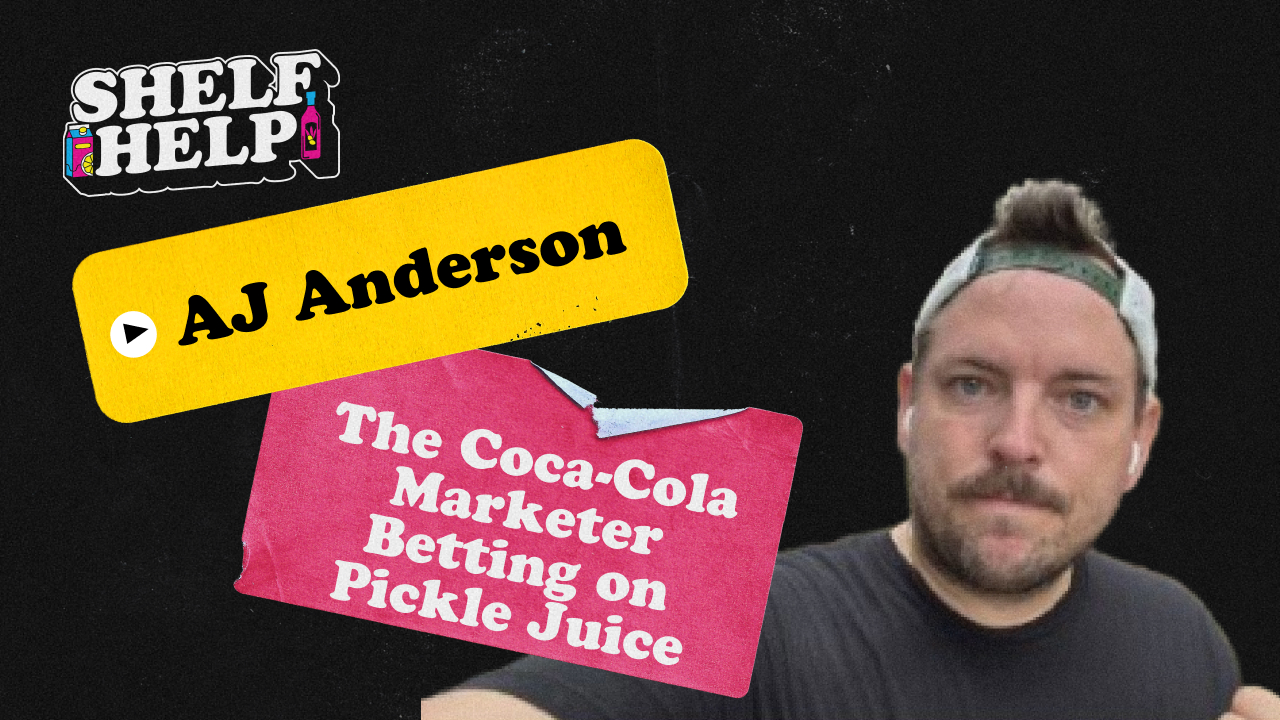



On this episode, we're joined by AJ Anderson, Founder and CEO of Fast Pickle, the 3 ounce pickle juice shot brand bringing real brine into electrolyte replacement. AJ spent five years at Coca-Cola before becoming a serial entrepenenur.
AJ breaks down the formulation proces, copacker sourcing, and why the new label says "intentionally hypertonic" instead of calling itself hydration. We get into the packaging design journey too, from a first label he designed himself, through public critique on BevNET's Elevator Pitch, to the black and electric green look he has now.
We also cover the tactical stuff. Packing pallets in his garage, cold emailing roughly a thousand specialty stores, using Amazon Market Basket data to find climbing gyms, and the Danny Wimmer Presents festival partnership he expects will drive 25 to 30 percent of revenue this year.
---------------
Episode Highlights:
🏃 The family health scare that reset everything
🥒 Why pickle juice instead of another sweet powder
🧪 Formulating a 570mg sodium shot, no added sugar
📚 Hypertonic vs isotonic, and why "hydration" is wrong
📦 Packing pallets in a garage at the top of a hill
⚠️ Shelving the preservative free version on purpose
🥫 The Recovery Seltzer and its pickle margarita flavor
🎨 Three label iterations, flat green to street black
🛒 Cold emailing 1,000 specialty stores, and the reply math
🎸 Selling shots across 80+ bars at rock festivals
📊 Amazon Market Basket data leading to climbing gyms
🔮 Building a challenger brand in a challenger category
---------------
Table of Contents:
00:00 – Intro
01:16 – Origin story
04:32 – Why pickle juice
05:35 – Launching January 2025
06:24 – Formulation and the 3 ounce format
06:58 – Co-packer selection and real brine
08:43 – Hypertonic vs hydration
10:44 – A polarizing taste
12:37 – Garage fulfillment and the first pallets
15:14 – The preservative decision and natural retail
17:02 – The Recovery Seltzer idea
18:23 – Specialty channels and Fleet Feet
19:23 – Packaging design iterations
23:55 – Advice on brand identity
26:00 – Go to market and profitable growth
29:27 – The Danny Wimmer Presents partnership
36:07 – Cold emailing 1,000 specialty stores
38:56 – Climbing gyms and Market Basket data
---------------
Links:
Fast Pickle – https://fastpickle.com/
Follow AJ on LinkedIn – https://www.linkedin.com/in/helloaj/
Follow me on LinkedIn – https://www.linkedin.com/in/adam-martin-steinberg/
For help with CPG production design - packaging and label design, product renders, POS assets, retail media assets, quick-turn sales and marketing assets and all the other work that bogs down creative teams - check out https://www.kitprint.co/
Shout out to my friends over at Glimpse, the go-to partner for automating retail-related back-office operations and unlocking margin trapped in invalid fees and manual processes.
Are you in the market for a new flexible packaging partner? Check out HD Packaging. Third-generation, family-owned and built for the needs of category leaders like Newman’s Own and A Dozen Cousins. Faster launches, lower costs, and no artwork fees.
Episode Transcript
Speaker: 00:00
All right. Welcome to Shelf Help. Today we're speaking with AJ Anderson, founder of Fast Pickle, the pickle juice shop brand, bringing real brine into the hydration recovery space. AJ is really a lifelong marketer and serial founder. In addition to Fast Pickle, he also runs Wildlife's well-known Nashville Media and Marketing Lab. I think he started in 2018 or so, as well as Flatback, which is kind of a services for equity fund. So definitely got a lot of experience, you know, marketing, career spanning, automotive, action sports, energy drinks, a lot of CPG-related stuff. I think actually got a start running marketing for NAS Energy at Coca-Cola back in the day. So a lot of really good experience. Um, I think AJ started Fast Pickle out of his garage in Nashville in 2024 or so. So not too long ago, first year it already sold 100,000 bottles, became Amazon's overall pick in the electro electrolyte shot category. So definitely doing a lot of things right. So yeah, AJ, first off, just for the uh the listeners that are not as familiar with with fast pickle, love it to just get quick lay of the land, just in terms of kind of the origin story, why behind the brand, core products in the lineup, and then uh we'll take it from there.
Speaker 1: 01:14
Sure. Yes, thank you. Yeah, uh yeah, I think starting kind of with the origin, we'll walk people through everything. So I I run a performance agency uh started in 2018, as you as you said, Wildlife, and throughout the years, taking on tons of clients, traveling around the world, you know, I was diamond status on Delta and ambassador, you know, Bonvoy, and like I was kind of just like living the high life and well, what felt like the high life, you know, and then I think I I was I was drinking a lot, I was like, I was I was uh living, at least I thought. And uh it was 2024, I believe it was that uh we got news that my wife had cancer, thyroid cancer, and we had a we had just moved to Nashville from Los Angeles. We had a, I guess that would have been a two or three year old at the time, and our lives kind of just like came screeching to a halt. You know, we're like, how is this happening? Like, what is she you know, we didn't know how the how severe it was at the time, you know? It's like causes you to just kind of reassess your entire life. And I actually just made a post about this on LinkedIn, but uh in that process, it was like, fuck man, like I'm treating my body like shit. I'm treating probably my friend family and my friend, you know, like I hadn't, you know, I wasn't being a very good person in general. I wasn't living the way I wanted to be living. So as a as a family, we decided to like, you know, stop traveling so much, uh, focus more on our health, like make meals at home, um, do more things together, therapy, you know, just like how can we like reconnect, you know, in like the the deepest ways. And in that process, I started just working out more. So I've like worked out off and on throughout my life. You know, I'm a little bit bigger of a guy, always have been. And so going to the gym with my friend Andy here in town in Nashville, we would go to the Y, and you know, every now and then he'd be like, Let's just go hit a mile before we go into the gym. I'm like, what are you crazy? Like, I don't I don't know, I don't know. That's crazy, man. Uh so then we started doing it. I could I couldn't even get through a mile. I was just so out of breath, and you know, zero stamina, and just stuck with it over and over again. And he had to go out of town, he was from the UK, so he had to go back to the UK for like a month. And when he was out of town, I'm like, I'm gonna get really good at this shit. Like, uh, he's gonna come back and uh you know, I'm gonna be able to run three, four, five miles. So that's what I did. I was worked at it, worked at it, worked at it. And during that time, you know, my body, I was like really hard on it, right? And was like starting to like understand what I should do for my body to sustain that sort of electrolytes and protein and you know, BCAs, whatever else I needed to be able to like support that that journey as it was kind of like a not a joke, but a challenge to like you know be better than my friend, but also obviously a challenge to myself at the end of the day. And in that process, you know, I would order XYZ brand, you know, a pouch from Amazon, and it would be really cool, cool branding, and I would, you know, put it in my thing and mix it up, and it would be like so sweet.
unknown: 04:09
Right.
Speaker 1: 04:09
And I don't really have a ton of patience to drink like 16 ounces of something, you know, some like four or five, eight ounces, maybe most. Mix it up, drink it. And then so I kept buying different brands, and um, you know, it would be sweet or artificially sweetened. And eventually I'm just like, there's gotta be a way to get you know sodium replacement essentially, but electrolytes in general in like a different vehicle. So I kept coming back in my research to pickle juice. Uh, and I remember, you know, when I was a kid, I would race BMX, and my grandma would always be like, oh, drink pickle juice, you know, cramps. I started researching, researching the cramp and anti-cramping properties of it. And you know, I just kept coming back to pickle juice. And I was like, man, that's kind of like punk rock because I grew up in like hardcore and BMX and skating, and like what it felt very contrarian to where the market was at. Obviously, there's some players, which we can talk about in a minute, but that coupled with building the performance agency over the last several years, like I really wanted to like own a brand that I could bring to market and utilize my team kind of as the machine. So that I started down that road. I had my marketplace guy kind of deep dive Amazon at Walmart and trying to understand the gap, if there was one, you know, what it looked like, velocity, all of that stuff. And you know, he basically came back with what he thought was a big opportunity to bring a modern Challenger brand into the mix, at least on the pickle juice side of things, uh, which little did we know those weren't our competitors at all in a good way. So that's it, basically. That's how it kind of came to be. Now it's 2024. We launched the product on January 1st, 2025. Actually, everything up to that was like formulation, you know, working on the back end. So yeah, it's kind of a long, a long road, but really kind of cool foundational work to get to you know in the Halo product is the three-ounce pickle juice shot sold in six, 12, and 24 packs, and now one gallon jug.
Speaker: 06:00
In terms of those early days of formulation and and product development, the pitch is really, you know, real pickle brine, no sugar. And I think what you call it is like a hypertonic formula. Back to those early days, let's just say to the first version that you made to the that final version when you said, yes, this is this is ready to go to market. Tell me a bit about that that journey of getting a final form pack you felt was was ready.
Speaker 1: 06:24
Sure. Yeah, I mean, so I I knew I wanted it in either two and a half or three ounce, you know, because I was targeting 500 plus milligrams of sodium, which essentially is the equivalent to the sodium you would lose in like a half or sorry, like a 5K, like 30 minutes or or so of like hard work. And, you know, I felt like that size was totally reasonable for someone to carry in their vest or like you know, in a pocket, like I'll carry a couple in my pocket while I'm running. So I knew that I wanted it to be in you know the shot format. And then, you know, in the journey of trying all the competitors and like trying, you know, some homebrew stuff, uh, you know, I eventually landed on a co-man that I was working with on the formulation. And uh, you know, we we kind of took a little bit of ideas from one brand and another brand, and like, as most people do, write things you like and don't like and put it together. I knew I didn't want any added sugar. Um, I knew some other brands have that. I knew that I didn't want a ton of random stuff in it, you know. But you know, one thing that we do have uh is a preservative. And while that really troubled me for a long time, it turns out not very many people really are concerned about it. But the reason we have the preservative is because it's real brine from real pickles. So essentially how our process works is you know, we are buying brine from a manufacturer that produces pickles, and then we're doing a couple things to the brine to get it to our standards, mostly kind of adjusting the electrolyte profile and a little bit of the taste, and then bottling it here in the US and then in into three-ounce bottles, really. So honestly, like that part went a lot faster than I thought it would go. I think because I was so clear about what I wanted and what I didn't want from the sodium profile to the vehicle, it really wasn't that bad. And I think like to be fair to the other pickle juice players, like it is kind of what we're doing here, right? Like we are, whether they're trying to or not, be a nice contrarian solution for people who sweat and work hard, whether it's athletes or linemen or you know, construction workers, in general, pickle juice is that option. So, you know, from going going from that base to getting to where I want it to be wasn't super far away. You know, it's not like I was starting with a a neon colored sports drink and trying to work back from there.
Speaker: 08:39
That term hypertonic, what does that actually mean? And I guess why does it really matter for recovery versus a I don't know, a standard isotonic sports drink?
Speaker 1: 08:48
Yeah, great question. You know, so a couple things there to unpack. One, and we were guilty of this in the beginning, you know, a a beverage like ours, a beverage like many others, many other electrolyte replacements that are on the market. Technically, we shouldn't be using the term hydration. Like we don't hydrate, right? So it's like hydration is similar, is is like a similar function to an isotonic, which basically is helping balance the electrolyte profile in your bloodstream, which is what isotonic means. Whereas hypertonic basically means we're introducing a large amount of one electrolyte or multiple electrolytes into the bloodstream for a purpose, right? So the sodium replacement, you know, helps replace the sodium, you're losing your sweat, you know, alleviate some of the muscle issues, keeps your energy up. So that is probably one of the biggest misconceptions that I see in the industry that I'm in, like on the electrolyte supplement, is everybody calling themselves a hydration beverage. It is not hydration. So we did make that mistake early on. Uh, all the new packaging, new product, you'll never, in fact, on the new label, it literally says there's a sample label. This product is intentionally hypertonic and formulated for rapid sodium replacement for sport. It is not intended as a hydration beverage. So kind of like turning it around and owning it the best we can. In the word hypertonic, like I purposely chose a word that not everybody understands. So they're gonna be like, what's up? Interesting.
Speaker: 10:18
You know, I think it sounds sounds like an elite word, too, also.
Speaker 1: 10:22
Exactly, right? But it, you know, the the nice thing is it does sound elite. It does sound like, hey, this is really gonna help me take it to the next level, but also it it could not be more factual, right? Like it is like fundamentally exactly what the what the drink is and what it does for your body.
Speaker: 10:38
How did you and how how do you continue to balance the the focus of function versus taste? And maybe there's not really much of a trade-off, but if there is, how do you think about that balance?
Speaker 1: 10:50
Well, for the three ounce, you know, I I think similar to cilantro, right? Like it's polarizing pickle juice, like you like it or you don't like it, it kind of makes my job a lot easier. Like I don't have to spend a lot of time trying to convince people. You know, if we're at an event and we're sampling product, if someone comes up and like, I don't really like pickles or pickle juice, am I gonna like this? I'm like, you're definitely not then because it is pickle juice and it's strong pickle juice, you know. So it just kind of like it kind of weeds out the the customers a little bit more, which is kind of nice for us. So it I think it's an amazing tasting pickle juice, personally. Um, but from our real competitors, which are on the sports strength side of things, uh, you know, it is probably just a little bit more challenging. But that is where innovation comes to play, in which we can talk about other products we're introducing.
Speaker: 11:36
Tell me about that process of finding your co-packer, how'd you kind of know who was going to be the right one? Tweaks or adjustments that you have to make to conform to whatever their capabilities were, if any.
Speaker 1: 11:46
Sure. Yeah. Well, I don't know if you can believe this, but there's not a lot of people producing pickle juice. Don't surprise in the country compared to a different supplement, right? So we didn't have a lot uh to choose from, but uh basically how we selected our our co-packer was the group that we were able to negotiate and work best with, who also had a really amazing base product, which is pickles, right? So, you know, it's like they don't make the pickles for us, right? They make that for other customers. So kind of sampling the whole landscape of pickle manufacturers, which is kind of the starting place and and ending at one that we really liked the ingredients of, we liked how they operated, we liked their capabilities and obviously the flavor. So, you know, we we started with them pretty quickly, and obviously just on a small scale, you know. I think like our our first order, man, I don't even remember. I think our I think they I think our first order was a pallet in that would have been January, yeah, Jan December 2024. I guess we would we're actually in Florida visiting family, and so we I send one of my guys from the agency up to the facility to bring a pallet all the way down to Florida in which we spent we had this tiny little um what storage locker, like I mean like a four by six in which we had a pallet. We had about three feet to get a little table to just pack samples, and we were just sending, we sent out like hundreds of six packs to ambassadors, to friends, to family, um to kind of get some buzz going and then start fulfilling some orders from there. Um, and then back in Nashville, you know, we started, man, I think we would get a couple pallets, probably one pallet at a time for half the year. I think we it's all I could really afford. And, you know, the velocity wasn't super high. And the challenge is that my house in Nashville is up on a hill up like a winding driveway. So whenever we would get freight with a lift gate, they would have to drop it at the bottom because they couldn't get up the driveway. So it was twofold. One, it was every every time we would get a pallet, it's like backing one of the vehicles down, filling it up multiple trips, uh, if needed, up to the garage, unloading into the garage, repacking, and then you know, going to ship at the UPS store because I couldn't get a UPS UPS truck, wouldn't come pick it up either. So it was a lot of a lot of lessons early on. And uh, you know, thankfully, it went from you know having buddies over, helping pack stuff all night long to be able to fulfill orders the next day, ship stuff off to Amazon, to being able to move into a small little warehouse space in October, you know, where we can receive and ship pallets pretty easily, thankfully. Love that. That's awesome. Yeah. The journey. Uh photos I can send you to, Adam, if you wanted to use it to show up.
Speaker: 14:37
Yeah, send over for sure. Yeah, definitely send over.
Speaker 1: 14:39
In the garage, you know, it's like even my daughter like would come down and like at three or four and like help pack like you know, bottles of pickle juice. We just had like a whole line set up of people just packing orders in this garage next to like my sauna and the workbench and stuff was pretty funny.
Speaker: 14:55
You're also working on like a preservative-free uh flavor blend. Does that make things harder at all in terms of the formulation? And I guess also from a shelf life standpoint, and then anything else you've got coming down the pike from a product roadmap standpoint that you're comfortable sharing at this point?
Speaker 1: 15:12
Yeah, thank you. Yeah, the preservative thing is interesting. You know, I've gone back and forth on it pretty heavily. It's it's it's weighed on me for a variety of different reasons. And while I don't personally, I'm not personally like a fan of a ton of preservatives. I also understand why this specific preservative is there. Um, we have tested preservative free back and forth uh with this manufacturer, with other manufacturers. And at the end of the day, you know, I think from a business perspective, the unlock is is natural, right? And to go into natural retail. And to be frank, I just don't care about natural retail. Like I don't, we're not gonna be there. It's not where we're it's not where our products are destined to to win, right? I think our velocity there would just never catch up to the other brands that are on the shelf. So, you know, I think we're in, we are in currently specialty, you know, some specialty stores around the country. You know, I think we have the ability to be in, you know, large like home improvement stores, right? Where like workers, where people who are who are working, working, sweating are are there to buy product. That's why you know specialty works for us. So, you know, I kind of just I have to make decisions as as a business owner, a multiple business owner, really is like what what are the things that are gonna weigh me down and like have to focus on? And what are the things I can just focus on and move quickly? And like what are they gonna do for me from for the business, right? So I've basically identified that producing the preservative free blend in a way that's satisfactory to me for for taste and also for you know how that's packaged, whether it's high pressure or high temp, you know, that's put on the side on the back burner, really. Like it's not a priority right now. So in time, possibly, but as of right now, it's it's it's gone. However, um you know, I made the comment about introducing more people to the brand. So a product that we have been working on for, I don't know, probably I've had the idea for actually just about a year. It was after the Nashville marathon, rock and roll marathon last year. It was the first half marathon I ever ran at the in the finishers village. Uh, you know, it was it was hot and like people were just wrecked. I've never been in a marathon or half marathon or anything like that. So it was all new to me. It was cool to see, but everybody was just wrecked, laying in the grass, it was hot as hell. The water station had people backed up, huge lines, but then the only other beverage there was athletic brewing, which I love athletic. I I don't drink alcohol anymore, so you know, drinking NA beers are great, but ultimately, you know, we're I think I was looking for something a little bit healthier than that, something that could help replace those electrolytes, something that's ice cold, in a can, crisp, carbonated. And that's when I had the idea for this recovery seltzer is like how can we produce something that is light? Is you could drink a couple of them easily. Uh goes down, it's just really refreshing. So that's what this is. This is the final version of the recovery seltzer that will be going to production uh probably later this month with the design help of your team, Adam.
Speaker: 18:20
Love it. Yeah, we're excited. We're super psyched. It's funny, you you mentioned some of like the probably less obvious channels. I had um the Southern Meat Stick brand anthem jerky on a like a few months back, and they've had a lot of success, I think. And Home Depot tractor supply company has had like a lot of success there. Shields, dick's sporting goods. That's gonna be a really good channel for sure.
Speaker 1: 18:42
Totally. Yep, that's exactly what we're pointing towards. And yeah, we actually just got the opening order from Fleet Feet here in Nashville last week. Yeah, there you go. We're already in Fleet Feet Roanoke and that area, but uh the Nashville obviously it's local for us. We've been working on it for a while. They have six stores here. So to get that's really awesome for us to be kind of like our anchor account that we can go like, you know, drive velocity with samplings outside, we can do events together. Yeah. So that's kind of continuing down that specialty direction.
Speaker: 19:13
From a brand identity, positioning, voice, tone, and and visual identity packaging design side of things. What were some of the key variables things that that were top of mind for you?
Speaker 1: 19:23
Man, I had no idea what I was doing. I had no idea. I designed the first label and uh it was really bad. Let me see if no, these are the newer ones. Yeah, I mean, I I I just I knew that I, you know, I had the little running guy, the pickle running guy. I knew that's kind of what the direction I wanted to go in. I wanted to make it really playful. I wanted to just like kind of the brand itself is is just we just have a fun with everything that we do. Yeah. So that was the goal, but man, it was like I didn't know anything. I mean, it's it was like flat green with like there was, I don't even know the terms you would know, but like things were not popping at all. And in fact, I remember I was on uh the BevNet uh elevator pitch podcast, I think it was, with Ray Latif. And you know, we we had some great conversations, and you know, one of his big things to me was like, well, your packaging, like it just it it it's kind of I don't I can't remember exactly what he said, but essentially it was a little elementary, like it didn't really pop or whatever. And I heard him. I I defended it, of course, that I wanted it to be you know fun, but the more down the road we went, I mean, it wasn't even that it was so flat, that it I lacked features and benefits, you know, there were no bug callouts. But at the time we weren't a retail, we were just focused on on selling DDC. Yeah, so then the next iteration was um, let's say mid-2025, you know, changing up things a little bit, keeping the pickle guy. I actually always felt like the middle, this middle iteration I'm talking about now was just a stepping stone. It was never the final. Utilizing the pickle guy, having some more features and benefits, callouts, and kind of understanding the the label ecosystem of a three ounce, really, and like understanding the limits that I could push there. Um, and then coming to you know the most recent one, the black, black and like electric pickle green label, that was that's kind of like where I wanted to go. You know, I think it took us a while to understand who we were as a brand. Totally. But knowing that like we're we're for the I say like for the streets, right? Like for the people that are out working, you know, out sweating, out doing the thing, you know, and like I I wanted to take that back to almost like you know early days of Supreme in New York, you know, you could see like the the the bar logo here of like bringing that back to like the street style. And I knew I wanted to get away from the green a little bit and go to black, bring that electric style through, because if you look at especially sorry, specifically pickle juices, uh everything is just green, green, green, green, green. So it gave us an opportunity to like bring a little bit more edge into it. So I feel really good about where we're at now. Um, and I think we just have opportunities to continue to to tweak it. As we introduce these new innovation SKUs this year.
Speaker: 22:03
How do you think about positioning Fast Pickle in the broader, I guess let's just call recovery and I guess hydration space against electrolyte powders, white drinks, all the other stuff in terms of positioning it and differentiating it in terms of when someone's thinking about what they should buy, you know, why they should buy Fast Pickle compared in comparison to those other broader categories, let's say.
Speaker 1: 22:22
Sure. Yeah, I mean, I think like, okay, let's let's dumb down what we're doing here, right? This is all this is all a monopoly game. Like we're all just you know, we're all just people here that have these brands, and everyone's kind of posturing for some sort of positioning placement, but really like we're just selling a brand and an ethos to somebody else, you know, hopefully they they like the product as much as they like the brand. So, you know, for us, it's like you know, a 12 or 16 ounce sports drink or electrolyte product has its place. A stick pack or sachet powder has its place. And I think a three-ounce shot or a two-ounce shot or you know, something in that level of vehicle also has its place in terms of like a kit for somebody, right? Whether that's a runner, a cyclist, or like I mentioned, construction outdoor workers, you know, we're we're seeing a lot uh more traffic from that cohort recently buying our product, which is awesome. You know, think like lunch boxes, center consoles of trucks. So, you know, really like it it's the approach of like we're a contrarian, you know, solution essentially for electrolyte replacement. And, you know, I think it's people that are tired of the traditional way of getting that. You know, I think that's why what Ross is doing with Cadence is so cool because like it it is it is the solution that high-level athletes need, but it's delivered in a way that's really never been delivered in before. You know, it's like an absolutely delicious beverage that you know people can crush and and get behind. And that's kind of what we're we're going for on the three-out side of things.
Speaker: 23:54
Clearly, you've you've learned quite a bit about launching a brand, building a CPG brand, what it takes, a position and everything. Let's just say one of your one of your buddies in Ashley came up to you who said, Hey, I'm thinking about launching a brand too. I've been working on the formulation for a while, got it pretty dialed in. I'm about to kick off brand identity, patching, design process. What's one thing you'd you tell them to keep top of mind, or things that you avoid that could kind of trip them up along the way? From a design perspective? Or just and or just the brand identity process, building out kind of the positioning and voice, all the kind of stuff in terms of just building the brand in general.
Speaker 1: 24:30
Sure. Yeah, I think like the what I should have done from the beginning is like just trust myself. You know, I think like that's the push-pull is like what you as a founder, as a creative, think is cool versus like what moved what like drives velocity or like moves the needle, right? So I think that's the constant push-pull. You know, I think like a the the original packaging I produced like is not something that like the first the first one is not something that like I personally would love. Like it's not like a sticker I would put on my car, but it's what I thought would represent the brand well, uh the first iteration anyway. But, you know, retrospectively, I think I would have done things a little bit differently. So that's probably what I would say is like, you know, understand like what you think is cool. Like, why are you doing this? What's the value prop that you understand the product to deliver? And like what, like why you? Like what if if you can answer like why are you the person to do this, then you can start to understand what it should look like, I think. But then, you know, like communicating the the features and benefits depends on where they're going, if they're going D to C or retail, but you know, we need to telling the why of both the brand and the product, how what you know what it solves is obviously super important as well. So I think those two those two things are are super powerful. Also, I would just tell them be prepared to eat shit for several years while you build while you build this thing.
Speaker: 25:57
Yep, that's a good thing to see expectation too as well, that's for sure. In terms of go-to-market stuff, 100,000 bottles in in year one, Amazon's overall pick in the electrolyte shot category. What have you found is just general, not just Amazon, but just in general, like what have you found has been key to profitable growth early on?
Speaker 1: 26:14
Yeah, good question. There's a lot of learnings. I think, you know, I I come from the agency side, the performance side, you know, so uh kind of an interesting learning there is like I didn't I didn't like read my own warning uh or heed my own warning, I guess you could say. Um, you know, like on the agency side, when a new brand comes to us and wants to work with us, you know, we we have pretty much just say no, like you're too young, it's not gonna work, like no one knows who your brand is yet, you're gonna waste your money. But I was just so excited to jump into it. And you know, I think like understanding that there's unless you have like a pretty large investment, essentially in performance, there's there's like a hump you have to get over basically from like a signal perspective. Sure. And for a lot of brands in the beginning, it's a quite quite a large investment. That's why second-time founders that have money and can dump it into it, they can grow pretty quickly on the e-com side. But for for newer, newish people, like it just I mentioned before this started recording, just start it just takes time. So, you know, I think like under starting to understand that eventually uh kind of limited some of the burn that we were they were spending on the the meta side of things, the Google side of things. But for Amazon, you know, I think it was constantly iterating like the A plus content, constantly trying to reevaluate what we put out there. You know, I think for me, some of the most beneficial things that I did were talk to people that have done it before, you know, having conversations with Will Nitza and Sean Riley from Dude Wipes and you know, people that have done like we'll give you the real dope on like what it takes to get there, you know, because that knowledge is priceless, but you know, uh LinkedIn is just a beautiful place to read fancy stories, right? But when you talk to real founders about what it takes, you're like, oh shit, like that makes sense. I guess I guess it's just gonna take a couple of years, you know. So understanding that and and kind of positioning yourself for success. And like I said, just for me, it was early on, like some of those conversations came in mid-2025, and that's when I was starting to understand, wow, this is this is this is just gonna take more time than I thought to be able to catch on, you know? Yep. Especially, you know, we're I don't want to say we're we're like creating a category because pickle juice exists, and there are a couple pickle juice brands that basically posture themselves for uh electrolyte replacement in sport, but you know, it's effectively like we're we're we're growing that category together, like us and these other brands, right? So people don't know that category exists. So it is doubly challenging for us, you know, and I think like I see a lot of founders talk about how that's like the double payoff when you help grow a category and your brand. It's like that's awesome. Like I'll check back in with me in nine years. You know, right now it's really challenging, but I think it's exciting at the same time. You know, I think we've set out to be a challenger brand, and we just I didn't understand how much of a challenger category we were also gonna be at the same time.
Speaker: 29:10
And now you've got this festival partnership that you recently locked up, which I think is contributing a pretty significant portion to revenue as well, which is awesome. Yeah, tell me a bit about tell me all about this this festival partnership and kind of what it means in terms of you know how it's gonna take the brand to the next level.
Speaker 1: 29:26
Sure. Yep. So without getting too far into it on this podcast, uh we partnered with a company called Danny Wimmer Presents. So Danny Wimmer himself and a couple other partners in on the deal are ultra marathon runners. And so we got connected with them through music. And uh essentially they have all they love pickle juice. They've been like using it, you know, when they're in like, you know, chamony and like different events, like trying to like you know, utilize it to be better runners and like get rid of cramping or you know, any sort of issues they're having on course and they like the vehicle of it as well, which is awesome. So conversations kind of started there and um you know ended with like, hey, I think there's something that we can do at the festivals. You know, there's so some of their festivals would be um Aftershock, uh Louder Than Life, Bourbon and Beyond, Rockville. So really major rock festivals in the United States. Uh, and the majority of them are during summer, right? So it's like hot days, long days, you know, a lot of people getting dehydrated and you know, sweating like mad. Um, you know, I think uh I don't know. I'm gonna say this now and then I'll tell you if you need to cut it out. But one of the one of the guys told me that at one festival they'll do like 20 semi-trucks of bottled water, like 20. So I mean, and like that is an unreal amount of of water.
Speaker: 30:48
That's crazy.
Speaker 1: 30:50
Yeah, yeah. So, you know, we we were like we tested it actually last year uh in the fall at Aftershock Festival in California, just selling three-ounce shots in the in the bar area at one of one of the bars at the festival, and then also having them in the green room, and the response was was pretty awesome. We sold out of all the product before the end of the festival. I think we only sent them like eight or so cases, but I was just surprised by how well it did, considering festival markups and you know how how much things cost it, something like that. So, yeah, so going into this year, we agreed on a full rollout in 2026. So we just finished Rockville, and it I think everybody was surprised still by how well it did, which was was really awesome. And I think they've been an awesome partner for us in like understanding how this product reaches the broader market, you know, defining the three ounce early on for athletes and then really just for people who work, which is you know, kind of what I always think about when I think about someone that's gonna need a three ounce, as opposed to something like Cadence, right? It's real like athletic, like high performing. This is kind of just for the everyman. They've they've been really awesome with that. And you know, I think that's where I've had the pleasure and and ability to move forward some of these the skew innovations that we've been talking about. I won't get into the the other one that I'm having some issues with, but the this the seltzer, the recovery seltzer, for example, I didn't mention this before, but the flavoring is is uh like a pickle margarita, it's like a lime, salt, pickle flavor, very light. It's really it's honestly delicious. Uh but and and even just something as simple as the the the can, right? I I originally wanted a 12-ounce traditional, I like that that more traditional feel. But and working with them on understanding the festival goer, which ultimately is is going to be generally who I'm targeting with this more accessible, still pickle forward beverage. It's just not as strong as the shot, you know, understanding that they would prefer a 12-ounce sleek based off of the historical sales data, essentially, you know. So they've kind of been it's kind of been my way of like learning some level of like retail or specialty retail without having to take those major risks of like potentially having a buyback or slotting fees. It's like literally real time with uh the fans at a festival. So going into suburban and beyond a louder than life, which I think are August and September and Louisville. I was actually just in LA meeting with the team. We're rolling out kind of a wider offering at that event with different SKUs. And then also, you know, I think there's like 80 plus bars at each festival. So like trying to offer them at each bar. We're gonna have our own activation there. We're gonna do, I'm trying to focus uh on how do we take that festival goer, um, you know, adopter at the festival and bring them into the ecosystem digitally for fast pickle after. So, you know, we're introducing a lot of QR codes and a lot of different ways to incentivize them to get to our site and put their email in while they're at the event so that we can retain them and keep nurturing nurturing those people and stay in touch with them. So that's a big part of what we're doing this year. You know, I think I estimate that'll probably be about 25 to 30 percent of our revenue in 2020, which is awesome. And the agreement is two years, so and in the next year as well, which which would be awesome for continuing to test new SKUs. But uh, yeah, I mean, I think you know, and they've already submitted a PO for this, so like that helps me move forward and and as a kind of an anchor customer to be able to test some of things, which is awesome. Yeah, it's awesome. And the runner. So like I was out in LA and it was we all went for a run and you know, went to dinner together, and there was a trainer there, and we were chatting with the trainer about you know pickle juice and everything. So it's like everybody is very mindful of of wellness and uh and what it takes to just kind of be the best at what you do, whether that is a business owner, a runner, a father, husband, whatever.
Speaker: 34:54
Totally. I love that. Beyond the festivals, Amazon, D2C, you mentioned retail a little bit.
Speaker 1: 35:01
Yeah, yeah. So, you know, my my my relationship with retail is love hate, mostly on the hate side. But, you know, I think like going to so my first job with Naulis Energy Drink, right? Going to Knacks show in Chicago a bunch, and then dealing with sea stores, but I was on the marketing side, so like leveraging an athlete appearance at a sea store. I, you know, I got to learn kind of the leverage side, the mechanisms around that. But then with fast pickle, you're going to fancy food, and then you know, expo West, even though I'm not natural, just learn as much as I can. What I've what my takeaway has been it's kind of similar to like how I live my life and how I started the agency, is like there are like the suggested guidelines and the rules for like how you do things, but then it's like who like why? Like, why why do we why do we do everything a certain way? Like, why you know everyone's dying to get with the Kehi or like distributors? And I think there's just like so many rules that are still like left to be broken about how we approach retail or anything really in life in general, but in business and CBG world in general. So I mean, essentially what I just started doing is just reaching out to people. I just started cold emailing as many specialty stores as I could. Um, I would say this is in the fall, maybe. I emailed, excuse me, probably a thousand around the country, large chain, small chain, one-off. You know, I've I and essentially what it came down to was, you know, I would I would let's say I sent a thousand emails, I maybe got 200 responses. So I'm like, all right, 20%. That's that's not bad. You know, and and probably like you know, maybe 150 of those asked me to send samples, so sending samples to everybody. And then out of that, you know, we probably landed, really only like got orders from maybe like 20 stores out of those. But like I said, some included like Fleet Feet, Roanoke, and you know, like other there's a couple, there's a mountain bike uh chain in Montana and Idaho that ordered eight cases. So I mean there are some some pretty awesome relationships that came out of it, but you know, I haven't even re-approached that that methodology. Like I think that's just a great way is to just like reach out and and back then, I mean, the brand was much smaller, we didn't have as much awareness about it. So I think I'll reapproach that again and like try to find new ways. But I mean, when I'm in different cities, like I'll just stop into stores and introduce myself and explain the product and leave samples. And I think that's just what I try to do. I try to keep a couple of bottles on me at all times and try to just leave samples for everybody. One of our first retail, actually, our first like retail store ever is here in Nashville Framework. It's a sauna cold plunge studio. Shout out Alan. So Alan, this was like February 2025, literally like a month after launch. Yeah, he emailed me. He wrote on the website, he's like, hey, you know, I'm into this pickle juice thing. Like, I would love to like try some samples. And I like I looked it up, I'm like, framework, you know, it's in Nashville. I'm like, I wrote back, I'm like, hey man, like you're in Nashville, I'm in Nashville. He's like, Oh, I didn't even realize it. So I literally went down there like the next day with a case of product and met with Alan and saw the facility. And you know, Alan's been really awesome. He's brought in a lot of like local CPG brands into that, into his facilities as well. So he was kind of the early adopter, and you know, so we're carried at both of his locations, and then like we'll do events there with him and some of the other brands. So that was just kind of like a really cool way to like start our our kind of like retail journey, I guess you could say, and that early on to, and especially because here in Nashville, anytime we're sampling, everyone's like, where can I buy it? Where can I buy it? So you have to have that anchor to drive back to. Um, and now uh here in Nashville, we're in framework, we're in there's a series of climbing gyms. So nice, yeah. Actually, my wife and I went on a date night to the climbing gym, and I was like looking at their assortment. I'm like, man, this is like really weird product. There's like nothing here that really like resonates. And then I remembered this is kind of funny in terms of business data, BI, that uh in our Amazon market basket analysis for a couple weeks in a row, I was seeing all this climbing equipment purchased alongside Fast Pickle. Yeah, so I went home and you know, I started, I I added the GM, I think, on uh LinkedIn. And you know, it was it was a long, it was probably like a year-long process to be able to get someone to even talk to me. But when they did, they agreed to to take some in. So I we just got a reorder, I think, a couple days ago, actually. So that's been a really cool relationship. And then, you know, getting into the the Fleet Feet stores. Uh I can't remember if it was recording or not, but you know, we're in got our opening order last week for for Fleet Feet National, which is really awesome. That's awesome, man. That's exciting. I think it's like I think the biggest takeaway for me of this business has just been, you know, like I said, I think like we when you enter a new segment, like CBG, outside of my five years at Coca-Cola many moons ago, yeah, C BG was was new to me. And I think what's nice is like people can it's like a fresh perspective, right? Of like how how can we come in into this industry with like a kind of a challenger mindset and do things differently and like look at what the rule book is and try to tear it up and just do it our own way. And like the cool thing is that that'll work either way, it'll work like right away. Like if it hits, it'll hit, you know, like a big TikTok video or something, it'll explode, or it'll work over time because you're still doing things your own way, uh, an authentic way, and growing a brand. So that's just how I approach it. You know, it's taking a little bit longer for us, as far as I think, anyway. But super happy to be here, happy to like talk to everybody about fast pickle and and educate the masses on the power of uh of what we're doing.
Speaker: 40:53
Yeah, I love the brand. I feel like that's only the beginning for you guys. I think that's a great way to close it, AJ. I appreciate the time. I think uh I think that's the pod.
.svg)