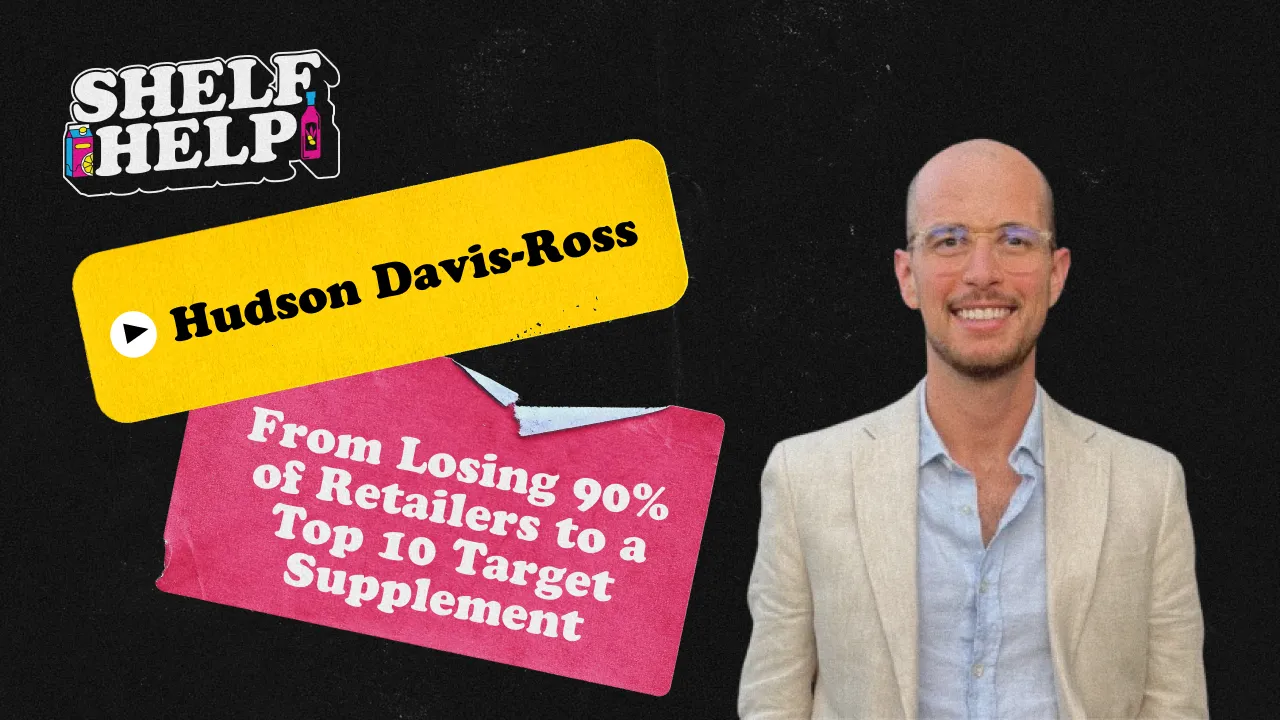
From Losing 90% of Retailers to a Top 10 Target Supplement | Hudson Davis-Ross, Plant People



On this episode, we're joined by Hudson Davis-Ross, Co-founder and CEO of Plant People - the functional wellness brand behind Wonder Gummies, the line of zero-sugar, vegan mushroom and botanical gummies sold at Whole Foods, Sprouts, Erewhon, Target, and more.
Before Plant People, Hudson was on the founding team of Rise Brewing Co. and helped build Aloha.
Hudson walks through the origin story: two co-founders recovering from spinal surgery, a bootstrapped launch that did $4.5M in its first 18 months, and a COVID collapse that wiped out 90% of their independent retail accounts. We dig into the survival playbook that followed, including a line-by-line P&L purge, agency payment plans, and the two decisions that saved the business: moving from glass jars to pouches (packaging went from $1.50 to about 20 cents a unit and DTC shipping from $8.95 to $4.95) and shutting down in-house fulfillment for a 3PL.
We also get into the move to gummies, why adherence beats potency, how they priced the launch at $34.99, and the rebrand from clinical to colorful. Hudson breaks down how customer demos and surveys shape new SKUs, how he thinks about Grüns, AG1 and Lemme crowding the category, what really happened after landing 800+ Target doors, and why they raised a Series A while already profitable.
---------------
Episode Highlights:
🌿 How two spinal surgeries led to an herbal supplement brand
💵 Bootstrapping to $4.5M in 18 months with two part-time employees
🚧 Losing 90% of retailers when COVID shut down independents
🍬 Why gummies beat capsules on adherence (and where they lose on potency)
🏷️ Pricing at $34.99 and anchoring a new category
✂️ Going line by line through the P&L to survive
📦 Glass jars to pouches ($1.50 to about 20 cents per unit)
🚚 Shutting down in-house fulfillment for a 3PL
🎨 Rebranding from clinical to colorful with the Wonder line
🥊 Competing as Grüns, AG1 and Lemme flood the gummy aisle
🧪 How customer demos and surveys shape new SKUs
🎯 Saying no to Target, then landing 800+ doors
💸 Raising a Series A while profitable
---------------
Table of Contents:
00:00 – Intro
00:59 – Origin story and bootstrapping to $4.5M
02:20 – COVID and losing 90% of retailers
03:01 – Launching the Wonder gummy line
05:03 – Gummy adherence vs. potency
07:57 – Pricing the launch at $34.99
09:57 – Hardest decisions coming out of COVID
12:12 – Glass jars to plastic pouches
14:52 – Pouch economics and shipping savings
16:53 – Moving from in-house fulfillment to a 3PL
18:59 – Early brand identity on a lean budget
21:23 – Rebranding from clinical to colorful
23:15 – Defending share in a crowded gummy category
28:16 – How new SKUs get greenlit
32:08 – Breaking into Target
35:47 – Operational lessons from the Target launch
39:12 – Raising a Series A while profitable
42:08 – Where to follow Hudson and Plant People
---------------
Links:
Plant People – https://www.plantpeople.co/
Follow Hudson on LinkedIn – https://www.linkedin.com/in/hudsongr/
Follow me on LinkedIn – https://www.linkedin.com/in/adam-martin-steinberg/
For help with CPG production design - packaging and label design, product renders, POS assets, retail media assets, quick-turn sales and marketing assets and all the other work that bogs down creative teams - check out https://www.kitprint.co/
Shout out to my friends over at Glimpse, the go-to partner for automating retail-related back-office operations and unlocking margin trapped in invalid fees and manual processes.
Are you in the market for a new flexible packaging partner? Check out HD Packaging. Third-generation, family-owned and built for the needs of category leaders like Newman’s Own and A Dozen Cousins. Faster launches, lower costs, and no artwork fees.
Looking to dominate the cognitive health space? Upgrade your formula with Cognizin. It’s the branded, clinically backed citicoline trusted by top innovators in supplements, foods, and beverages. Differentiate your brand today at Cognizin.com.
Episode Transcript
Speaker 1: 00:00
Welcome to Shelf Help. Today we're speaking with Hudson Davis Ross, co-founder and CEO of Plant People, the functional wellness brand behind the infamous Wonder Gummies. Plant People started in 2018, I believe, after Hudson and his co-founder Gabe both had spinal surgery. They're going through some recovery. After seven or so, seven years or so of scaling on fairly minimal outside capital, Mana Tree, who I know really well, took a minority stake along with I think it was Unileader Adventures, as Hudson was getting ready to launch in close to a thousand target doors. Um, I think before Plant People, Hudson was one of the founders of Rise Brewing Code, Nitro Cold Brew brand, launched out of a Brooklyn restaurant back in 2015. Also was on the founding team of Aloha National Bar brand that I'm a super big fan of too. First off, maybe just to set the stage for the small amount of listeners in the CBG space that aren't as familiar with plant people. Just love to just get a quick lay of the land, just in terms of the origin story and why behind the brand, what the core chronic lineup looks like, and then uh we'll take it from there.
Speaker: 01:00
Awesome. Well, first and foremost, thank you for having me.
Speaker 1: 01:04
Yeah.
Speaker: 01:04
Really excited to be here and give you and your listeners a download on on the on the business. Yeah, we started the business in about 2018. Um my business partner and I both had spinal surgeries, learned how to walk again. We didn't want to take pharmaceuticals at the time. So we started playing around mushroom, herbs, hemp, all herbal ingredients. And those worked great for us on our roads to recoveries. And then when we started giving it to friends and family because people are interested. And they essentially said, hey, if you're selling, we're buying. People were sleeping better than ever, people were less stressed, et cetera, or more focused, depending on the ingredients we were giving. And that's kind of how it started. So we didn't raise any capital or anything like that. We we went to market and started hustling, walking into stores, set up a website, did initial branding for very little. We put our personal savings into the business. It was very minimal at the time. And, you know, ended up doing the first like 18 months, about 4.5 million, super profitable with just me and two part-time employees. At the end of that period, we ended up scaling up the team to 14 people. Um, and we were launching with major retailers and um and distributors at March 2020 Expo S. But we all know what happened March 2020, COVID hit and everything got canceled. So we spent those following two years not doing as well because we lost 90% of our retailers because we were only really in independence, even though they were doing exceptionally well. They were all closed for about like three years, uh, many of whom did not come back. And then CAC was just really expensive, and we weren't VC backed. And back the name of the game in D2C up until around 2023 was really like spend, spend, spend, acquire, acquire, acquire. Um so it was hard for us to keep up. So, anyways, those two years after COVID, 2020 to 2021, were pretty brutal, but we were able to turn it around. And what came out of that was we rolled out, sort of rolling out this wonder gummy line at the end of 2022. And the the sort of like genesis of it was that even though we were selling capsules, powders, and tinctures, and while the form was really effective, they just it wasn't fun. It wasn't like something you would want to share. It wasn't something that you were excited to have. You put them away in a cabinet. Whereas gummies, you know, you share them with friends, they're delicious, you're excited about them, you leave them out for people to try. You have more than one serving. I don't think you're like having multiple capsules of a serving. Like gummies, people just gobbled them up. And we felt like there was no uh gummy in the mushroom ingredient category. So like lion's mane, raishi. And so we wanted to be the first in the market. And we went a step further and we made them zero sugar. So at the time, in the gummy category, there wasn't really zero sugar gummies. In fact, gummies had a bad rep that they were really heavy in sugar sugar. And so we were like one of the first in the market back in 2022 to roll out with the zero sugar gummy. And then a lot of them weren't vegan, they were using gelatin, which is you know animal parts and cartilage. So it was it was a huge opportunity to go after the mushroom category but gummies, but also offer a clean gummy. In fact, we probably could have launched those gummies two years prior, but we didn't because we wanted them to be zero sugar. So we went a step further to have some more defensibility as we hit the market. And I'm proud to say, ever since 2022, I mean, it's been explosive, profitable growth. You know, we've been doubling, tripling since, um, and we're really a gummy supplement category. The one thing I would say is it may sound like a pivot, but it really wasn't. It was really a foreign factor change. We actually our initial formulas, formulas were the same as that formulas that we were selling in capsules, but we just did it in a gummy. So, um, so yeah, it's been an amazing journey. We're really at the crossroads of like delicious efficacy and being clean.
Speaker 1: 05:04
I'm not a gummy expert, but I think obviously it's become a really popular form factor because it's just a really convenient delivery method for consumers. But from what I have heard at least or somewhat know, is that uh the challenging part about it from a manufacturing standpoint and a formulation standpoint is a gummy is not a huge, not a huge volume that goes into each gummy. And so, you know, figuring out how you can cram all your target ingredients in there while still making the product taste good without giving away any super big trade secrets. What were some of the key variables you're playing around with uh to get to the point where you felt like these gummies were ready for marketing and you felt good about them?
Speaker: 05:41
Yeah. So to your first point, um, yeah, I think partly why gummies, and we noticed this when we were trying to make the switch, is that with all the reasons why people have gummies over capsules and tinctures, the biggest is you leave them out, they're yummy, they're they're they're shareable, they're more interesting, and so what ends up happening is your adherence goes higher. Whereas capsules, powders, and tinctures, you kind of put them away and you kind of forget, or you, you know, you don't you're not looking forward to it. So what we find with gummies is that there's just a stronger adherence. And some studies say that it's like 30 to 34 percent increased adherence than traditional capsules and powders. Wow. On your question around jamming things into gummies, I'll be honest, the you can jam more potency into powders and capsules. The question is, is what is the problem you're solving? Yeah. Yes, capsules can be more potent. The cool thing about gummies is that you can actually mask the flavor of some of the herbs or botanicals you put in it versus, say, a powder. With a powder, you mix with water and you're it's all over your tongue. You can taste it. And so, like, we kind of say to the customers, like, what are you choosing for? Are you choosing for potency or like pretty good potency that tastes great or you're more likely to take? If the you're taking something that's like super potent, say like a an oil-based tincture, but you're not, you keep them putting it away in the cupboard and you're not taking it, or you're not sharing it with friends and you're not excited about it, and you're just not taking it. Like, what why are we even having the conversation? The goal is for you to take these supplements. So we find that you have higher adherence than traditional capsules, and but potency may not be as strong, but you can definitely fit, we're definitely seeing people and customers saying the products like they work, et cetera. And we know they do. We do our own testing, et cetera, and third-party testing. The last thing I'd say is that, like, you know, I there's a lot of unique herbs that you just can't put in powders because they just taste terrible. And gummies allow you to use those. So it's really kind of nice. You can actually explore more uh more bitter herbs or herbs that you uh traditionally can't put in, like, say a tincture or a powder.
Speaker 1: 07:57
When you started making this, you call the form factor shift to gummies, what did your strategy or going to process look like for nailing down your go-to-market price for these gummies, especially taking into account when you kind of, I don't know how much you felt like your your price was anchored to the previous form factor because it's so different. That's a great question.
Speaker: 08:14
I've actually never been asked that, but I'm excited that you're asking because it's super detailed. Um yeah, so I think because we were a first mover in the mushroom category, and the mushroom category was also very on trend. Like people were really picking up in steam, and we were starting to hear about it in podcasts and stuff like that. We charged a little bit of a premium, not like a ton, but we actually added an extra $5 to it. And also at the time when we were rolling on mushroom mushroom gummies, we we really felt like the you can only start high and go down, you can't go up. And we were a small brand, we were just coming out of COVID. So what we ended up doing is launching with $34.99 with these gummies. I think, you know, we had a feeling down the road we would drop below that number three, so $29.99. And by the way, this wasn't a sh a shot in the dark. Like this was like actual research of what we saw, like mushroom powders were doing, mushroom capsules were doing. And it felt like if you could be under three, that was super competitive. But because we were first to not only do gummies in this category, but also zero sugar, we felt like we can charge that extra $5 to $34.99. So we ended up launching with $34.99 based off of quantitative data, but also understanding the market and the landscape that no one was doing gummies or zero sugar, and kind of at the time, really vegan. So gel-stin free. But can I tell you something funny? Is that all a lot of competitors came out after us, like I'd say like two years plus, and they're all matching our pricing. It's kind of interesting. And actually, some of them went like a dollar below us. So you can tell we, because we were a first mover in it, we've kind of anchored the pricing in the category.
Speaker 1: 09:57
And just for maybe some other up-and-coming founders uh that are listening that are maybe also going through challenging periods of their company. What were some of the like hardest decisions you had to make during that climb out of the darkness period?
Speaker: 10:10
Hardest decisions. So I think it was twofold. I mean, there was a lot of decisions happening at that time. There was a lot of just saying no and a lot of like discontinuing of like marketing services we were paying for, you know, negotiating with like tech platforms to get a lower fee for certain things like that. I mean, I was when we were in those tough times. There was a weekend where I didn't like there was multiple moments in like weeks and months where I was like, I don't, like really honestly, like a year and a half where I didn't know if we were to make it. Yeah. But there was definitely like a three-month period where we were at our lowest, and I was like, we're gonna have to go above and beyond and like do some stuff. So we went, I basically like went line by line in our PL and started just like turning off, canceling platforms, just like basically plugging holes in everything, asking why we're spending on this, asking the team to stop spending on it. And then we went to a bunch of agencies to go on payment plans for one of which, I'm not joking, we paid $200,000 over two years. And they were so intense with us. And I was like, you just gotta trust we're good people, we'll pay it off. And when we finally paid, the CEO jumped in because we hadn't heard from him in like a year, and he goes, I am so impressed that you guys still paid it off, even though we were like so aggressive with you and that we were gonna like take you to court and this and that. I was like, listen, I like all I could say was we were gonna pay you. And you know, we didn't want to leave anyone else in the world on bad terms because we weren't able to make it through. That said, it was COVID, so they were flexible, obviously, right? And as long as we were paying $3,000 a month, essentially, or $5,000 a month, you know, it was it was good. But like the the two toughest sort of decisions was so I think that's like the sum of all parts. I would just say there was a lot of small, like, you know, death by a thousand cuts sort of like decisions that sums it up that we made. But the two biggest ones that got us out of it that felt really tough at the time was the first being moving from our glass and metal jars packaging to plastic pouches. So in order to survive, I had to call my co-founder. I'm like, listen, I've been doing a lot of research. We this is what we need to do. We need to move to these pouches. And it was really tough because we were known for sustainability. It planted a tree for every product sold. And so we were really big on like everything related to Earth impact. And what we found after I did a lot of research is our glass jars had a lid, a liner, a glass jar, a label that went around. And each one of those items are shipped from around the world to our co-packer. So when you start looking at the carbon emissions of that versus producing plastic pouches, literally in Austin next to our 3PL, the carbon emissions is like 1%. So us making that change dropped our carbon emissions annually by 99, like 0.8%. I remember I did the calculations. We went to a few like independent um consultants and websites to see like what the impact change was. The other was when you have five components to make a jar, you are increasing your liability that one of those items will out of stock. And that was happening at COVID. That didn't happen to us just for the record, but that was happening. So we were we were able to remove that. The third was the glass jar was clear, and it when sun hits supplements, it deteriorates the supplements. So that was like kind of a nice icing on top. The next is what we realize is that customers, and we know this, we all do this, is that when you tell people to recycle a jar, you're supposed to peel off the label off the jar, but no one does that. And you're supposed to take the lid or the cap off the bottle or whatever you're eating or drinking or using, you have to take off the components. No one does that. And so in reality, we were kind of forcing ourselves for customer perception that glass and metal looked really cool on shelves, but actually it wasn't better for the planet. And also, there's like, you know, if you go deeper, there's like sand shortages for how glass is made and this and that. So we kind of started there, but the main reason why we did it was because it was so much more cost effective. So again, five components shipping around the United States, all the shipping, etc., to literally producing a one unit pouch in our backyard. And it that went from a dollar fifty per unit, not including shipping, to around 20 cents. Now it's even lower because of our scale. So it was a massive win. And so if we could save that margin, the other win that happened was you were no longer having breakage issues with glass. So when you ship glass around the United States to you yourself, or even to like distributors or to retailers, there's breakage. We were losing about one to two percent per year, or we had to refund people or we had issues with production. And then the other thing is when we were able to switch from a jar to a pouch, for direct to consumer, I was able to go from shipping one unit, say instead of a jar, it's a pouch, our shipping went from $8 or $8.95 to $4.95. Right. That's massive. Totally. And with that $4.95 product, I get for shipping, I can actually put in two to three pouches of that product in that shipment and still pay $4.95. Yeah. So just from like a survival standpoint, this was a major decision. And we were so nervous to tell customers. And we ended up telling customers we had to do. Some people kind of freaked out, but those people who are freaking out, we realized we like look them up, those people were actually, they don't really buy anything. They're not into consumer, they're like super intense around sustainability, and they're not like the customers we need to scale this business, anyways. So we felt really bad about it. That was a really difficult decision. Also during COVID, we had to stop planting trees for you know every product sold. So that was really sad because that was like part of like who we were and what we we thought we were doing. But it was really interesting to see like underneath the hood what that impact on carbon emission was. So that was a huge decision. And I don't think we would be out of COVID if we hadn't made that decision. That impact makes sense. And then the second one kind of related is we moved our to what we were saying before the podcast about being vertically integrated. We were doing our own distribution center in Brooklyn, and we were at the scale, not big, but we were kind of like small to medium size, and we were like, I'm me as the CEO, I'm spending 30% of my time just focused on operations, like managing people, making sure people are happy. And it's a tough job packing boxes, you know? And we were we were launching at Whole Foods with these new gummies, and that's really a national footprint. So what we ended up doing is moving our warehouse and our distribution center that we were renting and like doing our own, our own custom experience, which we were really proud of and we wanted to really do, but we had to eventually like lay off those people in in order to move it to a 3PL, which got rid of me focusing on it 30% of the time. Me, we were shipping now about 100% faster. It was crazy. So we were really good at shipping, but after a while, it was just very difficult to motivate the team internally to, and there was a lot of like team in and out on the on the warehouse floor because it's a tough job. And it went to like we were shipping out every like two to three business days. It was slow, it was we were having a lot of incorrects. And so we ended up hiring a 3PL that is like in the center of the United States for national footprint for the retailers and distributors, but also next to our pouch manufacturer. Nice, you know? So we really centralized things, made it more domestic, and also near gummy manufacturer. So everything kind of came in. So the reason why that was difficult is we kind of had to like talk through with like the head of office at the time of like winding down his role. And I think we were really lucky because he he agreed. He actually was like, I've been through this. He went through the whole COVID experience. His name is Tim. We're very lucky that he was with us. But it was a very difficult moment because we were really proud to be vertically integrated at the time in terms of distribution, uh, not manufacturing, but uh that was probably pretty difficult.
Speaker 1: 18:59
From a brand identity and packaging design standpoint, thinking back to some of those early days, what were some of the key kind of variables, things that were top of mind for you? And you were building out the brand identity, positioning voice, visual identity for the brand. And then it's kind of a two-part question how, if at all, did did things change your approach to that as you started shifting to the to the gummies?
Speaker: 19:20
So I think from a branding standpoint, I I ran uh uh branding, a business strategy firm for about four to five years. So I have always felt that it is silly to spend a ton of money before you launch. I am a big proponent on spent raising money or spending money when you know what your product market fit is, or even if you have one. I think you learn a lot more in this the six weeks of your launch than you do in the six months leading up to your launch. You learn from customers what they like don't like if you're listening, if you're really like digging in and walking into stores and trying to like figure it out. So I I was really lucky in that I had like a list of designers and people I could go to and say, hey, like can you do the build this branding for you know five to seven thousand dollars? I'll give you some like stock options. And what if you know for the strike price, the price of the stock option was great, but you know, it wasn't like a ton. I was still paying them. I just sort of like shift, you know, juzged it and made it work. And so I I was really focused on just getting to mark in to learn, and I had had experience on like branding. So I encourage everyone else to do that. It may sound like I have like a special sauce because I ran a branding firm. Sure, you could say that, but you'd actually be quite surprised, you know, if you just get a designer that you really like, a freelance designer, you can really just get to mark and come up with something great. And now these days, you know, like people are building things on AI. Like I don't even, you don't even need a designer to do a lot of things. So, long story short is what we wanted it to feel like was trusted. We had a different vibe at the time. We had like a clinical vibe. We had like everything was kind of like white or cream background with like green and gold and a little bit more like minimalist and clean. Um, and it felt regal because I had like a little bit of gold foil in the packaging and and the brand. Um, we wanted it to feel earthy. Um, and as that changed with the gummies, this is a great question that you're asking this, by the way. The reason why why I love this question is because as we were working on the gummies and coming out of COVID, we were like, even though people love our current formulas and capsules and tinctures and powders, we're not seeing the velocity of what you see with the gummy category are functional, functional foods. And even though no one was doing mushroom gummies at the time we launched them, and it was the first mover, we were like, okay, we're gonna do like a form factor switch up right now. And what else do we want to do? And what do we love to do? So my business partner and I, he's a chef. I'm come from food and beverage. So aloha, right? And then also rice, coffee, et cetera. And the fun thing about those food and beverages is you get to, if you get to like go to events, you get to do exciting things and this and that. And so when we started thinking about us doing that with our capsules of powder and tinctures, we're like, this isn't exciting. This isn't like, this feels clinical going to an event and a party. People aren't going to like come up to you unless they're super into herbal ingredients or early adopters. And so we were like, we want this to feel fun. Yeah. And we wanted it to be like kind of like a superhuman type of product. So we called it Wonder. And then from a from a packaging standpoint, we wanted to brighten it up. We wanted it to pop on shelves. And that's why if you look at our packaging, I don't know if we're doing video with this, but there's packaging behind me. And it's a lot of colors. So we use a lot of bright colors. And that's kind of like our brand right now is vibrant colors, happy, happiness, joy, and less on the clinical side. So we, as we made that four form factor transition from traditional supplements to gummies, we also made that transition to the branding to a little bit more colorful, more fun.
Speaker 1: 23:15
From what I know, Client People As I Checked is the number one supplement brand in Whole Foods, Sprouts, Errolan, among others. Seemed like the gummy supplement category has certainly exploded over the past few years, whether it's groons, like now AG1 coming into the mix. How have you guys, how are you and how how have you so successfully defended your position in a category that's just been getting so crowded this fast?
Speaker: 23:40
Yeah, I mean, I'll take a step back and say with all the in new entrants and the grounds and the AG1 and other gummy companies, they are just seeing what we've been seeing. So to us it's validation, which is people are ha people are more excited about gummies and traditional supplements, and they're taking them more than they are with traditional supplements, which is really comes down to adherence. Not only is it more touch points for the customers, which is great. Like you want your customer to constantly be touching the product, right? And telling people about it. You don't want them to put them away in a cabinet, but also they're seeing more value and taking a gummy, and they're seeing the impact to their health because they're taking gummies more. So we're really excited that all this is happening. It isn't really changing who we are, what we do. Like, honestly, like the hype in the market hasn't really changed anything. Like, not one thing. We see it, we share it with the team. We're not trying to like go after certain categories because other people are doing it. Like we had a Green's gummy before Brunes did. Still does exceptionally well. We just didn't double down on and focus on that. That wasn't, we didn't have one product and two years of just spending on D2C. We've always been an omnichannel, our marketing spend has always been, we've always been focused on building an omnichannel brand to prove that we can be in retailers, D2C, Amazon, TikTok. And we have totally. Yeah. If we had one product from day one and just put all of our money into it and kept on reordering that getting volume pricing, we probably would have grown much faster. Um, but we also would have, you know, hung our hat on that, right? And if the goal is to sell the business, most acquirers want to see you do an omni-channel footprint. A lot of D2C businesses fail going to retail. So we've done it, we've done taken a different road in terms of our growth, but we've really proven that like our brand platform essentially. Yeah. On the Greens acquisition, on that comment, you know, on that note, like it's amazing what they've done. It's a great comp for us in terms of like acquisition and raising capital. I'm very happy that it's happening right now. Totally different product. We have a greens gummy. They they really focus on nutrition. We're really focused on need states of sleep, focus, stress, electrolytes, you know, beauty, you know, uh, weight management, metabolism, probiotics. We're kind of like a new age Ollie. That's like how you should really think of us. Yeah. And then AG1, yeah, again, like they are greens gummy. They're also really late. I think what I did a LinkedIn post about like welcoming them into the arena. I saw that. Yeah, I saw that. And I thought it was kind of interesting because people were asking me, kept on sending me text messages, what do you think about this? And I'm like, they're late to the game, you know, like it's probably gonna rip, honestly, because gummies rip. But, you know, I I definitely feel like, you know, they talked a lot of crap about gummies for many years, AG1. Yeah, many years. So it's just kind of funny to see that. So it doesn't feel as like genuine, but hey, listen, it's AG1, and I think they've done amazing things. I also met the founders like 11 years ago when it was Athletic Greens, and I feel like it's amazing what they've done. Yeah. Um, and I love their brand. So, anyways, long story short, is we're really pumped. We feel like we're the leader in sort of like neat state, sort of comparable to to say an Ollie, uh, which is obviously massive industry leader. Uh, the other brand that's kind of doing that right now is Lemmy. Um, but they're a little bit, you know, heavier on like beauty, weight loss, toning, a bit more feminine. Uh, and I don't know. I mean, uh they're in a different ballgame. It's a Kardashian brand. I but the fun fact is, which is crazy, and I hope they're listening to this. If you look at Erewan's numbers, we're two-thirds the revenue. We're the they're the number one like solution for functional supplement brand at Heroan. We're number two. And we're two-thirds their revenue, which is crazy because that's we're talking about Erewhine and we're talking about Kardashian. I can't think of a better product market fit than a Kardashian brand and Aeroan. And the fact that we're doing two-thirds their performance is crazy. Yeah. Crazy. And actually, they went down year over year, and we've only gone up. So I'm really hopeful and really excited about where we are as a brand. And it gets me really hyped up and excited to see why, to see other people get really excited about the gummy category.
Speaker 1: 28:16
You just touch on something. I've heard you say you're pretty intentional about timing and when to bring new SKUs to market. So I'm kind of curious what the journey or process looks like for your team that ultimately leads a decision to say, get to the point where you say, Yes, we're going to bring this new SKU to market. And then part of that question is, I'm curious, do you you mentioned groons and they're focused on like nutrition? You have a variety of different need states. And I'm curious, do you, when you think about building out your product roadmap, do you think about having kind of a mix between what I think people call them uh, you know, vitamins versus painkillers, painkillers being, you know, supplements that can have feel like have a more immediate impact versus you know vitamins that take a while to have an impact?
Speaker: 28:54
So yeah, I think um, you know, on product development, we're pretty, we have so many formulas in the pipeline that we could roll out with. Yeah. But we feel pretty satisfied with the products that we have. And we do have some launches coming up that we're really pumped about. And we've been launching stuff this year, probably not at the clip that we did the last two years, because we feel like we can build a $200 million business on the current product set. Um so that's kind of like where we are today. How we think about it is we really listen to our customers. So we do customer surveys, we do a lot of qualitative things. So we do a lot of demos. I used to do a ton of demos for Whole Foods back in the day. Like I would do, I think one year I did like 40, and I would just talk to customers and they would tell me what you know you know what they're interested in. So a great example was when we had the Greens Gummy many years ago, we rolled out with the Greens kids gummy because people kept on asking me at these demos can I give this to my kids? And that's essentially how we rolled out that product. It wasn't just because of me and the founder and CEO and just hearing that. It's that's where the inkling came from. And then we did research and did a survey. And we also looked at the market and was like, is there an opportunity? The answer was yes. The other was a great example was we did a huge survey of like what customers would like to see. We did like our best customers or worst customers, our middle customers, what types of products that they would want to see. And actually, the number one product that or type of need state was weight management and metabolism. That's what people were working on. So that's how Wonderburn came about. And each time we get these inklings, we run it by through surveys, but then we also asked the buyers at like the biggest retailers because when we roll out new products, we want to make sure it works for the entire omni-channel system. So not just D2C and Amazon, but also retail. So there's actually a few products, and one that I'm working on right now, that retail was just not ready for. Like the buyers were like, that's like two to three years ahead. And now I can tell that they're like asking for it. Interesting. I've started to notice that like this last six months, like every bar me and major retailers have asked for like this type of category. So it's kind of funny because we presented it to them two years, two or three years ago, and they're like, I don't know, I don't think like consumers are ready for it. And now, like, so much has happened in the space where they're they're saying we're good to go. So, and then we look at Amazon. We look at right now, we're not looking at TikTok because I think TikTok's a bit of like a discount channel right now on current products and market. Yeah. Um, but we do look at like search volume, keyword searching for an Amazon, Google search, et cetera. And yeah, that's kind of like how we come up with the product development. That makes sense. Pipeline. We also have a someone from Scientific Affairs. Our manufacturers are also really amazing in coming up with ideas and ingredients that we could play with. But my my focus right now is to grow revenue, retain revenue with the current product sets.
Speaker 1: 32:09
Last October is launched in an 800 plus target doors. Curious, like what that journey to shelf looked like to get to the point where they said yes. Um, and then once you got that yes, and now you've getting ready to get on shelf, meet on shelf a little bit, like what had had the what had to change, if anything, significantly from an operational standpoint to really be able to effectively service a big mass retailer of that size?
Speaker: 32:33
Great question. We do exceptionally well in natural specialty and boutique wellness. We're the number one or two or three brand at onfair.com, which basically manages our entire boutique sort of independent channel. We're the number one supplement brand at Whole Food Sprouts and Airwan, and like Thrive Market, like it's just like that type of like premium retailer vibe. We have been for like two to three years in multiple categories. So it's not just like happening and it's like a spike, it's like this is real. So we're kind of like barreling into mass, right? In the mass channel. So Target, Walmart, and the next is like Club, which is Sam's and you know, Costco. Obviously, there's a lot of author retailers in there, but those are sort of like the big ones. When we thought about mass, the first retailer we wanted to work with was Target. It felt like the easiest transition in ratio of like vibe and premium were what we're seeing in natural specialty to retailer sort of distribution size. And we were really excited about. So we we actually met with them pre-COVID, way back in the day, and then COVID hit. So we we stopped talking to them for like three to four years. Then we picked it up. They were really interested in carrying our products. We actually said no to them. And the main reason why is we had grown 3x that year. And even though we had the inventory, we wanted to stay laser focused and complete the year. And of I think it was like 2024, we said that. And we basically said, let's touch base in six months. They were kind of surprised by that. It was obvious, but I felt like it was the best decision. And then, like, three months later, we were like, We're actually we're we're ready because I could tell that like we're gonna be a good place instead of six months, we'll hold up three months. And then there was like a few months of back and forth. There were some buyer changes. We flew to Minneapolis for that meeting, presented to them, and the vibes were great. Like, I think in pitches, it's not just about products you're performing. I generally feel like most buyers kind of know what they want to do with the brand before they enter the room. They're not walking in blind, you know. That's what I'm trying to say. It's like they've seen our deck, they've seen our numbers, they know what's happening, but we go in, and I think the the key is to present to them 90%. The deck needs to be tight. It needs to make sense of why it fits for the target, target or retailer consumer, not just for you, why it's big for you. It's why is it big for you know that their shopper? And then we ended up like really trying to like get the energy in the room to feel like there was momentum just in the culture. So that when she leaves the room, she's kind of like going to other meetings and be like, wow, like this meeting feels so formal. Like she she wants to feel what hopefully her customers will feel, which is like, wow, this product patent pops off the shelf, feels like the energy feels exciting. So that was a big part of it. It was only a 20-minute meeting. So we had to run through the deck, ended up carrying over because you know, when a meeting's going well, it kind of like carries over.
Speaker 1: 35:45
When it goes over, it's a good sign. Yeah.
Speaker: 35:47
Yeah. And then, yeah, I think like Target's been interesting. I mean, they've been great. The buyer has been amazing. I think operationally, it hasn't been like ideal for us. We found out that like they didn't order inventory for a third of their stores for like three months essentially. Um, I was on Pat leave and I was looking at the data and I was like, why is there like an out of stock this high? I think you just assume that it takes a while to hit shelves. And then at three months, I was like, guys, this is not good. So we found that out. And then we we were given side caps, which is amazing. Um, so it's like it's not an end cap, but it's it pops off in a quarter of you know the aisle. So that's been really awesome. Um, I think what's been difficult for us is you know, it's just a different type of consumer. I think like a target Walmart consumer is way more persuaded on brand awareness and social media virality, stuff like that. Like, you know, where we had our wedge in the market with national specialty, we really could we were winning on ingredients and clean gummies, this and that. And I think, and obviously delicious, but I think like the mass consumer is a bit more focused around like price, but also like virality and awareness. Have they seen this around? Blah, blah, blah. And there's just so many consumers and so many distribution points that your brand awareness needs to be much bigger, like much bigger. And so I think for us that's where we've struggled. And in initially, we're not really right now, but we really focused on that the last like you know, two years with Target. And I'm proud to say that you know, we're we were we are only in 800 stores right now or 850. And when you look at like the top 10 vitamin supplements, we're like basically number 10. And everyone who's one through nine has been on shelves for like a year and a half minimum more, if not years. And they're national. That's crazy. So even with like a bumpy beginning of them not ordering inventory, um, you know, a bunch of our side caps were thrown out, blah, blah, blah. All the things that you kind of, the trials and tribulations of dealing with retailers, we're still like pumping. And similar to what I said about Let Me with Erwan, if you look at the the retailer, the brands that are doing that are number one through nine and we're number 10. By the way, that that data is like a month or two ago. And I think we're a little bit higher now. Those brands ahead of us are doing a hundred million, two hundred million dollars a year. Right. And they're national. So the data is pointing in a really good direction. And in fact, I think they see what we see is that we're performing, or velocities like two to three X are sort of direct, sort of like anything related to like herbal gummies. But you know, we're in the ranks of like Bloom and Lemmy and Grunes and uh Nello and stuff like that, which is really huge because they're viral, they're national, and some of them are lower price point. But, anyways, we got some great news last week. So um, I'll be announcing it soon. But let's just say that our partnership is gonna get much, much bigger, everything from stores, but also uh, you know, product sets. So we're really absolutely psyched. Um, that's hot off the press from last week. So I'm really excited about that. And I'm really proud of the team because I think in the beginning we were like, what's happening with inventory, going into stores, and then we were also like, man, the mass consumer just needs more brand awareness. And we like tried a lot of things. It's a very cross-functional effort, and we've proved to make things happen, and we were successful. So I'm super a pop.
Speaker 1: 39:12
That's awesome. I want to talk about the rays for a second. I think I I've heard you say when you're talking about the rays, like you had an 18-month runway, you guys are profitable at the time.
Speaker: 39:20
Yeah, I mean, it's interesting because when we brief pre-COVID, we didn't take money when everyone wanted to give us money, and we said no, because we were profitable and growing. And then COVID hit, we needed money, and but everyone said no. And then after COVID, everyone started asking us why are you raising now when you're doing so well? I think it just very frustrated. I think like when we were doing so well in 2024, 2025, even like the year right, years right after COVID, we were at our our height. We're still we're at a height now, but like I'd say, you know, 2020 for 2024 and 2025, we weren't fundraising, but people would hit us up to raise, and then they would ask us, like, why are you thinking about raising? It's like, well, you're the one that hit us up. And also, also, like, when is the best time to raise that? You know, is it when you're not doing well? Like, that's a terrible time to raise.
Speaker 1: 40:16
Totally.
Speaker: 40:16
Um, I mean, most people do it then or when they're flat because they're trying to survive. But for us, the way we were thinking about it is we just wanted to fuel the fire. We wanted to scale up that everything was working. So much of what we were doing last year before we did a Series A after being bootstrapped for seven, eight years was really like ROAS positive. We wanted to invest in that. I mean, we weren't really investing for inventory. We had a line of credit, we don't need that. We were profitable. And I think we just wanted to go into this year with more fuel and see what we can do from a marketing standpoint. I think what we've learned is we do need to be spending more. Like, I think we started off this year, like, oh man, we're doing so well. All we have to do is keep on doing the same stuff, but you know, just be prepared to spend more. Whereas now it's like, I think we're at the size where everything's working in the business model, TikTok, Amazon, D2C, retail. We just need to be spending more to drive people to store and more brand awareness. So that's like kind of the stage of we're in. Uh, and I'm happy we we raised that capital. I think we started having those discussions. A lot of people reached out, a lot of PE firms in particular. Um, you know, the goal wasn't to start that process in Q2, Q3 of last year, um, and then we closed in November. Always takes forever. But the goal was really to actually go raise in in in uh January of this year. So we started a little bit earlier. Like would have been nice to have completed the year because our numbers were so strong and raised in Q1 and a little bit higher valuation. But, you know, our investors for the Series A were super flexible on you know increasing valuation as we were having the discussion, which was great because we were outperforming um and our forward revenue kept on growing. So that was really nice is to have like a partner on that. Yeah, totally. So yeah, it's been awesome.
Speaker 1: 42:08
Yeah, it's in this has been awesome. What's uh what's the best place for people to follow along with with you and all your expertise in the space? And then um, what's the best place for people to follow along with with plant people as well?
Speaker: 42:19
Yeah, so following along with me, I just broke 10,000 followers on LinkedIn. There we go. Which to me, I'm like proud of because I was like, I'm gonna start posting and doing things on LinkedIn about two to three years ago, three years ago, and it's paid off. I haven't really like focused on it, but it's like it's it's been nice and I get a lot of like interest there. But I give updates on the brand and sort of what I'm seeing in the space, etc. That's a really good way to kind of like follow along. And then I'd say like following around with a brand is like TikTok and Instagram. Like that's that's like that's where you can feel the vibe of the team and the culture, um, and like what's happening over there.
Speaker 1: 42:59
Cool, awesome. Yeah, that's it. This has been awesome. I appreciate the time. I think uh I think that's about the pod.