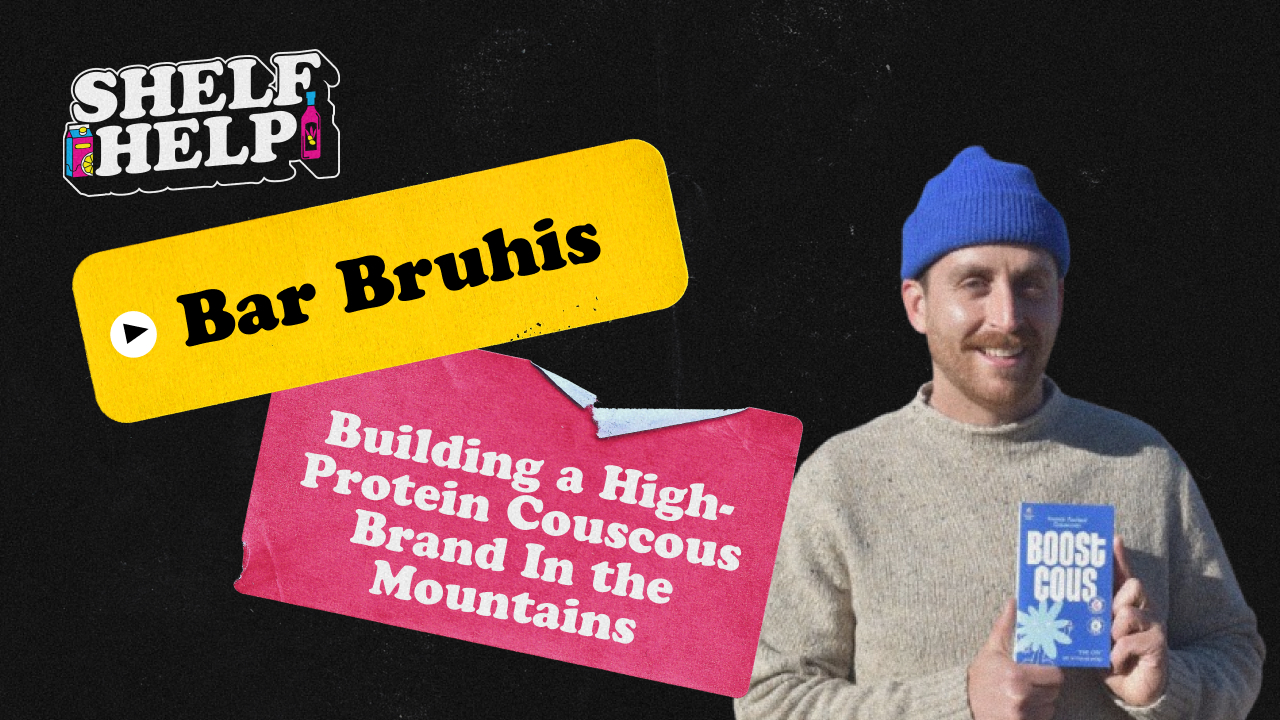



On this episode, we're joined by Bar Bruhis, Founder and CEO of Boostcous, the gluten-free, high-protein couscous brand that packs 18 grams of protein and 11 grams of fiber into a five-minute meal.
Before going all in on Boostcous, Bar spent a decade in SaaS and DTC, running day to day at KnoCommerce and helping start Sumo.com.
Bar walks through the two-year formulation grind: roughly a hundred failed kitchen batches, a promising overseas manufacturer that collapsed the moment tariffs hit, and the decision to rebuild the supply chain and vertically integrate production in the US.
We dig into how Bar funded the first run for under $50K, the signal that made him leave KnoCommerce to go all in, the five customer segments, and why he personally texts and calls one-star reviewers.
We also talk about cracking paid ads with a founder video he spent 70 hours making, going viral through Snaxshot and the New York Times, finagling his way into ExpoWest for free, and the aisle-placement that puts Boostcous next to rice and quinoa instead of pasta.
---------------
Episode Highlights:
🥣 Why regular couscous is just a carb bomb
🧪 Two years and 100 failed kitchen batches
⚠️ How tariffs killed the overseas manufacturing plan
🏭 Vertically integrating production in the US
💸 Launching for well under $50K
🚀 The signal that made him leave KnoCommerce
👥 The five customers he never expected
📞 Why he texts and calls one-star reviewers
🛒 The first 500 orders sold from his garage
📈 Going viral via Snaxshot and the New York Times
🎬 The 70-hour founder ad that cracked paid
🛍️ Finagling his way into Expo West for free
🤖 Building the company AI-first
---------------
Table of Contents:
00:00 – Intro
00:50 – Origin story
02:55 – The product: 18g protein, 11g fiber, three ingredients
03:25 – The two-year formulation journey
05:22 – Tariffs blow up the plan, rebuilding in the US
07:12 – Moroccan vs Israeli couscous
10:18 – Funding the first run (write it to zero)
12:28 – The signal to go all-in and leave KnoCommerce
14:17 – Who the core customer actually is
17:08 – Finding your real customer fast
19:05 – The first 500 orders from Bar's garage
20:04 – Brand identity and naming Boostcous
22:58 – Cracking paid and going viral
25:01 – The 70-hour founder ad
26:44 – Expo West strategy
28:48 – First retail doors and velocity learnings
33:05 – Building the company AI-first
35:42 – Product roadmap and flavors
37:14 – Where to follow along
---------------
Links:
Boostcous – https://boostcous.com/
Follow Bar on LinkedIn – https://www.linkedin.com/in/barbruhis/
Boostcous on LinkedIn – https://www.linkedin.com/company/boostcous/
Follow Bar on X – https://x.com/Bbruhis
Follow me on LinkedIn – https://www.linkedin.com/in/adam-martin-steinberg/
For help with CPG production design - packaging and label design, product renders, POS assets, retail media assets, quick-turn sales and marketing assets and all the other work that bogs down creative teams - check out https://www.kitprint.co/.
Shout out to my friends over at Glimpse, the go-to partner for automating retail-related back-office operations and unlocking margin trapped in invalid fees and manual processes.
Episode Transcript
Speaker: 00:00
Welcome to Shelf Help. Today we're speaking with Barr Bruhis, founder, CEO of Boost Coos, gluten-free high protein couscous brand that's making waves and growing super quickly. Before launching Boost Coos, Barr spent 10 years or so in the DDC world running day-to-day at NoCommerce, helping start sumo.com, just to name a few, and just left NoCommerce. And I think in April 1st to go all in at Boost Coose after after I think hit 5,000 in daily sales on track for 3 million this year. So super impressive. Get why you left. Yeah, super excited to have in bar. Maybe just kind of first off, just the listeners that aren't that familiar with Boost Goose. Love to just get a quick lay of the land, just in terms of kind of the origin story, why behind the brand, kind of core products in the lineup, and then uh I'll go from there.
Speaker 1: 00:50
Yeah, yeah. And thanks for having me on, Adam. Stoked. Yeah. I think you you had a couple of friends on here recently. I think I saw Sam from Goodwipes most recently. He's the man. He's uh such a character. But yeah, boost goose. Yeah, so we we launched Booscoose in December of last year. I can give a little bit of backstory, like before that. So yeah, I was born in Israel. That's where the name Bar comes from. I lived there until I was eight, then moved to the States and um always grew up eating couscous. Uh it was kind of like a big part of my diet. Um, and always loved like how quick and easy it was to make. Like, you know, you can cook it in five minutes as opposed to like rice or pasta that take at least 15 up to like 30 minutes. And it's way more versatile, right? You can eat it hot or cold, whether it's on your salad cold, or like if you want to eat it hot, you can uh eat it as like a bed to stir fry or curry, kind of as a rice replacement, even as a pasta replacement. Fast forward, I uh I lived kind of all over. I I ended up moving to Colorado just outside of Aspen, a small little mountain town called Carbondale. I love to do a ton of like outdoor activities like mountain biking, backcountry skiing, and would always come home looking for a quick and healthy recovery meal. Uh kept coming back to couscous, but realized it wasn't actually that good for you. It's normal couscous. Um, people think it's actually a it's it's a grain, but it's actually just similar in a flour and water. So it's just pasta, right? And so yeah, looked for alternative, didn't really see anything. I think there's a ton out there that's working in uh like the better for you category on the pasta and rice side. Like Bonza's great, so is Goodles. You know, I don't think we're really competitive to either of those companies. On the rice side, there's Rite Rice who went out of business actually for getting sued for having rice in their in their name. And now we we see a lot of right rice customers move over to Booscoose. But yeah, we saw that there's like a need here, right? Like went to the grocery store. Literally, the only company that's making couscous is Near East. Bad branding, bad ingredients. So yeah, went to work, tried to formulate a new product. It took about two years. And now, yeah, we have boost goose, which is uh protein-packed couscous, 18 grams of protein, 11 grams of fiber per serving. It's three simple ingredients. So it comes from chickpea flour, lentil flour, and pea flour. It's all non-GMO, glyphosate free and like a naturally occurring protein, which I I think protein right now is like a huge trend, but like do you really need protein sprinkles? Probably not. Do you need like a good, healthy source of protein? I think yes. And so, yeah, that's us.
Speaker: 03:25
On the topic of the three ingredient formulation, chickpea, lentil, and pea flour, just tell me a bit about the journey like that ultimately got you thought there. I think from what I read, you you initially tried just adding protein to kind of traditional couscous recipes and before you ultimately got to where you are today. I'd love to hear just a good bit about that journey in terms of different variables it played around with, key tweaks you made along the way that ultimately got you to to the current form factor.
Speaker 1: 03:50
Yeah. Yeah. I mean, that that's like I feel like an entire story in itself. And I feel like, yeah, people see products and you don't end up talking about like the the the origin story. But yeah, we um so maybe it could have been a little faster. Obviously, I'm I was like running no commerce and doing some other things, but I do think it would have still taken quite a bit of time. Um we essentially, yeah, like you said, we started by, hey, okay, there is regular couscous is semelinant flour and water. Hey, can we actually just infuse that with like a pea protein or a pumpkin seed protein and see how that like works? We tried that a ton of different variations in our kitchen, you know, bought a dehydrator. Essentially, like there's two types of couscous: there's Moroccan couscous and Israeli couscous, Israeli or pearl couscous. We were going for the Moroccan or uh you essentially like you you sieve this like water in semolina flour formula through a sieve and you essentially try to like dehydrate that, rehydrate it. We tried a like probably a hundred different variations in the kitchen. All of them like were not good. Like we would like be stoked, try them, our stomach would hurt, and it's like like this is not something I could like actually try to sell. Then did a bunch of research. It turned out that there's like some protein couscous in Europe, which was like a good sign for us because it's like, hey, if this is working in another market, maybe we can do it here. Yeah, found found like one protein manufacturer over there. We actually like tested their product, went and visited their facility and like actually really liked it. And we were like down to to use it. And then Trump tariffs hit, and it was like, this is the entire model, it is like upside down. Also, the supply chain is gonna take way longer. Then it was like back to the drawing board and probably like the lowest point of like, do we have a business here? Like, can we actually make this happen? Then it was kind of like, okay, you know what? Like, we know that there is a product that's working. Let's try to like completely engineer that and vertically integrate it in the United States. So we went out, found the biggest pulse flour manufacturer, which a pulse flour is essentially just um a legume flour. Um, so you you know, you take chickpeas and grind them up um, or lentils or peas. Found the biggest pulse flour manufacturer, called around to like every co-man you could think of, found a gluten-free pasta manufacturer. Um, you know, took a long time, but like essentially became friends with one of the operating partners there, older, older gentlemen that would just like give calls and kind of like butter up and ask questions. And really cool guy that like wants to see innovation in the industry, and he was willing to take a bet on us. Um, we were able to, there's like even another part of that story where we we found the biggest um dye manufacturer in the country who had like essentially had the way pasta's made is it's extruded through like a dye. And we found a dye manufacturer that had a small pasta line to test their dyes. He'd never used it for RD, he'd always used it for like dye RD essentially. And we were able to convince him to do that. So we flew out to him, got our first formulation kind of dialed, and and then we were able to negotiate with our manufacturer on an MOQ and kind of took a leap of faith of like, hey, let's throw some money into this, see if like people even care. If not, we've just lost like a little bit of money. And now I think it's safe to say that people care about it and and and want to eat couscous.
Speaker: 07:12
Traditional couscous is is typically you know, like steamed or absorbed is the right word. And I think yours is you point out maybe this is the difference between the Israeli and the Moroccan. I think yours is like more boiled and strained. Were you worried at all about consumer behavior in terms of changing their cooking method? And and I guess if so, how did you Yeah, yeah.
Speaker 1: 07:31
So you are right. If you uh if I come back on in like two or three months, we we do have another skew coming out that is uh the the Moroccan couscous. But yeah, there's two types of couscous. The Moroccan couscous is actually much easier and quicker to to make. Um you can absorb, you know, you you you can literally just uh boil water in a kettle and then pour it on top. It absorbs it. You can like cook it anywhere way faster, way easier. Our current version is more of an Israeli type uh uh version of couscous, which normal like uh just similar in a flour and water couscous, the Israeli version you do also cook similar to pasta where you know boil water, yeah, cook it, drain it, rinse it. So that's our current version. It was definitely, you know, one of like I mentioned in the beginning, like there's essentially two value props to normal couscous, it's convenience and versatile versatility. Both versions, I think, are still versatile. The convenience factor was definitely a concern. Uh but you know, I think it's one of those things that was like move fast and fail. And um, you know, I think it's enough of a pain point to where, okay, like let's launch with one skew. This is the skew that we know we can produce. If we can get to uh enough product market fit and enough signal, then we can actually launch a second skew and then eventually even more SKUs after that. But uh yeah, definitely a concern. It hasn't seemed to come up uh yeah. Like if you look at our reviews, I'm very customer obsessed. I like talk to our customers, text our customers. Certainly, like, you know, I'd say like one in a thousand, like we'll have an issue, but I think that's like normal for like any CBG brand.
Speaker: 09:07
In terms of that, Copac or overseas, tariffs kind of totally threw things off. You had to go back to the drawing board, other first-time founders that are whether it's just the nature of their formulation or they decide to do it intentionally, ha are a big part of their supply chain is international. Um, anything that kind of comes comes to mind or recommendations you might have that can help stress test and de-risk it, whether it's you know, dual sourcing ingredient flexibility.
Speaker 1: 09:33
I mean, I think that like it was a blessing in disguise that we had to rebuild our entire supply chain. I think not having to deal with overseas shipping and duties, all the things, um, uh tariffs, like it took us a lot longer to get to market, but we are way more flexible now. So if you can, I think manufacturing uh like onshore is it is definitely better. Having said that, our some of our future SKUs will not be like fully US. And so we have learnings to do there too. I'm not sure that I'm like, you know, we're just getting our chops there. So I would say if you can try to do it uh in the US, um, but I'm I'm certainly not an expert in in that regard, and we're very much learning on the fly.
Speaker: 10:18
You and your your other partner, I think you guys put in a each put in a good chunk of cash for that first order. Just for some really early stage founders that are as very similar, place, it's time to pull the trigger if they're gonna do this. We put in um like uh I guess a good chunk of cash is relative.
Speaker 1: 10:36
Like compared to other CPG brands, um like I I know plenty of CPG brands that require like at least a hundred thousand dollars to get off the ground. Uh yeah, you know, I can share that we were like well under 50. Like I it I don't know that I'm comfortable sharing the exact number, but it's it's around that. And yeah, you know, I think for us it was from the get-go, it was the approach was always, hey, listen, this is a startup. Both of us actually had like other jobs, and it was essentially like, hey, can we like do something that's different and can can this thing get legs? And from the get-go, it was always let's put in X amount of money and pretend that it that money doesn't exist. It's like putting that money would have been either I put it in like a Bitcoin style style investment where it's like super high risk, or I invest in myself and be willing to have it go down to zero. So, like as soon as I transferred that to the business account, I just like in my head wrote it off as like that's going to zero. Yep. And then from there, like all the decisions get easier, right? It's like, okay, we have X amount of money in the bank. We are we need to prove out this business with that amount of money. And ideally, we don't put any in any more money. And so that's the way we thought about it. And and yeah, obviously nerve-wracking to like go to go do that that first run. But you know, we we negotiated net 30 terms, so it was always like, okay, if we can, if we can have this product land at our warehouse, we could start selling it even before like it lands in the warehouse and we could start getting cash to feel better about it, uh, or to feel better about the debt that we we carried. But yeah, you know, I think my mindset from the beginning was always like, hey, we're burning this, this money's gonna be on fire. It's like either going to zero or going to to more than zero.
Speaker: 12:26
When you decided to go full time on this and and leave no commerce, if was there one specific moment you're like, all right, this is the data I need to see. I'm burning the boats.
Speaker 1: 12:34
Yeah, it was pretty early on. So like I said, we we we launched in December and I had the conversation with Jeremiah at No in like mid-January to essentially say, like, hey, you know, I think I have have too much on my plate. And that was that was essentially the the the conversation I had with myself is you know, I was stretched too thin. So I I you know I had No, which uh, you know, we had 6,500 merchants on there and like a growing business software. Um I do D2Ski, which is uh an event in Aspen every year where we fly out 30 of the biggest uh D2C brands. You know, this year we had like Sam, like I said, grooms, like David Protein, like some some of the biggest and and fastest growing companies. That like that took a lot of planning and coordinating and all of that. And then I also had boost goose, and it was just like, this is too much. I need to take things off my plate. So I hired someone to help for D to Ski. The no and no was the kind of like the first thing where I was like, this needs to come off the plate because the only reason Boost Goose is gonna fail is if I don't put in the right attention. Like right away, we saw like we were getting uh first order profitability, low CPAs, really good reviews, customers were using it, they were buying it again. And so right away it was like there's enough strong signal. I wouldn't say there's like one specific number I was looking at, but across the board, I could just like gut feel that there was enough signal that there's gonna be a business here. And um, yeah, I'm an all-in-or-nothing type person. So I knew that I couldn't be like, you know, one foot in, one foot out of like two different businesses. So decided I just had to step away from now.
Speaker: 14:15
What have you learned since launch about who the the core customer is of Boost Coose and anything that's been surprising in terms of who you found is actually the the core buyer at all?
Speaker 1: 14:26
Yeah, yeah. I think when we so it's it it's such an interesting like experiment to to think through who your customer is and build like a customer demographic before you launch and then like recalibrate it. And uh, I think my time at No helped me a ton with that, right? Like post-purchase surveys, you learn so much about your customer, who they are, why they're buying, where they're from, uh like demographic, all sorts of things, right? And so going into it, I I think I I'd like to think that I had like no ego attached to the persona and wanted to just let the customers tell us who they were. But yeah, like certainly I, you know, I thought, okay, like it's probably gonna be like that the female that like lives in New York, LA, Austin that does Pilates and is looking for a healthy recovery meal after their workout, or like that Jim bro in those same geos. Yeah, we've been really surprised to see who who it actually is. So, you know, we've uh I'd say we have like probably five different customers. Number one would probably be like the mom or like the caregiver with kids, really quick and easy for them to make for themselves. They're also a lot of moms in postpartum need high protein. So that that's been really interesting to see. But then also feeding their kids, it's high in iron and there's no choking hazard. I don't have kids, so I like didn't think through that, but um, it's it's a huge market, right? And huge share of wallets. So that's one. The kosher community was another really surprising one. We are fully kosher certified, and I think they were already eating couscous in their diet, and uh, you know, then wanted a healthier version of that. Um, that community also has a lot of word of mouth, and so been really interesting there. The gluten-free community, that's another one where um, you know, at first I didn't think was gonna be that big, but it's actually been huge. And we have all sorts of stories of moms reaching out and saying, like, hey, my my son or daughter was diagnosed celiac at birth, has always wanted to try couscous. This is the first couscous they've ever had. Really like moving stories like that. Um so yeah, those those are probably like the three core ones. And then and then the two other ones are those like ancillary ones that I I'd mentioned, like that that uh, you know, 2030 something that's like looking for added protein. Um the I think the most interesting one that's like come up recently is like the GLP1 movement. Uh, you know, they're looking for really high fiber, high protein foods. Uh one in eight American is on GLP ones now. So that's that's been an interesting one to to to explore. They're all uh you know that when you're on a GLP one, you're you're pretty constipated. And so like having a high fiber that's soluble fiber really helps you out.
Speaker: 17:07
This question might end up being a plug for for no commerce, but for some of those first-time founders that are tr trying to figure out really who their actual core customer is or is gonna be as you know as fast as possible post-launch, like what's the what's the best way you think they can do that?
Speaker 1: 17:24
Yeah, um, I think this advice probably is across the board. You have to be customer obsessed. Um, and and that will answer so many of your questions. Um so um, yeah, certainly like no or any other post-purchase survey is super helpful. You know, when we started no is always surprising. It's like 40% of people will fill out that survey. Um, I personally am in that 60%, so it's like even more surprising to me. But, you know, getting like, you know, two out of five of your customers to like answer a survey and designing that survey to really to really help you, right? So like what are the main value props of your of your product? List them out and have people like check off the ones that like resonated with them for the purchase so that you can like double triple down on that, right? Like most founders are like too obsessed with their product and they give too many value props. Like this is simplify, it's food, like give two value props. Um you know, I think uh also understanding why people didn't buy um or what uh or like uh why they didn't almost buy, that's like really, really helpful for understanding um like customer hesitations. Um, but that's just one data source. Like there's so many others, right? Like I look through our orders. If anyone's like ordered, you know, we like had someone order like $200 worth of booscoos today. I'm like texting that person and I'm like getting on a call with them and like understanding their story. There's like I do think surveys are so so important, but like at the end of the day, there's nothing that like a human conversation, especially a phone call, ideally like a uh like a face-to-face conversation, will give you so much more context and just continue to absorb that. Um, our first 500 orders, we did like we just posted, we we like got a front page article in the um in the Aspen Times and like some some other newspapers here and um essentially said, Hey, if you want free shipping, come uh buy from Bar's Garage. And they would like just literally come to our garage. And like that demographic skew is a lot older. It's a newspaper reading article or newspaper reading audience. So, you know, I I took that with a grain of salt, but still very much asked them like what matters to you, um, looking at all of your Facebook comments, all of your Instagram comments, um, seeing like what are the patterns there, and then yeah, certainly looking at your your reviews. And we have, I think we crossed 200 review reviews today. We have like 195 star reviews, but there's 10 that are not five star. And I'm like very much obsessed with that and like emailing, texting those people, understanding like, hey, what do you not like about our product? You know, who what is your demographic and who are you and why did you buy so that I can understand like how I can attract more of the right person.
Speaker: 20:04
On that front, from a brand identity standpoint, as you're building out the brand from a look and feel positioning voice standpoint, what were the key variables that were top of mind for you when you were we were building all that out?
Speaker 1: 20:18
Yeah, so you know, we wanted the product to be we wanted we wanted it to track and and resonate with a wide variety of of consumers, right? Like like I you had asked for the like customer profile, and I think I named like five or six, right? So it's like I actually have a box right here, but like you know, the box, it looks like it might be a little glary, but like the box is like meant to be like fun and light, right? And something different than like what's out there. Like I mentioned, like right now it's just Near East that's that's uh like producing couscous. Um, but yeah, we you know we kind of borrowed like a lot of the colors are from like Middle Eastern, uh like whether it's like um like the the blue is like kind of like coming from like the Israeli flag or like even like Greece where like um a lot of couscous comes from. We knew we wanted to be like fun and light, so we created these characters and we have a bunch of these characters like all through our website. Yeah. Even like, you know, this is like all the different characters like dancing on like our hat. Uh so yeah, we knew we knew we wanted to be fun and light. Um we knew we uh wanted to kind of grab some some uh inspiration from like where Couscous comes from, which is like you know, Africa, Greece, the Middle East. And we let our designer kind of take their stab at it, uh, and that's where we ended up. A lot of iterations between like first and and what you see on the box today. But that's kind of the inspiration.
Speaker: 21:49
Booscoose is I assume a huge people why people discover the brand and try it for the first time. It just seems to be pretty clear what the product is and and what it does, but I think the name naming process is it can be a Lot more complicated and and one of the hardest, harder things that people do when they're building a brand. You guys obviously hit it out of the park. What what did that naming process look like for you and any other alternatives that you guys were close to landing on before you decided Boost Goose is is the one to go with?
Speaker 1: 22:17
Yeah. Yeah. I can't take full credit for the name. My friend Steven came up with the name. But yeah, it's yeah, like you said, it's it's definitely an iterative process, um, making sure that you can trademark that name, making sure that you can get the domain. So super, super iterative. But um, yeah, my yeah, my friend Steven came up with the name. You know, we we saw that there's like an opportunity for like the domain for the trademark, um, and we just kind of kept building that out.
Speaker: 22:45
Your launch went pretty viral, viral. I think you did 10k plus in like the first two weeks in market, which is isn't pretty awesome. And then sales kind of and kind of slowly dropped after that, which is not uncommon at all after kind of a a boost at the beginning. Was there a moment where you realized all right, this organic momentum is is not gonna carry us where we need to, and we need to start figuring out how to crack paid?
Speaker 1: 23:07
Yeah. Yeah, I think I I kind of knew that that was gonna be the case from the beginning. Um, our first sales came from like I I have a LinkedIn and Twitter following that I've just been building for 10 years, like and it mostly came from from that. We had um, you know, we had a couple viral posts that like there's kind of like this trend of um, like I hinted at it in the beginning, but there's like protein is just such a trend right now that like people are almost like tired of new protein sources, right? Like, um, like it's like uh like like I think the joke is like come on really, like um, like what like I don't know, I've seen like literally like sprinkles with protein, like I don't know, brownies with protein, like all these like sources. So then um, yeah, someone uh uh snacks shot, which is uh Andrea, she's great. She like posted about um like a picture of us and like uh protein couscous like entered the chat or something and it went viral, got like a hundred thousand views on Twitter. Turned and then from there, like a New York Times writer like saw it and they also like posted about it, and that got like another 250 or 500,000 impressions. And then from there it was just like kind of this like downstream effect of um like a bunch of different creators made videos for it, like it like this this news outlet well worthy. So we just got like a ton of like like organic PR, honestly, that we couldn't have engineered, obviously, like net new product. So there was some engineering there, but um, yeah, we got lucky there. And you know, from the beginning, it was always like, okay, hey, listen, like we could we we'll always post organic content and we always like want to be like founder-led. We want people to resonate with the story and feel like they know the brand and feel like they they are early supporters of the brand and and like moving with us in the movement. But yeah, we knew that like in order to build a scalable, repeatable, repeatable business, we needed to crack paid ads. I'd actually never logged into Meta or like Facebook Ads Manager before starting Boost Fuse, surprisingly enough, right? Like I've been on the SaaS side of D2C, but I'd never logged in and just kind of dove into the deep end, watched like so much YouTube. Obviously, I'd already been following the right accounts on like Twitter and LinkedIn and had the right network. Um, you know, Connor Rowling has has helped uh a bit. Some of the other like operators that are like operating really big businesses and and know the ins and outs. So I was able to like kind of ask questions along the way. But yeah, it was mostly just like self-taught, like bang my head at the wall, like trying to figure it out. Uh and then yeah, now like you know, it's still just me and my co-founder. We are scaling meta like pretty rapidly. We've got a lot of whitelisting ads, a lot of creators that we work with. Our still our top performing ad is an ad that I probably spent like 70 hours creating. It's our founder ad, where I just studied like so many ads, thought about our story, filmed it, edited it in CapCut, um, you know, like test the different hooks. But that's like kind of what helped us get to this like very low CPA that that gets us first order profitability. And yeah, now we're we're continuing to scale that. We're all obviously on Google as well. We're testing Axon, we're testing uh uh we want to launch on TikTok shop and Amazon, but right now just doing it all ourselves, like trying to stick keep that bootstrap mentality of staying lean, even if we do raise money, it's gonna be like, hey, like how do we stay as lean as possible and do this as profitably as possible?
Speaker: 26:44
In terms of the the retail side of things, tell me about your Expo S strategy back in March.
Speaker 1: 26:52
Yeah. Uh well, so Expo is insane. It's like the Super Bowl, and there's just like so much just shit going on and so many people. It's exhausting. You know, again, like going back to the like, hey, we're bootstrapped, we don't want to put more money into this. We want to, you know, I think eventually we will raise money, but we want to get to as far as we can without it. Uh, expo to me is a massive opportunity to unlock retail, and you kind of have all these buyers in one room. We don't have like connections to those buyers. Like you go talk to like a Peter Raw, uh Ray Hall from like David Protein, like that dude doesn't need to go to natural expo because he can just call the Costco buyer and go fly out and see them, right? But like we don't have that, and so yeah, yeah. And then from there it was like, okay, how do we get into the room? It's really expensive. So yeah, I just like finagled my way in for free to Expo. Uh I don't know that I I should share like everything that I did there, but yeah, we went to Expo for free. We were able to meet a couple buyers there. Nice. Uh yeah, we we met the Gelsons buyer actually that hopefully will launch there in the next month or two. And yeah, yeah, we we we uh like you know, for the first year it's like, hey, we're just gonna go and like literally absorb and meet as many people as possible. I think my favorite part about the CPG community is especially coming from the SaaS or software side, like everyone in software can be a friend of me. They can just pivot and especially now with AI, like they can pivot even faster into your lane. Um where like CPG, like everyone is kind of like a real friend, right? Like um, like most companies that we saw at at Expo, it's like, oh, we could like partner with you guys, do a collab, like, oh, you have a sauce company, oh, you have uh this company. So we made a ton of friends, which was really cool. Um, and that was like the the main takeaway there.
Speaker: 28:46
Tell me about those first conversations with some of those first few retailers you got into, which I think were near carbon deals in terms of what the pitch looked like, what the buyers cared about, what you felt like really resonated with.
Speaker 1: 28:56
We're still obviously learning on the retail side. It's funny, like that, like looking back on it, it's like when I first started, I had no idea what I was doing. I had no idea what a distributor was. I didn't know what Unify or uh UNFI or Kahy was. I didn't know how like margins work. I was just like, okay, well, there's these grocery stores that are here. Let's just like go knock on doors. I I would literally just take a box in. Um, we I still have it, but like I would just take a box in with like my picture on the front of the Aspen Times newspaper. I was like, hey, look, this is me. This is my product. You guys want to sell it? Like in so many words. Um and um yeah, we got super lucky, you know. Like we we live in a small community, everyone wants to help each other. Um, and they were like, Yeah, we'll buy two, three cases, see how it goes. Um, and you know, I still have it set up this way where they like text me when they need new cases, like we need to get off of that because as we scale, but like, yeah, it's insane velocity. Like they are like we were we were sold out and they would like text me, like, yo, or like I would even go into their store and they're like, We had like this lady, Kathleen, she came in, she's like, I cannot believe you guys don't have booscoos, like blah, blah, blah. Like, so yeah, good signal. But yeah, but to answer your question, it was just it was like me walking in with a newspaper in our box and just saying, Hey, do you guys want to try it? And I would leave, you know, I would leave a box, let them try it, and come back the next day kind of thing.
Speaker: 30:23
Anything that you've uncovered speaking with the retailers you're in so far, that's in terms of what has actually had the biggest impact from a velocity standpoint thus far?
Speaker 1: 30:33
Yeah, I think it kind of depends on the region. We're in some grocers in New York, some in in Colorado. And we certainly like need to continue to improve our packaging. Yeah, adding I can tell you that like certainly online, like adding the core, like the kosher logo on the packaging helped a ton. But yeah, I think um, and it and now we're GFCO certified, so we need to add that to our next packaging for for the Gloon Free community. But yeah, I think uh we a couple of things we learned. One, we don't sit next to pasta, we sit next to rice, pharaoh, and and quinoa, which that aisle is far less competitive than the pasta aisle. And like I'd like to say we like engineered that, but we just kind of got lucky and and backed into that, um, which is great. So that's the first part is you know, are sitting in this aisle that has way less competition, like as opposed to like the pasta aisle that has all these awesome brands that are these different colors, but you still have to make a decision. You go to the rice fair on Kino Isle, like it's all like white packaging that is pretty old school. So yeah, we we learned that we made our learned that it was like harder to read our front-of-the-box callouts. Um, we also learned that the our front-of-the-box call outs were for the entire box. We said for we used to say 46 grams of protein and can't remember how much fiber. And now it's a per serving, um, which is what the customer wanted to see. Yeah. So we learned that um and adjusted it. But yeah, a lot of those learnings, you know, I'd say like 90% of those learnings actually came from online and translated into retail versus like talking to the retail buyer. Like, you don't own that customer, you can't talk to that customer. Like online, like people that are like pissed off that you have 46 grams of protein on the front of your box will like blow up your ads and just comment until like they can't comment anymore, which is actually good for the the meta algorithm because they're actually feeding the impression count. But yeah, we we learn from them.
Speaker: 32:30
You mentioned you and your co-founder trying to stay as lean as possible for as long as possible. How are you how are you guys thinking about your how you're gonna split your time focus between D2C and retail as as retail really continues to start to take off?
Speaker 1: 32:45
Yeah, it's a good question. Uh yeah, I think it comes back to I genuinely believe right now is the best time to be building in CPG. One, because of the tailwind of CPG, right? Especially like if you can get on certain trends that are like built to last, like fiber and protein. I think it's it's a really good time. The other piece of that equation is like AI is obviously in such a good place right now to be able to automate and essentially make like one person three people. And so, yeah, to uh back to your question, we're essentially building the company AI first. So anything that we can do to automate, whether it's like email design, whether it's responding back to customers on customer support, whether it's like high touch items, like I'll give you an example. If someone cancel their cancels their subscription with us, they get a personalized email from me and my email that is personalized via AI and automatically pulls from our recharge API, builds it on a skill that I built based on the first 10 emails that I sent, and then it automatically sends it to that person. We may or may not win that person back into a subscriber, but like, you know, 10 out of 10 times that that person is now more uh affiliated with Boost Goose and happier customer. So all of these things are being built to like essentially try to automate as much as we can on the D2C side. Certainly we'll still need humans. And um, you know, like one of the first hires that we'll likely make is gonna be like a chief of staff or like a growth role to be able to take a lot of what I've got on my plate off of my plate so that I can start to focus on retail and have those retail conversations. And then eventually, like certainly we need to hire humans, right? Like the the retail side is still very archaic. It's like 1980s, like you need to send a pitch deck, you need to fly out, you need to shake hands and make best friends with that buyer. And so, yeah, like we'll we'll need humans that have done that that can bring connections to the table. And we certainly want to do that. Um right now, I think we have so much more juice to squeeze out of D2C and so much more to learn from our customer and be able to build like a better story. Like the story I want to tell a retailer when I walk in is hey, we not only know that we should be in here based on the data from our customers, we've made a thousand customers, 800 of them are telling us to be in your store. We also know that we can drive you more foot traffic because we have now a brand following and people that are gonna come into your store to go buy booscoos, but then put other things in their car. Um, and so we're we're trying to build that story alongside, you know, starting to like get some retail traction so that we can learn from the retailers um along the way. Uh yeah. So yeah, ideally we'll we'll hire someone so I can focus more of my time there.
Speaker: 35:34
How are you thinking about your product roadmap prioritization, more flavors versus other grains, et cetera? Whatever you're obviously comfortable sharing at this point.
Speaker 1: 35:41
Yeah, yeah. I think um, you know, the the couscous market is is a big market. It's like a $30 billion market. I think there's plenty of room for us to grow into the couscous market. I think the way that I think about it is, you know, probably 80% of Americans know what couscous is. They've either like of that, probably 50% of the 80% has actually made couscous themselves. The other 30% probably had it at a restaurant or seen it, whatever. Um, 100% of Americans know what protein is. And so we're looking for that Venn diagram, which is a very, very large Venn diagram. So right now we're we're strictly focused on couscous. Um, there's like so much for us to do there. And there's a lot of white space. Um, we like, you know, there's two two versions of couscous is Israeli and there's Moroccan. We think that we can create both right now, we have an Israeli version. We think that we can create the best, better for you Moroccan as well. So we'll continue to dive in there. And then from there, yeah, certainly there's so many opportunities when it comes to flavoring, right? Like whether it's you know partnering with other companies like you know, like like the Olipop Times Grooms or even Olipop times like Goodwipes, like there's those so many like opportunities there for partnership, but also like our own flavors that we create. And then, yeah, then you know, being able to create variety packs and things like that. Yeah, short term, certainly like very much focused on on couscous. Long term, you know, we do think we can boost other grains as well, but that's that's not something that we're thinking about like day to day.
Speaker: 37:12
Yeah, fair enough. Cool, this has been great. Appreciate you coming on. What's the best place for people to follow along along with you? And then what's the best place for people to follow along with uh with Boost Goose as well?
Speaker 1: 37:24
Yeah, yeah, and and thanks for having me on. That was fun. Um, yeah, best place to to follow me is uh bar brewhis on LinkedIn, Twitter. Um I I I have a website, barbrewis.com too. Um I I try to keep updated, but it's not that updated right now. Um yeah, probably the only bar that you'll you'll find, certainly the only bar Brewhis that you'll find. So I'm sure if you type in RB on anything, you'll you'll see me. Um thanks to my parents for for giving me that SEO boost. Um and then Boost Goose, yeah, everything is at Boost Goose, so boostgoose.com, at Boostgoose, Instagram, TikTok, whatever. So yeah, you can find us there. Perfect. Awesome, Bob. Appreciate the time. I think that's the pod.
.svg)