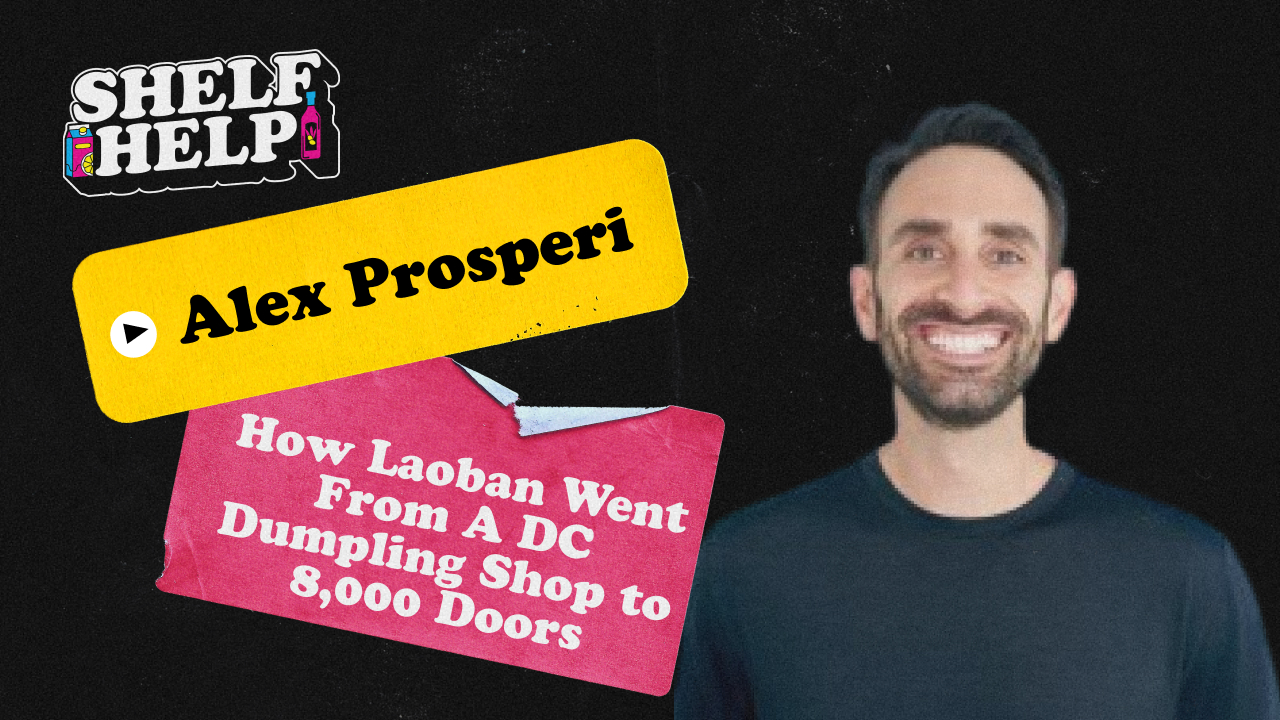
How Laoban Went From One DC Dumpling Shop to 8,000 Doors | Alex Prosperi, Laoban



Summary
Laoban went from one DC dumpling shop to about 8,000 doors and aims to become the Siete of frozen Asian food. VP of Marketing Alex Prosperi explains building retail media around each retailer's report card, when to trade ROAS for attributed units, why Costco is really eight retailers in one, and running marketing with a team of two.
Key Takeaways
- Laoban pivoted from a DC restaurant into frozen retail during COVID with Michelin-recognized chef Tim Ma.
- Incrementality beats tail SKUs in roadmap decisions, and Lucky Danger serves as Laoban's R&D lab.
- Retailer report cards differ: digital penetration matters at some, dollars per store per week at others.
- SKU picks change by retailer, and standing out behind a frosted freezer door takes deliberate packaging.
- Alex spent years at Unilever and led marketing innovation at GoodPop.
Show Notes
On this episode, we're joined by Alex Prosperi, VP of Marketing at Laoban - the frozen Asian food brand that started as a DC dumpling shop and now sits in around 8,000 doors.
Alex spent years in big CPG at Unilever, working on a series of brands, before leading marketing innovation at GoodPop.
Alex breaks down how Laoban went from a DC restaurant to a COVID-era pivot into frozen retail with Michelin-recognized chef Tim Ma, and why the goal is to become the Siete of frozen Asian food.
A big part of the conversation focuses on where marketing spend is going at the current stage of the company. Alex walks through building retail media plans around each retailer's report card (digital penetration at some, dollars per store per week at others), when to trade ROAS for attributed units, and why Costco is really eight retailers in one.
---------------
Episode Highlights:
🥟 From a dumpling shop in China to around 8,000 doors
🌮 Building the Siete of frozen Asian food
🧭 Roadmap decisions: incrementality over tail SKUs
🧪 Lucky Danger as Laoban's R&D lab
🧊 Why frozen is so hard to get right
📊 Retail media built around each retailer's report card
🚚 "Honk if you like buns" and moving up the funnel
📦 Standing out behind a frosted freezer door
🛒 Picking SKUs per retailer (and the scallion pancake problem)
🏬 Costco: one retailer, eight regions
🚀 The first 90 days of a launch
👥 Running marketing with a team of two
👀 The brand Alex is watching (Little Spoon)
---------------
Table of Contents:
00:00 – Intro
00:46 – Laoban's origin story
02:15 – Building the Siete of frozen Asian food
04:13 – How the product roadmap gets decided
06:05 – Lucky Danger as an R&D lab
08:22 – Why frozen brands fail
10:40 – Where the marketing dollars go
12:20 – What a well-rounded retail media plan looks like
14:05 – Differences across retail media networks
15:31 – Omnichannel and moving up the funnel
19:07 – Prepping for a line review
20:39 – Choosing SKUs for each retailer
22:33 – Winning at Costco
24:19 – The first 90 days of a launch
25:41 – Pros and cons of retail exclusives
27:03 – In-house vs. agency on a team of two
29:34 – Big CPG vs. startup marketing
32:20 – The brand Alex is watching
---------------
Links:
Laoban – https://laobanfoods.com/
Follow Alex on LinkedIn – https://www.linkedin.com/in/alexprosperi/
Follow me on LinkedIn – https://www.linkedin.com/in/adam-martin-steinberg/
For help with CPG production design - packaging and label design, product renders, POS assets, retail media assets, quick-turn sales and marketing assets and all the other work that bogs down creative teams - check out https://www.kitprint.co/
Looking to dominate the cognitive health space? Upgrade your formula with Cognizin. It’s the branded, clinically backed citicoline trusted by top innovators in supplements, foods, and beverages. Differentiate your brand today at Cognizin.com.
Episode Transcript
Adam Steinberg: 00:00
Welcome to Shelf Help. Today we're speaking with Alex Prosperi, who heads up marketing at Labon, the frozen, frozen Asian food brand that started as a dumpling shop in DC, now is in the freeze aisle across country. Alex is originally a Chicago guy, I'm pretty sure. Been on the brand size CPG since business school, cutting his teeth at Unilever, working on Magnum, Talente, Q Tips, then led marketing innovation at Goodpop before eventually coming over to Lab Bon. So really got a lot of experience in the brand space. So excited to chat. Alex, just can maybe just first off, just maybe for the listeners in the CPG world, there's probably not all that many that maybe aren't quite as familiar with Lab On love to just get a quick lay of the land just in terms of kind of the origin story and kind of the why behind the brand, what the core product lineup looks like today, and then we'll take it from there.
Alex Prosperi: 00:47
Absolutely. Thanks so much for having me. Yeah. Yeah. So Laoban was founded by uh Patrick Coyne. He was teaching English in China and uh often visited the local dumpling shop and just fell in love with dumplings. And uh they called the guy who ran the dumpling shop uh Lao Ban in Chinese, that's boss. So he came back to the States and just like couldn't find anything that tasted like what he was having in China. So just kind of like had it in the back of his mind, and then one day started on kind of scaling um kind of fast, casual dumpling shops. Um I think like in the early mid-2010s, that was a very big trend. The sweet greens, the kavas of the world were really scaling and ended up partnering up with Tim Ma, who's a uh five-time Michelin awarded chef uh based in DC. Um, he has a number of amazing restaurants. One in particular, Lucky Danger in DC. If you live in DC and haven't been there, definitely go. Um, so the two of them partnered up and just started uh making dumpling shops. And um that went on for a little bit of time and then COVID hit, and the two of them decided to pivot into retail and selling um, you know, frozen Asian food at grocery stores. Uh that was only five, six years ago. And uh we're now in around 8,000 doors. We've got pasta sticker dumplings, soup dumplings, baob buns, scallion pancakes, uh, crab rangoon, popcorn chicken, low-mane bowls. I think that's it. And a lot. We've got a lot of fun innovation coming in uh 2027.
Adam Steinberg: 02:16
On that front, when we spoke a few weeks back, you were talking about obviously the brand was starting as a dumpling brand, but you described really the goals being the modern frozen Asian food brand of the next generation, comparing it to how Siete really won you over as a shopper with Ciete chips, and you know, next day there's Cieté sauce. I buy their taco shells all the time now as an example. Yeah, tell me a bit more about how you guys have a similar vision.
Alex Prosperi: 02:40
Yeah, I think for us, you know, when Patrick and Tim started this company, I think part of the inspiration was, you know, going to the grocery aisle and just not seeing necessarily modern new product innovation with bold flavor sitting there. There were a lot of kind of legacy players who were there, a lot of brands I think we know, we've seen for decades. So there was an opportunity. There wasn't necessarily packaging that really stood out. There wasn't necessarily like a fun, cheeky, approachable brand that could hit with kind of like a new age consumer. Um, and so I think that that helped with kind of the inspiration for taking it to retail. And yeah, my example on Ciete, like that is really driven by like I go back to when my wife and I first started having the tortillas, and it's like, what is this better for you thing that tastes just as good as I have at a restaurant? And you start to build this brand affinity, and then they just kind of got us. And so over time, it's like you blink twice and uh you've got like the enchilada sauce, you've got the regular sauce, you got the taco seasoning, you got the beans, you have the chips, you have kettle chips, you have chip like cookies. So, like before you know it, half of your pantry is this brand. And so I think for us, if we can take up that mental availability for people where if they want Asian food, they're gonna think about us, whether it's do I go to the restaurant, do I do takeout, do I do DoorDash, do I scratch cook? Do I get something frozen? And even just like a layer up from that, if they're just hungry for something frozen, we want to be in that consideration set. So that's kind of where it comes from.
Adam Steinberg: 04:14
From a product roadmap strategy, how does the team, how do you guys decide what comes next, what earns like the next spot in the product roadmap?
Alex Prosperi: 04:21
Yeah, uh, it's a very collaborative effort. It's, you know, Patrick and Tim with their you know culinary uh, you know, brain power, it's it's marketing, you know, how does this fit with the consumer? It's finance, what's the feasibility of this? Um, it's operations, you know, can can we actually make this? It's sales, like will our buyer really want this? Um so it's kind of thinking through all of those, you know, different areas, but ultimately at the end of the day, it's, you know, does anybody want this? Like what consumer need are we meeting? I think like I've been in CPG long enough where I've seen some innovation and it hits like the PR headlines, you know, like some big consumer publication runs it, and you know, maybe it's there to just, you know, it's like when Oreo sells their LTOs, it's I don't know how many people are gonna buy it, but it's just so you come back and buy the base one over and over and over again. So maybe there's that role that some of those innovations um play. But ultimately, we want to make stuff that tastes delicious, that hits a consumer need. We also want to make sure it just overall fits within our portfolio of products. And part of that is like is incrementality. It's making sure we're not just launching, you know, the fourth or fifth or sixth flavor of one platform. Um, I've been part of brands where we have really long tails, and uh it can be okay to have your 15th to 30th skew not sell that much because maybe those SKUs do something unique to the consumer. But generally speaking, I think on first principles, if you can slowly but surely build out your portfolio to a way that you're not launching tail SKUs, yeah, generally prefer. So that's totally that's a lot of the thinking that goes into it.
Adam Steinberg: 06:06
What's also a bit different about Lauban is that you start as a restaurant. I'm not sure how much of the restaurant still plays into things today, but how does the restaurant still somewhat function as I don't might call it an RD lab or customer test kitchen?
Alex Prosperi: 06:21
Yeah, yeah. Uh we go to DC as a team three to four times a year. And every time we go to Tim's uh restaurant in Chinatown called Lucky Danger, and there's like a table in the back. Um, you know, there's usually around eight of us there, and we sit and his team's amazing, and they just keep bringing out all this food. And a lot of it is stuff that like similar products that we've launched, um, but some of it is like stuff we haven't even considered launching. So we'll be talking about what we like about each item. And so that's like the broader team. But you know, one of the big built-in advantages I think this brand has and why when we talk to consumers, you know, using third-party platforms or just doing demos, why people generally gravitate to us is the it's the flavor, it's the texture that really stand out. And I think that comes from the tens of thousands of data points you get by having a brick and mortar restaurant to start. I mean, it's uh it's certainly a competitive advantage that, you know, over years Patrick and Tim were talking to people face to face after handing them an item. Uh both from a here's here's what I um here's what I think about this, but also looking at just sales data of hey, we launched these four different pot sticker style dumplings. This meat didn't work as well. Or the veggie one actually did way better than we thought. So yeah, there's a lot of a lot of fun like little intricacies that come with working for a company where they started as you know, restaurant first and the net pivoted to to frozen.
Adam Steinberg: 07:55
You get to make money while getting customer feedback, which is great.
Alex Prosperi: 07:58
Totally. And to your point, there's so much value in the sampling, but then the reality is you have already launched the product. So if the feedback is not good, then what?
Adam Steinberg: 08:08
Yeah.
Alex Prosperi: 08:08
Then it's like, all right, we got to tinker with it, which is a whole other thing, or we got to cut the SKU, or it just you know, it fuels future innovation. But yes, in a perfect world, if you could do it before you make your MQs on packaging and stuff, like it's correct. Totally.
Adam Steinberg: 08:22
Great point. You've been in Frozen for I think quite a while. Definitely one of the more challenging categories. Also feels like it's one that's getting a lot of attention these days. What's the easiest way for a frozen brand to fail product-wise compared to other categories?
Alex Prosperi: 08:37
Yeah, there's a lot of like just things you don't really think about until you're in it that make it hard. Like one of the things I was thinking about was the other day, we were just sending product to people. And this is a real problem, like in the summertime. You know, I would I don't know what percent of it is, but like we'll send stuff to content creators and influencers or people who just write us really nice notes or comments or DMs, and you know, a decent amount of time stuff just melts.
Adam Steinberg: 09:05
Yeah.
Alex Prosperi: 09:05
And it's just like it's it's a it just adds a layer of complexity. It's a very small micro problem, but it just adds a layer of complexity to everything you do and cost, obviously. Totally. I think like one of the things that when I think back to my time at Unilever in ice cream, I don't know if you remember Halo Top, but yeah, it was like the at least in my world, it was like the first functionally driven product. Yeah. And it worked because there was like this cohort of, you know, fitness, nutrition people who focused people who just wanted ice cream without feeling the guilt of having ice cream. And I think it worked for a while because it was new and it was different, and there was nothing else like it. And they bought up so much shelf space. But like after a while, like it just has to taste good. And it is really hard to make things in Frozen taste good. I had a just reminding me, I had a buddy at Unilever who this was in 2018-19 before non-dairy ice cream became so everywhere and easily accessible. And he said to me, like, the brand or brands that figure out how to make this stuff taste good, they're just gonna win. Because at the time, like you have the keto phase and you had all these brands that were like keto driven and the packaging told this story, and then you eat it and you're like, I don't know, uh anyone eating this thing. So I think just losing sight of at the end of the day, like the number one thing the consumer cares about is that they're gonna spend their money and like what they eat. Um it's just hard to do in Frozen. Yep.
Adam Steinberg: 10:41
Totally. As a furlier stage, fast growing brand. I think you mentioned, I mean, it sounds like almost every marketing dollar, at least right now, is going to like lower mid-funnel conversion to just really drive velocity as much as possible. Web, what what does lower mid-funnel look like to you guys right now?
Alex Prosperi: 10:56
Yeah. Yeah, I would say the the bulk of our dollars are kind of lower mid-funnel, um, kind of, you know, conversion consideration tactics for sure. It's definitely shifted since when I like started in CPG six, seven, eight years ago. But uh, yeah, I mean, retail media networks are really like a tried and true playbook now. So we're looking at our top retailers, we're looking at what our company goals are for those retailers. And we're asking ourselves, how do we leverage these retail media networks to capture anybody searching, not just for our brand, but for our category. Um, and that's Asian, that's ethnic food, that's frozen food. How are we capturing them and bringing them down the funnel and ultimately converting them? And our tactics there just really vary based on what's important to the retailer and what matters to the consumer there. So our playbook for you know, Whole Foods and Target and Walmart and on Instacart with Costco, you know, it varies based on those factors. Um we we also have, you know, just a number of kind of like you're more blocking and tackling shopper marketing tactics with like, you know, your like fetch rewards, your Ibottas of the world, stuff like that that we we certainly lean into. But those are that that's generally probably the the biggest area of you know resource allocation that we have uh right now.
Adam Steinberg: 12:21
What does well-rounded retail media strategy look like? Are ones brands that are doing it, you know, exceptionally well from an ROI standpoint, like what are they doing especially well?
Alex Prosperi: 12:28
Yeah, I think the first thing, and and we've we've tested a lot of things this year, and I think ultimately reflecting on a lot of what we've done through three quarters of the year so far. I think we've done a really nice job of making sure that each strategy with each retailer caters to what that retailer cares about. You know, there are retailers who are everybody's pretty focused on digital penetration. What percent of your total sales originate with online? So it's delivery or click and collect, but some are more so than others, where you hear directly from the merchant, you know, this is a number I want you to hit on a month-over-month rolling basis. So for us, a well-rounded plan is something that that helps us get to that number and make sure we're meeting the consumer in a way that fits for that retailer. Other retailers, while they'll care about digital penetration, they're more focused on dollars per store per week. And that's that's your report card. And so for us, it's building a well-rounded retail media plan that helps drive that. So in that case, maybe your ROAS KPI is important, but you're willing to sacrifice your ROAS to some degree. There's a margin for error there, if it's going to uptick your attributed units moved, because that's ultimately like what you're graded on. So it's really thinking through kind of that holistic nature of like, what's the strategy, what's the goal, what are the KPIs to measure, and then figuring that all out and then working with your, we work with QBR, it's a wonderful retail media focused agency, working with them to unlock the right tactics that that ultimately like convert the shoppers we need to convert.
Adam Steinberg: 14:06
Are there big differences between the networks like Walmart Connect versus uh what's Atari's for like Rounddale versus any crowd resonator one? Like, are there big differences between across the individual retailer networks?
Alex Prosperi: 14:17
Yeah, there it's like yes and no. I would say at the end of the day, the game is pretty much the same. Like you are looking to find people, and it depends just where you're playing in the funnel. But if you're like as low as possible, you are just looking to convert anyone looking for a soup dumpling. Anyone who's searching for Asian food, like that is the game. How you get there might differ a little bit, but I would say like on the whole, they're all very similar. There are definitely differences in terms of there are some retailers, if you don't spend into a certain threshold, you have to operate it using Critio, the third-party platform that plugs into a lot of retail media networks. There's one retailer in particular where all of your sponsored search, your sponsored display, your sponsored video, and then display on separate pages. You can run all that yourself. And there's another retailer where once you're out of a sponsored product world, you have to work with them to execute those tactics, which that's all great. But yeah, it is, it is quite nuanced. Um, it's definitely not like a set it and forget it. Yeah. But at the end of the day, you know, the game is pretty similar. And then it just comes down to what each retailer cares the most about and making sure you're like meeting those KPIs.
Adam Steinberg: 15:32
You think about omnichannel and tracking those and actually converting people from online to coming in towards the case.
Alex Prosperi: 15:37
Yeah, yeah. We've definitely started, I would say this year doing moving up the funnel and doing more stuff you can't quite measure the impact of, but you know matters, right? Like more awareness-y stuff. So, like we did uh, I don't know if you've worked with Agile before. There, it's run by this guy, Tom, uh Tom Shea. Shout out to Tom. They lease all these trucks and you can put your brand on the truck. And so right now there's five big trucks rolling around Los Angeles with our branding on the sides. And on the back, we put bow buns and it says honk if you like buns. So very much on our brand, like cheekiness. So we're starting to do more stuff kind of like off the digital shelf to start to get the mental availability into people and starting to hit people a little more frequently. Um, but ultimately, like we think our, you know, our product stands for itself and we think the packaging is quite distinct to that shelf. So I think for us as we think about omnichannel, especially with retail media, we want to make sure like our PDPs have 95, 100% scores on the on um, you know, target.com and Walmart.com and Instacart, et cetera, so that when people see them and then they walk by the shelf, you know, part of the going back to your question earlier, Adam, around frozen, part of the problem is like there's a door between you and the product. Yep. Like that's that's hard. And especially if somebody just opened it, it's frosted over. So you can't even see it. So part of having green, pink pastelli packaging is it is quite distinctive in the frozen set. So for us, it's how can we utilize you know retail media for lower funnel conversion? But then for the people who aren't ready to buy, but who see us want to make sure that when they get the shelf, oh, what's that? That was the the pink green brand with those goofy guys on the on the front of pack. I'm gonna go try that. Yeah. So we're definitely trying to connect the dots more and you know, starting to think more about kind of like upper funnel awareness things that we can do to just get more product in people's hands and bring more people into the tent.
Adam Steinberg: 17:40
Totally. The topic of tools you guys do use, and you mentioned uh social nature, bizarre voice. You know, there's some data that's basically showing that Laoban is, I think you coined it as like over-indexed, and a lot of the areas that retailers really find attractive and and and care about. Like tell me more what are some of those areas that they're finding I don't know, getting the most value out and most excited about based on being over-indexed in.
Alex Prosperi: 18:01
Yeah, yeah. I think without going in too specifically the details, I think yeah, I think a couple areas that stand out are the ability to show the retailer that you have a shopper who is here for the future. We we, you know, we are fortunate that you know, people of all ages buy us, but having a shopper that SKUs like a little younger is certainly welcomed information. I think we uh it it matches, you know, how we talk to our audience on social um or in any of our creative. But I think that's one area that uh just like who the consumer is and what kind of like their their future, you know, spend profile looks like. Um, I think incrementality is like another area that generally retailers are happy to see. They want to know that you're not just bringing somebody who is uh gonna buy your product, you're bringing someone that might be interested in buying other products in their set. So there's definitely certain types of very granular data that we're able to show that speaks to the incrementality of our shopper at the shelf.
Adam Steinberg: 19:07
In terms of what buyers care about, uh, what is prepping for a big line review look like at Laubed and how does marketing feed that story as part of that?
Alex Prosperi: 19:17
Yeah. Yeah, it's like um, well, I've seen it multiple ways. I've seen it, you know, it's tomorrow. Let's just put it together. Um, you know, we just had one last week and we probably had an initial kickoff call like a month before. And it's that same group. It's operations, it's finance, it's sales, it's marketing. And it's very, very collaborative. And ultimately it's you only have 30 minutes, you only have 60 minutes. So you're really focused on what are the few pieces of data from like a performance perspective that really matters to the retailer. If there's anything that kind of needs to be right-sized in the moment, you know, you want to bring that up. But really, you're just trying to be as clear and concise, as focused as possible about what you believe you're doing well, how you believe you're helping the retailer, and making sure that they are as excited as possible about the new items that you're bringing because you're excited about bringing those items up. Totally. But yeah, it's it's a lot of work. Uh AI, as we were talking before the call, it certainly makes it easier with like deck presentations and organization and stuff like that. But you know, it's it's ultimately like a relationship business. So it's making sure that the story you're telling, you know, fits and uh, you know, you put your best foot forward. And uh, but yeah, no, it's it's a it's a good amount of work for sure.
Adam Steinberg: 20:40
I think you guys have got like 12 or so SKUs at Whole Foods, seven in Target. This is the last last I checked. Yeah. Uh a small handful at Walmart, a total like 8,000, 10,000 doors total or so. Like, how do you decide which SKUs to target for rich retailer and how many to go after? I imagine you just want to get, you know, the most you can in all of them, but like I guess like what's the yeah, five processor, how do you how you which SKUs you want to approach them with, or is it more driven by them? Okay, we want to try these first three SKUs first and then we'll kind of go from there.
Alex Prosperi: 21:05
No, you nailed it. It is, it is a total, uh, it's a two-way street. If you approach it as a one-way street, that's not it's not gonna work well for you. We definitely have our opinion on it's kind of like a perfect shelf. If you have three SKUs available, this is what we think you should take. If you have five SKUs, if you have five slots available, these are the five. If you have a full door, take them all. But it also just depends. Like it depends on what problem you're solving for for the retailer. Did the retailer have a similar brand to you that didn't perform well and you're looking to bring in a similar item? And they're like, no, no, no, no, no. Let's try something new. Some retailers lean harder into innovation and super unique items. So one of the things we, you know, prioritize with our innovation is trying to bring stuff to market that frankly like doesn't exist at like natural or mass retailers. So great example is like scallion pancakes. There's not a lot of mass. Retailers or natural retailers that you can just go buy frozen scallion pancakes. And frankly, it was one of the problems we had to solve at the beginning was like people didn't even know what these are or what to do with them. So when we launched those, we did like a funny marketing campaign called Does It Scallion Pancake, just showing all the ways you can make you can use scallion pancakes. So we're constantly pushing content out about that. But yeah, so it it is really like a two-way street driven by what we think is the right assortment and matching that with uh the retailer and buyer needs.
Adam Steinberg: 22:33
Costco's definitely kind of its own animal. What's what have you found is unique about winning at Costco versus Sammy's other retailers?
Alex Prosperi: 22:40
Yeah, Costco's unique because it's one retailer, but it's it's really eight retailers because there's eight regions. You know, so you're constantly pitching, like like right now, our pork bow um is available in the Northeast region and uh it's essentially been on shelf for sure all of 2026. Like every every day it is there. In other regions, it goes on usually like 12-week rotations, and then it stays on if it performs well, or even if it performs well, it doesn't stay on because the the buyer wants to try something else, but maybe they'll bring it back. So it's a total puzzle. Our in our internal chart of skew by month by region, it's very fun to look at. But yeah, so you've got the complexity of eight different regions. You also have the complexity of it's a closed loop. It's a it's a member, it's a member retailer. So there's not a whole lot in the marketing playbook that you can execute on.
Adam Steinberg: 23:37
Sure.
Alex Prosperi: 23:38
We have like a playbook at this point that we go to anytime we launch a new item in a new region, but like I said, there it's closed. So there's just not as much third-party like plug-ins you can do to drive velocities at Costco. So a lot of it comes down to making sure you have the right products in the right region at the right time. And then with the levers you do have available, making sure they're operating as highly efficient as possible because you just don't have a lot of time. That's the other thing. It's like those pallets move really fast, and after a couple of weeks, your dollars per store per warehouse, dollars per store per week aren't working like you can get cut. So yeah, it's different. It's a different beast.
Adam Steinberg: 24:20
What does the first 90 days or so look like from your side of the world, marketing side of the world for a new launch?
Alex Prosperi: 24:27
So there's a lot of work that goes into it in the months leading up to it, but we're really focused at launch, making as much noise as possible. So from an organic lens that's having a really robust organic playbook ready to go, tons of content banked, working with influencers. So we will work with influencers kind of on a one-on-one relationship. We have third-party platforms that we use to kind of scale, you know, the amount of content that we have out there. We will do some PR. We'll also work with, like you mentioned earlier, a social nature to try to get as much um ratings and reviews up there because that really helps with your search on retailer.com. And then retail media networks. We're making sure like our budgets are loaded, we have the right plan in place. Once those items start showing up organically on retailer.com, like we're bidding on there and we're making sure we're moving as much product as possible. Because to your point, Adam, like the first couple of months, the buyers are looking really closely at velocities and dollars per store per week. So you want to make sure you get off to a good start. And I think it's in any race, it's not how you start, it's how you finish. But in this case, it's also really how you start because you gotta have momentum.
Adam Steinberg: 25:34
If you start bad, you're not going to finish, right? Yeah.
Alex Prosperi: 25:39
Yeah, exactly. That's a good t-shirt. That's a good t-shirt. What do you feel like are like the pros and cons of a retail exclusive? Yeah, there's a lot of pros and cons. It's a great question because it sounds like on the surface, like exclusives are great, but a lot of times exclusives they can be intentional. It can be we're giving you this amazing, you know, thing on a stick, like here's your catch to take it. Also, it, you know, with shelf resets, like sometimes they just become exclusive because of timings. But there's a lot of really great things. We've done a couple, we we've, I think, grown into this innovation partner for a lot of retailers. And uh, it's a really nice place to be because you can kind of like collaborate with the buyer. And it's it's always great if you can get insight from the buyer because who knows the shopper of the retailer better than that person. Um there's always a great advantage with that. You also can really focus your marketing efforts on like one retailer at a time, one consumer at a time. You don't have to necessarily worry about where you're doing it here and here and here, which is also great. You know, the only, I would say, quote unquote, downside is if you do an exclusive at risk of like, you know, not hitting as many people as you can out of the gates and getting your product into as many hands as possible. But, you know, certainly for like an emerging brand, there's a lot of, you know, great relationship building that comes from it and partnership that comes from it.
Adam Steinberg: 27:04
Yeah, that makes a lot of sense. You're running a pretty lean marketing team of two. What do you keep in-house versus pushed agencies versus freelancers?
Alex Prosperi: 27:13
Yeah, um, yeah, you're right. It's it's me and my colleague Selena, um, who does an incredible job. She runs all of our organic social, our influencer, our content creation, our UGC, our customer support. And so she's hands on the keyboard for so much stuff. And honestly, like most of the outward-facing stuff that comes from the brand. So for us, it's really important that there's somebody in-house who lives and breathes the brand every day. I know marketing in particular, like it's very common to do fractional, whether that's like the main marketing person or like specific roles within a company. And for a lot of brands, it is the right thing to do at the right time. But I think as we were scaling, I think Patrick's vision of it is we needed somebody in the seat 24-7 to be focused on marketing. And then especially with all the consumer-facing social influencer stuff, like there's just it's so much work that we really needed somebody who was in a house. Uh, I think like a good example of where we're really comfortable outsourcing is retail media. So, like I mentioned, we use QBR run by Nico and we work with Brianna over there. And they're awesome. They're best in class, and they do so much work for us.
Adam Steinberg: 28:31
That's awesome.
Alex Prosperi: 28:32
And I'm confident in saying that they do more work collectively as an agency than we would do by having, you know, one person in the seat running retail media here. And you just get the added benefit of they're working with dozens of other companies. So they're constantly just giving us best practices of this is what we're seeing, or um, this retailer just unlocked this new capability on retailer.com that if I was managing it, like I just wouldn't, I wouldn't have the expertise personally, and I just wouldn't have the time to know those things. So yeah, things like that. You have an amazing designer who feels like she's in-house, but she's not. But she just does an incredible job for us. So I think design and creative, we still outsource, but at some point, maybe we get to a point where that has to be brought in-house just because we do so much stuff. But yeah, I would say like influencer being in-house for the most part, and then retail being external is probably like our two our like biggest decision points of how to manage, you know, the headcount and stuff.
Adam Steinberg: 29:34
I just want to remind back to your time on the big CPG side of things. Like, what was the biggest surprise after making that shift to earlier stage like Lab Ben?
Alex Prosperi: 29:44
For sure, you know, at Unilever, you're like managing brand budgets that are eight figures, 20, 30 million dollars, and there's just like so many people involved and everything, and everything's really matrici' and and complex. And you're you're like going through budgets, and sometimes like hundreds of thousands of dollars is like a rounding error. And it's like somewhat hyperbole, but it's also like not, and you just realize like there the scale of everything you do. Um, whereas, you know, from a budget perspective here, it's like I know where every dollar of my marketing budget is going. I'm reconciling forecasts versacules, you know, everything is accounted for. The other, I would say, like anecdote that speaks to it is at Unilever, like I was on the brand team and there was shopper marketing. And to me, shopper marketing was I had to deliver an eight and a half by 11 piece of creative to the shopper marketing team. That was it. They just magically made everything else happen. So when I got to shelf, there was a little placard on the Magnum ice cream pine. I had no idea at the time, I had no idea how it got there, or all the retail media online or the couponing programs. It was just like, oh yeah, that's a line item in the budget, and there's a group of people in that room that do that. Whereas here you are just hands on the keyboard on everything. So I think it's the the scale of things, but also I think one of the most fun parts about being here is like you just learn to do so much because you there's no one else to do it. And so I feel like you grow so much as an individual by just having to teach your brain things that you didn't you would you probably wouldn't have had to do if you were at big CPG. And that's no judgment, it's just like the reality of working at a place with eight or nine people versus a place um like a Unilever.
Adam Steinberg: 31:43
For someone else that's about to make this jump, how can they set themselves up for success? But I feel like you just kind of laid it all out. So I think that's that'll be super helpful for people that are listening there considering making that jump.
Alex Prosperi: 31:52
Yeah, it's really like to your point, it's uh it's it's like accepting that if you were somewhere bigger before so many things that you just assumed happened, you will have to make them happen.
Adam Steinberg: 32:03
Yep.
Alex Prosperi: 32:04
And if you're coming into it fresh, just coming eyes wide open, that everybody in the company is in the same page, and if something has to get done, somebody has to get it done, and no task is too small for any one person, regardless of your title or your pay or anything like that.
Adam Steinberg: 32:20
Yeah.
Adam Steinberg: 32:20
Well, yeah, this has been awesome. Last question for you, you know the space so well. Any particular brands that jump out that you've been tracking closely, or just trends in general across the CPG space that have especially been piqued your interest lately, or things you think you're about to poise a takeoff, or just things someone that's doing something super interesting?
Alex Prosperi: 32:37
This is actually great timing with this question because my wife and I went to Targa yesterday and we have a one-year-old, and I think we bought one of every little spoon product. Like every no joke, every aisle we went up and down. It was like, what? They make like like we bought a um, you know, it's like individual oatmeal cups that you can just buy, add water. So they have one. I don't know if you've seen these, they have one where it's it's pancake mix, and you add a quarter cup of pancakes, you put it in the mic, we did it this morning. He didn't like it, but you put it in the microwave for a minute and 10, and it creates this fluffy pancake. And you just scoop it up, you rip it up, and it was a chocolate chip banana, and I ate it and I thought it was great. I mean, I didn't know about this brand like a year and a half ago, so maybe. Yeah, totally. Before you had a kid, right?
Adam Steinberg: 33:25
Totally. Yeah.
Alex Prosperi: 33:25
Yeah. But uh, I know they were D to C before this year. They've been target everything. And they just they nailed it on the product, they nailed it on the packaging. The vibe of the marketing is just so like welcoming and not intimidating. Um, and then at the same time, there it's very healthy, it's better for you, no added sugars, non-GMO, all the stuff like you care about as a parent. Um, but I'm just amazed at it. Feels like every week there's like a new product category that they're into. So um definitely some recency bias for me, but that's definitely not a great example. Yeah, that's definitely like my the the brand we are like going to like real hard right now. Makes sense. That totally tracks.
Adam Steinberg: 34:07
Well yeah, Alex, but this has been awesome. What's uh what's the best place for people to follow along with you and all your expertise? And then where's the best place for people to follow along and everything going on with with Laoban these days?
Alex Prosperi: 34:17
Yeah, uh, I don't tweet much. So I would say uh uh just on LinkedIn, Alex Prosperi, and then uh Laoban Foods on uh LinkedIn, Instagram, TikTok, and uh YouTube. Those are kind of the main the main areas. Yeah.
Adam Steinberg: 34:32
Awesome, Alex. I appreciate the time. I think it's been awesome. I think that's the pod.