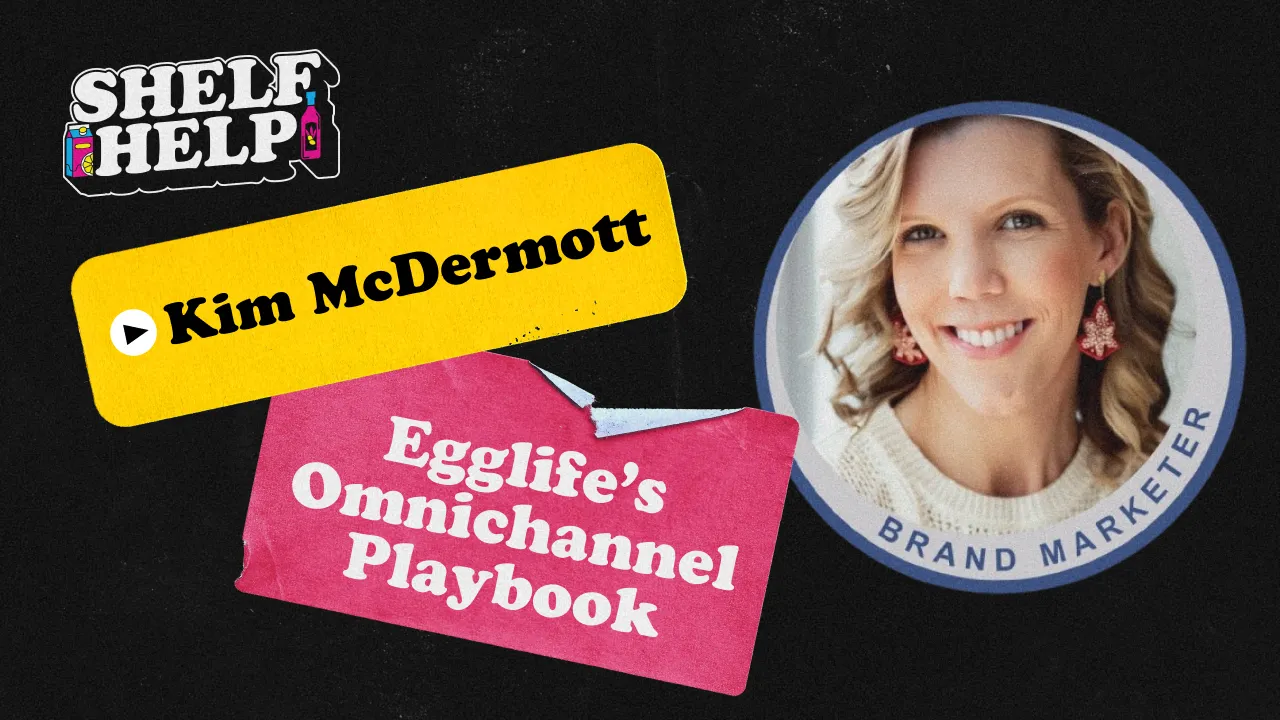



On this episode, we’re joined by Kim McDermott, Senior Brand Manager at Egglife Foods, the brand that’s redefining what low-carb, high-protein eating looks like by replacing flour with eggs. With amazing wraps, and the recently launched pasta line, Egglife is just getting started.
Before joining Egglife, Kim led key marketing and brand initiatives at global CPG giants like Kellogg and Molson Coors, bringing that enterprise muscle to a fast-moving insurgent brand. At Egglife, Kim leads all things e-commerce, digital retail, shopper and experiential marketing.
Kim unpacks Egglife’s 2025 rebrand, from what triggered it to how they rolled it out across shelf, screen, and shopper marketing. We also dive into the nitty-gritty of Retail Media Networks, digital rebate strategies, driving trial, and what to expect as a marketer at a fast-growing upstart brand vs a multinational CPG conglomerate.
*There's a typo in the captions right at the end. Egglife's correct URL is https://www.egglifefoods.com/*
—---------------
Episode Highlights:
🧠 Big CPG vs up-start brands
🛒 Retail Media Network strategy by banner
🔄 DTC vs. in-store marketing mix
💸 Using digital rebates to drive first-time trial
🎨 The 2025 rebrand - why they did it and how it landed
📦 Packaging changes that actually drive velocity
🎯 The right KPIs to judge a rebrand
📈 How she thinks about internal bandwidth vs. agency help
👀 Trends and brands Kim is watching closely
—---------------
Table of Contents:
00:42:28 – Intro and Egglife origin story
01:48:10 – Going from multinational CPG to a fast-growing upstart
05:36:12 – The Egglife rebrand
09:04:27 – The rebrand – key decision points
11:21:05 – How to decide if a packaging redesign makes sense
12:52:03 – Packaging redesigns – balancing the familiar with the new
14:18:14 – Unveiling the rebrand at ExpoWest
15:32:08 – The rebrand – KPIs
16:39:27 – Retail Media Networks
19:44:04 – Work with an expert to get Amazon listings set up
20:36:08 – No two Retail Media Networks are alike
21:57:04 – Retail Media Network recommendations
22:43:17 – Driving ecom sales vs in-store sales
23:46:23 – Digital rebates
26:24:10 – Resourcing – internal vs external
29:45:17 – Trends and brands Kim is tracking
—---------------
Links:
Egglife Foods – https://www.egglifefoods.com
Follow Kim on LinkedIn – https://www.linkedin.com/in/kmcd82/
Follow me on LinkedIn – https://www.linkedin.com/in/adam-martin-steinberg/
For help with CPG production design - packaging and label design, product renders, POS assets, retail media assets, quick-turn sales and marketing assets and all the other work that bogs down creative teams - check out KitPrint.
Episode Transcript
Speaker: 00:00
Welcome to Shelf Help. Today we're speaking with Kim McDermott, who is joining us from the Chicago area. Kim is the Ami Channel senior brand manager at EggLife, where she leads all things e-commerce, digital retail, shopper, and experiential marketing. Kim's got a long track record of spearheading key marketing and brand initiatives of pretty iconic brands like Kellogg, Molsoncoors, Gallo, et cetera. So definitely excited to dive into it. So yeah, Kim, maybe just first off for the listeners that the ones that aren't that familiar with Egg Life, maybe just give just a quick lay of the land, just in terms of origin story, high behind the brand, or products you guys offer, and maybe just throw out a few places where people can get their hands in them and then uh we'll start from there.
Speaker 1: 00:43
Yeah, absolutely. So um, thanks for having me, Adam. Really appreciate being here.
Speaker: 00:47
Yeah.
Speaker 1: 00:47
Egg Life has been around since 2019. So we're a pretty young brand. We are the superior alternative to a traditional flour-based tortilla. Our products are made with egg whites. So much like you can make at home, um, it's a very simple, clean product, our signature core wraps. They're available in six flavors nationwide at more than 15,000 retailers. So you can get them at Kroger, Aldi, Sprouts, Whole Foods, Target, Walmart, you name it, we're pretty much there. The company started simply because our founder, Peggy, couldn't really find the foods that she wanted to that were high in protein and low in carb out there in the marketplace. So she decided to make it herself at home and perfected it over a short amount of time and was able to get it to market. And so our wraps have really kind of transformed what people can do with traditional flour-based products and basically gives an opportunity for consumers to enjoy the foods that they love, but might not have been able to eat in the past. And so anything that you can make with bread or a tortilla or a wrap, you can make with egg life.
Speaker: 01:46
I love them. It's a that's a really smart product. And before jumping on board with Egg Life, you spent a lot of your career at some of the biggest brands in the world, like Coors and Kellogg. Egg Life is definitely a newer brand, you know, fast-growing brand, much smaller than where you're used to. I'm just curious, what was that? And what was what's been maybe the the biggest surprise after making that shift?
Speaker 1: 02:05
Yeah, I feel like such a, I feel this is so typical for me to say, but COVID kind of changed everything.
Speaker: 02:10
True.
Speaker 1: 02:11
So I had been in the alcohol industry for about 15 years, working in a variety of different marketing facets, and got really into e-com right before COVID hit, um, when Instacart started to take off, online shopping, and got an opportunity to go to Kellogg's, which obviously huge legacy brands, great portfolio, and working commercial strategy on the e-comm side. So really start to understand internally how to sell into a larger organization the value of e-com and dot com and the value of online sales in a time when things were kind of going nuts with COVID and everybody was stuck at home. So I'm I went there for a couple of years and then I had kids. So again, yet another reason to have a catalyst in your career. Started to realize that I was starting to care more about what I was feeding my family. And a lot of big brands that I had admired in the past, or some that I'd worked for, started to realize that there's a lot of additives and preservatives and dyes and everything else in products. Um, not to belittle that. There's a time and a place for those types of products. But what I started to notice was in the health and wellness space and the natural food products was that you could get what you wanted without having to sacrifice on taste. And egg life played a big part of that when I uh started to research the brand and the company and figure out where they came from and how they started and what their core values and principles were. And it really is a clean product, very few ingredients and very transparent. I think that's the one thing that I found is really important in my with my transition is working for a company where transparency is apparent not only internally, but externally consumer-facing as well. Um and so, yes, went to uh from big, big CPGs down to a very small startup, and it's been here almost three years, and it's been a great learning experience.
Speaker: 03:54
That's great. For marketers that were in a a similar, a similar boat working for some of the biggest, let's just say I don't know, multinational CPG conglomerates. They're thinking about making a or considering making a move to more, you know, upstart brand, fast-growing, much smaller brand. It's like, I don't know, one or two, three things that jump out in terms of what should they expect that's gonna be maybe the biggest change.
Speaker 1: 04:17
There is no structure. Um, and you need to be very comfortable with ambiguity and constant change. I love learning new things. And so I found in you know larger organizations, CPG and otherwise, there's a lot of red tape, there's a lot of upward stagnation when you're trying to develop new processes, bring new new ideas to the fold. The great thing about a startup is that you have autonomy. You are an owner and a stakeholder in the brand success. And ultimately, if you have the right team around you, they'll let you do what you want to do to make the role your own and to help drive the success of the business materially. It can be scary and again, lack of structure, not necessarily the most stable in terms of like my K is getting that constant refill. But uh in the long in the long run, I think the value that I've learned in taking on so many different roles in this company, I'm not pigeonholed into one position. And I also really have a stake in whether this company succeeds, which is something that kind of puts you closer to entrepreneurship yourself, right? I think everybody, or most people that I know in the CPG world will have ideas of their own on how to bring new products, new brands, new services to life. And this is kind of a stepping stone of getting there.
Speaker: 05:34
Yeah, totally. And that's really helpful for people. You and the team rolled out a pretty big re-brand earlier this year. Looks great, by the way. What what was the why behind the rebrand or meaning, like, you know, what led to that decision to go through a massive re-rand in the first place and any like specific shopping behavior or data points you were seeing? Yeah, I'm just kind of curious what the what the why was initially.
Speaker 1: 05:53
Yeah, I'm definitely not going to be the subject matter expert on this, but I can speak to it because I have been through with the brand the last few years. So, one of the big things about Egg Life is we still lack awareness despite being ubiquitous in the in the marketplace and having a lot of loyal brand followers. When you say egg life to just, you know, the average shopper at like a Walmart or Target, a lot of times they don't know who we are. So a lot of what we need to focus on is um brand and product awareness continually, as well as findability in store. We've had um some legacy hurdles where we were able to get into retail accounts early and grow and do really great things with them, but there's never a singular point of distribution. You know, if you need to buy butter, you know where to find butter. If you need to buy an egg white wrap, it can be in the shredded cheese, it can be in the eggs, it can be in the refrigerated bakery, it can be in the health market section, it can be next to cookie dough, refrigerated cookie dough. So findability was a big thing and then driving awareness on our brand. We found that the packaging itself, while it was the rainbow effect, right, where we could get in multiple SKUs was really eye-popping on shelf and the macros were clear on package, people still didn't know how to use us. And so a couple of things that we really wanted to hone in on were making sure we're playing up that color pop and that rainbow effect to the maximum, but also that we were providing occasion usage and day parting kind of inspiration for folks, whether it be from breakfast to, you know, your lunch reps to dessert suites. I think our rebranding has allowed us to really play that up while still showcasing like what we are and having the little people and being able to see like what is this product. It's just really popped. And I give a testament to our CMO for kind of sticking it out through the process. It was a very long process to get to where we are. But seeing four times purchase intent in the consumer response data helps us realize that we're going the right direction.
Speaker: 07:48
You touched on that in the process, how long of a process, and was like, once that decision was made, yes, we were going to move forward with a rebrand, everyone's aligned in this. What did that process look like from beginning? Then you don't have to go in every little detail, but what were some of like the key steps that were involved?
Speaker 1: 08:04
So consumer research, first and foremost, right? We had to do, we do eye tracking studies, we had to do some consumer calls to understand like what is it that that isn't coming through on package? What can aid in findability when we know that we're not in the same place that we start? So really standing out on shelf, having an ownable color. We we we've seen other brands in our space lean into vibrant hues and kind of own that color. And so we needed to find something unique for egg life. Kind of blurple bar branding that you see that's the constant across all of our product lines is how we're kind of leaning into that. And then, yeah, it was it was a multi-agency long drawn-out process where, again, small company, everybody has an opinion, everybody's a marketer. And so just trying to dial in the what do we need to convey? How do we do it in the simplest way possible, in the cleanest way possible that speaks to our brand mission and values and can step step out on shelf.
Speaker: 08:59
Yeah. You talk about every every everyone's a market. It feels like in these types of initiatives where everyone wants to have a say, were there any decision points that you're looking back were like the most contentious internally or required the most debate?
Speaker 1: 09:12
I think I think our CMO did a great job of gatekeeping. That's great. And letting folks see it when they needed to see it and not before then, because uh again, very small team, and we all want to we all are trying to go in the same direction and to to help improve the brand. Um, so yeah, she did a great job with that. And I think we got to a really great place finally. Yeah.
Speaker: 09:34
Yeah. For I mean, decision by committee and these types of things often doesn't end up in the best, the best place. So siloing things and only showing when it's ready, I think makes a lot of sense.
Speaker 1: 09:44
Yeah. And and another thing is we got a lot of positive response from the retailers when we showed it to our buyers. So that kind of helped reinforce that we were going in the right direction. Yeah. Um, and then when you start to see it expand but beyond our core product line, it really starts to bring the brand to life.
Speaker: 09:59
Yeah, totally. I know as like part of the re-brand, you you introduced a resealable pouch, which I thought was really smart. What led the team to finally pull the trigger in this? Because I imagine that it was talked about for a while.
Speaker 1: 10:12
Yeah, this has literally been part of the Egg Life brand from day one. Um, we actually, when we first launched, and this predates me, had resealability on our packaging in a different format. Um, but unfortunately, through having it on shelf, there's just a lot that goes into the science behind the gases that are kept in the bag to maintain freshness. Right. Um, it is a refrigerated perishable product. And so we wanted to make sure we got it right so that we didn't have any quality issues when we got to shelf. And it's just taken that long, unfortunately. But it also gave us an opportunity to launch that at the same time as the redesign and the and the rebrand refresh. So it was just yet another positive attribute to our brand relaunch um that we could kind of tout at the same time.
Speaker: 10:59
Yeah, that totally makes sense. For let's just say, like I was a marketer brand leader, a fast-growing CPG brand, similar stage to egg life. I was having a conversation with you, and I told you, hey, you know, we're we're considering a packaging refresh. What questions like might you ask that would just help me confirm, just even if this is the right strategy in general?
Speaker 1: 11:21
I think the biggest thing is what is the objective of the brand refresh? Like, what are you hoping to get out of this? And what is the biggest pain point of your current packaging to figure out whether it's worth it? Um, if it's that you really need to increase sales velocity without your current brand, that the packaging refresh might not be the answer.
Speaker: 11:37
Yeah.
Speaker 1: 11:38
And for us, again, it came down to communication on shelf, given our challenges with findability and lack of consumer education. We really tried to hone in on the things that we knew weren't working currently. So, yeah, that's that's the biggest thing. I mean, I I've worked at bigger companies that have done refreshes every season with like the new football teams or the Christmas packaging, which have very different objectives, most of which are geared more toward satisfying retailer needs um or off-shelf displays. But this was really about us kind of taking the next step, knowing that we were going to be launching new product lines as well. And we needed to change up the communication hierarchy on package so that it worked for the consumer.
Speaker: 12:18
Yeah. I feel like you guys did a really good job of with this. I think also was like the challenge like how do you balance the need for a fresh look? Obviously, you're doing a re-brand for a reason, but you also want to keep like some level of familiarity for those existing, you know, customers that have been buying the brand for a while, want to make sure in the walking down the aisle, they immediately know still what they're looking at and you know where to find it, and not feel like, you know, it's a totally new brand or product. How did that come up in the conversations at all in terms of balancing? Yeah, that need for a fresh look while keeping some of those familiar legacy brand elements.
Speaker 1: 12:52
Yeah, I think it was easier for us because we haven't been around as long, right? And so we own the name. I think actually the bigger hurdle comes when you are a legacy brand and you don't want to mess with things and you don't want to make the wrong move and have to revert. And I know that there's been a lot of recent brands in the headlines about that, particularly in the beverage space. So I think that we had it a little bit easier because we still have a lot of room to grow for brand awareness. And now we can kind of take this, and this is not perfect either. I will say we've already identified some challenges and some need to make some optimizations, just given all the different ways that our product shows up on shelf. Sometimes it's on a peg hole, sometimes it lays flat, sometimes it's in a shelf-ready display case, sometimes it's not. And so, how do we best utilize our number one marketing billboard opportunity to quickly and easily help consumers find us and explain what we are?
Speaker: 13:44
Totally. Yeah, that makes a lot of sense. Part of the big unveil, at least at Expo West this year. Um booth looked great. I was there, it was super busy. Yeah, it seems like Expo West, there's in one instance like a great event for these kind of things because a lot of the most important stakeholders you're trying to get in front of, at least from the BDB standpoint and CPG, are there so you can really get the message out. Maybe on the flip side, because you know, it's like the Super Bowl of CPG. Every, you know, brand is there. It seemed like in the flip side, it could be harder to like really rise above the noise to a certain extent. What did you find was key to launching a successful kind of rebrand at Expo S.
Speaker 1: 14:23
Yeah, I gotta give um props to my coworker, uh Steph Hunter, on this because she kind of really owned this space, but it was about being very bold in every facet. So we um are in the emerging brands area, the new hot new products section, and we had been there the past couple of years in a similar space. So it was about us kind of showing up in a really big way. So we leaned in entirely into that blurple color across all of our brand and across all of the touch points. So not just the booth itself, but we did a great um, you know, the apparel that the team was wearing. We did a merch line to try and drive some interest. And um, we pulled that through socials so that we were announcing drops at our booth to drive traffic to the booth. And we made sure that everything complemented our new product lines. So we showed the product in coolers and provided some information about where it would go and where the new product lines should sit on shelf because we have very distinct categories that we're now playing in, but also making sure that we stayed true to our brand purpose and vision as well as our core products, our wraps, because that that big bold color effect, it just looked so great when we got it live.
Speaker: 15:29
Yeah, it looked looked really good. So it's been a few months. What were what were, and I guess have been the some of those key metrics that you guys have been focused on to gauge the success and impact of the rebrand.
Speaker 1: 15:42
Yeah. So and on the onset, I think I mentioned the purchase intent and something that we wanted to make sure was clear. And so that was kind of a key deciding factor with what we went with. It's really early. And I know that our sales team would love to see kind of, you know, an attribution now. But part of the things that we need to focus on are is it really helping our household penetration rate? Is it helping with trial and repeat? We'll continue to do eye tracking studies to understand is it conveying the messaging it needs to convey and getting that attention on shelf. Um, and then again, more retailer reactions because what works for grocery might not work for club, what might not work for alt channel as we start to expand. So we need to make sure that we're continuing to make optimizations and not just rest on our laurels.
Speaker: 16:23
Shifting gears a bit, one of the things you you oversee is everything related to retail media network stuff. Um what I know this is kind of a broad question, so I'll let you take however you want, but like what does a well-rounded strategy look like for a brand that's investing budget here? And what should they keep top of mind?
Speaker 1: 16:40
No two platforms are alike. And every platform has different capabilities. Your KPIs should be closely tied to your store sales objectives. So if you have a high digital penetration rate at a given retailer, more of your resources should be dedicated to your retail media network versus more of your those legacy retailers that really haven't developed the capabilities on their platforms. Seems pretty obvious, but when you get, you know, buyers in the mix and they're trying to tell you to invest, and everybody has a retail media network, it's about being smart for where you're investing. There's definitely, we don't look at ROAS very often, we flip it to more ACOS. And I know that that's a standardized term in the industry as well, to set a benchmark and threshold of which we're not going to spend above as a percentage of our total sales, because you can get a 12 ROAS off of anything, but if you keep investing and it's there's going to be a point of diminishing return. So flip it us on its head, take into account your total store sales, not just your attributed sales, not just your online sales, take into account all of your sales, particularly if you're getting up into those high 30% ranges of digital penetration. And then make sure that everything is, I hate to say it, it is so cliche, but omnichannel. So if you're going to be investing in on-site search and you've got an offer running, like a promotional offer running in store, make sure that that is pacing against what you know would likely be increased traffic around promotional periods. Make sure that you have the ability to plus up that activation by pulling it off-site or doing something around your social and paid meta around that. Um, it's just about being very closely tied to your total sales KPIs and then putting forth the KPIs on the platforms to assist with that.
Speaker: 18:26
Yeah. Yeah, that's super helpful. Does I'm not an expert here on Amazon, but it seems like on like the Amazon, which we'll talk about in a second, but it seems like what's happening at Amazon, it almost seems like it's kind of a requirement to participate in their ad network for the the retailers that do have a more established and sophisticated retail media network. Does it feel like investing in those essentially is starting to feel like, you know, a requirement and kind of a must do to to win at retail?
Speaker 1: 18:52
Yeah, I think it depends on the size of your brand. Um, so we don't have any JBPs per se as a as an emerging brand, but we're getting to the point, right? And yes, it has very much become the equivalent of a slotting fee in some regards.
Speaker: 19:05
Right.
Speaker 1: 19:06
But I would say it's more prominent on some retailers than others. Amazon is obviously its own beast because it is a 3P and you kind of make it what you want it to be. We used to have products sold on core through our 3PL, and that was a very different strategy than we have now, where we've sunsetted that and only operate on fresh and whole foods. So we leverage Amazon advertising through just the fresh and whole foods platforms.
Speaker: 19:32
Yeah.
Speaker 1: 19:32
And kind of push through that. So we're in we're in a bit of a unique space as a refrigerated product. Um I would say for Amazon in particular, I think you mentioned this before when we were talking that if you're not on Amazon yet and you're getting ready to set it up, finding somebody who knows exactly what to do because it's very hard to change things on SKUs or ASINs once they are established. Um, the biggest thing that we found is, you know, go back to your objectives of what is Amazon doing for you? Is it as a is it a core need channel? Is it competing against your D2C? We no longer have D2C, so that's not an issue for us. Is it acting as a growth channel, driving incrementality, or is it really just a survival place for you to continue to drive brand awareness for people who are just looking to understand more about egg life? Is it a is it an education outlet? That can help inform the level of investment you make and how you set up your products on the platform. Whether you variate or whether you don't variate is really important when you are first setting something up.
Speaker: 20:32
That's super clear. You you talked about there's um no retail media network is alike. What would you say are like an example of some of the biggest differences between a few of them?
Speaker 1: 20:44
I've been really surprised at, and I won't call them not individually, but I've been really surprised at the level of transparency between among certain retail media networks. Um one very large one is I have a dedicated uh account executive who works very closely with us to provide as much reporting as possible, knowing that we are an emerging brand and don't necessarily qualify for the level of detailed reporting that they give to legacy brands. And conversely, I've got another retail media network that is an established grocery retailer that has all the data. We know they have the data, doesn't share the data. And unfortunately, it just inhibits everybody all around, right? If we can't figure out what's driving uh our brand at your retailer, we can't help fix it. We can't help, you know, improve the growth trajectory. And we can't continue to invest more dollars in an unproven platform. So there's again, no two are alike, and it all goes back to what your retailer objectives in total are.
Speaker: 21:48
To sum this up in terms of these retail media networks for brands that are uh just starting to dabble and starting to spend dollars here. I don't know, one or two three top things they should keep top of mind, let's say.
Speaker 1: 21:59
Auto campaigns. Will only take you so far. It's very important. Although it seems easy and that AI and models should be able to generate what works for your brand, you need to continue to test, not just with keywords and bid strategies, but test a tactic layered on top of another to figure out what is driving it. Is it upper funnel? Is it lower funnel? We don't always give visibility into what our competition is doing. What are ways you can work around conquesting against your competition if you can't directly target them? Work within your category. So if you're one of a handful of brands that are advertising in your category, what can you do to make yourself stand above the rest? And it doesn't have to be a lot of money. It's just about being smart with your investments.
Speaker: 22:42
Those are all really great. How do you generally like think about balancing efforts to drive econ sales versus driving them to buy in store?
Speaker 1: 22:54
Yeah, that so that it's funny because it's all kind of starting to blur, right? Like, especially when you're talking about it, yeah. Like, well, you need to invest here in order for us to give you this display activity.
unknown: 23:03
Right.
Speaker 1: 23:04
So yeah, I don't, I don't necessarily know that there's there's like a clear set of tactics. I I think of one retailer in particular where we really struggle on repeat. And so, which we don't, we're not struggling in other retailers. So it's like, what is what is the underlying factor here? Why are we seeing higher spoils? Why is this not working? And it's not a particularly high digitally penetrated retailer. So we have to lean more into our resources of in-store. And it goes back to honestly old school tactics. Like we are just working off of a trade promotion calendar. We are doing whatever we can to drive visibility on shelf. And we're doing things to try and educate consumers when they're at the point of purchase.
Speaker: 23:47
How does digital rebate work exactly? And how do you drive customers to follow that multi-step process to actually go through the whole workflow?
Speaker 1: 23:54
Yeah, there's there's a variety of different tactics out there. There's tons of companies. Um, we've probably tested all of them in AngLife, to be honest, uh to figure out what sticks. And again, these all go back to individual retailers as well. So a digital rebate is not going to work as well at one retailer over another. And you just kind of have to come to terms with that. Um, like it goes back to the level of digital savviness of their consumers. And so we, you know, we everybody knows Ibotta, we use ibotta, we use IELT for a lot of different tactics. The digital rebates, there's a couple of different ways you can do it. You can incent folks to go and purchase based off of an offer that they see either on a loyalty app or that they get served through an ad. And then essentially they go buy it in good faith, and they come home and they take a picture of their receipt and they upload it and then usually get money deposited either onto their app account or through a rebate like a PayPal or a Venmo. We try when we're doing things like this to limit the number of times that we incent because a lot of these digital rebates have become super ubiquitous throughout, particularly the emerging brand landscape where we can't compete. Retailers are also kind of phasing out traditional coupons as is due to fraud and just costs and waste. So these digital rebate platforms are everywhere, but it's becoming pretty clear that there's a certain cohort of users, consumers that will use them, and there's just a cohort of users that will not.
Speaker: 25:22
Yeah.
Speaker 1: 25:22
So your older consumers are just likely not going to be as prone to it. And even like the youngest consumers don't want to make the effort. It's a lot of, it's a lot to go through to save a dollar on a package of perhaps. Um, and so kind of you have to weigh the value of the offer, the frequency of it. Do you offer someone a lower offer but give them the opportunity to redeem it multiple times or in multiple trips? Um, it all goes back to that strategy. And the less friction that you can put along the path to purchase, the better. However, I will say that there's still if you're requiring somebody to go and show something in store, like if you're showing a digital barcode on your phone, there is still that hurdle of technology, both on the consumer side and on the retailer or the cashier side. So all of this is still kind of evolving. And again, I know there's a lot of companies out there that are offering this. It's just about being smart when you use it and really being targeted as to who's getting it. You just putting a blanket offer out there and letting it be available to everyone isn't going to drive the results that I think most people intend for it.
Speaker: 26:22
This is really helpful. Really helpful when you guys are thinking about resourcing like what frameworks do you guys use, or how do you think about like variables or factors coming to place you're thinking about building out your plan with regards like internal versus external resources? Do you find there are always certain functions like influencer management or creative agencies packaging design that you always tend to bring in-house versus ones you always contract out, or is it pretty situational that that you found? And maybe it's different at an organized organization the size of egg life versus a cores and a gallow, right?
Speaker 1: 26:54
Yeah, yeah. It's definitely so again, we are small and scrappy. And so if someone isn't playing six roles on this team, they're probably not going to be hired for one specific need. So we've done a variety of different models when it comes to like media management. Um, when I started, we were a hub and smoke model where we kind of had, you know, PR on one end and influence on the other and above the line media, and everybody kind of played their own role in the creative. We've since then we went to a consolidated strategy where we had an all-in-one house. And neither of those worked perfectly. And so we're back to more of like a hybrid now, I would say, where we try and find resources that complement the existing agency that we have, either that through relationships that they have with other clients or more of a one-off basis because we're not we have an evergreen strategy and we pulse during certain promotional periods like back to school and New Year's being our big samples. But we don't really have an always-on need for that much of a resource effort internally. Um and we found some really great, you know, this new model of working remotely and having kind of people able to build their own lifestyles around their work gives us the opportunity to find some really great talent that we can just do project-based work with uh from a creative side or um even from like the experiential tour. You know, this won't be something that we would do experiential and keep on staff all year long. It's just not a big, we're not a big enough brand. Like what is your guys' like due diligence process and how do you guys, yeah, how does like some sort of external partner w win your business, let's say I think what I've seen in the last three years is that we are in a interesting, I like an interesting hybrid state where we are not at a point where we can hire an agency or a resource that's going to grow along with us, that we that kind of grows up with us. We're also not a small fish in a very big pond when it comes to big traditional agencies. And so we're in this like hybrid state where we need somebody who has some pedigree of expertise, but isn't the biggest agency out there. And I think we found that we move so fast at a small company that we need folks who are genuinely dedicated individually to our brand, that again are just as committed to seeing the brand succeed as we are, because they're ultimately another brand steward, another brand ambassador for us. And if they don't believe in the strategy that we have, if they don't believe in our execution or our creative or our new campaign, then it's gonna fall flat. And so all of our agency partners, I would say, are true partners. We have a great media agency that we work with. And I think has kind of stepped in at the right time for us as we start to grow and expand on our product lines.
Speaker: 29:46
Last question for you, Kim. Any specific brands or just general trends across the CBG space that make kind of piquing your interest or ones you've been tracking?
Speaker 1: 29:55
Yeah. So anything that I can feed my kids, which sounds so sad. Fair enough. That I really I just there's some brands that I'm just so inspired by. Like Ithaca, I think is doing great things. So's the pasta sauce brand, how they're kind of targeting Gen Z in a unique space in a very, very traditional category. Johnny Pops and Soli kind of taking on the kids' snacks and the kids' desserts in the right way, proving that you don't have to have all these fake ingredients and terrible things that we all ate as 80s nice kids growing up, and hopefully they haven't affected us long term. But yeah, and there's there's just some brands that are doing really great with certain retailers that I think is really cool too. Some brands that have really popped at Target. Veggies Made Great is one of those ones where they've just kind of owned the frozen category and with a with a good message and kind of that exclusivity at those retailers that's I think really helping to drive traffic there.
Speaker: 30:56
I think that doesn't make a lot of sense. Kim, this has been awesome. Really appreciate the time. You've shared a lot of really useful insights. I think uh people listen to this or get get some good stuff they can take away from it. Yeah, what's the best place for people to follow along with you and also with Egg Life as well?
Speaker 1: 31:09
Yeah, so our uh we're on Instagram, we're on TikTok, we're on Facebook, uh, we're on Reddit, we're on Pinterest, and you know, please follow along at aidlifefoods.com. We have a big announcement today. So hopefully when this airs, um, it'll be out there. But we are launching our pasta today.
Speaker: 31:25
So very exciting.
Speaker 1: 31:27
20 plus grams of protein, less than I think five grams of carbs. Really great way to get your pasta fixed without all of the guilt.
Speaker: 31:34
So yeah, I'm excited to try it. Very excited. Awesome, Kim, appreciate it. This has been great, appreciate the time.
Speaker 1: 31:40
Thank you, Adam.
.svg)