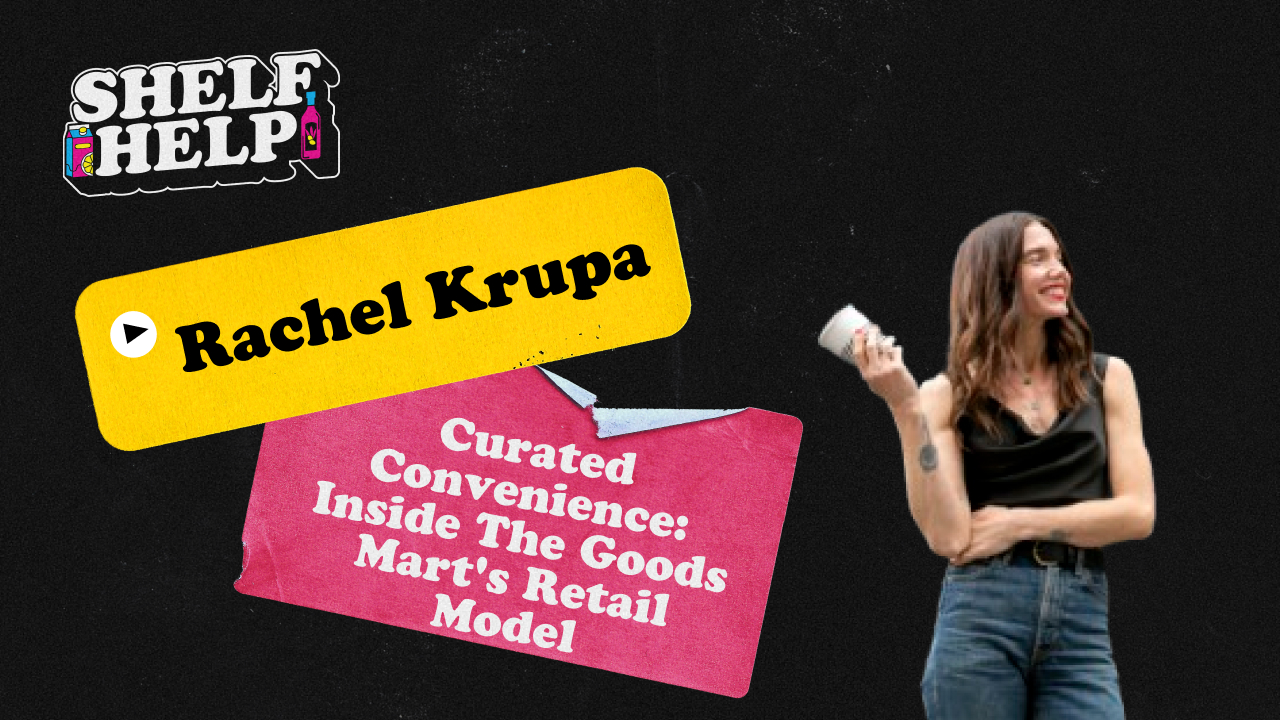
Curated Convenience: Inside The Goods Mart's Retail Model | Rachel Krupa, The Goods Mart



On this episode, we're joined by Rachel Krupa, Founder of The Goods Mart, the better-for-you convenience store that's reimagining what a 7-Eleven can be. Rachel is also the founder of Krupa Consulting, the CPG and wellness PR agency she's run since 2010, working with brands like Thrive Market, Our Place, and Goop Kitchen.
We dig into how Rachel went from running her PR agency to opening a convenience store after founders kept telling her they had no strategy for the convenience channel and The Goods Mart's core bet: a tightly curated shelf of better-for-you brands, no GMOs, no artificial colors or flavors, and accessible pricing so the store never feels precious.
Rachel walks through what she actually looks for in a brand, the packaging iterations every product goes through before it scales, and why a small-format store surfaces feedback that velocity numbers alone can't.
We also get into the curation business that now drives much of The Goods Mart, placing emerging brands in hotel minibars and corporate pantries for clients like the Fifth Avenue Hotel, the Waldorf Astoria Beverly Hills, and OpenAI New York. Rachel shares her honest take on fundraising, her grocery consulting work, and the brands she can't stop watching.
---------------
Episode Highlights:
🏪 From PR agency to convenience store
🥫 The better-for-you gap in convenience retail
🎨 Brand pillars and the case for curation
🛠️ Building the first store with no playbook
☕ Accessible pricing and $2 coffee
🚫 Why The Goods Mart charges no slotting fees
💸 Getting creative with revenue instead
📦 The packaging iterations every brand faces
📊 Small-format stores and real-time customer data
🏨 Curating hotel minibars and corporate pantries
🏬 Consulting on grocery concepts like Flow Grocer
👀 The flat drinks and gummies she's watching
---------------
Table of Contents:
00:00 – Intro
00:51 – Origin story: from PR to convenience store
02:55 – Brand pillars and the case for curation
04:49 – Building the first Silver Lake store
06:38 – Accessible pricing and everyday value
07:48 – Being first to carry emerging brands
08:37 – Why The Goods Mart charges no slotting fees
10:58 – The financial model without slotting fees
12:14 – The curation vertical and COVID pivot
13:50 – Small-format stores and real-time data
16:15 – What brands need buttoned up before pitching
18:56 – Why it's not a shoppy shop
20:19 – Everyday low price over promotions
22:08 – The new Williamsburg flagship
24:15 – Operating in LA vs New York
25:34 – Hotel minibars and corporate pantries
29:17 – Fundraising and consulting for grocers
31:08 – Brands and trends she's watching
---------------
Links:
The Goods Mart – https://www.thegoodsmart.com/
Krupa Consulting – https://www.krupaconsulting.com/
Follow Rachel on LinkedIn – https://www.linkedin.com/in/rachelkrupa/
Follow me on LinkedIn – https://www.linkedin.com/in/adam-martin-steinberg/
For help with CPG production design - packaging and label design, product renders, POS assets, retail media assets, quick-turn sales and marketing assets and all the other work that bogs down creative teams - check out KitPrint.
Shout out to my friends over at Glimpse, the go-to partner for automating retail-related back-office operations and unlocking margin trapped in invalid fees and manual processes.
Are you in the market for a new flexible packaging partner? Check out HD Packaging. Third-generation, family-owned and built for the needs of category leaders like Newman’s Own and A Dozen Cousins. Faster launches, lower costs, and no artwork fees.
Episode Transcript
Speaker: 00:00
Welcome to Shelf Help. Today we're speaking with Rachel Krupa, founder of the Goods Mart, the Better For You Convenience store concept that's redefining what a 7 Eleven could look like. Rachel's also the founder of Krupa Consulting, a very well-respected PR agency that she's been running since 2010 or so, with including clients like Thrive Market, R Place, SeedLib Milk Bar, Cloud, Goop Kitchen, Lunin, Lucia, just just to name a few. My uh previous company actually worked with uh her team as well, and they were awesome. So definitely knows the CPG world, PR world very well. I think opened the first Goodsmart location in Silver Lake back in 2018, just opened the Williamsburg Wharf kind of flagship location, I think pretty recently, maybe just in the past month or two. And uh yeah, so super excited to dive into it. A lot of cool stuff to talk about. Um yeah, Rachel, maybe just in terms of uh rewinding back to 2018, you're running Kruber Consulting full-time, you know, seems like founders kept dropping by your LA office, which I visited a few times with you know, dropping off samples, and sounds like eventually you decided to open a convenience store, which I think is the the very long story short, but yeah, I think you you've said some of the past interviews, founders kept telling you they didn't really have a strategy for convenience stores, and you led you to feel like you saw an opening. So yeah, I'd love to start off walking through the origin story, why behind the brand in Goodsmart and the Goodsmart concept, and then uh we'll take it from there.
Speaker 1: 01:26
Yeah. Um, thank you so much for having me on.
Speaker: 01:28
Yeah.
Speaker 1: 01:29
It's always fun when you have someone you I mean, we worked with each other. Flocano was like one of the first clients that I had, the first one within the cannabis basis. It's it just it makes us feel like we're like, how many years ago is that? It's like more than a decade, which is wild. But yeah, so it was like just through the PR world that essentially we were launching Better For You brands. And at that time, like if you think 2017, that was like more the rise of Whole Foods. And Whole Foods had this beautiful, like local section that everyone loved it for, and like the foragers that they were doing. And then you would go to a 7-Eleven back then and or you know, not to Bash 7-Eleven, but any type of convenience store. And it didn't match the types of products that people were looking for and excited about. We were also working with a lot of them from a PR perspective. We had brownie brittle, you know, barnana, and some of like the early darlings within like the better for you space. And it's like you walked around like a conventional store, you're like, what is everything inside? If it wasn't better for you, what was it? You know, and then you started to like dabble into ingredients and you're like, why do we need, you know, more of like the standard Coca-Cola, Doritos type of products? Couldn't there be a convenience store that actually existed for our generation to have all of the better for you? And so that was in 2018. Our brand pillars were no GMOs, no artificial colors and flavors, and everything was organic cotton and no hormones within like the meats and like curated based on what we were looking for as like customers, so that you didn't have to do the work when you were the shopper. Like to me, like shopping and like something great about curation is like I don't have to do work. Like I can go in and like, yes, if I'm plant-based or gluten-free, like I'll look to see what those are, but at least I know there's like a level like playing field of like, I know I can trust all of these. If I do have eating styles that are different, at least I know like the base levels there. And that's like more of like the initiation of the goods is like better for you, but also elevating like really cool young emerging snack brands that didn't have a place to exist yet. I mean, the world's changed so much in eight years of like where things are in the whole CPG industry. But back then it was completely different. Like it was just like just bubbling up into like what it was and what it has become.
Speaker: 04:01
Makes total sense. I feel like especially when uh people are just getting so much overloaded with so much information, so many choices these days, like the paradox of choice is like such a real thing. It's I feel like offering such a more curated product set that people just don't have to think about as much. That's probably a a relief for a lot of people.
Speaker 1: 04:16
And have a good story behind it too. You know, like they say like the major ingredient in like a really great product is love, you know, and it's not an ingredient that's on the label, but it's the ingredient of the story behind it or the people touching it as they're making it. And like you can taste it when someone's so passionate about what they're doing versus just like turning it out for profit.
Speaker: 04:37
Totally. Tell me about that first the journey with that first location on Sunset way back in the day.
Speaker 1: 04:42
Well, I mean, it was, I mean, what I know now versus what I didn't know now was just like crazy of just like the learning curve of, you know, going to business school without going to business school. And it was like a beautiful combination of having been in PR at that point for eight years. I really tapped into the connections that I had garnered over, you know, I'd been in PR 23 years. So whatever the eight minus 23 is, like, you know, tapped into all of those relationships and found a space that, again, did not know what I was doing. And I was still like, will be the first one to say, like, I kind of know what I'm doing now, but still don't know what I'm doing. And anyone really knows, because like, you know, you kind of have to go with the the flow in order to pivot in changes you need. Um, but then I just didn't know. I mean, I didn't know contractors, didn't know like actually how to get inventory, how to receive it, like distributors, and so learned all of that, but like asked a lot of questions of former clients. I'm like, okay, who's a general contractor? Um, I got the general contractor from Michael Palmer, who's the founder of McConnell's, because like I know of, you know, when I would say this to him, is like how neurotic he is with like perfection of things. And I'm like, whomever hits general contractor, like I need him. And he was amazing. We launched Thrive Market from a PR perspective, and we got there for Spire to come and help us like figure out that backside from the operations side. Um, and then just tapped into friends of like who's a designer, like who's like artist? Like, just asked for help in a way that was just like, I'm building something, like, how do I do it? And we tapped Ashley Kough, who is an incredible registered dietitian, to help build those brand principles of like, what makes sense, you know, non-GMO? Do we want to say everything needs to be organic? No, because it was just like more of if you have these, it just talks about the quality, but you it was very important to me from the get-go. It was like also accessible because where we were opening in Silver Lake and wanted to make sure that when people walked in, it didn't feel too precious or pretty in like a sense that like I need to have a $20 bill to buy anything. And so one of our brand ethos from the get-go was more of like, we're gonna have cheap, good coffee, you know, and black drip coffee, you know, eight years ago it was a dollar fifty. Now it's two dollars, you know, we gotta have eight years of a little bit of inflation, but like getting a really good cup of coffee for two dollars now, like you can't get better. But that was like the initial, it was like I had no idea what I was doing, but asked for help and made a lot of mistakes and continue to make a lot of mistakes, but constantly learning, so it's not a mistake if you're learning from it. I guess it's growth, they tell me.
Speaker: 07:29
Totally. Yeah. As long as you learn from it, it's growth.
Speaker 1: 07:31
You're like, hey, probably if you do it twice, then it's like, you know, that's on you.
Speaker: 07:36
Correct me if I'm wrong, but I'm pretty sure one of your core tenants is is you want Goodmars to be the first to carry something, the first to carry brands. Uh, assuming that I'm on the right track there, from the decision-making standpoint, in terms of what you decide to keep or cut and keep on stay on the shelf. What's the I don't know, velocity threshold when a skew gets pulled? And how long does a brand on shelf get to prove that they can gain some traction and show some solid velocity numbers? How does that whole process work?
Speaker 1: 08:05
All good questions. And I think that's like what we've been saying is like we want to be one of the first for brands to be on, and we still do, but there's so many new avenues for brands these days that allow people to test and try things and like different models of how people are going to market. You know what I mean? There's so many different iterations of small format stores that people can get researched. So for us, it's more of um, you know, we're a tried and true retailer. Like we buy product, we sell it, there's margin, there's no slotting fees. I'm a big believer in like giving people the opportunity to have shelf space without having to have them pay for it.
Speaker: 08:43
Sure.
Speaker 1: 08:44
Just because like that's a barrier for some really great brands that are just like hustling to get packaging right, you know, and then you have to pay for a slotting fee, and then you have to pay for marketing, and then you have to pay for all these things. And if you have a really good product, I want to be one of the first to introduce those. And I think that's more of the always true. Like, yeah, we would love to be the first to carry a lot of different brands, but we know there's so many more like concepts like us now these days that you know what I mean, there's a lot of options. So for us, it's really from a standpoint of like we always want to be the first, we're always gonna give feedback, we're always gonna be very brand focused, just because for us, like our logo and our backdrop is black and white, because like we want to be the platform for brands versus like the shininess of our brand. So our brand's important, but it's more about talking about the founder and the brands that exist and like those that we can help build. Um, and then because of the, you know, two decades plus of like CPG work is like also just trying to help them. Like, how else can we be helpful? Like, you know, do you need help with marketing? Do you have questions? And like we know and we're very honest with brands. You're like, your package is gonna look like this now if you're just launching. That's V1, V by the time you get to Whole Foods or a National Retailer, your brand is gonna probably go through three, four, five iterations of the packaging. Probably, yeah. So, like, go bold, like just like have fun with it because it's going to change. It's not like if it's when. And for us, it's like be a little bit test things, like work with us to test things so that consumers can be like, should the core ingredient be in the front or should it be in the back? Do you lead with this color? Do you lead with that? You know, so for us it's more of like if a brand wants to like test and try things and like get fun and funky with it, like let's do it because like that's how we feel that we can be a really good value ad because we're very brand and forward founder. So we're we're very brand and founder focused.
Speaker: 10:45
You mentioned uh slotting fees from what I know about retailers. You know, retail is not a super high margin business. Slotting fees, I think historically are something that has really helped be a great revenue channel way to boost the margins a bit for retailers. You're not doing slotting fees, which I'm sure brands are overjoyed by, but that raised a broader question in terms of how your overall financial model structure differs from the average C-store, let's say.
Speaker 1: 11:13
I mean, should we do slotting fees to like make it from a I understand people why? Like I 100%. And it's like it's so needed. And I think it's just like I'm a little bit, you know, I've always been told that hard-headed in what I believe and what I feel is right. I will always be leading with what I feel is right versus the bottom line could get me in trouble for saying that later on. You know what I mean? But at the end of the day, to me, it was just a non-negotiable um to do that because at the end of the day, I love building brands and helping them. And so that allowed us to get a little bit more creative in how we are generating additional revenue because like those fees do make it we're talking about pennies when we sell things. Like if you're selling a five dollar, you know, item and you have a 40-50% margin, like you gotta sell a lot of things.
Speaker: 12:05
Yep, totally.
Speaker 1: 12:06
You know, and at the end of the day, for us, it's like, okay, we got a little bit creative during COVID and started launching more of curation. And for us, again, it's our mission has always been to how do we grow and help emerging snack brands. It is get into the hands of more people. And we can do so much within a store, and stores are hard to operate. Like everyone knows that who owns the store. It's not easy. Getting the product on the shelf and like getting that is the easiest part of the business. It's when you have to layer in like staff, you have to layer in like, you know, just like expiration dates, layering all the operational wizardry that you have to have in a retail store, it's hard.
Speaker: 12:49
Yeah, totally.
Speaker 1: 12:51
Long-winded to say, like, we now have like a curation vertical where we're curating and getting these young brands that are in our store into the hands of more people through hotel mini bars and corporate pantries. And so for us, like that felt like more of the right because that felt more of now these brands are not only on our shelves, they're in where we say active participants of shoppers, where, you know, if I'm in a hotel mini bar, I'm the first one to be like, what's in the mini bar? And like want to try everything. If it's given to me free at work, I'm 100% gonna try it. So the level of discovery is increased, you know, what is it, tenfold? I don't know how many folds it would be, but like the ability to be discovered is so much greater and higher that then they're gonna be found, tasted, and then hopefully repurchased. And like then their trajectory of growth is like, you know, they're flying out of the nest and they're ready to go to the next step.
Speaker: 13:48
I've seen you talk about you put a big kind of emphasis on more anecdotal data. What does that mean in practice?
Speaker 1: 13:54
Yeah, so because our stores are also intentionally small footprint, the store, when we say our flagship store, people are like, oh, how big is it? And you're like, it's 700 square feet. That's big for us. So we love stores that are smaller format because A, it's twofold. Like you're talking to the customers and actually getting real-time feedback from them. Like I was in the store earlier today, and it was just like, hey, what do you like? You know, and you're actually asking questions and we prompt the team of like sweet or savory. So we're learning if more people are going for sweets or like savory. You're learning if it's chocolate or gummies, you're learning if it's like you want monk fruit or stevia, or do you want real sugar? And like, where are people going? Do you want energy drinks or do you want hydration drinks? Do you want functional? So these are questions that we're asking just to help our customers kind of lead them into like what snack or what product that they want. Then we also just have like backside some Slack channels that we're like talking about these are what people are looking for. Here's this. So it's more of a soft touch of things that are not necessarily so much of like, yes, we have the velocity because of our POS system and we're gonna be able to say these things are what's selling. But the backside of it is like where I think more data is more valuable to young brands because then you're able to say, like, hey, like we're having, you know, 200 people coming in and half of them are steering away from stevia. Cool. No one's asked for energy drink, but everyone wants hydration, or people keep coming in to ask for hydration, like you know, the little like sachets. Yeah, right? Did I say that word right?
Speaker: 15:29
I think so.
Speaker 1: 15:30
I think so. I'll just own it. Or are they coming in literally for hydration like in a can? And so those are more of the the qualitative points that we look for, in addition to velocity of like, you know, right now, like our number one skew is like rotten. People love a good gummy and they like that it's a version of a trolley. Gummies are like our category that like we literally cannot keep in stock. We've sold out of product within, you know, the few weeks that we've been open. And so, you know, people are going for gummy, but they're going for real sugar gummies. You know what I mean?
Speaker: 16:04
Interesting.
Speaker 1: 16:05
So, how often do you get that? And how often can you get an actual customer to give you um all of their input, sometimes too much, but we want it all.
Speaker: 16:16
For emerging brands that are really excited about Goodsmark want to do all they can to get on the shelf. What's things that they should be doing to have buttoned up before they come and walk to the door getting meeting with your your buyer team to give them the best chance of actually getting on shelf.
Speaker 1: 16:32
Have a good product that tastes good. You know what I mean? Pretty simple. Like simple. I think it's just like there. It's you know, having like a good like communication system, like making sure you know what your pricing is, like making sure your volumes are, like just like you know, kind of know the basics, but at the same time, like we've definitely helped brands like figure out their pricing, you know, or help them dial in on like a flavor of something. So I think it's just more of like understand where you are with the product, at least come and be like, hey, here's where we're at. We've told brands of like it's too soon, like you need to dial up the salt because like we know that for us for a brand to be on the shelf, like I just want it to be that people know at least they're gonna try it and like know that someone in their life is gonna like it. That we've all had like a cookie that's been $12 and you ripped it open and you took a bite and you're like, I wish someone would have told me it was a stevia bomb, you know? And there's something so disappointing that you spent $12 on a cookie that you thought was gonna be your best cookie of your life, and it was actually the worst cookie. So for us, like that's where again, like more of the conversation that we have with our team members in the store is like, hey, do you like this flavor? Just to give you a heads up so that when they rip anything open that comes from the store, at least they're like, oh, I understand why they say this is so good. Maybe it's not for me, but I know why. And it's not too like bipolar in one way or another.
Speaker: 17:56
What are some red flags that would tell you, regardless of how the product is amazing, that they're not ready or not a good fit to be on the shelf at Git Smart?
Speaker 1: 18:03
They don't answer an email for like two weeks.
Speaker: 18:05
Okay, fair enough.
Speaker 1: 18:06
You know what I mean? Like isn't it you say that you laugh, but it sometimes happens. Or you order a product and it takes like a really long time, or it's not forwardly communicated that, hey, we're gonna be out of stock in like two weeks and we're not gonna have like a refill for another two months because of this. So again, it's just goes back into the communication side of it so that we're all working together. We all are driving sales. Like we want to push your product, but we need your product to push. And so I think that's where it's more of just being honest. And I think any buyer is gonna say the same thing. It's just like be upfront with if things are going. Young emerging brands are gonna have hiccups, but the sooner you can tell us about that hiccup, the sooner we can plan. So we're not disappointing our customers or disappointing, you know, our clients.
Speaker: 18:50
A recent interview, you had said something that just jumped out to me when I was doing a bit of research beforehand. And I think you said something along the lines of I'm not a big shoppy shop type person that you want Goodmarts to be more of more than a shoppy shop. Can you walk me through what you mean by that?
Speaker 1: 19:04
Well, if you look at the definition of a shoppy shop, a shoppy shop is by definition something that is more of like touristy and more of a very trendy store. I think after eight years of having the Goods Martin of being around still, we're not necessarily trendy. Do you know what I mean? But we're highly curated. I love, you know what I mean? Those in the world of shoppy shops today, like there's so many people doing beautiful things. We're not the ones that are gonna ever label ourselves as that just because for us it's like about longevity and about the curation that we do. Yeah. And sometimes we're not gonna have the product that everyone is buzzing about if we feel that there is another product in that category that we love better. We're gonna have the one that we love better versus the one that is getting the rise of like social platform love. Because for us, it's like who's the founder? How does it taste and how does it look? So that's where I say it a little bit. And like that's more of how we look at it. But there's so many people in like that space that call themselves that are doing incredible things. And so it's never a negative, but it's like all ties rise. But like I would never call it because like it's just I can't.
Speaker: 20:15
Not every sea store, but a lot of sea stores, they run like pretty heavy, like limited time offers, seasonal holiday programming. Do you have any regular emotional cadence that you like to do or kind of seasonal holiday type stuff? We do none to do or thinking about doing?
Speaker 1: 20:27
We do none.
Speaker: 20:28
Okay.
Speaker 1: 20:29
It was one of those early conversations, like in 2017. Alex Duong, who's like an incredible like operations wizard, who was the one that helped us, who was at Thrive Market, one of their first employees there. He was just like, we talked about this. It was literally I feel like a half day discussion of like, okay, here's like what it's typically ran, blah, blah, blah. His parents owned like gas station convenience store. So he grew up with the knowledge. And or he was like, or you can do an uh EDLP. And I was like, what is an EDLP? He's like, everyday low price. And I'm like, I am doing an everyday low price. I am not doing promotions. It's too much operational, it's too much of this, this, this, and on this. Like, it just adds a level of complexity when you are a small nimble team, like to do promotions. For us, it was like everyday low price. You know, we're gonna put it on there, we're gonna be fairly priced. Our big philosophy is what should someone pay versus what will they pay is the bottom line ethos of like what we do. And our fun things are more of like, hey, we're trying this product, we want you to let us know if we should carry it. You know what I mean? Sometimes when people come in sample, or we do more community things that are like, hey, this slushie is gonna be a dollar today because all the proceeds are going to this nonprofit. So that is more of our promos, or it's the last day of summer, let's have a hot dog cookout. You know, we're very much of like, you know, of the dirt and the grind of like New York City and like old school way of marketing and building a community.
Speaker: 22:00
Love that. What does the next store look like from here?
Speaker 1: 22:04
We just opened this one. And then this one is like taking like, you know, a beautiful years off my life in the sense of just like creative. And I would just encourage everyone to come and see this store that we have because it is the true expression of what I've always felt the Goodsmart should be. I think you open a store, your first one is like, I love it. But then you are like, what are the things that I could change as soon as you open it? And this is like eight years of all the things that I wish I could change or what I would want to carry. Our stores have been three, four hundred square feet. Like while this is just over 600, like double the space. Like people are like, oh, it's small. I'm like, wait, this is like, you know, it's like when you move into a one bedroom from a studio in New York and you're like, oh my gosh, I am living large. Like, I feel like I'm living large in this space right now. But for us, it's like more focused on this space. There's so much more community building that we have to do. Um, and there's so much that there's gonna be living on this. I'm also a believer in like I like to see how people interact with the space. So if and when we open up another one, that is gonna be the expression of what it will be next, of more of like what's missing. And also, I don't like having cookie-cutter ways of things looking and feeling. And if someone is doing something, I'm gonna do the complete opposite because like I think the world needs more creativity and uniqueness and interest to just spark a little, like I've I don't know why I've been saying lately, it's like a hip hip pop, you know what I mean? You know, there's something with a little hip pop, you know, and you walk by and you're like, ooh, it's a little pop of the hip. Um, and I think that's how like I always look at our stores, you're like, ooh, this is like a little thing. And so that's why we have like vintage things. Our merch is literally vintage t-shirts that are I found spam, I found Tony the Tiger. Right now, I'm like noodling if I should have my mom pull the trigger of a you know, macho man Randy Savage Slim Jim t-shirt that I found. Like, those are the things that for us is like, I probably wouldn't have done that eight years ago. But today, in today's world, like that works. And so I like to sit to see what is of the moment versus totally.
Speaker: 24:08
Totally. From a real estate standpoint, you've you've now operated in both LA and New York, which I imagine are probably two of the hardest places to operate from a real estate standpoint. Which which have you found is is harder and why?
Speaker 1: 24:24
I mean, they both have their challenges, but I mean, we haven't had one in LA now for you know a good amount of years. Yeah, it's been a while, so it's hard to say, but I think there's there's pros and cons. I would say like New York may feel something that I would always do more than LA because of LA and parking. Parking, and if you have a small footprint store and you're in LA, where people are going to park. And like the cost of parking in LA, because no one's gonna valet. I mean, you know what I mean, for a small format, like you're gonna have to park and then walk blocks. And so I think that's the only thing that I would say is different is like the parking when the first Silver Lake store had six parking spots in front. That was like the the kicker for us, and like six parking spots like that were on our lot. Like, oh my gosh, this is amazing. Yeah, but here people walk, people travel for things in New York, like it's so easy to take a city bike or get on the subway, or you know, like it's just easier to navigate. So I will always say New York also has its pros and cons, but like they gotta love the great and grind of New York.
Speaker: 25:31
You mentioned like the B2B curation side of the business so they can say hotels, corporate parties, probably big activations. How does that side of the business work?
Speaker 1: 25:42
It started as a friend who's like, hey, can you curate the snacks for my MIDI bar and my new hotel that I'm opening up? I'm like, okay, sure, let's try it. You know what I mean? Like, again, like I will try anything at least twice. I will not say just once, you know, give it like something may, you know, not have worked the first time. But yeah, it was just kind of fun. It was more of again, like I love curating snacks for people and for places. And snacks to me are a moment of what people are talking about, and it adds to an emotion. You snack when you're happy, you snack when you're sad, you snack when you are stressed or, you know, just like need to chill.
Speaker: 26:19
Yeah.
Speaker 1: 26:20
And so getting into again, like the hands of more people is like why we did it. And then it's also like a really great, like just revenue driver for us as well. So we act as a we're just always trying to figure out the term because like we're acting as like a wholesaler, but also a distributor of it, um, and creating like our own backside. So like our clients are ordering directly from us. So on our side, it is just fun. You know, we're working with OpenAI in New York. We're opening, you know, working with like Fifth Avenue Hotel with Hotel Chelsea, the Waldorf Astoria in Beverly Hills, 26 convene locations and all the Alfred Coffees. So it's like they are opening up and crushing it. And so for us, again, it's like a great revenue driver, a great way to introduce folks. The hospitality business and like the corporate side and like talking snacks all day is like the my favorite thing. And it just was like a natural extension of what we were doing and also the relationships that I had, you know, over the past 20 some years of PR world, where the conversation was not necessarily always hard. It was like, who's doing your mini bars? And like, can I just revamp them? And there's just different systems. And so I think that's where it was a great natural extension that is now become, I would say, more of the major driver of our business in the Goodsmart than the retail shop because we're shipping to over 70 locations right now.
Speaker: 27:44
That's awesome.
Speaker 1: 27:45
The corporate side is like again, like our leader within like where we are focused on more so than the brick and mortars. Like so that is definitely a you know, the driver for us. Um and I would say, you know, you're working with smaller margins because like it just depends on, you know, people are either selling or reselling. And so you just have to be conscious of that. And like again, like we never want to have someone not experience a really great product because of the cost.
unknown: 28:11
Yeah.
Speaker 1: 28:11
Obviously, things cost more within natural, but at the same time, there is like a threshold that people be willing to pay on things. So it's more about volume. And so, but these are places in it depends on if people are purchasing or if they're giving it away for free. So I would say no two accounts are ever the same, which is like has its complexity and challenges. And I think we're the ones that are kooky enough in the sense to like try it, because for us it's talking snacks in like Fifth Avenue Hotel, which was amazing because they were like, we want all art deco and like more mid-century modern type vibe. And you're like, ooh, packaging that fits your energy and vibe, like, okay, let's do that, you know? And so you're talking more about the snacks and more about like what is that experiential side when someone wants to go into a hotel room and what is that story? Because, like, if you want that entire ethos to fit, that's like the beautiness of it. Like, snacks have a story to tell.
Speaker: 29:06
How are you thinking about uh potentially fundraising?
Speaker 1: 29:10
I've not raised a lot in eight years, you know, less than a less than 500,000. Let's say that. We have not raised a lot in eight years. I like doing and trying things, and so I will not say that fundraising is never on the table, but like I um like to be crafty and like figuring out like how to do things. And some things are meant to be funded and other things are meant to be built and spread versus scaled. And so for us right now, fundraising is not something that we're actively looking at. I can't say never. Um, but for us now, um, I really love trying to be creative in what we're doing because like we have our store, we have the corporate side, and then we also consult actually for grocers and developers who want to build their own, their own groceries. So we just built out um and helped curate Flow Grocer in Miami and really worked with their team to do the operational side of what a grocery looks like. I've built out five, six grocery stores, and so it's like, you know, over the years. So it's those are things that like I think you make a lot of mistakes when you're building out retail concepts. And like I've made those mistakes, and so I have a lot of knowledge, and my team has a lot of knowledge that we can share with people to not make those mistakes. And so that's like another side of the business that allows us not to have to necessarily fundraise all the time because we're doing consulting, and those are also fun projects. It fits our ethos. It's how do we get brands in the hands of more people? It always doesn't have to be the goodsmart, it can be another really great concept that's in another state that we're helping to curate and figure out the logistics for. That's equally as fun, you know. And so we're very much of like, how does it fit our mission and our goal? And like, kind of that's our north star. And so everything we do kind of has this fit within that north star of what we're doing.
Speaker: 30:55
Yeah, totally. Yep, I love that. Last question for you. Definitely curious to see what your answers on this, just because you're running a goods mart, you see so many new and cool brands coming through the door, coming on the shelf, or maybe not quite ready for the shelf. Any particular brands that really jump out to you that are on the shelf or you've just seen, or just kind of trends in general in CPG that are like jump out to you first, things that are especially piquing your interest as of late.
Speaker 1: 31:22
Um, I mean, I will always eat gummies, gummies all my thing, but like at the end of the day, there's so many different gummies in the category. You know, I think it's a matter of like the flavor and like what are the its taste and texture for me with the gummy.
Speaker: 31:37
Same.
Speaker 1: 31:38
I think beverages are always like interesting. Um and like I love like the hydration, like kind of like flat. I think there's such a like category to be had in flavor forward flat drinks. That's not a tea, that's not a matcha, that's not just a still water. Like, that's like my favorite brands right now are like OEM, which is like a really cool hydration drink out of LA. It's like this soft grapefruit like taste that's like I'm not a grapefruit fan, but this soft grapefruit is like what it's called, and it's just like the perfect citrusy, but like also just like really pleasant. And then you have like Haiku, which is like also another hydration drink that we I know, you know, a lot of people love Rick, and like he's a really great founder coming from Liquid Death. Um, but like that hydration drink. So I think it's like, how do you do things that are flat that are they're quenching? Because like I think the powders and things are great, but at the end of the day, you're bringing things to powder and you gotta shake things and you gotta do things, but like just pick up a can, people like it, and just like chug it. How can you chug it? So I think those are categories that I like right now. Yeah, and then just like random things, you know, clap popcorn. I eat a bag a day, and like if you put the birthday cake flavor in the refrigerator, it's like the best thing you've ever had.
Speaker: 32:55
Wow, all right, we'll try that one. Awesome, Rachel. What's the best place for people to follow along with all that you're all that you got going on building, and then best place to follow along with with Goodsmart?
Speaker 1: 33:07
Probably social of Instagram right now, just Rach Krupa, R E C H Krupa, and then the Goodsmart.
Speaker: 33:15
Perfect.
Speaker 1: 33:16
I will always answer DMs. LinkedIn is always there too. So we're already I'm always easily to be reached.
Speaker: 33:21
Awesome, Rachel. It's been awesome. I think uh I think that's the pod.
.svg)