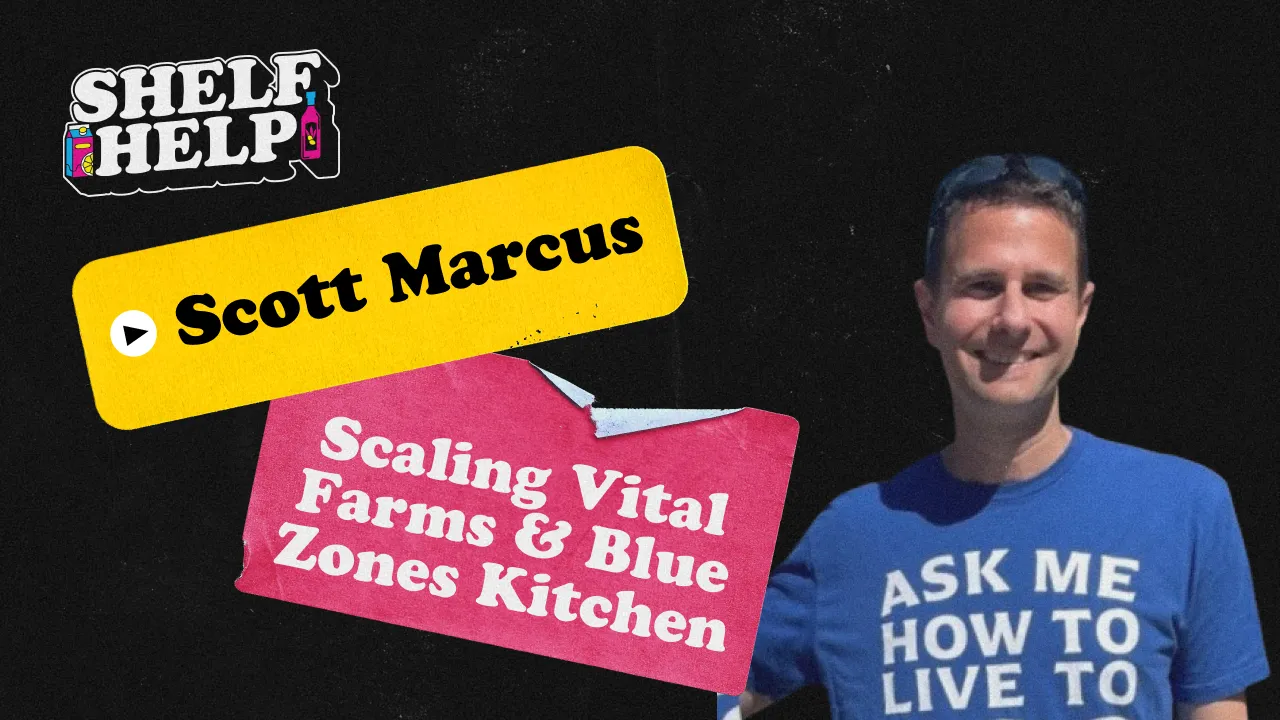



On this episode, we’re joined by Scott Marcus, CEO and Co-Founder of Blue Zones Kitchen, the mission-driven frozen foods brand rooted in the research behind the world’s longest-lived communities.
After helping scale Vital Farms to the point of IPO and beyond, Scott set out to build a new kind of food company.
Scott breaks down how he and his co-founders, Dan Buettner and Matt O’Hare, transformed decades of Blue Zones research into a modern CPG platform. We explore what it takes to build a Public Benefit Corporation from scratch, how the team approached R&D and formulation, and the principles guiding their product roadmap.
Scott also dives into packaging strategy, pricing, distributor and broker selection, and what he sees shifting across the frozen aisle and the broader better-for-you landscape.
—---------------
Episode Highlights:
🌍 Turning the Blue Zones lifestyle into a CPG brand
🏢 The decision to be a Public Benefit Corporation
🧪 How clean, nutrient-dense R&D actually happens
🗺️ Structuring an intentional product roadmap
🚀 The core ingredients of a successful product launch
🎨 Packaging, color strategy & communicating trust
💲 Pricing strategy
🥶 Why the frozen section is changing faster than people realize
👀 The emerging brands + trends Scott is following
—---------------
Table of Contents:
00:00 – Intro
00:55 – Blue Zones (Kitchen) overview
05:07 – Scott’s next adventure
07:44 – Crafting a compelling story
12:22 – Public Benefits Corporations
15:04 – Public Benefits Corps vs. Certified B Corps
17:54 – R&D and formulation
21:09 – Product roadmap strategy
22:56 – Keys to a successful new product launch
25:17 – Visual identity and packaging design
27:23 – Own a color (or not?)
29:23 – Pricing
35:11 – Distributors and brokers
42:04 – The frozen section
48:33 – Brands and trends Scott is watching
—---------------
Links:
Blue Zones Kitchen – https://bluezoneskitchen.com
Follow Scott on LinkedIn – https://www.linkedin.com/in/scott-marcus/
Follow me on LinkedIn – https://www.linkedin.com/in/adam-martin-steinberg
For help with CPG production design - packaging and label design, product renders, POS assets, retail media assets, quick-turn sales and marketing assets and all the other work that bogs down creative teams - check out KitPrint.
Episode Transcript
Speaker: 00:00
Welcome to Shelf Help. Today we're speaking with Audrey Berger, who recently just finished a tour of duty as the president of Primal Kitchen after a pretty long journey with the brand. Prior to Primal Kitchen, Audrey Audrey spent about half a decade owning a brand man management shops at Crafts, primarily focused on the uh frozen category, which is seems to be having a bit of a moment right now. Since Audrey left Primal Kitchen, Audrey's been running Pace Setter as a consulting firm focused on helping really emerging brands kind of find their stride. So a lot of great experience. Really excited to dive into it. Audrey, maybe just to kind of start off for these up-and-coming operators that are actively looking for someone to help scale. Give us kind of quickly the land in terms of pace setters, your focus in terms of how you're typically helping brands these days. Yeah, awesome.
Speaker 1: 00:51
I love it. Well, first, um, thank you for having me. I'm a fan and regular listen to listener to the pod, so it's exciting to be here. Yeah, for sure. Um paceetters. So paysetters was founded really with the goal of trying to help increase the chances of success for emerging brands and turn them from just being brands into lasting businesses. Uh, to be a founder is to take in a great risk, to have amazing insights and to get to that first million dollars is super hard. Um, but the same things that get your product kind of onto the shelf, off the ground, um, aren't necessarily the things that are going to make your business a $50, $100 million brand and something that you could pass down to your kids or sell eventually. And so my goal is to kind of pair founder mentality with know-how and structure to really set businesses up for success. And then your second question was on strategy sprints. So you can tell there's like kind of a running theme going on here. Um, I ran cross-country and track in college. And so it's been fun to ideate in that space. But a strategy sprint is really kind of a set mission critical goal. So call it two to four weeks. What we're really trying to do is help founders or operators get an answer to a pivotal problem fast. So something like a go-to-market plan or brand purpose work or really thinking about uh your differentiation if the new competitors come into space. Um, so set engagements, they give founders and operators tools quickly. Um, and then you're not spending a ton of money and cash flow and fractional engagement. You're really able to make sure that those dollars are immediately going into impact and affecting your business.
Speaker: 02:28
I feel like that's really helpful. Go to market is kind of part of what you do. This is a kind of a really broad answer. And I know there's a different bunch of different ways you can answer it, but you're just such an expert in this world. When you think about what a well-rounded retail ready launch plan looks like, what comes to mind?
Speaker 1: 02:45
Yeah. Oh my gosh, such a good question. I would say really trying to think about the future first. And that is so hard to do when you are in the day-to-day, but really having a vision for where you want to end up, it's very easy to say yes to the first retailer that knocks on your door, vice versa, the first retailer that you knock on their door. Um, but the decisions you make in the first three accounts could affect you for the next three years. So, really trying to think about how do you want to price and position yourself at a Whole Foods or a Walmart is going to drive how you act at an independent retailer because your pricing and your margin strategy are going to cascade from there. Typically, Walmart's going to be your cheapest retailer or your least expensive, maybe a better way of saying it. So you certainly don't want to price at a price point at Whole Foods. And then by the time you go to Walmart, you'd be losing money. So really trying to think about that right balance. Um, I also like to think a lot about product retailer fit. It's not something a ton of people talk about, but different retailers have very different consumer demographics. So this might sound obvious, but is often overlooked. Like on the East Coast, if you're going between a Wegmans or a Wake Fern, we'll hit the W's, all the W's, Whole Foods, Walmart, Wegmans, Big Fern, um, you're probably gonna have a lot more luck launching at a Wegman's. While that is a heavier private label retailer, they are a bit more natural leaning. They're a bit more premium. Whereas a wake fern is like tried and true, you're gonna get consistent volume, but it tends to be an older shopper, more entrenched in their ways. And so they perhaps are not gonna pick up a newer brand. So knowing which retailer you're partnering with at each step is super important to have that infrastructure in place to be able to support your business long term.
Speaker: 04:32
Yep, that's really helpful. What have you found, just working with founders and in your own experience, what have you found are like some of the most common pitfalls or ways that earlier stage brands build out a forecast that ends up being way off and that you know can end up getting them in a tough cash position.
Speaker 1: 04:50
Uh one question that I used to ask people when I was interviewing them was tell me about a time when you when you made a mistake in a forecast. Because it's just not possible to not make a mistake. You will. We can predict the future. If we could, we'd probably all be maybe investing in a different space and making a lot of money. But what you can do is try to at least increase your odds of success. Um, so earlier stage, you have kind of two options. You either maybe go on the low side and you piss off your retailers and you have bad CFR, or you go on the high side and now you have $100,000 worth of inventory stuck on your balance sheet. Um, at an earlier stage business, my vote is to always kind of don't be pessimistic, but I would say maybe go on the lower side of your estimate. So your MOQ or your minimum order quantity is a great starting point. Really understanding if I have to run 3,000 cases, where would they go? And if that doesn't work, if I've totally missed my forecast, where will I sell them? If you have a D2C site, that's always a great place to say, like, okay, at minimum I can sell these on D2C, or at minimum, I can sell these to gross reality. Really thinking about MOQ to start, how can I deliver against that? Because the reality is that people love a sellout story more than they love a heavy inventory story. Um, there's a few pitfalls that, you know, when I was thinking about this question that have come up pretty repeatedly, I'd say one is if you're estimating off of an existing item or competitor, you need to be honest about ramp up. So if I say that I think I'm estimating Audrey's burgers is estimating off of Adam's burgers, um, I think I'm gonna turn 60% relative to your product, but your product is three dollars cheaper than mine.
Speaker: 06:38
Right.
Speaker 1: 06:39
We need to start to think about elasticity. We need to say, hey, it's also gonna take me 12 weeks to get there. So really trying to just be honest about what a ramp up period looks like and not overlooking that difference between dollars and units. Another big thing is what I call the D load. So it's that lull after initial buy-in of a product. So typically retailers will buy one to two cases per store. So if you have a six-count case, you're gonna sell one unit per store per week. You are not gonna get orders for like a solid month. That can be super scary to have that goose egg come through and you're like, oh my gosh, you cut production, you cut everything. Instead, just like be ready for it. They're gonna take time to move through inventory.
Speaker: 07:21
Right.
Speaker 1: 07:22
And then the last one um was seasonality. Um, it's human nature to believe when things go right, like we've done, we've done it. Um, and when things go wrong, it's someone else's fault. And so if you launch during a period of high seasonality, just be careful to not bring your entire forecast up because you launch during grilling season and you sell a product that's used on a grill. Um, and vice versa, if you've launched during a down period, don't be scared that your product isn't gonna make it. Um, really be conscious about seasonality is is super important early stages.
Speaker: 07:54
I think you said something about getting those first doors and then going into a lull. Um I talked to operators, you know, a fair amount, and a lot of them have told me after this is a little bit further along, after the first year or two on shelf with a retailer, even when the brand is like is the velocity leader in the category and all the numbers are looking good, that I've heard that it can it can still be challenging to capture more shelf space in that store and then get the opportunities to take advantage of out-of-isle opportunities like end caps, side caps, that kind of stuff. I guess maybe partially just because like the big established brands, even if you're the category leader, just is paying for more shelf space and trying to box you out. Maybe that's part of it. But I'm kind of curious, have you had a similar experience at Pramlo Kitchen or other brands you work with? And if so, any strategies you found that worked actually combat some of the challenges.
Speaker 1: 08:45
Such a good it's a very real issue, right? So I would say I had this problem when I was the market leader, like of the entire category when I worked on Cool Whip, and there was nothing else other than Cool Whip, and getting an NCAP was hard, and it was hard at Primal Kitchen when we were the fastest growing item in the set. I think that the reality is that the retailers are very powerful and they're also fighting their own battles. So to get an NCAP for them, maybe they are being measured off of the margin they can get against that or the units moved. Um, oftentimes retailers have very different objectives for NCAFs that might not match velocity objectives that we're seeing on shelf. So when we try to say, like, okay, how do we want this? I think is always the first question. There have been times where we have secured an NCAF and like everyone high fives, and we're like, oh my gosh, we did it. And then we get the bill and we're like, oh no, that did not pay back. So being like really critical about dollars moved and units moved are not the same thing. And even if you moved a ton of units, it might not actually pay back. But then the second thing is like, how can I complement the retailer towards their objective? So it's one of the most valuable areas for them to make extra money. So is it I'm selling hot dogs alongside the retailer's private label buns and making that like an exciting opportunity for them because a lot of times it's a bit deeper than just performance.
Speaker: 10:17
Yeah, I feel like that's some of those things are not things like especially earlier stage brands would even like know is a factor that's impacting them. That's super helpful to know. So I think between your time and primary kitchen craft, you launched 100, maybe even 200 plus skews. Um I know this one question could probably be an entire podcast on its own, but just maybe at least from a high level. What did the journey or process look like at Primal Kitchen that would lead the decision to actually bring a new SKU to market?
Speaker 1: 10:44
Yeah. I think Primal Kitchen is such an interesting example of kind of the work that I'm doing at Paysetters and saying early stage, like when I first joined Primal Kitchen, it was still very founder retailer led in terms of what we were launching. Like it was legit DMs or like, I just want to launch this because I know my consumer so deeply and they are my neighbors. And so I'm going to launch this thing. And that's great. There's absolutely a time and place for that. Some of our best innovation were not things that we came up with. There were things that retailers brought to us and they kind of knew where the category was going before we did. And say later, as we got bigger, um, we were a bit more structured naturally. You know, your MOQs are getting higher, the risk is higher every time you get bigger in your launch, uh, launching something new. And so we really tried to think about category shaping behaviors. Um, so what was going to be next in a category, being really proactive about price and pack and positioning. Um, and then our guardrails are very stringent. So Primal Kitchen has just like incredibly tight guardrails, which I was always extraordinarily proud of. But when we decided we wanted to launch like a chicken dip-in sauce that might mimic a very popular chain of chicken sauces, um, but we wanted it to be two grams of sugar, that was gonna take some time. And so being really clear about what we wanted to do and making sure that we had a sense on hey, the end outcome is X product. If it's gonna take two years, it's gonna take two years, um, and really being a bit more proactive about that strategy.
Speaker: 12:23
Once you guys decided, okay, yes, we're gonna bring this new ski to market, because what would you say are the keys to a successful new product launch in in market in terms of hitting budget and then also actually hitting your launch timeline goals?
Speaker 1: 12:37
Okay, two two questions that. So I'm gonna try to answer both. I'd say on a launch, and how do you know it works in market? You know pretty quickly. I think when something doesn't work, people tend to be in denial about it. Um, there are many, many, there is way more times that I've been like, just give it another week, just give it another week, than being like, oh my gosh, in week 18, this totally popped off. So I would say if you're seeing out of the gate, traction is not where you projected, act quickly. Um, there is probably a reason as to why it's not working, whether it's the packaging or the communication, something that like needs that initial hook to get people in. Um, but I would say like being really tight on those turn rates is always helpful to understand if it's a success. And then kind of very connected to that, I would say launching and making sure you hit your timeline, sometimes those behaviors can be interconnected. Um, so we always we used a term proud, not perfect, especially earlier on when we were trying to launch. Our top objective was making it on shell in time for a reset date. And so if we were 90% happy with a product and it was kind of a two-door decision. So, say, I can't agree on it, needs to be slightly sweeter, slightly less sweet. Let's go with what we've got. Um, if we could tweak it the next run, we would just to make sure that we wouldn't miss a timeline. Um, because those are trade-offs that you are just going to have to make. And then you're able to understand really quickly, like, hey, maybe the reason it's not working is because that decision we made at the last second about the claim, we might have gotten that wrong. Um not being scared to change quickly versus saying, like, oh, we need to wait 26 weeks to decide if this is working or not. You only have one shot, you know?
Speaker: 14:28
Right, totally. How do you think about introducing new products into the existing product line supply chain? And I guess more specific into the existing kind of production schedule.
Speaker 1: 14:40
Yeah. I'm sure all our ops friends that are listening to this are like, ah, yes, Adam, thank you for asking this question. Because I think it's so often overlooked. We even changed at one point the way that we were approaching our kind of like stage gate style to bring ops in earlier because this tends to be a sticking point. It's um, if you have a lot of claims or allergens, how do you fit that into the line time schedule? You want to run it at the same time as other allergens. Um, how is it gonna cannibalize other items? Is always a really important question we're asking in forecasting because this might be a slam dunk in isolation, but if it's totally gonna eat into like my top turner, it's gonna mess up the schedule as well. So we're always trying to think about how could you build off of existing bases? Some of our commands um across many product lines that I've worked on, they'll want you to have a base, like an OG original product. And then you can kind of iterate on top of that. That makes it a lot easier for ordering patterns. It also helps you stay really efficient from a scheduling perspective. Um, but then also really trying to think about how do you build something that isn't just a line extension? Like, does this have the ability to be a core item in the future? Um, and if not, then only order the MOQ or make it limited time only. Like just be realistic with yourself about what this is to your portfolio and how many hoops you're gonna make your ass team jump through to produce it.
Speaker: 16:14
Yeah, that makes total sense. This is like a much more in the weeds question, but um what have you found is the key to having a product detail page that converts.
Speaker 1: 16:26
Oh, okay, good one. Um that's a it's hard because you have so much real estate compared to when you are selling something on shelf. You have your billboard of packaging and for salad dressing, you have only a few inches. For a frozen meal, I had much more space to play with. Um, but when you're online, kind of you can choose the fonts, you can choose what goes where. The world is a little bit more of your oyster. Um, so what I always try to think about is knowing what you're selling um is a is an oversimplification, but uh it's arguably the most important thing behind taste is setting appropriate expectations for a consumer. So if the number one purchase driver in your category is you're selling mac and cheese and it's made with real cheese, you're probably gonna want to highlight that. Um, but if your number one reason to switch is that you're organic, you're gonna want to make sure that's on the page, maybe three times. Um, like several places, not just the USDA bug. The clearer you are on like your reason to play, I have real cheese, but then your reason to win, I am organic, um, the clearer you can be for consumers that are shopping really quickly. They're scrolling, whether they're on the Instacart app, or they've pulled up your phone like while they're in store and they're trying to get more information. Like take advantage of that because a lot of people do shop on two screens.
Speaker: 17:55
That's a good point.
Speaker 1: 17:56
The scanning apps have become super popular, like a Yuka, uh, to test to scan the barcode and see like what the score is for my health. So knowing that people are like actively checking your work, if you will, or checking for alternatives is helpful to understand.
Speaker: 18:14
That's a really good point. Shifting gears a little bit when it comes to packaging design or packaging redesigns. You can totally correct me if I'm wrong, Gary, but I think I've heard you say something along the lines of, you know, definitely test before you change. You're seeing your packaging every day, but the average consumer might only see it like once every month or two. Um, what does a good testing process look like?
Speaker 1: 18:38
Yeah. It's interesting when you like take a step back and reflect on that. Like every single day, I would look at Primal Kitchen Mayo packaging. I know that by heart, I could see it with my eyes closed. But for most shoppers, they're coming to the aisle maybe once a month if they're a heavy user. And so, because of that, or a light user, right, they're coming maybe once every six months. You are just not as important to them as you as you believe you are. And so when I think about testing protocols for an earlier stage brand, even less so, right? You have less mental models that a consumer knows you by. That is a good thing and a bad thing. Good thing, if you change, they probably don't remember you. Bad thing, if you change too much, they're never gonna remember you.
Speaker: 19:27
Right.
Speaker 1: 19:27
So earlier on, it's just not realistic to have a ton of money to go test and learn. Um get people outside of the industry, highly recommend outside of the industry, and build like a little community of your consumer, your target consumer. Text them pictures of packaging, get their opinion on any sort of change. Does this move the needle? Does it not? And then really, really importantly, go to shelf. Print out your packaging, the highest quality that you can. Go to FedEx, go to whatever, find a bottle that looks something like what you have, or a box or a package, and put it on shelf. There have been so many times that I've seen a beautiful package on my computer screen and been like, yes, ship it. And then it gets to shelf, and I'm like, oh my gosh, everything else is white. I cannot believe we chose to launch something white. So when you're scrappier like earlier, do that. Take the time. When you're bigger, you're gonna probably want to test more simply because the risk is higher. Um, it is fairly rare. It's more common, maybe is a different way of saying it, that packaging kind of totally messes with someone's brain and they never buy you again than you would think. Um, and so testing with light shoppers and heavy shoppers equally is very important. If we think about like the classic kind of how brands grow model, is that light shoppers are the ones that are going to drive your business? And if they're the ones coming least frequently, it's most important that you are thinking about their mental model. How do you fit into primal kitchen is the green brand with a green cap. If that's the only thing they know about primal, I can move the other pieces around and like still be okay. Um, but if they don't have anything in there, like it's a very risky move. Um, so making it really easy for people to find you, whether it's light or heavy buyers, but really not overlooking the risk of the light shoppers that have less affinity to you is is super important.
Speaker: 21:32
In terms of packaging and redesign, how do you balance the need for a fresh look with some of those familiar legacy brand elements, especially for those existing customers? I think I've heard you reference the Tropicana bundle, which everyone talks about all the time as like a classic one. But yeah, how do you think about that that balance? Yeah.
Speaker 1: 21:50
Poor Tropicana, they're never gonna make it. So I read the textbook example. Um, but for for those people that somehow have missed it. Um, Chapacana back in gosh, late like 2009, maybe. Um, they went from that like classic straw poked in an orange to this like super modern juice visual. I don't even know how to describe it. They also moved their logo, they changed their logo, they changed the primary name of the product. It was like the example of just like changing too much too fast. Yeah. We're fairly simple people when it comes to being a consumer. I've been in consumer research where you basically take um piece of paper, give it to consumers, and you say, draw the packaging from memory. And you'll see that like they're actually pretty good at it. You can also find out when they draw like a previous iteration of your packaging, maybe five years prior or 10 years prior, and you realize kind of what are your distinctive assets. Um for them, their distinctive asset was totally that orange straw situation. They wanted to become more modern, natural, clean. And instead, they just like lost everyone. Everyone was confused. So if you're gonna modernize, like do it, amazing. But keep things in the same place if you're gonna update your logo. Um be wary of like making major visual changes at the same time as making layout changes, because it's just overwhelming for consumer behavior to need to like look in seven different places and also be presented with a totally new positioning all at once.
Speaker: 23:29
On the flip side, I've heard you talk about Chobani's rebrand or packaging refresh, whatever you want to call it, which was a great story of success. And I think in part due to the fact that they, I think, as you said it, train their consumers before the switch. That was I was really curious. What what do you mean by that, that they train their consumers?
Speaker 1: 23:47
Yeah, if I'm a Chobani bully, I'm a or a Tropicana bully, I'm a Chobani fangirl. Um Chobani was on top of the world when they rebranded, which I just find the whole situation to be very fascinating. Typically, you see a rebrand come from like an area of weakness. It's like the last ditch effort, like I've got to save this, or we gotta change consumers' minds and hearts. And I think instead they saw it as wow, what we have is amazing, but like if we want to get from here to there, we need to change something. And so um, this is uh an audio medium, but go Google like Chobani before and after. It's dramatic. They went from like a pretty standard like Greek style, uh style font. Um, and everyone was looked the same. It was like totally copycat. I remember like actually buying Chibani in this era and pulling the lid off, and underneath the lid were like, it's like classic consumer behavior that like there's yogurt stuck in there, you lick it off, great. And underneath that was like new look coming, and it was a picture of the new packaging.
Speaker: 25:00
Whoa, really?
Speaker 1: 25:01
And I remember being like, wow, that is so smart. This is so interesting. So if you're a habitual shopper, um, or even not super habitual, I was like, oh, great, okay, I know to expect this the next time that I come. The other thing about the change was it it was bold. They were trying to solve for like a copycat moment. And so even if you hadn't gotten pre-warned, when you got to shelf, you saw something different, something that was totally different from the stark white. They went to this like creamy white matte finish, like hand-drawn versus photography. It popped on shelf in a way that, like, even if consumers weren't warned, they were shocked into knowing. Um, which I thought was really just very fascinating in the way of changing consumer behavior at shelf. Um, and it really, I think, changed a lot for them. It opened up their ability to go from being a Greek yogurt to being like this modern natural dairy brand. And I've loved to watch like the way that they've continued to tweak it over time to expand their product line. Now they sell far more than yogurt. Um, and I do think that that change was like a very important pivot point for them.
Speaker: 26:13
Yeah. All right, totally shifting gears a little bit. And I you transitioned over to craft, I believe, like right when that primal kitchen acquisition was happening or just had happened. What was that process like for you coming into that team?
Speaker 1: 26:30
Yeah. I moved to Primal Kitchen right after the acquisition. And I felt very lucky to do so. I had long admired the brand. I was ready for kind of a more natural era in my life, if you will. And so it felt like a good opportunity in a culture fit. What I think I was really lucky about is that Kraft Eins had not been very acquisitive during the era that Primal Kitchen was acquired, but basically everyone else had been. So there was like this era of gobbling up all these smaller natural brands. And we had the opportunity, and we talked about it regularly. What worked and what didn't work from those other businesses. So, okay, this brand immediately integrated and switched packaging. This brand immediately switched sales teams, what worked, what didn't work. And what we decided to do was to set Primal Kitchen up to be largely autonomous. So um unique systems, uh, we had a separate sales team, we had a separate structure, separate email addresses, which I know seems small, but like is impactful when you think about kind of some of those firewalls. But what we did was we took core Kraft Heinz employees who we thought were good culture fits and we moved them to primal kitchen instead of trying to force primal kitchen to move into Kraft Heinz. And so for me, I was one of the first employees to do that. There were two other um employees on our leadership team and then several over time, but took the mentality of like, there's multiple right ways to do something. Just because I did something at Kraft Heinz and there was a different approach at Primal Kitchen, didn't mean that anyone was right or wrong. Um it just was a question we needed to ask ourselves on what was right in this moment. Yeah. So if Kraft Heinz had a leg out from like regulatory or legal, um natural fit, we're gonna go that way. Um, if we thought that PK had a leg out, like our in-house agency or a sales team that just understood premium and natural, we nurtured the PK side of things. And so I really do give Craft Heinz like so much credit for giving the brand the space to grow up and leverage the mothership when necessary. Um, but then also leave the things that really worked and allow them to grow as well.
Speaker: 28:45
Yeah. Yeah, that's that's super refreshing to hear. But leaders at companies, not the founders, maybe it's you know, um, director, VP, chief marketing offers an example, or ops leaders. Um recommendations you might have for them in in terms of how to set themselves up to success, how they should approach this from fucking mindset standpoint, kind of during and and after this integration process, which I imagine can create a fair amount of anxiety for some people, like what's gonna happen in my role, how am I supposed to integrate within this team? And yeah, how they should kind of think about approaching that in the right way.
Speaker 1: 29:17
It's hard. It is. Like, I think if you're going through this, like it's very hard. And I would go back to this idea of like, there is not a right way or wrong way to do anything. And so even if your acquirer says like they're talking in acronyms, and you like leave a call and you're like, I have no clue what anyone just said, that does not mean that you are not smart and do not deserve to continue to grow in the organization. Um, and so really just like trying to like value yourself, value what you built, but then ask questions. Like, if there is a change coming, I would say like stage gate is a really good example. It's something that like founders or early operators like tend to press off. It's gonna slow us down. It's totally unnecessary. Like, I don't want to do this. What we try to do is hey, like you want to do stage gate, great. Why? Oh, you just need to see the financials. Perfect. We can give you financials, but we're not gonna go to stage gate because we want to launch on our timeline. We have different retailers, we have different reasons, et cetera, et cetera. And so really trying to figure out like, why are we trying to change this system process y approach? Is there a light version that we can do? And like, how do you get to the minimum amount of information needed? Right. As you get bigger, naturally, you're probably gonna have to give more information, but like give yourself bite-sized opportunities to learn. And then also vice versa, say, like, oh, maybe they are doing something that I hadn't thought of. And let's test it in a certain area. Um, but really try to protect your team from corporate uh overload. It's not a bad thing. There's absolutely reasons for systems and structures, but you don't need it for everything.
Speaker: 31:05
Right. That's a good balance. I like that. That's a good way to approach it. I'm not sure how long ago it was, but I saw that you wrote about the rise of private label fairly recently in your subtack, which definitely seems to be things that something that people are talking about a lot from your perspective. Give us just kind of general lay of the land in terms of the state of private label and kind of trends you're seeing these days.
Speaker 1: 31:28
Yeah. Private label, I don't know, it's like a passion topic. I remember when I first started in food and I mentioned to one of our executives that I barely bought any branded products. And they were like completely just wrought by this information. We're like, there's no way. You sure? And I was like, yeah, for the most part. There's like only a few brands that I like actively buy. Um, and so you know, it stood out to me that I didn't think this was just me, um, and it wasn't just my frugality. Um, we've really seen retailers reshape private label and what it means to consumers in the past five years. Call it maybe even as short as a decade ago. Private label was very much like an active trade-down choice. I spend less money, so I get less. Um, and now retailers have kind of said, let's flip this script on that. I'm spending less money, but I'm getting perhaps a duke, like an equivalent product to the branded players. And I can do that because I own my supply chain. There's no slotting, there's no advertising costs, all the reasons to be. And they've also worked really hard at like removing negative connotation behind a store brand. Maybe like old targets, like market basket, like that red brands was like something you would like to hide in the pantry. We used to talk a lot about um when I worked on Cool Whip, for example, private label is our number one competitor. And we talked about, okay, Cool Whip is always bigger in the holiday. And people that buy private label during the year buy Cool Whip during the holiday because they want to put that one out. They want people to see they bought the branded player. But throughout the year, maybe they trade down to private label. And so it's very much like that behavior of like, what am I proud to put on my countertop? Now you have something like a good and gatherer or better goods. And it's no longer relegated to like hidden in the fridge or the pantry, you might actually be proud to say, like, look at this sick new product from Good and Gather. Um, so very much a change of both mindset and quality that I think consumers have really started to react to.
Speaker: 33:38
Yeah. Yeah, I think that's accurate. That's kind of what I've seen. What does this private label landscape look like, say, five, five years and 10 years from now, or you can pick one of those and just more in the context of what brands should be doing to respond to where this is going, prepare for it, um, just in terms of all these changes that are happening and coming up.
Speaker 1: 34:01
Yeah. I think brands need to look at private label as a competitive brand, not just a copycat. Um, you look at a lot of these retailers, they're employing their own good, better, best strategy within their own brands. They're thinking about it as a house of brands. But what I think they still haven't figured out quite yet, and I'd say give them five or 10 years, and maybe they will, is market leading innovation. So I walked to Walmart recently, and there was an end cap of better goods, and it was like chili lime flavored gummies and white hazelnut spread, which both are intriguing products. But are they private label mass scale produced products? Probably not. Um, so those private labels are still good at copying of adjusting and tweaking, but I haven't yet seen them compete on market leading innovation. And so being really um brands just have a leg up at focusing on that. How can you change your packaging to be more cutting edge? How can you lead with new innovation or formats or patents? How are you thinking about protecting your insights? Um, when I think about newer brands, there's an opportunity to play into your niche. So a private label brand inherently needs to serve everyone, needs to be gen pop, which means it kind of stands for nothing on purpose. It needs to be an open vessel.
Speaker: 35:29
Right.
Speaker 1: 35:29
Uh, there is such an opportunity for brands to own the fact that they do stand for something, to have clarity on that, um, and then to win from their niche instead of saying, like, I'm going to be everything to everyone.
Speaker: 35:40
I hope a lot of founders are listening to this piece. Audrey, last question for you. Any um any brands or just trends in general in the CPG space that you're kind of particularly excited about these days or you're you're tracking closely?
Speaker 1: 35:56
Yeah. Well, I'm super excited, I think, about just like the general movement towards simpler, cleaner ingredient statements, end-to-end, small brands, big brands. I think that's awesome. And being a part of that with Primal Kitchen, like riding ties journey. So um, I'll put that to the side. One trend that I'm keeping my eye on is reinvention of commodities through different use cases. So Praza is like a big example of that, where they took commoditized products, they put it in new packaging. It's cool, it feels special, um, it feels fun. There's another brand that just launched called On or In. It's kind of like onion. Um, and it's onion in oil, so pre-chopped onion in oil, which I like can't believe this didn't exist. It's like jarlic or ginger, um, to like flavor without the cutting board. Or I just saw a brand on Instagram, literally yesterday, they just launched, um, called Pantry Gems, which is teason size tomato paste. So you don't have like an entire can of half used tomato paste.
Speaker: 37:03
So you're smart.
Speaker 1: 37:04
Again, like another way we're like, is private label gonna play there? Probably not, right? This is like such an interesting space for consumers and the people that eventually consumers turn to founders, say, like, hey, how do I reinvent commodities? How do I make cooking more efficient, more fun? Um, so repackaging and re-modernizing occasions is is super exciting to me.
Speaker: 37:26
Yeah. That's really interesting. Yeah, Audrey, this has been awesome. Really appreciate the time. A lot of really useful insights for uh operators and and founders alike. Uh, what's the best place for people to follow along with you these days? And also best place to follow along with pace setters and all you're doing there as well.
Speaker 1: 37:43
Yeah, absolutely. Um, well, thank you for having me. You can find me on LinkedIn as Audrey Burger, burger like the food, or at pace setterscpg. I also write on Substack under Pace Setters CPG, and I lurk mostly on X and Instagram under Audrey's burgers. So my name with an S behind it, so possessive and plural. Um, but you can tell like I love the industry. I really legitimately want to make it a better place. And if you're listening and you need help with your brand or you just want to talk to someone, um, I certainly would love to be a part of the journey. So find find me on one of those platforms.
Speaker: 38:21
Perfect. Yeah, we'll definitely link to the sub stack too in the in the notes, too. Cause I think yes, you have some great, great content on there.
Speaker 1: 38:27
Awesome. Thank you.
Speaker: 38:28
Awesome, appreciate the time. I mean that's the pod.
.svg)