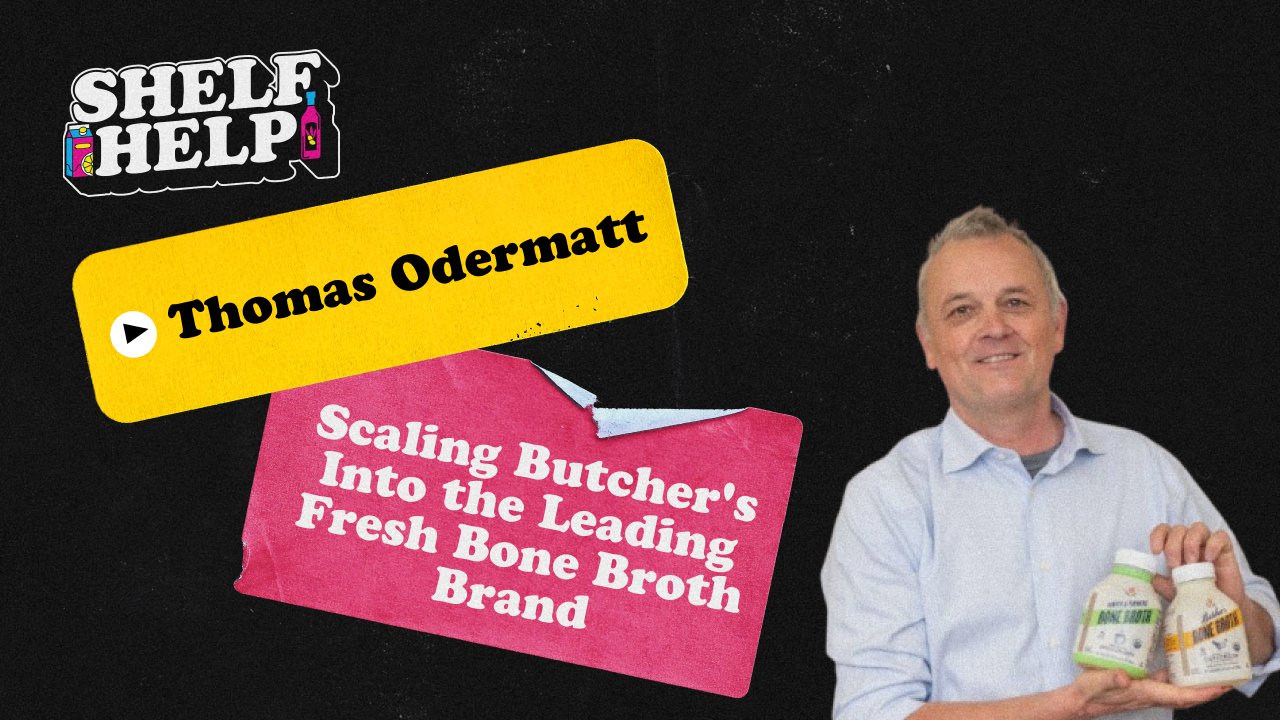
Scaling Butcher's Into the Leading Fresh Bone Broth Brand | Thomas Odermatt, Butcher's Bone Broth



On this episode, we're joined by Thomas Odermatt, Founder & CEO of Butcher's Bone Broth, the leading fresh, organic bone broth brand sold refrigerated at Costco, Whole Foods, Publix, and more. Thomas is a third-generation Swiss butcher who built Roli Roti, America's first gourmet rotisserie food truck, before spinning Butcher's out as a standalone brand.
After deboning chicken for Bay Area tech giants, Thomas found himself staring at 10,000 pounds of leftover bones a week and, as a butcher's son, refused to throw them away. That became Butcher's Bone Broth, launched into retail around 2015 as a fresh, refrigerated product in an aisle dominated by shelf-stable aseptic cartons.
Thomas walks through landing his first account at Berkeley Bowl, why he's raised the price only once in nearly 12 years, and why he still makes every bottle in-house with no co-packers and no venture capital. We get into winning the club channel at Costco without cheapening the product, pushing velocity instead of chasing margin in the expensive fresh aisle, and adding 800+ new Albertsons doors.
We also cover the recent decision to spin Butcher's out as a standalone brand, the packaging thinking behind earning a female shopper's trust, and Thomas's people-first take on management.
---------------
Episode Highlights:
🚚 The farmers market loophole behind the food truck
🥼 The white chef's coat that killed the "roach coach" label
🍗 Deboning chicken for Bay Area tech giants
🦴 10,000 pounds of leftover bones a week
🛒 Landing the first account at Berkeley Bowl
💰 Raising the price just once in 12 years
🏭 No co-packers, no VC, every bottle made in-house
🚂 The "Union Pacific" slow-and-reliable growth model
🧊 Winning the fresh aisle on velocity, not margin
🎨 Spinning Butcher's out as a standalone brand
📦 Packaging a butcher's brand that women trust
🏬 800+ new Albertsons doors and product-market fit
🐂 "Grab the bull by the horn" as a management value
---------------
Table of Contents:
00:00 – Intro
00:49 – From a Swiss butcher shop to a Berkeley business plan
02:51 – The farmers market loophole behind the food truck
03:59 – The white chef's coat that beat the "roach coach" label
06:27 – "Five products, five fingers" (and catering Paris Hilton)
07:25 – The leap from food truck to retail CPG
10:57 – 10,000 pounds of leftover bones, and why bone broth
14:29 – Landing the first account at Berkeley Bowl
16:35 – Raising the price just once in 12 years
19:29 – No co-packers: every bottle made in-house
20:57 – Self-funded, and the "Union Pacific" growth model
22:46 – Winning the fresh aisle on velocity, not margin
24:55 – Spinning Butcher's out as a standalone brand
27:22 – Packaging a butcher's brand women trust
29:04 – Winning the club channel without getting greedy
31:34 – 800+ Albertsons doors and product-market fit
33:31 – Listening, culture, and the bull by the horn
37:09 – Where to follow Thomas
---------------
Links:
Butcher's Bone Broth – https://www.butchers.co/
Follow Thomas on LinkedIn – https://www.linkedin.com/in/thomas-odermatt-656a1449/
Follow me on LinkedIn – https://www.linkedin.com/in/adam-martin-steinberg/
For help with CPG production design - packaging and label design, product renders, POS assets, retail media assets, quick-turn sales and marketing assets and all the other work that bogs down creative teams - check out KitPrint.
Shout out to my friends over at Glimpse, the go-to partner for automating retail-related back-office operations and unlocking margin trapped in invalid fees and manual processes.
Are you in the market for a new flexible packaging partner? Check out HD Packaging. Third-generation, family-owned and built for the needs of category leaders like Newman’s Own and A Dozen Cousins. Faster launches, lower costs, and no artwork fees.
Episode Transcript
Speaker: 00:00
Welcome to Shelf Help. Today we're speaking with Thomas Odermat, founder and CEO of Rolly Roti Parenthood, one of the leading fresh organic bone box brands in the U.S. and a rotisserie truck that's been a Bayeria farmer's market staple since 2002 when I was living in San Francisco. I went there many times. And um yeah, Thomas is a third-generation Swiss butcher who grew up in in uh at his family's award-winning butcher shop in the Swiss Alps before I think eventually getting a master's in organic farming, finding his way to the US to study at um at UC Berkeley before eventually launching what was, I think, essentially America's first gourmet rotisserie food truck. So yeah, very cool story. Excited to dive into it. Thomas, maybe just first off, for listeners that aren't that familiar with with a Rolly Roti and a bit of the journey from the food truck to launching the Bone Both brand, love to just get a quick lay of the land just in terms of kind of the origin story and the why behind the brand and then core products in the lineup, and then we'll go from there.
Speaker 1: 00:59
Yeah, yeah. Thank you so much for having me, Adam. It's yeah, it's a pleasure to spend some time with you. You know, jumping into my journey to the United States, to Berkeley specifically, at UC Berkeley, I had to write a business plan, and you know, I'm not 100% familiar with anything that I really did and done, but I knew one thing is that back in our butcher shop in Switzerland, we had a good old rotisserie open grill, and we put some chicken there, we put some porchetta there, and everything sold very, very well. And writing a business plan was a challenge because what I'm I I don't know exactly what I can do in the United States has not been done. But one thing I figured out is that rotisserie chicken is a very beloved product. In fact, last week was a rotisserie week, rotisserie chicken week, so we celebrate that in the United States. And quite frankly, it's a very delicious product. But I thought, you know what? In Europe, we have those food trucks everywhere at the farmers market. Why do we not have that here? So I researched and I'm like, it's called road coach here, and and it's also by the regulation in 2002, 2001, you needed to move a truck every 15 minutes because that's the retail regulation. So I'm like, no wonder there's no food truck out there who can position itself and grill chicken on the side of the road and need to move every 15 minutes because it's a thing of the nearly impossible, even if you just move an inch. But I found a loophole that gave me confidence that I can do a business. The loophole is called farmer's market because the farmer's market is regulated by the AC Commissioner and the Retail Food Code. It's not a street food vending code. And that code was very specific. If a farmer's market is open from nine to one, you must participate from nine to one. And no matter what kind of establishment you have, whether you were a hot dog vendor, a farmer, an orange seller, whatever, you just cannot move out of the farmer's market. And the insurances were all in support of that as well. So I then like, okay, so I got a captive audience similar to Europe, and what I'm gonna do to overcome that bad name that I've been called Roach Coach Operator. I said to myself, we must use the simplest thing in on earth, white. What is white? White stands for clean, white is is pure. So I put myself a Don Chef's coat on, printed my name in the front, and I looked like an official chef. I didn't have the chef's hat on because it's not possible to grill chicken with a chef's hat. But all of a sudden everybody's calling me chef. I'm like okay. I'm a chef, I guess. By by name and not by title. But that changed, Adam. That changed the equation of how my business grew. So I started off with chicken only, only chicken. Then my wife Yumi said, Well, you want to make a complete meal? Yeah, okay, yeah. Throw some potato underneath. Ask the farmer. That was a challenge because at that time, 2002, fingerling potato were not available in the US as in quantity, just in a little like farmers market style and so on. So I had to basically work with a farmer to build a potato business that is specifically to fingerling potato that is a hard-cooking potato. It's not falling apart. So again, first the challenge was food truck, roach coach, second one, complete meal with finding the right potato, the right product. And then in 2006 I added the porchetta, which was another element of convenience level for this part of the world we like to eat a sandwich, something in between bread. So tailored to something in between bread. So that's what I did. And I never ever ever put more products on the farm on the food truck than I could sell. For instance, I have a firm belief, and I grew up as a firm believer. I don't drink coke. Not to say it's bad, but I don't put soda pop on the farmer's market because the farmer's market is all about a healthy living, healthy lifestyle, eat less and better quality. And so I was very disciplined. I am still disciplined. I always say any establishment that wants to be successful, five products, five fingers. And the food truck lent itself to a pretty famous operation. I mean, I catered Paris Hilton, Harrison Ford, Will Smith when he was here to. And when you cater, that's when you are a chef and you can be creative. So you always have to have two businesses in one. So one is your commodity-driven business. Despite you, don't I don't do commodity chickens, but it's just mass product. And then my taillet product where I have fun as a hobby cook to create food like farmers market salads and so on. And that became a very big part of my business at that time.
Speaker: 07:20
That makes total sense. Well, uh, yeah, I'm curious. I mean, let's talk about the leap from the food truck business to a packaged CPG product that's now found in retail. And I think you launched Butcher's Bone Broth as the first retail product about 10 years ago, I think in 2015. What did you see, whether it's at the farmers markets and then the food truck business and whatnot, that told you bone broth was the type of product that you that was the right one to bring to retail?
Speaker 1: 07:53
Yeah, that's a very good deep question, and I have to answer it very, very deeply. So my parents are I'm a third generation butcher. Our family's business is 70 years old. And the butcher has one thing that it's around the world, they are not throwing away stuff. They are the first people who understand to use everything from an animal. And so my father was cutting. Imagine this, my father Otto cut the bones, cut the meat, take the bones, put them aside, and then my mother Maria, who took those bones and simmered them with no intention of ever creating a retail product. It was just a product that when customers come in, oftentimes it was even for free. Hey, you want a cup of broth? And that's how the relationship with the customer and the butcher was. And the product was never a mediocre product. It was a product, as far as I can remember, it always had that jiggle on top, that wobbly thing. And that's the good stuff. That's what the good stuff is in it.
Speaker 4: 09:16
Yeah.
Speaker 1: 09:17
So fast forward, I grew up with broth. I drank a lot of broth, and probably pretty much every day we had a soup on the table and we ate that. Soup, whether it's warm or cold. Yeah, sometimes in the summer we had a cold cuspaccio soup or so on. But here is the thing. Look, the food truck was and is my platform. And the food truck has one thing that is I'm very proud of. It's called the farmers market. Farmers market is an incubator hub. You always learn everything there. Yeah. And my business, as I mentioned, was a catering business on the side. So all of a sudden, I've been asked to go and cater all those big companies in the Bay Area, tech companies. The Q, the V, the F, you name it. And they always say, Why is your chicken so much better? It's because I put the time and the effort in it to make something real. So I took, I cooked for a long time those chickens. And they asked me, can we buy those chickens? Well, you already buy it through catering. No, we wanted to basically have the raw meat. We want to replicate what you do because we believe your chicken is better than anybody else's. Well, yeah, because I sourced directly from the farm. So all of a sudden, I started to debone chicken for the G, the V the F and what have you. And I'm like at the end of the week, I'm like scratching my head, I'm sitting in front of 10,000 pounds of bones. I'm like, no, I'm my father, Otto, never threw stuff away. Thomas, you can't throw stuff away. I did not go into business of bone broth because it's the trend, it's the hype, the chimbros and company are there. No. I went into bone broth business because I needed to get rid of, I needed to see the end of a product come to a perfect use. So I started to make bone broth. And because I'm a butcher's boy, I knew the formula, I know how to make good bone broth, duck tickles, and as butchers, we never had aseptic machineries. We don't. Everything is fresh. Or you can have a cup of warm broth when you come to my shop. And and this is how I grew the business. This is what I strongly believe less is more. So less is more.
Speaker: 12:08
When you transition or I say expanded into the retail format, what do you feel like was the biggest learning curve going from the food truck to selling into retail?
Speaker 1: 12:21
Well, I learned that the food truck, the way I set it up, is not scalable. It's just not a scalable business. Unless I would go into restaurants. But by Mother Nature, I'm not a restaurant guy. I'm a butcher and a farmer. And that's about it. As I mentioned to you, I didn't want to be a chef, but I've been called a chef because of that white shirt. So I have huge respect for chefs. I mean, boy oh boy. But the lesson I learned is that running a business that you see does not pass that scalability model, you must pivot. You must open up yourself for different ideas, for different mindset. Imagine when Google tells me, can you make this chicken? I'm like, why me and not them? They are specialists. No, they want you because you make something that nobody else does. You have the skills of the knife. You know how to cut it. You're a craftsman. You're not just like somebody with a machine operator. You're a craftsman and they pay for it. Right. But they didn't pay for my dilemma at the end of the week. They didn't want to take the bone broth. So I understand it's an educational purpose. I would have to educate those guys, and I probably would have even a PhD in educating people over bone broth. But the hardest thing really was to face the challenge of the cold chain distribution. How do you figure this out that you have a product that is really, really good, fresh, the way Mother Nature intends and the way you did intend when you developed the formula or or or the product, the recipe. I started off local. I started off with Berkeley Bowl in Berkeley. I went there with a crate of broth and I said, just put them in a meat shop because I don't know anybody other than the meat shop. And they're like, that's unique. That's a that's a new concept. Let us try. Imagine 2015 is when the septic bone broth became the hot second wave where the chimbros come in and say bone broth is good, you need to eat it, blah blah blah blah blah blah. Right. Yet the product is still an aseptic package product. It's just the bones are better sourced, the story is bigger, and you get healthy. Okay. I didn't want anything to do with that because I don't I don't believe in that. So two days later the Berkeley Ball meat buyer calls me up and said, You got more of that stuff. He didn't even know how to call it that stuff. And I'm like, no, I don't. I didn't think you would sell it. He said, Well, it sells. You better bring me more. How much do you want? Well, I want 200 more. I thought, what? So all of a sudden I got in manufacturer's dilemma. How do you make 200 bottles right now while I've cooked all those 10,000 bones, but I basically gave away the soup to some friends I know in the in the market field. But all of a sudden I created a model, a market, and from there on I really walked the West Coast first, from Bristol Farms to all the local stores. I got into Costco, they supported me, and I put all my effort in it. And and again, I was not in the business to make money. I was in the business to get rid of a problem I had. And trust me, it's 11 years now, almost 12, and I only raised the price once.
Speaker: 16:39
Wow. Selling something out of a food truck versus selling something in retail is a totally different environment. Like what did your strategy? How did you decide what your on-shelf price is gonna be at at retail?
Speaker 1: 16:51
Yeah. Well, look, at the food truck, transaction, face-to-face, you have a conversation. You can justify your price. Right, totally. At the retail, they don't know who I am. They don't. But for me, the most important thing was the bottle needs to be unique enough to stick out in an environment that has no bone bruff yet. Secondly, the product needs to be so good that it has a fact, not the wow factor, but the fact of like that's the good stuff.
Speaker 2: 17:33
The people start to talk about the good stuff. What is the good stuff? Well, it's what's in it.
Speaker 1: 17:43
And visually, you can see the difference in my boom broth. And so the pricing became really about what do I want to make. It's not about what do I need to make. I just what do I want to make? And again, my instinct as a butcher, son, I just like, it needs to be reasonable priced. Yeah, it's a premium product, but it's a reasonable price product. When you look in comparison, my protein versus other people's protein, I'm pretty damn cheap. Yes, I'm a premium product, but I'm inexpensive in comparison. And I think that's where the butcher's mentality comes in. You I don't want to talk too much about the butcher, but in on the bottom line, Adam, you can always trust the butcher. Sure.
Speaker 2: 18:41
You can always trust the butcher.
Speaker 4: 18:43
Yeah.
Speaker: 18:45
So in terms of scaling up, going out from making the bone broth and the food chart to really scaling up, shifting to command. Tell me a bit about that journey. Yeah.
Speaker 1: 18:57
Adam, you always will hear from Thomas a little bit of the background. And actually at the end of the day, you probably know more about me than than you may should know. But I'm gonna give you a very honest answer. I grew up in the mountains, pretty remote area in Switzerland.
Speaker 4: 19:15
Yeah.
Speaker 1: 19:16
And over there was to burn as horses, as goats.
Speaker 2: 19:22
And we don't trust somebody else.
Speaker 1: 19:26
And to answer your question, I'm not using copackers. I am my own manufacturer. I have not done any research. I have not done any copking agreements. Everything I produce is made by us by the people behind me in what we call it the chickle lab.
Speaker 2: 19:55
It's the kitchen.
Speaker 1: 19:56
And we're making everything from scratch. It has changed our business model. We're no longer disowning chicken because we use a lot more chicken. The sourcing is still the same mentality. Organic, organic, organic. Nothing else. Nothing below organic. But my formula is so unique that I would not think a copecker could make it or I could trust a copecker. Okay. That's mountain people's mentality. We're similar to Midwest people. Fairly, what I can do, I can do it. Old school. No, you know, it's just we're just who we are, I guess.
Speaker: 20:44
How big has the facility gotten today to be able to produce the volumes that that retail demands at this point?
Speaker 1: 20:52
Yeah. So where another unique thing about Rolly Roadie is and Butcher's Bone Bruff is we are self-funded. We don't have venture capital money behind us. We we I I like those folks, but I I have not seen the need for that. What we do is we put the money back in the business. Because what I know is what I can control. What I can control, I know. And we're growing organically. We're not the fastest. I always say roly-rolly is like a Union Pacific. There's 110 rail carts on it. We're not the fastest, but sure we are reliable, and we're just pulling our way through it. We're conscious of our environment, we're extremely people safety, food safety, and top of that, making the best product there is. And and I have no interest in anything other than that. The growth of our business, it's a moment in time. Every year, one or two more new tanks. And again, we're not your normal food manufacturer. We're a putricha who makes the product and we just take care of the product. And yeah, I can stem Whole Foods, I can stem Costco. I got critical mass, but keep in mind every bottle goes through the same quality process.
Speaker: 22:34
And on that topic, you've committed to being in the refrigerant aisle, not going the aseptic route. That's it separates the brand, but also hold case refrigerator real estate and retail, like some of the most expensive, just from it cost more money to maintain that space and whatnot. In terms of as that, as the market is expanded, there's more of the players in the market where most of them are aseptic. As what has been the response, and what was the response from retailers?
Speaker 1: 22:59
You're 100% right. Look, I play in everything that is expensive. The logistics, the periphery is more expensive than the center of the stores. Everything is cost prohibitive. Yeah. It's just what it is. And I play in that thing with the know-how of velocity. I push velocity. And I push for there's nothing wrong with the product falling off the shelf. I like that old term. And I fully understand that that's the thing. I also know that I don't have as much of a margin than everybody else in that field. There is also another old school way of me thinking is I never had a marketer, my team, until six months ago. Okay, well I I never had a marketing thing. The product was its own marketer. And yeah, it grew a little bit slower than the big boys out there, but I could care less. I care about I am so obsessed with my product that I I just look on my lane. It's my lane, I grow it, and I have a good time in making sure that my customers are really deeply engaged with me in with the product.
Speaker: 24:30
Yeah, totally. So you you just brought on a marketer within the past six months. I assume or making an assumption here that maybe was related or timed up with, I think in October or so, officially repositioned Butcher's Bone Broth as kind of a standalone brand from Rolly Rochi, at least to a certain extent, with kind of a new look, a new website and whatnot. What led that led to that decision to spin out the Butcher's brand out on its own and be a bit more standalone?
Speaker 1: 24:58
Well, that's a very, very good question. I mean, boy or boy. So nobody ever really asked me that. But I give you I give you the point. So Rolly Rodi is known as a food truck business as a thing. Could scale that probably by the name Prof. A lot of people don't know what Rolly Rodi stands for, just from a name of it. But in fact, going back to the history, I am, we are butchers. We are a butcher's family. So might as well use the word butchers. Is it an i an ideal name? Probably not, but it's an identity. We are in this conversation you and I have probably I brought up the butcher about ten, twelve times. Yeah. Because I strongly believe that the butcher is a person of quality you can trust the damn guy in your town. He you can trust the butcher, you can trust the baker, you can trust the cheesemaker. And that's about it from what I know I grew up with. Fair enough. I know that it's very expensive to change from a name that's known to a name that's not known. But the purpose of the butcher is to highlight the quality of what you get with my product. You feel good about buying it from the butcher because honestly, you don't want to buy the bra from a food manufacturer, you don't want to buy from a food scientist. I want to buy my bra from the damn good old butcher that was the guy who saw the bones first.
Speaker: 26:54
Totally. I feel for that in terms of refreshing the brand when you spun it out. From just kind of a brand identity tone packaging design standpoint. What was the top of mind for you when you're really building out the brand identity and look and feel of what of the packaging and how you want it to look on shelf?
Speaker 1: 27:11
Yes. I purposely choose the butcher because of my heritage. But I knew the butcher is a male. It's not necessarily a female, but I wanted to make a product that is for females. Sure. That female feel good about it. Female trust the butcher in a way. The feel and the touch. There's nothing wrong to show where I'm coming from. It is my history. You can talk to me and you know he has an accent. I have an accent. I cannot lick this away. This is who I am. And and I grew up in this very brural environment. I grew up in that's my cousin. That's my friend. He's a farmer. And I know those guys and I know how they work. And I know when they show me they have hands, their hands has history. They have carves in it. Same as mine. I have history. My hands went through a lot of crap.
Speaker 3: 28:22
Yeah.
Speaker 1: 28:24
And that's what I put forward at it. Totally. I love that. Put it forward with honesty. It's an honest product. I want nothing but customer love. I want customer to love the product. I want customer to feel good about it. I want customer to tell everybody else this is possibly the best thing since sliced bread when it comes down to broth.
Speaker: 28:52
From a retail standpoint, you've gone from various farmers market to Whole Foods, Costco, Sprouts, Publix, Target more, I think a big Albutz's expansion more recently. Costco specifically is its own animal. What have you learned about winning in the club channel specifically?
Speaker 2: 29:12
Yes. Two things. Don't be greedy. And value.
Speaker 1: 29:20
You have to provide value. You have to provide the best product and the same product you do for retail. Don't make a product specific for Costco and cheapen it up. No. Live with low margin. Live with low low money at the end of the day. The volume is there. If that's not the game you want to play in, then Costco is not your market place, your your partner. But Costco is known for the best quality, for the best value. And again, that is why I never increased the price other than once, because Costco asked for volume. And I could go back to my partner at the bone supply and say, Look, I am entering Costco. Can you help me? Yeah, you buy a load, a truckload, we can we could shave off something. And this is exactly what then I be was comfortable in giving Costco back. And so I built this model around Costco. I didn't build a model that is dependent on Costco and whatever. I understand. You go into a Whole Foods and you feel like $7.99 for one bottle and Costco does it for two for $9.99. Give me a break. I hear you. I hear you. But behind the scene is the volume. Costco buys a truckload. I buy a truckload. And it's this the logistics is low. They're running on the lower margin. They expect you to run on the lower margin. If you understand that path, you have success in Costco. It's all about the value. And you must provide the best product, best foot forward, what I call it.
Speaker: 31:27
You touched on how you really put a big focus on velocity. You added a big chunk of new doors, I think, recently. I think it was 800 plus new doors through Albertson's in a pretty short amount of time. How do you what's your strategy to really effectively draw drive really good velocity numbers at so many new locations at the same time?
Speaker 1: 31:49
So my point behind that is product market fit. Does the product fit the market? And once the product fits the market, I know very well that the customer will seek a product once they see the product market fit. Does it fit into their lifestyle? Does it fit into their health journey they are on? Does it fit into their family's wallet? Into their financial ability to buy something slightly on the premium side. And then what are the attributes of the product? Yeah. Oftentimes the attributes actually are secondary, but for me they are primary. No salt. Absolutely no salt added. No sugar. No of that crap in it. And never boil the product.
Speaker 2: 32:42
That is a huge value that I provide.
Speaker 4: 32:46
Yeah.
Speaker 1: 32:47
And look, there's a saying in retail, you're in it fast, but you're also in it out fast if you don't perform. Yeah. And that's where the product market value is. The market product market fit is really there that you are producing a product and you provide velocity for the retailer. Right.
Speaker: 33:18
So you spent I think 20 plus years building a pretty big business, the slow, hands-on way I I would I would probably define it. And I can't remember where I read this, but I've heard you say something along the lines of 90% of management is is listening. Tell me more what this means to you and your general approach to management and building teams and culture.
Speaker 1: 33:40
Yeah. I never was the 90% kind of guy when I started it. It was me obsessed with my idea, me obsessed with my journey and really driving a business forward to provide something. Today, the world has changed. My world has changed. I am no longer the same as I was 20 years ago.
Speaker 2: 34:10
I'm more calm a little bit, when if I could say that. And I'm more perhaps wiser because I have more thinking.
Speaker 1: 34:25
I'm no longer behind the roti-serie grill. I'm no longer on the meat chopping block where I physically work and then I'm so wiped out that the brain just doesn't function anymore. But to say, you know, I think it's a real it's a real challenge to to look in how you grow and where you grow fast and why you want to grow fast. I think it's not about the matter of growing fast, the matter of how you build this thing, how you build it. What are your values? What do you stand for? What are your culture? When you look behind me, there is this. I am not from Texas Tech. This little bull here, I cannot even point it out. This little bull here actually stands for one of the value I stand for.
Speaker 4: 35:28
Okay.
Speaker 1: 35:29
Grab the bull by the horn. That means basically if something is not right, you must wrestle it. If something is not right, you must talk about it.
Speaker 3: 35:40
Yeah.
Speaker 1: 35:41
And I think that has given that answer to listening to it. So I listen to that bull. Because if that bull is telling me something is not right, you must wrestle it. Right. The telling me is exactly that listening. I listen into that damn thing in the back. I listen. Somebody tells me 90% of me is now who we are. I also recognize we're talking about prof, transition, pivoting. But when I talk about what is my business, I'm in the people's business. It's all about the people. And I better listen to those people for a reason I hired them, for a reason I partner with them, and for a reason I do business with them. We also have another very, very strong value that I super strongly believe in. I want to do business with people who want to do business with me. There's no reason to do business with a person who doesn't want to who doesn't want to do business with me, and I get it.
Speaker 4: 36:56
Yeah. It's not for everyone. It's not for everyone.
Speaker 1: 37:00
Totally not.
Speaker: 37:01
I think that's a great way to close it, actually. Yeah. Awesome. This has been great. What's the best place for people to follow along with gear expertise? And what's the best place where you want people to follow along with the brand these days?
Speaker 1: 37:15
You know, I need to get better on LinkedIn. I really do. But I have a different approach. I I will I will come up with something very, very unique. Because I am an extremely unique person. I must I must admit, I'm different. Because I grew up really different. I grew up really, really different. And I I'm a different person. And I always want to be different than everybody else. Because I enjoy to take that uneasy approach. Like the food truck, a road coach, and you're gonna have no law, and you have a law that doesn't tell you to move and whatever. But there's always a way change to your not to your benefit, but to work with the law, to work with the regulament, and to be better than that, you just need to be better. You don't break the law. No, no, no, no, no. We are not in that business. You just need to understand how you can get from A to B different. And I'm your typical entrepreneur that I always say if a thousand people walk front, I want to walk backwards. Why is that? Because I want to see the people's face, I want to see how they suffer, I want to see how they enjoy themselves, how they how they like life.
Speaker 2: 38:51
Have fun with them. For sure. So that's how you get a hold of us?
Speaker 1: 38:58
Buters.co is our website. Follow us on this, what's called Instacart. Instagram. And yeah, an Instacart you go and buy.
Speaker 4: 39:12
Right, exactly.
Speaker 1: 39:12
Here you go. Yes, I don't that's you know, I I really must tell you, thank you. It's been fun. You have extremely good questions, you prepared yourself very well, and I think we both come from a different CPG background. But at one point, we're melted together because we are like minded. We're both entrepreneurs, we both think a little bit different, and we both have something in common. We are pleasing the customer. We're served to our customers.
Speaker: 39:52
Yep. That is a great way to put it. Well, Thomas, this has been awesome. I think uh I think that's the part.
.svg)