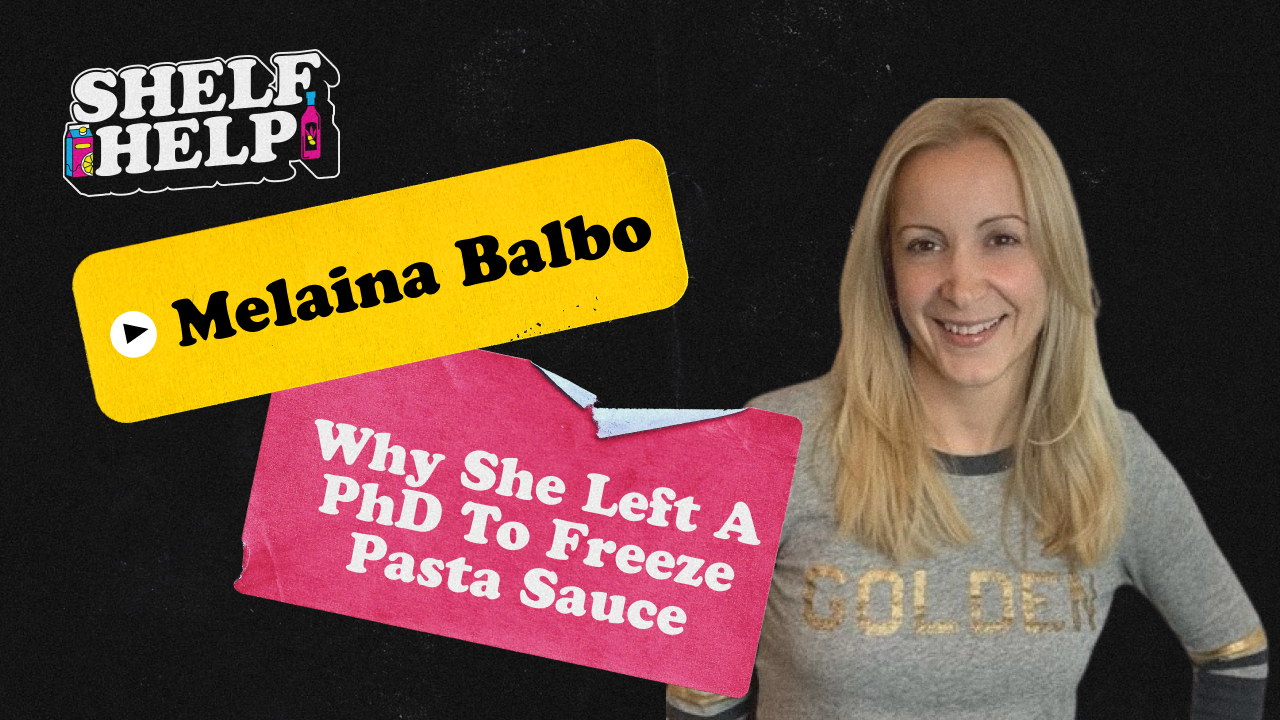



On this episode, we're joined by Melaina Balbo, Founder & CEO of Bis - the frozen Italian sauce brand selling handmade Pomodoro al Basilico and Pesto Genovese in two ounce pucks.
Melaina was deep in a PhD in Italian literature and cinema before she traded the library for the kitchen.
We dive into the origin of the brand, starting with the frozen care packages her parents shipped on dry ice when she was a graduate student, and why Melaina became convinced that processing for shelf stability is what makes a jarred sauce taste like it came off a shelf.
A big part of the conversation focuses on packaging. Melaina shares what it took to find an individually sealable portion cup, roughly 15 versions in, and how hard it was to get large packaging suppliers to call a small brand back. She breaks down what the new labels finally communicate on shelf, with the hero ingredient front and center.
We also get into the accidental first order at her local co-op, why specialty and gourmet stores fit a product nobody expects to find in the freezer aisle, and the buyer feedback that frozen pasta sales lift when Bis sits next to them. Melaina closes with the advice she would give a founder a year behind her.
---------------
Episode Highlights:
🇮🇹 What Bis means and why the name works
❄️ The dry ice care packages that started everything
🥗 Why processing for shelf stability changes the flavor
🍝 Two ounce pucks built for cooking for one or two
📦 Testing 15 portion cups before landing on recyclable PET
🍳 Three years in an incubator kitchen 80 miles from home
🏭 The co-man matrix: frozen, format, and state lines
🎨 Why the old packaging was capping the brand
🛒 The sample drop that turned into a first order
📞 Getting large packaging suppliers to call a small brand back
🏷️ Hero ingredients front and center on the label
🧊 Frozen pasta sales lifting next to the pucks
🔮 Home shopping, 3PL, and national distribution ahead
---------------
Table of Contents:
00:00 – Intro
00:59 – What Bis means and the why behind the brand
02:55 – Care packages on dry ice and the frozen insight
04:29 – Portioning the sauce into two ounce pucks
05:42 – The long search for the right portion cup
07:58 – Chef Space and the 80 mile drive to an incubator kitchen
10:41 – What to look for in a co-manufacturing partner
12:21 – The packaging that was holding the brand back
13:01 – The accidental first order at the co-op
14:22 – Getting packaging suppliers to take a small brand seriously
16:06 – What the new labels communicate on shelf
18:23 – Not reinventing the wheel
21:36 – Specialty markets, demos, and local visibility
22:48 – DTC, 3PL, and the cost of shipping frozen
23:39 – Winning shoppers away from the shelf stable jar
24:57 – Why frozen is making a resurgence
25:40 – Hardest lessons as a first time founder
28:35 – Home shopping, national distribution, and what is next
---------------
Links:
Bis – https://eatbis.com/
Follow Melaina on LinkedIn – https://www.linkedin.com/in/melaina-balbo/
Follow me on LinkedIn – https://www.linkedin.com/in/adam-martin-steinberg/
For help with CPG production design - packaging and label design, product renders, POS assets, retail media assets, quick-turn sales and marketing assets and all the other work that bogs down creative teams - check out https://www.kitprint.co/
Shout out to my friends over at Glimpse, the go-to partner for automating retail-related back-office operations and unlocking margin trapped in invalid fees and manual processes.
Are you in the market for a new flexible packaging partner? Check out HD Packaging. Third-generation, family-owned and built for the needs of category leaders like Newman’s Own and A Dozen Cousins. Faster launches, lower costs, and no artwork fees.
Episode Transcript
Speaker 1: 00:00
Welcome to Shelf Help. Today we're speaking with Milena Balbo, founder and CEO of Beast, the brand bringing authentic handmade Italian sauces to market in a pretty cool frozen format. Melena is the daughter of two born and raised Italians, native New Yorker who spent her summers in Italy, former academic who was deep in a PhD in Italian literature and cinema before ultimately decided to trade the library for the kitchen. And yeah, I think Bees is born out of some care packages. Her parents had used to ship in grad school, and then their homemade sauces and soups or whatnot, and they're frozen and sent on dry ice via overnight mail. And that's what's kind of inspired it today. But I know I know Milena will tell us a lot more details here. So yeah, excited to dive into it. Milena, just first off, for listeners that aren't as familiar with Bees, would love to just get a quick lay of the land, just in terms of kind of the origin story, why behind the brand, and then kind of core products in the lineup, and then uh we'll take it from there.
Speaker: 00:59
Sure. Well, thanks for having me, Adam. Yeah. Well, first off, beast or bis in English, if you all prefer. It means in both English and Italian, it means second or twice or again. And in Italian, it means seconds, as in I'll have seconds. Fare il bis means to have seconds. So that's kind of the that's kind of the message we're trying to send here that we want you to have seconds. But yeah, the uh the the idea was that I wanted to I wanted to bring the actual experience of eating in an Italian family. You know, we I grew up literally as, you know, in a in a big Italian family experience. Like I I mean, I want to say Italian American, but it didn't even really feel Italian American. It felt Italian, you know, because they they were all raised in Italy, married in Italy, came over from Italy, so uh so it really felt more Italian than Italian American. And I wanted, I mean, this is a girl who didn't realize that people bought pasta sauce, you know, spaghetti sauce. I didn't, you know, I didn't, why did people buy it? I didn't, you know, so so I wanted people to get that experience. And the only way that I could think to do that was to try and find a way to raise the bar on the flavor. And frozen was the only way I could think to do that. Right now, uh, where our core products are are simple. We have we have our foundational sauces of our Pomodoro al Basilico, uh, tomato basil, and our pesto genovese, which is a classic basil and pine nut pesto sauce.
Speaker 1: 02:37
You found frozen was the only format that you felt like could maintain the integrity of what ultimately led you to come to that conclusion. And what did you find was by going a frozen format you could elevate the you know, quality and kind of maintain the level of experience and quality things that you felt were important?
Speaker: 02:53
You brought that, you you touched on it earlier, and it was the p frozen packages, you know, uh when when I the first time I moved far enough away that I couldn't just drive home, my parents did send me care packages on dry ice of sauces and soups and whatnot. And uh and that was the only way that I ever I ever experienced preserving product like that. And that said, you know, as an adult, you move out, you have your own apartment, you have emergency pasta emergencies, right? So you try to keep some sauce on hand. And I've tried, you know, as I I tried every kind of sauce and every jar and every everything, and there are some great products out there. There are high quality, delicious sauces in jars. I am not trying to knock anybody else's products, but there's always seemed to be something that is different. There's a there's a something that just doesn't taste, just still tastes like it's from a jar, right? Like it's been on a shelf. And as far as I could tell from my inexperienced non-food industry palette, the only thing that I could fathom was that it was because it was processed for shelf stability, right? That's the only thing, like I said, I I this was not my industry. I I had no experience. So I said, you know, that must be it. And taking that out of the equation, that the only thing I could think of was freezing. So yeah, that's what I did. And I did a little digging and did a little research and said, is this possible? Can I do this? And lo and behold, you know, yeah, I could. And, you know, that was the first step. And then the second step in the format, the way we do it, in portioning it and putting it into smaller two-ounce pucks, that came secondary because while the frozen aspect is nice, the second part of my why was not just the flavor. It was, it also came a little bit. The secondary part is catering to the needs of a modern household, which is that it's not always cooking for a family of four or five or more. It's oftentimes cooking for one or two or on the go or whatever. So I wanted to cater to that and also be sustainable and be economical. And so these pucks allow you to cook just what you need when you need it. It allows you to be flexible and so, and it also allows you to, you know, be quick about it. You can just, you know, a quick melting two ounces or four ounces or however much you need. Yeah, it it really caters to to your to your life. So that's how we did that. And it was not easy to get it to where it is, but but yeah, we we finally got there.
Speaker 1: 05:42
What was the hardest part? The one thing that came to top of mind for me was liquid freezes, it takes up a different volume than when it's in a liquid format. How did you count for that difference in volume depending on the state of the material?
Speaker: 05:55
It it took a it took a lot of different experiments with packed. Well, first, I mean, finding the actual portion cups that we are using sort of off the shelf was forever. It took forever. And and in the meantime, in the meantime, we really weren't using we we try to totally I'm sorry for sounding a little bit discombobulated here. Initially, we couldn't find the cups that we currently have, which were the cups that were in my head the whole time, right? That was the idea. Yeah. And so and so in order to get the serving size that that this was exactly what was in my head, right? And it was the right serving size and everything. And you couldn't really, you know, play around with it all the time, right? You couldn't keep changing it. So we did it in this one particular very inefficient, time consuming way because our first order happens to be a sort of accidental order. And it and we'll get I guess we'll get to that a little bit later. But but what we it basically it just took us a long time. I mean, we tried trial and error, trial and error to find a million different I mean, by the time we f we finally stumbled upon the cups that we have now, and I mean stumbled upon, it we probably tried 15 different portion cups of varying of varying materials and sizes and shapes. And the reality of the matter is at the end of the day, half of them weren't even like recyclable or they were I didn't I didn't even like them. You know, they were I was just it's a matter of going through desperation. These cups that we have are well that they're not they're not plant-based, which is what I really wanted, uh, but they are PET fully recyclable, so that is, you know, a plus.
Speaker 1: 07:57
I think you got off the ground through a I think it was called Community Venture Chef Space Kitchen in Louisville. I assume that's kind of a shared kitchen type space. Yeah, tell me a bit about the journey from starting out in your home kitchen where you're dialing in the formulation to this commercial incubator kitchen type place and where you're at now.
Speaker: 08:14
That was a yeah, that was uh an amazing place. Community ventures is uh an organization in Kentucky that they do a myriad of different ventures there involved with this uh small business association. They support amazing, amazing projects all over the state. I was looking, I live in Lexington, and I was looking for a kitchen here in Lexington, obviously. There's one half a mile from my house, and for a million reasons that are ridiculous, uh, and that's a whole funny story, but uh that did not work out. And I started looking farther afield, obviously, and I came across Chef Space and it's 80 miles away. Yeah. And it's it's a hike. But they had this program that was just about to start. It was called this entrepreneur entrepreneur program. And it was designed for people that, you know, wanted to start a business, obviously a food business, whatnot. And I said, okay, well, you know, whatever. You know, it's once a week for like six weeks. And and then at the end, you get like, you know, two months of free kitchen space or whatever to start. And I said, okay, whatever, you know it, for a couple of months. While I try and find a closer space, I'll do that. Well, you know, it was such an amazing and supportive space. And the president of the of the kitchen, his name is Tom Murro. He was there so invested, really. It's such a true incubator kitchen. It was just amazing that I I ended up staying there for three years. Wow. Because and I and I did that hike. I mean, I I've so many audiobooks and podcasts in deep on that 80-mile drive. But but it was so great because they really helped with every step of of you know compliance and and regulation and just really learning. There were so many supportive people. So yeah, we really grew there and did a lot of work there and and yeah, worked out a lot of kinks in that kitchen. That's great. So yeah, they were really, really great. It was a great experience. And they actually helped us find our kitchen now.
Speaker 1: 10:15
Go ahead, sorry.
Speaker: 10:16
Sorry. No, they actually the kitchen that we are in now is actually also owned by community ventures, but it's our our private kitchen. It's a private space that is in another one of their properties. So it's it just kind of happened to become available, and we were lucky enough to be able to take ownership of it or you know, rental ownership of it.
Speaker 1: 10:38
So you're now in the thick of the Copacker search. What's made it so hard so far? And have you what are you looking for in the right partner?
Speaker: 10:46
Well, it's I think what's made it so hard really so hard is that you know, when you're starting doing it the first time, you don't even really know what you're looking for, right? Like you it's hard. I mean, not that you don't know what you're looking for. You you kind of don't know where to begin looking. So, you know, I I've been getting help now from, you know, people who know better than I. But, you know, what it to me it feels like such a difficult matrix, right? You're looking for someone that does, you know, obviously someone that works with the kind of food that you work with, and then someone that does frozen food, and then someone that is able to accommodate your particular packaging, and then someone that works, quite frankly, I'd like someone that works in our region, right? Ideally in our state, because that sometimes not working in your state, and that's gonna be a hard one because Kentucky is not exactly, you know, it's a small state, right? But sometimes if you don't have someone that works in your state, you're locked out of programs that are are state-centric and and you know, grants and things that are local. So that's gonna be a tough one, which is why we may need to keep our kitchen to work on out of our kitchen, do some manufacturing in our kitchen and and do co-packing for other things. So it's a difficult little matrix to work on, which is why now we're actually seeking some insight from some agencies to see if maybe one of them can help us guide us through that phase of growth, because uh I'm not sure that we are equipped experience-wise to really navigate that.
Speaker 1: 12:19
Got it. No, that makes total sense. Well, I guess totally shifting gears a little bit from a visual identity and and packaging standpoint. You had told me when we chatted a few EAs a few days ago that you felt like the sauce was really where you you want it to be. You feel confident about it. You know, wherever a channel's in, it's gonna do great. But the packaging was was not ready to be scaled and distributed at any level just until now. What did you feel like was getting in the way?
Speaker: 12:44
Well, it it was literally the portion cups, primarily. Um, and that because prior to finding those the cups that were individually sealable and and in the proper format, we, as I mentioned earlier, we were doing our first order was not supposed to be an order. Our first order was supposed to be, I brought it to our local co-op. I had made an appointment with their buyer, and I just wanted to bring him some samples for their opinion, right? To get some to get some feedback. And uh and he said, Oh yes, I shared it with the staff, they loved it. We'll take a case of each. And I, not wanting to disappoint, said, Okay, great. But then that meant that I had to provide them with product that wasn't in the packaging that I wanted. So at that point, we were making using molds and then vacuum sealing pucks in a thinner pouch and then putting them in a stand-up pouch, which is completely inefficient. And and mind you, it that's how we started selling it. And people bought it and it was great, and we grew with that packaging. But obviously, it's not scalable or sustainable in any way, which is also why we purposefully really slow rolled everything while we did this search for the proper packaging that could be individually sealed and would extend the shelf life of the sauce and the pucks and and everything. So that was a a huge, huge uh part of it. And honestly, one of our my biggest challenges personally, as I was, you know, the person I I was the one that was really doing that uh research per you know. I found it really challenging to even find people to to to you know, uh I found it really challenging to even get people to talk to me, being from such a small business, you know, you're this scrappy little group of of people trying to grow a a something out of nothing, and you're approaching these large packaging companies. Uh, you know, I would go to I went every year to the fancy food show, every winter. And I would walk and I would talk to people and I would explain to them and I would show them, you know, the other cups that I and I and I would get some, you know, interesting people to talk to, but I would never really it would never go anywhere. And and I always felt like this I would just get very discouraged because I I felt like I was getting nowhere. Eventually, obviously we we made some headway, but that is a very discouraging thing when you and and you know, obviously, again, it wasn't my industry. I I didn't know really it took me a really long time to to find the right people to talk to, you know, and and make the right connections. Um But eventually, you know, we did. But that was a a major part of it. Now we uh now we have our our pack that packaging in place, our inner packaging, and um and we're getting our custom pouches done, and then and now you know we're at that place where it's kind of ready to go.
Speaker 1: 16:07
So what yeah, what actually finally changed and like what do you feel like is now package the packaging now like accomplishes and communicates that it wasn't done before?
Speaker: 16:16
Well, I think well, before in the early, early days, it was literally just something that we sort of cooked up that we liked that we didn't really know. We just you know looked at other it was it was literally a few of us just sitting down with nothing. It just none of us had any skill whatsoever. We just put our heads together and came up with something you know, based on on what we saw in other brands and and what we thought communicated our idea of of Italy and our ideas of our of our culture and our family and and things like that, you know. But now our labels, you know, I think they stand out with the the idea was to to have the ingredients of the of the sauce be you know front and front and center, just like right right up front. And our other sauces that will be coming out, we already have everything all designed for what's coming later down the line, so that when they line up, you know, they'll you'll see them on the shelf, and it's very clear that they're all together, that they're all a brand, that they're standout what what uh what each uh flavor is. They all have their little standout hero ingredient. You know, I think it should it stands like it communicates, you know, the the quality of the ingredients. It communicates that, you know, our customer, I know our customer, our customer reads labels. And I know that when that customer looks at that and they see the hero ingredient, they're gonna pick it up and they're gonna read the back of the label. And so that is that's important to us. You know, that is very important to me. And also, I think the style of the label is very, it's very like kind of old school Italian. Like it's it looks very heritagey, if that's a word. Heritage-y, you know. But um, but that was kind of the idea. I mean, I know that I know that that's maybe not as as uh I know that a lot of people are kind of tired of the sort of classic sauce, and everybody's trying to do a sort of new take on sauce, but I think that kind of gets lost somewhere. Like I'm not actually trying to reinvent the wheel here because I think the wheel has gotten lost. You know, I think maybe people are trying to reinvent the wheel because the actual wheel was never really there. Do you know what I mean? Like I don't know who if people have ever actually tasted real sauce. They've only tasted the sauce in the jar. Like if you have you ever actually sat at the you know, Italian table? This come here and I'm just gonna give you the table and you can sit here and then and then you can take this from here and do whatever you want with it, you know. So I I'm not trying to to do to give them something. Like I said, I'm not trying to reinvent the I'm just trying to reinvent uh a delivery and and uh a way to a way to enjoy it and and a way to share it, basically.
Speaker 1: 19:39
Totally.
unknown: 19:40
Yeah.
Speaker 1: 19:40
From a retail and go-to-market side of things up until now, you've put a pretty big focus on kind of your local area thus far. How did that first kind of co-op conversation go actually come together? You said you had a lot of conversations, didn't go anywhere. Why do you feel like this one actually actually went somewhere?
Speaker: 19:56
Well, I mean, I did have a personal relationship with uh with the with the store because it's our local co-op here in Lexington. So, you know, it's Lexington is not a it's not a small town, but it's not a big city, you know, it's kind of like a big town. So, you know, I go in there a lot. It's a it's our it's our local, one of our local co-ops. We have a couple. So it's not that they know me, but they recognize me. So when I made an appointment there with the buyer, you know, he knew me by face. And I so I'd had a few conversations with him about it. And he was very eager, you know, when he heard about it, when I talked about him with it, when I talked about it with him. Sorry. And so yeah, he he shared it, like I think I mentioned earlier, he shared it with the staff. And I just really wanted feedback. That's all I wanted. I said, would you be willing to try this? You know, tell me what you think. This was the idea. And they really, you know, he came back and said, Yeah, we really liked it. Everybody really liked it. We think the concept is great. We love, you know, they they're really eager to carry local brands and local makers. And the fact that we try always to use local produce when we use our fresh herbs and and onions and whatnot. So they love that. You know, that is a very big thing for them. So they always support that. And uh he said, yeah, well, we definitely would love to carry it. And, you know, as soon as you can, we'd love to take a case of each. And and so there we were and off and running. And that was the first order. And and and from then, uh, we basically, it's been a you know, personal, obviously, outreach every time. And we focused, we have focused from then on on specialty markets and gourmet stores where we are able to be more visible. Because as you can imagine, no one is looking for pasta sauce in the freezer aisle. Sure. Clearly. So the idea, you know, is to go to stores, like I said, where we can be more visible and also to Have a more personal touch, and we can have more, you know, in-store demos, and we can leave product with the store so they can have their own samplings even when we're not there. And there can be a little bit more personal outreach. And that is how we've been able to grow locally. We are also uh available on Fair and on, you know, Air Goods and Mabel. And so people randomly there have we have stores that have found us. So we also are in California and Washington and Florida, Georgia by stores that have just found us and we ship to them. And so that's kind of really neat. But they're sort of, you know, we're they're just one-off stores and uh and we're happy to ship to anybody, of course, but we don't have a a grand following, a grand uh presence in any of those places yet. We are currently working on our 3PL so that we can get back to doing D2C. In the beginning, um when we first uh had our website, we did uh offer direct to consumer because in my naivete, I I just I wanted to have d D2C because I am a D2C shopper. You know, I buy a lot of as a foodie, as a eater, I as a shopper. I love I love buying food online. And uh so it didn't it didn't occur to me that shipping frozen things from one location would be such an onus. But I was happy to do it, obviously. But we took that down for the moment while we revamp and while we get our 3PL in place.
Speaker 1: 23:34
Got it. How do you think about, like you said, most sauces live in the center store pasta aisle right next to the pasta? How do you get how are you thinking about as you get into more and more retail? How do you think about driving people to the frozen section from the pasta aisle versus just grabbing a shelf stable jar that's that's right next to the pasta?
Speaker: 23:53
In the stores where we currently are, uh we have been they have been smart enough to position us next to the frozen pasta and the frozen pizza, so the in the sort of Italian section, right? And and you know, on a couple of occasions I have had buyers actually tell me that they have seen the the sales of their frozen pasta actually lift a little. So that is encouraging. And so it is a nice selling point when you are pitching to a buyer. I mean, I have I don't have it right now, it's simply anecdotal. I don't have enough data to really sell it, you know, but but it is something. And and it is nice, it's gonna be something to to for us to track down the line as we as we grow. I will definitely keep track of that. But I think that is something to to to keep to bear in mind. And also I'd like to be able to have some collaborations with frozen pasta makers and hopefully, you know, do some do some sales together and do some, you know, I don't know, frozen pasta, frozen pizza dough, frozen whatever. I think I think frozen has made or is making a resurgence, and for good reason. I mean, frozen had a really bad rap in like the 70s and 80s when basically we were freezing terrible things, like, you know, really highly processed foods and TV dinners and things that were just not great. But frozen allows you to keep a lot of preservatives out of food. And so I think people are taking to that now. And uh and you know, I I think it's it's brought some people back into that, into the fold, if you will. So hopefully that will that will help us.
Speaker 1: 25:39
Being a solo first-time founder and in a category with especially in the Pasasas Isles, you know, probably some of the biggest brands in the in the world out there. What's yeah, what's been the hardest part from a learning curve standpoint and any recommendations for others that are a similar place but maybe a year or so behind you in in terms of where they are to get smart as fast as possible?
Speaker: 25:59
Uh well, first of the first thing is like, you know, I I don't ever compare yourself to any other brand or any other person or any other, you know, don't compare your product and don't compare your journey because they're it's an easy trap to fall into. And, you know, it's a it's not worth it, and B, it's just irrelevant. And also, I mean, I I highly I mean I can't stress this enough, just really get help, like get a lot of advice and get a lot, you know, go to Fancy Fair, go to Expo West, you know, and I'm I'm gonna I'm gonna pitch them here because I think they're wonderful. But you know, Ali Ball and Retail Ready is magnificent. They are a program that helps CPG food founders like get ready to sell on retail shelves. And I know that I mean, as as a as a uh a frozen brand, or you know, it's it's obviously selling D to C is very difficult. And so going wholesale is a natural fit. However, even if you are a shelf-stable brand, going retail going wholesale is super important. I mean, I know it seems so easy to say I want to go D to C only. It just retail ready is so important for so many things, other than that, even if you don't want to, even if you don't want to go on uh retail shelves. So that her advice, her advice is invaluable. And and even if you don't want to go to her, go to somebody else. Just get a lot, a lot of advice. And uh yeah, and and you know, just take it all one day at a time, I guess, you know. Yeah, makes sense. Every every every brand has to start off as a business. Like you can't just go from one day being, you know, a person and then and the next day being, you know, a global phenomenon. You have to be like, yeah, so yeah, I guess that's it.
Speaker 1: 28:02
Over 10-year overnight six net is the typical exactly, exactly. So well, yeah, I mean, I think when we spoke recently, I mean, it seems like um, you know, this is kind of this is your growth phase that things are starting to pick up and move pretty fast, getting a good amount of inbound interest now, feeling a little bit overwhelming at times in a good way, which definitely know that feeling. At this kind of stage of the business right now, where you're at, what do you feel like are some of the the biggest risks of the business? And what do you feel like are some of the biggest opportunities for the brand at this point over the coming months?
Speaker: 28:35
Well, we have a lot of actually really good opportunities coming later this year. Um, we're looking at we're looking at going uh on to a home shopping network later this year, and we are gonna be getting, like I said, our 3PL in place, and so our D2C is gonna be back online and we're looking at some talking with some other like you know, national distribution. Although honestly, like um that scares me a little, you know. It scares me. That's the part that's overwhelming, right? So that that that's it's scary. So I mean, personally, like I I I feel like risks, I mean, and and I say it's scary to me because I'm just you know, that's just me. I just I live in my head a little bit. But uh but I think you know the the risks are, you know, I guess it's all risky, isn't it? Right. I mean I mean making making a bad decis I I don't know. I I mean everything is risky, right? I uh everything is a risk and everything can be a reward. And I mean, I I don't I guess the risks can be not doing the right thing, doing the right thing, not doing enough. I mean, I honestly, I I can't even think about it that way because yeah, I I just I I look and I leap. So I I yeah.
Speaker 1: 29:58
Not uncommon for entrepreneurs, for sure.
Speaker: 30:01
Yeah, yeah. Um yeah, um I look and I leap. So I I I that's yeah.
Speaker 1: 30:07
It's an exciting journey you're on for sure. Well, yeah, I think this has been awesome. It's been great to hear about what's been on the Beast. I think I think uh we'll be excited to start tracking more closely now and everyone who listened to this episode. What's what's gonna be the best place for people to follow along with with you and and uh your kind of journey and as you continue to learn things along the way, and then where's the best place for people to follow along with the brand as well?
Speaker: 30:28
Sure. Well, I am on LinkedIn at uh Melena Balbo. And uh Beast is also on Instagram, it's eat eatbis, all one word. And on uh Instagram, it's eat.bis, eat.biss. And uh yeah, so please follow along. Our website uh is up, it's uh eatbiss.com. It is being redone, and uh that's it is still up, but it is being redone, so you'll see a revamped in a couple of weeks. It'll be all all new and fresh for you with some some new good things up there. And uh yeah, we look forward to seeing you all there. And uh I hope you I hope you follow along. And and by the way, Adam, let me have your address and I'll send you some.
Speaker 1: 31:10
Sure. I appreciate that.
Speaker: 31:11
Yeah. So awesome.
Speaker 1: 31:13
Well, Melinda, this is great. I appreciate the time. I think uh I think that's the pod.
.svg)