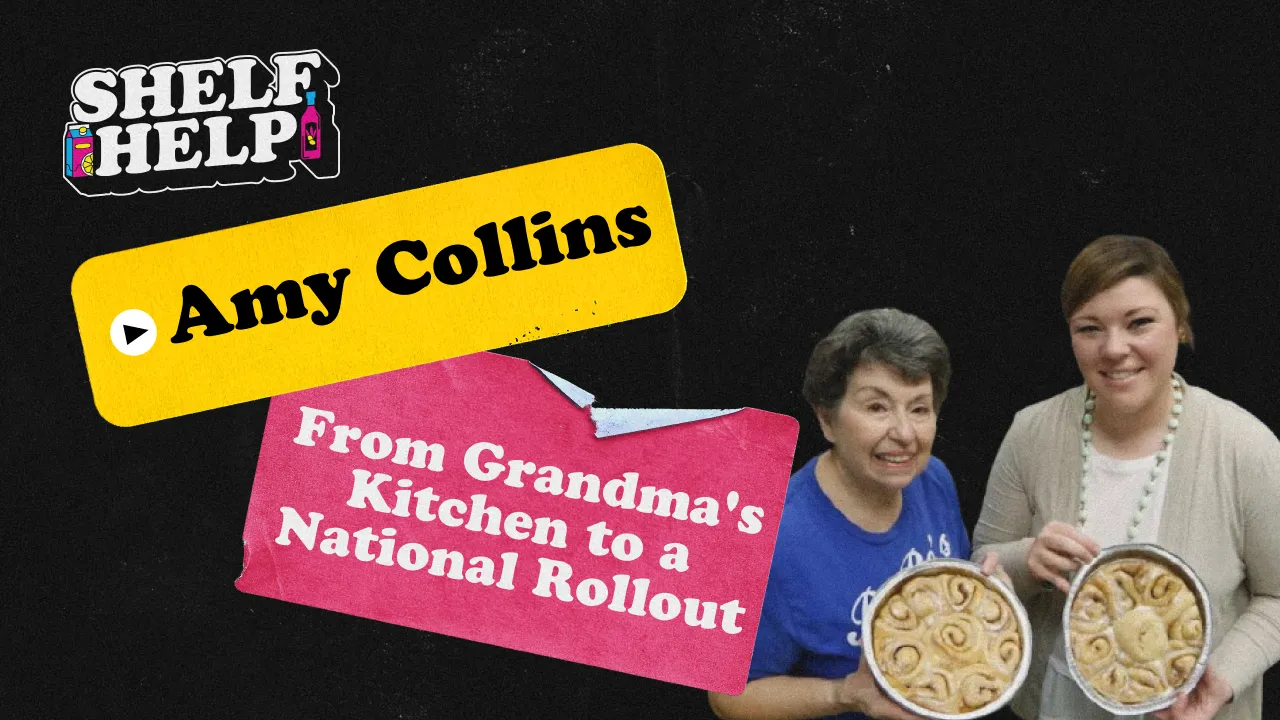



On this episode, we’re joined by Amy Collins, the Co-Founder and CEO of RoRo’s Baking Company, a Dallas-based brand bringing her grandmother’s beloved cinnamon rolls and dinner rolls to freezers across the country. What started as a family recipe baked by hand in a shared kitchen has grown into a nationally distributed brand carried in Whole Foods, H-E-B, Harris Teeter, and more.
Amy shares her journey from ICU nurse to food entrepreneur, how she scaled from self-manufacturing to partnering with a copacker, and what she’s learned about preserving authenticity while building a frozen brand at scale.
We get into the decision behind frozen vs. refrigerated vs. ready-to-eat and some of the learning lessons that Amy has gathered during the journey thus far.
—---------------
Episode Highlights:
🥣 The family legacy behind RoRo’s Baking Company
🍞 Pre-baked & frozen vs. refrigerated vs. ready-to-eat formats
📦 Packaging & brand identity lessons learned the hard way
🏭 From shared kitchen to building a commercial facility
⚙️ Transitioning from self-manufacturing to a copacker
🧊 Competing and winning in the frozen category
🛒 The role of demos in driving retail velocity
💻 DTC and national shipping via Goldbelly
🎯 Managing expectations and staying scrappy
🌟 Trends and brands Amy’s keeping an eye on
—---------------
Table of Contents:
00:00 - Intro & RoRo’s Overview
00:41 - Origin Story
03:53 - Pre-baked & Frozen vs. Refrigerated vs. Ready-to-Eat
05:24 - Brand Identity & Packaging Design
09:12 - Kickstarter & Building Out a Commercial Space
12:32 - Commercial Kitchen vs. Copacker
18:38 - Searching for & Choosing a Copacker
22:56 - The Frozen Category
26:36 - Demos
27:48 - DTC & Goldbelly
31:16 - Learning Lessons & Expectations
32:41 - Trade Shows
34:18 - Trends & Brands Amy’s Watching
—---------------
Links:
RoRo’s Baking Company - https://rorosbakingcompany.com
Follow Amy Collins on LinkedIn - https://www.linkedin.com/in/amy-collins-4a200216/
Follow me on LinkedIn - https://www.linkedin.com/in/adam-martin-steinberg/
For help with CPG production design - packaging and label design, product renders, POS assets, retail media assets, quick-turn sales and marketing assets and all the other work that bogs down creative teams - check out https://www.kitprint.co/
Episode Transcript
Speaker 1: 00:00
Welcome to Shelf Help. Today we're speaking with Amy Collins, co-founder and CEO of Roro's Baking Company. Launched around 2011, I believe, out of the Dallas area. Rorose is a fresh baked good brand born out of Amy's grandmother's homemade recipes. So really excited to get into it, learn more about the journey. So yeah, Amy, first off, just for the listeners that aren't all that familiar with Roro, maybe just give a quick lay of the land in terms of origin story, kind of why behind the brand, core products in the lineup today, and maybe just a few places people can get their hands on them, and then uh we'll go from there.
Speaker: 00:40
Awesome. Yeah. Um, well, thank you for having me. Roro is uh with my grandmother. She passed away this January, but she started the company with my husband and I. I was just out of college. I was a nurse. I went straight into working an ICU job and kind of all during this time got this entrepreneurial bug. I didn't know quite what I wanted to do. And the cinnamon rolls were a tradition in our family. And so she would make them out of her home kitchen. They were a tradition on like Thanksgiving, Christmas mornings, and she would sell them like to friends, family, um, and people would go nuts over them. And my husband and I got married, and she ended up making like 250 pans over the course of several months and just putting them in her freezer at home. And so they ended up being the wedding favors at our wedding. And then it was that fall went to my husband, my brand new husband, and I was like, let's start a business together. Let's just see what happens. You know, I think that we could sell these. I didn't see, you know, myself being a nurse forever. I kind of like just got this bug that I could do this part-time and see what develops. And so, so yeah, we started, we put in all the money ourselves. I think we each, goodness, my grandmother and grandfather and us, I think we each pitched in like $3,000 each. Um, got a logo designed, found a shared use catering kitchen that we rented hourly near us, and we just started. And so um didn't even really realize where we would sell them, thought that we would do coffee shops, kind of just some local markets here in Dallas. And all of those doors kind of kept closing. Everyone in a coffee shop expects like a really large cinnamon roll. Ours was different, it was in a pan, and they were a little bit smaller, and so was introduced to a friend of a friend who worked in a central market store here in Texas. Um, they loved the story and introduced us to the buyer, and she wanted to meet with me. And I met her in the Dallas Lover's Lane store, which is pretty uh iconic central market location here in Dallas. And she loved it. And by the end of the meeting, walked me over to the frozen set and was like, okay, here's where your product's gonna go. This is before um any talks on price. She just loved the brand and she loved the story. I wouldn't even say brand. She loved the story in us. We weren't a brand at that point, nor were we trying to be at that point. And so that is what threw us into grocery, um, the world of distribution. They helped get us set up with a distributor and just started learning the language of what it looks like to sell something in retail. And so that's how we started. We did that hourly kitchen for a couple of years. I would work nights and meet everybody at the bakery every Saturday morning. I don't think we had a traditional weekend for the first couple of years. And we didn't have kids at the time, so we could do it. We had the time. And so it was just kind of the perfect time to jump in and start. Since then, things have grown and are obviously different now on how we operate and produce and do things that we'll get into. But that was really the origin story and and what pushed us into grocery. It wasn't something that I think we were initially planning to do. We didn't say I'm starting like the word or the phrase CPG. I never said that until like five years ago. Like it was just not on my radar. It was not a thing. I didn't know what it even was, and it wasn't as hot as it is now. But um, yeah, so that's how we started.
Speaker 1: 03:52
That's great. What led to the thought process to go with the, I guess, pre-bake that then you can reheat versus selling just the domes or fully baked, but in the, you know, ready-to-eat bakery section of grocery stores.
Speaker: 04:03
Yeah. So when we started, our main reason was we just basically replicated what she was doing. So she would make these pans, bake them, freeze them, and then have the ability to store them. And so that was kind of the beauty and what people also liked about the product is that when they heated it up, it tasted like she just made them. And so when we started, I don't think we even entertained the idea of fresh bakery. You know, shelf life and spoils was something that we didn't want it to go bad. Um, we wanted to really, if we were going to do something, maximize how long that we could even hold on to it. And I think that at the time, like everybody says that frozen is really difficult, which it is. But at the time, I think to us, fresh bakery seemed even more difficult to manage when you don't have distribution. It's just kind of you doing that and what we could kind of lose on that. So, but no, she had a the cinnamon rolls and dinner rolls. Those are the two things that she made. And so that was what we really just launched, exactly how she did them. You know, we would hand package everything with dome lids. It was very labor intensive. Um, but yeah, we just we got a logo. We figured out how to get all the nutrition facts and things like that. We went to school together, she called it, and we got our manufacturing licenses together and all of those things. And so um, but yeah, it was really just that we wanted to preserve what she was already doing and see if other people loved it as much as we did, was really the initial goal there.
Speaker 1: 05:25
From that visual identity kind of packaging design standpoint, what were some of the kind of key variables that were top of mind for you?
Speaker: 05:32
Yeah, I mean, I think initially, so we went through a logo update last fall and a whole packaging update last fall. And so we, the initial logo, I just knew I wanted something nostalgic. She, I believe, picked the color. She loved Royal Blue. That I mean, that truly was how we decided the coloring. And then we just kind of worked a step-by-step process. Like, here's what we're thinking. We only launched with the cinnamon rolls when we started. We actually were called Roro Rose Cinnerolls originally, and then changed the name of the brand a couple years later once we expanded the line. But yeah, so that that was very, I would say, just we wanted something that looked cute, that represented her, something that felt warm. But then as things evolved, and I know we're probably gonna jump back and forth here, but went through 2020, the business exploded that year, did really well. That's what the kind of when we transitioned to two different co-manufacturers. We knew that we had to fix our all of the elements of our packaging because that was a really big chunk of um the cost. And so we knew that we could do that. And so that round, I don't recommend doing it that round. I went to a company that didn't have a ton of CPG experience. Um, it was a recommendation through a printer, and I didn't feel good about it the whole time. And I should have spoken up, but that was just one of those things where sometimes you get so far into something. And if it doesn't feel like it's on brand, like to trust, I wish I would have trusted my gut because we went through that. It got on shelf, fell completely flat. I am obviously not a CPG expert in packaging. And so we did that, got some feedback at the time, thought it was great, was happy with it, quickly realized it was not great. And um, looking back, I'm just mortified, honestly. And so we actually hired Andy Kurtz with Buttermilk Creative, who's awesome. Um, he I went through SKU, he was one of the mentors there. That's how I got connected with him. And um, I just loved his work. I loved just the nostalgic feel that he brought to a couple of the recent brands he had worked with before us. And I liked him as a person. I felt like he got the brand and Roro. And so I think that's a big part is like connecting with who's designing your product because regardless of if they're gonna have the same style, I think somebody who understands truly the feel you're going for, it's really hard to convey feeling sometimes on packaging and authenticity. And so I think he just did a really good job with that and listening to us. We found that having, you know, her picture on the front of the packaging wasn't necessarily people don't really care about that until they taste it and they like the product and love the product, and then they want to know who she is and who our family is. And so I think we learned that kind of lesson through that. And I'm not saying that's the case with everybody. I some people can do that and it works great. But for us, still being relatively unknown in many parts of the country, it just wasn't landing how we thought it would. And so, yeah, our goal was really to lean into taste, flavor, and nostalgia. And those are kind of the subsets that we gave him and brought to him what we really want to convey. And and everything else can go on the back, everything else can be on social media or our website. And that's our job to build that relationship once they try it. But we have to get them to try it. And so, so yeah, that was kind of the whole backstory of the packaging growth and where it came from. And I'm I wish we had done it sooner, but it's hard when you invest a lot of money into something and then it's not exactly how you wanted it. And so I felt like we were taking a risk again with Andy, and um, and I'm super happy with how it turned out. So um, but yeah, that's just starting to hit shelves finally in everywhere this spring. But um, but yeah, that was something we did last last year with him.
Speaker 1: 09:00
It's awesome. That's exciting. Yeah, yeah, I forgot I forgot things about buttermilk.
Speaker: 09:03
Yeah.
Speaker 1: 09:04
You touched on it briefly, but you made that leap, started baking at a small commercial scale kitchen fast forward a few years. I think it was like 2013. You ran a Kickstarter campaign. I haven't really talked to too many people about Kickstarter. Tell me about that journey, however.
Speaker: 09:16
We did Kickstarter. I don't even know what's happening with it now, but we did it when it was like pretty exciting and had just kind of had a lot some success stories. And um and so yeah, we I mean we made a video, we had a play a plan, but it wasn't necessarily, I don't think I knew exactly how to maximize that at the time. And so um I I think I I had mentioned it wasn't a successful Kickstarter. We raised some money, it was helpful, um, but that wasn't how we initially raised money for the brand. And we we truly have never fundraised for the brand, which is also pretty wild. But um, but yeah, so we my grandmother was my grandfather got sick very quickly, and so he ended up passing away. And we right as we were starting, and so we kind of spent a year and a half in a that kitchen I was telling you about, like kind of moving stuff back and forth, storing stuff at her house. It was just crazy. And so she came to me and was like, Amy, I don't want to do this anymore. I believe in this brand. I have this amount of money that I want to give to you. And so she did, I mean, that would was technically like a friends and family, I guess you could say, is what that equated to. And so she put in a a portion of the money for the build out of this facility. We found a warehouse. I became the general contractor of the the build out and I like went to the city, I paid $200. Um, I had no business doing that, but I figured it out and I talked to some friends who had just recently done a build-out um himself and and really just um I learned and I I searched online and I talked to people. And um, so yeah, we hired all the subs and figured out um what we needed as far as a grease trap, rotating ovens, freezer space, all of that just to kind of get us to the next step. And I think that everything we've kind of done in our journey was to get us to this next threshold. What do we need now versus trying to plan out five years ahead back then? I guess is what I'm saying. So so yeah, we did all that. It took about, I don't know, nine to 12 months to get everything before we were up and running. And then at that point, we hired some staff members. It wasn't just us producing it anymore. Um, I was able to focus a little bit more on just the growth and just kind of getting my head above water of like, okay, we have this business, we're selling in in stores in Texas. And how do we incorporate all these other parts that are needed that we've been kind of neglecting because we've just been going back and forth in this chaotic space? Um, so yeah, we stayed there for a while um through 2020. Um and uh it was wonderful. It was hard work, but just to have a place to produce it and really learn um to make bigger batches, larger scale. We certainly were not at scale in that facility, but it was a much larger scale than we could do prior. And it allowed us to expand into more than just you know central market um and and keep up with that. So it was a great stepping stone for us.
Speaker 1: 12:14
Tell me about that decision process of scaling up via deciding to build out your own in-house production facility versus trying to go straight from the hourly kitchen to trying to go find a co-packer. What kind of variables came into play there and how you ultimately decided, yeah, we're gonna we're gonna continue to scale up in-house before we eventually decide maybe we'll go to a co-packer.
Speaker: 12:32
You know, honestly, I think the word co-packer and co-manufacturer probably wasn't even on my radar at that point. I think that we just knew that we this wasn't sustainable, um, that we knew we needed a place just to put our stuff and to produce it. And so I think we I think we probably were starting to maybe look at at what that potentially could look like after we were in our facility for a year or so. But no, it was really just to give us a starting point because we were really limited in what we could produce. And so, and my grandmother at that time was still very involved. She was at the bakery three days a week, if not more. And so it was really just a wonderful outlet for us to continue, continue to create it and build it. And I think we wanted to produce it. I don't think we had an initial desire for anyone else to produce it. Yeah. Especially because we were, you know, figuring out the quality. And, you know, when she started baking it, she the one thing we changed, she would use margarine and we switched it to real butter. And so it was just, you know, some things that, like your grandmother does that isn't necessarily going to translate to a consumer. And so just those kind of like things you had to figure out along the way and testing out, you know, it didn't exactly scale up from, you know, a 10 quart to a 60 quart. And so working through all of those kinks, I think if we would have tried to do that to a co-manufacturer right out of the gate, it would have been a disaster. Nor did we have the business to, you know, need a co-manufacturer. I think um, but yeah, to answer your question, it it took a while to find one too. And I think for what we make, you know, I think with bars or drinks or things, it's a lot easier. Not that it's easy, but it's easier to find there's just more of them who do that. And so, like a yeast-based dough that rises twice, it's labor-intensive that a cinnamon roll, even it's just a lot more involvement and touch points than people I think really understand, which plays into the cost and all of that. And so, so yeah, for a while, we just truly couldn't not find someone that was doing what we needed them to do, um, that would even listen to us. Um, there was a couple here that are just massive, and we just weren't at the the scale to need it. And so, yeah, that's kind of why we started.
Speaker 1: 14:38
Yeah, that totally makes sense.
Speaker: 14:39
Which I'm super glad we did, because I think if we hadn't have made it ourselves, there would just be no way for that quality to still stay there, even through transitioning to co-manufacturers. So yeah.
Speaker 1: 14:50
Yeah, I imagine it's also, you know, you got to a certain scale, understand what it looks like to make your roles at the quality that you want at at least a bit of a larger scale, which I'm sure helped as you were onboarding with a Copacker. I often talk to brands and when they're making that shift to Copac and really getting ready to scale up, there's often you have to make some decisions around potential formulation changes or production process changes just to be able to transition from a smaller kind of self-manufacturing environment to much larger scale Copackers in terms of just creating more efficiencies, using their larger scale equipment, that kind of stuff. Did you have to make any big changes in that front when you did eventually shift to a copacker?
Speaker: 15:30
We did. And so we shifted in 2021, right when everything was starting to go up in cost significantly that year. So we, I would say, so we were planning to do it. I know that we had talked about the um we have two different manufacturers. That wasn't my choice at first. We were planning to have everything produced here and got really close into that situation. And then they decided that it didn't make sense for them to produce the cinnamon roll item. And so I had to scramble and thankfully found our manufacturer now that we have a wonderful relationship with. And now I'm glad that it's split at this point just because it kind of diversifies some things. But yeah, so I mean, we had to change the shape of the roll. We made a decision to change that. When we started, it was a crescent roll shape, which is something that we'd love to bring back and plan to at some point. But at the time, it was either to change the recipe or the shape because costs were just killing us. And so we decided to change the shape. And so that was something when it's a personal brand like that, it's really hard to even change things that some people just don't even care about, but you care about. Thankfully, with the the cinnamon roll scaling up, we I mean, we have not had to touch that recipe, which is amazing. The roles with changing the shape, we had to, you know, obviously alter some bake times. There's the butter ratio changed a little bit with that, um, just because the way it's not rolled up versus on top. And so we had to kind of tweak, you know, adding more on top of the rolls and things like that. But no, I mean, I think that was a big learning curve. One of our buyers once told me she was like, you know, never move to a co-manufacturer when you're launching into a new account. And I was like, why? Like, it'll be fine. And so, but yeah, I just think there was a lot of nothing ever goes right on the first time. It is always something that feels like the end of the world when obviously it's not. But yeah, I think that um the role manufacturer I think was difficult because they're a larger manufacturer. And so that was the most different than how we were producing things. Our first day I walked in, like with everything, you know, measured out and our measuring cups. And he was like, Amy, I don't have any measuring cups in this facility. Like, you need to give me the weights. Like, what are you doing? And that kind of forced us to really commercialize it and and to get everything accurately weighed out. Uh, it really um just kind of legitimized the business to an extent for all of our our recipes and everything is very well documented and and weights that can scale up and translate to different, you know, producers and things like that. So it kind of forced us to do that, which was good, but it was a hard, it was definitely a learning, huge learning curve, big pain point in the business, just a lot of growth and um stretching with with that change. Um you lose control.
Speaker 1: 18:09
You mentioned that uh the there aren't as many co-packers out in the world that can produce the types of products that you have with the yeast and and whatnot. And I just know in general there aren't you know a lot of readily available just lists of copackers, co-manufacturers are out there in the world. Of some of them, I think don't even have websites and whatnot. I'm curious, would you go about actually finding the two that you're working with today? And I guess how did you ultimately know that they were the two right ones, at least for the time?
Speaker: 18:38
Um well, I spent two solid years searching and looking and calling and visiting. Well, there was a few that we got kind of far on the stage, and then the cost was just outlandish. There was no way that it was gonna work. And so it's very difficult. And they definitely are there. It's do they make something and are they already having lines that are in line with what you do? For one of our facilities, we invested in a piece of equipment that they didn't have. Like that was obviously a very expensive, risky thing, which is you know, we own that equity, but um, but at the same time, like it's a give and a take. Uh, you're most likely not gonna find a facility that does everything exactly how you need to do it. And so that was hard because there were some, you know, non-negotiables as far as just how things are produced, ingredients that are used, things like that. Um my husband found one of them in a Google search, and I swear I was like, How in the world did you find this? I've been searching for like a year and a half, and they just come up, and that ended up being one of the ones we go with. We went with, and we still are are with them, and um, and it's been great. Um, it's very hard to find there's lists, and I, you know, you can search co-manufacture list and kind of, you know.
Speaker 1: 19:47
It's gotten easier for sure, I I think in the past year.
Speaker: 19:50
But it's still, it's not there may be somebody that says they do cakes or brownies, and you call and they're like, Oh, we don't do that anymore. We we just do, you know, these things. And so there's a lot of that. And there's a lot of people that, you know, will say that they do these things and and then, you know, it's just not exactly what you thought. But it takes a while. And I think when if you self-produced before, which I do think has benefits, and I would highly recommend to a lot of people, if not all in CPG at least, to produce it for some time, it allows you to know like what's not okay and what's just kind of a deal breaker versus if you're gonna bring something to market, it has to taste good, it has to be a good quality. And I think that a lot of times that can be missing if you don't have like that direct contact with the product and and really know what exactly it's supposed to taste and look like if you're just kind of going in with the formulation. It's just hard to get that, I think.
Speaker 1: 20:41
Um Yeah, totally. If you had to just throw out, I don't know, one or two recommendations for some up-and-coming operators that are a few years behind you, they're about to start search, and then once they find one actually make that transition.
Speaker: 20:53
I think if you and your gut feel like it's not right or the quality is not there, you have to speak up and say something. I think it's so easy to feel like you are just this small fish in this huge facility and and that they're doing a favor for you. And like that you have to speak up for yourself and you can't because that's gonna translate to shelf. And and we've had an experience where, you know, the quality wasn't what it was supposed to be and product was in in stores. And so it's like, you know, if if somebody tried this and didn't have a good experience, like we're never gonna have that person again. And so I think even if you're gonna lose some money to speak up if something's not right, I I think that that's key for your long-term brand success and just realizing that it's a partnership, that it's not just a one-way street, have all of your recipes, own all of your recipes. Some people will go in and tweak things and and then document everything and and just make sure that you know you have ownership of that.
Speaker 1: 21:48
Yeah.
Speaker: 21:49
And I would physically visit them, meet them, see what they're like, see how they treat their staff, and really just feel because that's gonna translate into the products that they're they're making for. You. And so yeah, it's hard. It's not fun to kind of have to stay on top of things. Your job shifts, especially if you move from production to co-manufacturing. You are now a middleman who is kind of managing a lot of moving parts, and that can have its own set of stressors and also benefits. You know, you can place an order and have something to your facility, whereas it would have taken us, you know, a couple of months to make, they can make in a few days. And yeah, I think there's wonderful benefits to it, but it can also definitely be challenging. And I think just going in with, you know, feeling confident and that you are the brand owner, that this is your product, but also really building a relationship is key. And I think kindness also goes a long way.
Speaker 1: 22:44
Shifting gears a little bit, talking about more retail go-to-market side of things. You touch on the frozen section category a bit towards the beginning. What have you found is kind of unique about this frozen category? Yeah.
Speaker: 22:57
So frozen is revamping, which I know you know it's all over LinkedIn and stuff, but I I do feel like frozen is having a moment. And whereas before, I feel like there just wasn't a lot of options. Even now, like if you look in our set, you will see a lot of things that look like they were produced or, you know, invented 20 years ago or launched brands, um, which most of them were more than that. But it just, I feel like nothing has really evolved with the consumer and where they are and just what they like to look at as far as a shelf presence. And I think there's a lot of just inauthenticity that is very clear and frozen. And so I think it's been really fun to see um not only us, but other brands just come in with, you know, joy and color and uh no preservatives. Like there's something that you look on the back of the packaging, and there's gonna be a slew of ingredients that have just been there forever that aren't even needed. And so I think that our consumer who's, you know, buying our product sees that, they see through that. And so I think it's a really unique opportunity to come in and just be a real family brand. And I think that that's being done with some other companies and in other spaces of frozen that, you know, you see the founder, you see the story, and and that hasn't really been done before in this space. I think it's done really well in a lot of other sections of the grocery store, but frozen bread, especially, it's a lot of giants and then a couple little guys, you know, coming up the ranks. But there, there is still a huge gap there and a lot of opportunity um to disrupt. So yeah, I I think that frozen is definitely on everybody's radar. So it's pretty fun to be part of it all.
Speaker 1: 24:44
It's definitely the talk of the town these days for a lot of reasons. It seems like that's one of the challenges is merchandising, standing out of the aisle a bit more. Obviously, you're behind a glass door when someone's walking down the frozen aisle and you want them to kind of draw your draw their attention to Rowros.
Speaker: 24:58
I mean, one of the main changes we made was if you look at the name of the product, cinnamon rolls, dinner rolls, parker house rolls, it's all huge. Whereas before it was a very small thing. The brand um logo we we made smaller. And then the colors, they're not as muted, they're very bright, they're eye-catching. And so just from a shelf perspective, I feel like when you look at it on shelf, it pops. And so that's something just we've changed to try to gain somebody's attention in those few seconds. Another thing is we do a lot of partnering with influencers and local, you know, moms and things. I think that that's a really good way. We do a lot of um something we're trialing, is um kind of adding on digital offers. We've found that we've been gaining a very large percentage, like 80%, I think, of first-time buyers through that. And so really just gaining trial in a in a more affordable way. And so just doing some things that are maybe that people do, but is a little bit outside of the box. And then our packaging as we've updated it, and those images are kind of flowing through on your apps and stuff, it's just much brighter, also and catches your attention and just looks like just a feeling of joy and happiness. And so I think that is really, you know, we can't do stuff in the aisle, unfortunately, and all those kinds of things. But yeah, and also being selective in how we promote and what we in certain stores testing out certain promotions, seeing how they perform, seeing what doesn't. We've kind of learned like what price point gets people to try it, what price point isn't worth the investment. And that takes time and a lot of trial and error and just looking at you know the data, we we stay on top of looking at that every month and and things like that. So yeah.
Speaker 1: 26:37
Are demo is a part of your guys' strategy? It has been.
Speaker: 26:40
We first started, we were doing demos all the time. And we still do demos, but I have found if it's not us doing demos, they're not as successful as far as if you're gonna spend the money to do it. And so I think in certain stores they work better than others that we found as far as resonating with the customer. So it is something that we do still do. And I I definitely like trade shows, things like that when we sample, that is highly our most effective way. We've been able to go to different headquarters for retailers and sample there. I think that's also like a big part of what helps just get excitement and trial, where you don't have to spend necessarily as much money, but just get a big group of people to try them. Yes, sampling is definitely by far, it's just you have to be careful in how you do it. We send boxes to people to pass out to their neighborhoods, those kind of like grassroots things. But yeah, that's I think frozen, it's a little bit harder as far as doing, you know, getting people's attention than it is sometimes in um grocery or things like that, the trials.
Speaker 1: 27:39
But from a D to C standpoint, I believe you guys focus on partnering with Goldbelly.
Speaker: 27:46
So we do a lot of e-commerce on our website. So we 2020 was like half of our business for a D2C, which is crazy for frozen. Once now we've moved into more retailers. We're in about 1300-ish stores. And so now that they can get them more places, we've really focused on in-store. But no, Goldbelly, we met at the fancy food show, those guys, like right when they started doing Goldbelly, and so we've been with them for a really long time. And so we do a lot of our drop shipping from there. We've had a lot of good morning, America features. And so we will sell a bunch of product within a 24-hour period, and so that's a really big e-commerce boost for us. And then we kind of try to build that and grow that email list and kind of push them where they can also find them in stores. And so that's been a really big part of why we built the brand. But but yeah, Gold Belly is nice. Things like that are nice because the items they kind of land into both gifting and groceries. So they can kind of get away with with playing in both spaces. Grocery and retail is definitely are the majority of our business now, but especially when everyone was on lockdown and everything, that's when it kind of we just started to really grow that D2C business. And so um yeah. But yeah, it's they're different animals, obviously, but I think there's benefits to both, and and there's different needs and customers that want both. And uh, yeah, that's how we've kind of grown that.
Speaker 1: 29:02
Yeah. That makes total sense.
Speaker: 29:05
Um product roadmap standpoint. We're really careful not to oversaturate and overextend ourselves. We brought back some favorites. So we have like a pumpkin spice, cinnamon roll, a cranberry walnut cinnamon, those were favorites before we um kind of outstarted not producing them. And then we launched um a jalapeno cheddar Parker house roll this winter. And so that'll be in stores here coming up. And so as far as the process, you know, we really it's very important to us to stay true to who we are, stay true to something that my grandmother made that are her recipes or built on her recipes as far as product extensions. And so I think staying in the role space as we're still establishing ourselves is really important. And then we're testing out doing some rotating SKUs, like seasonal SKUs that you see. Refrigerated does this really well. End caps and stuff for holiday people get super excited, but frozen has never really done this. So that's something we're trialing to do, you know, a skew for the first three every quarter, basically, swap that out with a different seasonal item, but still have that brand block on shelf. So it's not just something and really build excitement and trial. And so that's gonna be a way that we test out some new items as well and just seeing what sticks, what's successful, what's something that people really resonate with without having to, you know, invest in all that comes with launching it because it's expensive, you know, the packaging, the design, everything. And you have to, if it's not selling, then you know, you've just kind of wasted a lot of time and money. And so I think just being a little more strategic and how we trial out some of that. But yeah, as we grow, I mean, we have some ideas for some, you know, extensions. I think that for now we want to stay in the frozen space in the frozen bread, sweet roll category and roll space. I think there's a lot of opportunity that we still have um where we can maximize what we're already doing. Um, and so that's kind of our core focus right now.
Speaker 1: 31:02
Super logical. Um yeah, I mean, it's some super impressive 1300 plus stores at this point, bootstrapped, had a lot of success. I think other side of things, some of the best learning experiences come from when things didn't go exactly as expected, looking back, anything you kind of would have would have done differently that might be helpful to some other up and coming operators that are a few years behind where you are.
Speaker: 31:23
I mean, man, the whole packaging thing was a pretty much a disaster. So I'd say that that was one of them that I regret and wish that I I spoke up sooner or followed my gut instinct. But yeah, I I think that that's one of them, a big one for me. But I'm also really happy with where we landed. I'm a big believer in, you know, there are going to be roadblocks, there are going to be mistakes, there's gonna be a lot of no's. There's gonna be things that you think are gonna be great and are just not. I mean, we've done different shows that I thought was gonna be highly successful. I've gone into, you know, buyer meetings, like with this expectation that, oh, this is happening, and then it's a a no, you know, for a couple of years. And so I think just kind of also like realigning your expectations that it's gonna ebb and flow. It's gonna be, if you're getting into this business, it's gonna be great days and really difficult days. And um, and not everything that you think is great at the time, such as, you know, our our packaging debacle is how you actually see it. And so I think for me, like having other mentors and people around me to kind of help just shed light so you're not just doing it just with your core team of people, but that you have other people and other perspectives just to kind of speak into some things that maybe you're blinded by because you're so in it. And so I think that that's that was a big lesson for me.
Speaker 1: 32:39
Both super helpful. Really helpful. You saw you mentioned trade shows. What have you found is kind of your your favorite one personally?
Speaker: 32:45
So we have done a lot of the fancy food show. We did Expo East before it changed. Um, I've been to Expo West, um, not our own booth. That's something that we haven't done, which I feel like in this world, it's you know, you have to do those things. But I don't think you have to do those things. I think that you go to the shows where you feel like you're gonna get the biggest return. And um so yeah, I'm trying to think what else. We've done some distributor shows, NFRA is a show we've done. Um for frozen. I feel like that's good. Um, but yeah, I I feel like Fancy Food is probably one of the more fun shows with um and a lot more uh results than I think some people have thought. And it's a little bit smaller, a little bit more manageable as far as building relationships. And so and that was kind of the first before all these other things happened. So it's it's been really neat to see just the evolvement of trade shows, even. But yeah, I think they're wonderful. I think it's it's a big way. I feel like we've we've never gone to one that I can recall and something hasn't panned out, whether that's two years down the line from that initial connection. So I do think that they're valuable and you can, you know, go to them every year or you could take a year off. It you know, I think just going based on the needs of your business and not feeling like you have to be at everything is also important. So yeah.
Speaker 1: 34:04
Yeah, I totally agree with that. Now you've been in the C BG space for a while now, definitely in the frozen aisle. Any brands or specific brands or just kind of trends in the the space in general that you've been kind of tracking or things that have popped up in your radar that's gotten you kind of excited.
Speaker: 34:19
Yeah, I mean, I have other brand friends that I love. I went through um with the leisure guys, they're doing amazing. Um, we were on food together.
Speaker 1: 34:26
Yeah, they're great.
Speaker: 34:27
We have friends, a dear friend, Carrie Mori and Callie's biscuits, they're in Frozen and doing great. And so I think just leaning into nostalgia, something sweet. I love those girls. I saw she was on here and really just leaning into who you are and authenticity. And I think there's a real desire for connection that people are looking for. I think that that is translating to what they're buying and what they're connecting with on shelf. And so I don't know, it's fun to see other family brands on shelves that are whether that's siblings or family members or mother, daughter, things like that. I think that it's exciting to see that there's a place for that and that it's uh becoming a more mainstream option for people to buy. And so it's fun to be a part of that because I think, you know, all the bigger players in the space, that authenticity piece is the key piece that I feel like is is missing. And it's not something that you can replicate or recreate easily. And so I think it's just a really unique time and why Frozen is doing so well is because that's just kind of coming back. There's an expectation there from customers. And so it's exciting to see. And I'm cheering all of them on too. So it's been fun.
Speaker 1: 35:35
Well, yeah, I mean, this has been awesome. Really appreciate the time. It's been super informative. I think this will be really helpful for other operators in the space that are maybe a few years behind you. But yeah, what's the best place these days to people to follow along with you? And then best place for people to follow along with the brand as well.
Speaker: 35:49
The brand is our Instagram, it's just Row Rose Baking Company. We're on Facebook, Instagram, LinkedIn. We post a lot of like the behind-the-scenes updates of my life and stuff, which has been fun and connecting with people on there. And then we're in retailers all throughout the southeast, southwest. So Whole Foods, Harris Teeter, we're in Gelson's now, across Finally into California. So, but lots. Um, our store locators on there, and you can find where we are. But yeah, a lot of retailers in Frozen. So thank you so much.
.svg)