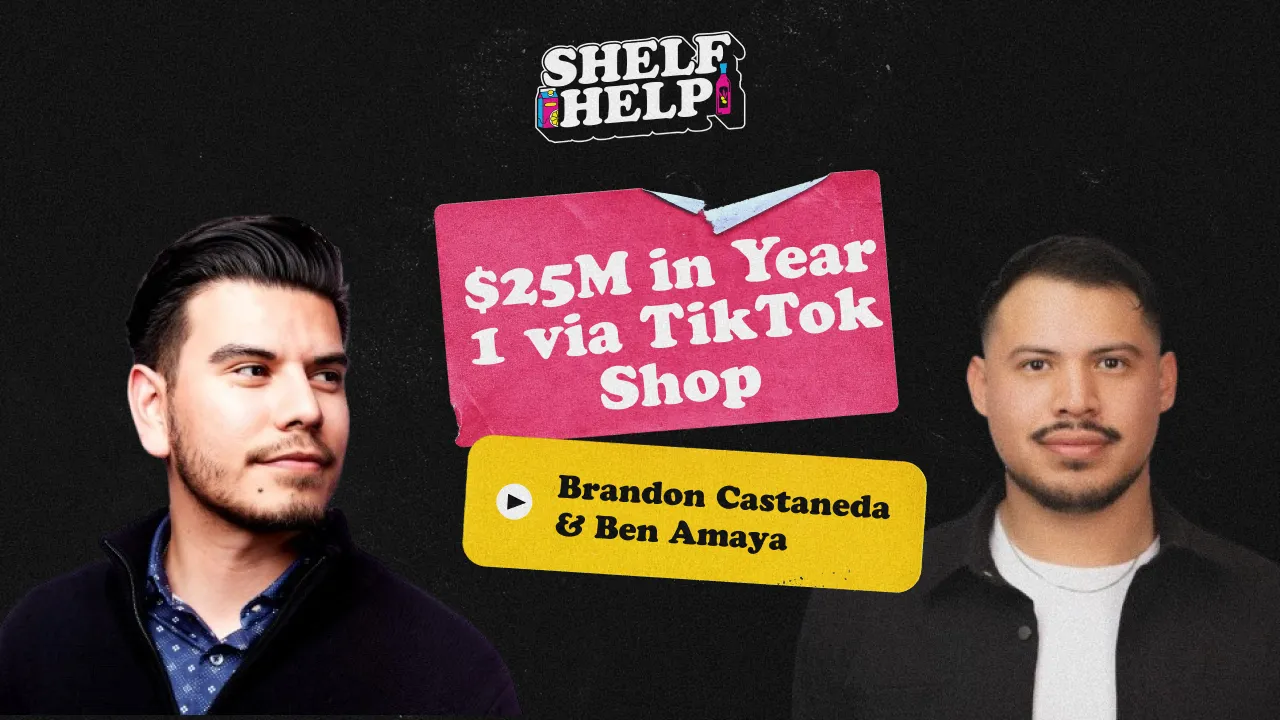



On this episode, we’re joined by Brandon Castaneda, Co-founder and CEO of EZ Bombs - a breakout Hispanic food brand that went from zero to $20 million in just one year by turning traditional Mexican recipes into viral “bath bombs” - and Ben Amaya, the brand’s Director of Marketing.
What started in Brandon’s mom’s kitchen exploded on TikTok Shop, where EZ Bombs quickly became the #1 food brand on the platform. Built on an authentic birria recipe, a family-first ethos, and a network of over 10,000 affiliate creators, the brand has rewritten the playbook on viral food and modern CPG growth.
Brandon and Ben share the full blueprint behind EZ Bombs’ rocketship trajectory - from finding and scaling with the right co-packer to managing 245,000 monthly orders, building a creator army, and preparing for national retail. We dig into packaging strategy, flavor formulation, TikTok algorithms, and the biggest mistakes brands make when they try to scale without a community.
—---------------
Episode Highlights:
🌮 The viral origin story behind EZ Bombs
📦 What Brandon looks for in a great co-packer
📱 TikTok Shop mechanics that still work today
🎯 How to get creator content that actually converts
🔥 Designing for retail and the feed
🥘 Flavor formulation & CPG product dev 101
🛒 Winning the shelf: where EZ Bombs fits in-store
💸 Fundraising strategy and brand positioning
🧠 Mistakes most food founders make on TikTok
—----------------
Table of Contents:
00:00 – Intro
00:54 – EZ Bombs Intro and launch story
03:21 – Family business dynamics
10:37 – Exploding on TikTok Shop
12:59 – Scaling up with a co-packer
15:39 – Seeing the TikTok Shop opportunity early
17:25 – Recommendations for launching via TikTok Shop today
22:53 – Product dev and formulation
27:27 – Nailing down a co-packer
31:57 – Packaging design
38:20 – Expanding into retail
42:51 – Fitting into the right aisle
45:12 – Fundraising
—---------------
Links:
EZ Bombs – https://www.ezbombs.com
Follow Brandon on LinkedIn – Brandon Castaneda
Follow Ben on LinkedIn – Ben Amaya
Follow me on LinkedIn – Adam Steinberg
For help with CPG production design - packaging and label design, product renders, POS assets, retail media assets, quick-turn sales and marketing assets and all the other work that bogs down creative teams - check out KitPrint.
Episode Transcript
Speaker 2: 00:00
Welcome to Shelf Help. Today we're speaking with Ben and Brandon, who are joining us from Orlando, Florida. Brandon is the founder and CEO of EasyBombs, while Ben is the director of marketing. And um Brandon and Ben have been spearheading a pretty meteoric rise at EasyBombs, hitting about roughly 25 million in revenue in year one, primarily via TikTok shop. So definitely excited to dive in in terms of all the success they've had and all of the uh the magic behind everything. So yeah, just first off, Ben and Brandon, whichever you guys want to take this one, just for the listeners that aren't that familiar with Easy Bombs. Let's just get a quick lay of the land just in terms of the origin story, why behind the brand, core products you guys currently offer, and then a few places you want to call out that uh people can get their hands on them, and then uh we'll go from there.
Speaker 1: 00:54
Sure. I'll take this one. So thanks for having us on, Adam. Really appreciate you us being here, a part of the podcast. And to give you a little backstory on easy bombs, it was an idea that I thought of where I had seen that TikTok shop was really taking off, and I really wanted to sell a product on TikTok shop. I knew it had to hit a couple of criteria, it has to be viral, it has to be something you can explain in a couple of seconds, and ideally something that somebody has never seen before. I think that is what is the recipe for success on that platform. So doing some research, I remembered that bath bombs were wildly successful when they first launched years and years ago, and still to this day, it's a massive business. And I really thought one day, like, what if you were to make a food bomb, like a food bath bomb? I think that would really resonate really nicely on TikTok. Uh and then I thought through it, I'm like, well, what kind of food would it be? And being Hispanic and my my heritage and our roots of uh being Hispanic, I immediately thought, I gotta call my mom and ask her, how does she make her her BDR recipes? How does she make her posole, all the different dishes that she makes? Because she's been an amazing cook ever since I've been born. So she's been the family cook. And I called her up, I told her about the idea, and I said, I think this is something we should really take seriously. Let's see what happens. So we launched a business between her, my mom, uh, my sister, and also my dad out of her house at I would say it was November 2023. We didn't know what would happen. We didn't have any idea if this would be widely accepted, if we would just maybe sell a couple of hundred of these. And long story short, it just really started to take off within the first week. We just started to see some of these videos going very viral. And we started off selling on our website, then moved into TikTok shop. And now, as a company, we've been growing into all different types of channels online and also in retail. You can grab them at our website, easybombs.com, you can find them on TikTok, Amazon, and some retailers that we're working in right now are uh like Albertson's Pavilions. We have uh about 600 Walmarts online, so there's just a lot of different places where you can pick one up now.
Speaker 2: 03:08
Super exciting. You saw an opportunity, created a product, you wanted to kind of seize that opportunity, and you guys made it happen to say the least, which is awesome. You mentioned working with your mom and and dad and then you know, son, uncle, whatnot. I'm just curious for being a family business. I think there's often there seems to be somewhat of polarizing views on on both sides about building a business with family from so from someone that's you know actually done the thing, built a really successful business with your family. I'm just curious what what's that experience been like and anything you want to call out in terms of pros and and cons.
Speaker 1: 03:43
You know, it's funny. I I I get asked this a lot, and there's two that are very common questions. One being a family business, and the other one is working with friends. You know, you always hear people talk about don't work with friends, don't do a family business, it gets difficult, it gets complicated. And the funny thing about Easy Bombs is that not only did it start off with the family business, but we have since started to hire a lot of friends and family. So it's really a family and friend business that this has grown. And I gotta say, it does come with some challenges, and and it does come with a lot of benefits. The benefits being that I rather see my family succeeding and my friends succeeding and winning in this experience that we're having with this company and this growth. We're all learning, getting better together. And I can confidently say everybody that's on the team with us and that has sticked with us, their lives have improved, their knowledge has improved since we've started. So I think that's such a huge win and something that makes me feel super proud of what we're building here. I'd say some of the cons that come through this is that the business has experienced extreme rapid growth. And we're now getting into challenges that none of us have ever been in this position before, working with a retailer like a Walmart or Costco. And when you start getting into all of these higher level things where you're dealing with corporations that are massive compared to our small team size, the experience that we lack is is really evident at that point. You know, we've done a really great job navigating those waters. But when you deal with friends and family, I would say that there's obviously some emotional attachment and the feeling of, well, we don't know enough about this, and why are we bringing more people in? Uh so I would say that that the lack of just not knowing. Uh, I think that the family has done an amazing job, though, not only learning as much as they can, but also understanding that it's now time for us to continue to, you know, look and seek for help that is beyond us, the expertise in this field in these areas that we just don't know. Because by the time we figure it out, the challenge has already passed us. We can't even, we don't can't even act on it anymore. We need to deal with it today and learn about it and figure out how we can do better in the next uh time we're in the situation. I'd say Ben was probably the first true uh, I would say, expert in his field of what he does to that we've brought into the company that isn't an immediate family, uh, has become a friend and was like in the process of being a friend at that time. So Ben, I'd love to hear your perspective on how that's been.
Speaker: 06:24
If you see us across the street and I'm just with Brandon, everybody thinks that we're related. So I think as we progressively get to know each other more, I just become closer to the family and become part of it. So yeah, uh it's definitely um it's definitely a cool experience. I think I'm proud that I've I'm part of witnessing, you know, such an explosive product, an explosive team. Um from what I've you know, from what I fell in love with the team at the beginning when I first met um everybody, it was really unique because everybody had a unique role. I don't know if we've kind of laid out already who's all part of the team that was that established this company. You know, we have Brandon here, who's the CEO, who spearheaded a lot of the ideas and also a lot of the strategy at the start. Uh Nicole, which is his sister, she, you know, had her hands deep in the uh content strategy within TikTok, Instagram, and really kind of took a lot of that weight at the time to uh to make the account really get some steam. Um and then we have mom, which is you know, she's she's part of the the trio, which is the founding groups, and she's now the face of the brand, which has really allowed you know the product to to mold itself into a really powerful story. Um, and seeing that they're you know their dynamic with what their skill sets can bring to the table, um, I I think that Brandon, you know, he is looking with really good lenses and from the outside looking in, everybody can kind of nitpick where things can improve. I think everybody has an opinion on that, but nobody knows what the right is what the right opinion is, especially when you have such a uh I would say like tight group of people that one, they've known each other since the beginning of time and and then you know now are progressively growing into new different uh ventures together. So it's an interesting experience altogether. It's awesome to see because uh the Brandon that I met a year ago isn't the same Brandon today. The Tina, you know, the mom that I met a year ago, she's not the same today. She's grown so much in how she likes to film, the stories she just likes to tell to the audience. Um, and Nicole's done so much as far as uh the impact when it comes to social media, um, from doing the content creation with Tina and Brandon at the beginning to now like scaling it to working with thousands and thousands of creators today um to speak on Easy Bomb's behalf, which is exponential. You know, it's amazing to see. And so with that type of dynamic coming in with my expertise on the TikTok shop side of things, it made things so much easier to really just say, hey, you're super strong over here, you're super strong over here. I can help, you know, grasp like that skill set and then just reharness it in some of the directions. Um, the avenue that I feel that it has really where I have been able to add a lot of value has been specifically on the TikTok shop advertising side, and then even with Meta and some of the social advertising. And so I'm dependent still of the dynamic here of them being able to execute. Um, and they've been solid to be able to do that. I can't say that every family business is that way, but that's what makes EasyBomb so great is not only is the product displaying this you know impactful story when they're consuming it as a as a customer, but the people behind the scenes are also doing the same thing internally with within the you know the organization. So I'm I'm excited to be part of the team.
Speaker 2: 10:05
You guys both touched on the t the TikTok shop growth a bit. One or both of you, I think, has spoken about that crazy growth, uh hitting that 25 million in sales and you're one a fair amount on at least one or two other podcasts. So I'm not gonna ask you guys to rehash that and dive into too much detail, but maybe just for those that that are less familiar, whatever you feel like are kind of the things to highlight, I'd love to kind of hear a bit about what that about all about that that crazy journey and where it started, where you started to feel like we were getting some real traction here and you know where you where you are today with it, let's say.
Speaker 1: 10:38
I'll speak on the journey a little bit here and give you some context. So as mentioned, we launched it November 23, and we it was November 6th, actually. We put our first video up, and what was so funny is we built this whole concept with the plan that we're gonna be on TikTok shop and come to find out like a day or two before it's time to go live and we're gonna start posting stuff. We can't sell this product on TikTok shop because we're making it out of my mom's kitchen, like it's not commercially being produced and it's a food product. So if somebody gets sick or whatever the case is, we're like, okay, so that's not gonna work. So plan B, let's just use TikTok for what it does good, and let's just share what we're doing and bring everybody back to our Shopify site. So we just started posting videos, TikTok and Instagram. And our first video that we posted went on to get like one and a half million views uh within about the first week, week and a half. It just really started to pick up steam, and then that video snowballed into the rest of the things that we were posting because my sister was posting three times a day at that point, and we were just really hammering all of the social feeds about this product. And uh what ended up happening is two weeks into the business, we completely had sold out. And when I say sold out, we were we had only made 500 at the very beginning, and we were thinking maybe that's enough to last us this whole month. And we had sold 2,000 of them in a 24-hour period uh at that second week mark. And we were ordered all types of ingredients to arrive to us so we can produce what we've sold because it wasn't even made yet. So we had to shut down the website and we started collecting emails and you know, text message um SMS numbers so that way we can text everybody and let them know, hey, we're gonna do another drop. And I'm not even kidding, every Saturday we would open up the website, and within five minutes, the site's sold out. Like everything's gone. And we just kept pushing the number higher and higher and higher and higher until somewhere around February, we like capped it out at like almost 5,000 orders in like 10 minutes. It was just insane. Like it just felt like no matter how much we tried to keep up, it just wouldn't uh it wouldn't last. We were making 4,000 of these bombs out of my mom's house every single day, and it was just a full production line. So the experience was pure madness up until that stage. What really helped us start to scale more was getting into a co-packing uh relationship with another manufacturer. So they were able to start manufacturing and ramping up where we were going from 4,000 individual bombs a day to now they're able to start reaching numbers closer to 20,000, 30,000 individual units per day, because we were able to just really scale that up. And you know, there was that wasn't perfect either at that time because now we're on TikTok shop and things are really heating up, and we're selling these things faster than they can pump these out of their these out of their facility. So we're literally at this point where we don't have new packaging, we're using like this blank white bag with stickers on the front and the back. And imagine if you're selling 10,000, 15,000 of these bags a day, that's two stickers. Like we have 20 to 30,000 stickers a day that need to be produced. So at some point, I had our sticker guy producing 30,000 stickers a day, cutting them, and at the end of the night, he would put those in an Uber to go to our manufacturing facility so then they can sticker all these bags throughout the night so that way we can keep the flywheel going. So um there's so many of these like little details that just were just so hard to keep up with the scale on TikTok that it it was such an awesome journey with it, and it's such a cool thing to really think back that we survived it, and not only did we survive it, but we like far exceeded what I think anybody in the same position probably could have done. And um after that we got into a co-packing, not the co-packing, um, 3PL relationship that allowed us to really just continue to scale. So I would say from start to uh 3PL took us about like nine months, and by that ninth month, we now were in a situation where we could finally lift our heads up and breathe and realize like, okay, like we've built a machine now. There's a company that makes the product, there's a company that ships the product, and now all we have to do is focus on sales, marketing, and customer service, and how do we improve the experience? So that's that's really kind of what the journey was like. So it really wasn't until about month nine, give or take, where we were now starting to think about okay, how do we produce more inventory to get onto Amazon? How do we get into Walmarts? How do we get into retail? So it was just a journey that just felt like it took a long time in the moment, but looking back, it was just so quick.
Speaker 2: 15:33
It's so rare to be part of something that just catches fire like that. You saw that opportunity with TikTok shop. I'm just curious what gave you that much confidence that early on that TikTok shop is gonna be as big of an opportunity as it turned out to be, and put all your eggs in that basket to it to a certain extent, at least, at least at the beginning, let's say.
Speaker 1: 15:53
Oh man, it was super clear. I mean, I wasn't around to really capitalize on the Amazon early days. You know, if you had an opportunity to get on to Amazon early, you could plant your flag in a category for product, and now everybody's fighting for that ranking, and now you've basically dominated that that sector. And when I saw TikTok shop coming out, they were super aggressive of them trying to gain market share, all the way to the point where if you're a seller, you could come onto the platform, sell a product for $20, $30, didn't really matter the price of the product. And they would apply coupons where some of these people were getting some things for less than a dollar with free shipping, and the seller wasn't eating that cost. TikTok was. So I'm like, there's no way this is gonna last, but what an awesome opportunity to like launch something where it's basically free. It's like a stimulus for e-com. I'm like, if you're not doing this right now, like you're sleeping on the a massive opportunity. So that's that's what really gave me the confidence that TikTok shop is undoubtedly where it's gonna be at. Now, the incentives aren't the same that they used to be. They're still amazing incentives, but we definitely got in at the right times where we got to capitalize on a lot of that seller uh TikTok discounting that was happening, and I think that really springboarded the brand significantly.
Speaker 2: 17:19
It was a really unique opportunity at the beginning. I'm curious from what I know, things have changed since you launched on TikTok shop, but if you had let's just say like two or three things that you'd tell a new founder who's planning to put a big focus on this channel as part of their launch and end growth strategy in terms of where TikTok shop is today, what what would be two or three recommendations you do have for someone that's thinking about focusing on this channel when they're getting their brand off the ground?
Speaker 1: 17:47
Um I have some thoughts around it, but I know Ben's uh spoken at length around this stuff too, because uh we definitely use it around a discovery tool. So, Ben, why don't you take this and maybe give some ideas on how a new brand can take this?
Speaker: 18:04
Yeah, absolutely. I think that the the approach that um that we had taken at the early stages was purely just because of restriction, you know, purposes. If we would have been able to jump in earlier, I think that if the story would have likely still continued to be the same. There might have been a little bit more impact. Um and the one powerful reason why the uh the I would say we we were able to exponentially grow so quickly was just the ability to precede and continue to stay um on top of everybody's for you page. So the the consistency factor is you know definitely plays a role, but without there would be no reason to do that without seeing some type, you know, some type of upside. And the upside really lies in just the availability that TikTok allows brands to create of of crow of driving that awareness to new users. Um, you know, saying something as simple as football in five different videos will automatically place you in a whole different algorithm than you were initially placed, unless you previously spoke about football. Um, so the the the uniqueness of the platform is is significantly different than Instagram. Um we learned that pretty quickly too, where we would cross-post the same stuff on other platforms and other social media platforms, and we can see that users would identify with their product a lot better over here because the intention is there. Facebook and or Meta was still um, you know, trying to identify how to uh make their algorithm a little bit better in that sense. They had had a lot more uh historical background, especially with the consumers in the market. So they've um they didn't I would say that they didn't consider like you know what the value would be to really just allow the algorithm to do its thing. And with TikTok being able to do that, that's where that's what has allowed us to come to the conclusion that TikTok's just the way to be able to tap into newer markets and and educate people on on the products. Um so for now, I think as far as new businesses joining on platform is really on identifying what's the what's the value that the product can add, who is the main consumer, how can I get in front of that consumer more frequently and build consistency around those main points? If you're looking to expand further, how can you almost like sub-niche into it a little bit further too? Um you know, we're talking about football, or you can break that down into micro, you know, uh audiences where you can even go a little further to speak on college versus NFL versus you know the little leagues. Um, so there's there's something for everybody on the platform, and I think that's what's great.
Speaker 1: 20:49
Just to add something, just to add something to it too, is I think the discovery part of the platform is unlike anything else, too. So like even as a company now that is more mature on TikTok, uh, we are still looking at TikTok on how do we not only reach new people with the existing flavors that we have, but we're gonna be putting a big focus around testing new flavor launches because you know you don't want to test a new format of a bomb or a new flavor of a bomb in retail. It's so expensive, so challenging to get into retail in the first place. And then we're gonna spend all of this money to test this in what, thousands of stores versus with TikTok, we could do a drop and say, let's let's just release a thousand and see what the heck happens. You know, that's one piece is the discovery. And then I think the second piece is definitely affiliates. So none of the other platforms or any of the marketplaces that exist out there today have anything close to what the TikTok affiliate program has. And I think that is their secret weapon here because even to this day, we're working with over 10,000 affiliates each month that are posting content for Easy Bombs. So I think if I was a brand on the outside. Looking at how can I utilize TikTok? Whether I'm new or an existing brand, but I'm not on the platform yet, I would definitely hit the affiliate strategy hard first because your content can suck genuinely. Like your own personal content can be terrible, or you could probably not even post at all. But if you have thousands of affiliates posting and talking about your product, they're gonna get way more sales than you because it's just a matter of like math. Like if you have 10,000 videos being sampled and you all could only make a hundred videos this month, you guys worked your butts off to make a hundred videos, you're not gonna get close to trying to make 10,000. So, like statistically, those 10,000 videos might not be as good quality every single time, but you don't need everyone to hit. You need 10, 20 of them to hit, yeah, and that changes your business overnight. Totally.
Speaker 2: 22:54
Talking about formulation, product development form factors. You briefly touched on at the beginning, starting in your kitchen in your mom's kitchen and then shifting to a co-packer. I imagine it took a while to dial things in and find a formulation process that worked. I think as an example, I think I read it sounds like you're getting you're having some issues with kind of like a crumbling texture and getting the right salt levels about you know giving any away any trade secrets. What were some of those key variables that you guys played around with or tweaks you guys made between that that first version versus the version that you knew was wasn't right? Here's how many batches it actually took to get to that stage.
Speaker 1: 23:34
You know, you know what's funny about this is that normally this is a problem when your spices clump up because you haven't used them. Like this is a problem. Like they are clumped up, they're stale, they're like you have to rattle the spice container around to like break them up to actually use them. Yep. So it's funny because it happens naturally over time, but when you actually want to get them to hold, it's not that simple. It's like it doesn't work the same. Uh we tried all different types of things at the beginning. Like we were trying to mix in stuff, like maybe is it oil? Is it you know, a little bit of water, is it the pressure? Does it need to be baked? Like there were just so many different variables that we tested and went through. And you know, being somebody that is not a food scientist expert, you know, we leaned on a lot of Chat GPT to help us figure out what ingredients are safe and how can we do that. And then from there, we started to ask around people that we could find in the industry on how they would go about doing it. So when we landed on the formulation on what we used, um, we at this point still didn't have any like mechanical press that was allowing us to really get that shape that we wanted. The first 500 that we made, we literally like threw gloves on and hand rolled these things. And they look terrible compared to what they look like now. Like, because there's a really there's a balance between how much moisture you add. I really wanted the seasonings to still look like seasonings, like the way that they look like now. So that was really tough in the very beginning. But what ended up happening is we we ended up getting the right equipment, we ended up finding the right ratios of things, and through more trial and error, I think we still to this day have like the best looking product because there are dupes or competitors that are starting to create it, but like ours are super firm, like we've dropped them off of a 10-story building and they don't break, but they have to be firm enough to survive that wear and terror of traveling to you, but also still malleable enough that when you go to cook them, they're gonna dissolve, you know. You don't want it to be soggy, you don't want it to be like a rock. Like you just you have to find the right balance. So uh through making millions of these now, I think we've nailed it. I think we I think we got it down.
Speaker 2: 25:59
When you made that started to make that transition to it to a Copac, did you have to make any formulation or process changes as you made that transition, whether it's to enable automation on their side or to be able to actually produce things at a much larger scale? And if so, I'm curious like what kind of trade-offs did you have to make, if any?
Speaker 1: 26:19
Yeah, so what's cool is that we really perfected the process internally uh at the house. We bought all the equipment and owned all of the equipment internally to do it. Uh, the only differences that we experienced going into the Kopacker was now getting it at scale. Like the first machine that we had would only stamp one of these bombs out at a time. And then the new equipment would now do 18. So, in order to make batches at the larger scales, there were just a couple of tweaks in terms of like moisture content. But even still to this day, we own all the equipment at the manufacturing facility that we work with. We own the entire process. Uh, they're just contracted essentially to make the product. So the product has never changed from the time that we started it to where it is now. Like we've been a part of that the entire way, and there's nothing that has been sacrificed or changed in order to scale it up. It's just like little tweaks of like the difference of going from making $4,000 a day to $100,000 a day. They're just a couple of little changes on uh on on the quantities you're dealing with now, you know? Yeah, totally.
Speaker 2: 27:28
And in terms of actually finding and nailing down that co-packer, what was that process like to actually find the one that was gonna be the good shit?
Speaker 1: 27:35
Yeah, I got hung up on like at least once or twice because it's like, no, we're just we're doing we're happy with what we're doing. We like doing spice blends and that's it. And I was like, okay, that's not gonna work. Uh but what actually happened was we initially were buying all the seasonings and spices from Amazon, but with the volume we were seeing, we literally wiped them out of several items. So now here we are having to fulfill another big drop that we just did. And I'm like, where do we find you know, 500 pounds of guajillo powder? Like you can't just go get that at the store, and then now we need onion powder, we need garlic powder, like there's just so many things that we're missing now. So I just picked up the phone and started calling around all these different manufacturers in the LA area, and I happened to stumble across one that happened to have everything that we needed in stock, which was kind of a miracle. And they asked me, Well, we we have it. Um, you know, how soon do you want to pick it up? And I'm like, today, I'm renting a U-Haul right now, and I'm going down there to go get it. So they were just really kind of blown away by like how quickly we were reacting. We bought a palette of just spices at first, and then that palette turns into like a pallet and a half, then two pallets, then two pallets um two times a week. So after a couple of weeks, they just saw like wow, like this is scaling up really quickly. We started having a conversation around maybe them making the blend for us, so then we didn't have to buy individual ingredients, and then we would produce it because we were still very secretive about how much we wanted to share on the process. But um, we ended up just really getting to meet the owners around it, three brothers that are all my age and they're awesome people. They've actually become like friends, not all just friends, family to us in that regard. And uh they they've been great. So we ended up uh signing some NDAs, put some really strong agreements in place, and then we taught them the entire process. So they exclusively make this product for us and only us. And um not that they would ever would, but contractually they're not able to make this for anybody else. Yeah.
Speaker 2: 29:45
Great. That's awesome. Sounds like a great partner. As we said, it's not always easy, just in terms of what's a recommendation sure you might have for some other up-and-coming founder starting to get formulation underway that had some getting some traction, some good feedback. Now they're ready to start actually finding a Copac or in terms of convincing them to give you the time of day, actually doing that search process, how you vet them and you know, diligence them to see they're actually going to be a reliable partner. Curious what kind of recommendations you might have on that front.
Speaker 1: 30:13
It's it's a call, it's a question of the chicken or the egg, right? It's like I need to show that there's enough demand to get a copactor interested, but then I need a copacker to make the product to get any demand, you know? Um, so it's always a tough one. And I think under a traditional like relationship where somebody's going to find a copacker, they might struggle with that. Because it also depends on where you're at in terms of like your availability to make an investment into what you're looking to do. Like some of these copackers might have you know minimum mortar quantities where you're looking at five to ten thousand units or at least ten to twenty thousand dollars. So if you're committed enough and you have enough resources to be able to pull the trigger on that, it's definitely an option. Another option is why don't you just pre-sale as many of these things as you can with the explanation that they're not gonna ship for a month or two. And then you at least have something to go back to a co-packer and say, hey, like this is what I have. Like, what's the worst that's gonna happen? You refund everybody that paid, but now at least the co-packer's interested and they're like, okay, I think you got something real here. Let's actually make this happen, you know? Or if you pre-paid, let's say you got this bottle of seasoning from me, and I not only refunded you, but I sent you another one for free. And I said, Hey, just thanks for believing us in the beginning. Like, that's just the way I would do it. Is you don't need to necessarily have it every single time to start. If you can have a prototype, a sample, a story, you want to see if people will buy into that and vote with their credit card and actually be there to show up when it's time to sell it versus sitting on pallets of inventory and now you're trying to figure out what to do with it. Totally.
Speaker 2: 31:56
Yeah, that's really helpful. From a visual identity packaging design standpoint, thinking back to as you were putting together that brief as an example, what were the what were the key variables that were top of mind?
Speaker 1: 32:08
Let's uh let's tag team this one, Ben, because I'll talk about the packaging like in its original state to like where it got to like net where it's at now. But Ben's actually dealing with a lot of the packaging stuff as we're moving forward um here. So uh to talk about the packaging, you know, it's funny, like in the beginning, we just literally ordered these like little baggies from Amazon that are meant to hold cookies, and you just put one bomb in, and then like they had the thinnest little glue strip that you had to peel off to like fold it and seal it, and it was so hard to do it with gloves on. And imagine doing thousands of these that I was like, okay, that's not gonna work. Um, so we kind of evolved from that, and we then put it into like that stand-up pouch. We ordered these pouches off U-line, just slap stickers on the front, on the back, and we found that that was actually the best way to do it. And we know once we really liked that form factor, that's when we realized okay, we have to do packaging and like get it custom printed. But more importantly, I want this packaging to really be something unique because this product is unique, it needs to be something recognizable, I need the branding to be on point. So at one point we had, I think it was three different designers that we hired at the same time to just go and start making designs because I didn't know exactly what I wanted, and what we came out with never existed yet. So, like it was really cool to see some people had some terrible ideas, uh, but it was still better than what we were currently selling with. And when I got to see this one, uh, this one was the one that just stood out to me. And I felt like if I was holding this in the aisle of international foods or spices or anywhere in the grocery store, I feel like it's unique. I feel like once you see it and you you got a good visual of it, it's gonna stick with you. And that's like what really drove me to want to pick that as the packaging. So that's where that's where the state of the packaging got to and um what we've kind of rocked with. And now Ben's dealing with a lot of the things that we're working on when you bulk up that packaging, like what does that look like? Because there's some funny nuances about it. So why don't you share the whole cost of stuff we're dealing with?
Speaker: 34:24
Yeah. It's not even that it's uh necessarily a challenge, but I think that there's this new pain points to communicate with the customer, you know, when you're actually going on shelves and you're looking at your product and saying, How's how am I addressing as many questions as that that they might have with literally three seconds of of their you know their time walking through the aisles? Um and we we're at a good place as far as design and and aesthetic. I think we, yeah, what Brandon was saying, like it resonates really well. Uh now as we're scaling up to you know bulk size, where you know uh consumers can buy more than or they buy one single SKU that has just more uh serving sizes, how do we how do we relay that story and then also educate them that this is still a bigger value than you would get online? You know, you're you're a member of Costco, so we're saving you money, but you're getting more too because everybody knows Costco's, you know, there to give them the best thing for their buck. Um and so as as we're looking at everything, we're looking at uh, you know, what is what is a consumer responsive or you know, what are they responding to online and saying, I'm using one bomb every 30 days. Does two bombs, does the ratio of, you know, the impact of serving size for two bombs really mean more to that customer just because there's two bombs in the bag? Or should we just focus on this one bomb value and how much that can uh emphasize what the value of the bulkness of this product is? Um so that's just kind of the I would say the the initial point that we're at with the pouches. And then beyond that is communicating the same contacts now on shippers, now on you know, on standees that are gonna go into the aisles that are additional marketing um aspects. How can I get their attention to answer the same you know 21 questions within three seconds if they are curious? Uh, because I think we have a we're we're in a really good spot as far as the packaging. Uh a fun little fact on a backstory, and I don't know if uh and Brandon, I haven't really talked about it to reflect this far back on on the evolution of the packaging, but um the transition from the sticker to the the prints happened around last summer. And literally that month was our biggest month of the year, and it was yeah, it was around July. And um, when I when I look back, we had uh a progression of the the product evolution essentially that we showcased in the content. So um kind of tying both points of of the packaging and then also the you know what's the value that TikTok brings, being able to be transparent with your audience um showed us that it definitely is a huge value add when consumers can see the growth and the progression of the brand. So I know that sometimes uh it could be a sticky situation to get almost like overanalyze the sit, you know, the the the idea of of making this product perfect out of the gro, you know, out of the initial start point. If you can show the journey to your consumer, they tend to, you know, become a lot more loyal and all the feedback that we've gotten on the current state of the packaging has always been positive. And now it's just how do we make it to where the next person that finds us you know can really resonate with that same storyline and so on.
Speaker 2: 37:53
That's super clear. Yeah, you you you I think you touched on that a little bit in terms of having to be able to answer all those questions and catching people's attention and they're walking down the aisle, and you've got people say you've got three to five seconds max. Um that kind of leads into my next question, talking about retail. So you guys had so much success on TikTok that at some point you decide, okay, it's it's it's time for us to expand beyond this channel into brick and mortar retail. I'm curious when did you guys know it was the right time to launch in retail?
Speaker 1: 38:28
I don't know if we knew that it was the right time. I just felt like it was naturally the next step because what what happened in our first year, it was all focused around TikTok because that's all we had enough inventory to even you know fulfill. There was there were so many times where we were just running out and we were literally sending our last shipments out the door, and we weren't getting new product till the morning, so we had to stop even packing orders until the next day. Like our label maker was just constantly shipping, like printing these shipment labels. So year one was TikTok. November of the first year is when Amazon came online and they do all their fulfillment, so that was easy. I'm not a big lift. Uh, but then all these stores started to really hit us up, and different stores wanted to work with us, and you know, we we wanted to be a little bit selective on how we did that and understand what we're gonna do before we just say yes to everything. And it's funny because we started off the year with about 12 stores that had our product, and the only reason that we were in those stores is because our manufacturer has a good relationship with them and he already sells a bunch of product and manufactures for them. So he just put it in those 12 stores. The velocities have been great there though. And um, we had a goal. We were like, let's just try to close out 2025 with 500 retail stores. Like, let's let's grow out of that. I think that would be an awesome win if we can get to that number. And now, fast forward, like here we are in the beginning of July, and as we stand right now, we're I think somewhere in the neighborhood of like 1,200 stores, with probably gonna end the year with the range of like 2,500 to 3,000 uh altogether. So it's just snowballed up so quickly. And I kind of feel that one thing that is really solid advice for anybody that wants to work with some of these some of these stores is that a lot of them are creating their own marketplaces, like Walmart. So Walmart had already expressed interest with us last year, and it's such a slow game of ping pong where it's like they email you and then you email them, and then you wait like three months. It's like trying to communicate with somebody on Mars, like it takes forever, you know. And then uh what ended up happening is in January, we ended up getting on Walmart.com, and the only reason we did it is because people were taking our product and selling it there, and we're like, that's not us, and then we would have bad, you know, customer service complaints come in. So we ended up getting all those taken down, and we're like, well, we've already gone through the whole setup of this Walmart.com thing. Like, why don't we just send some inventory there and get things started? So we sent it at the very beginning of the year, and at that time we had gotten invited to Bentonville, uh Arkansas, to do an um international food summit for Walmart that they were hosting, and it was just so I think everything just aligned perfectly at that time because they had already expressed interest. Now we're on their platform, and they started to see sales were like doing very well for somebody that's on the platform for two, three weeks now. Like you guys are crushing it. What the heck is going on? So now rather than us convincing them on how well we think we're going to do, like the proof is on their platform now because we can't make that up. So I think that's what really accelerated everything and what really poured fuel on the fire for Walmart. Uh the difference with Costco was there was a lot of viral success, which led us to an opportunity to do a roadshow with them. And the roadshow program is basically you've you've probably seen them at your Costco's, like, you know, and they're all they have a bigger booth and they're giving out a lot of samples, and they usually have like a unique deal. So we did a roadshow program with with Costco, and we did it actually in our hometown where we started the company, and it was really awesome because we broke records on the most sales in a four-day road show that any company has ever done. So we absolutely killed the numbers. And because of that, like we're launching in about 30 clubs in uh SoCal with the plan to expand into many more clubs and regions in the Costco network. I think it's going to do awesome at Costco.
Speaker 2: 42:49
This is kind of uh in the weeds question, but where where in the store did you guys envision the product with Sit Andrew? Where did retailers fit? I'm talking about whether it's the you see I think you mentioned the international aisle, the Hispanic aisle, or there's also the spice section. Maybe it sits, maybe it should sit near the meat section where you're actually that's what you're actually going to be using it with. But yeah, I'm curious how did you guys think about that and how did retailers think about it? And was it were you guys on the same page, or did you guys have to do some convincing, let's say?
Speaker 1: 43:18
You bring up a good point because if we launched a cereal brand, then it's like obviously you're gonna go next to the cereals, you know. If we if we launched uh a can of vegetables, like you're going in that section, it's very clear cut. But because our product it truly is seasonings and spices, and it's a blend, it's like the form factor and the difference in the product and what it produces, it it has a lot of variables. Like you're right, it can be in the meat department, but not all stores have a meat department. So we're like, okay, maybe that's not the right approach. Uh, but we do see that when our product is in the store, meat sales go up too. So that's like an interesting correlation. Uh we did talk about the spices, but if you stand in front of a spice aisle, it's all single ingredients typically. There's less of the blends there. And if they are, like you'll start to see like those taco seasoning blends and stuff like that. I think we would pair okay in that area. And then when we got to the international food sections, like it's just clear as day. It's like you're selling taco shells, tortillas, tapatil, tahin. Like these are all the things that people that are already familiar with somewhat of Hispanic culture are looking at. So like, why would we try to have an uphill battle when we're like next to the gravies and like stuff like that? Like we should be right here where people can see us front and center. So uh retailers agreed. Uh we had some data to suggest that the international food section gets a little bit more food foot traffic uh than the spice aisle itself. So I think it it's I think it's a good home for us, and we'll see if it actually pans out to be a good spot or not.
Speaker 2: 45:00
Yeah, totally. You guys are just growing, growing so quickly and so fast. I have to imagine you have investors approaching you guys. Have you guys raised money at this point? And if not, again, I imagine you guys are getting approached.
Speaker 1: 45:13
You know, we've bootstrapped it from the beginning. Like we we started this company with no debt. I mean, I put in the first contributions of cash to just get things off the ground and in the right direction. But the company has been very profitable from the very beginning, it's grown extremely fast, but we've been able to manage the cash in a way where we can just continue to like scale this up. And even to this day, I don't necessarily feel that extra cash in the account is going to really move the needle for us right this second. So we are entertaining uh different opportunities that have come our way because there is a ton of PE firms that have hit us up and want to talk with us and want to, you know, hopefully make an investment. I do believe we are going to take on an investment, whether it's in the short term or within the next six months. But I think it's gonna happen sometime this year, if not maybe Q1 of next year. And more than anything, I think the investment is going to be geared around what are some of the bigger swings that we can take from a full-out nationwide marketing campaign? Like, what does that cost look like? What are some of the cost that we're gonna need to have in the bank to acquire a you know very experienced executive team and seasoned team around this retail and digital strategy? Like these are two big components. And I would say the third one that is less of a concern right this second, but with the escalation of the growth is floating the amount of inventory that we would have to float. Like, you know, if Walmart puts in a $2 million PO, you know, we could float it, but then what if Costco hits us with one at the same time? And what if Albertson's hits us with another one that's like next thing you know, like the cash amounts are just they start to get really excessive very fast. And although we have ample cash in the bank, we have lines of credit, like we have all these things at our disposal, uh, the fear would be is that the scale could be growing so quickly that the inventory demand is gonna need to be there. So I think putting a good solid plan together is what we're working on right now. And um, I don't know what we would be seeking or what we would be comfortable with, but I feel like you're gonna see a headline in the next six to nine months that shows Easy Bombs has taken on X amount of equity. And hopefully in a few years from then you see another headline that says that we sold.
Speaker 2: 47:42
So I mean, I think I've heard I don't know what that's saying is, but people often say the best time to raise money is when you're not trying to raise money. So it sounds like you guys are in a good position from that standpoint.
Speaker 1: 47:52
Yeah, it's that, and then the other one goes is the best time to sell is when you feel like it's not time. It works both ways.
Speaker 2: 48:03
Yeah, for sure. Well, yeah, guys, it's been awesome. I really appreciate the time. I think this has been super helpful. I think people are gonna get a lot of value out of this. Um I think pretty obvious where to follow along with the brand, TikTok, and you know, I'm sure some of the other socials, but for you, for you guys individually, what's the best place for people to follow along with you guys?
Speaker: 48:22
Yeah, LinkedIn, you can just look up Ben and Maya hashtag easybombs and yeah, go find me.
Speaker 2: 48:28
Perfect, straightforward.
Speaker 1: 48:31
Yeah, I don't know. I'm I'm kind of a a little bit of a ghost online. I mean, I have uh I have my you know, obviously LinkedIn profiles and like Instagram and stuff like that, but I don't really do a whole lot or post a whole lot. I've been really heads down on stuff. If you want to follow me on LinkedIn or Instagram, you know, you can. That's a good spot, but I I don't really interact there a whole lot just yet. Trying to focus on this and then maybe, maybe I don't know, another couple months or a year or so you might see me be more active on there.
Speaker 2: 49:02
Yeah, makes sense. I think that's the plot. Appreciate it.
.svg)