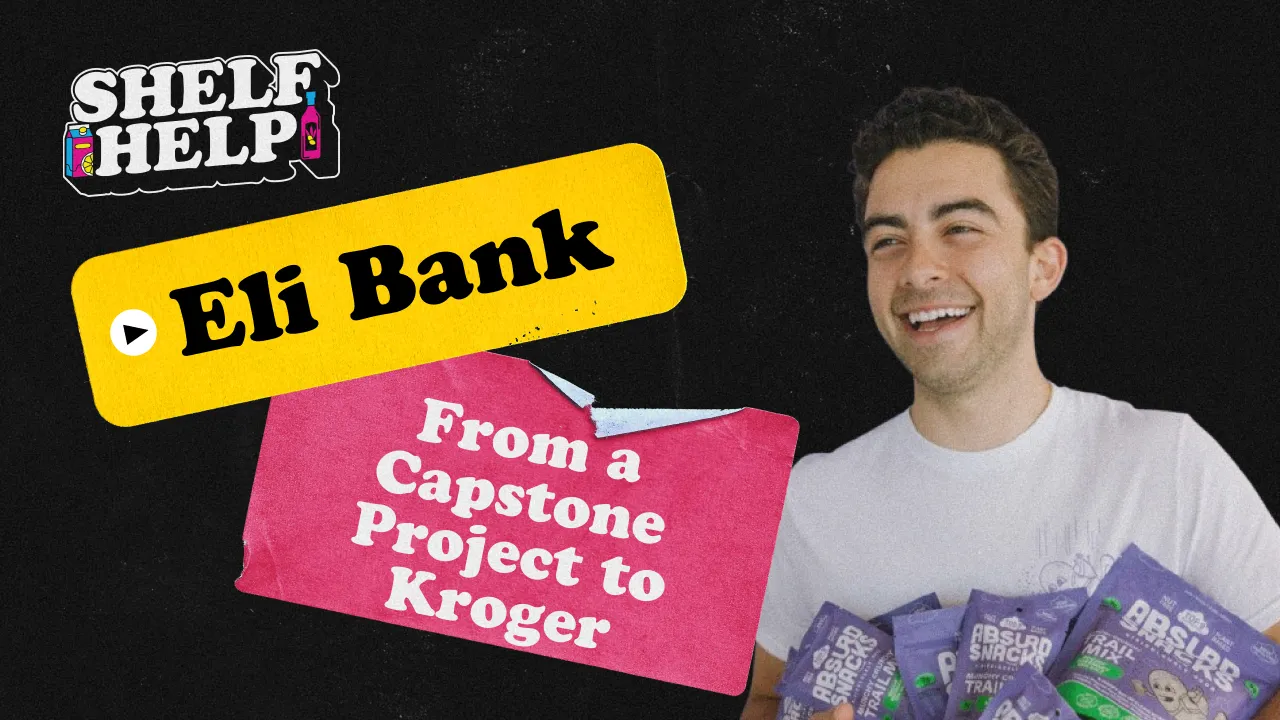



On this episode, we’re joined by Eli Bank, the Co-founder and COO of Absurd Snacks, a top-9-allergen-free, snack company that started as a senior capstone project at the University of Richmond and now sells in Whole Foods, Kroger, Publix, and college campuses across the Mid-Atlantic.
Eli walks us through how he and co-founder Grace turned their classroom idea into a fully commercialized brand, navigating student grants, allergen-safe formulation, hand-filling tens of thousands of bags, and eventually scaling to a co-packer.
We dig into the behind-the-scenes of launching in national retailers, demo tactics that drive real velocity, and how grants in the early days can be an alternative to fundraising.
—---------------
Episode Highlights:
🥣 From college project to Whole Foods shelves
💰 How to fund your brand with grants (instead of VC)
🌰 Making snacks that are top-9-allergen-free
🏭 When to move to a co-man (and how to pick one)
🛍️ Opening doors at Whole Foods, Kroger & Publix
📈 Demo strategies that actually drive turns
🎯 Channel differences and retailer expectations
🚀 What he’s learned after producing 100K+ units by hand
📦 Fancy Food Show & trade show strategy
📊 Trends Eli’s watching in snacking and allergen-friendly CPG
—---------------
Table of Contents:
00:00:00 – Intro
00:40:11 – Absurd Snacks intro
04:17:00 – From capstone project to on the shelf
09:49:25 – Grants, the alternative to early-stage fundraising
11:48:25 – Formulation and commercialization philosophy
14:21:26 – Transitioning to a co-packer, allergen free reqs
19:36:22 – A bunch of recommendations surrounding co-packers
22:50:08 – Opening up the first few doors
25:54:07 – Demo strategies
29:36:18 – Whole Foods vs Kroger vs Publix
34:16:26 – Fancy Food 2025
38:37:09 – Trends Eli is tracking
—---------------
Links:
Absurd Snacks - https://absurdsnacks.com
Follow Eli on LinkedIn - https://www.linkedin.com/in/elibank/
Follow me on LinkedIn - https://www.linkedin.com/in/adam-martin-steinberg/
For help with CPG production design - packaging and label design, product renders, POS assets, retail media assets, quick-turn sales and marketing assets and all the other work that bogs down creative teams - check out KitPrint.
Episode Transcript
Speaker 1: 00:00
Welcome to Shelf Help. Today we're speaking with Eli Bank, who's joining us from the Richmond, Virginia area. Eli is a co-founder and CEO at Absurd Snacks, a better for you brand that focuses on allergen-free, new, nutrient-rich, maple-sweetened snack mixes and other things like granola clusters. Eli and his co-founder Grace started the brand in college. So, Eli, for the listeners that aren't as familiar with Absurd, give us just kind of quickly the land in terms of origin story, why behind the brand, some of the core products you guys offer, maybe the most popular ones, and then maybe just throw out a few places that people can get their hands on them and then uh we'll go from there.
Speaker: 00:40
Awesome. Totally. Well, hey Adam, it's it's great to see you. Thank you for having me on. Um excited to share more about Absurd. We we started Absurd about three years ago. It was a senior class project when we were a student at the University of Richmond here in Virginia. Kind of an experimental program that aimed at giving students from all over campus, so from all disciplines, an opportunity to ideate, create, and launch a packaged food product. And so, like any entrepreneur, we were inspired from a problem that that plagued people that were close to us in our everyday lives. It was actually a classmate named Dan who had severe food allergies, and I really struggled to find snacks that were safe for him to enjoy. Grace and myself, who now run the company full-time, we are lucky enough, knocking on wood, to not have any major food allergies, but we're inspired from the need of having snacks that pull up a seat for everyone at the table because allergies have this domino effect that don't only affect those with them, but those around them. And we don't think it should be so absurd for food to be more inclusive of folks with food allergies. So we kind of set out on this platform. We wanted to make snacks that were safe to enjoy and share, but didn't sacrifice on taste and nutrition. We saw so many other brands out there that were, you know, just free from one of the top nine food allergens or just free from another food allergen, but that was kind of the core of their company. With that, um, sacrificed the uh clean ingredient labels and uh you know macronutrient forward products that consumers really look for and need in their diets and in their pantries. Um of course, you know, taste is king. So if a product doesn't taste good, um, it's not gonna be enjoyable for everyone. So we really wanted to remove that stigma. Um we started producing here in Richmond. We were selling at farmers markets and getting the lay of the land, getting feedback. And what we quickly realized was that this problem plagues families everywhere. So no matter where we were selling, no matter who we were meeting, everybody knew someone with a food allergy and could see why this was such a big opportunity. Our flagship products are snack mixes. They're primarily made from crunchy roots of chickpeas, those granola clusters that are made with seeds and oats, and our dried fruit. We have two flavors right now: a rosemary sea salt, so they're more on the salty side, salty savory, and then a maple cinnamon, uh, just sweetened pure maple syrup. They are free from preservatives, natural artificial flavors, um, just packed with really clean, simple ingredients that you'd find your pantries at home. Yeah, and people love to eat them on their own. They'll use most crunchy toppers. It's interesting. We launched it as a um a snack mix, something that you'd keep in your pantry, take on the go with you, but people start getting really creative. So they would throw it on top of a soup or a salad, they'd use the maple on their yogurt or ice cream, and that's something that we've been able to lean into as a kind of a versatile uh product that has many uses throughout your day. So that was 2022. And since then, we rebranded, reformulated. We now sell in, we actually just hit the 200 store mark, which we're super excited about. Mostly retail stores around the Mid-Atlantic, so Whole Foods, Kroger, and Publix, a lot of independence. We do some food service as well, like hospitals and universities, and uh gonna be on Amazon Prime soon. And yeah, continuing to grow and learn. And now, yeah, we're starting to think about what's next for the product line as well.
Speaker 1: 04:09
Super exciting. Super exciting. Yeah, it's it's uh I know we connected a while back. It's been exciting to see the journey. And I know you guys, as you said, started the brand in college. I think it was started as like a capstone project. So assuming that that is correct, I'm curious. Like, when did you and Grace know absurd snacks wasn't just a capstone project anymore and was actually evolving into a real company?
Speaker: 04:33
Yeah. When we started selling, we were primarily at farmers markets. So we'd do like two to three farmers markets every weekend, and then we started selling into some local retailers, um, which were actually recommendations from consumers at these markets. Um, places that they shopped often. Richmond has been an awesome place to grow the business too. People are really passionate about artisans and local makers. Um, and it's a big foodie town. So kind of that cross-section um has created a really warm embrace. But um, I think we were able to kind of align the market opportunity where we see food allergies affect over 120 million Americans, more than one in four families, and more money is actually spent on allergen-free food by those who we we would call them like allergy adjacent. So not necessarily those with allergies, but those with an allergy in their household or in their place of work. And that number continues to grow at an exponential rate. So there's really a need for products like ours. That combined with the qualitative data that we'd see, you know, speaking and meeting consumers face to face and just seeing the emotion that came to them when they were able to learn about a brand that was, you know, doing something that was not only so close to home, but also could potentially save a life, is um, you know, carries a lot of weight. So once we started seeing that kind of day in and day out, we said this thing really has some legs, and we were having a lot of fun doing it, and there was no time like the present. So we were able to kind of keep going after school. The opportunity was extended to the other 14 students who were with us at the time. They all decided to take full-time jobs and go the corporate route, and Grace and I never looked back.
Speaker 1: 06:13
That's awesome. Now you guys are getting bored for it. I love it. What were the like what would you say were the pros and cons of starting a company in college? Like I imagine, you know, at least back when I remember being in college, people are super open to chatting with you, people open to being like mentor and people willing to help college kids and students, but obviously less experienced. So yeah, what would you feel like were the the pros and cons? And I guess looking back now, would you you know recommend starting a company specifically in the CPG space in college or recommend waiting, getting some more experience, capital? Like looking back, what's what's your take?
Speaker: 06:47
Yeah, it was a really interesting experience. I would say a pro was definitely the roots of our story. People, especially like those local retailers, by the time that we graduated, we were selling in about 20 stores, and those 20 stores took a chance on us because of our story. And so having kind of that footing to go off on really gave us a foot in the door. We were also able to participate in like some student pitch competitions, which gave us some funding up front, which was really helpful, especially coming out of college, not having any funding, for lack of a better term, being young, dumb and broke college students that we're just kind of figuring out as we went. But yeah, I would say maybe one potential con was that we were kind of on our own. And it was up to us to build our networks and to learn from people who had done it before. We were very lucky to have the support of our professors who had industry experience and had startup experience and were able to kind of take us through the process of customer discovery. After graduating, we took a step back and we were able to conduct 75 customer interviews with people that we anticipated would need our products. And learning that process of really being able to gather organized and concrete feedback helped us to really validate the opportunity. Um I think without that, you know, we would have kind of been stepping in blind to something that we didn't uh know a ton about. So I would say um a big pro was to your point, like people were willing to lend a hand and to help us out. But the con is being your own boss, it's definitely up to us to continue, go make that happen, and then show up day in and day out.
Speaker 1: 08:29
Yeah, totally. For those young guns in college that have an idea, thinking about getting started now, don't want to wait. What's I don't know, recommendation or two you might have may I have for them?
Speaker: 08:40
Yeah, I mean, if you're in college, you may not realize how many resources are at your fingertips. Most universities do have uh, we were very lucky to have a lot of support at the University of Richmond. There's a ever-growing excitement for innovation on campus, and there are more programs being put into place, but most universities do have faculty that will have the real world experience to connect you with resources and experienced professionals and programming that can help you validate your own ideas. We actually now work part-time with the University of Richmond as entrepreneurs and residents, and so we have office hours every week and connect with new entrepreneurs who are exploring business ideas and new ventures of their own. So that kind of community, I think we actually are connected through Startup CPG, which is a perfect example of like a free resource that anyone can access, and you can get connected with people who can teach you about potential pitfalls that you might run into or may not see coming. So, especially as college students, I think people are always willing to have conversations, lend some time. Um, and so I'd always encourage them to go out and just learn, just be a sponge and uh never say no to a conversation.
Speaker 1: 09:50
You mentioned um yeah, it's won some grant money in college which I think helped kickstart some things. And I've I've have spoken to a few brands, it's usually in the early days where they're pretty successful, and a few, you know, won multiple grants. And I think when people are getting off the ground, everyone just thinks about going to try to raise the money from investors, and grants don't feel like they're in the mainstream, but it feels like it can be a big leg up for a lot of people. I'm curious, like, what was the I'm sure you guys are competing with a fair amount of other brands, entrepreneurs that are trying to win that grant. What do you feel like was key to standing out and winning the prize?
Speaker: 10:23
Yeah, that's a great question. Some of the pitch competitions that we did were CPG focused and had a lot of food and beverage competitors. Others were less focused on a specific industry. And I think knowing your audience and trying to make sure that your pitch is catered towards them to be relaying the right information is really, really important. Um, and that goes with any pitch. But also bringing the excitement and like we we are absurd snacks for a reason. We started as college students. We never want that personality to fall through or not be a core piece of our brand and who we are. And so we just we like to keep it light and we like to keep it fun. And as a part of our mission to be more inclusive and remove that stigma from foods that are focused on being more inclusive, we really need other people to feel that excitement. And so bringing that energy to the table definitely lended itself to getting other people excited about what we're building, the spirit and ethos behind our brand, where we see it going in the future. Um, then also the traction that we've had so far because we've been very lucky to have a lot of support and to build a really strong community that has allowed us to make it this far and continue to grow. Yeah, I think like the conviction and the founders and the opportunity, and then also just understanding really where and how you're gonna grow and do it intentionally is really, really important.
Speaker 1: 11:46
That makes a lot of sense, actually. Shifting gears a fair amount, thinking back to three days, talking about formulation commercialization. Did you guys, when you're working through those early days, did you guys try any other bases before you came in, honed in on the chickpeas? And I think you guys originally started using Fava Beans. I'm not sure if you moved away from that, but yeah, did you guys try a bunch of different a bunch of different bases? And I'm just curious like what that initial formulation process was like to get to the current or at least the the initial V1s of formulations you were happy enough to take to market, let's say.
Speaker: 12:16
Yeah. I guess taking a step back further, when we started this class, on the first day, we had a Zoom call with Mark Randolph, one of the founders of Netflix. And he just came in to give us some words of wisdom as we kind of set out on this journey. And one thing that he said that was a North Star for us was never fall in love with the product, always fall in love with the problem. And I think in that spirit, we've never been attached to a single recipe. Um, when we got in the kitchen, we were actually split up into groups, and our original recipes um were a brainchild of Grace's from when she had been roasting chickpeas in her college dorm. She was a runner, a V1 runner in college. Um, as kind of an on-the-go snack to get some protein in after a workout, she would air fry chickpeas and then season them with cinnamon sugar, season them with salt and pepper. And um, it was kind of an open canvas to, you know, create these fun little mixes that would give her the protein boost she needed after her workouts. So that was the inspiration for the initial recipes. There were several different types of beans that were tested. We did used to use fava beans in conjunction with chickpeas due to some supply chain efficiencies as well as customer feedback, a lot, a lot, a lot of customer feedback. We decided to take out the full fava beans. So now we do use something like the protein from fava beans in our granola clusters to be able to get the nutrition that they offer. But um, yeah, I guess to go back to your question, we definitely played around with the formulas a lot, um, really let the customer feedback be the guiding light in terms of um what consumers liked and what they were looking for and how those needs are changing too. So that continues to kind of be our guiding force, and you know, we continue to iterate and improve. Yeah, hopefully we'll it'll never be perfect, but hopefully we'll keep inching closer.
Speaker 1: 14:22
It's a never-ending journey for sure. I think you guys just super recently just transitioned over to a to a co-packer, uh, which I know is a is a big process and is a game changer for business, but also it's pretty nerve-wracking. Yeah, tell me about that journey of making that pivot.
Speaker: 14:35
Yeah, we've had a tumultuous journey when it comes to manufacturing, but we always knew that it would it would work out. We just needed to find the right partner to do it. When we started the business, we were producing in Richmond here with a partner who shortly after shut down their manufacturing facility and we had to pivot. And so we ended up finding another local brand. The the hardest piece of our puzzle is that we are top nine allergen-free. And where we produce has to be able to accommodate an allergen-free product. Um, there can't be traces of peanuts, there can't be traces of tree nuts. We need to be completely top nine allergen-free because the safety and security of our consumers is our top, top priority. So we actually got connected with another founder who had a top nine allergen-free brand, but they made products in a different category. However, in their space was an oven that was not being used and they had extra capacity. So we thought, why not see if they can manufacture for us? We can learn the ins and outs of what it takes to run a manufacturing facility, be on the on the floor as much as we can so that we can also be very hands-on with the process, but have a partner to help us bring it to life. And so for about a year and a half, we produced with this other brand here in Richmond until they decided to leave that facility to move into a new space. And at that point, we searched all around Richmond, other areas of Virginia, um, and we ended up going a different direction. And uh, we were very, very close to working with another Copacker, but their minimum order quantities were really high. And so I think like from the outside in, something that a lot of people may not realize is that large-scale manufacturing is really not set up for small brands. It's either you're self-manufacturing in a small kitchen or you're producing at mass, mass quantities. But there are a lot of moving pieces in a big manufacturing facility and a lot of overhead. So it's very expensive for them to run these massive pieces of equipment and run a very small amount of product. And so for a small brand, they're not able, we're not able to afford to work with a copacker of that scale. So we kind of went through the motions, spoke with about 250 manufacturers across the country, some even outside of the country. Um, and we were very close to working with one and making the jump to their um their volumes, but we ended up coming to a mutual decision to put a pin in that relationship and wait until we were at a point where we were at a bigger scale so that it also didn't put a big strain on our supply chain. Um, and that way we could really grow into that volume. So to bridge the gap, we ended up leasing a facility on a part-time basis as needed from another allergen-free brand, kind of going back to our roots and and what we knew and working directly with another brand who had empty line time, but instead of having them manufacture for us, we decided to do it ourselves. And so we hired part-time staff. We put together a food safety plan, we got all of our certifications and audits done, and we started self-manufacturing. We started doing it with just us, and then as demand grew, we needed more and more help. And it got to the point where we were stretched too thin and we had to figure out where we were gonna go next. And along the way, we had support from a number of mentors, one of which was uh running actually a manufacturing facility in the Midwest. And about a year ago, when we were putting together our food safety plan, they were in the midst of an acquisition of another smaller brand. Um, and they were bringing in this brand because they wanted their specialized equipment. And so as we kind of went through this process and stayed in touch with this mentor, um, it got to a point where they um had expanded their facility because of this equipment, and they um were it was all kind of ironed out and they had settled in. And we were continuing to reach out to a number of different co-packers to see, you know, which one might be the best fit, which one could accommodate our volumes and our products. And in having more conversations, we realized that their equipment actually could have been a perfect fit. And so we decided to take the leap of faith and ask this individual who we trust and know really well if they'd be willing to manufacture for us. And so from October of 2024 through the end of spring of this year, we brought that relationship to life. And now we are officially transitioned to manufacturing in an outsourced fashion with a really, really great team of people that we we trust deeply and know they care deeply about what we're building as well. And so just that synergy has been really special. We're excited to now finally have capacity to grow, and you know, it's been a good problem to have to have a supply constraint rather than demand constraint, but now we can finally really step into the momentum and and keep growing.
Speaker 1: 19:25
Looking back now, I know you're I think you're still kind of somewhat maybe on the tail end of that full transition. Looking back now, any recommendations for other up-and-coming brand owners that are about to start that same transition?
Speaker: 19:37
Yeah, I think uh if you are looking for a contract manufacturer, you absolutely must visit their facility before you sign anything. Get a sense of not only how their operation works, but also the people that work there. Like these are people who will be up close and intimate with your products. And it is so important that they are putting the care in that you would and that they appreciate not only like the products that they're making, but the the mission of your company and like they really become an extension of your family. So I would say definitely like pay attention to more than what's on paper and more than that, what meets the eye at surface level. A lot of manufacturers will try and make something work because they want to make a dime, but at the end of the day, like manufacturing is a very nuanced part of our industry. Um just because someone says it can be done doesn't mean it'll be done right. And so I think that care is really, really important from both sides. I will say having the experience of self-manufacturing behind us, we will never regret it. Um, everything in that regard definitely happened for a reason, and we were able to learn a lot in the process. So even though it can be expensive upfront to buy equipment and lease a facility and figure out the kinks of starting up a facility, it can definitely be a worthwhile experience, especially to bridge that gap, to be able to, you know, conserve your cash and not have that huge upfront cost of buying a ton of inventory because you're working with a manufacturer that may not necessarily be, you know, within your current reach. So definitely just like be careful and have a ton of conversations and try and get referrals and speak to other people who have worked with them before and ask a ton of questions. There are no dumb questions and there are never too many questions.
Speaker 1: 21:28
Did you did you have to make any formulation changes or packaging changes, shifting from production in-house to shifting to a copacker to accommodate their production lines, automation, their capabilities, whatnot?
Speaker: 21:41
Yeah, big time. When we were in our old facility, it was a lot more manual. Everything was really done by hand, and so with that, our formulations were pretty different. But we also had you know self manufactured for a year and a half, and during that year and a half, we were gathering a lot of feedback. So between the shift to A more automated setup, as well as gathering all that feedback, we were able to really gear the changes that we were making to our formulas to be closer to what our consumers were asking for. So part of that, a big piece of that was the irregularity with our granola clusters. We were making them and breaking them up by hand, every single cluster. And so some of them would be a lot bigger than others, some of them would kind of crumble and fall to the bottom of the bag. And it created this experience in our snack mix that wasn't so mixed. We'd have those big clusters kind of float to the top, and then all the smaller, fine pieces would fall to the bottom. So when people would stick their hand in for a big handful of snacks, sometimes they weren't getting an even mix of all the elements. So now our granola clusters are a lot more even and it creates this really satisfying eating experience that we're really proud to bring to shelves.
Speaker 1: 22:49
That's awesome. Love that. Fast forwarding a bit. I mentioned you guys are in 200 or so doors. I know you mentioned the first 20 or so are really local to school, and I imagine that was kind of a brute force, them just kind of giving it, giving you guys a chance as being local. But for some of those, like getting on the whole on the shelf of Whole Foods or Publix as an example, like what did you guys find was key to getting those buyers to give you a shot on the shelf?
Speaker: 23:15
Yeah, we definitely always try to play a local angle. When it comes to retail, it can get really expensive really quickly. And so we've always taken the approach of going an inch wide and a mile deep. So geographically, we don't want to just have stores everywhere for the sake of opening more stores. Every time that we get into a new retailer, we want the retail partner to know that we're going to be there to support it. We're going to make sure that our community knows that the products are available there because every time that we are putting the time and resources to create a new partnership, we want to make sure that they're executed properly. Bringing those to life was definitely a lot of persistence. Whole Foods was our first chain retailer. They're kind of our cornerstone partner. And we first met with them actually right at the tail end of our senior year of school. We were able to get a lunch meeting with a local Whole Foods Forager. Funny, kind of a funny story, actually. We had gotten an email of this forager, and their office was based up in Silver Spring, Maryland, which is about two and a half hours from here. And we were trying to get in touch with her, but it was hard to get a response over email. So on a whim, Grace sent her an email one morning and said, Hey, you know, we're actually going to be up in your neck of the woods this morning, which we were not. And if there's any chance you have a minute to say hi today, we'd love to swing by. And she responded within 10 minutes and said, Actually, I'm open during lunch today if you want to swing by for lunch. So Grace ran out of track practice. I left my class. We talked in the shower, got changed and jumped in the car. And two and a half hours later, we were at the table with our forager. Um, and the first thing she did was take the bags and rip them open and pour them all over her plate. So from that moment until the time that we actually got on shelves was a year and a half of persistence, a lot of following up, trying to build a relationship. We definitely knew that we had work to do with our supply chain and our recipes at that point. We were really just selling our MVP, but our that original forager ended up leaving Whole Foods a few months later and was gracious enough to connect us with her successor. And so ever since then, we've been yeah, staying close touch and Whole Foods has been an amazing partner for us, and we're hoping to continue growing with them.
Speaker 1: 25:34
Demos have been a pretty big key contributor to your guys' success at retail. I know that's a key success to a lot of brands, but everyone seems to do it a little bit differently. I'm just kind of curious, what's your playbook look like from a demo perspective? And as you guys think about going from 200 stores to 2,000, how are you thinking about how you're going to scale your demo strategies?
Speaker: 25:55
Yeah, for sure. Appreciate you asking that. Um our playbook when it comes to demos is really that people first playbook. So we are relationship driven in everything that we do. And like I mentioned, the kind of that local play, when we're able to meet with new consumers face to face and be able to introduce them to the product and the brand and why we do it, it allows us to create these face-to-face relationships. And so when people see the products on shelves, they're not just seeing another product, they're seeing our faces as well. Um and they're they're really entering into a community with more meaning than just being another snack on shelves. As a small brand, it's often hard to get a lot of shelf placement. So if you're lucky enough to get one spot on shelf, then getting on shelves can sometimes be almost easier than selling it off-shelf. So supporting those stores by being able to go in, set up our table, we'll talk to the grocery teams to introduce them. After all, like if consumers are asking store employees for recommendations, we want them to think of absurd snacks too. Or if somebody has a question about our products that they're asking a store employee, we want them to know and be equipped with the information so that they're able to communicate about our brand how we would. And those relationships really go such a long way, like making sure that product stays on shelves with a lot of our retailers. We work directly with them, which essentially means like we don't have a middleman. So we are responsible for calling the stores and going in in person and making sure that the product is actually on shelves and that it's actually still in stock, and that we're actually keeping that shelf space and it's not being given to another product. And so going in stores and demoing is really an opportunity for both of that. We'll bring the store teams merch so that they can rep absurd snacks. We'll bring them samples so that they can share it in the break room. We'll go and give out samples and do giveaways and just try and build the excitement around our products, our brand, and our community. And then in terms of how we grow that, we've actually just started building what we're calling like a fleet of brand ambassadors or demo warriors. Um, these are individuals who we've met along the way who have expressed interest in what we do and our mission. That interest is really what's been driving us to um build this, we'll call it an army of brand ambassadors because they resonate with what we do and why we do it.
Speaker 1: 28:14
Yeah.
Speaker: 28:14
So many of those are, you know, college students with roommates who have allergies or individuals who have an allergy in their household or their family. And we've been able to build relationships with them over time, and so they get to know our brand and our products really, really well. And we'll go and do trainings with them, both virtually or if it's possible, in person too. And we have regular check-ins with them. And so it's definitely like a face-to-face relationship. I think in the future, as we start to scale this operation, we'll want dedicated teams to be able to manage based on like on a regional basis. Right now we have between like one and three reps per geographic region. So we're able to divide and conquer those stores accordingly. But of course, it's a hard operation to scale. I think a lot of brands go the agency route where they will pay an agency to manage all of those brand ambassadors for them. But what we have kind of found is that oftentimes when we are in stores as shoppers and we talk to ambassadors who work for an agency, they don't feel the same connection to the brand as our ambassadors do. We always really want to keep that small brand feel because the the excitement and passion that those ambassadors are going to have about our brand is going to come off and be understood by the consumers that they meet in stores. So it really goes a long way for those demos to be more effective and more efficient.
Speaker 1: 29:36
I'm pretty sure you guys are on the shelf at Whole Foods, Kroger, and Publix are some of them. What have you found are some of like the key differences between those three, just in terms of how working with how it's different just working with them on a day-to-day basis? And are there, you know, in terms of how you actually win and drive velocity each one of those, is it pretty different or is it pretty consistent across all those three?
Speaker: 30:01
Yeah, it's pretty different. And honestly, this this gets us really excited because we uh see uh these differences in in velocities or in consumer behaviors as opportunities. So when we first launched with Whole Foods, it seemed like a no-brainer. It's a dream retailer. Their consumer base is looking for products that are healthier, have simple simple nutrition labels. They also like small and emerging brands, so they're willing to support local. Whole Foods always has those local tags on their shelves. So in stores and surrounding areas, people are able to see that our products are made locally, and that goes a long way with their consumers. So when we demo in a Whole Foods, that's definitely going to be our best performing demo. The traffic is so consistent, we're meeting people every minute, so it's really like a constant flow of traffic. We also typically see that stores perform better on certain days in Whole Foods. So a lot of people are shopping in Whole Foods on the weekends. So we'll typically do, we're based in Richmond, but when we were doing all the demos ourselves, we would go up to DC for a weekend. Um, we were able to stay with family and friends up there, and we would hit eight, ten stores in a weekend, four hours of demo, and just really try and cram it in while the stores were at their busiest. When we first launched with Kroger, we tried to set up demos, and it was interesting because the store teams were not used to people demoing in there. Every once in a while, a brand will come demo, but Whole Foods supports a lot more demos because they work closely with local vendors. And so from the store level down, we really saw such a difference in the culture around their relationships with vendors. And I think that also goes a long way because in a Kroger, as a bit more of a conventional grocer, they do have a local shelf in a lot of the stores around Virginia, which we are um lucky to be on, but not everybody knows about it and not everybody's looking for it. But we'll meet a lot of consumers in there that have literally never tried a demo, uh a demoed product in their local Kroger store, and then there's a bit more explaining to do. So it's just, yeah, the expectations of the consumers are very different. When it comes to publics, a lot of public shoppers are shopping only on BOGO days. So, you know, Wednesday is going to be a great demo day because that's when the new buy one get one discount list comes out every week. And you know, if you're a public shopper, you know how excited you get when that newsletter comes out. So if we can cram in a bunch of demos on Wednesday evenings, then we know that it'll be packed with all of those parents and those uh young independent adults who are trying to get the best deals on the best products.
Speaker 1: 32:33
That's super insightful. Really insightful. Stepping back from uh traditional retail, I think I've read or heard that you guys are starting to do a push into food service. Are you guys thinking about I think you mentioned universities? Are you guys thinking about school districts?
Speaker: 32:50
Yeah, we've done a bit of testing with younger consumers like grades grade school kids and children and students. And it's interesting because a lot of other allergen-friendly products and brands out there target specifically towards a younger demographic of kids, but it's a common misconception that allergies are limited to kids. There are actually more individuals over 18 in the US with allergies, with food allergies, than there are kids with food allergies. Um there's a bigger market opportunity for it, and there's a lack of products that are catered towards them. Um by nature of our products, just being a more natural product, having the crunchy texture, even especially our rosemary sea salt flavor, it tends to lend itself to a bit of a more sophisticated palette, which um has kind of guided us to work with a target of an older audience. So being that our core consumers are above the age of 18, we typically, of course, we you know want to offer, especially the maple cinnamon, tends to be like the kid favorite flavor. We definitely want to offer it to those channels, but with limited resources as a small startup, we definitely tend to prioritize opportunities that will put our products in front of um consumers that are more among the ages of like 25 to 40.
Speaker 1: 34:15
Yeah. Yeah, that makes a lot of sense. Fancy food last month, I think it was in June, right? Just in June? Yeah, I know you got set of presence here. How did how did that go?
Speaker: 34:23
It was great. We had a booth up in the debut district with the Startup CPG Pavilion. Startup CPG is awesome. They have supported us since day one. Um, and we were able to get a really cool spot kind of right at the front of their pavilion. So when you went up the escalator and entered the debut district, we were like right there front and center, which was really great. I think it in terms of traffic and and quality of individuals who came by was it exceeded our expectations. We were debuting our kind of refreshed recipes. We had gotten in our product from our new manufacturer literally a week before the show. So it was just in time to be able to showcase it to the community. And yeah, the reception was great. We got a lot of new contacts at retailers and some other really exciting accounts that we're now kind of working through, trying to iron out and lock down some of those deals. So with trade shows, it is definitely a lot of fun when you're there, but the real work comes afterwards in making sure that the great relationships and introductions that you've gotten can come to life. So hopefully we'll see a number of those. We've already seen some orders come through, but hopefully we'll see um, yeah, some even more of those new partners come to fruition over the next few months.
Speaker 1: 35:35
How how'd you guys go about designing your booth?
Speaker: 35:39
We had so being in the start of CPG Pavilion, there were some restrictions around how much we could have, which honestly made our lives a little easier. So of course we, you know, we still wanted to stand out and draw attention to our booth, but at the same time, we had to kind of play within those those rules. So yeah, we we had some giveaways at our booth. We I guess like being we were sitting on the computer the second that the booth selection came out, so we were able to choose that spot right on the front, which I think played a big role in having a lot of great traffic to the booth. Um, and that we really wanted it to be product-centric. So having samples out, making sure that people could try it, and then having kind of a strategy for having people behind the booth, but also outside, so we could funnel in individuals to the booth. I think a lot of brands spend an arm and a leg on trade shows to try and catch everybody's eye. But as a small brand, like sometimes less can be more. And so we definitely wanted to find ways to keep absurd snacks top of mind for folks after the show, but we yeah, tried not to empty the bank while doing it.
Speaker 1: 36:48
Yeah, I think that's very smart. How do you have a few weeks to work and reflect on how it went? Any uh recommendations you might have for people or things to keep top of mind.
Speaker: 36:56
Totally. I guess on that note of expense, there are actually a lot of programs specifically for fancy food because it draws a lot of international presence to um get discounts on your booth or get some of those materials that you get for the show to be subsidized. So if you're you're based in the southeast, I don't know exactly offhand which states it applies to. We would recommend looking into Susta. It's the Southern U.S. Trade Association, I believe, and they offer programming for we're based in Virginia, so definitely Virginia-based brands to get some of those expenses reimbursed. And then on the main floor downstairs, there are always pavilions for certain states. So Virginia has a pavilion, uh, Michigan has a pavilion, New York, New Jersey, Pennsylvania. And if you are in one of those states that has a presence, you can reach out to your Department of Agriculture or Department of Health to learn more about how you can get involved and get a subsidized booth under their pavilion. And then lastly, and of course, Startup CPG, if you're not in it already, join it. Pay attention to all the opportunities that they have. Ever since they have been building their team, the opportunities seem endless. They really have so many programs. They have a presence at pretty much every major trade show, and it's always open to applications for brands to get involved, and they just do a great job of spreading the love too. So you always kind of get to see new brands popping up and getting opportunities at different programs and events.
Speaker 1: 38:26
Yeah, that's right. I did not know that there were different avenues and potential options to get it partly subsidized for cover part of the cost, which is great. That's super helpful. Yeah. Yeah. Last question for you, Eli. Any any specific brands or just trends in general across the CPG space? You guys are in so many stores all the time, seeing so many brands that you're kind of that's caught your attention or gotten you excited.
Speaker: 38:50
Yeah, it's funny. I think my new favorite sport is running around grocery stores and just watching the shelves. Honestly, it it brings us so much joy. But um, unfortunately, we didn't get a lot of time to run around the trade show this time because we were at the booth, but I will say protein is in everything right now, which is interesting to see whether or not consumers want it in everything. Time will tell. We see a lot of superfoods, a lot of mushrooms being used. So adaptogenic mushrooms, see a lot of like teas and beverages that use mushrooms for different health benefits. I think there are a lot of products that will use specific ingredients for specific purposes and then use that as a point of marketing that product. So whether there's something used for focus or something used for energy, definitely not like a new trend, but I think we're relying more on natural ingredients to provide those benefits than maybe chemicals were looked for and synthetic ingredients were used in the past. So it's interesting to see like how much consumer reception there will be to those trends and if they're here to stay. Um it's interesting to see like some of maybe the more recent trends of glyphosate-free um certified products and um seed oil-free products. Seed oils like within the industry, I think, have a bit of a different um perception than they do from a consumer standpoint right now. Uh you know, different seed oils are um kind of grouped together, but we're still trying to see kind of where there's not a lot of research behind it right now. And um there's also not a lot of information that is um solidified that differentiates one from another. You know, other things that we'll keep keep an eye on. But yeah, it's always it's always fun to see new products popping up. I I guess the last one I would add is, and maybe to shout out some brands here too, would be brand collaborations are so hot right now, which personally I love. I'm all about like the fusion of multiple cuisines or multiple types of products. So everything from Grazo doing partnerships with Firehook Crackers, partnerships with Alex Ice Cream, seeing Flyby Jing use their Chili Crisp in a number of different products has been super cool. And I think that we'll start to see more smaller brands try and participate in those as well. Hopefully, retailers can help support, you know, bring those to light because I think a lot of times smaller brands aren't able to do those more exciting product offerings because the retail opportunities can be really expensive.
Speaker 1: 41:33
Totally. Yeah, talking about uh like brand collaborations. I just bought uh if you've tried that brand Fruit Riot, it's like the frozen fruit covered with sour candy type stuff. I just tried the I just did a collab with Olipop where they did cherries with uh like the the Olipop cola flavor on the outside. Super good. So try those yeah, they're really good. All right, gotta try them out. Anyways, yeah, it's been great. Really appreciate the time. A lot of helpful insights here. I think a lot of uh up-and-operators can get a lot of value out of this. What's the best place for people to follow along with you and and also the brand?
Speaker: 42:07
Definitely follow us on Instagram, follow us on TikTok. Our username across all platforms is absurd.snacks. You can find our products in Whole Foods, Kroger, and Publix or on the Mid-Atlantic. Um, you can order us online at absurdsnacks.com. Definitely give it a try. We'll be on Amazon Prime probably come end of August. Our opening inventory is being processed as we speak. And if you want to get in touch directly, feel free to DM us on socials for a small team, so you'll find us. Um, or you can always reach out at Eli at absurdsnacks.com.
Speaker 1: 42:36
Perfect. Awesome, Eli. Appreciate the time. This has been great. I think that's the pod. Thank you.
.svg)