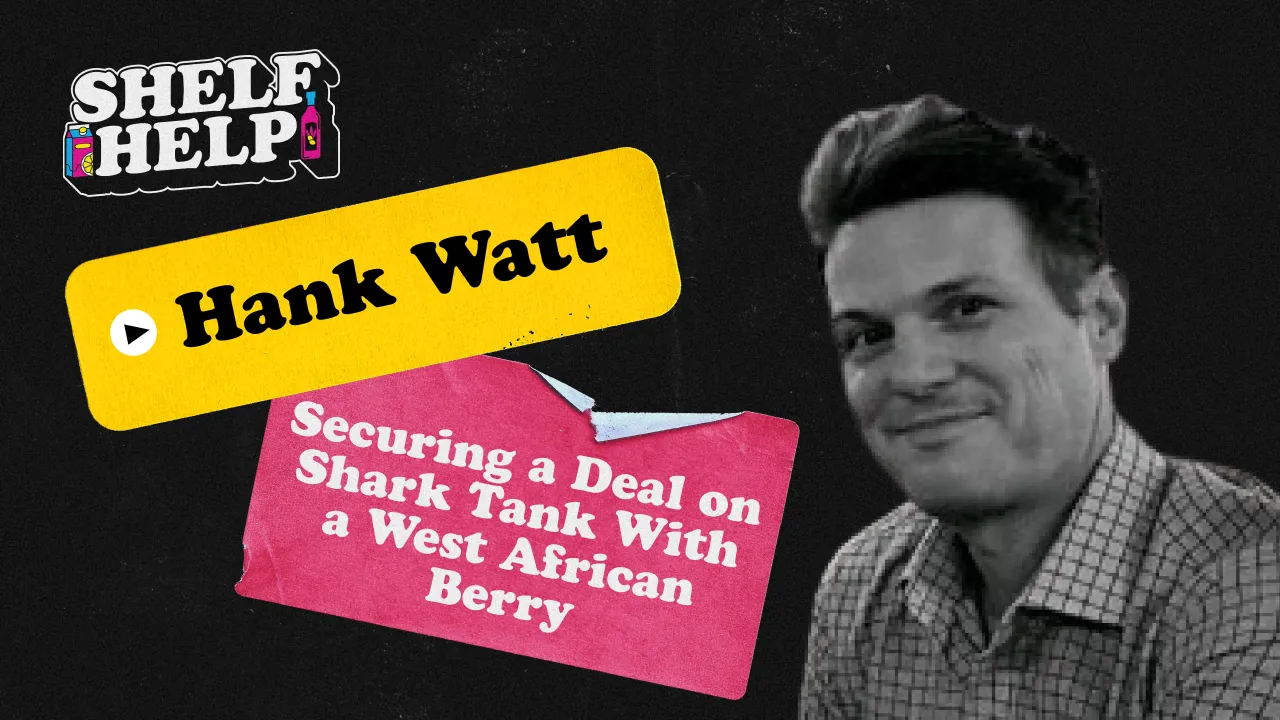
Securing a Deal on Shark Tank With a West African Berry | Hank Watt, Nature's Wild Berry



On this episode, we’re joined by Hank Watt, Co-founder of Nature’s Wild Berry, the miracle fruit brand that transforms sour and bitter foods into sweet, candy-like treats - without sugar or artificial sweeteners.
After losing 80 lbs and reversing pre-diabetes using miracle berries to sweeten his green juices, Hank teamed up with chef Juliano Bonanni to launch a business around this West African fruit.
Today, Nature’s Wild Berry is riding a wave of viral content, Amazon success, and a deal with Mark Cuban and Lori Greiner on Shark Tank.
Hank breaks down the origin story, what happened leading up to Shark Tank and after the episode aired, and why he’s deliberately holding off on retail until the brand reaches mass awareness.
We also dig into how Gary Vaynerchuk and his team changed their growth plan.
—---------------
Episode Highlights:
🍋 Losing 80 lbs thanks to the miracle berry
📺 How Shark Tank changed the game overnight
📦 Why Amazon is their core channel (and what Hank learned about product reviews)
🏪 When retail expansion makes sense—and when it doesn’t
🎥 Gary V’s UGC growth advice
🧪 New formats, clinical use cases, and the long-term vision
📈 Trends Hank is watching in sugar reduction, functional ingredients, and consumer behavior
—---------------
Table of Contents:
00:00:00 – Intro
00:54:05 – Nature’s Wild Berry origin story and the magic behind the berry
07:13:18 – The Shark Tank experience
11:00:04 – Focusing on Amazon
16:27:18 – Expanding into retail
19:23:08 – Gary V’s UGC recommendation
21:18:12 – Product roadmap
22:45:13 – Brands and trends Hank is tracking
—---------------
Links:
Nature’s Wild Berry – https://www.natureswildberry.com
Follow Hank on LinkedIn – https://www.linkedin.com/in/hankwatt/
Follow me on LinkedIn – https://www.linkedin.com/in/adam-martin-steinberg/
For help with CPG production design - packaging and label design, product renders, POS assets, retail media assets, quick-turn sales and marketing assets and all the other work that bogs down creative teams - check out KitPrint.
Episode Transcript
tSpeaker: 00:00
Welcome to Shelf Help. Today we're speaking with Hank Watt, who is joining us from Santa Monica, beautiful west side of LA. Hank is a co-founder of Nature's Wildberry, a brand centered around a miracle berry that turns tart and sour tastes into a really enjoyable sweet taste. And in 2003, Hank and his co-founder appeared on Shark Tank, where they secured a deal with not just one, but two sharks, Mark Cuban and Lori Granier, which we'll definitely talk about. We won't dive in too much of that because I know uh Hank you've spoken about that so many times. But um just first off, maybe for the listeners just that aren't as familiar with Nature's Wildberry, maybe just give a quick allay of the land in terms of kind of the origin story, why behind the brand, the products, and kind of the science behind that, the why and the how, that why the miracle berries work, and then maybe where listeners can get their hands in them today, and then uh then we'll go from there.
Speaker 1: 00:54
I really was mind-blown completely when my best friend and co-founder introduced these red, delicious berries and they promised to turn sour things sweet. And that's the one claim we make, but we let people figure out that they also curb bitterness and it makes umami more savory. So if it if you're a foodie um in your 20s or 30s and you haven't heard of a miracle berry before, consider yourself normal. We've probably had 400 million views on social media. Over a hundred of that uh was through Shark Tank with all the re-airs and the social media there too. But if you ask 100 people, 99 will say, I've never heard of a Miracle Berry. And who the heck is Nature's Wildberry? You're probably one of the first in your circle who have ever heard about this if you're listening to this podcast right now. So good on you for figuring it out early. But this berry is a foodies dream, like I said. It brings people together. Um, that's what it did for me and my co-founder who had a restaurant. He was looking for a way to sweeten his desserts without an animal byproduct. He wasn't vegan for the animals or for the planet or for environment or whatever. He did it for the enzymes in the food. So they wouldn't cook anything above 118 degrees. And that way, when you left the restaurant, you really felt actually energized instead of like in a food coma. And um, the the the byproduct of having everything raw was that it attracted all these vegans. And if you know anything about vegans, especially raw vegans in LA, they uh walk around with pitchforks. So uh they will not have honey, and he could not sell a dessert for the life of him. And uh, if you know if you've ever been in food before, if you're not selling everything on the menu, you're losing money. And so uh he needed my help in more ways than one. Uh, he is one of the 4% of people that prefer bitter taste over any other flavor. He's he's really interesting. His second favorite is sour, and that's 5% statistically of Americans who prefer sour over anything. And uh he hates sweets, and so I probably have the largest sweet tooth in the known multiverse. I would be the perfect judge to help him create his dessert menu. He looked all over for something that he thought was the healthiest sweetener that wasn't an animal byproduct. And then, you know, that's when we came up with the Miracle Berry. I thought it was too fantastical. I imagined like Jack and the Beanstalk, you know, you just sprinkle this and out comes this fantasy. But uh, and and if it did work on people out there, it wouldn't work on me. And if it did work on me, well then, you know, I wouldn't be impressed. And if I was impressed, it would probably be like a gimmick that I would forget about in a week or two. But uh the very first time that I let this berry coat my taste buds and I had something that was sour and it became sweet, I thought I'd heard the chorus of the choir of angels and the gates of heaven open up, and I thought to myself, this thing is going to transform my life because for the first time it could make things that I detested anything healthy, anything healthy, it could make taste way, way better. Almost to the point, and I'm not kidding you, just like candy. On a molar basis, this miracle berry is 400,000 times sweeter than sugar. So scientifically, there's not a sweetener out there that can deliver on that promise. And so if you love sweets or like if you just love trying new things, then you'll definitely notice this. In fact, it works on every single person. You just have to do it right. And so uh the whole thing has been about education over the last uh you know eight and a half years. We've been in business. We founded in 2016. And um, the important thing is right out the gate, you need to let this berry coat your tongue. We think of it like the anti-additive. Like every sweetener out there you put in your food, you put in your drinks, and it affects the way everything changes, everything tastes. But with this, it is uh kind of introducing the fourth dimension of time. And so you let it coat your tongue, it binds to the taste receptors, it blocks that bitterness, it makes umami even more savory, and then it turns sour things deliciously sweet, like unlocks flavors you've never tasted before. And I know it sounds like I'm selling this thing, but talking about it doesn't know justice. You have to really experience it for yourself to get it. And um that's why when the rest of the food industry didn't do anything with it for three years, I understood because this is an education play. And a lot of companies, especially those who are already have very successful products in the market, they don't want to spend a lot of time educating people, especially when it comes to changing behavior. But like I said, I was the most skeptical person in the world, and I knew that if it would make sense to me, like if it made sense to me, if I had a very strong reason to do it because I liked it and I could make it affordable, then people would follow suit. And uh that's that's kind of the origin story. He helped uh his customers really enjoy these desserts. Um, it really kind of blew up in this kind of in this culinary exploratory way. And uh that's when I convinced him that he needed to become my co-founder. It did take me about three years because he looked at me as his best friend and probably not a trusted business partner. And, you know, no sweat to him for thinking that. I mean, we were drinking buddies, we were party buddies, and so when I looked around for a co-founder, I was like, listen, man, it's always been the two of us. We've been best friends. More importantly, I can trust you with our bank account. And uh, when you save each other's lives a couple of times, you can trust somebody with your bank account. And uh and plus, we have this story. You're you've got all this culinary experience, you're a food professional. I'm not, I'm just a foodie at heart, and I think that we would make a great team. And uh, when you think about like even on a meta level, the fact that he doesn't like sweets is a perfect reminder that the berry isn't for everybody. So so while I while I understand why people say don't get hired in your own supply, um, I can't agree because we actually made the company for me. I have the berry like 15 or 20 times a day. Actually, I've already used it, I'm using it with my with my coffee. So if I'm talking a little fast, it's all the caffeine. But uh but because he uses it maybe once a year, it's a great reminder that you know you can't get upset when you realize your product's not for everybody. So that's a that's like lesson number two, or I don't know if you're keeping track at home, but that's what I would say is a pretty important takeaway.
Speaker: 07:13
And you get asked about this shark tank all the time, so we don't have to spend too much time on it. But just for those that that don't know the story, just kind of give a quick overview in terms of maybe just what the process was like leading up to the show once you knew you were gonna be on it, you know, what being on the show, the deal you secured, and then the impact on the business, let's just say immediately after the after the show, and then I know there's always a a big uptick, and then and then now a few years later, what's still uh what impact are you still feeling?
Speaker 1: 07:45
I applied to Shark Tank twice in 2017 and 2018. I founded the company and co-founded the company in 2016. I was very eager to get on Shark Tank. First of all, it was my favorite show since it started, but I didn't want any other competitors to get on before me. Like I was like, I really wanted to be the first Miracle Berry company. Mostly not so much because I wanted people to think I was the first, but I wanted to be first to mine. We got a chance to get four offers. The only one who so the sharks were Mark and Lori, the two that we went with. Mr. Wonderful Kevin O'Leary made the first offer. So I'm eternally grateful for like I think he made the first offer in six minutes into the show. Like I was ready to sell the whole time. You know, like that whole thing about turning your like obstacles or your, you know, your challenges into my opportunity. I was ready to go with all those overcoming objections. I didn't even get a chance to use them. But and then Damon went back and forth between Kevin because I think that Damon really, really, really wanted our deal. He really like his health and fitness paired up exactly with uh what we were doing. In fact, at the very end of the episode, he was like, Why did you go with Mark and Laurie? And uh, but just he, you know, those type of comments, and then by the way, I can't I'd be remiss if I didn't shout out the world-class editors. Um, you know, they it's a 45 to an hour minute process in there, and they have to cut it down to eight. And they told the story extremely well. It's more emotional than what I remember it actually at the time, just because I was kind of like a deer in headlights up there. But uh, but the one thing that they cut out that they didn't show was Mark saying, This is my ego. The one thing that they cut out was Mark saying, Damn, you're smart. And I was like, man, if they could put that in there, I would show that to future generations. I would never let that die. But uh they cut that out. But uh yeah, that uh that was something that we really wanted to close. Like, so it was not it's nine months from the time that we shot and uh filmed the handshake deal to the time that we aired. Nine months. And during that time, your head plays a little mind game on you. Like, did that really happen? Because everything you know about Shark Tank you saw through the TV. And then this is all like completely the opposite. And so you're like, Did that really happen? But we did due diligence in five weeks. It was probably the fastest that uh anybody's closed a deal. As you probably are aware, most deals never close. Yeah, and so for us, it was very important to have their expertise and they have guided most the follow-up questions are how you know, how active are they? And if you want them to be active, then they're gonna match your activity. If you want them to be passive, they're gonna match that as well. I know other founders who have closed the deal, who have moved on from their sharks and have, you know, tried to raise in institutional money and they don't use the sharks as much. To me, I was there to milk every last drop out of the sharks, and they have been so supportive. I cannot tell you how it was the best decision that Nature's Wildberry has ever made.
Speaker: 11:00
I know Amazon's big a big um channel for you. I think it's fair to say Amazon's a pretty, you know, a game-changing channel for a lot of brands, but I know it's also can be considered by many to be a pretty polarizing channel. I know it's been a big part of the business so far. Like what's first of all, it's been like selling in this channel, and what what would you say are the pros and the cons?
Speaker 1: 11:20
First of all, I wouldn't be talking with you today if it wasn't for Amazon. All right. I could just I could just say that absolutely. And so if you delineate that, you translate that out a little bit. If I have a problem with my margins and selling on Amazon, it's not Amazon's fault, it's my fault. Right? If I can't charge what I need to make to earn a profit on the first sale, to pay for the mistakes that as a founder you're inevitably gonna have to make and that are very expensive, but you need uh cash in the bank to pay for those mistakes, or else you go out of business, right? And so you need to be able to convey and build the value and create the urgency and because money is finite, right? If it can be delayed, it will be delayed. And so you need to give people a reason right now why your product will either make them more happy in life, give them more fun in their life, satisfy the curiosity that they care about, bring people together, all that kind of thing. And then, you know, if you let it, it can transform your life. If there's something there that can actually be a fundamental tool for them to use later on, well, then you've got a reason for them to spend money. See, price is only an issue in the absence of value. And so if you're not creating the value, you can't have the margins. Um, and then you know, I think it's like 180 million Americans have Prime. It's over half the country. Yeah, you know, so it's the majority of the people in this country that have credit cards and like to make purchases, and you're in that buying decision-making mode when you're on Amazon. And if you're actually searching on Amazon before you search on Google for something, you really want to buy it.
Speaker: 12:59
Do you find some people that search or uh eventually find themselves on the brand page by searching for like other things? Like I don't know if it's like you know, snow or something along those lines or something. It's just directly brand search.
Speaker 1: 13:13
Yeah, our our keyword, our keyword, and it's like a 95%, is Miracleberry. Okay. I mean, it's not nature's wild berry is obviously our brand name, so people are gonna, but outside of that, people are looking for Miracleberry. But on Amazon, if you're not doing search find buy, then they're not gonna really reward you. Uh so that's why our link out on Instagram today is still our Amazon profile, not our Shopify. Uh, we do have Buy with Prime on our Shopify page. I would recommend that still. I know that people, you know, are fighting for every cent and every dollar, but you're going to make more capturing those customers than if you let them buy a competitor's product. So I would highly recommend reconsidering that if you have been against that idea. Amazon still provides you with their information. You still get that customer information with Buy With Prime. So you're not really missing out on too much. You just got to know where to look. But uh yes, Amazon has been fundamental and uh critical for our growth. It has also been allowed us to focus on other aspects of the business and growing other channels. So uh we have been able to use that as like something that's actually more it started off at 99% of our business and then it's come down to 90, 80, 70. I think it's right now just hanging around 60% of our total revenue. So still, you know, probably the most valuable thing that we have in terms of a sales channel today. But the reason why we went D2C e-commerce first is I've got I'm in going in my ninth year of Nature's Wild Bear. We found it in 2016. So um I have seen in nine years great brands, like phenomenal tasting brands that had the whole value package, but didn't have the velocity at shelf to stay successful. And as soon as you start getting delisted from one place, it becomes another place, another, and you get one shot. And if you are extremely lucky, you get two shots, right? If you are very likable and you come back with a good reason why you're not going to get delisted again, but after the second shot, you might as well hang it up. And so having a community, like it's so cliche, having the community that wants to buy your product and go into the store today to pick it up rather than having to wait overnight. Because right now, if you go to Amazon and you search in Nature's Wildberry, this is going to get delivered to you the next morning. I've seen some really great people lose their what I think would have been their great calling just because they felt the pressure to have to go through distribution and go through the channels that you know have so many hidden fees, and you know, there's so much chance, and you might not get paid for 120 days, or if that, if the deductions don't keg up all your cash flows. Um, no, there's a better way to play the game, in my opinion. If you've got a non-perishable product, D to C is the way to go.
Speaker: 16:14
Do you have uh do you have specific metrics that you have in your mind that you want to hit before you really take that, you know, both feet early into retail, whether it's like you know, repeat purchase rate on Amazon or like annual unit numbers?
Speaker 1: 16:28
We're able to separate the zip codes where we're shipping to on Amazon. We're able to separate the zip codes through all the other channels too. So when I locate markets that you know are dominating compared to others, that's where we're going to be going to retail first. Los Angeles is number one. So SoCal is where we're gonna start out. We're gonna we're we're looking at all the natural retailers right now. We actually have an improvement of this coming out very shortly. I'm so excited uh because it had it it wins on every aspect across the board. You're gonna have fresher product, it's gonna last longer, it's gonna be lighter weight, it's gonna look more professional, it's actually better for our margins. I mean, in every possible way, I'm I'm super excited about our tens. But that's gonna allow us to um just have the confidence that it we're providing the most superior product um at our retail launch to the people who already love us the most. And then, of course, with this product, if you're not ready to invest heavily in demos, I mean, I'm talking about every single day. Every day, multiple locations in a regional area where you can get the uh word out, every single aisle that you walk down, including the entire perimeter of the store, you're gonna find things that pair well with the berry. And so that's kind of the concept.
Speaker: 17:47
Where do you want, where do you envision the brand and the product sitting in retail? Is this the produce aisle? Is it like the supplement section? Is it some other aisle I didn't name?
Speaker 1: 17:58
We will have a presence in the supplements. I mean, we can't help it. People do love that aisle, and for those customers, we want to be there and show up for them. But uh, by far the most traffic occurs in the produce. And if you've if you are a history student like I am, and you love learning from the best, I've taken pages right out of Olipop. And you know, traditionally sodas are sold by the six or the 12-pack, right? And what do they do? They sell it by the can, you know, and people have price points in their mind. They think uh in terms of immediacy, right now, like why do you show up to the grocery store? You want it right now, right? And so if you want that uh that probiotic can, um, and you can even you've got three dollars, guess what? You can afford their product. And so that's exactly what we're gonna be doing. We've got a freestanding uh floor stand that will be right next to citrus or berries or you know, fruits. I mean, it works with 25 uh fruits in the produce section. So we're gonna sell a ton of produce together, but we're gonna have the individually wrapped berries available for $2.99. What people care about more than your story and more than your branding is what does it do for me? Especially what can you do for me lately? If you can make healthier things taste better, you're going to attract people. If you can be in the business of helping people improve their lives, you will not go out of business.
Speaker: 19:23
From what I know, just reading on your background, I think you had a conversation with Gary V that kind of led you led you to shift your focus and to have more of an influencer strategy, which definitely makes sense. I'm curious, what was his reasoning or thought process as after he understood what your product is and what your brand is?
Speaker 1: 19:40
Like when we first launched, we were going to every single restaurant and we would talk to the chefs, we would talk to the owners, we would talk to decision makers, whoever's the buyer, and we would give them the demo. We would bring in cameramen to record the whole thing. And I got that all from Gary V. And uh that started because he popped up on my radar when we uh first launched uh in 2016. Of course, he was popular before that, but that's just when he hit my radar. We went up to his location in Los Angeles in the valley, and we did a demo and completely blew the entire office away. Like, you know, just like uh Steve Babcock was the guy that we actually got to sit down with, which at the time was the CMO of Gary's company. And what a great guy! I can't say enough great things about him, just uh just a solid human at his core. And he gave us the inspiration and the direction. He said, Hey guys, I love this story about you going to the restaurant. You guys have this restaurant history, it translates well into the videos that I'm seeing, but it's not moving the needle. And what this is, is an influencer play all day. And literally, we left that meeting and we never did another restaurant visit ever again, from that day until recently. Um, and we just focused on DMing. Just six, seven, eight hours, and I'm not kidding, eight hours a day. And Instagram removes your ability to DM. I call it maxing out your DMs. You have to do that if you really want to get attention, you have to max out your DMs. That means you have to play the numbers.
Speaker: 21:18
In terms of innovation, product development, any new form factors or SKUs, product lines in the pipeline that are exciting that you've got coming that again you're you're feeling like you're you're able to share.
Speaker 1: 21:31
Yes. Okay. On Shark Tank, you might notice a third product that I I'm not selling today. It was called Barely Bears. You know, the barely bears were something that I were ahead of its time. And we're gonna be launching that again, but not in the bear format. We're gonna do other other things, but it's the melt, it dissolves on your tongue. And uh the reason why barely bears failed is because when people think of bears, what do they think of? Gummy bears, not melts, and so that never got the traction. Um, and I thought, you know, this was just something that I could be clever with. Guys, girls, whoever's listening, if you think you're clever, get some help. Get a co-founder who will shake that out of you. People like clever is not subtlety, does not work. You need to make this obvious. You need to think about mainstream. So you need to not, you need, yeah, don't go down the clever path. I I believe that the product has a future, and we're probably gonna have a wafer in the future, not a bear, obviously.
Speaker: 22:38
Taking a step back from Nature's wire nature wildberry bit just because you've been in this CPG space for for quite a while now at this point. Any brands andor just kind of trends in the CPG space in general that you've gotten particularly excited about lately, or any anything you've been you've been tracking at all? Anything that uh you know has longevity, right? I know you mentioned the blog, definitely gonna share that in the show notes. Other than that, what's the best place uh to follow along with you and uh and the brand Nature's Wildberry as well?
Speaker 1: 23:08
So I'm a little embarrassed about how much time I spend on LinkedIn, but I gotta tell you, every positive thing, including Shark Tank, including all my mentors, all the mentorship that I've given out, key relationships that have come started online and grown offline have been through LinkedIn. And uh they have a very valuable product there. It's obviously not for everybody. So reach out to me on LinkedIn. Well, if you if you've got email, Hank at Nature's Wildberry.com, it ain't too hard. Then yeah, like make sure you follow us and uh ask your questions because you know there's a whole rabbit hole you can go down, and the more you find out about this miracle berry and nature's wild berry, the more there is to love. I promise you.
Speaker: 23:48
I believe that. Well awesome, Hank. Really appreciate it. This has been great, appreciate the time.
.svg)