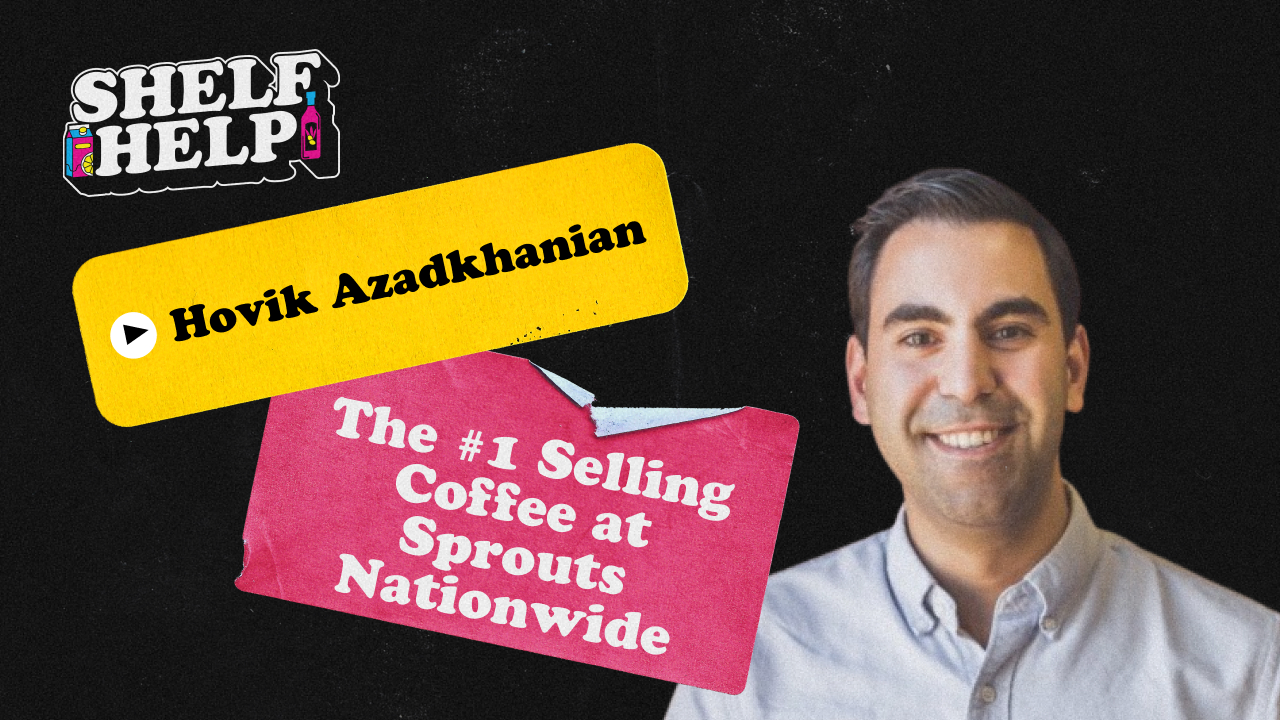
The #1 Selling Coffee at Sprouts Nationwide | Hovik Azadkhanian, Heirloom Coffee Roaster



On this episode, we're joined by Hovik Azadkhanian, CEO of Heirloom Coffee Roasters - the fastest-growing coffee brand in the natural channel and the first nationally available 100% regenerative organic certified specialty coffee.
Hovik has been in the coffee roasting business for over 30 years, starting alongside his dad as a kid and spending years in private label and toll roasting before launching Heirloom.
We dive into how roasting millions of pounds of coffee for other brands gave Hovik the data to develop Heirloom's proprietary Culinary Roast - a technique that manipulates time, temperature, air pressure, and gas flow to unlock specific flavor profiles at scale. That process led to winning the Good Food Award against 1,700 coffees, a first for any regenerative coffee.
Hovik walks through the realities of the coffee supply chain, including a USDA study that found 43% of certified organic products tested above the legal limit for banned substances. He breaks down Heirloom's triple-testing protocol across 311 synthetic pesticides and the story of rejecting tens of thousands of pounds of glyphosate-contaminated coffee.
We also get into Heirloom's direct trade model, which cuts out 15-20 middlemen and pays farmers three to six dollars per pound versus 30-60 cents under the traditional model. Hovik shares the Pacayala cooperative story, how Sprouts took a gamble on an unknown brand, and what's next as Heirloom eyes mass retail.
---------------
Episode Highlights:
☕ 30+ years roasting coffee (started at age 8)
🏭 From private label to building a national brand
🧪 The Culinary Roast (manipulating time, temperature, gas, air pressure)
🏆 Winning the Good Food Award against 1,700 coffees
⚠️ 43% of organic products failing pesticide standards (USDA study)
🔬 Triple-testing protocol for 311 synthetic pesticides
🌱 Direct trade model (farmer to roaster, no middlemen)
🤝 The Pacayala cooperative story in Honduras
🛒 Going national at Sprouts and becoming the #1 selling coffee
📊 Using SPINS data and shopper surveys to drive velocity
🎯 Land and expand in natural, then break into mass retail
🔧 New form factors in the innovation pipeline for 2026
👀 Brands to watch: Simply (legumes) and Painterland Sisters (yogurt)
---------------
Table of Contents:
00:00 – Intro
00:33 – Origin story and why behind the brand
04:17 – Reacquiring the Oakland roasting facility
05:25 – Developing the Culinary Roast process
08:29 – Iterations and the Good Food Award win
10:20 – R&D and SKU strategy
12:41 – The glyphosate contamination story
15:25 – USDA organic study and the limits of certifications
17:37 – What CPG brands should do about independent testing
19:39 – Vertical integration and cutting out middlemen
20:45 – Building direct farm relationships
23:06 – The Pacaya cooperative in Honduras
26:00 – Farmer economics (30 cents vs $3-6 per pound)
28:45 – Retail trajectory and going national at Sprouts
30:58 – Tactics for driving velocity in natural channel
31:56 – Retail expansion plans and breaking into mass
32:22 – Food service as a brand awareness channel
33:13 – Brand identity and packaging design decisions
34:43 – 2026 goals and new form factors
35:29 – Brands Hovik is watching
---------------
Links:
Heirloom Coffee Roasters – https://heirloomcoffeeroasters.com/
Follow Hovik on LinkedIn – https://www.linkedin.com/in/hovik-azadkhanian-a2404830/
Follow me on LinkedIn – https://www.linkedin.com/in/adam-martin-steinberg/
For help with CPG production design - packaging and label design, product renders, POS assets, retail media assets, quick-turn sales and marketing assets and all the other work that bogs down creative teams - check out https://www.kitprint.co/
Episode Transcript
Speaker: 00:00
Welcome to Shelf Help. Today we're speaking with Hovik Azadkanian, co-founder, CEO of Oakland-based Heirloom Coffee Roasters. Heirloom is the first national coffee brand to offer 100% regeneric organic certified specialty coffee roasted with a pretty cool proprietary technique that beat out 1700 coffees in a blind taste test, which we're definitely going to talk about. By the way, Heirloom is the fastest growing coffee brand in the natural channel, number one selling coffee at Sprouts nationwide. So they're definitely doing a lot of things right. Yeah, Hovick, first off, just for the listeners that um are not all that familiar with Heirloom, love to just get a quick lay of the land just in terms of kind of origin story, why behind the brand, what makes the coffee really different. And then if you want to just call out maybe a few places that newer places that the listeners can get their hands on the coffee these days, and then uh we'll go from there. Sure.
Speaker 1: 00:53
I've been in the coffee roasting business for over 30 years. Uh I started roasting with my with my dad when I was like eight years old, and I've been in love with coffee ever since. Most of my career primarily was spent on the private label and toll roasting side of the business. So we would roast coffee uh for other companies, and that's kind of where I first was introduced, or I should say I witnessed so many coffee brands kind of derail from the original messaging of the brand and turn into just another marketing brand or another brand uh on the shelf. And so they would paint these beautiful pictures of like direct trade, vertical integration, focus on organics, focus on the farmer, on the packaging, but the products inside of the coffee was kind of nowhere near what they said. And so as the industry evolved, a lot of these larger brands consolidated and shifted most of their coffee roasting activities to massive roasting houses that acted as like these large white labeling and tolling facilities. And so that really disheartened me. Um in what most of the larger specialty coffee brands have turned into throughout the years of these large white label companies that they just became marketing companies. And so they've kind of lost the messaging and they've lost, lost the promise, and they've they've ignored the supply chain in general. And so that's why we started uh Heirloom Coffee Roasters. We wanted to create a coffee brand that was totally different. We wanted it to be a coffee brand that was truly built on a platform of direct trade where we purchase coffee and source coffee directly from farmers. We wanted to cut out the 20-something layers of middlemen involved in the business. Every layer of middlemen that exists in the coffee business takes margin away from the farmers themselves. And so that's something that we wanted to, that we wanted to fight against. And the second is we wanted to create a coffee that was truly clean and healthy. We wanted it to be totally clean, free from pesticides, synthetic chemicals, fertilizers. And we didn't want that to just be a claim. We wanted it to be totally validatable. And so we started to source coffee that was farmed on regenerative farms where they never used mechanical agricultural practices. They only practiced regenerative farming, no synthetic synthetic chemicals, pesticides, fertilizers, et cetera. And we wanted to roast coffee that was truly delicious. We wanted something that was more than just like a good cup of coffee. We wanted it to be special. And every time we drink heirloom, we want you to say, wow. We want you to look at your cup and say, this is truly a sensory experience. And so after we launched the brand, we became the first 100% regenerative organic certified coffee brand in the nation. All of our SKUs, with the exception of DCAP, because that isn't available yet, but it's also not on our main offerings list, sourced from 100% Rock Farms. And so we essentially created a brand new category in the retail space around clean, healthy, regenerative coffee.
Speaker: 03:44
That totally that's a great overview. I mean, you touched on a lot of the stuff I was going to ask about initially. But you and your partner, Rick, you guys acquired, reacquired the factory, and you guys are doing a bunch of you know, private label contract roasting for other brands, which I think is some of the learnings that you got, which led you to launch Heirloom. When you guys you know decided to reacquire the factory, and right when you made that close, did you guys already have this kind of clear plan in mind of launching Heirloom and this we're getting organic certified plan? Or just kind of you kind of you kind of the journey of doing all this private label stuff and all the other stuff you saw working with other brands kind of led you to the conclusion this is what the next step should be.
Speaker 1: 04:18
Well, when my partner and I decided to buy the company, so just rewind, my dad started a company in the 90s and he sold it to his business partner um in the mid-90s. And then that business partner sold it back to us in the uh in 2018, so November of 2018. During the diligence phase, Rick and I knew that our number one goal was to create a brand that was scalable, that was truly different than everything else in the market, and that was 100% clean, healthy, and verifiable. And we wanted to create a standard that solved one of the biggest problems in CPG, and that was this like fogginess of white labeling. The consumer doesn't actually know what they're buying. So we knew that was essentially the goal, and that was the end goal. When we purchased the facility, we did kind of this reverse triangle merger. We moved everything and all of our production into our Oakland facility where we are now. We were heavily involved in private label and white labeling, and we were also involved in cafe restaurant supplies. So we were roasting coffee for cafes and restaurants, but we knew for sure that the end goal was to create what would eventually become heirloom coffee roosters. Got it.
Speaker: 05:23
Cool. The culinary roast kind of process, which I think is some proprietary to you guys, and you guys develop this by leveraging so much data from roasting, I think, millions and millions of pounds for all these other brands. I guess, you know, without, you know, giving away too many trade secrets, love to just kind of get a sense of, you know, walking me through the development and kind of innovation process. I think, you know, you described it, I think, as when we chatted uh a few weeks ago as kind of treating coffee like a fine dining ingredient, manipulating time, temperature, gas, air pressure, bunch of different stuff. So, like, yeah, what does that actually kind of mean in practice? And how is this like really different from the typical specialty roaster and what they're doing?
Speaker 1: 06:00
Yeah, when we roast our coffee, we have to combine kind of this world of technical skills and this world of artisanal roasting, but we also have to define it in a way that's replicatable. And so we had to create a new standard. The standard eventually became known as the culinary roast, but to get to the culinary roast, we had to roast millions of pounds of coffee really for other people. And so what we did was collect all the data around roasting for other brands, uh, time temperature, and how it affected the flavor profile of the coffee based on the density of the coffee itself before it goes into the roaster, the water content, the age of the coffee, which regions it came from, the mineral content of the soil in the general area. And so we had this ability to roast coffee on like the specialty coffee scale, but we knew that we needed to turn it into something that was much more technical and scalable and repeatable. And so we learned if you manipulate time temperature, air pressure, gas flow at certain stages of the roast, you can change the way the coffee tastes by either increasing or decreasing the uh ability to taste sweetness or tartness or fruitiness. You're able to manipulate the body of the coffee and create kind of like a syrupy texture. And that's all down to the way that we manipulate that roast from beginning to end in the roasting process. It gets a little more technical and the technical side becomes more proprietary. But a good way to look at it is you can start with the same ingredients and you can have one chef create a meal with the same ingredients and have it taste great. And you can have another chef take those exact same ingredients and create a work of art that's memorable, something you'll never forget, one of the best meals of your life. Um, and that's all in technique. And so the technique is where the culinary roast comes into play. We're able to take coffees that are grown using a very specific set of requirements from the regenerative bombs, no chemicals, pesticides. They usually grow it in some of the best soils, most mineral-rich uh soils that exist in the regions. And because we source some of that incredible unroasted coffee, we're able to take it to another level when we roast it at scale. The other thing is because of our size, we have to be able to roast coffee at a pretty large scale. So, you know, it's a lot easier to make incredible coffee on a five-pound roaster. It's a lot harder to do it on a 600-pound roaster and do it consistently four times an hour every day. So that's part of the that's part of the process that we had to create.
Speaker: 08:29
Yeah. How many thinking back, how many iterations or batches do you think it took before you kind of knew that you had nailed the the callinary roasts and like what thinking back was there kind of a clear this is it moment? We roasted millions of pounds of coffee to get it right.
Speaker 1: 08:44
We were really lucky because we were in the toll roasting space, so we had a lot of opportunity to practice. Yeah, totally. But when it came to our own coffee, we practiced so many times. The thing is, we just couldn't sell it because we didn't have the business yet. So we ended up donating a lot of coffee. We ended up using it up for for other purposes. I guess the aha moment, the this is it moment, is when we we came to a point where I thought we had it right and we had roasted our, I don't know, batch number 10 trillion of our sugar phoenix blend. And it came out, it smelled right. We followed the roasting, the roasting program to the tea. It smelled perfect. And I just took a scoop of that coffee and I said, I think this is it. So I scooped out like a pound, put it in a bag, and handed it off to our team to send it to the Good Food Awards. And that's where it was entered against 1,700 other coffees in in a blind tasting. I think is the largest coffee uh competition in the world for a single award. And we ended up winning the Good Food Award, and that was kind of the this is it validation. Yeah. The other thing that that is interesting is that was the first time a regenerative coffee had ever won the Good Food Award. And it was also the first time that a coffee that was not from like a micro a lot or a um one-time only kind of a lot won the Good Food Award. And so to me, that said that I can choose a coffee, I can create a coffee that's scalable and replicatable and create this incredible culinary experience time after time. And so once we won that award, that was kind of that was kind of it for us. We knew we had something incredibly special. And we also knew that it was not something that others could replicate.
Speaker: 10:20
Yeah. Cool, that makes sense. And like I'm not sure how many kind of like flavors or you know, blends you have at this point. Um, maybe this question may or may not make a whole lot of sense, but I'm curious how kind of RD works for new SKUs and this kind of vertical for you guys as brand in terms of how you decide on new kind of single origins or blends. And I'm sure there's just so many different options you can go with. What does that kind of decision-making process look like in terms of RD?
Speaker 1: 10:45
Yeah, there's two kind of paths that kind of exist simultaneously. The first is the qualification of new coffee. And so that goes through a very rigorous process. Uh, we have an entire QA team that's dedicated to maintaining what we call the heirloom standard. So, not just from the clean, healthy side of the product, but also the taste, uh, consistency, and the coffees that we choose must be something that will uh continue to be supplied by that farmer or that co-opser. We don't buy one offs, it just doesn't work for us. Once the coffee goes through that extremely rigid process, which could take two to three weeks, we send it off for lab testing. And once we lab test the coffee to make sure I think it goes through, it tests for 311 different synthetic pesticides, chemicals, molds, toxins, glyphosate, and all sorts of other nasty agricultural chemicals. So it has to pass that test too. So once we've cleared the coffee to see if we're allowed to use it, then we do the quality ting and the the like the repeated quality testing to see if the coffee will work in our blends, or if it's something that's incredible, can we use it as a single origin? Now, we don't want to fill our library with hundreds of skews. We actually kind of operate in like an eight to ten skew at any given time world. And so the coffees that we choose need to be something that we can use in different blends, but also as a single origin if we need to. We try not to introduce new skews very often. If there's a major request from a major retailer, we'll consider it, but it has to be values aligned and it has to somehow positively impact the farmer for a longer term. It's not like a one and done kind of a thing. And so um, once we've clear everything, then we start the negotiations, we see how long the farmers are willing to supply that specific coffee. And if there's a really long runway, we will either choose, we'll we'll either introduce a new single origin or we will add it to an ingredient, an approved ingredient for one of our main skews or one of our cool.
Speaker: 12:40
That makes total sense. Um, on the topic of of testing 300 different plus pesticides is uh is pretty amazing. When we chatted a few minutes ago, you you mentioned there was an example of a lot of beans that you guys came across that ended up testing positive for glyphosate. Yeah, walk me through what happened there and kind of what what that means in the broader context of your understanding of the the supply chain and some of the challenges there.
Speaker 1: 13:02
We lab test our coffees three times during the supply chain. So once when it ships from once when it's about to ship from the farm, once when it arrives at the port of Oakland, but before it enters our facility, we have a holding facility that's separate from our roastery. Um and so it's tested before it enters the holding facility. And then once periodically, well, it's every quarter, we test the roasted coffee uh from each skew. And so this particular batch that we had tested, tested negative uh from the farm. So we knew the farm was clean, the soil was tested at the farm, um, and the coffee itself was tested. So everything worked out. And somewhere in between the farm itself and the port of Oakland, there was some sort of a contamination for a significant amount. I mean, we're talking tens of thousands of pounds of coffee um from from a specific uh um from a specific uh crop. And what was interesting is the other coffee that came from the same crop didn't test positive at all all the way to our facility. So we started an investigation. The investigation is actually still ongoing, but what we think happened is there was some sort of a wind drift situation, either in transit from the farm to the exit port or in transit somewhere. And so what we do as a company, and this is why it's so important to have such a rigid standard, is somebody immediately pressed the emergency red button. We rejected the coffee, it never entered our holding facility, goes into like quarantine and then a rejection process that gets sold to or it gets offloaded to, depending on uh the quality of the coffee, the companies that don't care whether their coffee is frayed with pesticides or not. And so the coffee was offloaded, never entered our facility, but it was critical that we maintained our standard because you look at it from like a high level, there's multiple certifications on these coffees. They've gone through a rigorous standard. The farmer has upheld their end of the bargain. But how does the consumer actually know what they're getting is clean and healthy? They kind of don't. And so it falls on companies like Heirloom and other pioneering brands that really maintain this standard and create something that's radically different in terms of testing to validate that the product that enters your home that's like in the same pantry as your kids' food and snacks is not covered in sticky, nasty agricultural pesticides that have been linked to chronic diseases and all sorts of terrible things.
Speaker: 15:24
Yeah. Yeah. On that front, I think you you mentioned um you referenced some USDA study that I think you had found that like 43% of certified organic products tested above the legal limited band substances, which was shocking to say the least for me. Like, what does that mean for the average consumer in terms of like what that should tell them about organic steel, what it actually guarantees? And if they want to be conscious about this, what is what should they do?
Speaker 1: 15:46
Yeah, uh the the study was really concerning because it it was a I think it was a 2011 USDA um uh study on organic um products. And what it found was 43% tested positive, but above the legal limit. So the the products that were certified organic had the USDA seal on the actual product that was going to go to retail was not allowed to be called organic because it was sprayed or had heavy amounts of pesticides on it. Um I think there's, I want to say it was 39% or 38% and some change percent of the same tested products tested positive, but were below the legal limit to be pulled from certification. So those products were allowed to be sold as USDA organic. That's super concerning, especially when you're a consumer who's relying on the brands to protect them, the the USDA seal to protect them against these horrible chemicals and pesticides. Um, there's there's like a lower limit that's allowed. Uh to me, that's just wild. And so very few of the tested materials were actually free from chemicals and pesticides. I can't remember exactly the number right now, but and so that was very eye-opening for me. And that's kind of what sparked the whole movement internally to start testing all of our ingredients. And then we said, well, you can test it once, but that doesn't mean anything because I bet you most of these tested brands and most of these tested agricultural products would have tested negative at the at the original farms. But by the time they made it to the retailer, they could have been cross-contaminated, somebody could have switched labels. There's a lot of tricky business in a supply chain where there's 30 different touch points or 20 different touch points. So that's really what kind of sparked the testing movement for me personally and and and ended up becoming part of the airing standard.
Speaker: 17:37
Yeah. Just to, I guess, to close the loop on this a bit for other CPG brands and operators that rely heavily on certifications is kind of a core selling point. And maybe the ones that don't, like, should they be investing more in independent testing? Like, what should this look like across the board? Maybe not just coffee, but in general.
Speaker 1: 17:57
So far, I've learned that you cannot rely fully on certifications. They do a lot of the work, but at the end of the day, it's a brand's responsibility to protect their customers against what they claim to keep out of their products. Yeah. You can be a brand and not make any claims and not source organic or clean or healthy products, and that's fine. But the second you put that badge on your product, you're making a promise to your customer that what they're about to ingest and what they're about to take into their homes is clean, healthy, and free of toxic chemicals. What should brands do? I think it's very important to test. It's also extremely expensive and can be very cost prohibited when you can't do it at scale. And so it's, you know, it's a question that has to be asked. I'm not sure I have the best answer for every brand out there, but they should be relying on their suppliers to not just make claims but stand behind them and validate them. As a consumer, you have to do your homework. You can't just trust every little, every single nice looking badge that's on every package. I think if you're going to dedicate your health to the promise that a brand makes, you have to do your homework on the brand. You have to understand their sourcing strategy. And it's not a crazy thing to ask the brand for lab results or testing results. We get probably 50 to 60 messages a week asking for our lab results, and we display them, we just send them directly to whoever asks because it's so important to build credibility in like this really opaque market where everyone is blinded by flashy marketing.
Speaker: 19:34
Yeah. Yeah, that totally makes sense. Um eye-opening, but I guess it's something that people should hear. Shifting gears a little bit talking about vertical integration supply chain. You mentioned at the beginning at kind of a high-level touch on it, that there's typically 15 to 20 touch points between then the coffee cherry is picked off the tree for the top of coffee that I'm drinking at home in the morning. Um, you basically cut that to farmer, heirloom, consumer. Like walk me through how you went about actually kind of building these direct farm relationships from scratch, how you kind of found your first farm partners. Maybe you want to talk about uh, I think it's the Pacquiaal co-op in Honduras as an example.
Speaker 1: 20:09
Yeah. Um, so the traditional model is broken to say the least. You know, it the system that exists takes advantage of the people who do all of the work. And so the farmers who grow the coffee, who dedicate their lives to growing incredible products, who purposely dedicate land to being clean and healthy and not sprayed with chemicals and not mechanically tilled, you know, they they have the most skin in the game, but at the end of the day, they get paid, they get paid the least under the traditional model. Like I said, there's like 15, 20, sometimes 30 different touch points between a coffee cherry being picked off a tree and the end user. And so we wanted to change that. And what we did was we had to get introduced to regenerative farmers because that was kind of the baseline for us. The regenerative organic certification already does most of the the heavy lifting for our validation. And so what we see is farmers that practice all these different things to get ROC certified, they've already done most of the most of what's required. We have a couple relationship partners that we rely on to make the introductions to these farmers or these co-ops. There's there's not very many of them, many of them. And right now they only exist in about six countries, I think, for coffee, many for other categories, but for coffee, not many. We're also the largest rock certified coffee brand in the world at the moment. I'm sure someone will outpace us at some point, but right now we are the largest. And so we've built a reputation and a name for ourselves to a point where the farmers are coming to us directly. Um, and if they don't come to us directly, they just ask, and it doesn't take very many asks to get the name heirroom. And so what they do is they'll reach out to us and say, hey, I'm either considering becoming regenerative organic certified, or I just became regenerative, organic certified. How does it work? And then we walk them through our process. The great part is if you're a farmer and you're considering becoming regenerative, organic certified, and you meet the quality. Specifications that we need for our coffee. The mineral content of your land is perfect. The quality and taste of the coffee before certification and sampling meets our requirements. We'll dedicate the first couple purchases and we'll promise to buy your first lots as long as it meets all of our qualifications. And so we incentivize the farmers to become regenerative organic certified. The first rock certified coffee we ever purchased was from Nicaragua. And that was like, that was really hard to find because when we first learned about regenerative agriculture, there was no rock certified coffee. And so we reached out to like the Rodale Institute, the ROA that certifies ROC. And just about every single coffee broker, distributor, reseller, and trader that I knew. And we just got crickets. And then finally, the ROA and the Rodale Institute both pointed to a crop that was coming from Nicaragua that was going to be the first actual rock certified coffee. And so we jumped on that as fast as we could. I think there were two containers that were shipped from the farm. It was the first two containers ever. And I believe we bought the first container. And so I went, I remember they landed at port. I went to the port to like the um the uh consolidation center, and I asked to get the very first sack of coffee off that container, threw it in my car, uh, brought it back to the roastery, and we ended up roasting the first batch of rock certified coffee ever. So that was really cool. I roasted it on my Diedrich IR5 roaster, this little sample roaster we used. Um that was really cool. The Packayal Cooperative, which is the first rock certified coffee producer in Honduras. There, it's an interesting story, but it's like really an amazing story. Um, it was started by a brother and sister in the Marcala region, city of Marcala, in the La Paz region of Honduras. And this was an area that was kind of completely ignored and forgotten. The unemployment rate was sky high. Most of the men in the region had actually left to go find work elsewhere, including the United States, and they were sending money back to their families. And so it was just a few rungs from the ladder away from being uh just a completely barren town. And so this brother and sister decided to stay and practice uh coffee farming, which is what they were used to when they were growing up, and they started to do regenerative agriculture and they started to grow regeneratively grown coffee. They ended up achieving rock certification, and they um the the coffee was so incredible that they sold out of their first batch and their second batch, and they they kept doing well. And so their neighbors and family members wanted to join in and said, What are you doing? That's so different. They ended up starting a co-op. And so this like one to two family like club of farmers ended up starting a co-op that last I checked had 450 different farms and impacted thousands of workers, mostly single women that um that didn't have any any work. And so this form of agriculture ended up becoming an economic engine for the community. And we visited last year, I think it was last one, maybe two years ago, and we saw the before and after, and it was it was it was wild. The streets were paved, uh, stores were full, all of the grocery stores had products in the shelves. You saw school children walking around in uh in school uniforms, and it was just a really alive and vibrant city. And I was talking to the brother, and I said, This place is amazing. I keep hearing horror stories. They said, Yeah, the horror stories were before we started regenerative farming and regenerative coffee farming. And so everything you see here is built on coffee and bananas. And we did it in the last, I think it was like eight years it took. Just this incredible story of how um shifting your practices and changing the way you grow product and not relying heavily on agrochemical companies and doing everything the right way, the clean way, can completely transform your entire community. And it's a success story that other communities and producers in other countries are replicating.
Speaker: 25:57
That's amazing. And I mean, it's part of just like these close, much more close relationships you've had with these groups and investing the time, you know, eliminating 20 different touch points on the supply chain. Then one of the things that really jumped out when we chatted was you said that you know, these farmers historically were getting 30 to 60 cents a kilo, maybe 10%, 10 cents more uh if they have the fair trade sticker. But because of your guys' model, now they're getting three to six dollars, which is like insane how much of a big of a difference that is, which I just was like super impressed by. And I imagine that's totally changed these communities that you guys work with.
Speaker 1: 26:31
Yeah, the example I just gave is like the best example of what can happen when a farmer sells directly to a roaster. Yeah. Depends on the farm, it depends on the co-op. But in the traditional model, the farmers get the smallest portion of the price paid by the roaster. Um, and they're middlemen everywhere. I mean, anyone who can get involved in between the farmer and the roaster, uh, they take advantage. So, like local consolidators, they're the ones who drive around farm to farm and buy coffee from these small, they're tiny, small plot farmers. It's not like they have hectares of land. These these guys drive around in these trucks, buy coffee from each one of these small producers. Then there's export houses, there's brokers, distributors, last mile resellers, and they paint a very pretty picture, like from a marketing perspective, especially in the US. But you know, you don't actually see what happens uh in the supply chain. And so, for example, a roaster who's gonna pay like three to four dollars, I guess that was before COVID, prices have changed after COVID for a pound of coffee, and the farmer would get as could could get as little as five to 15 cents for that same pound of coffee. But in the direct trade model, we cut out every single middleman, we go directly to the farmer or the co-op, and we end up paying them better than farm gate. It's a term used in coffee. I don't know if it's used in other categories, but better than farm gate prices. So the deal is made with the farmer, funds get transferred to them through an intermediary, and they reinvest that money that we spend or that we pay them right back into the community, right back into the farms, which continuously grows and gives us an opportunity to secure future supplies of the coffee that we need to build our brand. It's life-changing for farmers, and it kind of puts it all into perspective like, why are so many people involved? Well, I get it, because they're just taking from these people and do all the work. Right. And then, you know, after we roast, you know, there's typically many different touch points. In our case, because of full vertical integration, because we buy the coffee directly, we manage all the logistics, the roasting, we distribute directly from our factory. So there's no co-packer, no white labeler, uh, no uh third-party manufacturer, there's no 3PL that has roasted coffee sitting on shelves for months. Goes directly to our retail partners or our distributor partners that'll send it out to the retailers.
Speaker: 28:44
Yeah. That's awesome. On that topic, talking about retail, trajectory, pretty awesome, pretty remarkable. It's launched late 2021. I think when national within six, eight months, became the number one selling coffee at Sprouts. Um, and then a leader in the natural channel overall. Yes, walk me through that journey to to Sprouts in terms of how you got that first buyer meeting. What was the pitch? What drove them in so well? And then yeah, what kind of what's the go-to market strategy looked like since and and how it's how's it been going?
Speaker 1: 29:14
Uh it was not a typical pitch with Sprouts. We actually applied online when they were accepting applications for new brands. And that same year, we ended up winning the Kahi Golden Ticket. And so that was uh it's like the on-trend brands uh award. And we actually didn't know that we were we were even going into Sprouts until we received like a title wave of massive POs. Everyone's sitting there, like, what is this about? And we reached out to our category manager, and at the time uh it was a different category manager, and she's like, Oh, I forgot to tell you, uh, you guys are going national with Sprouts. What? But the buyer was was incredible. I mean, she she at buyer at the time uh at Sprouts, she took a major gamble on a brand that nobody had ever heard of that had no brand recognition, that had no market penetration. And they took a major gamble on what would become the future of clean, healthy coffee and regenerative coffee. And it worked out really well because the the customers love the product and ended up growing really quickly. I mean, we took we took the number one spot on the non-functional coffee side relatively quickly, and we've maintained that position for quite some time. But at the end of the day, the Sprouts shopper, they're not discount shoppers. They want high quality, really good tasting, clean, healthy products. And Sprouts delivers on that promise with the brands that they carry on shelf.
Speaker: 30:34
Yeah. What have you found in terms of kind of core tools, tactics? You can speak to Sprouts or just kind of natural channel in general, specifically in this coffee category that you found have the most impact from really driving velocity. This could be, you know, interesting ride promos, demos on site, getting people to taste the coffee, get out shelf talkers, eye violators, you know, floor display type stuff. Like what have you found has been the most impactful from that perspective?
Speaker 1: 30:59
You can have to back up a little bit. The the most valuable thing that has driven velocity for us that we've heard, because we survey our customers all the time, just the value proposition of the brand is something that the customer aligns with. And they end up trying the product once. Once they taste the product, they love it so much, it's very hard to go back. Um, other tools we've used other than leaning on our industry partners, like we we lean on data a lot. Um, so we use a lot of STMS data, we use a lot of shopper marketing surveys, and then of course, floor displays and shelf toppers have driven success. Um, you know, we don't rely heavily on discounting. We're not we're not a discount brand. We feel like the product speaks for itself. And once we get some sort of trial driven for a customer, they tend to come back. And it's proven itself time after time, retailer after retailer. We just feel like the product is so good on so many different levels that the customer sees that right away.
Speaker: 31:53
Yeah. What's the next phase of retail expansion look like through let's just say the the rest of 2026?
Speaker 1: 31:59
Well, we've penetrated most of natural at this point. There's still a few key retailers that we're um that we're buying and have been in talks with for for quite some time. And so as we kind of kind of land and expand in the natural category, we're looking to break into max with the right partner. And that's kind of gonna be the next evolution for the brand.
Speaker: 32:18
Yeah, makes sense. That totally makes sense. I think you also have told me that food service has has become uh a pretty great channel for you guys in terms of selling older on tap to campuses, corporate accounts, those types of things. Has this channel become a like a pretty meaningful revenue driver, or is it more kind of like a flywheel? People try it in office and then they go buy it at the store as well.
Speaker 1: 32:39
Yeah, it's interesting. We've kind of started in food service, but we started in food service to drive awareness of the brand and to get eyes on the brand. And so all of our partners that we work with in the food service space, um, hey, they've been great partners, but they're mostly forward-thinking companies that really care about sustainability, removing plastic from the uh supply chain and delivering on incredible quality to their to their employees. It's not a category that's major growth for us, it's something that we rely on to just connect the uh the shopper with our brand in the workspace.
Speaker: 33:12
Yeah, that totally makes sense. Clearly, you guys have built a really differentiated brand here, and it's showing in the numbers from a brand identity packaging standpoint to really convey all that you've told me about what's so special about this brand, like thinking back to when you guys are developing the brand identity and the look and feel of the packaging and the and the brand from a visual identity standpoint. What were some of those key variables that were top of mind for you uh in terms of maybe in the context of whoever you worked with to actually build it out? Like what do you remember you kind of included in the brief that was the most important?
Speaker 1: 33:43
I said earlier we're heavily reliant on data and a lot of the um customer cohort analysis, analyses that we did, uh kind of painted the picture of the perfect heirloom customer uh and created a profile of the customer that would most want to join our movement towards like a clean, healthy future for food. And so we provided our designer who's extremely patient and built helped us design an incredible package. But we wanted to speak to the consumer and tell them what you're about to buy is not typical and it's not a discount brand. It's something that's going to deliver incredible quality and it's something that's gonna be radically different than what we were used to. Clean, healthy, pesticide free, but also delivers on flavor and quality. So everything from the texture of the product to the design is is is built around validating our claim as top quality product on the shop.
Speaker: 34:39
Yeah. That totally makes sense. That definitely aligns with what my thought would be. The rest of the year, just you know, you touched on kind of blend and expand, looking at potentially the right mass partner this year. Other than that, what else is kind of on the radar for 2026 in terms of where you want the business to be by the end of the year?
Speaker 1: 34:56
Well, we're always, I said earlier, we don't release a lot of new SKUs, but we have a pretty comprehensive innovation pipeline. So we have different form factors that we have been quietly innovating in our lab and our RD space. We are likely going to take the next step in the form factor space for Heirloom. Um, and it's most likely gonna be something that enters the market this year. Um, I think form factor is really the answer.
Speaker: 35:22
For sure. You don't have to release more. I can I can make some guesses, but that's that's gonna be exciting.
Speaker 1: 35:26
For sure.
Speaker: 35:26
Well, yeah, this was an awesome last question, especially you have such a great take on the CBG world. Brands or just kind of trends in general, like say outside the coffee space, uh, you know, have kind of piqued your interest, things you've been just kind of tracking for fun, things that really kind of yeah, piqued your interest at all.
Speaker 1: 35:43
Yeah, um, I'm not really interested in trends. Um, I kind of, you know, we've seen them come and go all over the place. You know, we built a movement and we're doing pretty well in that movement, and we kind of created a new category. So trends aren't something that I'm really that I really focus on. But if you want to talk about brands that are kind of killing it in the space right now, yeah, like addicted to simply, they're just doing an incredible job in the the legumes and lentils and and bean space. Um and they're a big proponent of regenerative agriculture, so they're doing an incredible job. And Painterland sisters, um, like in the yogurt space, they're just, oh my god, they're doing such a great job. And the product is tastes so good.
Speaker: 36:22
It's amazing. I know.
Speaker 1: 36:24
So good. Yeah. Um, and and they're also dominating their category. So I'm really proud of what those two brands have done. It's been really exciting to watch them both grow in their category and become leaders in their uh respective spaces. So um big fans of both. Yeah, likewise on the same page.
Speaker: 36:42
Well, yeah, Hovik, this has been awesome. Um, so many great insights here. What's um what's the best place to follow along with with you and uh as you're building the journey, and then what's the best place to follow along with Heirloom these days as well?
Speaker 1: 36:54
Yeah, um, I tell my story pretty uh vividly on LinkedIn, so you can find me there. Um and um the brand itself you can find on Instagram at Heirloom Coffees, and that's where most of our most of our communications are. And of course, you can find us in store at Sprouts nationwide, just about every natural retailer and specialty retailer in the country, most regional retailers, and of course our website, heirloomcoffee roasters.com, uh, where you can buy our coffee directly from our coffee roastery and get it delivered like a day or two after it's roasted.
Speaker: 37:26
Awesome, love it. We hope we appreciate the time. This has been awesome. I think that's the pod. My pleasure. Thanks for having me.
.svg)