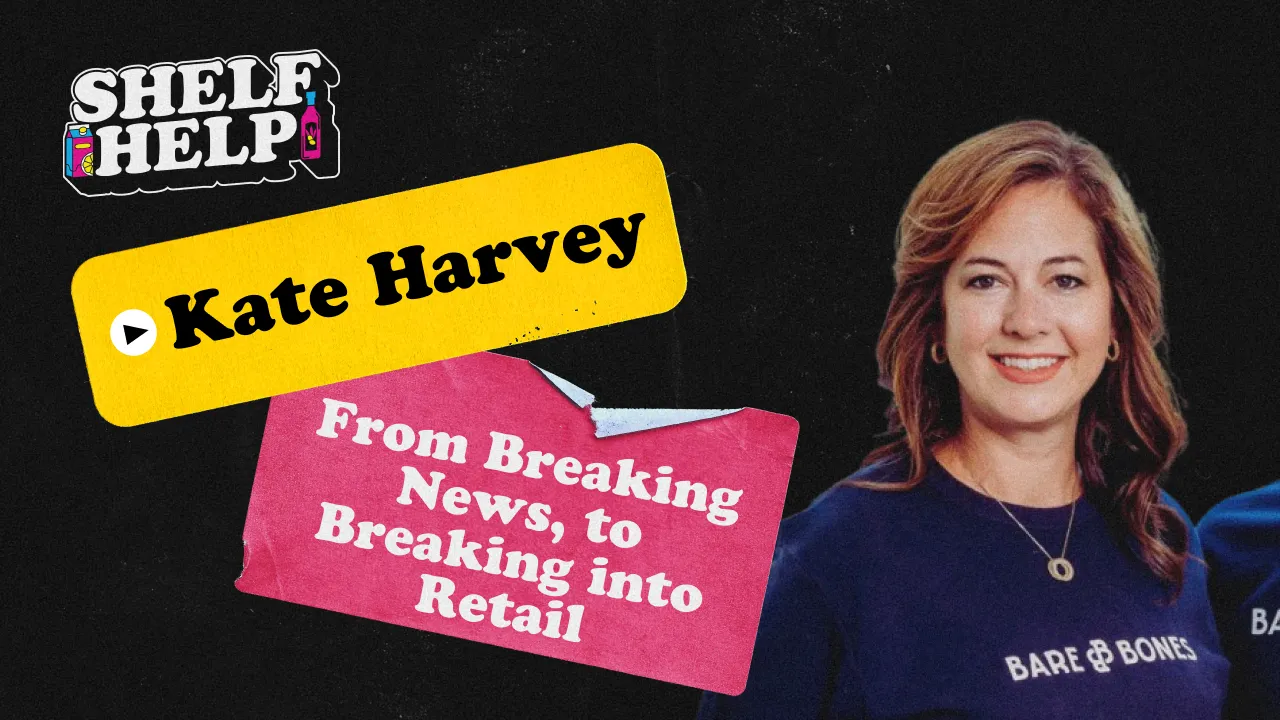



On this episode, we’re joined by Kate Harvey, the co-founder and CEO of Bare Bones, a category-defining brand on a mission to make nourishment more accessible, flavorful, and functional.
What started out in a small kitchen has evolved into a national brand with innovative products like shelf-stable broths, instant protein sticks, and collagen-fueled hydration powders.
Kate joined Shelf Help where we dove into how Bare Bones went from frozen bone broth to an omnichannel platform brand. Kate breaks down the co-packer horror story that nearly derailed their Costco launch, the multiple iterations of their visual identity, and how she thinks about shelf placement, demos (or lack thereof), ExpoWest, and driving velocity.
We also get into on-the-ground tactics that are working right now and what trends Kate is tracking.
—---------------
Episode Highlights:
🥣 From journalism to bone broth founder
🧪 Early R&D and finding product-market fit
🧃 Why form factor changes everything
🚫 The co-packer horror story that almost derailed a Costco launch
🎨 Packaging design change that unlocked +40% velocity
🏬 How Bare Bones thinks about demos, displays & shelf location
🛒 What Costco taught them about scale
📈 Sampling strategies that actually work
📊 Tactics that are driving trial right now
🌿 Trends Kate is tracking across the store
—---------------
Table of Contents:
00:00 – Intro
00:38 – Bare Bones intro and origin story
02:36 – How Kate’s journalism background set her up for success in CPG
04:01 – Building Bare Bones with her husband
06:03 – Formulation and R&D - the first form factor (frozen bone broth)
07:43 – Expanding into the powder-stick format
11:48 – Learning lessons from a co-packer nightmare
14:44 – Visual identity and packaging design
22:01 – Rebrand learning lessons
25:08 – ExpoWest, what it’s actually good for
27:40 – Where bone broth sits in the store
29:29 – Costco
34:26 – Demos and sampling
36:48 – On the ground tactics that are working well as of late
38:14 – Brands and trends Kate has been tracking lately
—---------------
Links:
Bare Bones – https://www.barebonesbroth.com
Follow Kate on LinkedIn – https://www.linkedin.com/in/katherinepoythress/
Follow me on LinkedIn – https://www.linkedin.com/in/adam-martin-steinberg/
For help with CPG production design - packaging and label design, product renders, POS assets, retail media assets, quick-turn sales and marketing assets and all the other work that bogs down creative teams - check out KitPrint.
Episode Transcript
Speaker 1: 00:00
Welcome to Shelf Help. Today we're speaking with Kate Harvey, who is the co-founder and CEO of Bare Bones, a brand focused on offering protein and hydration in a convenient, easy-to-use format, which we're going to dive into here in a second. Prior to Bare Bones, Kate had a bit of a unique background. She spent quite a long time as a journalist, a journey and tradition. I'm excited to dive into it. Maybe just first off, Kate, just for the listeners that aren't that familiar with Barebones, maybe just give us a quick lay of the land in terms of origin story, why behind the brand, Corporating Guys offer, and maybe just throw out a few places that people can get their hands in them and then uh we'll go from there.
Speaker: 00:39
Sure. Yeah, thanks, Adam. I'm excited to be here. So Barebones started in 2013 where Husband-Wife founded company. My husband, Ryan, was an exec, he was a chef in fine dining in San Diego and found that that lifestyle wasn't conducive to his interest in health and nutrition. And so he found himself drinking stock from the back of the stove during service at 910 in San Diego. And he realized not only did it taste good, but it was really nourishing. And supermarkets didn't sell anything like this, a true chef quality stock. So he started making a chef quality stock on our stove in North Park and freezing it and shipping it nationwide. And he called it bone broth to set it apart from the stocks that had been sold in conventional retail for decades prior. And so that's kind of our origin story. We started in bone broth, but really we are not a bone broth company. We are about convenient protein and delivering it in delicious formats and delicious flavors. So we now have our liquid bone broth line, an instant bone broth line. And we recently launched a collagen drink mix that's delicious. Uh, it comes in lemonade, fruit punch, and passion fruit flavors. So I came on a little bit after Ryan started. I was a journalist at the San Diego Union Tribune. I think it was called UT San Diego at the time. I covered retail and small business, and I had through my work met the owner of Jimbo's Naturally, which is a very beloved natural and specialty retail chain in the San Diego County area. And so through that relationship, we had our first meeting with a retail buyer and got some feedback on the product and the packaging. And that was kind of how I got involved and eventually quit my job. We moved out to Oregon to set up a broth factory and an old sushi restaurant, and I came on full-time.
Speaker 1: 02:35
Awesome. How do you feel like maybe looking back and now your experience in journalism played a part in the success you're having as an entrepreneur in this CPG space today?
Speaker: 02:45
Oh my gosh. I wish it had contributed more. I will say that. I think certain skills I developed as a reporter have really been an asset to me as a founder, one of which is just deep curiosity about everything and lack of like a confidence and asking questions and not knowing the answers yet. I think that really helped us as we started out. I thought I understood business and I thought I understood the retail side of business when I made the move over, but I quickly learned that there's a lot of opacity and a lot of nuance to both consumer packaged goods and to running a business that I just I'm not sure you can fully grasp until you've lived it. So I probably came into bare bones from that job with more confidence than I should have. But at least I was curious.
Speaker 1: 03:40
Yeah, I think that's probably a good thing. There's coming in to some level of, yeah, I don't know, faking it till you make it. It's uh part of part of the entrepreneurship journey to a certain extent.
Speaker: 03:49
Yeah, for sure. I say all the time, if I had known what I was getting into, I never would have started. I would have stuck with my journalism job, which at the time was really rough on me. It was like emotionally taxing. I would have stayed there.
Speaker 1: 04:02
What's it been like uh building a business with your partner in life?
Speaker: 04:07
And honestly, the greatest blessing. A lot of people remarked, like, I could never work with my husband. I could never work with my wife. And because it's all we've ever known, it doesn't feel that hard to us. Actually, bare bones predates our marriage. We didn't get married until June of 2014. So we were colleagues in the business before we were, and for that reason, we just kind of I think in a new relationship and a new season of a relationship, it gives you a lot of permission to revisit ground rules and expectations and all of that. And I think we were just lucky that the business predated everything and we were able to sort of build the marriage around the business in a way that benefited both and gave us like safe spaces to we could compartmentalize if that makes sense.
Speaker 1: 05:04
Yeah, totally that makes lots of sense.
Speaker: 05:06
Yeah, yeah. So that said, it is a challenge. Like it's it's hard, especially when things are tough with business. It's hard to leave that at work and not allow it to bleed into every conversation that you have. But over the years, as we've built out the team, Ryan and I have gotten progressively better at establishing and maintaining those boundaries. And we just have a very open, honest dialogue. If something, for example, yesterday we were on a like a date day. We went to a spa and then we had lunch after. And as we were just talking over lunch, Ryan mentioned something about the business. He's like, Like, let me know if you don't want to talk about work right now. Like and we just have a very open partnership that way. Like it just they do bleed into each other, but we're both okay saying, I don't want to talk about that right now.
Speaker 1: 05:58
That's great. That's awesome. Sounds like you guys got a good setup. Reminding back to some of those early days, I believe the original first and original form factor was the frozen liquid format. Did it take a while to cone in like the actual final formulation that you guys are happy with that you wanted to bring to market? And curiously what that process was like.
Speaker: 06:16
Well, that's a great question. You know, those early days, I don't think it was that hard. Um, partially because we were the only people doing it. And Ryan had his chef experience and background. He knew how to make a high-quality bone broth, a high-quality stock. And it's it's not rocket science. It's just taking fresh vegetables and like high-quality animal byproduct and like simmering it for 24 hours. Um, there were some challenges in the early days with when to add the vegetables to the simmer so that they didn't taste burnt or scorched. Beyond that, it was really not challenging. Our biggest challenges were how to package it for consumption and how to ship it safely so that the packaging didn't get compromised or so that the product didn't get compromised. And those were certainly the biggest challenges. And we were so married to this idea of we really rejected like the science of food because neither of us had a background in the the science of food. We rejected the idea that you could make this product shelf stable. And that was one of our early like missteps, I think, not being more open to and curious about how the science worked. Um, we really should have gone shelf stable in those earliest days. And one of our biggest competitors did go shelf stable in the earliest days, and they captured a ton of market share because they did that.
Speaker 1: 07:42
That makes sense. One of the reasons you made the not necessarily pivot because I know you still have the look and version, but the expansion into the powdered format for some of those challenges that that that you expressed, what led you to finally make that decision to make this expansion or pivot?
Speaker: 07:57
That's another great question. We got consistent feedback from our consumers that the liquid bone broth was delicious. They loved it, but it a, it was really expensive, and B kind of inconvenient. They wanted to be able to fly with it and take it on vacation, take it to the office, take it backpacking, send it to school with their kids. And there just isn't a really good or convenient way to do that with a liquid, liquid anything, let alone bone broth. And so we had been considering ways to dehydrate or create create a powdered form of our bone broth. And we actually, for a very short period of time, because we couldn't figure that out, we just launched a collagen powder.
Speaker 1: 08:41
Okay.
Speaker: 08:45
What really was our unlock, and this was actually 2019, one of our angel investors introduced us to a gentleman who has a very close relationship with Kinders, which is a brand that does a lot of business at Costco. Costco had come to Kinders asking them to make an instant bone broth for them. It wasn't in Kinders Wheelhouse, it wasn't on brand for them, and they were looking for a partner to bring this instant bone broth to Costco for them, per their request. And so these two investors got together and they were like, I know the perfect brand. And so they kind of we entered into a relationship with this team, and they helped us innovate and develop the recipe for our instant beef bone broth, which we launched in of all times. It was like Memorial Day weekend of 2019. It's hot, it's not the ideal time to launch a bone broth, but we launched it in Costco and on Amazon simultaneously. And within a month, that instant beef bone broth was the top-selling beef broth on Amazon, which is pretty monumental for us. And it just kicked off this flywheel that has never stopped.
Speaker 1: 10:02
Man, that's that's awesome. Was it to maintain the same flavor and the same experience that customers were getting in the liquid format to convert that into the powder format? Was that a tough process? Sure.
Speaker: 10:15
Yeah, you know, it's funny. A lot of people assume that we take our liquid bone broth and we just like dehydrate it.
Speaker 1: 10:20
Right.
Speaker: 10:21
That is not what happens. It's a totally different supply chain and process of manufacturing. So we're starting with the individual ingredients that are already dehydrated or spray-dried and agglomerated, and we're mixing those to make an entirely new product that does have the same nutritional profile as our liquid bone breath. So, in a lot of ways, it's easier. In some ways, it's harder. And we're learning anew every month how much how difficult it really is to make this product in a way that tastes good and performs well and can be packaged in a convenient way. We've kind of been baffled, honestly, that we don't have more competition. And it's because it really is challenging to make a dehydrated bone broth product taste delicious. So yeah, it was a process. I think we went through at least 12 iterations of the instant beef bone broth before we launched that. And several months later we launched instant chicken bone broth, but it was not, we weren't thrilled with it. It wasn't the perfect final formulation. It is now six years later, and we have launched what I believe is our final version six formulation of instant chicken bone broth. That's what I'm drinking right now, and it's it's delicious. But it took us six, you know, six years and six versions to figure it out.
Speaker 1: 11:47
Yeah, that's a bit of a journey. I know you spoke a fair amount about the journey nightmare, however you want to describe it. You went through with a, with a I think you might describe it as a Kopacker middleman. So we don't have to patch the whole saga in detail, but maybe just based on that experience, what are some recommendations you might have for some other up-and-coming founders and brand owners that are about to start to search for a co-packer? And once they find one, actually engage with one.
Speaker: 12:13
Oh man, yeah, that that's it's a tricky one. There are a lot of pitfalls with co-manufacturers because I alluded earlier to the opacity of this industry. It can be hard. It's not like you can get on Google and find a co-manufacturer very easily and vet them and determine if they can make your very specific nuanced product in the way that you want it made. It's just not a thing that exists. It is getting a little bit better, but co-manufacturers are stuck in the 20th century. And so to get an introduction to one or to find one can be really challenging. I recommend working with an outsourced operations agency. There are a lot of those out there, many of them really, really good. That's in fact how we got started with our co-manufacturer. So starting with an outsourced ops team who are really good at supply chain and have already vetted a lot of co-manufacturers who do a lot of different things that can match you. It'll save you a lot of time and heartache in the end to do it that way versus trying to go out on your own and find a co-man.
Speaker 1: 13:25
Yeah.
Speaker: 13:26
When you do get introduced to a co-manufacturer, it is absolutely mandatory that you make an in-person on-site visit during production. Make sure that the name on the building matches the name on the contract that you're signing. And yeah, uh, those are those are two of the big ones. And then on the contract, have an attorney review it. Always have an attorney review it. You will, it will save you a lot of heartache. It's expensive, but it's worth it because this is your bread and butter. This is this is the heartbeat of your company. If your operations and your co-manufacturing relationship are toxic in any way, it can ruin you.
Speaker 1: 14:06
Totally. Those are all really helpful. Really helpful. Hopefully, it helps at least one person if they listen to this.
Speaker: 14:12
Yeah. And I'm happy to answer questions about any of those outsourced operations agencies who can help you. I know of at least three that are really good. Um, and in fact, that first ops consultancy that we hired, our VP of operations came from there. So yeah, she stayed on with us after they sort of dispersed and she came on in-house.
Speaker 1: 14:34
Yeah, that's great. Yeah, I interviewed um Chris Bauer. I'm not sure, I'm not sure if you're familiar with Catapult. They're similar. They really help, really help brands find co-packers and kind of commercialize their products. Shifting gears a little bit talking about visual identity, you know, packaging design, packaging updates, sample. When you're thinking about back to that original kind of packaging design, what were the kind of key variables that were top of mind for you in terms of that original version? And maybe another way to look at it. What were some of the key things that are included in that brief with whomever you worked with to actually design the visual identity and packaging? Are we talking OG OG back in like Yeah, I mean you can talk about that one and then and then maybe the, or maybe the current version, which everyone you feel like is talking about.
Speaker: 15:14
Yeah. Well, I'll I'll give you a little background on the OG, just because I think there were some missed ups along the way. So the original packaging design for our frozen product line was done by somebody who she was a designer in the restaurant community in San Diego. And she didn't have a whole lot of experience in packaging design outside of like maybe alcoholic beverages. So it was interesting. And she kind of led the process. And her process was she went into Whole Foods Market and Sprouts and stood in the broth aisle and was looking at what are the colors that people are using, the textures and the visual, like the imagery, and trying to find a unique angle that would help us stand out on shelf. And that was what sort of drove her. And also, how could we tease out this idea of bare bones and sort of like that ancestral ritual surrounding how you take the bones of an animal and simmer them down? So, what we came up with was a very sort of Egyptian-inspired, hieroglyphic-inspired like visual identity that was really rustic and masculine and um maybe didn't follow the rules of great packaging design. So we we used that for several years. That was fine because we were a very mom and pop homegrown brand and we were just selling direct to consumer. When we took our first round of investment a couple of years later, our investors felt very strongly, and they several of them came from CPG, they felt very strongly that we needed to do an a brand overhaul. And so we worked with um agency out of Austin called Tarmac, PTARMAC, and they sort of helped us restart the brand in a way.
Speaker 1: 17:10
I think is that right?
Speaker: 17:12
No, this this one was 2016 to 17 that they helped us with that. Got it. Yeah, so we've been through now three major overhauls of the brand. That one we felt was a really solid, it was a really solid brand, and that gave us the bare bones blue, which we feel like we have a lot of equity in now. But then in 2020, shortly after we launched the instant bone broth, we felt what we needed to evolve a little bit further because a lot of the prior identity had been built around just bone broth. And we really leaned into the animal imagery on pack, and we we found that was off-putting to consumers. They didn't want to see the face of the cute little cow before they drank the beef bone broth. So um, we worked with the Mac and Roni, Ron and Mackenzie. They're a couple, a married couple in New York, and they they sort of helped us to tweak our visual identity. And it works so hard for us now. And we removed the animal from the front of the pack. We removed the, we had a window that you could view the broth through in the liquid bone broth. And we just we gave it a much cleaner design. We used vegetable illustrations and for the instant bone broth, we we showed the instant bone broth stick on the front of the pack. And um, yeah, our velocity surged after we did that.
Speaker 1: 18:37
Yeah, I think I read it was like 20 to 40 percent, which is pretty crazy.
Speaker: 18:40
Yeah, it was wild. And that's on the liquid bone broth. The instant bone broth, it was harder to do like a before and after of velocity, because again, that was primarily a club and Amazon brand or Amazon product line at the time.
Speaker 1: 18:55
Yeah. And so when by that time that that the latest rebrand in 2020, once you made that decision to yes, we're gonna do this, like what how long did that whole process take of going to the rebrand when you felt like it was it was ready to bring to market?
Speaker: 19:11
Man, that I don't recall. One of our one of our philosophies at bare bones is always be improving. And um we're always in pursuit of perfection. And so we're kind of always working on packaging. That said, these big packaging overhauls that we've done like two or three of now. I think each of them took at least four four months to dial in the actual packaging and design and agree on a direction, and then a few months to apply it to all of the packaging, and then you're rolling it out, which is always messy. So a year, a year and a half, it's a long process and it's really painful, but worth it.
Speaker 1: 19:58
Yeah. Thinking back to that, maybe the most recent one in 2020, what were um some of the more like decision points that were more contentious internally or required the most debate, whether it was just between you and Ryan, or maybe with that team, or yeah.
Speaker: 20:11
Yeah. So one of the one of suggestions from one of our investors was changing the name. Oh, that's we were just bare bones with bone broth under the name sometimes. One of the investors wanted us to become bare bones nutrition. And we felt that that signaled something different from the actual strategy and the heart of the brand. Our approach is always to deliver nutrition, but we're food first, food and flavor first. Um, and positioning it as barebones nutrition made it feel like a supplement brand. So I would say that was the most contentious, but it wasn't even that contentious. Um, we're really, really fortunate that our investors have been very deferential to us over the years and given us a ton of autonomy in running the brand. And then there was a little pushback on we use a lot of white as the backdrop to our packaging. And it's a little bit counterintuitive because most brands in CPG look at a white package and they think private label, but we really wanted to communicate the cleanliness and the like bare bones. We've stripped everything out that you don't need and we're delivering everything you do need. So there was a bit of debate around the usage of white in our packaging design. Those were the two biggest contention points.
Speaker 1: 21:33
Yeah, that makes sense. Those don't surprise me. Now that you've gone through this two or three times, yeah, let's just say I was a a uh a new brand leader at a fast-growing CPG brand like bare bones, but maybe a few years behind. I told you I'm considering a packaging and refresh. What would be like in a few questions or questions you might ask me just to help me decide, even if this is the right strategy to do in the first place?
Speaker: 22:01
One would be where are you selling your product? And two, why do you think that you need to do a packaging refresh? What are the data points that are making you suspect that or feel that? Three, what's your budget for a packaging refresh? For what is your brand strategy? And that's something that we're learning now in a way that we hadn't before, as we're going through yet another visual identity refresh. The strategy should drive everything. Everything. So if you don't have your strategy dialed in, you're just treading water and spinning your wheels to evolve that visual identity. You need to have a really good reason to do it because again, it's expensive. You're inevitably, and we have a kick-ass VP of operations. Inevitably, we end up having to throw away tens of thousands of dollars of packaging every time we change it. And then another thing to consider is who is your regulatory compliance partner? Because you want to make sure that you're in full compliance with all of your regulatory agencies when you make any packaging updates. Because again, you just you can't afford to make mistakes.
Speaker 1: 23:23
Right. Totally. Those are all very helpful. As you were thinking about whether it's the most recent one or some of those other ones, how did you think about that need for like balancing, you know, obviously you want a fresh look for reason, but also keeping some of those familiar legacy brand elements for you know the existing customers that really resonate with the brand. And also, you know, when they're walking down the aisle, making sure they can continue to find it and not get lost.
Speaker: 23:50
Yeah. This is always we call it it's high stakes, right? The bigger you get, the bigger of a deal it is to make a, you know, a change. So really identify what the brand elements are that people recognize and resonate with and preserve those as much as you can and or hint at them in any evolved identity. So for us, we we felt on the last round of packaging that it was our bare bones blue that was really the thing that people identified as this is bare bones. Even if they couldn't see the logo, didn't see the logo, maybe didn't read the packaging, they knew that was bare bones. So that's one of the equities that we've really held on to through every packaging design round that we've done.
Speaker 1: 24:42
Yeah, that makes sense. I think you I'm correct if I'm wrong, but I think you did like that most recent the 2020 re-brand. You did that big unveil at Expo West, I think.
Speaker: 24:52
Yeah.
Speaker 1: 24:53
Seemed like it's a great event for these types of things because you got all the important stakeholders in the same place and you can get, you know, get their attention. But it seems like on the maybe on the flip side, because every brand is there, there's so much going on, it can it can potentially be hard to rise above the noise to a certain extent.
Speaker: 25:09
Yeah, I have such mixed feelings about Expo West. I will say if you're planning to go to Expo to get new business and have an ROI, I don't, I don't think that is the purpose of Expo West anymore. It's certainly not what it delivers for brands. For us, um, when we go to Expo, it really is to get eyeballs on something new that we're doing and to get early voluminous feedback on what we're working on or what we've launched. So for us, launching that new brand refresh at Expo was a tremendous success. We um, you know, we made this big backdrop that had the new packaging on it. It was really unmissable and um eye-catching, and it drew a lot of people in and they gave us their feedback on the new packaging. Meanwhile, you know, to speak to the difficulty of rolling over to new packaging, we were handing out samples in the old packaging. So we were getting feedback. It was almost an A B test on the two packaging designs. And um we just we got a lot of confirmation that we were on the right track to make that packaging switch. The other great thing about Expo is we got product into a ton of people's hands. And when you have a physical sample that you can send home with people, they remember that in a way that they can't remember just grabbing a little like cup, sample cup of something. They have your website information on the package. So when they get home to the piece of their home, they're trying your sample, they're reading the packaging, they're visiting your website. It's a lot more stickiness to it. So yeah, it's it can be successful. Know what your goals are in going to Expo because it's a heavy lift and it is um, it's a lot of money.
Speaker 1: 27:01
Yeah, it's gotten a lot more expensive in the past few years, from what I know.
Speaker: 27:05
Yeah. I will say the times the years we haven't gone to Expo have been our best years financially.
Speaker 1: 27:11
That tells you something, I guess. In terms of launching in retail, I guess this is probably more applicable once you at least on the bone bross. I think you shipped into the power form. Where in the store did you like envision this product line would sit? Because it feels like it could potentially sit in soup, I guess, or maybe like the supplements aisle, maybe just like the beverage aisle. I'm curious, like, where did you envision it? Did retailers have a clear vision of where it would sit? Were they initially unsure were you guys aligned, or maybe that's a more straightforward answer than I think it is?
Speaker: 27:41
Yeah, there was a lot of discussion about that and a lot of uncertainty. And when we first launched the instant bone broth into traditional retail, my preference was to A-B test it in nutritional supplements and in the soup aisle. When we pitched it to our soup buyer at Whole Foods, she goes, Oh no, I think this is actually beverage. And we were like, uh, okay, this isn't even one of the considerations. And we we felt strongly it did not belong in beverage. What I knew based on my experience as a consumer and running sales for bare bones is that consumers, you want your product placed in the most adjacent spot to what people will be looking for when they discover your product. If the most natural for someone to be looking for a liquid bone broth, discover that, oh, hey, here's this much more convenient and much more affordable version of bone broth. I'll buy that. As opposed to someone going into the beverage aisle looking for an energy drink for an electrolyte mix and finding a savory bone broth. It just didn't feel like a natural fit. So we felt very strongly and we advocated very strongly for our soup buyer to take the product line. And I think that's proven out, especially now with the way grocery prices are fluctuating mostly in the upward direction. Um, having a more affordable bone broth option next to the liquid bone broths that are getting more expensive by the day is working out really well for us.
Speaker 1: 29:28
That's great. That's that's super insightful. I know Costco, I think, got wrapped up in that original Copacker fiasco, but it sounds like eventually got on the shelf have had a fair amount of success there. You know, Costco's a bit of a different channel than other ones. And yeah, I'm just a bit about that journey of getting on the shelf of Costco, just in terms of maybe that first buyer meeting, getting the commitment. And then once you got that commitment, all those, all the steps in terms of actually leading up to a successful launch.
Speaker: 29:55
Oh, there's so much to Costco. There's a lot of urban legend around it. Some of that urban legend is actually true. The the challenge with Costco, well, I'll start with like, here are the wonderful things about working with Costco. They're easy in terms of they place a purchase order. It's a full truckload of product. You send the truckload of product, they pay you in 15 days. They have like two or three ways that you can support your product, your item in their warehouses. So it's pretty simple versus and you're not going through a middleman, you're not going through a distributor. It's a very direct relationship. And it's a lot, it's like big orders. Challenges with Costco. They don't want to comprise more than 20% of your revenue because they're very protective. And this is one of the things I do love about Costco. I'm a Costco super fan as a member and a consumer, and now as a supplier, they're very protective of your financial security, both their suppliers and their members. For the longest time, Costco wouldn't even allow the use of a credit card in their warehouses.
Speaker 1: 31:11
Yeah, I remember. Yeah.
Speaker: 31:12
So they they're the they do don't want to comprise more than 20% of your revenue, is to protect you as a brand. They know that they're kind of a fickle customer in terms of they can they can move quickly, they can approve an item and have it in their warehouses in a month if you can produce it. That's not true in any other retailer that I know of, really. So they're very nimble, but they also can drop you equally quickly. Once you sell through the item, they're on to the next one. That's part of the treasure hunt atmosphere that they create at Costco. So they don't ever want to jeopardize your longevity as a company. So that's a challenge. They also are very hard on price. They do their comps, they know their comps, they're gonna know by unit what you're selling for on Amazon and at Walmart and at Sam's Club and at Kroger. And they're gonna grind you down if they feel like they're not getting the best price. Other challenges from a channel strategy perspective is if you're selling your products in Costco, it's the best price in town. Members are gonna go in, and they do have a lot of business members who will go in and buy up a ton of your product and turn around and resell it on Amazon and compete with you on your brand, on your product listings, and drive down your margin. So that's one of the challenges. And I don't know if I fully answered your question.
Speaker 1: 32:44
No, these are all really helpful, though. What do you feel like is the key to winning in Costco? And especially that may be unique to Costco.
Speaker: 32:54
Partnership with your buyers. The merchants love to be a part of and have input on packaging and how you communicate about your item and how you display and merchandise your item. They also really know their members. They have a lot of insight into how their members shop, what's important to them, um, that is invaluable. So developing those close relationships with your merchants is the key to success. We've been really, really fortunate to have some fantastic merchants who we have a direct relationship with, and they have championed our items. Like if we did really well in their division, they went out and championed us to other divisions and got a volume buy. So we're talking now instead of one or two divisions picking up the item, you've got nine divisions all at once selling the item. Talk about economies of scale. It's insane. So, as much as possible, make sure you have a great broker for Costco because a great broker can make or break you. They need to have a strong relationship with your merchants, and they also need to trust you as the brand to come into those meetings because you also don't want them gatekeeping those relationships. You want to rely on your broker for insight, expertise, and like guidance, but you don't want them owning those relationships. And the Costco buyers don't want that either.
Speaker 1: 34:21
Right.
Speaker: 34:22
So that's really important and the key to success there.
Speaker 1: 34:25
Talking about demos and sampling strategy in general, how big of a part of that has been in terms of where you've gotten the brand to today.
Speaker: 34:35
We are historically, we have not been a brand and selling items that do well with sampling. So until we launched the instant bone broth, we really didn't do any sampling. We attempted it in Whole Foods Market to be a good partner. Ryan and I would go in ourselves and do sampling at like the Hillcrest Whole Foods in San Diego so that we could get a feel for how to run an effective sampling program. And it just was very off-putting to a lot of customers because they they would see our like Cambros or our AirPods and think, oh, coffee, and come up and find that we're serving meat juice instead. So we didn't really lean into sampling in retail ever. We did do a lot of demos at Costco in the early days and with mixed success. Those who've never really driven velocity, it's more of an awareness thing for us personally, just again, because of that initial reaction to being served meat juice. What has been the huge unlock for us is taking those instant sticks. It's a single serving of instant bone broth or collagen drink mix and finding partners and who service a similar demographic to ours, partnering with them to get those samples into the hands of their consumers. We've partnered with the lift box, for example. We've partnered with Snack Magic, all of these like subscription box type things where people are looking to discover new items that meet their health needs or make their health journey more exciting. So that's been a huge unlock for us. We're also partnering this year with Mammoth March, which is this long distance like trekking event that they do all over the country. We've partnered with them to provide samples for those events. That's been the type of sampling that really drives velocity in every channel for us and brand awareness. And again, it's that take-home thing, too. So then your brand is sticking in their minds.
Speaker 1: 36:39
What have you guys found in terms of driving sell through and maximizing velocity? And what have you found are some of the key kind of tools or strategies you found that have the most impact?
Speaker: 36:49
The biggest things tactically lately, well, it depends on the retailer, but almost universal. This is a universal truth. When you do deep discounts, you drive trial. So having a deep strategic promotional cadence in store has been our most effective strategy. Outside of that, it really does depend on the retailer. At Whole Foods Market, we have found off-shelf display to be incredibly effective. It's also highly competitive to get off-shelf display, like end caps or they call those wings. It's competitive. Every brand wants that placement. It's also incredibly expensive. So you need to know your ROI analysis and know how much it's really going to cost and what velocity lift you need to see after for it to really pay off. In recent years, investing in digital retail media has been the second most effective strategy. Outside of that, make sure your packaging talks for you. Make sure your package it is the most important marketing you're ever gonna do. In store, out of store, anywhere. So make sure that your packaging is working its butt on.
Speaker 1: 38:10
Those things, all three things really make a lot of sense. Last question for you, Kate. You've been immersed in the CPG space for a while. Any specific brands or just trends in general across CPG overall that have piqued your interest or caught your attention or things that you're tracking at all?
Speaker: 38:28
Always, you know, for a long time it was the sparkling water, which is still somehow growing, I think. Like the sparkling water category has always been really interesting to me. Um, and I had this idea for a brand if if that had the bandwidth to do this. Married sparkling water with like aromatic bitters, so supportive of your gut health, kind of a thing. I think someone's already doing that. I've run out of time to be the first to market on it. Um, so yeah, sparkling water categories, super interesting. Hydration in general, it seems like most people are eager to address their hydration needs in various ways. Um, and there's a lot of interesting innovation coming out that way. And you've got all kinds of electrolytes and collagen drink mixes um that are playing in that space. Another really interesting one is the grain alternative pastas and anything that has protein infused into it or delivers a lot of protein, a significant amount of protein. Like Bonza is one of my favorite brands right now because my kids don't eat much of anything that we like to eat. They don't like vegetables, they don't like to eat meats a lot of times. So, like, how do I get protein into my kids' bodies besides bone broth, obviously? So bonza is really interesting and Goodles and like all of these. I just think it's super interesting when a brand or brands come into a sleepy category and find a way to disrupt it. And there are so many categories in the store still ripe for disruption. Like who's making the better for you jello? Nobody.
Speaker 1: 40:14
I have yet to hear one about that.
Speaker: 40:16
Yeah. But it's just I I'm fascinated by any anytime some someone's disrupting.
Speaker 1: 40:22
Totally. Yeah, I'm on the same page. What's the best place for people to follow along with you specifically? And then also best place to follow along with bare bones as well.
Speaker: 40:31
Probably the best place to follow me is on LinkedIn. I'm Katherine Harvey on LinkedIn. Um, and bare bones, you can find us on LinkedIn, on Instagram at bare bones broth, and on Facebook at Barebones Broth. And then our website has all of the retailers you can find our products in. We have a really slick store finder who can explore our story, our why, our recipes, and find other ways to follow us there.
Speaker 1: 40:58
Awesome. Well, thanks, Dave. It's been awesome. Appreciate the time.
Speaker: 41:01
Yeah. Thanks, Adam.
.svg)