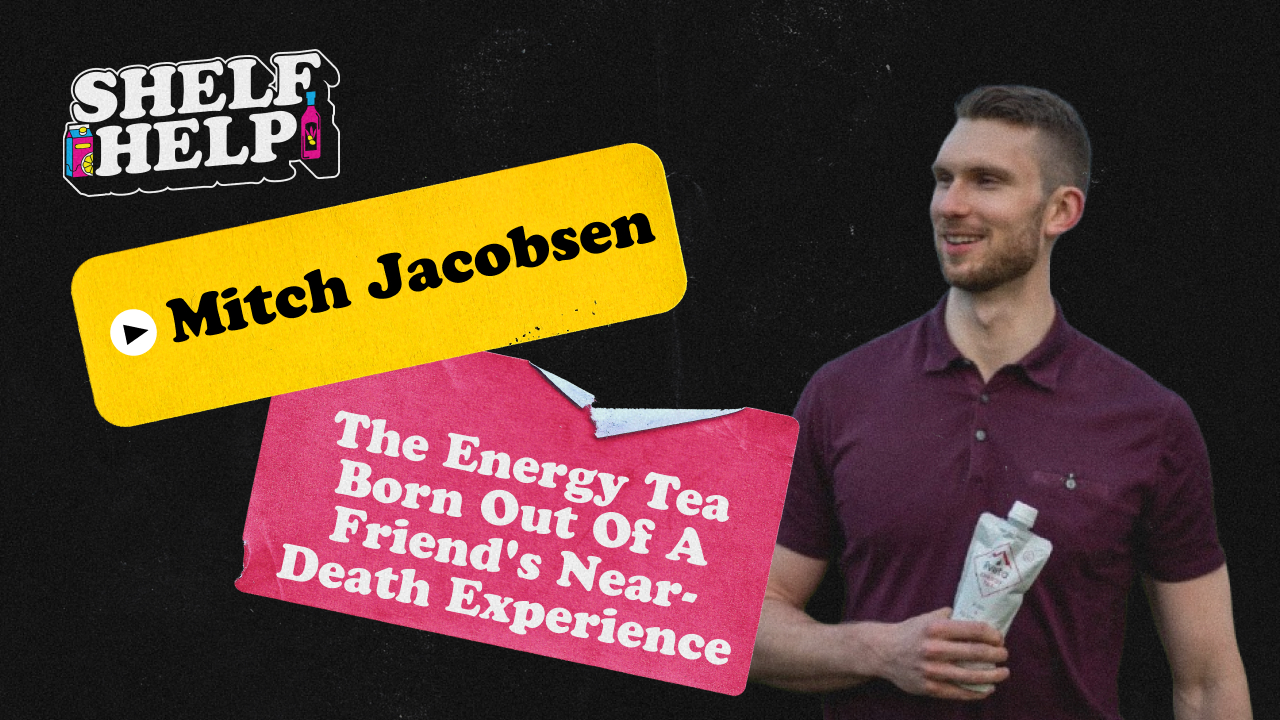
The Energy Tea That Was Born Out Of A Friend's Near-Death Experience | Mitch Jacobsen, Rviita



On this episode, we’re joined by Mitch Jacobsen, P.Eng., Co-Founder & CEO of Rviita, a Calgary-based energy tea brand packaged in lightweight, resealable spouted pouches.
Mitch went from petroleum engineer to beverage entrepreneur after a friend’s energy drink-related near-death experience. He walks us through the hard-won lessons of product development as a CPG newbie and why he chose to vertically integrate early and build a custom filling line.
We also get tactical on distributor relationships in Canada, how to prep for buyer meetings, and channel strategies for Costco and Amazon.
—---------------
Episode Highlights:
🍵 The “why” behind Rviita’s tea-based energy and low-sugar formulation
🧪 Early R&D mistakes and how a bad taste test improved the product
🧴 Why a spouted pouch (and how it became a moat)
🏭 Building a custom filling line - costs, headaches, and speed advantages
🔌 When vertical integration makes sense (and when it doesn’t)
🛒 First retail commitments, buyer outreach, and meeting prep
🚚 The Canadian distributor landscape and how to be a great partner
💸 What distribution really does to your margins
🏬 Costco realities: packaging, sampling, and velocity expectations
🛍️ Amazon playbook: positioning, reviews, and ops basics
🎨 Brand identity and packaging design choices that drive trial
👥 Internal vs external resources as the team scales
📈 CPG trends Mitch is watching next
—---------------
Table of Contents:
00:41:10 - Rviita intro and origin story
02:37:22 - The early days of R&D and formulation as a CPG newbie
03:31:13 - Mitch’s two core product requirements
04:10:06 - Ranking dead last in a friend and family taste-test
05:53:26 - The path to a unique packaging form factor
09:32:06 - The decision to vertically integrate early
10:24:23 - Building the custom filling line, the pros and cons
12:35:17 - Recs for early operators considering going vertical
15:17:22 - How investors view the vertical integration decision now
15:22:04 - Brand identity, packaging design
18:04:00 - Getting the first retail commitment
20:00:09 - Mitch’s cold call approach for buyers, how it’s evolved
21:13:08 - Buyer meeting prep
22:33:27 - The distributor landscape in Canada
24:49:03 - How to be a good partner to your distributor
26:20:17 - A distributor’s impact on margin
27:17:25 - Costco
30:25:29 - Amazon
34:47:22 - Internal vs external resources
36:20:10 - Trends Mitch is tracking
—---------------
Links:
Rviita – https://rviitalize.com/
Follow Mitch on LinkedIn – https://www.linkedin.com/in/mitch-jacobsen-p-eng-89277649/
Follow me on LinkedIn – https://www.linkedin.com/in/adam-martin-steinberg/
For help with CPG production design - packaging and label design, product renders, POS assets, retail media assets, quick-turn sales and marketing assets and all the other work that bogs down creative teams - check out KitPrint.
Episode Transcript
Speaker: 00:00
Welcome to Shell Phelp. Today we're speaking with Mitch Jacobson, the founder and CEO of Ravita, a tea-based, honey-sweetened, uh, better for you energy drink based out of Calgary. Mitch started after seeing his friend experience a pretty serious health scare, which he may touch on here in a second. Uh pride or Ravita, Mitch spent about, I think about half a decade or so in in the oil and gas world before jumping into the world of entrepreneurship. Definitely excited to jump in. Maybe first off, just for the listeners, Mitch, that aren't as familiar as Ravita, maybe just give us the quick play of the land in terms of origin story, why behind the brand, core products you guys offer, and maybe just a few places that people get their hands in them, and then uh we'll go from there.
Speaker 1: 00:41
Absolutely. Well, thanks so much for having me, Adam. It's an honor to be here. So yeah, my name's Mitch. I'm the CEO, the janitor, and sometimes even the receptionist here at Revita Energy Tea. It's a clean energy drink and a flexible beverage poach. So when I was in my mid-20s, I was working downtown oil and gas calgary here, kind of the Houston of Canada, sometimes we call it. And I was an energy drink addict. I was drinking these things all the time in the afternoon to get me through work. And I was starting to experience adverse health effects from these, which was kind of ironic because when I was in my really early 20s, my best friend at the time ended up having a minor heart attack that we ultimately attributed to energy drinks. Fortunately, he's okay. He made a full recovery. But the combination of these things was really the light bulb moment for me, Adam. Like, what the heck is in these energy drinks? And is there a healthy alternative? So I went and looked everywhere on the market for something with natural ingredients, wasn't carbonated, was easy on my guts because it was energy drinks were giving me heartburn and stomach aches and those types of things. Couldn't find it anywhere. So even though I had no CPG experience, I started messing around in my kitchen and ended up formulating the clean, better-free energy drinks that we have today. We're carried in most major retailers across Canada, hoping to expand into retail and into the US next year. But you can find us on Amazon, both Canada and the US. We ship to Canada and the US from our website. And then in Canada, here we're in Costco. So we'll be safeway, law blahs, pretty much all the major chains.
Speaker: 02:08
Let's rewind back to those early days talking about formulation product development for a minute. So I imagine it took quite a while to kind of dial things in, find the formulation process that really worked. And you know, I you know, I don't want you to give anyway any any trade secrets, but just kind of curious what the kind of the key variables you were playing around with, key tweaks you made between that first version and the final version that you felt like was right, you felt good about bringing that one to market and like how many batches it took to get you get you there.
Speaker 1: 02:38
Yeah, absolutely. Well, it took a lot more than I was expecting. So when I started, like I said, I had zero CPG experience. Like I didn't even know where to begin. So my first step was Googling how do you start a beverage company. I was step one. Step two was messing around in my kitchen. I was mashing caffeine pills together and mixing it with tea and coffee and all sorts of things. Figured out pretty quickly, I had no idea what I was doing. So through my research and those Google searches, I ended up finding a food scientist, which I didn't even know that was a profession, but uh called, we just cold called a whole bunch of food scientists across Canada and the US. Most of them laughed at me effectively when I told them this idea, but I did find one that was willing to work with me. So I put them on retainer at the time, and we just started going back and forth with the formulation process. So I didn't really know. I had some guidelines, but I didn't know what the end product was going to look like out of the gate. So I wanted it to be natural. I didn't want to use any artificial ingredients. I wanted it to be non-carbonated because carbonation was always screwing up my gut. So I was using energy drinks as a pre-workout sometimes. Carbonation just didn't appeal to me. So I figured there's got to be other people that feel the same way. So really natural ingredients, non-carbonated was kind of the the first two guidelines that I wanted to use. And I wanted it to be low sugar. So I wanted it to be ideally sugar-free. We ended up we're 30 calories now. We use organic honey instead of like stevia or erythritol. But yeah, the it took, I thought it was gonna take, you know, three or four months, maybe a couple trials back and forth with this food scientist. It ended up taking over two years at them. Uh, so the very first batch of samples I got back from this food scientist, I'll never forget it. Still working my downtown job, Calgary, Alberta. Get home from work one day, and there's this beautiful FedEx box on my front porch. I'd spent like $20,000 at this point, you know, in food scientists and set up startup fees. And I got samples of this drink I think is going to change the world. I had all my friends and family over that weekend to do a blind taste test of my drink because I wanted to try and get non-biased feedback or as much as I possibly could. Ended up being dead last in that blind taste test. My business partner at the time wrote it tasted like battery acid. So that's where that's where we started from. Dead last in the blind taste test. So got a pretty rude awakening really early on. Went back to the drawing board, changed a bunch of ingredients. You know, I was trying to use some complicated things early on, like branch chain amino acids. And I was trying to make it more like a pre-workout drink, but we dropped out pretty quick because we figured out it was going to be pretty difficult to formulate with it. And really, it was just an iterative trial and error process. You know, we try one thing, it wouldn't work, try the next thing, it wouldn't work. I ultimately ended up landing on organic honey as a sweetener. So got a really nice, unique taste profile from that, and then what natural caffeine from tea? Because we experimented with a whole bunch of different caffeine sources. Tea was ultimately the one that made us feel the best. And there's research showing now that tea contains amino acids that can prolong the positive effects of caffeine. It's a long-winded answer to your question, but it took a very long time and a lot more money than I was initially expecting.
Speaker: 05:44
Unfortunately, that seems like a common story. Yes.
Speaker 1: 05:49
You always think it's gonna be easier than it is in reality.
Speaker: 05:52
Always. Well, I know that the the brand is is now packaged in in the flexible pouches, which is definitely pretty unique in the beverage market, it'd say to say the least. And from what I know, you landed on those pouches after a formulation taste and andor I think I've read it was maybe like some rust issues with the can, which I think is maybe related to that first taste test and why it was lassie. I'm curious, like how that just tell me a bit about that journey that ultimately led you to the pouches.
Speaker 1: 06:18
Yeah, absolutely. So when I first visualized starting an energy drink brand, of course, I thought it was going to be in a can because all energy drinks are in cans. And I originally went down that avenue. I had a cam design, we were looking for can contract manufacturers. So I had a serendipitous meeting about a year into this RD process where I ran into a gentleman who helped launch Monster into Canada. And I'm telling him my idea, and I showed him my designs, and he looked at me and he's like, I'm gonna tell you the cold hard truth. Like, you probably won't even last six months. Like, how in the world are you gonna compete with the big energy drinks? Like, you don't have a chance. Like, you're not your can design looks very similar, you're not differentiated. And this was pretty disheartening for me because I'd spent a lot of time and money on design on this can. But I went back to the drawing board and I thought, okay, if I put a healthy energy drink in a can and it's just sitting on the shelves next to other energy drinks and cans, how how am I really gonna make it stand out? How am I gonna get the consumer to perceive it as better for you and not just another energy drink in a can? So I started looking at glass bottles and different options, had an engineering background. I'm an engineer by trade. So I was also looking into what's the most environmentally sustainable packaging type. And in my research, I kept this flexible beverage pouch kept popping up as a really low carbon footprint. It takes less water and greenhouse gases to manufacture as compared to other packaging types, and nobody was using it. And so I thought, well, wouldn't that be cool? Because it's gonna solve two problems for me. One, it's gonna be environmentally sustainable. I'm gonna check that box. But two, if I put this thing in a pouch, I'm gonna be totally differentiated and I'm gonna kind of own that space and the energy drink aisle. And so that was kind of some of the decision factors that ended up leading us down to the pouch. What I didn't know is because nobody's doing it, there's no stock pouches. So I had to custom design our own pouch. We have a patent now, but it was a lot of RD work back and forth designing this thing uh and getting a packaging company that could actually produce it for us.
Speaker: 08:17
Yeah. Interesting. Now that you've been in the market with it for these pouches for a while, like Nat at this point, what do you what have you found? I feel like are the biggest advantages and on the flip side, any any drawbacks you you found at all?
Speaker 1: 08:32
So the greatest advantage is kind of like what I just said, it really differentiates us. Like if you look at us on a shelf, your eye is drawn to this thing because no one's ever done a pouch like ours. It really stands out. So it's draw it's driven a lot of trial that way. So it's been our greatest marketing asset. Now on the flip side, because it's so unique, the manufacturing is a nightmare. So we ultimately ended up having to build our own manufacturing line, which I never planned for. I wanted to use contract manufacturers when we started. I had no interest in doing manufacturing. Now we do everything in-house. So great marketing tool, but a real manufacturing headache.
Speaker: 09:09
Yeah, fair enough. Fair enough. You mentioned you initially engaged a co-packer when you're working on the cans, and then you pivoted the pouches when probably sounds like probably out of necessity in-house. I'm I'm I'm curious in terms of the there's like you know, the filling portion, but there's also the portion of actually producing the actual liquid formulation that's actually gonna go in the pouch. Was were you also doing that internally, or was everything being done in-house?
Speaker 1: 09:32
So we initially started with a co-packer for both. So they would blend brew our liquid and then fill it into pouches, but it was effectively lab scale, quite a slow filling machine. They could do like, you know, maybe 20,000, 30,000 units a month, which pretty much gets you get one big retailer and you've outgrown them. So that's what happened. We worked with them for the first couple of years of our business, but outgrew them very quickly. Also had a bunch of quality challenges with our pouches. We looked all over Canada and the US, and there is companies that can fill pouches, but not our specific pouch type. We have a very unique spout. So it's a 22 millimeter spout, which is totally unique to the market. So no one had a filling machine for this thing. So there's a couple companies that said, well, we'll cope back for you, but you got to buy us a filling machine. And at that point, I thought, well, why don't I just buy my buy myself a filling machine? So we do everything in-house now. So we blend the liquid and then we fill it into the pouches.
Speaker: 10:25
So yeah, you you mentioned you you engineered and actually built that filling line custom to those pouches. What was that journey like? And I'm kind of curious. I imagine it definitely took a you know a good chump of CapEx to actually get that built out. Like, what did that part of the process look like?
Speaker 1: 10:40
Yeah, it was brutal, Adam. So the the first couple years of our business, we were running this thing out of my garage. So this Copacker would ship pallets to to my garage effectively, and we would distribute it out of there, which was it was great. It was a lot of fun. I was in you know my mid-late 20s at the time. No overhead, you know, hand bombing cases to retailers. It was great. It wasn't a lot of pressure, we were making progress, but then we start shorting retailer orders because I can't get enough from my co-packer. Uh, I look everywhere else for another co-packer, nobody can do it for me. So now I'm at this real crossroads in my business. You know, we've done a small seed round at that point, just friends and family, a couple hundred thousand. But now, you know, I'm looking at building a manufacturing line and it's well over a million dollars in CapEx to build this thing. And not only that, but we got to move out of my living room, we got to get a lease. You know, now it's not just a Bobby business anymore. It's it's the real deal now. And there's you got to sign personal guarantees, and there's a lot of financial pressure. So it was a big change two years into the business. But went and got bank loans, signed those personal guarantees, raised another small, I guess you could call it like a pre-seed round that's helped finance the capex for building up the production line. And we went to work building this thing, took way longer and cost more than we thought it was going to initially, but it's truthfully saved our business. It's brought our it's significantly improved our gross margin. And being able to have control over our supply is such an asset. When you get customers like Costco that we got this year, if we were trying to juggle that with the contract manufacturer, I think it would have been a nightmare. Whereas, you know, Costco comes to us, they need an emergency order delivered next week. Well, we can just run on the weekend or we can run a night shift. So being able to bring all that in-house was the greatest business decision we ever made, but also the hardest. And it came with a lot of trials and tribulations.
Speaker: 12:32
Yeah, I can imagine. That sounds like you felt like it was the right call, so which is which is great. For other operators that are considering going down a similar path for whatever reason, maybe they've got a unique packaging form factor like you, or maybe some formulation they feel like they don't trust anyone else to do it for whatever reason they've they're seriously considering going down this path of you know building out their own in-house production line. What are just a I don't know, a few kind of recommendations you might have for someone like that and a few things to watch out for, other than maybe the obvious is like it's gonna cost a lot of money.
Speaker 1: 13:02
Yeah, so I think the first thing, and a mentor actually told me this, I didn't believe him, but he was right. Whatever your initial time and cost estimate is, double it because that's it's probably gonna cost twice as much and take twice as long as you think it's gonna take. That's pretty true. There's there's just little things you don't think about unless you have a lot of experience in this. Hire an engineering firm to help you. We hired a local engineering firm here that helped us put together the drawings for the facility and make sure that pipes are sized correctly. Like, even though I'm I'm an engineer, I wasn't specialized in that. So we would have had a lot of screw-ups and a lot of hiccups if we didn't hire an engineering firm and then go and raise money. Just doing bank financing is really challenging. It's gonna put a lot of strain on your cash flow. So I think you want to make sure you go out and you you raise the capital. You make sure that you have the cash in the bank to be able to float yourself through that period of building out the production line. Because, like, for instance, you know, we ordered a filling machine, we thought it was gonna be here in December of 2022. Well, we didn't even get it until December of 2023. Things get delayed, there's gonna be supply chain issues, it's probably gonna take longer than you think it's gonna take. So you want to make sure that you have enough cash in the bank to be able to float yourself through that period.
Speaker: 14:18
I'm curious, what's the take from like investors now that it's already built out and everything is is going?
Speaker 1: 14:23
Yeah, absolutely. So I think initially some of our investors were pretty weary. Can you guys actually pull this off? But now that we have it working and it's functional and our gross margin profile is totally different than when we were using a Copacker, we get a lot of compliments from investors now telling us that they don't see a gross margin profile for a young company like us. Like they never see that because it's really difficult when you're contract manufacturing, you're losing a lot of that margin. The fact that we have control over our own supply, you know, we own all of our ingredients. We're not getting a contract manufacturer to do that and taking 10, 10% in the middle. So they love it and they see it as a huge positive. And then we're not doing it right now, but we also have the ability to co-pack for other brands. So it's a possible secondary revenue stream down the road, which helps, I think, de-risk things for some investors. So overall, it's been a massive positive. And I would say it makes it a little bit easier for us to raise capital compared to some other brands our size.
Speaker: 15:21
That's great. That's awesome. Shifting gears a little bit, talking about visual identity, packaging design a bit. Um, I'm not sure if you read that book, Ramping Your Brand, which it seems like everyone at CPG talks about about it. Yeah, one thing he talks about is like how his view premium pricing really comes from brands having one really clistal clear promise versus I think he called it like featuritis. I know you said you had that initial version look great, then you went to the next iteration, whichever you want to speak to, like in that context, thinking back to that design process and building out the brand identity. What were kind of those key variables that were top of mind for you? And maybe another way to look at it, whether you work with a freelancer agency, like what do you remember? Was it the key things that were included in that brief that you gave them?
Speaker 1: 16:08
Yeah, I don't know. Really good question. First, I love that book. It wasn't out when I started, but I sure wish I would have read it back. I wish it was available back. You would have saved me years of mistakes. But I definitely made that mistake when I first launched the featuritis mistake. Our packaging looked totally different than it is now. It was a lot more complicated when we would explain the product to people instead of just saying it's a better-for-you energy drink, I would have this long, convoluted, it's an energy tea, and we has amino acids from caffeine from tea and all these different features of the product. And at the end of the day, doing enough demos and customer surveys now, the reason people buy this is not because of the hundred features that I could list off. It's because it tastes good and it makes them feel good. It gives them an energy boost. They felt better than other energy drinks. So I think now we're really trying to simplify our brand messaging and make it a little bit more mass market. I think when you had Will Nitza on, he talked about that too. It's getting away from being a niche brand and being more of a mass market brand. Because if you want to be able to have an exit one day and you want to be able to really scale and grow your business, you have to effectively become mass market. So now when we think about our messaging and our package design, we're really trying to hone in on what's that core problem that we're solving. I think in wrapping your brand, he calls it your high-stakes consumer outcome. And for us, it's better for you energy effectively, is if I had to boil it down. So yeah, it's we we definitely made that mistake early on. Like we just worked with a designer that we knew, but now you know, if I could go back, I would have worked probably with an agency or someone more experienced in CPG that could have helped walk me through that process and really understand what problem we were solving.
Speaker: 17:54
Yep. That's super helpful for other entrepreneurs that are a bit behind you there starting to go through that process.
Speaker 1: 18:00
Yes, everyone makes that mistake. I definitely for sure.
Speaker: 18:04
In terms of retail and and go to market, I think I read you guys are in like a thousand, two thousand or so doors across Canada. You can tell me if I'm wrong there, but um, what was the what was the first retailer that you got to take a chance on the brand?
Speaker 1: 18:18
Yeah, so it's it's kind of two local Calgary ones. So there's a retail chain here called Calgary Co-op. It's about 30 some stores in the Calgary area. Maybe similar to like uh what would it be like in the States? Like a Safeway type of account. And then we actually do have Safeway here. That was our second big chain that took us on. Yeah, I just cold called their head office one day, explained who I was, asked for the beverage buyer, and I don't know if the receptionist was just having an off day or what, but she gave me the beverage buyer's number, was able to get a hold of her, and we got a meeting in office. This was just before COVID times, there, where you could still meet people in person in early 2020, and was able to get a meeting, explain the product. Our barcode didn't even work at the time. I remember she went to scan it to check and didn't work. So we had to get new packaging with barcodes because I used the wrong format. But it was really grassroots just calling, trying to get in front of people, trying to get them to trust me, telling them I would do whatever it took to make sure this was a success. And she uh must have had an off day too, because she she gave us a yes and gave us an opportunity. And we did all the demos and everything we could do to get it moving in that first store, and that ultimately led us to getting into Safeway in Alberta here as well, which is our next big retailer, and then just grew the brand from there.
Speaker: 19:34
That's great. I'm sure, I'm sure it's evolved. Like now, I think I'd read that like you know, yeah, cold calling buyers has has been a big part of getting in a lot of doors. I'm sure the cold call script evolved and got honed in over time. And you know, the more recent times when you found like the script that's really work, what's you don't have to get it word for word, but like what is what is your your most recent cold call script kind of kind of look like or what the main bullets included, let's say.
Speaker 1: 20:00
Yeah, for sure. Well, I think early on when you're not in any retail stores, it's a lot harder. So you have to be maybe a little bit more aggressive and actually pick up the phone and and call people because you can't tell them, oh, well, I'm in these 500 other stores and I'm seeing good performance. So I think in the early days it was more folks for focusing on the the features, like that little bit of the feature itis, but also just letting building that relationship, showing them like I would go into a retailer, and if they showed any objections, they'll be like, I will guarantee all the sales. If it doesn't work, I'll just buy it all back. Like that would use I would say things like that, and just to get an opportunity in the store. Now I would say we focus a little bit more on the data because we've gotten more sophisticated. We know these buyers are looking at the data, we know they understand their set very well. So we can go and say here at X retailer, this is what our velocity is. This is how we help them put an incremental sale to the category. This is how we're gonna help you. So I think what it boils down to is how can we help that buyer? They want to see more sales in their six foot set in the energy drink aisle. So how are we gonna solve that problem for them? That's really where I tailor my, I guess, cold emailed or cold calls around that.
Speaker: 21:10
Yeah. Yeah, that makes that makes total sense how it's evolved like that over time. What are the cool core tools you found a brand should kind of have in their tool belt to pitch buyers? Obviously, data sound like the main thing, but yeah, anything else that kind of jumps out as you're thinking about between any book those meetings and leading up to the meeting.
Speaker 1: 21:26
Good question, Adam. So the first thing is understand who your buyer is. I try to learn a little bit about them. LinkedIn is a beautiful tool for that. Try to understand what do you think some of their pain points are? And then we always develop a custom presentation. It's typically five to ten slides for every buyer. I don't always use it, but I at least have it available. So if I'm on the team or the Zoom call, I can say, hey, I got this quick presentation. And then the next big thing is I keep it quick. You know, these buyers, their whole day is presentations. They're getting pitched by everybody. So one of the ways we try to really stand out is I'm Going to give them a 45-minute long presentation going through every part of my manufacturing. I have a quick and I tell them this this is going to be five to seven minutes. I don't like long presentations. I'm not going to put you through through through one. This is how I'm going to help you. This is how I'm going to expand sales in your set. So I think keeping it as concise as possible, I know, is really appreciated. And then really think about how can I solve the prop pro problem for this buyer? Because this buyer wants more sales and they want to bring incremental people to the category. So we really try to focus on how we're going to help them with that.
Speaker: 22:32
Yeah. Yeah, that makes a lot of sense. I'm curious on the on that distributor side of things. What does the distributor landscape look like in Canada? And I guess from what you know about the US market, or are there any big differences between you know the US and K and Canada in terms of distributors and the distributor landscape?
Speaker 1: 22:52
Yeah, 100%. So I guess for perspective, like the entire Canadian market is less than the Californian market. Fair. But this massive geography. I I'd say it's very similar. Like we have Unified, the US has a unified here, but there's like you know two main unified distribution centers where I don't even know how many there are in the US. So I believe the US is a lot more regional and fragmented as compared to Canada. That's my understanding, anyways. The grocery market here is dominated by two big players. There's the Empire Group, which is Safeway Sobies, and then Lawlaws, which is like Superstore, and then all the La Blah stores. I think they have more than half of the market share in the grocery business here in Canada. So it's just a lot less players. It's a lot less regional. There's a lot less distributors. So it would be your distribution strategy for one state in the US would be probably somewhat similar to what your distribution strategy might be look like for all of Canada or half of Canada. So we've chosen the route of using more of the smaller regional distributors. Like we, you know, have we used to have a Western Canadian and Eastern Canadian distributor. Now we just have one. Their name's John Luke O'Neill. They do a great job for us. They're a little bit smaller than some of the big players, but they have you get you get a little more love from them because they have less brands, they're a little bit more reps. You can develop a relationship with them instead of just being a number in the catalog. So that's been one of my biggest learnings. I like working with smaller distributors that have between maybe a hundred and a thousand brands instead of like 20,000 SKUs, really getting to know the sales reps because our product is unique. And if those sales reps don't understand our story and they can't sell it into a grocery manager, we're not going to have nearly as much success as just being found in a catalog. That's been my biggest learning. And I think we're going to have that same strategy when we venture into the US market is picking some of those smaller regional distributors.
Speaker: 24:44
How have you found working with those smaller regional regional ones at least? What have you found is the best way to partner with them?
Speaker 1: 24:52
Absolutely. You have to help them do the work. You can't just expect to ship your product to a distributor and then it your product be sold. You have to provide them with marketing support. You have to provide them with demos, in-store support. So we try to take a very, we really do look at it as a partnership. So they're not just like a courier to us. We're not just shipping them our product and then expecting them to sell it. We're going to be actively involved with trying to get them listings. And then we we did this more in the early days, but like I would go into stores and write orders for that distributor. Sometimes even for some of their other brands. Like I just meet up, meet the grocery manager, you know, get an order for Revita, be like, hey, do you need any other products from this ex-distributor that we're using? And then send it in. Like that's how actively involved we are. Now we have brand ambassadors in the major cities in Canada that go around, they do demos, they talk to the managers, they help write replenishment orders for these regional distributors, and then developing a relationship with the actual individual sales reps in each region. So getting to know them on a first name basis, calling them, seeing how we can help them, sending them swag, free samples, promotions, spiffs, those types of things to really incentivize them to help sell our product. So I'd say it's it's definitely it takes a lot of work on the brand side, but having a smaller regional distributor that has more of those resources to work with you and a few less brands to sell, that's been the strategy that's really helped us grow in retail across Canada.
Speaker: 26:19
That's great. That's super helpful. I saw some guy in the CBG space I follow on Twitter. He he said he I tell earlier stage brands they should expect about a 30% impact to margin. What from your from your perspective, what do you what do you feel like brands should expect in terms of the margin impact when when partnering with a distributor?
Speaker 1: 26:37
Yeah, I think I saw that exact post, Adam, and I would tend to agree. So I think in the yeah, in the early days you're budgeting, you should budget about 30%. If you want to use some of the bigger national distributors, sure their margin might be 2018 to 22, somewhere in there, but then you're gonna have to hire a broker. You're gonna have to do more of your own in-store. So you're gonna end up probably netting out around 30 or 35%, anyways. Yeah. So I'd rather just give a smaller distributor a little bit more margin to play with, but get a little more support from their in-store sales team. So I think if you're a young brand, I'd budget 30%. Maybe you could get it down to 20 to 25, but I think 30 is gonna be pretty safe out of the gate.
Speaker: 27:17
Yeah. Costco's turned to a pretty big partner for you guys in Canada. I believe they're definitely kind of the dream retailer for some, but they're also different in a lot of ways. And yeah, tell me about that journey of getting on the shelf just in terms of getting that first buyer meeting, getting that commitment, and kind of all the steps once you got that commitment leading up to that successful launch.
Speaker 1: 27:36
Yeah, absolutely, Adam. Costco is the dream retailer, and sometimes I gotta pinch myself that we got that opportunity, especially being a younger brand. So we happened to meet the Costco buyer at a trade show here in Canada, if you can believe it. He came to our booth. We didn't even look at his badge initially, so we didn't know who he was, but you know, we tried to treat everybody the same at the booth and ended up having a really good interaction with him, which ultimately led us to getting a small listing just in Western Canada here. So we were in 20 warehouses in Western Canada, which isn't a ton, but it's really good for us and really good volume for a smaller brand. And they are the dream partner. You go direct to them. But just like using a small regional distributor, you have to provide them with a lot of support. So we were doing a ton of demos. We were attending the demos ourselves. We were doing a ton of social media, getting in all the Facebook groups for all the different Costco's. Amazing partner. There is uh few opportunities that are more fruitful than working with Costco, but you also have to really prepare yourself. Like our manufacturing line, we were running that thing around the clock, a lot of last-minute production runs, and then really making sure that we supported the the Costco stores with a ton of demos and marketing support.
Speaker: 28:48
That's gonna be a next question. Like what other brands that maybe they just got that commitment from Costco, they're planning for that launch, where like a few things they should keep top of mind. It sounds like not surprising, demos are a big thing. Anything else that kind of jumps jumps out that someone else should, other brands should keep top of mind as they're getting ready for that launch.
Speaker 1: 29:05
100%. So you really budget for the demos. You know, they can range any depending on how much product they got to buy, they can be between four and eight hundred dollars per demo. So that adds up really fast when you start budgeting for that. Make sure you have you invest in a ton of inventory out of the gate. So when we launched, it sold a lot better than they were expecting in the first few weeks. So we were getting these follow-up orders really quickly without our normal lead time. So if we were this is where I said if we had a contract manufacturer, probably they might not have been able to pull it off, or very unlikely would have been able to pull it off without weekend shifts. But because we do our own manufacturing in a house, we just worked around the clock, we came in on the weekends, we did whatever it took. So I'd say make sure you invest in like ideally a couple months of inventory that's just sitting in your warehouse ready to go, so that if things take off better than you were expecting, you have it ready to ship and then really budget for significant trade spend to be able to support the stores. And I don't think 20 spending 20% in trade spend, especially initially, is unreasonable at all because those demos add up. You're gonna want to do things like running social media ads to promote sales in stores, you're gonna want to attend the demos yourself, you're gonna want to get involved in the Facebook groups and all that stuff really starts to add up. So making sure that you have a budget to be able to support your launch.
Speaker: 30:24
Yep. I think that's a good dose of reality. I know Amazon's been a pretty big channel for you guys. One of the the the only markets so or channels so far that you're sold in both Amazon Canada and then and then um Amazon in the US. I'm curious just from purchase patterns, reviews, anything else. I'm curious, have you found any big differences between the average Canadian versus US Amazon consumer?
Speaker 1: 30:52
Yeah, so I'd say they're similar in a lot of ways. I guess to to preface this, we're not currently on Amazon Prime in the US, just with the whole tariff challenges we decided earlier in the year to pull off of that for now. Hoping to relaunch maybe in Q4 uh here of this year. As far as the difference in consumers, I think very, very similar, I would say, in terms of the feedback that we get. If anything, I think we probably get more positive response from US consumers. You're more of a tea drinking nation. So especially in like the southern US where they drink their sweet tea, we get a lot more comments about our products uh from consumers there. So that'd be the one main difference that that stands out. But I think very, very similar between a Canadian and a US consumer.
Speaker: 31:38
Yeah, that doesn't surprise me. If you had to define this like two or three key variables that determine, based on what you found so far, that determine if a brand's going to be successful on Amazon or not, what are a few things that come top of mind?
Speaker 1: 31:50
I think your repurchase rate is probably maybe the the North Star that you should look at. So if you register your brand on Amazon, you can you can get your repurchase analytics. So I think really making sure that you're driving trial and then getting people to come back and buy your product. You know, as we both know it's virtually impossible nowadays to build a CPG brand just on trial. You you really need repurchase if you're gonna have a sustainable business. So that's a big one. Really monitoring your reviews, I think we've learned so much, especially from those early reviews. And as much as it hurts to get some of the negative ones, a lot of times that critical feedback can really help you improve. So even some of our early you know, feedback on Amazon has helped us improve the product over the years. But I'd say repurchase rate and then more on the advertising side, your your A cost or your uh basically like your acquisition cost for advertising. If you can keep that under 30%, I think you have a sustainable business because definitely margins and beverage specifically where it's heavy to ship are pretty compressed on Amazon. So if if you can't get your A costs down at a reasonable level, it's gonna be really difficult to scale with advertising on Amazon.
Speaker: 32:58
Yeah, it seems like running ads on Amazon is kind of a prerequisite requirement at this point.
Speaker 1: 33:03
Pretty much.
Speaker: 33:05
From what I know, I think like from what I've heard is making sure you get your listings set up correctly, including all the back end components the first time is super important. As I've heard it just can be really challenging to go back and forth and fix any issues later. I don't know if you've had that experience or had to learn the hard way, but if you had some experience that what are some of the key things that a brand should watch out for or really be careful with as they're getting their listings set up.
Speaker 1: 33:32
I don't know. That's a great point. So we had that actually issue and relaunched. So this was back in like 2020 when we first got on Amazon and I set the listings up myself, didn't know what I was doing. Wasn't using chat chat chat VPT back then. So I think I just Googled some guides and I did make some mistakes. And I think what could have what should have taken days to set up our listing ended up taking, I want to say, like, six months, because we had to go back and forth with the support team and I made mistakes with how the product was classified. I think getting an expert or really doing your homework and making sure you set up the listings correctly is really important. So that might be something you want to invest in hiring an agency or somebody to help you with. So you don't go through that same same issues that I tow with.
Speaker: 34:16
Yeah, totally. Talking about marketing resources for a bit, I know you guys are still you know fairly early, but when you think about resourcing, I'm just kind of curious in terms of like how you think about frameworks you use or variables or factors that come into play as you're kind of building out your your plan with regards to internal versus external resources. I'm curious, are there certain functions like I don't know, influencer management or creative agencies, packaging design, production design that you always feel like you you've you've found like bringing in-house, whether it's you'd be viewing in-house as like, you know, kind of like a full-time contractor versus an agency?
Speaker 1: 34:48
Yeah, great question. I think we're still navigating that. I think the hub and spoke model that like Will talked about with that cue bar is where we'd ultimately like to get to. I think our core operations should always be in-house. So all of our manufacturing, obviously, we do all our own order fulfillment, like anything to do with customer experience, customer service, we keep in-house. The things that we're outsourcing now would be package design. So I think that's really important to have a third party that really understands it, especially if you're someone like me that's more analytical and enjoys the numbers as opposed to being visual. Having someone that really like yourself that really understands that is gonna save you a ton of time because really the most important part of your brand is the packaging design. That's your billboard. And if you screw that up, but it doesn't matter if you optimize everything else because you're not gonna see the velocities that you could have with a proper design. We've our marketing right now, we are doing in-house. We've had some challenges with agencies. I think a lot of young brands have that. We've cycled through a few. So I eventually we'd like to have like a meta-ads agency and agencies for Amazon advertising, but we also need to be at the scale where we can afford to get a good one because you do get what you pay for, I think, in that space. So long-winded answer to your question, but I think our core competencies will always keep in-house. But then things that are really specialized, like packaging design, marketing, and like ad spend, that type of thing, I think it makes a lot of sense for a young CPG brand to eventually outsource that to a very competent agency.
Speaker: 36:17
Yep, totally. I think that that's a I think that's a smart approach. Last question for you, Mitch. Any brands or just trends in general across the CPG space that you're in this space every day, I'm sure you're coming across a bunch of different stuff. Anything that's like kind of really piqued your interest or things you you've started tracking that's got you excited at all?
Speaker 1: 36:35
Yeah, I think one of the trends that's we're benefiting from, and we kind of had a hypothesis back in 2019-2020 when we launched the brand was that the market is going to shift a little bit away from zero sugar to low sugar, but no artificial sweeteners or nothing like stevia and erythritol. And so we made that bet back in 2020. We didn't use the stevia erythritol route. We're we use organic honey and fruit juice. Keep 30, 30 to 40 calories. And I think you're starting to see that now with Poppy and some of these other brands is consumers are now getting away from the zero sugar and shifting more towards, well, sugar isn't necessarily a bad thing if it's natural sugar and there's low amounts of it. So I think that's one of the trends that we're really excited about. And I think we're seeing more and more brands kind of shift and develop around that trend.
Speaker: 37:23
Yeah, on that front, I feel like you guys are in a good position. I feel like honey, sweet and things are only getting more and more popular too. So you guys are in a good place from that perspective.
Speaker 1: 37:31
Thank you.
Speaker: 37:33
Well, yeah, Mitch, what's uh what's the best place for people to follow along with with you specifically? And then also best place for people to follow along with the brand as well.
Speaker 1: 37:42
Yeah, absolutely. So myself personally, I'm most active on LinkedIn. I'm not really on any other social media, so just Mitch Jacobson, Jacobson with the EN on LinkedIn. And then as far as following our brand, we're of course on LinkedIn as well. But I'd say Instagram would probably be our main platform that we're we're most active on.
Speaker: 37:58
Cool. Awesome, Mitch. Appreciate it. It's been super helpful, super insightful. Think people are getting a lot of value out of this. Um, yeah, appreciate the time.
Speaker 1: 38:06
Thank you so much. It's such an honor to be here, and I really appreciate you having me.
Speaker: 38:09
Yeah, likewise. All right, and that's the pod.
.svg)