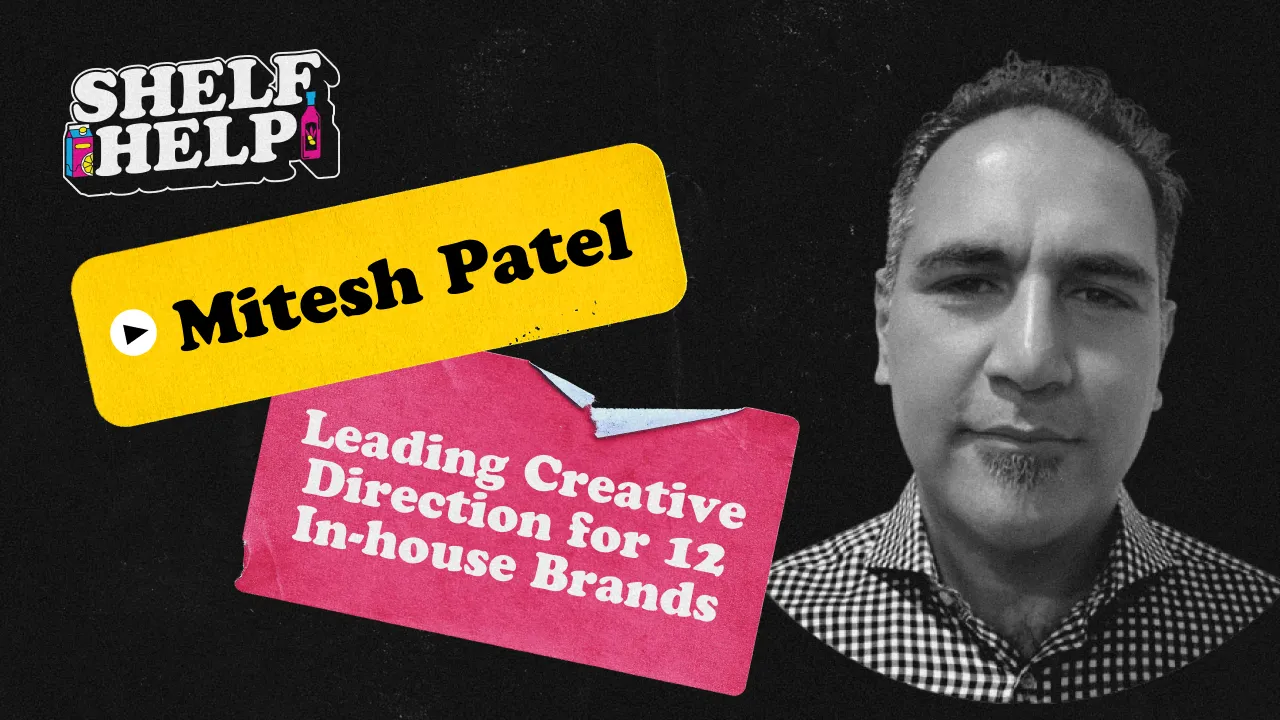



On this episode, we’re joined by Mitesh Patel, the Senior Director of Creative & Design at High Tide Inc., one of Canada’s largest and most diversified cannabis companies. Mitesh oversees all creative across High Tide’s portfolio, which includes over 200 retail locations under banners like Canna Cabana plus global ecommerce and accessories brands like Grasscity, Smoke Cartel, and Daily High Club.
Before joining High Tide, Mitesh led the creative vision at Famous Brandz, where he developed licensed cannabis accessories for Snoop Dogg, Jay & Silent Bob, and Hellboy.
Mitesh breaks down how High Tide builds a cohesive creative system across dozens of banners and channels. He explains how his team balances compliance with brand storytelling, how in‑house creative drives speed and consistency, and why retail design plays a bigger role in cannabis than most people think.
—---------------
Episode Highlights:
🏪 Building a design system for 200+ cannabis stores
🎨 Why High Tide keeps creative in-house
📦 Balancing compliance and creativity in packaging
🔥 Launching IP collaborations with major pop culture brands
🌍 Adapting cannabis retail for international markets
💼 The day-to-day of running a lean, high-output design team
🧰 Tools and workflows that keep creative moving
📈 What retail designers get wrong about ROI
🛠️ Mitesh’s transition from editorial design to global cannabis
🚀 How creative can drive strategy in CPG retail
—---------------
Table of Contents:
00:00 – Intro & High Tide overview
02:00 – How Mitesh manages his time to oversee creative of multiple brands
04:15 – Designing retail stores for speed & consistency
08:40 – High Tide’s core consumer and how to resonate with them
10:20 – Tips for designing dispensaries
16:15 – Tips for designing packaging for cannabis accessories
20:40 – Learning lessons from leading creative teams
—---------------
Links:
High Tide – https://www.hightideinc.com
Follow Mitesh on LinkedIn – https://www.linkedin.com/in/pt902/
Follow Adam on LinkedIn – https://www.linkedin.com/in/adam-martin-steinberg/
For help with CPG production design - packaging and label design, product renders, POS assets, retail media assets, quick-turn sales and marketing assets and all the other work that bogs down creative teams - check out KitPrint.
Episode Transcript
Speaker: 00:00
Welcome to Shelf Help. Today we're speaking with Matesh Patel, who's joining us from Toronto. Matesh runs all things craven design at High Tide, which is a diversified Canadian cannabis operator that owns, I believe, 200 plus retail locations across Canada, variety of in-house brands, as well as a number of accessory and e-commerce businesses as well. It's a pretty diverse and um broad spanning business. So excited to get into it. First off, just for listeners that aren't that familiar with with high tide, give a kind of quick lay of the land in terms of maybe just the origin story and all the different add-ons along the way and current high tide business portfolio and the core product services you guys offer.
Speaker 1: 00:42
Before well, thanks for having me. Just before I jump into that, I just need to clarify that you know anything that I'm gonna talk about is my own personal opinion.
Speaker: 00:52
Of course.
Speaker 1: 00:53
Um, and and not reflective of high tide as a whole. But yeah, so high tide started um from Raj. Raj had uh Smoker's Corner. I ran Smoker's Corner for 15 years. I actually came from Famous Brands, which is uh a company Raj owned and and then bought out when the acquisition of High Tide, and that's how it became part of High Tide. High Tide right now, um, as you said, 200 retail store locations uh across Canada, as well as we have four e-commerce companies in the US: Grass City, Dank Stop, Smoke Cartel, and Daily High Club. Daily High Club does um monthly subscription boxes. HighTide also has two CBD companies in the US, uh, New Leaf and Fab CBD that sell uh uh that sell hemp-based products, as well as we well, high tight has uh also a CBD company in the UK Bluff C BD.
Speaker: 01:52
That's a uh a broad business with a lot of different things going on. I'm I'm curious. Diversified business, a lot of different brands, products, services. You're kind of overseeing creative design across a lot of different stuff. I'm just curious, like how do you how you organize your time and like prioritize things to ensure you can get all the everything, all the different businesses and divisions all get the attention they need from a creative standpoint?
Speaker 1: 02:15
Start early. Um I like to uh get up a couple hours earlier than everyone. Really kind of map out your whole day, go through all of your different notes. You know, I tight. We use um a very good project management system. Uh I have daily meetings with my team. Uh we well, I I look at I look at the notes that that came the day before. Um I look at design like you're kind of a chef and you have to look at all all of your different team members. You know, I have staff that does production, staff that's more junior, staff that's more senior. You gotta go through all of the tasks and and and and see um what critical tasks have to be done on the day. How do you allocate uh your different staff members with different uh skill sets? And sometimes you gotta rejig things depending on um what part of the business is more busy.
Speaker: 03:16
What what does your team look like? Both full-time in-house employees, contractors, agencies, all the different things, and yet a broader team, not just internally, but all the kind of pieces that you work with regularly to kind of support all the initiatives you got going on.
Speaker 1: 03:30
The design team is completely in-house. Uh it gives me better control. Um it's an agile business. So if you're working with agencies, the great thing about agencies is they they're specialized and they're very good at doing very specific things, but um you got to work with their timeline sometimes. I found that having the diverse skills in-house quickly pivot to uh different things faster as well as adapt to different changes in the business.
Speaker: 04:01
A company that's so dynamic and moving so fast, I can certainly resonate with that for sure. I know high tide open, you got about 200 retail locations as of now. I believe you open those over the span of like five years or so, which I just on average, it seems like if I was doing the math right, that was about opening three new stores a month. I'm not sure how much of those were opening new ones, or maybe there's acquisitions we have to re, you know, do some redesign or whatnot. But like I'm sure that that's that's a pretty rapid pace of opening new stores. And I'm curious from the parts that you own, what's your process look like that is kind of enables you to support those rapid store design rollouts in terms of the aspects that you own?
Speaker 1: 04:41
So my team works on the exterior and interior graphics, and we make things modular and template things. We keep really good records. So, if, for instance, if we did a wall that's five feet wide, we'd have another wall that's five feet wide, we'd look at the different parameters and variables from store to store. Um, you spoke about like an acquisition. I think with an acquisition, we like uh carefully go with the team and and look through if it's photos or actually visit the site, see uh what things can be modular, isolate the things that have to be customized, really understand uh the different kind of materials and limitations. I think with while working on 200 stores, you really understand um you know what you're working with, what the timelines are for things. And it gets easier uh as you get more experience with it.
Speaker: 05:35
What are the the key few steps that are involved from kind of beginning to end that's in your world?
Speaker 1: 05:41
Well, we implemented very uh detailed intake sheets. So the construction department would send over measurements and we'd see what we can get. Work from Google photos to actual photos, have an in-house um mini designer, you know, you can estimate things based on the size of a door uh that are consistent. What's allowed our team to be pretty agile is do everything in real time. So we have graphics, we render it right on the photo, we know exactly what it's gonna look like before it's implemented, and we can get like up to let's say 95% accurate in most cases.
Speaker: 06:16
Did you find when you're opening stores as rapidly, did were there things that you feel like you had to be ruthless with in terms of like prioritization? Like maybe you can't do everything you want by the time these stores are open just because you're opening them so rapidly, or did you guys feel like you had a system that was great that you basically could do everything that you wanted to do by the time it was open and get right on to the next one?
Speaker 1: 06:37
So to answer that question, uh generally like I I think um had pretty good luck. Stores have opened on time without very few hiccups. I can't really remember a lot.
Speaker: 06:51
Sure.
Speaker 1: 06:53
Just having a really clear idea of timing. And then you because as you open stores, you're you're following uh methodical system of of what what you what you're doing, and you you understand from a customer standpoint, you think about what are the things that the customer is gonna notice. Part of the design process is you know, I'm I'm concerned about what is our long-term design strategy and and and how does that affect the customer experience. But if you're gonna cut corners, you have to look at what's a short-term strategy. And if somebody's gonna walk in the door, what are they most likely to see that that we can kind of quickly pivot to afterwards? Give you an example, like we might have a store with two facings. A customer might not know that the other facing even exists, and then you pivot to that after when you have more time.
Speaker: 07:49
Yeah, that's yeah, that makes a lot of sense. You talk about the customer a little bit. Have you found across the Canadian market on this retail side, have you found the I don't know, the target audience maybe the right way to say it, or just the average, you know, the the average person that's walking in the store from a foot traffic standpoint? Have you found that those like differ from region to region? Like maybe a store that's in you know the heart of Toronto, or yeah, there's another one that's you know downtown Vancouver, or there's another one that's like the outskirts of Calgary. Have you found like the target audience is pretty different? And like if so, are there differences that that your team reflects at all at all from like store design perspective? Is there a bit of uniqueness each one, or is it is it pretty formulaic, basically do the same look and feel across every store?
Speaker 1: 08:34
So what what's common, I think, amongst the cannabis consumer is it's not it's not um it's very blue collar. Um and you know, when I walk into a store, I I I want to feel as if I'm going to get my cannabis and I'm I'm not gonna be judged. I think a mistake that um some other companies made was that they went too fancy. They they thought they would reinvent the customer, and the legacy customer is very, very important. You have to have the right vibe that when you the cannabis customer hasn't changed from from legalization. And I think from the products they consume, you know, you could you see some evolution, but a lot more towards what everybody's always been smoking. Tech does change from region to region. Some regions are more receptive to tech than others. I think you have to have a good print strategy, you have to think from your consumer standpoint to um like you have to make sure that you're accommodating the consumer that doesn't want to use tech. The print's really important. Your advertisements have to be clear. In terms of ad copy, I'm not a fan of frills. I'd like ad copy to get to the point. I have respect for the fact that the consumers know what they want. I feel like the cannabis consumer is very knowledgeable. And if you're not authentic, you're gonna be called out on it and you're gonna turn away that consumer.
Speaker: 10:04
Let's just say someone that's stepping into a role that's similar to yours in an organization that's can about to be opening up a number of retail locations over the next, you know, say year or two. What are, let's just say, three key things that you tell someone to keep top of mind?
Speaker 1: 10:21
Have a modular plan. You're gonna have to set systems, putting work at the beginning and really thinking through how you're gonna execute on a larger scale is is important because the time you put in at the beginning is gonna save you hours and hours and hours as you scale up. I would try to skip putting in things that don't improve the customer experience. Less is more, and that that kind of falls into you know, be smart with your budget. Sure. You want to really understand how you can keep that consistent quality, and I think it's about you know understanding the different types of uh of materials and finishes in a way where you know and and actually focus uh and then do very thoughtful design because I feel like the the can't you know I I learned uh from from designing a lot of smoking accessories, the one thing about the cannabis consumer is they they appreciate quality, authenticity, and you you can put an expensive material on the wall, but if you can put some really intricate graphics that that speak to the smoking experience, I always say if you're designing something for like we back in the day of smoking accessories, I want to design something that looks great, but as a consumer smoking, it looks better as you get high. Like I really feel like that understanding and that level of authenticity, as people are walking to the store, they feel it and they experience it.
Speaker: 11:58
In terms of working with brands at retail, how can these brands like best work with your team than integrate within your team, integrate their brand into the mechanic cabana ecosystem, let's say.
Speaker 1: 12:10
So I'm not involved with like in-store execution of promos. That's another team. But what I would say is really understand your product, understand your uh USPs, understand how your product is different, and have that be the key message in your marketing. Put together a package of the different types of deliverables that are available in store and which can be used for advertising. And depending, I guess, on the partnership from our marketing department, those assets can be utilized. I also think that like there's a lot of different regulations. So, what what I'd like to see, I guess, in the future for other partnerships is really think through the space, think through the regulations, and rather than trying to think around the regulations, think how you can work with the regulations. If it's something that has to be locked, build something that needs to be locked. Before I started working in cannabis, my background was actually producing things and being on the other end, other end of the coin and trying to get into retailers. And one of the things that I put a lot of time into is really thinking about their space. And it's really, really hard to get marketing material, especially when you're dealing with uh the larger brands. I remember working with with um Costco and and looking at uh kind of pitching to them the idea of doing displayers and stuff like that, then talking about them not having power in a certain location and thinking of how to put through a battery pack, like you go the design is only as good as how it's gonna be executed in the store. So you really need to think about the store environment. You create things to work with the retailer, not the other way around. And I think that mentality is gonna be the key to succeeding in a retail environment.
Speaker: 13:59
Yeah, I could totally see that. What's that kind of rotating retail promo strategy look like for Canada Bana in relation to like what does your team's process look like to be able to effectively support those promos at your level of scale, if that is something that your team is is part of?
Speaker 1: 14:17
So my team designs a lot of the bigger activations for our own brand. It's very modular. Like we we know all the different signage areas. If there's a cabinet, we know the type of sign that goes on a cabinet. We know people walk generally directly to the POS. So a lot of our stores have chandeliers. We do signs there because it disrupts the consumer because they're gonna see that messaging from things like tea stands in the front, thinking the direction in which the customer is walking in the different specific stores, um, because we've high tight cent acquisitions, breaking those different types of stores in uh into different modular setups. Really actually like an important part of it too is once once you've executed, you you go to the store and you see how it's actually been executed on a store level. Assuming that like I I spoke previously about like rendering it in 3D and seeing it and looking beautiful in 3D, then you go in the store and then from a logistical reason it's just not feasible. You you you have to pivot on that.
Speaker: 15:26
Sure.
Speaker 1: 15:28
Like uh past life design stuff for some major retailers, thought the packaging looked great, the consumer wanted to see the product, and then heard back from the retailer that all the the packaging was getting destroyed because the customers on the shelf were ripping it and tearing it apart to see what's inside. So, you know, it it's a real-world environment that you have to really understand, and you're not gonna change your customer, you're not gonna change a human nature. So, really thinking through your design strategy to keep that in mind.
Speaker: 15:59
Yeah. Okay, cool. That's super helpful. Shifting away from like retail a bit, yeah. From what I know, high tech is a pretty substantial accessory business as you as you mentioned, both on like the marketplace side as well as like you have some in-house accessory design manufacturing business, which I believe is famous brands. If I came to you and told you I was getting ready to launch an accessory brand, this is my first foray into the space. I'm about to kick off packaging design. What are three or four frameworks or tips you'd give me or things to kind of watch out for that that could trip me up, let's say?
Speaker 1: 16:32
I think the first thing it starts with the product. If your product isn't good, then you already have a challenge there. So if you're coming with the product and you know what problem this is solving for the customer, how it differentiates, that that's really, really important. And then kind of understanding your key USPs is really critical. It's really important to do a competitor audit and really identify what your competition's doing right. Like it's never a good idea to try to reinvent the wheel. If you're an emergency, like a this is um the the second company I've I've worked at from the ground up. It's really important to understand if if it's a newer industry, don't be afraid to look out of channel. Don't uh put yourself in a box where you're like, well, that's the best that my competitor is doing. Well, if there's a key thing your customer needs, look out of channel and and figure out a way to win against uh your competition.
Speaker: 17:30
That's that makes a lot of sense too. I think those are all really good tips. Let's just say I was a brand leader at a long time, well-established access rebrand, and I told you I'm considering packaging refresh. What questions might you ask me to help me just confirm if this is even the right strategy at all to do a rebrand in the first place?
Speaker 1: 17:51
I think you'd start with why what's triggered you to want to do a packaging refresh. And then re I would follow the same process. Do a brand audit, but be just add another layer to that. Do a brand audit of yourself and and really identify the things you're doing well and the things your competition are doing well, and the things nobody's doing well, and how you're gonna put that as part of your strategy. That then you get a proper scope of what you want to do, right? Because when you're doing a refresh, like take a brand like Raw, you wouldn't want to change too much, or you're gonna lose your customer. The other thing is if you come to the conclusion that you have to change so much of your brand that you just you don't have the level of consistency that it you would confuse a consumer, you you might ask yourself, is this a brand refresh or is it a brand redo? And uh to justify a brand redo, I think you that's very risky and and and I would be very careful with that.
Speaker: 18:56
How do you balance the need for a fresh look? Obviously, there's a reason you're doing a refresh, I assume, with that importance of some of those legacy components of the brand that the existing consumers really know and trust. And when they're walking into, let's just say, a smoke shop or something and making sure that they're still gonna recognize it.
Speaker 1: 19:16
You I think what's really critical is you don't change too many different elements at once.
Speaker: 19:21
Yeah.
Speaker 1: 19:22
What what about your brand are you gonna keep consistent? It's kind of like when you're you're adding a new category or new product to your existing brand, it you have to have kind of a modular system that that a customer can first identify this as part of the brand. Also, if you go back to like a category level, maybe you're you're doing uh a hemp-based CBD product and then you're doing a Delta 9 uh product. How how do you make sure very clear that uh this is part of the same brand, but at the same time you're making it very clear on a category level that this is something that gets you high and this is something that's for wellness, right? Um I I I guess the answer is a little bit of uh it depends, but um it really does, right? And you have to be careful. Like you you've seen a lot of really big brands in CPG do a complete redo and then have to go back because their customer just doesn't want it.
Speaker: 20:25
Clearly, I've been building high tide and supporting all these brands from a design perspective, seemed like a lot of things have been going really well. However, I think some of the kind of the best learning experiences often come sometimes where didn't things didn't necessarily go as expected. I'm curious anything that kind of jumps out either at high tide or some of your past roles, even as well. What's a campaign or maybe design initiative or strategy that you work on that that didn't necessarily work or or go as planned and like looking back, what were some of those learning lessons or things and then looking back, man, maybe I should have done this differently.
Speaker 1: 20:58
So one of the things as a designer, you can sometimes just start staring at your screen and look at what's on your screen and print it out on a page, and it looks great and you feel really good. We in my past scroll, we were the supplier battery operated candles for Costco. So we're making millions and millions of uh candles here, and we did all the packaging for them. So we designed the box, we thought it looked amazing. We we we picked this really nice, sleek gray color, and we didn't think about the tray and that it's going on a palette, and everything was done, approved by the buyer, showed up, decided to visit the store, went to the store, and when you looked at it as an entire palette, and the the tray was gray, and there was no contrast, it literally looked like this gray, dreary thing in the middle of the aisle. And you know, it's something that I've I've taken away from experience to not like uh really understand your channel and where your design lives. Um, I learned a lot in in my previous role because we were in so many different types of stores and had zero control where you had to think about the fact that you could be on the bottom aisle or in the top aisle, or so I I bring that back with me working in this role. So whenever a design is executed, I really insist that the team uh looks at it in real world, look uh goes and sees how the campaign lives and be ready to pivot for the next campaign.
Speaker: 22:29
Yeah. Last I think last question I got for you any brands or let's just say trends in general in the broader cannabis or hemp or related accessory space that you're particularly excited about or and or any trends you you wish you you might have jumped on or might jumped on earlier?
Speaker 1: 22:46
Nothing that really comes to mind. I there there are some really, really great companies that that have outstanding design. Puffco comes to mind. You mentioned Raw. I work with Raw on the Collab recently, and really well-established brand, understands their audience, huge uh social media following, brands that really speak to authenticity in our space, really feel like as Canadian cannabis expands, there's a there's a to really get that legacy market, getting that connection with the consumer, really striving to be authentic. I I think the companies that have really done well and and still exist are the companies that didn't try to reinvent the wheel and really respect the the cannabis consumer. So I think those are those are two companies that have uh have done really, really well because they they truly understand their audience and and they haven't uh stayed away, um shifted away from that. And and and that's kind of my vision for as we continue uh design at high tide.
Speaker: 23:53
Yeah, I think I think both those brands are great examples of people that are doing a lot of things right. Yeah, Machesh, this has been awesome. Really appreciate the time. I think you've just shared a lot of valuable insights that I think a lot of people in the space are gonna really get a lot of value out of. And where's in terms of people want to follow along at any of your learnings, insights, where's the best place to follow along? Is it LinkedIn or Twitter?
Speaker 1: 24:15
I think LinkedIn. Um I'm not out there that much. Um but yeah, message me on LinkedIn if any questions. Love connecting with uh people in and out of the industry.
Speaker: 24:26
Cool. That sounds great. Well, appreciate the time. Attached system, great, really valuable. Thank you.
Speaker 1: 24:30
Thank you, Adam. Take care.
Speaker: 24:31
All right.
unknown: 24:32
Bye.
.svg)