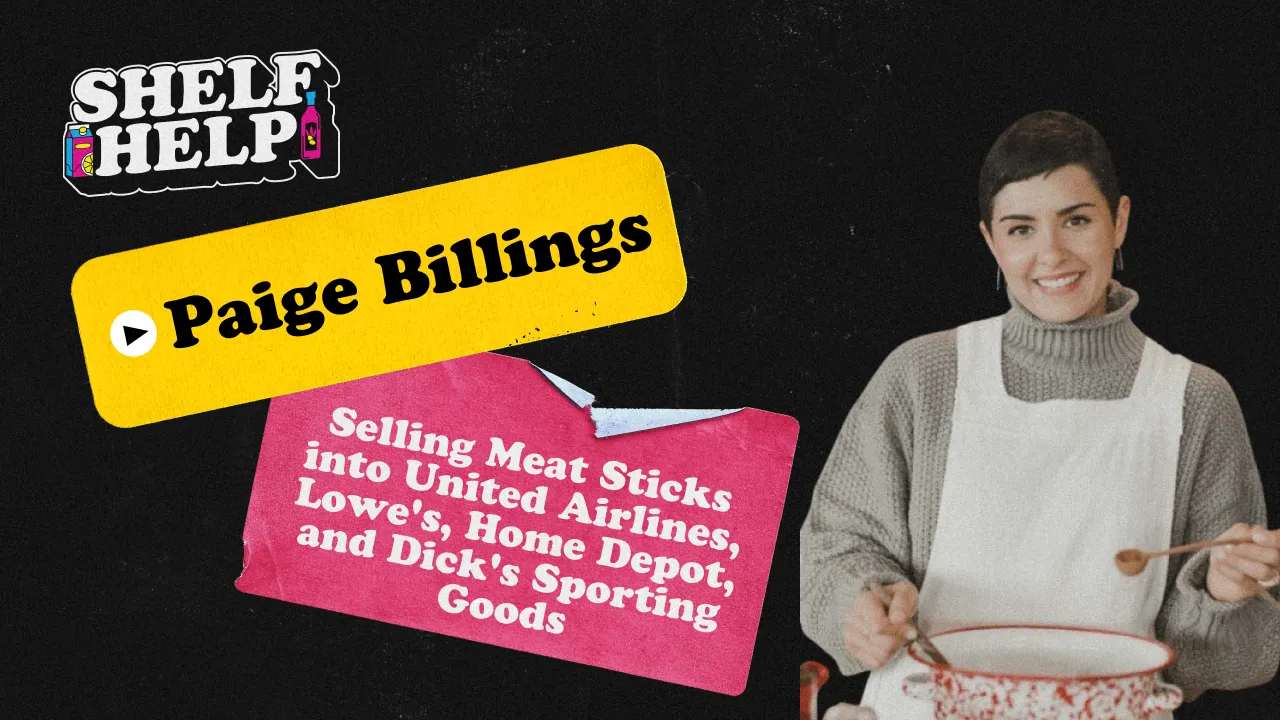
Selling Meat Sticks into United Airlines, Lowe's, Home Depot, and Dick's Sporting Goods | Paige Billings, Anthem Snacks



On this episode, we’re joined by Paige Billings, VP of Marketing at Anthem Snacks - the veteran-owned jerky brand started by a former Green Beret - and Founder of Dot Digital Media.
We dive into how Anthem has pushed into unconventional retail channels and the strategies for succeeding in limited shelf space environments - from Lowe’s, Home Depot, and Dick’s Sporting Goods to United Airlines’ in-flight program - proving that discovery doesn’t have to happen in the grocery aisle.
We also explore how Anthem leverages Pinterest as an underrated growth engine, persona mapping, and Costco.
—---------------
Episode Highlights:
🥩 Building a veteran-owned brand rooted in service and authenticity
🧱 How Anthem broke into channels like Lowe’s, Home Depot, and United Airlines
📦 Packaging that balances brand story and retail practicality
📌 Why Pinterest is an underrated platform
💬 Turning mission-driven storytelling into measurable marketing
🔥 Trends shaping the future of better-for-you snacking
—---------------
Table of Contents:
00:45:17 - Anthem origin story
03:15:13 - The early days, creating differentiation
06:48:21 - Target personas
11:10:09 - Packaging design
15:08:20 - United Airlines partnership
20:24:29 - Selling into unconventional channels
27:53:21 - Costco
32:32:08 - Pinterest, the under-the-radar channel
37:59:13 - Trends
—---------------
Links:
Anthem Snacks – https://www.anthemsnacks.com
Follow Paige on LinkedIn – https://www.linkedin.com/in/paige-billings-34623698/
Follow me on LinkedIn – https://www.linkedin.com/in/adam-martin-steinberg/
Try Anthem Snacks with code SHELFPOD20 until 1/31/26 (not valid on subscription products and cannot be stacked).
For help with CPG production design - packaging and label design, product renders, POS assets, retail media assets, quick-turn sales and marketing assets and all the other work that bogs down creative teams - check out KitPrint.
Episode Transcript
Speaker 1: 00:00
Welcome to Shelf Help. Today we're speaking with Paige Billings, founder of DOT Digital Media, SCPG median advertising agency, as well as she also is the VP of marketing at Anthem Snacks, which you're going to be talking about primarily veteran-owned meat snack company founded by a former Green Beret. Paige was also nice enough to create a discount code for Anthem if you want to try out their awesome products. So I'm going to include that in the show notes. But yeah, other than that, first off, Paige, maybe just for people that aren't that familiar with Anthem, maybe just give us kind of quickly the land in terms of the origin story, why behind the brand, some of the core products in the lineup, and then maybe just call out a few places where people can get their hands on them, and then uh we'll go from there.
Speaker: 00:46
For sure, yeah. Thank you so much for having me. So Anthem Snacks is a veteran-owned meat snack company based here in Bozeman, Montana. We get 10% of our profits back to veteran and first responder nonprofit organizations. And we're really focusing on giving back to the community that has given us so much. I also am a veteran spouse. So that's a little bit about the why. And then our core products, we originally launched with just beef jerky. Um, and we're different in the way that we are premium beef, so whole muscle cuts with beef jerky, slow smoked using real ingredients rather than like liquid smoke or infusions. And then last year we launched our first line of beef sticks, which was an incredible add-on to the original alignment of just beef jerky. And then this year we launched a turkey stick, which that one was super fun to create. And we can talk more about that later, too, because um poultry is an interesting mix when it comes to just meat snacks in general. So for our beef jerky, we have five premium flavors. Bourbon is definitely one of our best sellers. It is made with Willie's distillery bourbon, which is a veteran-owned distillery here in Ennis, Montana. And then we have, I would say like three novelty flavors. So two zero sugar flavors. That's more of a cowboy style jerky, like drier, a little bit more chew. And then we have straight fire, which was the first like RD project that I worked on at Anthem. And it is exactly what the name is. It is straight fire, it has Carolina Reapers, it has ghost peppers, it has habanero pepper flakes. It's pretty incredible. You can see like the spice on it. Uh, so that's our assortment of flavors. And then as far as where you can get us, obviously online at anthemsnacks.com all the time. Um, and then we are in tractor supply nationwide, exporting goods, shields, lowe's, home improvement, ace hardware, select 7-Eleven locations, Jackson's, the Naval Exchange, the Marine Exchange, Rebel, Road Ranger, Hannaford, a couple others, and then um Murdoch's, Pilot and Loves Convenience, and then specifically for Costco, we are currently in the Northeast region. We are going to be launching in Midwest, and then Bay Area in November in Montana.
Speaker 1: 03:06
Let's kind of rewind back to those early days and talk about just kind of formulation product development for a minute, like thinking back, what were some of those key variables you guys were focused on in terms of trying to really create a differentiated product? Was there an aha moment where all of a sudden everything worked and you feel like, okay, this is this is the right formulation, this is it?
Speaker: 03:26
Yeah. So yeah, I've been with Anthem since we started. I actually, when Nate called me, he was like, we originally like he was a freelance client of mine and just continued to grow as the business continued to grow. And when I joined Anthem, they already had, I would say, like the brand ethos kind of figured out, but they hired me really to create like the brand vision, who the consumer was, market the product, um, and get out there. And you're so right, like jerky and meat snacks is incredibly competitive because one, it's a premium product, it's a higher price product. So it's it's a lot of sourcing. You have to get, you know, the right animals, the premium cuts, the whole thing. And for flavor, you can't really go too many ways. You can go funky, and that can be an absolute win or an absolute miss. Like we have some really fun flavors I'll talk about. But we had our core line already figured out, and our original silver branding kind of already figured out when I joined the team. And I joined like six months after we started. June 2020 was when Anthem became a company, which was, you know, an incredible time to start a business. But when I joined, I was really creating, like I mentioned, like the brand identity, who we are trying to reach, the entire like social story of everything. And we have a founder that has an incredible story. He was a former Green Gray, he was wounded on a deployment. And so that already differentiates ourselves. We were veteran-owned, we're mission-backed. We're not just a company out here, just like trying to make product to profit off of and it, you know, hope it goes somewhere. So the mission side of it was huge from day one. And then also creating the visuals around where we live, Montana, that was also a no-brainer because we live in one of the most beautiful places. And so when you think of your hiking, you're hunting, what do you're bringing high protein snacks with you? And so we wanted to create a visual identity that just resonated with anyone who wants to go outside and experience nature, which definitely did. Like it hit a really um organic approach, like in the first little bit. And that's where we started fun RD. Like I mentioned, Straight Fire was the first project that I really helped on for RD, the concepting behind the branding for that bag. It's bright red. It's obvious that it's on fire. Um, and then when we launched our beef sticks, that's when the brand, I will say like the branding kind of changed. And that's when I took focus on the packaging design, the flavors, the RD, and all of that. And I will say, like, the beef sticks and the turkey stick were definitely like a brainchild of mine. I wanted them to be fun and funky and cool and really have flavors that I will say like felt young and fresh and refreshing to snack on. I feel like sometimes when you're go, let's just say, like, I go, I hike a lot. So I'm like, when you're on a long hike, there's only a certain amount of foods I feel like you can put in your pocket and that don't taste horrible after 10 hours of being in the sun. And so we wanted the flavors to really be able to stand being outside for a long time and not feel static or have depth of flavor, which I feel like sometimes can be amiss with packaged food.
Speaker 1: 06:48
Totally. One thing I was curious about in terms of who the target market is, and maybe it's evolved over the years and how much of it is focused on obviously started by Green Bray, how much is it, you know, the messaging around the veteran community, military community versus trying to go more broad than that? And how do you, I guess, blend the two if you do?
Speaker: 07:08
It's a great question because it's definitely evolved. I will say, like coming from Black Rifle in those early days when, you know, everything was gun-gun, shoot it down, the whole thing. Um, and I think it also changes in like what was socially aware at the time, too. Like that was a very social media specific time where now social media has changed so much. Where when we start when Anthem started, when we were thinking of who our consumer was, it wasn't necessarily like we have to be for the veteran, we have to be for the active duty soldier. That is definitely like a one major pillar of our personas, but it wasn't the only one. When we're thinking of like who we wanted our anthem consumer to be, it was really anyone who is an American who has values that resonate with ours. You know, veterans have a wide variety of who these people are, their backgrounds, their cultures. And we really wanted to be for the every person, which again sounds like crazy broad, but in the grand scheme of things, it comes down to like the values of what we putting in our product, the quality of ingredients that we have. We support American ranchers. Our beef sticks are made with 100% American beef, which was something that was incredibly important to us to be able to have that lineage of beef. Um, and then also just like the premium cuts. Definitely other jerkies out there that have different audiences. It's a different price point. It's all of that. And we really wanted to be for the person who was purchasing for their health, their flavor, their the chew, the texture. And also anyone, you know, whether you sit at a desk and that's your snack at 3 p.m. to get you through the next couple hours of the day, or you're literally hiking and climbing mountains every single day. We wanted to be for any of you. And I think you'll see that in like the variety of retailers we're in too, is that we're not just focusing focusing on grocery or, you know, online. We're really trying to spread a wide net of who can purchase our product because I've lived in a ton of places in the US with the military. My husband was active duty for eight years, and that changes also how you shop. Like living in Texas, I really only shopped at like two grocery stores. It was like HEB and natural groceries because of convenience. Where here in Montana, we have so many different chains of grocery stores and convenience stores, and Florida is different. And so having a wide retail net is super important too. It reaches new audiences. Obviously, Costco is huge. You have so many different buyers in Costco. Another thing I'll kind of touch on too, with like the packaging that goes into the persona of it all, is I want it to stay fresh in CPG. As you know, you've been in CPG for years. The products that are new and evolving, I feel like are very eye-catching. And sometimes you kind of fall into either it all looks the same or everything looks so dynamic on the shelf that you don't know how to make a decision on what you want. So when we were developing the packaging and the flavors for I'll just say like the beef stick line, we wanted it to stay true to our brand identity, but also stretch creatively. So everything's very tonal with the colors, like dill pickles, like green and green. Hot honey is red and yellow, and it's the colors you think of when you think of hot honey. So it's been evolving to answer your question for our personas, but we're really for the everyone, the every American who wants to fuel their adventure.
Speaker 1: 10:41
I think that's pretty natural for it to evolve over time as you focus on a niche initially to kind of use as your head and then expand out from there. Um yeah, you so you own the packaging, all the packaging design stuff. If I came to you and told you I was launching a new CPG food brand and I'm about to kick off brand packaging design, what are maybe just two or three tips you give me, or on the other side, things that you'd tell me to watch out for that might trim me up along the way throughout the process?
Speaker: 11:10
So I'm definitely like not a trained graphic designer. I didn't go to school for graphic design. So if anyone's listening, like there might be better ways to do it than how I do it. But for Anthem and some of the other brands I've done like brand identity and graphics and storyboarding and visual representation for, I really like to start with what you don't like. To me, that kind of gives me my right and left limit of like, this is what we like, this is what we don't. And I kind of what I mentioned earlier where things kind of trend in CPG, especially in packaging and branding, is it's not necessarily the most important to be the one who is going to be the most unique in a lot of ways. Like, I will say, like, sometimes companies um like reach change packaging and it's incredibly dynamic for that product or the way things are built, and that's great. Don't think you necessarily have to focus on that when you're launching a product, but I also think it's important to know that like how you launch a product is not necessarily how it's going to stay for the next like 40 years. Like it could change and be dynamic. Like I've been with HealthAid since 2018 and they've changed their packaging so many times. And it's just gotten better and better with each rendition. Same with Anthem. We've gone through so many different versions of packaging, and it all really comes down to what visually connects with not only the founder or the CEO or whoever's leading the company, but also who do you want to be purchasing your product? So if it's at the top shelf, and you probably know more than anyone, like you're buying shelf line lines, right? When you get into a retail area, is if you're on the top shelf, like how are you going to stand out? And our packaging specifically is bold and bright. And we've played around with, you know, matte and shiny and all those different things. For the first packaging design for our 2.5 ounce bag at Anthem, we didn't have a window. And we quickly learned that that was not necessarily the best. Did it look so cool? Yes. It looked like the coolest bag on the shelf because it was just so sleek. It was silver, it was awesome. It was incredibly hard to photograph. Um, and it didn't have a window. So customers kind of second guessed the purchase at first because they were like, well, I can't see what it looks like. And we're telling you it's premium, but like, can you tell it is premium? So when we redid our packaging design when we were uh partner with the UFC and we put their um their logo lockup on the bag, we put a window in and it actually made bags fly off the shelf. Not necessarily because of the logo, but you could see the product. Right. Um, and that was huge. And then when we started designing our stick, um, just stick film, obviously, sticks you have to have a clear back. That's just like what you do. But our caddies, we wanted to be super, super bright and like what you could see on the shelf, you know, stick goes into the caddy the same color. The pouches we wanted as big of a window as we could get away with, with showing all of the things we need to call out, right? The flavor, the protein, all of that. So I always start with what you don't like, then we go into colors, and then we go into okay, here are your 15 options of, you know, this, you know, this thing changes, this thing changes this thing. And I literally will send 47 designs when we're first starting because it could be as simple as like one color variant on the front of the bag in one spot, changes the entire look and feel. And that's how we've really focused on like Anthem is like we also do a lot of like we send it to everyone in our friend group families, and we say, like, which one do you like better, A or B. Um, that's kind of how we came up with the color for Turkey. Is I really like the color we have currently. We have a couple of people who liked the other version, and then it finally it came down to a poll. It's like this pink was way better than that pink.
Speaker 1: 15:04
Shifting gears a bit, I think it was only like six months into the business or so. You guys l landed a partnership with United, the airline to be clear. Yes. What did that what did that partnership entail and what it looked like?
Speaker: 15:18
That was crazy. It was such a whirlwind when we first launched that partnership because I was kind of a lot goes into those partnerships because especially from our side, our at the time we had a nine-ounce bag. We've since gone to a six-ounce, but we had a nine-ounce bag, which is a big bag of jerky, and then we had our 2.5 ounce bag. So when you when you're on an airline, you get a little snack. So we were like, okay, we need to make a one-ounce bag of jerky. And the flavors that we had originally chosen, actually, they didn't choose for going on board with them. They chose our peppered beef jerky and a one-ounce. So not only did we have to redesign a pouch for that um that size, but we also got to develop like a launch strategy with them, which was really cool. The team we worked with at United was incredible. They were super hands-on. Um, that was like my big first partnership with Anthem. And you know, when you're in an airport and you're walking by and you're like, why is there a party at gate 1A? And then you kind of like look, and there's all those balloon arches. We did that. We got to target two flights. So we did Denver to San Antonio, and they, with all of their data, were able to target flights that had a high amount of veterans on their flights, which was really cool. So we did panned out bags, we had a little United for Veterans table. We had the whole United team with us. It was really incredible. And then we hopped on a flight together with everyone. We went to Dulles, spent the night, and then did the same thing the next morning in Dulles. And that one was really cool because something I didn't know at the time before we did that was United hires a lot of veterans for their pilot program. So a lot of military pilots transition into the airlines, and United has one of the highest percentages of veterans as in their pilot program, which is incredible. So at Dulles, because it was I don't know, a bigger airport, bigger day. A lot of people were out there. We we handed out coins, we did like a bigger party, and that was really cool. So we were on United Airlines originally for six months, and then they just kept extending it, which was an incredible opportunity for us. So we were on domestic flights, and then Canada and Latin America, which was really cool. It was a purchase on board option as well. So it wasn't necessarily like a freebie, which was again something I really never paid attention to as like a passenger, is like what you get as a free snack, and then what you get as a purchase on board. Usually your higher quality and higher, yeah, just more expensive items are usually your purchase on board. So like beef jerkies. Um, you're usually not getting, you know, nuts as your purchase item. So that was really cool. And we had incredible feedback. We got to um, you know, the hemisphere magazine that you read when you're taking off when the TVs don't work. We advertised in that that was like part of the uh promotion with them. And that is actually how United or sorry, UFC found us. There wasn't um Wi-Fi on one of the planes that the UFC team was coming back from the East Coast on, and they opened the magazine and they said, What is this veteran owned beef jerky company? And we got an email two days later, which was really cool.
Speaker 1: 18:39
That's awesome. That's really cool. Did you approach this with actually a meaningful revenue andor margin in mind? Or do you guys more view it as a brand awareness exercise looking to drive trial and ultimately drive more people to buy this in retail or online or whatnot?
Speaker: 18:57
From my perspective on marketing, it was truly brand awareness. There wasn't any way that I could actually capture data on who purchased. We had a QR code, but that was not really giving us like data. So it was kind of two ways we were looking at it is like from the revenue and sales side, but it did open a lot of doors. It also has this was about a year into business that we launched this. So this allowed us to get in front of so many new customers that have now turned into online subscribers for us. Like there's a customer that emails us quite frequently, and I love seeing their name pop across my screen because they actually came from United. They messaged us on Instagram, I would say about two months after we ended our contract with United, and they said, Why aren't you on United anymore? And I said, That's a great question. You can ask them. Um, and I and he's uh been a customer with us ever since. And he and I know for a fact like it came from United. But other than that, I can't really track most of that. Um, but I will say, in terms of other data we gathered, it was really cool. Like I mentioned, they chose peppered beef jerky, which at the time was not a best-selling flavor for us. Smoked honey, bourbon hadn't launched yet, but bourbon and smoked honey are our best two jerkies, and it goes original and peppered. And so that was really cool to offer that flavor to so many people.
Speaker 1: 20:25
You've had a lot of success, and I guess what I would consider another, I don't know, what fairly unconventional channel in terms of I don't know what you call them, home improvement, farm supply type lows and tractor supply, whatnot.
Speaker: 20:38
Okay.
Speaker 1: 20:39
What's unique about this channel compared to the more traditional Kroger's, Albertson's, Whole Foods of the World?
Speaker: 20:46
Yes, we have. We've been doing incredibly well, I will say, in like home improvement and farm and ranch supply. I think a lot of it is that's our customer. So when it comes down to it, we have a huge audience that fits into the consumer of those those stores. Also, it's a really easy convenience item. So a lot of the times I feel like you're shopping at a hardware store or ranch and home supply. It's like you're picking something up quickly because you forgot something, you need something for a project, you're hungry, you don't want to stop at a fast food restaurant on your way home, you're just grabbing something. And so that definitely has been a big win for us in those stores. I will say, with Lowe's, that was an incredible opportunity for us. And we're actually expanding our SKU line in Lowe's because we've been doing really well in that store. Um, and then Murdoch is Murdox is a ranch and home supply store. It's based here in Montana and Bozeman. Like their headquarters is right down the street. Um, an incredible store. If you ever have the opportunity to find one, you can buy anything in this store. And we've been doing really well in that store as well. And I think it is, it comes down to convenience. You're going in, you're buying food for your horse, you're buying tack, you're buying something. And you're walking out with snacks so you don't have to go to a gas station. Um, and that that definitely was like part of our strategy when we started expanding into retailers, is it was another prong on the wheel of retail. We have, you know, convenience, you have grocery and branch and hardware was a big one.
Speaker 1: 22:20
Totally. Comparing these to traditional retail, what's the key to winning here in terms of driving south? Or and I'm talking about the things you might consider generally consider as more normal traditional retail, whether demo strategy, some type of promo strategy or rebate strategy, you know, shelf talkers, violator, what's kind of key to winning here in terms of driving velocity that may be different than your traditional?
Speaker: 22:45
Um, we actually don't do a lot of that. But so yeah.
Speaker 1: 22:48
Pay for a whole lot of that stuff.
Speaker: 22:50
We don't. Yes. I will say if you're new to CBG and you're you don't know what that is, it's incredibly expensive to do that. And as a younger company, we found other methods of marketing our products in these stores than diving into these traditional rebates. We've done a couple through the years and kind of learn from binding in what works and what doesn't. And that goes kind of back to the packaging, I will be honest, is we really wanted to stand out on a shelf and not have to have a massive display or not that we're against it. Like I would love to do one of those eventually at some point with our products, but we really wanted to be dynamic without having to hit you over the head with it at the store. We've done a couple promotions, I will say. Like we did a promotion in Town Pump, which is a Montana, Idaho, Wyoming convenience and gas station chain. I think there's over like 200 something locations. And we did a promotion with one of our nonprofit partners where we matched up to an amount sold. So if you bought a bag, town pump matched, we matched, and then all the money was donated to Big Sky Bravery, a nonprofit partner of ours. And so when we have done those promotions in the past, they haven't been really necessarily to benefit our dollar, it's been to put money in the pockets of our nonprofit partners. So that's definitely been a different approach that we've taken rather than our traditional media. And then just like general marketing, we we push a lot on social and um our advertising for meta and Google is pretty dynamic and we've dialed that in over the years.
Speaker 1: 24:24
Yeah. I feel like there's just a lot less shelf space available for like food and beverages at these stores, not the grocery store. There's aisles and aisles of stuff. What's key to getting on shelf in the first place?
Speaker: 24:39
We have a really good story, um, and our products really good. So I will say for like Costco, we do a lot of road shows. Our sales guy, Brandon, is constantly on the road handing out jerky. If you ever see him, say hey, I will be in the Bay Area in November, which is it's it'll be fun to go back. I grew up there, so it'll be fun to go hand out sticks and jerky.
Speaker 1: 25:02
Yeah, my parents at the road from the Nevada, Costco. So I'll I'll send them there.
Speaker: 25:06
Amazing. Yes, definitely. Um, so yeah, so you're so right. Like the shelf space, I feel like has gotten smaller. The competition has gotten greater, especially in the meat snack world. But in terms of catching the eye, it's really just driving foot traffic to those stores and creating in the story. I will say we invested in redoing our brand video last year. And um, I think it showcases where we started, our founder, who we are as a company, the values that we have, the product. Um, and we're just really good. Like I'll be honest, the flavor of our product is really good. Um, and I think that definitely sets us apart.
Speaker 1: 25:47
Totally. Yeah, that goes a long way. You also said that you also mentioned Dick Sporting Goods. Sounds like some success in I guess these sporting goods retailers. Also definitely an unconventional channel compared to traditional grocery or natural foods channel. Yes. Similar questions, like what's the key to winning in in this channel? And and maybe is it fairly similar to like these Lowe's and home goods, or is it different?
Speaker: 26:16
Yes, yeah. When I think of sporting goods stores, I usually don't think of food. I'm in the same way when I think of like retailer, like apparel retailers, they usually don't think of food, but there are. But we've been in Shields, they were one of our first wholesale partners or retail partners with us, and we are one of their top-selling products in food. And Dicks, we've been in for a couple years. And we again, it's a convenience item. You're there purchasing something. Usually it's a long day of shopping, doing errands. You're in and out of these stores, and you want to be able to buy stuff to go to a soccer game and sit there for five hours. You're buying your you know, G shot cubes, your scratch electrolytes, and you're buying your beef jerky. And it's that was again another pillar of this spoke and that and this wheel that we wanted to target because especially Shields, like it's such a cool. Have you ever been to a SHIEL?
Speaker 1: 27:06
I think so.
Speaker: 27:07
Oh my gosh, you need to get yourself to one. They have like a Ferris wheel. They're incredible. Yeah, yes, they're they're such a cool store.
Speaker 1: 27:16
Shop vibe, but different.
Speaker: 27:18
It is. Yes, they have like a full aquarium, it's super cool, but it's one of those stores that you're in forever and you're buying all your back to school stores uh supplies, or you're buying stuff for your sporting events, you know, your lawn chair, your umbrella, your water bottle, your cleats and snacks for that event. And so those felt really natural when we started growing into retail is like we need to hit who our consumer is outdoor active people in America who want high quality protein.
Speaker 1: 27:49
Yep, that totally makes sense. Yeah, both channels. You also mentioned Costco. Tell me about that first regional launch.
Speaker: 27:58
My gosh. That first regional launch was so cool. So I did all of the packaging design for the trays, for the new pouch, because Costco, as we all know, everything's you know, supersized. So that was really cool. I wasn't really a Costco shopper for like my family before going, you know, talking about this partnership, but then I was like, I need to go to a Costco and see what these trays look like and figure out what this all looks like if I'm gonna be designing this packaging. And similar, like going back to talking about like new CPG companies, you have to learn how to cut the first design and go in with the fourth design rendition that you have. But launching in Northeast Costco was incredible. Our sales VP, Brandon, he lives in the Northeast, so that was really cool for him to be able to be like in his home area, handing out jerky. How do I say this nicely? Like we sold out, we crushed um the first weekend there, and then we expanded more. So we originally launched with bourbon, like I mentioned, which is like one of our best-selling flavors. Um, and that was really cool to see just the response of new products. Everyone loves Costco samples, that was really fun. We had a big tent up. Um, we had a boom box, Brandon was on the mic telling people to come try the jerky. And then we did a second launch in the northeast for hot honey sticks, which was really nice. Also, same response. Um, and then I'm really excited. Like I mentioned, I'm gonna be in the Bay Area one, and I'm excited to bring the energy and out snacks. And then we are launching in Montana in November for a brand new store opening in Catlasbell, Montana. And also, we're launching with our bourbon beef jerky, which is gonna be really cool because it's made with bourbon from Ennis, Montana. We're a veteran on business and Bozeman. So hopefully that one is gonna be really crazy and fun.
Speaker 1: 30:05
That's awesome. What uh I imagine more of the the sales team and and whatnot are leading those negotiations, actually getting the commitment from Costco, but once they got that commitment, I assume that's where you got kind of pulled in. So I'm just curious for other brands that get that commitment from Costco for the first time between Costco saying yes and gearing up for that launch, what are things that kind of come top of mind in terms of they should other people should keep top of mind, they should be focusing on to make sure they set themselves up for success when they actually do launch?
Speaker: 30:38
Yeah. So I think one thing to learn or know about all these major retailers. So you're talking about like the Walmarts, the Costco's, the Targets, Sam's, all of those major retailers is if you're on the design or marketing team, you're brought in way before the deals even signed because I was creating what these products look like and rendering them to create a mock-up essentially of what they would look like in your store. So when we were starting to pitch these major retailers, that's when I got to my computer, turned the lights off and focused on creating these designs. And then got, I don't do CAD modeling. Um, so I got with our render team, they built out these renders, and then that's what you're pitching to these stores. They really want to see that you're ready to take a commitment on for these major retailers, and it's a big commitment because you're you're making product in massive scale. You have to make sure that you have the logistics and operation distribution set up to focus on that. But I will say, because of United, we actually had we have a pretty small team and we had the wherewithal to understand like the logistics behind setting up for United, which was a big lift at the time. And then when we went into these Costco partnerships and launches, we kind of knew what that all looked like. Um, so it wasn't necessarily new to us. I would say like more the design and concepting was more new to our team, but I've been pretty much part of it since the beginning. Not necessarily, obviously, the negotiations, but all of the visual concepting, what the marketing rollout's gonna look like, all of that. Um I will say it is possible to do without a ton of Costco influencers. Um, we haven't tapped into that yet, maybe in the future, but not yet.
Speaker 1: 32:27
Yeah, I've heard about the confluencers. Uh totally shifting gears a bit. Uh me connected a few weeks ago. You were telling me about your Pinterest focused role at Black Rifle and how successful this channel became from an ROI standpoint. So, yeah, what what else can you tell me about this?
Speaker: 32:45
Um yes, I could. If this podcast was four and a half hours long, I don't think I would fully go into Pinterest. Like, you can shut me up. Um, Pinterest, I will say, is like my favorite platform for growth marketing, both in CPG and in like traditional retail apparel or home goods. And I worked with like a breadth of clients across the board. Black Rifle, when we launched on Pinterest, I actually got hired full-time originally to be their Pinterest marketing manager. Like I went from contractor to full-time employee for Pinterest, and we crushed. We did an incredible lift on that platform. And um, I've been able to take that success and transfer it into all types of businesses on a platform. That's like the major part of advertising I do through my company, Dot Digital Media. And I was with a hunting company for almost seven years here in um Bozeman's called Stone Glacier. They sold to Vista Outdoor, which then turned to Revelist. Um, and when we first started talking about Pinterest, they kind of looked at me like, we're a male-focused hunting company that definitely has a lot of media like guns and heads. And I said, Yeah, but there's 70, 70% of uh consumers on Pinterest are women. So if they're looking for, you know, gifts for their dad, their husband, their boyfriend, their brother, like they're shopping on Pinterest. And I've seen crazy numbers upwards of you know, almost seven figures in revenue on the platform, you know, 10x months in revenue. And it's an incredible, it's an incredible platform, not only for revenue growth, but also for traffic growth. Like I've worked with some clients, um, a CPG client last year in Q4, and they wanted just traffic to their website to show investors that this is a viable product they should invest in. And they went from zero. Like the company launched and they gave me access to it on Pinterest, and we were doing over a million impressions just in December last year alone. So it's an untapped platform. And I think a lot of it has to do with the algorithm, is it's not social media, it's an SEO-based platform. So if you understand SEO, there's power behind it.
Speaker 1: 35:06
Wow, I never thought about that. That makes a lot of sense. Yeah, it makes a lot of sense.
Speaker: 35:10
If you had the Yeah, it's a search platform.
Speaker 1: 35:12
It yeah, if if a marketing leader at another healthy snack brand like came to you and asked this, like I don't know, distill down the three core things they should focus on or keep top of mind if they want to have some success on Pinterest, but what would those be?
Speaker: 35:28
Definitely understand your KPIs and what you're going for. So your end goal. I like to work backwards on a lot of things, and a lot of it comes into advertising as well as design is what's your end goal? Are you driving traffic? Are you trying to drive sales? Are you trying to drive to retailers? Albertsons, Kroger, Safeway, that brand, they're a massive advertiser on the platform and they will drive product advertisement. So, like Tropicana is a big one that advertises with Albertsons on Pinterest. And so knowing that end goal and then working backwards, like some of my current clients I work with on Pinterest, they're trying to just drive traffic on the website. So that's different. But I will say for CPG, most people are trying to drive take rate offshelves. So driving to retailers is crucial, or you can do an Amazon approach as well, and then also creating content for the platform, unlike TikTok, unlike meta platforms, and unlike um, you know, just your regular Google YouTube, you need to create product images for the platform that are simple, easy to digest. A lot, I will say when I see a lot of people want to do audits, and I'm like, oh, this is why it might necessarily not have worked, it's because you're taking your high-energy, crazy TikTok video and you're trying to get it on the platform where people are trying to scroll with their morning coffee and not get inundated with social media. Um, and so creating that product. And then also, secondly, I will say my third reason is you need to have a landing page that also nurtures that relationship you just had with them on the platform. So if you create an ad that's like a, let's just say it's an instant coffee company, and you have a beautiful mug of coffee with a girl standing facing a mountain, you're like, wow, that's so idyllic. And then you send them to a landing page where it's TikTok UGC videos of people, you know, talking really quickly at the camera, talking about, you know, buy this now, this pillow, buy three, get two off. That won't convert your audience. That you lost them when they got to your website. And so that's a big, I just say that in C that's a big learning across the board. Is like your ads have to match your website or your landing page you're converting them to.
Speaker 1: 37:44
That makes a lot of sense. Yeah, that's super helpful. Last question for you, Paige. Like any of specific brands in the CBG space overall, or any big broader trends that you've been tracking things have been getting you excited lately at all?
Speaker: 38:00
I think mine might be a little different than most people with celiacs. So yeah, I focus more on like the gluten-free, kind of healthy trends. I will say dill pickle is having another resurgence. And luckily, Anthem was ahead of that second wave with our dill pickle beef jerky or beef stick last year. But also, I will say like gluten-free is a trend again in a big space, is people are really focusing on like allergy-friendly recipes and products that you know, if you alienate a lot of people with allergies, they won't be able to buy your product. I will say that was a big focus of Anthem as well. It's like we're big ape free. So that's a big one. And in terms of like visuals, I will say the packaging in CPG right now excites me so much. When we were at Sweet and Snacks food show in May, I had so much fun just walking around and looking at people's packaging because the creativity bar just continues to rise. The colors, the brand stories, all of that. So really focusing on the identity as a brand has been really cool to see is um how how companies are taking what their ethos is and putting it into packaging has been really cool.
Speaker 1: 39:10
Yeah. I agree with all that. Well, yeah, Paige, this is an awesome what's the best place for people to follow along with you personally, and then best place to follow along with Anthem as well.
Speaker: 39:21
Yeah, so me personally, my website is dot digitalmedia.com. And then my Instagram is front page bakes. I'm baking all the time on Instagram. And then Anthem Snacks is at Anthem Snacks and Anthemsnacks.com. Come check out our products, buy us in stores, and let us know if you like it. Thank you so much.
Speaker 1: 39:41
Yeah, well, definitely like I said, we'll put that promo code in the notes for sure.
.svg)