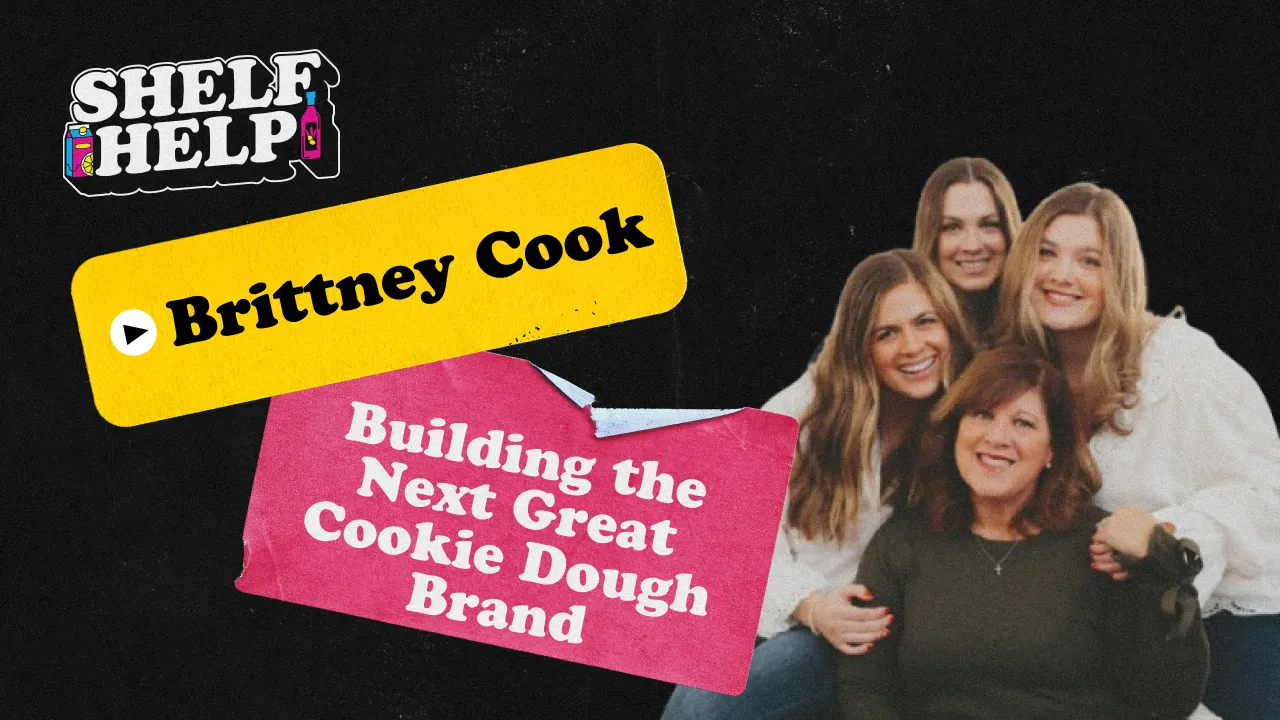



On this episode, we’re joined by Brittney Cook, the Co‑Founder and Chief Growth Officer of Something Sweet, a family‑run frozen cookie dough brand that’s redefining indulgence with clean ingredients and a heartfelt mission.
Brittney and her mom and sisters turned a deeply personal loss into a business that delivers small‑batch, brown‑butter cookie dough you can bake straight from the freezer. In just a few years, they’ve gone from hand‑scooping dough at home to landing in over 100 retail doors while keeping their faith, family, and product integrity at the center of everything they do.
Brittney walks through building a brand with her family, the operational decisions behind choosing frozen over refrigerated, and how she tweaked formulation for scale without sacrificing quality. She shares why brown butter is their secret weapon, how they developed their visual identity, and what it takes to plan and execute a successful retail launch.
We also dive into why velocity is more important than door count, tactics to drive sell‑through, demo strategies that scale, and the trends Brittney is tracking in the CPG space.
—---------------
Episode Highlights:
🍪 The origin story behind Something Sweet Dough
👩👩👧👧 Building a business with her mom and two sisters
❄️ Frozen vs. refrigerated cookie dough
⚙️ Tweaking the formulation for scale
🧈 Why brown butter is a differentiator
🚀 Scaling up while staying small‑batch
🎨 Visual identity and packaging design choices
🛒 Expanding into retail and planning for launch
📈 Why velocity should be your north star
📦 Tactics and demo strategies that drive velocity
🔎 Trends Brittney is watching in CPG
—---------------
Table of Contents:
00:20:20 – Something Sweet origin story
02:37:24 – Building a business with her mom and two sisters
06:24:09 – Frozen vs. refrigerated cookie dough
07:34:04 – Tweaking the formulation for scale
08:19:18 – Why brown butter
11:14:18 – Scaling up
12:31:20 – Visual identity and packaging design
17:44:22 – Expanding into retail
20:31:12 – How to plan for a retail launch
22:14:15 – Why velocity should be the north star, how to grow at the right pace
24:39:01 – Tactics to drive velocity
26:07:28 – Demo strategies that scale
28:51:02 – Trends Brittney is tracking
—---------------
Links:
Something Sweet Dough – https://www.somethingsweetdough.com/
Follow Brittney on LinkedIn – https://www.linkedin.com/in/brittneycook/
Follow Adam on LinkedIn – https://www.linkedin.com/in/adam-martin-steinberg/
For help with CPG production design - packaging and label design, product renders, POS assets, retail media assets, quick-turn sales and marketing assets and all the other work that bogs down creative teams - check out KitPrint.
Episode Transcript
Speaker 1: 00:00
Welcome to Shelf Help. Today we're speaking with Brittany Cook, who is joining us from the Sacramento area. Brittany is the co-founder of Something Sweet, a premium frozen brown butter cookie dough brand that was started by Brittany, her two sisters, and their mom in the fall of 2022, I believe. For the listeners that aren't as familiar with something sweet, Brittany, maybe just give us a quick lay of the land, just in terms of origin story, why behind the brand, core products you guys offer, and then maybe just a few places that people can get their hands on them these days.
Speaker: 00:35
Yeah. So I'm Brittany, I'm one of the co-founders. It's run by my mom, sisters, and I. And we actually launched Something Sweet in November of 2022, which was actually on the one-year anniversary of my dad's passing. Um, when he passed shortly after my mom and I lost our jobs. So we came to this really pivotal point in life as to if not now when. And that could have been us. Um, we grew up very spoiled by my mom. She's a self-taught home baker. And my dad had this favorite recipe of hers, which is the brown butter chocolate chip cookie. And we grew up with frozen dough in our freezer, and it was so convenient. And also we could have a cookie anytime we wanted with that homemade taste, and it was made by my mom. And so we decided just to go all in at that point because we were at this point in our life where we're like, if not now, when and we have nothing, nothing to lose. And we had a lot of signs pointing to this direction and this company. And so we all put our heads together. That was about in September, and we decided that we're gonna do it, we're gonna do it with meaning. And we went all in, and in a very short amount of time, we scaled the recipe, started hand scooping, made packaging, and launched it on the one year of his passing. So we decided to channel our grief into something bigger than ourselves that has a lot of meaning, but would spread a lot of joy to a lot of other families and really put a purpose to our grief. We have our two flavors: it's our brown butter chocolate chip and brown butter snickerdoodle, and it's pre-portioned, frozen, ready-to-bake dough, and it comes in a resale pouch. And there's eight pups per bag made with very simple pantry style ingredients that you'd find at home, but elevated with small batch brown butter. And you can find our dough in about 175 retail locations across Northern California, and then we're in Foxtrot in Chicago and Dallas, and then we ship nationwide too.
Speaker 1: 02:22
Awesome. That's a great overview. Definitely admire you, admire you guys how open, upfront, and honest you are about the journey and your family's journey and super inspiring. So I just appreciate you sharing that. And I'm sure a lot of other people do that are maybe on a similar journey.
Speaker: 02:36
Yeah, definitely. Thank you.
Speaker 1: 02:38
Something sweet is clearly a family business, you, your mom, your sisters, and I'm sure you probably hear this because you're in a day-to-day basis, but it seemed like there can be somewhat polarizing views on both sides about building a business with family and also close friends to a bit of a similar world and from someone that's actually done the thing and isn't doing the thing and has built a really successful business thus thus far, and you know, it seemed like it's only growing faster and faster. So I'm curious from actually the the horse's mouth, let's say, what's what's that experience been like and what it's like, what are some of the pros and cons, let's say.
Speaker: 03:12
Yeah, I think it is a very controversial like take on starting a business with your family. And I do understand all those perspectives. But the really cool thing about us is we've been a very close-knit family our entire lives. And with my dad, my dad and mom created a very strong foundation um for us to be close-knit and have nothing affect us no matter what it is. We work through it, we talk through it. Um, and I think what's really cool is when we started this business, it was a pivotal point where we saw each of us have very unique talents and skills. And so working together wasn't new to us and wasn't a challenge. So it was bringing all of our past and background and amazing skills and talents together. Um, it honestly is a beautiful business with all of us working together. Um, and it's very healing in a lot of ways for all of us because it's something to really focus on that distracts us and puts our grief into something that's so meaningful and that is for our family and our future. So I think in a lot of ways it just really works for our family, but I know it doesn't work for every family. Um, and I know that that is a very hard thing to do, but no matter what is thrown our way, we figure it out and we work through it in a very healthy way, but we don't really have a lot of those problems. We really just work together well and put all of our skills together. So it's been a really actually really good thing.
Speaker 1: 04:38
So that's great. Do you find it hard when you guys are all together just hanging out at your mom's house or one of your houses where the goal isn't necessarily to be talking about work, but inevitably all conversations lead lead back to work.
Speaker: 04:51
Yeah, yeah. I mean, there's not a time when any of us are hanging out, probably me more than any of them, who's like, oh my gosh, I just thought about this idea, or my gosh, we got just got an email from this person. We're always talking about cookies, but it's something that we all really love. So it makes it fun with it.
unknown: 05:08
Yeah.
Speaker 1: 05:08
Let's just say like you had two other friends that worked at an idea for a brand that they're really passionate about, felt really strongly we want to do this and say, hey, we want to start it, we want to start a business together. What are recommendations or things to watch out for you might you have for us to set themselves up for success? Let's say.
Speaker: 05:24
Yeah. I mean, I'd say first and foremost, have a really good contract and make sure everything is legally very clear and that there's no blurred lines. I think that that's super important. No matter if it's friends or family, have a really good lawyer and really define things early on. And then also define what you're good at and not good at, and then communicate. Communication is key. And if there's something you fall short on, be able to communicate that. But I think communication and a good lawyer and a good contract.
Speaker 1: 05:52
Having those more probably more awkward conversations to front around the legal stuff. But once that's done, hopefully you're avoid anything down the line. So that makes sense.
Speaker: 06:00
Yeah, totally.
Speaker 1: 06:02
Daving into the weeds a bit more, thinking about those early days when you're talking, thinking about formulation, developing the product that you have today. I when I think about buying cookie dough, my mind typically goes to like the refrigerated area versus the frozen area, not you know, the frozen aisle. And that's often, I guess, the maybe less healthy ones. But what was the thought process and kind of reasoning behind the focus on unfrozen versus refrigerated?
Speaker: 06:24
There was honestly quite a few different things in there in our reasoning behind choosing frozen. One, there was a gap in the market, and there still is, and there's a lot of room for innovation in the frozen dessert section. And we're seeing a lot of customers switch directions um into the frozen set for that frozen dough. One, because you get a longer shelf life, it's less less pressure on customers to use it right away. Um, our innovation in our packaging is a resealable pouch, so it's not like refrigerated dough where you open it and then sometimes you have to put it in a Ziploc bag or it's a little bit more complex. But also we remove any preservatives, artificial flavors, oils. So you're getting more of a homemade experience. The other thing, too, is as soon as our dough is made and pre-portioned, it is frozen, which locks in the freshness of the dough. So you're really getting the closest homemade taste compared to a refrigerated dough. Um, those are a couple main key reasons, but also just the sheer fact of like we grew up with frozen dough and the whole experience of it as a whole compared to like a refrigerated dough is just completely different.
Speaker 1: 07:34
Did it take a while to hone in that final formulation that you knew you wanted to do, assuming you're knowing that you're going this frozen route? Because it sounded like you know, your mom may have already had a pretty dialed in recipe that he was she was making for your family for a while, or did it take a while to hone in this final formulation that you know you're actually going to be able to scale, I guess?
Speaker: 07:53
Yeah. I mean, it was in my mom's recipe book for years and years and years. But obviously, when you take a KitchenAid mixer recipe and you're scaling it to a larger mixer, there's some tweaks that definitely need to be made into conversions of the recipe and all of that. But it wasn't that hard for us to figure it out and scale that recipe. So yeah, totally.
Speaker 1: 08:15
I know brown butter seems to be a big part of the differentiator you guys have. Why brown butter and what makes it so different?
Speaker: 08:22
Yeah. I first off, I love that question. Brown butter has become a huge, um, huge, amazing topic that I love to talk about. So brown butter, it's all not all is created equal on the market. We do a small batch that's a specific process, unlike any other. But brown butter as a whole is essentially butter that's cooked down. I like to explain it as it's cooked down past the point of ghee. So that when the ghee separates, there's these milk solids at the bottom that caramelize. And so that really gives cookies, in our case, a very dominant, like caramel nutty flavor, naturally without any natural flavors. So that's what really gives us a flavor punch in our cookies, but not all brown butter is creative. So there is other butter alternatives on the market. It's very complex as to what type of butter, what type of temperature. There's a lot of key components in it. Um, but when you taste our cookies, you get a flavor punch right away, and that's from our brown butter.
Speaker 1: 09:21
Is there um is there a difference in cost compared to standard butter, let's say? And if so, have you found that you've been able to command a premium price or at least one that exceeds or at least is equal to that added margin impact?
Speaker: 09:38
I mean, I think that it ranges. It's I think definitely makes our product a little bit more premium. But we've been able to kind of figure out manufacturing and scalability to be able to maintain margin and price point and be we are a premium price point and product, um, but we've been able to kind of lower as we continue to grow and find ways to maintain the quality, but also still maintain our margin and quality and price.
Speaker 1: 10:05
That makes total sense. Are there any ways that you differentiate from from other brands or I don't know, new copycats that are starting to come on the market that use brown butter as a selling point, let's say?
Speaker: 10:15
Yeah, I mean the traditional brown butter that assume as I assume most are using, and I have tasted myself both competitors and other brown butter products, it just is not the same. Um, we also specialize in a very specific type of way that we brown our butter. We have a specific manufacturer, and things are definitely different than the traditional. It's very much of a science. You have to do it at specific temperatures, and it also is different types of butter. And if you use an organic butter versus a normal butter, and there's a lot of factors in it. And I have tasted every single uh, you know, different type of brown butter product on the market, and ours is by far the best with the way that we elevate the flavor too. And we also elevate it um in our chocolate chip cookie with the use of almond flour and almond meal, and that also does enhance like the nuttiness and caramel taste.
Speaker 1: 11:09
You you guys have been pretty much doing most of everything in-house today. Is that accurate in terms of production?
Speaker: 11:15
So we actually outsourced our manufacturing both for our brown butter and our cookie dough. But for the first year and almost a half, we hand scooped every single dough. But we are very happy that we have transitioned to that.
Speaker 1: 11:31
I can imagine. Did you have to uh from when you should transition out of hand scooping to transitioning to a copacker, did you have to make any formulation or process changes that they asked for, or you felt like you just needed to do that, just needed to be able to support a larger scale, or be able to, or you pretty much able to bring over the exact same formulation process to that copacker and and just pretty much scale it up?
Speaker: 11:56
Yeah, pretty much. I mean, for us it was a pretty seamless transition, but I think it also had to do with who we chose for our manufacturing um and the capabilities and background and experience that they had. And we tried to just keep our recipe as close to origin as possible so that customers could maintain the could continue to taste and maintain the quality, and so that there was no drastic changes um and that we maintained that flavor profile. Small tweaks, obviously, along the way with you know, manufacturing ingredients in bulk and all of that, but nothing too drastic.
Speaker 1: 12:29
Yeah, that makes total sense.
Speaker: 12:31
Yeah.
Speaker 1: 12:32
From a visual identity packaging standpoint, um, thinking about back to those early days and you designed that that first pouch, what were the key variables that were top of mind for you, or maybe another way to look at it? I'm not sure whether you worked with an agency or freelancer or whatnot. Like, what do you remember were the key things that were included in the brief?
Speaker: 12:53
I mean, from day one, packaging was our number one priority in making sure that we invested right away to make sure that it was good. Uh, and also you always start out with being a new brand. You never know everything right away. There's always constant iterations because you hear customer feedback as to what they see, what is missing. So where we started versus where we're now is definitely updated based on just hearing constant customer feedback. Um, but we wanted to have a lot of meaning. We wanted to make it nostalgic. We wanted to work with an agency, which we worked with Wonder Kind, and they did an amazing job with our packaging and helped us iterate and they've maintained helping us grow with our packaging. But we wanted to make sure there was strong call-outs and that it was fun and inviting, but also gave customers clear vision as to what they were getting.
Speaker 1: 13:46
Did you launch and just focus on D2C and then expand it to retail? Or were you pretty much pretty quickly right into retail too?
Speaker: 13:55
So we started out by actually hand delivering in our local area. Then shortly after we did the farmers market and then we started shipping nationwide. Um and we did that for a little bit. And then we launched at our first retail location um a little over, it was a little under a year actually. And with that was Nugget Market. And then from there continued to grow into retail.
Speaker 1: 14:18
That makes sense. Yeah. Sometimes brands, when they launch in DDC, and that's the channel they've been focused on for a while before they branch into retail, it seemed like there's just um there's more opportunities to educate the consumer about what your brand is all about. Inevitably at some way or another, they're ending up on your website where they're probably ending up your homepage, getting a sense of who the brand is. And by the time they actually get to the product detail pages, they probably have already a good sense of what your brand is all about. But from retail standpoint, probably a lot of the times, the first time a consumer sees interacts with your brand is when they're walking down that frozen aisle and they've got you know two to five seconds to really understand what your brand is all about. And sometimes it seemed like that transition can be hard in terms of having to make some more tough decisions about what, from a hierarchy standpoint, what are the most important things you want to call out, making the you know the text bigger, imagery bigger so it really stands out and people again can get it right away from you know after two to five seconds or so. Did you guys have to think about that once you guys, because you were initially in DDC and then went to retail, or did you really think about that from that mindset right from the get-go?
Speaker: 15:21
Yeah, I mean, it's actually really funny because my mom and I, the amount of hours we stood in the frozen aisle just staring at other products um to see what stands out from a customer perspective, you know, what's the consistency amongst all of the other products that are hierarchy brands. And so trying to just figure out those little things. Um, but also within our first year, we did gosh, over a hundred plus demos talking to customers and really figuring out like what they needed to see for them to purchase. Um, and we do know like it's like a nanosecond that people decide. So you have to really have it pop on the shelf. You have to make sure that they know exactly what you're selling. And so we had to really kind of figure that out. We definitely started with not the packaging that we have today, but we quickly iterated that as we continue to grow because we just heard from constant feedback from customers, but also just standing in the frozen aisle, just staring at other product.
Speaker 1: 16:18
I think that's definitely the right way to do it. If I uh with all those learnings, if I came to you and told you I was launching a new CPG food brand, maybe it's not specifically in the frozen aisle, but just in general, I'm about to kick off brand and packaging design. What are maybe just one or two, maybe three things you tell me to keep top of mind or things to watch out for that could potentially trip me up, let's say?
Speaker: 16:42
Yeah. I mean, one, I'd say in your budget, invest a lot in up front into a really good design agency that can captivate your vision, but also who has experience who can specifically have that background in CPG your product design to make sure that you are not missing anything. Um, because if you can start out the best you can and put your product in the right placement, it'll only help you. And you can keep iterating as you continue to grow, as we all do, always iterating. That would be my number one, just to make sure. But yeah, I mean, I would honestly just say that. That's huge. And also, I mean, once you get your product launched, that's when then you'll just hear constant customer feedback of what you can do better.
Speaker 1: 17:26
You've obviously got some traction in DC in those farmers' markets. At some point, you decided, okay, it's time for us to really go in retail. So I think pretty recently you're just launched or maybe still rolling out in 100 or so Rayleigh's locations across California, which is super exciting. I grew up going to those stores growing up in the area. When or how did you know it was the right time to go for the first, let's just say, big retail push? And were there any metrics you were tracking to say, okay, these are the right ones we're tracking once they get to this point or feel like we're gonna be ready? Or were there just a bunch of other variables that ultimately made let you guys feel like this is the right time?
Speaker: 18:02
Yeah. I mean, I think to be honest, in our business, at least I can speak on our experience, you never feel 100% ready. But from the beginning, our main goal and mission has been to have compound and growth, be strategic about starting in a geo-targeted area, um, and not to get like shiny eye syndrome of getting those nationwide rollouts too soon. Um, because I think we have learned a lot just in our short amount of time, even our first 18 retailers, then 40 retailers, um, that incremental growth, we have learned something pivotal for our brand as we continue to grow. Um, and so it's also kind of a combination of like not you want to be ready, but you're not always 100% ready, but you want to make sure you're taking strategic growth um moves. And so for us, retail, we definitely have heard all of the different advice and feedback from talking to so many different founders, and we really take that to heart um and also kind of build out our own strategy with that advice, but very incremental, slower growth um has been the best thing for us.
Speaker 1: 19:09
Totally. I think that's super smart to hear that from a lot of people. Uh in terms of actually that journey of getting on the shelf or getting that yes from from Rayleigh's to say, hey, yeah, we're gonna roll you out in a hundred stores. Just tell me a bit about that journey in terms of getting that first buyer meeting, what it took to get that commitment and just all those steps leading up to that successful launch.
Speaker: 19:33
Yeah. I mean, so it's probably a funny thing to say, but I am the most persistent human being on this earth. So, you know, they these buyers know me, they know my name, and I'm very persistent with outreach and updates. And so building out a relationship with all these buyers has been an awesome experience. Um, but getting each of these buyers' attention and meetings and getting these launches has just been a slow, continual build of relationship and not easy by any means. But we don't have any brokerage team and we've done everything in-house ourselves and just built out a retail story and um velocity story that makes sense to the buyers. And we've also built up a strong customer base and have prepared ourselves for each and every step and each and every outreach that we make, we make because we're confident in that next step. Um, but not easy, lots of outreach and persistence for sure.
Speaker 1: 20:31
For other brands that have that commitment from a retailer, are gearing up for that that big launch, they've already got the yes, and now it's like from the yes to that point of launch. Like what are maybe two or three things that that they should keep top of mind or really should be defocusing on to give them the best chance of success out the gate?
Speaker: 20:49
Yeah. Yeah. I think number one is it can sometimes be easier to get on the shelf, but it's really important to stay focused to get off the shelf and to sell. Um and having a strategy of from the moment you launch, what's the strategy to market your product, to sell your product, because it's a gratifying moment when you're finally able to announce that you launched into this new retailer, um, but that moment lasts two seconds, and then it's really the hard work really begins. So you have to just make sure that you have a strategy on how to actually sell off the shelf and create more customers and create strong sell through. Cause I think a lot of people glamorize the retail launches, um, which is great and is a big accomplishment to get on the shelf, but uh it's faster to actually get off the shelf if you don't know how to support it.
Speaker 1: 21:39
I heard you say something along those lines of growing too fast can be the kiss of death for brands. And um it seems like, you know, a lot of C P G operators or investors that have had some success, they would definitely say something similar along the lines of really focus on velocity versus as many distribution points as fast as possible. To your point, it's you know, it a lot of times it can be Easier to get on the shelf, but if the velocity isn't there and you get kicked off the shelf, getting back on the shelf is going to be a lot harder. So I am just, yeah, from your perspective, it sounds like you've you've definitely learned this whether it was the hard way. You just kind of figured out pretty quickly for those up-and-coming CPG operators. Can you just help understand why they should really focus on velocity reverse just growing as fast as possible?
Speaker: 22:24
Yeah, I mean, I have talked to, oh gosh, I can't even count on both hands so many different founders, operators, people in the space who have learned themselves this exact pivotal lesson of um if you grow too quickly, it can be the kiss of death. If you don't have the right support, if you don't have the right capital, if you don't have the right customer base or have engaged in the right customer base right away, it can be the kiss of death. And I think that we as founders can all can all get this shiny eye syndrome where if we have a large retailer reach out on the early days and we say yes, but we're not 100% ready, it it can just set you sell you set yourself up for failure. So I, you know, we don't come from a background of CPG, but we put ourselves through basically like CPG school the last, you know, almost three years by talking to other people and hearing their experience because um what you don't know, you don't know. Um and so we're trying to just create our experience um based on, you know, knowledge of other people in the industry as well. And so I think it's super important for anyone who is starting out to make sure that you create a strategy um and are strategic about your growth because I think for us, we've had success with building a retail story to new buyers with a strong sell-through, compared to, you know, just launching nationwide in a retailer without creating a customer base, uh, you know, social media following, learning how to sell our product from the boots on the ground to the digital part. So I think it's super important for you to just think strategically. And I think for any founder who's starting out, the best advice I got was start in your backyard, which for us that's Northern California. And now we are basically in all of Northern California and have created, yeah, have created an awesome velocity story and you know, a brand.
Speaker 1: 24:08
More of a tactical standpoint, what are the tools, the some of those core key tools that you found thus far, at least that seem to have the most impact in terms of actually driving velocity, whether it's the independent grocery level that's I know you've been in for a while or what you've learned so far and the railies or the nuggets. And these could be things like, yeah, shelf talkers, aisle violators, you know, a really effective promo strategy. I know you mentioned demos have been a big piece. Yeah, what have you found could have the biggest impact?
Speaker: 24:39
Yeah, I think first and foremost, demos are definitely important, especially when you're starting out, but also continuing to grow because getting cookies into people's hands and in their mouths, you know, creates that sell-through and also brand visibility. Um, so I think that's definitely number one for us that we have maintained since the very beginning and has been very important to us. I think also media, social media has been very pivotal in helping bring brand awareness to specific geotargeted locations where our product is sold, doing small amount of ads, but just making sure they're geo-targeted, chart-targeted, and really continuing to show up every day, promote our product. There's a lot of other ways too, but I think those are definitely the two most prominent ones that also keep it scrappy and boots on the ground.
Speaker 1: 25:24
From an actual like logistical demoing side of things for your brand specifically, just out of curiosity, is are you typically having a uh like a little toaster oven there that you can make the cookies and have them like fresh and hot for people? Or what is there, I guess, is there a sampling component? And if so, how does that work?
Speaker: 25:41
Yeah. Um, we have definitely we started out trying the mini oven, um, but it just took a lot of time with how many people wanted cookies. And so we definitely went into it now. We pre-baked them, cut them up, but they're usually baked that morning, so they're fresh. Um, and so, and you still get the best flavored cookie and taste through that. But we are able to basically talk to a customer and tell them that they will imagine this, but like 10 times better, fresh out of the oven.
Speaker 1: 26:09
How do you think about you're just in your your backyard to a certain extent, but let's just say, you know, a year or two, maybe even shorter, depending how fast you guys grow. Let's say you come on board with, you know, a bigger distributor, or you just start getting into a big you know group of retailers on the East Coast as an example. How do you think about how are you thinking about how you're gonna be able to scale that important demo piece when you're not able to necessarily be there yourself?
Speaker: 26:39
Yeah, I think for us, demo team is really important. So as we continue to grow, we, you know, a part of our budget and a part of our launch strategy is to hire out in-house team that will do demos. Um, because obviously, you know, we can only do them so long. You know, I will always continue to be in stores as long as I can, but you know, you also still have to continue to build the brand and you know, build business. But that's super important to outsource, but also have it in a house um for a demo team.
Speaker 1: 27:09
Who are you thinking about if the next needs to be the the next hire or two?
Speaker: 27:13
Like I mean, for us, fractional uh help is definitely what we're looking to next, both in finance and sales to support.
unknown: 27:22
Yeah.
Speaker: 27:22
And then definitely additionally would be, you know, a contractor or a demo team or in-house, um, more full-time. So definitely it's more of a strategic step-by-step process. We haven't confirmed any of that, but um, it's definitely in the strategic plan for sure.
Speaker 1: 27:38
Yeah. You've been in the CBG space for a while, you're in retail a lot, and you're sure you're trying to track what's happening. Specific brands or just trends in general across CPG that you're particularly excited about or or has piqued your interest at all.
Speaker: 27:53
I am obsessed with frozen innovation. Obviously, I'm biased because we are innovating in frozen desserts, but I do think there's a lot of amazing brands that that sit in the same frozen aisle as us that I'm super excited about, both in desserts, but also savory as well.
Speaker 1: 28:11
I love it. Yeah, it seemed like there's definitely a lot of focus on frozen in the past in the past like years. So it seemed like there's a lot of cool stuff happening. So I I would agree with that.
Speaker: 28:18
Frozen is so back.
Speaker 1: 28:21
It seems like it. It seems like it's obvious.
Speaker: 28:24
Yeah, yeah.
Speaker 1: 28:25
Uh anything else we've been touching on that you feel like you want to share with the world at all?
Speaker: 28:29
Honestly, I think that we covered everything, but I do uh see on our website, we have our store locator. Um, and so if anyone wants to buy something sweet out of store near them, they can check that. Um, and then stay tuned and follow us on all of our social media channels. We definitely keep them updated with all the fun things that we're working on and doing. Um, and then we also just have a big year ahead. Um, would love for anyone to follow along on any of our platforms and in our journey.
Speaker 1: 28:57
In terms of people want to follow along with you and your sister's mom journey, what's the best place to follow along with you guys? Maybe that is just the brand, but in case there's other places.
Speaker: 29:06
Um you can follow. Well, anyone can follow us on LinkedIn. I love to post on there personally, and then any of our social media pages, you will find our faces. You will find any of our faces on there. So that's where we love to be.
Speaker 1: 29:21
Perfect. Awesome. Listen, great, uh Brittany. I appreciate the time. I think that's that's it, and that's the pop.
.svg)