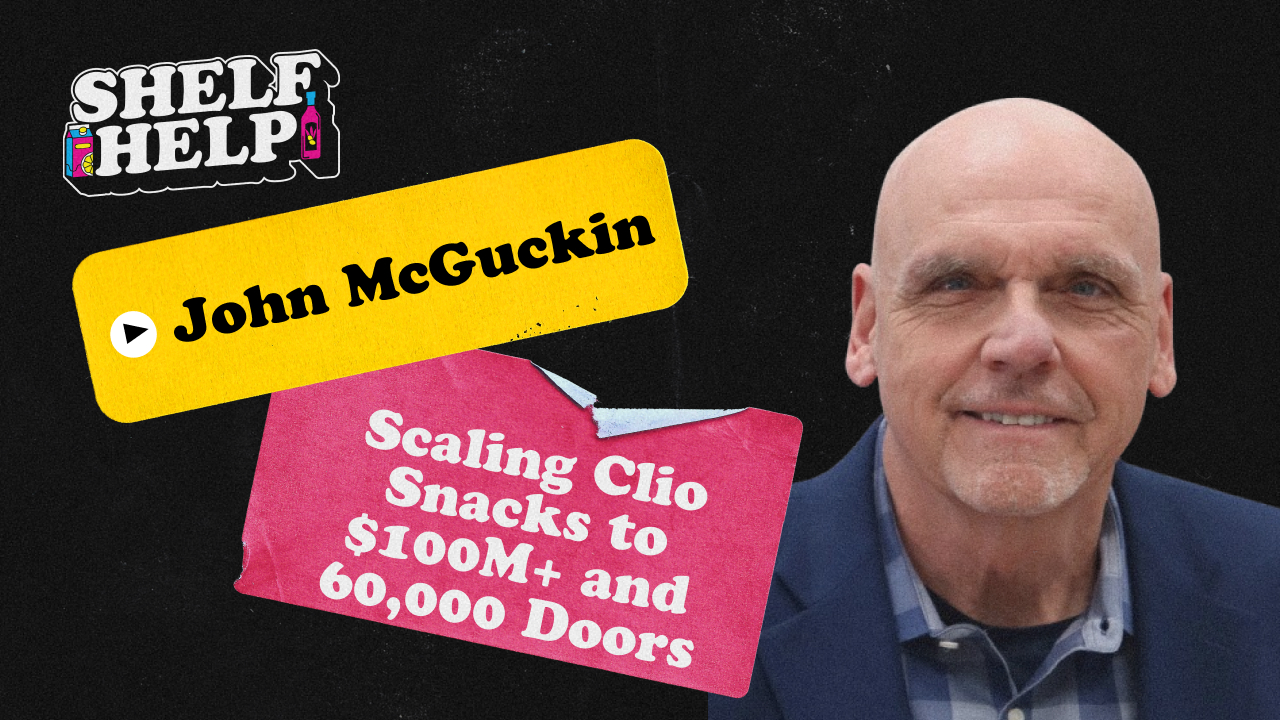



On this episode, we're joined by John McGuckin, CEO of Clio Snacks - the first and only refrigerated Greek yogurt bar - a chocolate-dipped, cheesecake-textured snack.
John took the seat as Clio's CEO in 2021 after a long track record of C-suite roles at brands like Sabra, Tribe Mediterranean Foods, and Maya Kaimal.
John breaks down why he took the job, how he read the post-COVID shift toward high-protein, permissibly indulgent snacking, and what operators should stress-test before stepping into a founder-led company.
John walks through the bet that changed everything: retiring the $1.19 single bar and moving retailers to four-packs and minis at $5.99, which fixed cash flow and unlocked a capital raise.
We dig into going multi-channel across colleges, C-stores, and airports, building a dedicated refrigerated snacking set at retail, running cold chain at a 98% service level through a disciplined S&OP process, and Clios' 86,000 sqft plant.
---------------
Episode Highlights:
🇺🇦 The garage origin story behind Clio (yes, a real syrok)
🪑 Taking the CEO seat as the first non-founder leader
🤝 What to stress-test before running a founder-led brand
📊 Reading the consumer shift that made yogurt bars work
💵 The singles-to-multipacks bet that fixed cash flow
🚀 Going multi-channel: 450+ colleges, 20,000+ C-stores, 65+ airports
🛒 Building a refrigerated snacking set at retail
🎃 Why seasonal flavors and end caps drive trial
❄️ Running cold chain at a 98% service level
🏭 Owning an 86,000 sq ft plant instead of co-packing
🎯 The single biggest velocity driver (hint: shelf position)
🚚 Getting distributors and brokers to actually work for you
👶 The kids' yogurt gap he's chasing next
---------------
Table of Contents:
00:00 – Intro
00:58 – Clio's origin story (Ukraine, a garage, a syrok)
03:26 – Where the Clio name came from
04:45 – Why John took the CEO seat
07:33 – Advice for stepping into a founder-led brand
10:18 – Betting on a new category: the Sabra parallel
13:00 – From $23M to a projected $120M: the multipack bet
15:42 – Going multi-channel: food service, colleges, airports
18:39 – The new-product and innovation process
19:24 – Building a refrigerated snacking set at retail
21:08 – Seasonal flavors and end-cap wins
23:14 – Cold chain and the S&OP discipline
26:33 – Where the brand sits in-store (and GLP-1)
29:38 – Owning manufacturing and self-funding growth
32:28 – Scaling from 1,000 to 60,000 doors
34:59 – The biggest velocity driver: shelf position
35:49 – Working with distributors and brokers
38:15 – The kids' category he's chasing next
---------------
Links:
Clio Snacks - https://cliosnacks.com/
Follow John on LinkedIn - https://www.linkedin.com/in/johnfmcguckin/
Follow me on LinkedIn - https://www.linkedin.com/in/adam-martin-steinberg/
For help with CPG production design - packaging and label design, product renders, POS assets, retail media assets, quick-turn sales and marketing assets and all the other work that bogs down creative teams - check out kitprint.co
Shout out to my friends over at Glimpse, the go-to partner for automating retail-related back-office operations and unlocking margin trapped in invalid fees and manual processes.
Are you in the market for a new flexible packaging partner? Check out HD Packaging. Third-generation, family-owned and built for the needs of category leaders like Newman’s Own and A Dozen Cousins. Faster launches, lower costs, and no artwork fees.
Episode Transcript
Speaker: 00:00
Welcome to Shelf Help. Today we're speaking with John McGuckin, CEO of Cleo Snacks, the uh the world's first refrigerated wrapped Greek yogurt bar. I am a frequent purchaser of these, so I am a big fan of the brand. Um, I think John took it, took the seat at uh the head seat at Cleo back in 2021 as the first non-founder CEO, roughly three years or so, taking the brand from about 23 million up to I think projecting 120 million or so in 2026. So some pretty rapid growth. John's got a lot of great experience in the space, was EVP of North American Sales and GM of Canada at Sabra, CEO at Tribe Mediterranean Foods, CAO at Maya Camal, previous Kitprint client, know those guys really well, chief customer officer at Lakeview Farms, global chief sales officer at the Chia Company, so as well as a U.S. Army veteran. So, long story short, knows the better for you, CPG space very well. So very excited to dive into it. Uh John, just yeah, first off, for the listeners that maybe aren't that familiar with Clio snacks, love to just get a quick lay of the land, just in terms of kind of the quick origin story and the why behind the brand and what the core product lineup looks like, and then um we'll jump in.
Speaker 1: 01:14
Sure thing. Adam, really appreciate the opportunity here to talk about uh Cleo. So the origin story is you know very interesting and certainly typical of you know some great American entrepreneur stories. So our founder is Sergei Konchikovsky. He he comes from Ukraine. And when he came to the United States, he came with memories of this product that he broke when he was a when he was a child called uh Siroque. And what Siroque is, it's sort of like a cottage cheese or a curd uh filled snack that's covered in chocolate. It has the only connection it has to Clio is that it it's sort of a similar process and it looks the same, but it certainly doesn't taste the same. In any event, Sergei uh got into the accounting area with Tom Wonderful and with Eneman's Bakery, but he is absolutely, you know, this creative mind and a fiddler. So he that that desk wasn't gonna hold him. Sure. So he was he was literally just playing around with with yogurt uh in his fridge one night that had had kind of sat for a while. He decided to cover it in chocolate and he gave it to his kids, who were, I guess, you know, very young at the time, and they loved it. And believe it or not, that's what spurred him to jump into this, you know, full-throated, invest in a in a in a small machine, in a in a small uh building, literally like a garage, right? Like there was a story like the Murray Lender with Lender's Bagels, he created in his garage. Uh so he sort of created this in his garage and uh he got a van and he actually took the product into the city and tested it with a couple different independent supermarkets in the city. And you know, about a week went by, the phone rang, and he said, Oh no, they're gonna call me and tell me to pick up all my product. But however, what happened was the product sold out. Wow. And the and the customers were delighted with it. So he started in 2016, so so it's been 10 years. Um, and it's really for him, I think, been, you know, quite a passion. And today he's chairman of the board. He's not integrated in the day-to-day anymore. We'll talk more about that as we go through, but you know, he's he's uh certainly a critical member of the board, uh, you know, a big owner in the company, and still provides significant creative input uh to our day-to-day operation. The name Cleo, by the way, came about in in in sort of a weird way. He was in France with his wife, driving through the south of France. He stopped at a stop sign, and this car hit him from behind. And when he got out, the the the gentleman who hit him couldn't speak English or pretended not to speak English, and Sergei couldn't speak French, so they parted ways. Believe it or not, as they were parting ways, Sergei, who at the time was thinking about how to come up with a creative name for the company, saw that the car was called a Cleo. So he looked at his wife and he said, That's the name of our company. We're gonna call it Cleo. Now, what he didn't realize at the time, in an interesting turn, is that Cleo was actually the Greek goddess or the Greek muse of history. So it ties back in, believe it or not, to Greek yogurt in a way that he couldn't have predicted. So um anyway, that's the that's the story. Uh and like a lot of entrepreneurs that I've been blessed to work with, he's you know, he's creative, he's dynamic, and always looking for the for the next idea. So, you know, we've been blessed to have the opportunity to work together.
Speaker: 04:36
I think I think that's the best naming story I've heard yet. We've certainly got a track record of leading some of the most well-respected brands around. I imagine anytime word gets around that you may be open to the next opportunity. I'm sure you got your pick of the litter whenever word you know gets out. Um what was it about about Clio that really made you pull the trigger compared to all the other opportunities I'm sure were in front of you?
Speaker 1: 05:00
Well, I think I think it it starts with the consumer. And when I when I first spoke with Sergei, you know, back in early, I guess early to mid-2021, and saw the benefits that that the brand held. So so the consumer had fast-tracked really from you know, in the in the early 2000s, I think the consumer was more about being very experiential, trying sort of exotic foods. So you think about Maya Kamal, you think about Sabra hummus, people were sort of exploring the world through food, and you know, people were using more olive oil and and more romantic type of uh European dishes. Um, but things had changed post-COVID and and and the culture really became one fast moving, on the go, permissibly indulgent, but I need my protein. And and and so it had those attributes going for it, even though it was, you know, really in the early stages. And then when you tasted the product, you know, just like when I was at Sabra or when I was at Maya Kamal, you know, the product was obviously high quality and superior. Um and and and then in looking at some early data that I was able to sort of get offline, you know, I saw that where it was in distribution, it, you know, it was doing quite well. And that was with nothing in terms of marketing support or even really trade support. But beyond that, it was meeting with Sergei, being exposed sort of to his passion. Throughout my career, I've worked with wonderful entrepreneurs. You know, what they all have in common is this passion for their brand. So from Murray Lender to Bob Rich at Rich Products to Jerry Schreiber at JJ Snacks to Yehuda Pearl at Sabra and now to and Maya at Mile Kamal and now Sergey, it just rubs off. I love that. So I was I was comfortable with him as the founder and really uh felt you know kinship with his passion. So the consumer, the founder, and then you know, the board. So when I when I had the opportunity to meet the board before I came here, I saw people that were just as passionate about the brand. You know, it wasn't like an investment where, okay, we're gonna invest in this company because we think it might be successful. It was an investment of people who like eat the product all day long and absolutely love the product. And every one of them is like the supposed marketing expert. Like, you know, they know how to how we can take it to the next level. So I was uh I was exposed to all these folks. And between the consumer fit, the founder fit, the board fit, and the fact that it was in New Jersey, which is my home, I felt like this could be uh Sabra 2.0. And thankfully, to this point, you know, that's the rec the direction that uh it seems to be moving in. That's awesome. That's amazing.
Speaker: 07:34
For the other seasoned operators that are that may be listening that are thinking about taking the CEO suite at a brand that that has been only founder-led up until that point, what's I don't know, one or two things that they should have top of mind or kind of you know, stress tests in the diligence phase to make sure that it's gonna be the right fit for them.
Speaker 1: 07:56
All right. So beyond, you know, understanding where the consumer dynamic is, you know, the is the product satisfying a need? You know, that that's probably the most important thing because if the if the product's not satisfying a need, it's probably not gonna be successful in the long run. But I'll go back to the to the first piece, and that's the founder, the founder himself or herself. You know, you have to feel uh you have to buy into their vision, but they have to buy into your ability to integrate their business and take it to the next level. Um and that takes time. But I think when you're first when you're first interviewing, you know, those sort of ground rules need to be established so that the expectations can be set. There's so many examples where a founder will step away and then meddle in the business, and then there'll be conflict, and then because of the conflict, you know, the CEO goes away. The founder comes back in, and then the company is not as successful as perhaps it could have been. You know, you go to Expo West, and there's hundreds and hundreds of founders who don't, who have maybe great the greatest products that you've ever seen, but they don't know how to properly integrate and scale the business. So getting that relationship right with the founder, you know, out of the gate and understanding those expectations are critical. And then the board, the board and the bank, you know, testing the relationship between the board, the founder, and the bank to make sure that all of these key constituents are supporting the brand to the level that you need it to be supported. I've been in a couple companies where there was a huge disconnect and even a bad relationship, like between the bank and the board, or the bank and the founder, or the board and the founder, and it's a that's not a good place to find yourself. So uh and then what that builds is the you know the ability to have trust and then ultimately, not right away. I mean, a founder's not going to give you autonomy, you know, day one. You kind of you kind of work to earn that over the course of the first nine to twelve months. But if things are going right, um, you know, your autonomy will grow because you're delivering results. And and that brings you to the next most important thing, which is people, the opportunity to bring in people that you know are experts in their field, that can live the culture, that have the same passion, and can and can grow this thing to the level that the you know the founder and the board certainly anticipate.
Speaker: 10:18
Case can probably be made that Sabra was really say kind of a category-defining brand that really brought hummus into the mainstream in the U.S. To a certain extent. I think Cleo's making a similar bet on Greek yogurt bars with this new product that Sergei came up with. What uh assuming that kind of tracks with you, like what does it take to build a new category and a nine-figure brand in that category? And how is that different versus building in a more established category where it's probably a bit more of a red ocean, but people understand the category, they know what to look for. Yeah, what what's what's different here and maybe what are the pros and cons?
Speaker 1: 10:53
Yeah, so I think first you need you need a lot of courage because you're putting your you're putting your career and and your you know your family to a certain extent on the line for for a concept or an idea. And and I go back to making sure that the product is actually solving for a need that's not out there, or you're creating a need based upon the consumer pulse that doesn't exist. So that's critical. And then you know, capturing the moment, you know, where is the consumer right now? What is the consumer looking for and how does it match up to the product that you're bringing to the market? So in the case of Sabra, you know, the hummus category, when I joined Sabra in 2007, was only about $80 million, and it was dominated by Athenos, which was a craft brand, and it was a sleepy category. In 2013, you know, it's a billion-dollar category, and Sabra owned, you know, more than 50% of it. So Sabra went from $10 million in sales to almost $500 million in sales in seven years. What did Yehuda do? He he created a product that was visually superior in a category that no one really knew about, except for, you know, your ethnic, uh, a lot of ethnic folks. So you had a lot of you had Greeks, you had Muslims, you had Israelis sort of getting it, but there was no product that really anglicized the flavor for Americans where they could really understand it. And that tied into that whole romantic notion of food back in the early 2000s, where people were more willing to experiment, and it took off like a rocket. And I think in similar fashion, as we as we continue to uh close opportunities with Clio across multiple channels, we're seeing the same kind of uh consumer appreciation and takeaway. So I think with Yehuda and Sabra, it was highly innovative. It was beautiful to look at, it tasted great, there was nothing like it in the market. And and then by bringing in the right people with the right passion, we were able to really, you can't even say that it was a category in 2007, but but boy, in 2013 it sure was.
Speaker: 13:01
Going from 23 million to 120 million-ish in in three years is is is pretty quick. What what broke first and what were some of the biggest changes to the workflow or process that that you've had to make along the way to actually uh set up the business to be able to hit that 120 million a year, going from 23 in only three years, and I'm sure it's building it to be able to go much further beyond 120.
Speaker 1: 13:26
Yeah, so just to be clear, the 120 million is our 2026 annual funding plan. Yeah, yeah. This would technically be the year four. It doesn't take away from the run rate, but not at all. Not at all. Technically year four. So when when I joined Clio, uh, we were selling basically single bars. So we were selling bars that retailers like Walmart were retailing for $1.18 or $1.29. That was that was sort of the portfolio. And it was at a time where, like a lot of new companies, you know, and I didn't mention this earlier, but cash flow is king. So it's as important as any of the other things that I talked about. So as we're building this business and investing in equipment and capital and people, we were selling these little single boxes, and it was not generating, you know, enough revenue. So one of the first things that you know we really focused on was let's let's not sell singles to retailers, you know, let's sell multi-packs to retailers. And so we were able to, you know, take a product, a single, and make it a four-pack. Um, and then we sold our eight-pack minis to go with the four-packs. And so instead of selling stuff at $1.50 to $1.69, we were, you know, $4.99 to $5.99, which was generating more revenue. Got a lot of pushback internally around those changes because people didn't think that Little Cleo had the leverage to convince the trade that it would be better, you know, to sell a multi-pack. The bet was that within 18 months or so, we generate the same velocities on the four-packs that we were generating on the singles. And thankfully, that that's exactly what happened. So that was the first real big bet. Uh, and that began to help us solve our cash issues. It also made us more profitable in the eyes of the retailer from a gross profit per, you know, per linear. So uh we became overnight, you know, as we began to ramp up our velocities, you know, selling at $599 and turning more meaningful uh to the retailer. So we didn't get pushback, and now you'll find almost exclusively retail supermarkets and mass merchandisers. You'll see our poor packs and our and our minis. Um, but we took the singles and we went in a different direction. So we said we're not going to discontinue the singles. We're gonna develop a multi-channel capability and get into food service. So I was able to uh attract Scott Thuze, who worked with me at Sabra, and he's the gentleman who ran our food service operation, responsible for the sale of the uh Sabra grab and go hummus with the pretzels, which are everywhere. So I brought in Scott, and uh, because Scott knew that business so well, we were able it's a different food service is a different business. And Adam, I know you know that. But he knows he knew how to do it. So uh today you're gonna find us in 450 colleges and universities, over 20,000 doors, over 20,000 doors and sea stores, you know, over 65 airports as we continue to build out this food service capability using those singles, you know, to help make that happen.
Speaker: 16:34
So uh that's been uh you know a wonderful play for us. When you brought the concept to retailers initially of moving to these multi-packs, did they have any resistance at all? Or were they immediately like, yeah, this totally makes sense. Let's let's make this switch as soon as possible.
Speaker 1: 16:50
We were blessed because I can't think of a retailer that pushback in in any significant way. And I think it was all about the fact that they thought that the product had legs, and just like us, they wanted to generate more revenue and more gross margin. So uh yeah, we had you know we had really very little, if any, headwinds around that that change. That's right. And then that led that led to beginning to really grow quickly, and then we had a we had a capital raise. I think had we not gone to the multi-pax, we would not have gotten the confidence from the investors. And I don't know what would have what would have happened.
Speaker: 17:32
Yeah.
Speaker 1: 17:33
Because we just never would have been able to generate the cash. And of course, now we're you know, double digity, but uh, you know, strong margin, self-funding, thankfully. So it was a it was it's been a great journey. And the other thing that happened at the same time that we went to multipax is I was able to attract really, really top talent to the company. So, you know, I I I see this as a team sport. So, you know, having the right lead in finance, the right lead in ops, the right lead in sales and marketing and HR is absolutely critical. And I always, you know, have the mantra, you know, get functional experts, get people that are smarter than you, and and and and just work together as a team. And as long as as long as everyone is sort of within within the culture and is passionate about the culture of the company, there's so much you can do. Sky's the limit. So I've been blessed along those lines too, in terms of people that have followed me throughout my career, but also the newer people that I've been able to bring in here, and we're having a ball.
Speaker: 18:34
That's awesome. In general, what does the kind of journey or process look like internally at Clio that that ultimately leads to the decision to say, okay, we feel like there's enough data here, enough justification for us to go through the whole process of bringing a new skew to market?
Speaker 1: 18:52
Yeah, so we do. We have brought new SKUs to market. Uh most recently, we brought salted caramel and cookies and cream. Believe it or not, we have as a brand, we have 70 ACV, which it's hard to believe. Yeah, it's hard to believe. But but when you look at the items, that's where the opportunity is. So our top 14 customers, we average about 3.8 SKUs, and we really need to be six or seven. And so that's the work that that continues. You know, the the title of of your company really, really speaks to the merchandising opportunity that is in front of us. You know, consider that when I first joined, many retailers just assumed we were like a yogurt. So they threw these single boxes in with Chobani and Danin, and it was just lost. So what we've been doing lately with with category management scan data is really building a story with the trade around creating a refrigerated snack set, typically adjacent to yogurt, but also adjacent to desserts, because that's we think where the consumer would look to find that footprint. And so we spend a lot of time trying to build with the trade as our partner the best way to merchandise this profitable snack category that can be proven to be incremental for the refrigerated case, especially given the high, the high retails and the low space that it occupies. So, you know, we've talked to some of what people might call our competitors in in this area and encourage them to work with us in in helping to create this dynamic. So it's it's a work in progress. We have some accounts like Market Basket with 12 items on the shelf. We've got great distribution at Walmart, for example, but the the average is only about 3.5 uh per score. But as we grow and we can show velocity gains, we gain the trust of the retailer and we're able to expand our distribution and as a result create that footprint for our consumers.
Speaker: 20:51
The latest seasonal flavor, which I think was Pina Colada, which I've not tried yet, but need to get my hands on that one.
Speaker 1: 20:57
I just saw the order sheet today. It's shipping this week.
Speaker: 21:01
Are any going out to Lund's or Whole Foods by any chance? Do you know?
Speaker 1: 21:05
I believe, I believe you will find them. Yes. Perfect. I agree. Yeah, so so what's nice about the seasonal guys is especially like with a pumpkin play. So what happens with the pumpkin play is a lot of retailers put that in their end caps, you know, during the fall. And so Clio now is elevated to an NCAP position with a with a skew, and we're met by consumers who don't even know who the hell we are, right? So they try it, and the next thing you know, they come back to the regular case, and they're buying vanilla and strawberry and cookies and cream or whatever is on the shelf. So it helps to build awareness about the brand and and get people to try it. So um these seasonal programs have been uh very good for Clio, and every year, you know, they're growing.
Speaker: 21:51
Do you have a process in place or a I don't know what the best term is, like a checklist that that says, or maybe you were thinking about doing so where You introduce a seasonal flavor and it hits a certain metrics for a long enough period of time where you say, okay, this one is showing enough promise. We need to convert this to a permanent skew.
Speaker 1: 22:15
Not not a seasonal flavor. We keep seasonal flavors as seasonal flavors because we're afraid that it would lose that impact.
Speaker: 22:24
Yeah, for sure.
Speaker 1: 22:24
But however, however, the other the other way to look at it is as some of our particularly club customers come and visit us and they talk about why don't we try this? Why don't we try that? Why don't we try cookies and cream? Why don't we try cake better? Why don't we try, I don't know, we uh th think of a flavor, peach, cherry. So we'll launch it in like a club pack, and that that's not a seasonal flavor. And then if it's successful, you know, then we'll we'll look to commercialize it once we do the work with the consumer testing and everything, and uh we'll bring that flavor to market if it's so successful in club that it's obvious that there's a consumer need or desire for that flavor. So, yeah, part of our innovation comes from you know running special exclusive packs for club to support their interests, and as a result, it supports our interests, and and and that's a good idea.
Speaker: 23:14
Cold chain, from what I know, is one of the more challenging verticals within within CPG. What would you say are the keys to to running a brand in the in a cold chain category uh successfully at nine figures and above and and growing quickly? And what do most operators maybe maybe miss?
Speaker 1: 23:34
I can't say what most operators might miss, but I know that the the learning here has been, you know, you start behind you. You start with your supply chain. And we've developed a very robust SNLP sales and operation platform working with Net Suite and really holding people accountable on the forecasting side of the business because it's so essential. If your forecasting is wrong, you know, you're either disappointing the customer or you're scrapping out profit. So, you know, we're experiencing, believe it or not, in the refrigerated environment at 98% service level, you know, on a on a 52-week basis, which really speaks to our operational group and this whole SNLP process. So securing ingredients and packaging at the right time, at the right place, and making sure that uh you're producing it on time because the the second thing you're limited by is shelf lay. So, you know, you need to get the product out there in the very early days so that you're guaranteeing the best possible freshness for your consumer. And then when you're working with your distributors and retailers, you know, really working hard on uh, you know, working with them on FIFO issues, order management issues, making sure, you know, they have just the right amount of what they need, working with scan data to kind of tie it all back together, working with your brokers on some of the bigger customers to make sure that from their perspective, they're getting it right from the customer. You know, here's what here's what we think we're gonna need, and then building it out into the broader supply chain capability. So it can be done. It can be done very successfully, but it it takes a lot of effort and and really people, you know, people drive that thing. And then we celebrate the success. And when we have an issue, you know, we do a learning and we learn from it and uh continue to improve.
Speaker: 25:17
Yeah. You mentioned SNLP process, and I think that's such an important part of running a company effectively. What does a well-run SNLP process and cadence look like in your mind?
Speaker 1: 25:30
So we run uh SNLP once a month, and we brought in uh a young technical expert. So we we used to just take like the sales forecast, sit down with the operations people, and sort of come to an agreement on what might happen. But now it's become quite the we still have that, but it becomes quite the technical affair. So uh it's all fed into a uh a database and and we can immediately see the the enhancements and the improvement. It's also a lot of communication around promotion, new item availability, when when it's going to ship, what are the what are the ups and downs in the business so that we can make sure that we have the right inventory on hand at the right time? And we're not we're not scrapping product or disappointing customers. So our SNOP includes, you know, myself, our operations lead, our COO, our CFO, our CSO, our CMO, um, and uh a number of operational folks who support the effort on the technical side. And we score card every single month, and you know, we're so far very happy with the results.
Speaker: 26:31
I don't know how we could do it any other way. You were talking about how in the early days the product was getting lost, sitting in the section, getting lost behind a bunch of other yogurts and whatnot. And now when I go into the store, you know, I see it sitting in next to the midday squares of the world and some of these other refrigerated snacks, which it seems like it's a good place for the brand to be. Like what yeah, where it were in the store, you know, in the retail environment, do you want the brand to sit where you feel like it's performs the best?
Speaker 1: 26:59
I think as I as I mentioned earlier, um, I think you want to be adjacent to yogurt, but also adjacent to dessert. Um we see we see the dessert category struggling a little bit as people are migrating toward uh snacks. And with GLP 1, they seem to be migrating more toward GLP one, by the way, just came along. I mean, it it certainly helped spur our growth, perfect bars growth, but uh it wasn't the cause of of the growth. But we're happy we're happy to support it. Sure. So I so I think that footprint, that snack footprint between yogurt and dessert would be ideal because that's where the consumer is is traveling. Um I think back to where bars were, and and I've been in the business a long time. So I used to, you know, work for American Home Foods in the grocery sale in Chef Bouillard, and I'd go into the stores, and you know, back then they had where they were just beginning to bring in these little little protein bars or granola bars, and nobody knew where to put them. Like, should they go buy cereal because there's granola in them? Should they go buy cookies? Should they go buy candy? Should they go buy peanuts? And now when you go into a store, you know, a whole aisle is devoted to bars. Yeah. So we see the same thing, opportunity refrigerated for fresh bars because people want to migrate to fresh, you know, more flavorful solutions, fresher solutions. And so we think that the the retailers who recognize that are a bit ahead of the game. And we do strive to remind them that these bars can be incremental because you're taking because either you're getting new consumers to the store entirely, or you're stealing from your buddies and grocery and building up your refrigerated uh business. So yeah, that's that would be ideal. And then ultimately having this destination where a consumer knows exactly where to go. That that's one of the things um that we're seeing is uh our online sales are off the charts. So uh, you know, I'll say customer A is looking for 25% of their sales and refrigerated to be online, right? We're we're doing 38. So it's it's easier to find us online because we have the same amount of space as Giovanni than it is sometimes in the store. So, you know, our goal is to try to win on both sides. We want to continue to grow the online because it's so important, but we we really do need to work with these other companies like Perfect Bar and Midday Squares and begin to build this this new snacking destination and refrigerate it. We don't look at them as competitors. We we look at we, you know, we hope to look at them as collaborators.
Speaker: 29:37
Yeah. I love that. Cleo owns and operates a vertically integrated facility, I think that's around 90,000-ish square feet. 86,000, yeah. 86,000. Cool. That was close. Yes. Yeah, walk walk just walk me through a bit of that decision to to own manufacturing versus what I might call like the more prototypical kind of running an asset-light Copacker model and try to stick in with that as long as possible. Like what's kind of the yeah, what's kind of the thought process of going vertical in the more earlier days?
Speaker 1: 30:08
So, in fairness, you know, Sergei started the company with a commitment to to make the product, you know, himself or our sense of. Does that make sense? You know, I've been with companies, you know, with with copacking and I've been with companies that that manufacture themselves. There's a huge difference in in my mind with being close to your manufacturing, close to your quality, close to your safety, and being and being able to be in control of the innovation process from A to Z, controlling your own inventory, and and then you're you're fully accountable yourself for delivering the best possible product. You know, the nobody's nobody I'm not suggesting that copackers take shortcuts, don't get me wrong. But but I almost think it's like your own family versus a you know, versus a niece or nephew. It's just different. And the love that you have for the fact that you manufacture it yourself, you know, I think people take great pride, pride in it. And it also from a learning standpoint, you know, I've learned so much just being closer to how we manufacture product, why we do it the way we do, what the issues are, what the challenges are. I I just think it's you're just in a superior position.
Speaker: 31:22
What did the financing look like for for that facility?
Speaker 1: 31:25
Well, it started out with Sergey, and then Sergey had an angel investor, and then ACG came in. Okay. Though they they they sort of represent the board, and you know, I'm I'm I'm I'm sure they feel really good about their investment right now. We did do a raise. We did do a raise uh right after I mentioned uh the multi-packs and and bringing in new people, and that really got us aligned. And now we're self-funded. We just put in a sixth line in our facility, it's self-funded, you know, and as we as we move down the road, you know, we have we're at least here through 2032. And uh, you know, we feel like as we invest in new equipment, new machinery, new capital, and grow our and grow, um, you know, we have the capacity to get us there. Um, you know, we look at the capital investments as being self-funding from this point forward. Certainly things can change, but you know, from a from a financial uh from a cost structure standpoint, uh we're we're paying as we go.
Speaker: 32:25
Cleo's in roughly 60,000 doors total, 20 to 30,000 of those are retail. What would you say are are kind of the the the differences and and the keys from scaling from let's just say roughly like a thousand doors to ten thousand doors versus the next phase up going from 10,000 to 20,000, 30,000 doors?
Speaker 1: 32:47
So I think I I don't know that it's really different. Uh okay. So if you start with you know retailer A, and you are you're able to show through data that you're adding value to the category, you're adding profit to the category, consumers are responding to the brand, you know, you take that information to retailer B without telling them who retailer A is. And suddenly you're building, you know, a brand from the standpoint of the category. Like we wouldn't just go and say, hey, buy Clio. We would go and say, hey, you know, you've had a lot of success with Perfect Bar, for example. You know, here's a brand that doesn't compete with Perfect Bar. It can sit alongside of Perfect Bar and drive incremental sales. And let us show you. So you start with two items, maybe three, you know, and then and then you go to five. And then as you as you begin to gain momentum, you take that story to other retailers. And some adapt extremely quickly, and some they you know, they just don't believe until you know later in the game, and then then they come on board and they have the they have the same success. So and then in the meantime, as you grow, you're able to build out your marketing capabilities and you're you're now talking to the consumer in new ways on social media, you're building household penetration, repeat, and trial. And so it it from that point it begins to mushroom. And when you can when you can take that whole story, now you're going from you know, 10,000 to 30,000 stores, 30,000 to 60,000 stores. And then if you're multi-channel and you they can find you in, you know, retailers, they travel too. So they have kids in college and you go to airports, and now they see us in airports, they see us in C stores when they get their coffee. You know, their kids are talking to them about this great product in the college and university. So it it begins to become common, let's say, for retailers to want to stock your product. But you have to earn it every day. I mean, you absolutely have to earn it through your supply chain. You have to make sure you keep the consumer engaged and hit those velocity targets that the retailer is demanding of you.
Speaker: 34:59
On the topic of those velocity targets, what have you found for Clio has has had the biggest and is continuing to have the biggest impact from a velocity standpoint? And whether it's you know demos or TPRs or something of the like, yeah, what's what what have you felt like has that has had the biggest impact?
Speaker 1: 35:16
Shelf position. Having the right number of items on the shelf in a place where the consumer can easily find us. Yeah. It it it's it's like the all every boat, every boat rises. Totally. The the caramel sells more, but the manila now sells more, the strawberry sells more, the cookies and cream sell more. Right. Uh and it just become it becomes a Clio house party. Totally. So that's that's really the thing now for us is most important thing is shelf merchandising.
Speaker: 35:48
Yeah, that makes sense. That totally makes sense. Key part of scaling, you know, really scaling up in retail is partnering with the right distributors and and and brokers. From from your perspective, how can a brand truly partner with their distributor to really maximize success and really be a true partner to them from the brand side?
Speaker 1: 36:04
I think communication is a is a really big part. Owning the relationship, you know, owning your supply chain metrics to the distributor gives you the opportunity to hold them accountable to theirs. So it's great that you got it to the distributor on time, but if their fill rates to your customer are weak, there's a problem. And you have to be able to be able to sit down and talk about the problems and then fight. Oh, you know, you really need to make sure the distributor has your best interest in mind and they're they're rotating your product and making sure that you know those code dates that are going out into the world, you know, are the right code dates at the right time. So uh yeah, we work with some great distributors, dot KE, Unify, and uh, you know, as we grow and become more meaningful to some of these retailers, you know, certainly we're moving more into a direct relationship with uh with many of them who are now putting us in their own warehouse. But you know, we're always going to need these distributor partners so that we can get to the you know the entirety of the market. On the broker side, you know, there's I was a broker for for a while, actually. And you know, you know, you know a good broker. You know a good broker by who they represent and what those brands are doing in the geograph in the geography in which they represent them. You know, in my opinion, we're too small to be a direct sales organization at this point. You know, maybe we'd get you know one appointment a month, whereas the broker is in there every week. And frankly, if it's an important account, I want to know when the when the buyer has a cold. So um, well, not me anymore, but our our CSO certainly does. Right. So so just having that hands-on understanding and then and then working together so that you have the attention of the leadership so that you have the right points of accountability, and that can be done through incentive programs and and other things that are mutually beneficial. So I I don't shy away from working with a with a solid broker. In many instances, I think it's a it's it's a better case scenario than than than what a direct person might be able to offer at this stage of our development.
Speaker: 38:16
Last question for you, John. You know the CBG space very well. Any brands in particular or just categories in general outside of Clio's category that have just kind of piqued your interest lately, things that you've been watching and all just because they they seem interesting?
Speaker 1: 38:31
Yeah, so it's interesting that in the in the yogurt category, uh, it's a $12 billion category in the U.S. And there's this segment of the yogurt category, which they call kids, which is about a billion. And it's kind of stagnant, even though yogurt's growing, you know, the kids segment's kind of sta uh static. So we are actually this month shipping a brand new product, three SKUs of uh kids' product. It's it's yogurt coated, so it's different colors. So it's like a cotton raspberry and a strawberry dream, and it's and then there's a drizzle on top, like chocolate. And it it tastes, it it's it tastes great. And and really what we found in in the research, and this is coming directly from the trade, is that they felt like you know, ages two to six was covered. There was a real gap between six and thirteen. Interesting. And and that's really the segment that we're going after with a Greek yogurt bar that has five grams of protein. So moms and dads, you know, kids need, you know, 12-year-old kids need about 30 grams of protein a day. So, you know, we're we're offering five. So we're in a kind of unique rare air among the kids category. And and boy, if we can carve out five percent of that business, it's a $40 million opportunity. So we're very focused on this. We've gotten some great early news from from accounts. As I said, we're already shipping it uh to a few this month. But we, you know, when you look across the country, some of the biggest retailers are jumping on this and they see this as uh as an opportunity for new growth. So uh yes, stand by to see that. It's something we've been looking at for three years, and it finally came uh to fruition here this month.
Speaker: 40:08
That's exciting. Definitely gonna keep an eye out for that. Well, yeah, John, this has been awesome. Really great insights here. Super appreciate you making the time. Uh what's the the best place for people to follow along with you and all your expertise? And then where where's the best place for people to follow along with the Cleo brand these days as well?
Speaker 1: 40:26
I think, you know, the same old, you know, LinkedIn, Twitter, Facebook, you know, but mostly go to the store and buy the product. There you go. Perfect. That is best that's the best way to follow us. Love it. Cool.
Speaker: 40:39
Well, John, yeah, this has been good. I really appreciate the time. Um yeah, I think that's I think that's the pod.
.svg)