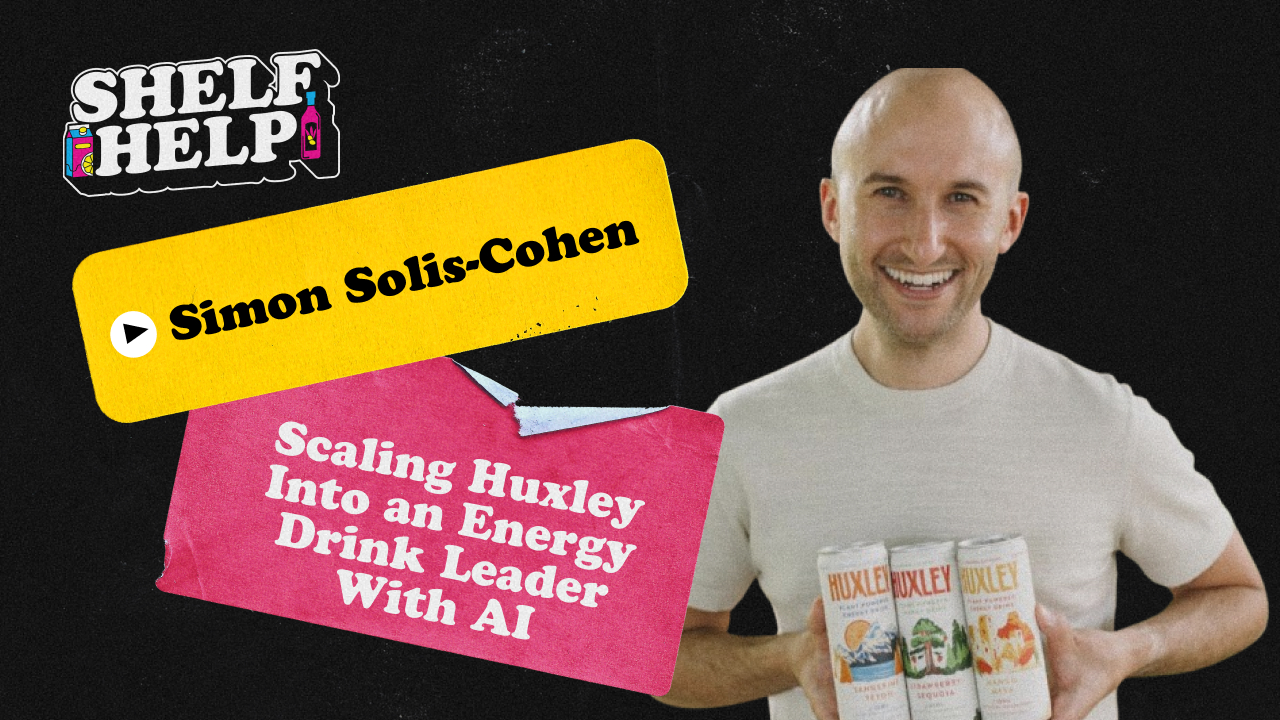



On this episode, we're joined by Simon Solis-Cohen, Founder of Huxley - the Minneapolis-based plant-powered energy refresher made with real fruit juice and caffeine from upcycled cascara superfruit. Simon is a chef by training who ran a wine marketing agency for years before selling it and going all in on Huxley.
We dive into the pivots that got the brand here, starting with the fact that Huxley launched as a coffee company. Simon breaks down why he left the coffee behind when Huxley debuted at Expo West, and how the team went from idea to a finished can in 130 days.
A big part of the conversation focuses on cascara, the upcycled coffee cherry husk that supplies Huxley's 90 milligrams of caffeine. Simon walks through why synthetic caffeine tastes bitter, why that bitterness pushes most energy brands into heavy sugar or sucralose, and why real fruit juice had to be the second ingredient in every can.
We also get into the packaging story. A conventional buyer told Simon his award-winning national parks illustrations would cap Huxley at hobby scale, and he rebranded a year in rather than wait. Simon shares what that unlocked at Sprouts, where Huxley now ranks number three in velocity among nationwide energy brands, plus the new Kroger natural and organic end cap and the AI tools he built to kill hours of distributor accounting every week.
---------------
Episode Highlights:
☕ Starting as a coffee company and killing it fast
⏱️ Idea to finished can in 130 days
🍒 Why cascara superfruit beats synthetic caffeine
♻️ The landfill math behind coffee cherry waste
🧪 How bitterness forces energy brands into sugar
⚡ Dosing at 90 milligrams and why that number
🥭 Making real fruit juice the second ingredient
🎨 The national parks cans and the alliteration
🛒 The buyer who said the design capped them at hobby scale
📦 Rebranding at year one instead of waiting it out
💸 Seed strapping and saying no to retailers
📈 Hitting number three velocity at Sprouts
🤖 Automating distributor remittances with AI
---------------
Table of Contents:
00:00 – Intro
00:52 – Why Huxley is an energy refresher, not an energy drink
03:31 – Idea to finished can in 130 days
05:02 – The pivot away from coffee
06:58 – Dropping the coffee line at Expo West
08:34 – Choosing cascara over synthetic caffeine
09:45 – What Bai proved about coffee fruit
12:11 – The landfill problem cascara solves
15:03 – Why bitter caffeine forces brands into sugar
16:59 – Dosing at 90 milligrams
17:56 – Real fruit juice as the second ingredient
20:39 – Building the V1 brand identity
24:07 – The buyer who rejected the packaging
26:52 – Why rebrand at year one instead of waiting
29:45 – Seed strapping and saying no to retailers
32:01 – Going nationwide with Sprouts
35:48 – The Kroger natural and organic end cap
38:10 – Automating distributor remittances with AI
---------------
Links:
Huxley – https://drinkhuxley.com/
Follow Simon on LinkedIn – https://www.linkedin.com/in/simon-solis-cohen/
Follow me on LinkedIn – https://www.linkedin.com/in/adam-martin-steinberg/
For help with CPG production design - packaging and label design, product renders, POS assets, retail media assets, quick-turn sales and marketing assets and all the other work that bogs down creative teams - check out https://www.kitprint.co/
Shout out to my friends over at Glimpse, the go-to partner for automating retail-related back-office operations and unlocking margin trapped in invalid fees and manual processes.
Are you in the market for a new flexible packaging partner? Check out HD Packaging. Third-generation, family-owned and built for the needs of category leaders like Newman’s Own and A Dozen Cousins. Faster launches, lower costs, and no artwork fees.
Episode Transcript
Speaker 1: 00:00
Welcome to Shelf Help. Today we're speaking with Simon Stolas Cohen, founder of Huxley, Minneapolis-based plant-bowered plant-powered energy refresher formulated with real ingredients and caffeine from upcycled superfruit. Simon's a chef by training, honed his craft at the Culinary Institute of America for working in some of the most prestigious kitchens in the world, then spent about a decade or so in the wine world running a marketing agency, which he eventually sold to ultimately go in on Huxley. So great journey. Really love the brand. Super excited to dive into it. Simon, just just first off, maybe just for the listeners that maybe are not all that familiar with Huxley, let's just start with just getting a quick lay of the land, just in terms of kind of the origin story, why behind the brand, core products in the lineup, and then uh we'll take it from there.
Speaker: 00:50
Yeah, definitely. And thank you so much for having me, Adam. So for those of you who are not familiar yet with Huxley, Huxley is an energy refresher. And so be clear, this is not just a typical energy drink like you see out there. And so what makes this different and unique than really any product on the market today is a few things. One, it's really about what we focus on and what we're selling. With no disrespect to any specific energy brand, but most of them are these days selling adrenaline in a can, right? It is 200 milligrams of caffeine, which is kind of common as the minimum these days in a crazy way. And then let's just be honest, a lot of them are full of artificial ingredients still, right? So sucralose artificial sweeteners are the main ingredient for a lot of these popular energy drinks. Obviously, there's demand for that. That's great, but there's a total other side of the population that nobody was speaking to, right? They don't want all of this artificial junk in there, and they don't want to feel like they're being shot to the moon on a rocket ship with caffeine and staring up at the ceiling like at night, not sleeping full of the jitters, right? And so I'm one of those people who does not want a lot of caffeine. I'm someone who can't handle it. And so for me, it was coming up with a completely different view on how to have that boost of energy without all of the overstimulation that typically comes with the category. And the other part, too, is focusing on flavor and taste. I feel like that a lot of people who drink their energy drinks, sure, they get used to the taste, but I rarely hear people say they crave the taste. I think that people think of energy drinks a little bit more from like a medicine in the sense that you take it for the effects and the result, but do you actually enjoy the experience necessarily while you're doing it? And so for us, we really wanted to flip that script when we were working on Huxley. We wanted to sell joy. We wanted to sell, we wanted to sell refreshment, not over stimulation. And that was that original thesis uh that started this idea for Huxley. And, you know, when I was coming up with the idea, I started a little digital note card, and all I wrote was healthy energy drink with electrolytes. And that was the kernel. That's how this all started. And, you know, we came up with this idea in uh 2023. I decided, cool, let's try it, right? I had zero background in CPG, as you mentioned in the intro. I come from the wine industry and from the colonizing restaurant world. And so we decided, let's just give this a shot. And I actually think it was a benefit to being a little naive, right? Because if I knew how competitive energy was, maybe I wouldn't have done not by and so my uh you know partner and I, Bethany, who uh you know came with me from my last company, my marketing agency, we worked together on launching this, and we literally went from idea to launching the product, like full product in a can, final packaging in 130 days. So we did that from the fall to early spring of 2023 to 2024, and we debuted the product. The official date launched was, and I'm nuts by doing this, Expo West 2024, March. So March 13, 2024. Um, so it's now been just a little bit over two years uh since we've launched the product.
Speaker 1: 04:00
That's a great beginning to the story. When we chatted just like a few weeks back, you told me that Huxley is 27 months old, you've pivoted a lot. You think you call them leveling up pivots, and and one of those was was making this move to being a refresher, which you gave a bit of the background in terms of kind of what the the thought process was there. Any other pivots, big ones that come to mind that you've gone through over the past two years or so?
Speaker: 04:24
Yeah, I mean, I think right, if you're running any business, it's just a series of micro pivots, you know, some well, some bigger than others. Um and so for us, we've definitely had a few, and I'm someone who's never satisfied and always trying to improve. Now you want to be careful, you don't want to completely change your business every couple months, you're gonna go not. But to your point about how to just continue to level up and take the business to that next level. And so, you know, fun fact, I kind of skipped purposely skip over in the origin story, but since you you asked, I'll kind of give you this little insight what people don't understand. So when we started this, when we like we had the name Huxley, we were doing a product, this is 2023. It actually didn't start with this product. We actually started as a coffee company. And so that's where I talk about some big pivots. And so we started, we're here in Minneapolis, we worked with a local coffee roaster who was absolutely incredible. He supplies, you know, he has his own brand, but then supplies private labels to tons of amazing coffee shops in the metro area here, award-winning coffee roaster. And I just love coffee. I've I have a great obsession with coffee. And so we started actually that essentially he was roasting it for us. We designed the packaging, we put it in and sold it. And that is one of those fail-fast moments. And we quickly realized that coffee is a commodity at the end of the day. It definitely has marketing and branding opportunities, but if it's just simply putting a different name on a bag of beans, it's really hard to differentiate. And I found that with coffee, especially in the CPG context, people go with their locals, right? So, yes, you have some national brands, and there's fantastic national brands out there, but a lot of you go, look, go walk into Whole Foods or Sprouts or you know, Cub Foods or Kroger Albertsons, there's gonna be those mainline, you know, national brands, and they're always pretty good at having the local brands. So I just quickly was like, oof, this is going to be very hard to scale a meaningful business around a commodity product at the end of the day. And then obviously, coffee was starting to get expensive for a lot of reasons and things like that. And so I'd always had a vision of doing more than just coffee. I thought about maybe building this as a platform brand, right? Where we could have a core brand and a bunch of different product categories. And then I quickly wised up and realized that that is kind of overextending yourself. But in the meantime, of that kind of epiphany, if you will, we started developing this energy product, this beverage. And so that was always like in the works. And then all of a sudden, after Expo West, even honestly when we debuted at Expo West, we still were technically selling coffee. And I remember I had this conversation with my wife where we were like, do we bring the coffee to Expo West as well and sell that too? Or just this new energy beverage? And my wife was, you know, way smarter than me on a lot of these things. She's like, no, no, no, just bring this new drink. Like, it's too many messages, they're not gonna understand it, just focus on this. And so we didn't end up bringing the coffee with us. We just did the beverage, and all of a sudden, it just started taking off, right? And so that's where you gotta follow the hot hand. And I quickly saw there was infinitely more scalable opportunity with our canned beverage than a bag of coffee with a cute design on it. Design is super cute, don't get me wrong, but it's about the business opportunity. So that's just one of many examples of some of these pivots that as a founder you have to really think about. And you have to be honest. And I think that some people become too in love with their brand and too in love with the product, it almost becomes too personal. And they can't decide to put it out to pasture to say it nicely. And I think I do a pretty good job of yes, I believe in my products, I believe in what I'm doing, but I can also stay arm's length away from them and be super objective about good and bad decisions. And if I need to make hard decisions, I can make them. I never regret a decision I've ever made. Probably like probably. I'm trying to think of one, not many. I think everything happens for a reason, and you have to just go through the journey. And if we didn't start as a coffee company, we might have never made this drink the way we make it today, right? And so to explain uh to the listeners to kind of more of that context, so what's you know, a lot, and we'll get into honesty a little bit more the product itself in a bit, but like one of the things that makes Huxley super unique than all these other energy beverages that are out there on the market is our caffeine source. So so many energy drinks, like back in the day, before I'll call this this kind of more modern wave that's coming out, they use synthetic caffeine, just like you know, Coke or Pepsi would, right? And it's a lab-made caffeine source. And then all of a sudden, you've obviously been seeing some of these newer brands that are coming out where they're doing things like green tea. We obviously saw what Yerba Mate did and things like that. And so I came across this really interesting ingredient because of my obsession and connection in the coffee world, talking to a bunch of different smart people in coffee, and learned about this thing called Cascara superfruit. Now, some people call it coffee fruit. Um, but once again, this is well, I'll shout out my wife for being smarter than me on a lot of these things. She made the point. If we called it coffee fruit, which is what most people call it, they would think it tastes like coffee. And this doesn't taste like coffee. This beverage is not coffee. Now, I am not going to claim to be a pioneer or something like that for this product. I am not the first guy to discover this by any means. There are definitely other cascara products out there. But not many have broken through. And I when I say broken through, I mean be a household name smashing success. The only one that I know of is Bai, right? So if we all remember Bai, yeah, because they called it the enhanced water. They had quite a good exit. Yeah, yeah. Yep, dead. They they made a lot of money, right? And I was, you know, very much looking at what they did. And and you know, the founder Ben wrote an incredible book that I read, and he talked about this decision using it. So they called it coffee fruit. And what people most people don't know about buy, it actually had a sneaky amount of caffeine in there. I don't quote like 70 milligrams or something, like 60, 70, right? So it was a sneaky amount of caffeine. Most people thought it was just water. And it was powered by coffee fruit by Cascara. And so that's probably the only brand that's really had a household penetration of note that has this product. But what's interesting is they never really talked about it. And Ben talks about that in his book. And I've been fortunate to meet him once and have a conversation with him and talk with him about this. And yeah, it just never became part of the marketing. They were selling other, you know, benefits of the product. And so I came across this and I was like, wow, this is a super cool ingredient. So first it's upcycled. So what that means for people who don't know the term upcycled is we're basically taking what is waste essentially and using it for an actual purpose. And so when you grow coffee at origin, where in the regions they grow coffee, a girl's on a tree, and it looks like an overgrown cranberry, right? So it's this kind of circular red, but it's called a berry, even though no one would think of it as a berry, right? Because it has this hard shell. But if this red hard shell, like a cranberry, inside is essentially this like mucus membrane. I know that doesn't sound delicious, and there's probably a way better technical term, which is this mucusy section in the middle, which is actually like the inside of the fruit. And then inside of that are two little seeds. Those seeds are green and super small. Those get taken out of this shell, this rest of this fruit, they get dried, and then they become just these dried little beans. That is the coffee bean, right? It only becomes brown and smells and tastes like the coffee we know when you say the word coffee, you can just instantly taste it in your mouth. That's only because of the roasting of the bean. The roasting is what develops the flavor. It's not the actual green seed. If you ate the green seed, it doesn't taste anything like a cup of coffee. And so that's what happens. But you have the rest of that piece of fruit. And so you have that husk, that that shell essentially around it. Typically, what had been happening for, you know, as long as I can research and find out and the history of coffee production is it was literally just thrown away. And so a lot of times it would go into a landfill. So we take all that byproduct, just take out those tiny little seeds out, throw the rest in a landfill. Well, here's what happens there's natural sugars in that product still. And so what happens when sugar sits in the sun, it starts to ferment. What happens to anything that ferments? It releases CO2. So Oregon, I believe it was Oregon State University did the study years ago, super fascinating. They calculated that in just one year of coffee harvesting and the discard of this cascade, this husk, and letting it sit in the landfill and rot and emit CO2, in just one year's global harvest, it emits as much CO2, I think it was three million passenger cars. Wow. Three million cars worth of CO2 emitted every year. Crazy. Now I'm not claiming I can save the world. That's not what I'm claiming. But if I can do my part, right? If we can start using this product, and then also farmers can make more money. We all know there's a lot of issues, obviously, with you know the industry and especially these, you know, credible farmers not getting paid their fair share, their fair price for these products and living in conditions they don't deserve to live in. Awesome. So for me, it was just like, wow, one, we're doing a good thing for the environment. Two, it's a really interesting novel story that I think people would find cool. And then three, I'll go back to what I talked about earlier, which is flavor. Everything I put in Huxley, every ingredient I chose was because it drove the flavor. And in this case, it was because it has practically no flavor. So a lot of this cascara products out there. So I think like if people, I don't think they make it anymore, but Stumptown Coffee, great coffee company out of uh I believe Portland, Oregon, love their coffee.
Speaker 1: 13:53
Yeah.
Speaker: 13:54
They had a cascara soda. I saw it at Whole Foods. This is, you know, back in 2030 when I was starting this. I don't believe it exists anymore, at least it's not sold for Whole Foods anymore. That was made using a cascara concentrate. And so they literally would take this, cook the cascara into essentially a syrup, and then it was almost this brown soda that, like, I wouldn't say it tasted like a cola, but it was starting to get reminiscent with that brown flavor. Now, I will politely say that is a very acquired taste. That's how I'll say it politely. There might be a reason it's not sold in Whole Foods anymore, politely, I'll say. It's not honestly a delicious flavor by itself, Cascara. So we don't do that. We don't, you know, I'm not gonna give our trade secrets, but we're not using a concentrate syrup on this. If you pour our beverage into a glass, it's not brown. It's beautiful, delicious, vibrant colors from the natural fruit juice we use. So we're using the shell in a different form. What's really cool about it is that in that form, it doesn't have much flavor. It's practically flavorless in our final product. So we're able to add caffeine without impacting flavor. Now, to flip that back to these other products using synthetic caffeine, synthetic caffeine is incredibly bitter. It is so unpalatable. Like if you go, like go to a gas station, they sell caffeine tablets, right? That you know, truckers or people doing road trips are gonna take, right? Just to stay awake, right? That is like, I don't want the drink, I just want the shit straight in my body. Take the tablets, right? It's powdered synthetic caffeine. If you're gonna take that up, grind it, put a little bit on your tongue, it'll taste disgusting. That's synthetic caffeine, right? It's bitter, it's like a medicine, right? And if you have a pill in your mouth, you taste that bitterness. So what happens is all these other energy drink brands that are using synthetic caffeine are starting at a deficit. They're starting with a naturally bitter formula, so they have to overcompensate bitter. Now, I have a background as a chef and as a Somalier and working in wine, so I know a lot about taste and the taste buds. The only way to cover bitter is sweet. So that's why you're seeing two solutions in the energy drink space these days. You're seeing either an ex, in my opinion, is the word excessive, that's my opinion, an excessive amount of sugar, right? You have brands out there 30, 40, 50 grams of sugar per can, depending on the size of the can, or you have the opposite. You have this massive push to these non-nutritive sweeteners, which is a fancy way of saying zero sugar sweeteners that are actually super sweet, right? So these are artificial sweeteners like sucralose, which has become essentially the darling sweetener of the energy drink industry. Some people use erythritol, not as much in energy drinks, and then stevia, which we don't need to get into. I'm sure everyone knows about stevia, but that to me has its downsides purely because I don't like the taste of it. That's just a personal opinion. Same with monk fruit. You know, I haven't read studies about stevia and monk fruit that scare me as much as artificial sweeteners, but the taste isn't great. So that's kind of where it starts when it's talking about flavor and taste with Huxley. It starts at this caffeine source and the fact that we're not starting with something bitter. We don't have to overcompensate with sweeteners like these other brands, and it allows us to really build a delicious product that has a natural plant-based source of caffeine. And the last thing I'll say is that the amount of caffeine also matters. So we're adding just 90 milligrams of caffeine per can, right? And so we're dosing it to make sure we hit that threshold. And the reason I came up with that threshold is really simple. That is one eight-ounce cup of drip coffee. Now I've heard a lot of people claim other numbers than 90. Other brands have said 80 or 100. I pulled what the USDA says. I Google this, USDA says 90 milligrams is the standard caffeine dose. Every type of coffee has different caffeine source, but that's the standard. And so, to be clear, that's eight ounces of coffee. Most people don't drink eight ounces of coffee. They're going to Starbucks buying those grande ventes, the whatever, whatever's, right? That's way more than eight ounces. So this is a pretty small dose of caffeine, all things considered.
Speaker 1: 17:41
Yeah. How did you land on the four flavors that you launched with?
Speaker: 17:45
Yeah, so when it, you know, came up to coming up with flavors, for me it's about having diversity in the different kinds of flavor groupings out there. So, what's a really important factor with Huxley is everything we do is fruit juice based. So, water is obviously the leading ingredient in our beverage, as every energy beverage has. But after water, this was a non-negotiable when we were developing our formulas. Fruit juice had to be the next largest ingredient by volume. It couldn't be sugar, it couldn't be artificial junk, it had to be real fruit. And what kind of that bee in my bonnet, if you will, that got me on this is, you know, picking up a competitor energy drink. It says mango on the front, beautiful picture of a mango. You turn it over and you read the ingredient list, and the word mango never appears, right? And your listeners are smart, they know this, it's natural flavors, that's what they're using. Some use artificial in the case of this specific brand, it was natural flavors. So to me, it felt kind of, you know, I'll politely say disingenuous to be selling a product that is being told it's a fruit. Now, of course, they have their legal disclaimers. I'm not saying they're doing anything wrong, but they're selling a flavor that's not in there. It's just these natural flavors. And we can get a debate another time on the pros and cons of natural flavors. Some are more scary than others. But for me, I was like, that doesn't feel right. If I'm gonna put a mango on the front of my can, you better see the word mango in the ingredient list. And it had to be, as I said, the main ingredient after water. So the base in every single flavor we have is real fruit juice. That is super key. And it tastes delicious. We don't need to F around an artificial flavoring and stuff like that. You get this beautiful color. You go pour a mango into a clear cup, it's golden. Pour pour the strawberry, it's luscious red, so on and so on. You see that natural color without adding any other ingredients for color, like most people do. And so for me, knowing we were gonna stay in the fruit world, and I think probably forever, there'll always be at least one fruit in it. Maybe we'll come up with a crazy flavor one day, but it's always gonna be fruit juice-based. And then for me, it was easy to say, cool, what are the categories of fruit? And I want to kind of hit each bucket. So I was like, I want a berry flavor, I want a citrus flavor, and I want a tropical flavor. So when we originally launched, we did that. So we started with strawberry, then mango and tangerine. Those were the three flavors we launched with. We then recently, in earlier this year, 2026, for the first time I've launched a new flavor since our official launch, and we introduced peach, which for me just felt like a really fun flavor. We wanted to bring a stone fruit in it. As it said, I want to have a lot of diversity. I don't want to cannibalize myself too much in early days with a limited number of skews. And honestly, my wife loves peach snapple. It's like one of her like childhood favorite drinks, right? And peach is a great flavor, and it's a flavor that naturally lends itself to being refreshing and to having a delicious juice. Like real peach juice is delicious, and so that's what's in there too.
Speaker 1: 20:40
From a brand identity, visual identity, packaging design standpoint. What were kind of the things that were top of mind for you when you build out the initial, say, V1 brand identity positioning voice? And then I know you guys did a full like re-rand last October. What was the the decision process that led to that next iteration?
Speaker: 21:00
Yeah, that's a great question. So, you know, it was a really interesting story. So, what talk about pivots, right? So, what Huxley looks like today is not what it looked like when I launched it.
Speaker 1: 21:10
Sure, that's common 24.
Speaker: 21:12
And that's very common, right? And, you know, I listened to some podcast once with somebody, I forget who it was, and basically a CPG person, they're just like, never fall in love with your packaging because you will never stop making tweaks. I don't know a company that has it, right? Like, even the big guys, even the multi-billion dollar public companies still make packaging refreshes every couple of years, right? I mean, I don't know. I'm not an expert on the history of Monster and Red Bull. I don't believe the current packaging is what they launched with. At least I don't think for Red Bull it is maybe monsters, or I think they've always had that claw. But like everyone is gonna make a tweak over time, right? And so I kind of just accepted that because I'm a perfectionist, so it's very hard to accept, but I'm trying. And so when we launched, talk about the pivots. We started with that coffee brand, and the whole vibe of that coffee brand was going after the outdoors community. We call it that REI padding. Agonia customer. And so all of our names of our coffees were this adventury vibe. Our tagline back then was a taste of adventure. We trademarked that. It was pretty good. Sucks, we can't use it anymore, but whatever. And we had that vibe. And then when we started this energy beverage, we were like, okay, we'll just keep that going. So the original packaging had this adventure vibe. And so I decided that, you know, I came from the wine industry where wine labels are really fun. They all tell a story. They all have this really intricate packaging and layering, you know, typically for the more high-end brands. And so I was like, let's treat this like that. And let's come up with something that does not look like a typical energy drink. No disrespect to the energy drinks out there, but the typical energy drink is just a logo down the front. And that's pretty much it, right? There's not a lot more going on besides that. I'd argue there's not a lot of storytelling. There's a brand, but it's not a story. And so for me, coming from the wine world where I ran a marketing agency where people literally hired us to create brands and create storytelling moments and not just throw a logo on a label. That's just what I was good at and liked to do. Yeah. So we started down this outdoorsy adventure idea. And so the theme I came up with is the national parks. And so what I did is I'm a geek and I love alliteration, right? Where you have the same first letter and multiple, you know, words after another. So I did alliteration for all of it. So we had Tangerine Teton, Strawberry Sequoia, and Mango Mesa. So you had Mesa Verde National Park, Sequoia National Park, everyone knows, and the Grand Tetons. And so I thought that was cute. And so what we did was our original designer, Hallie, who did these just stunning, stunning illustrations. Actually, that's what's framed behind me. She was kind enough to send me the original sketch of the original can. And I framed it up because it was such a beautiful work of art. Basically, what we did is we had these great sketches she did. She personally was a very outdoorsy person, been to a lot of these parks, so she could just sketch it from memory, you know, take a little creative liberties with kind of mashing up the landscape and then working the fruit in. And it was evocative. It was beautiful. When we launched at Expo West, we literally had tons of people telling us it was like some of the coolest packaging they've seen.
unknown: 24:00
Right.
Speaker: 24:01
And so it was great. We felt really good about it. We always got compliments. And then we didn't after one interesting meeting. And so we went to pitch a retailer that I'll leave out the name, but it was a national retailer. And we were doing the pitch in their office at their headquarters, going through it all. The buyer for the energy set looks at me and goes, I think it's a really cool product. It tastes really good. I do not like your packaging. And to be clear, I'm not a guy who just because one random person tells me something, I just like cool, let's change it. Like I'm not, I'm very maybe fault, stubborn, determined. I trust my gut more than anything.
Speaker 1: 24:41
Yep.
Speaker: 24:41
And so at first, you know, I was just like, What? Literally, dude, everyone loves our packaging. Like we get non-stop feedback of how cool it would be. And I'll say this is a more of a conventional chain. And he says, Look, I have no doubt with this packaging, you could sell a lot of this product at Whole Foods and Sprouts. And if that is your goal, stay that way. No problem, man. Do that. You can probably make a cool business. But it would be essentially a hobby scale business. Because let's just be honest, with no disrespect to Whole Foods and Sprouts. We've worked with them and we love them. There's just simply not enough doors between those two chains to build a profitable beverage company. You need scale and beverage to be successful. And so he goes, look, if you want to break into the conventional channels and you want to work with a retailer like us and all of our peers and play that next league and then eventually go into C-Store, where let's be honest, we have to one day get to to scale this meaningfully. This packaging isn't gonna work. It's not gonna resonate with the everyday American. It's too niche. And he goes, it doesn't look delicious. He goes, Mango Mesa, Mesa's a dusty mountain. That doesn't sound delicious. And I was like, super bummed. And so, you know, we went for out for lunch after that. Sat there, and I went through like, what is it, the nine stages of grief or something like that, right? So you start with denial. I'm like, fuck him. He doesn't know what he's doing. Who is he? And then you come around to acceptance, right? And you're like, shit, he's right. This dude's right, you know? Yeah. And I it dawned on me. I'm like, Sky's right, Sky's right. This is cool, but it's not gonna get us where we need to be. And it's not a it was too niche. People felt like they could only buy it maybe if they were shopping at Patagonia and Aria, and they couldn't buy it if they were at a conventional mass market grocery chain. And I kind of did some soul searching and I also did some research, and I'm just like we were saying, everyone rebrands, right? And I pulled up, we all know the original mothers, right, before it was Poppy. A lot of people don't even know it, if but go Google it. And I don't know, Olipop just just rebranded the Chern 26. But the original Olipop was a sparkling digestive to with a very different looking design, right? And I look at Olipop and Poppy obviously as the heroes of our generation of beverage, of the people proven how to do this. And I was like, look, everybody kind of flips that light switch from the niche natural channel product to the conventional mainstream product. And so I did this calculus in my head and I decided, why should I wait? Why wait two to three years? Why wait till more people know us? Why wait till our brand identity maybe becomes recognized? Now, I'm not gonna pretend our household penetration would be massive, but it'd be bigger than zero where we were at that point in our business. And why create confusion and go through the cost and the time of redoing packaging and branding once it's out there in the world? Way more than at that point, I think we were a year old ish, right? Where we had very minimal. And so I just kind of like F it. Let's just do it now. Let's just flip that switch, make this look a little bit more mainstream and conventional, and just do it now. So then we could hit the ground running and start doing that. Because look, as I said, I am beyond grateful for the natural channel, and that is where we're building our brand. And those partners, those retailers are incredible. But as I said, that is not enough to build a profitable, sustainable beverage business. It's just not. And so we are ready, and I'm happy to chat about our working and launching now in conventional chain grocery stores now. I'm not waiting. I believe the time is now for this product, and I believe we don't need to wait to start dabbling in those in those chains. And I do believe this packaging is helping us. And I, you know, I have a couple people like, dude, I like your old packaging better. I don't get it. Yeah, it was it was beautiful. But it was really about distilling the messaging. And my advice to anyone doing a rebrand is it's all about hierarchy. It's all about what is the message that you have to tell, and how can you visually lay out that thought of pack with the right hierarchy in fonts, in colors, in size, in illustrations or pictures, whatever, to make your point. And you can tell I love to talk, and you can tell I love to say a lot of things. And by nature, I probably said too much on the can in the early days. And we had too many messages. And so we distilled it down to the core reason people buy oxygen. And we do consumer and we said, why do you buy this? And the answer is really simple. It's what's on the front of our packaging in a big circle. It says 100% real ingredients. Yeah. That is the difference there. It's the lack of artificial ingredients.
Speaker 1: 29:13
I think you guys have gotten a Costco trial summit recently. Obviously, you have a lot of success in sprouts and some of these other smaller natural chains. What's what's been working really well there? And then that you're going to kind of port over to some of these bigger math retail that you really feel like you need to get into. And then based on the conversation you've had so far, what's what's been different so far?
Speaker: 29:35
Yeah, no, that's a great question. So, you know, we've been very intentional how we built this because beverage is a very, very expensive game, and we do not have tons of money, right? We have essentially seed strapped this. It's been very little money raised on purpose. I like to be scrappy. I think it actually forces you to make harder choices. Um, and we want to prove this out way more before we start blowing up our checkbooks. You know, I think there's a lot of people who can very quickly just burn through literally tens of millions of dollars a year trying to blow a beverage brand up overnight. And everyone I've talked to who's way smarter than me tells me, you cannot build a beverage brand overnight. It does not work. It's always, they say, you know, the 10-year overnight success story, right? Everyone thinks it's overnight, but it's it's 10 years always to do this right. Um, you know, and so for me, it's been about saying no more than saying yes to retailer opportunities and picking and choosing the right retailer opportunities and doing at the right time. Because we're all about supporting on shelves. I don't have a $20 million marketing budget I can go spend. I can't buy a Super Bowl commercial. I can't literally just blow money and hire a million different influencers. We can't do that. So we gotta be scrapping here and we gotta get it out there. And so when we do partner with retailers, we want to put two feet in. We don't want to be like, cool, you got it, peace out, good luck, let me know how those we write. So it's we do a lot of demos. We do lots of merchandising. You know, we work with two different merchandising that kind of divide up the country, and so we get boots on the ground. We, you know, want to make sure we can afford to run the promos, run the ads, you know, pay for displays and any other trade spend that you know makes sense for what our business initiatives are. And as everyone knows, you could quickly spend a lot of money doing all of that. So that's the point is we were very, very thoughtful about this. And all of our distribution is broadline at this point in our business, and you know, we'll probably stay that way for a while, where it's all running through Tehey and UNFI. Um and so we're really taking this kind of essentially DC by DC, where we choose a region each year, bite off a couple of DCs and say, great, the goal this year, we're gonna go into this DC and we're gonna try to land every account at that DC. That is the right fit. You know, we're not gonna go pitch this where we think it's just not a good fit, but we want to blow that DC up to create the operational efficiency and the pull that the distributors are gonna want to see. So, you know, originally I had zero plans to launch nationwide uh in 2026. That was not in the playbook. But you have to be agile, right? And so, you know, we are very fortunate that, you know, we were approached by Sprouts and, you know, we had done their innovation set program, which you know most people are probably familiar with and go through to kind of test the products. And they said, hey, we would like to put this nationwide. We want to take a bet on Huxley. And you can't really say no when Sprouts comes to you and does that, right? And so we were so excited about that and so grateful for that opportunity that we just said, all right, fuck the plan. We're doing this, you know? And so we went for it. And it's been a smashing success. We're really grateful for the partnership. They've been so generous to us and supportive of the brand. And we try to be supportive right back to them in executing and living up to their expectations. And, you know, I'm a data nerd, I love data. You know, we buy spins data for sprouts because that is obviously our major retailer at this moment, and we want to track every little cam that's going in and out of that place. And so what's been exciting is just watching us every single spins period work our way up in the rankings. Um, you know, so we literally started at the bottom. We launched in February 2026. Uh, you know, we're recording this here at the end of July. We just had a spins period launch on Monday. I just did a quick look at the data. I haven't done my full diligence, but you know, we've been working our way up. And, you know, I'm proud to say that as of this last spins period, we're now number three in total velocity for a nationwide energy brand at Sprouts.
Speaker 1: 33:23
That's awesome.
Speaker: 33:24
So, you know, considering it's our first nationwide launch, considering our marketing budget is tiny compared to a lot of these other players, considering most of these other people we're fighting against are already been national brands for many years. I'm really freaking proud of what we've accomplished in what maybe six months it's been now.
Speaker 1: 33:41
Yeah.
Speaker: 33:42
I'm not done. I mean, we want to be number one. We have to be number one, and I know we can, but it doesn't happen overnight. It's gonna take time, it's gonna take partnership, it's gonna take leaning in. And that's for me the most fun is just coming up with strategy, executing, and just seeing it go up. And we're at this point now where we're driving really meaningful growth, you know, and to, you know, kind of just share some of that growth that I'm just super proud of because I think that as a founder, look, no one's gonna toot your horn for you. Like you have to put yourself out there, and you should, you know, founders should be proud of what they accomplish. You know, when we pull our spins data now, you know, look at the natural channel. We are now for 2026 the fastest growing energy brand in the entire natural channel nationwide. And obviously a lot of that is because of sprouts and the amazing growth we're having there, but also we obviously work with a lot of other incredible natural channel retailers. And then, you know, in I haven't pulled the this specific stat for the current period that just came out Monday, but for the last spin's period, I pulled the stat that we were the number four overall growth inflator for the category in the natural channel nationwide. And so meaning that we're adding the fourth most incremental new dollars to the category nationwide to the natural channel than any other brand. And I won't name the other brands, but what I will say only one other brand on that list is a founder entrepreneur-led brand. Now, obviously, they've got a lot more money than us and been around a lot longer than us. The other three are essentially billion-dollar distributed public company brands. So it feels pretty good to know that we can go toe-to-toe with those guys on a fraction of the budget. Fraction of the budget.
Speaker 1: 35:19
Totally agree.
Speaker: 35:20
But now, to your point, we got to scale this outside to conventional. And so that's what we're working to bite off. And so, you know, we just launched, I guess last week, I think it was, in an amazing test case with Kroger. Kroger's been so supportive of us. They are absolutely fantastic partners. Their staff, their team over there. They love Huxley. Personally, just love to drink it. And so it's awesome. And so we're approached with this opportunity, which this new program they have. I think it just started maybe the last six months. I think it's a pretty new program. And they call it their natural and organic end cap. Um, and so basically it's a bunch of fantastic products. You know, it's not just an end cap for Huxley. We have just a couple facings, but they have, you know, I think it's like six, ten brands on the shelf. Some of them are new to Kroger in general, and then some of them are just like new skews, like Chomps is on there with a new skew. Obviously, Chomps has been in Kroger for a while. And then there's people like us who are completely kind of new to Kroger. And so basically, we just launched it's 291 doors. Most of those are the West Coast banners. So we have like uh Fry, Smith's, Fred Meyer, uh Ralph's, things like that. And then we literally just found out this week that they're gonna then be actually adding us to the Eastern stores that they run this program in, starting in uh, I believe, November, and then running a test on the eastern stores as well. So we're incredibly excited about these opportunities to prove this in the natural channel and in the conventional channel. And we think that maybe sometimes we all get too geeky and too in our own CPG bubble about natural versus conventional, and a product can't live in both, and I kind of call bullshit on that. Now, maybe some can't, for sure. But I think there's a lot of products that can live in both, and if conventional retailers give you the opportunity, you gotta seize it and you gotta prove it. And that's what we're here to do.
Speaker 1: 37:00
A few months ago, you wrote an article on LinkedIn that highlighting 10 things that you built with Claude that have been pretty game-changing for the business. And I'll we'll link the post in the show notes and we'll have time to talk to all each, all 10 of them. But love to have you maybe break down the three that you found thus far have had the biggest impact on the business thus far and kind of what they are and how you set them up.
Speaker: 37:23
Yeah, that's a good question. I am definitely a big geek on a lot of this stuff. I just went down the AI rabbit hole, you know, at the beginning of the year. Once Claude came out with their co-work tool that just completely changed everything, you know, with the end of the it's it's just incredible, right? Like, we're you know, we just hired a new employee about two weeks ago, so now we are in total four of us, but until then it's only been three of us running this entire company. We don't have a lot of time, we need efficiency, right? And so I was like, look, if we can build tools to automate as much as possible of the I'll call mindless tasks, because there's a shit ton of mindless tasks on this industry. So Archie and can use their brains for the things that actually takes real human thought and effort, also. And so, you know, I'll give like random examples, but I think these are pain points a lot of you know CBG operators deal with. Payment remittance from Unify and KE. Absolute pain in the ass. And they know this. They know this. I'm not telling them anything they don't know, right? And so I'm not talking about as I like fighting deductions, like that's its own thing. I'm talking about the accounting side of it. So I am nuts on a lot of levels. I admit this. I am very OCD about my accounting and about how we keep our books, we use QuickBooks. I like tidy books, right? I want to know every dollar I spend, where it's going. Obviously, we need to have you know clean numbers for a lot of reasons. And so what kills me is all these deductions and how you account for them. And so what I was doing is I was manually going through, taking every deduction on a check, grouping it by category that links to my GL, my general ledger, and then group it by month, because they might pay you for three different months on one check event. And then I was writing individual credit memos to offset. So for like fancy number, not simple numbers to make this easy. Say it's like a $1,000 check I got from a distributor, there could be $250 of a deduction for this category, $50 for that one, $100 for that one. Well, if you're gonna receive the check against the invoice, you need to account for why you received less than the full amount. So the way to do that is to write a credit memo. It's a credit. And then I group it by deduction categories so I can track my category. So how much of this is, you know, TPR funding, right? How much of this is distributor fees, blah, blah, blah, blah, blah. It would add them, it would take me hours every weekend. Hours. I probably usually like a Friday, because I just like don't want to do this the rest of the week. And I would take me all after a complete waste of founders' time to be like I need to be doing other things. So basically, what I did is I went into AI and I said, let's just automate this entire process. So now all I do is I take the export of the raw data. So for Kahi, you can log in and you can grab the you know remittance in a spreadsheet for Unify. They send you a PDF copy of it, upload that into this platform I built. AI can easily just pull the raw data out of it. And then I have integrated it to my QuickBooks, checks it against the invoices, and then it takes all of those deductions, both Unify and KG, they send you a decoder. There's an Excel spreadsheet that explains what every deduction is code-wise, groups it automates that entire process, and then literally it all happens in 15 seconds. I then just upload it 15 seconds later, it automatically figures everything out, maps it. I click one button that says post to QB, post to QuickBooks. It instantly creates the credit memos, it instantly then receives it against the invoices and marks the invoices as paid. So something that was literally hours every week is now a 1530-second job. Wow. That's amazing. Incredible, right? Not hard. It just takes time to sit down and build it, right? And so I've gone like deeper the rabbit hole than probably most people want to or should. I've probably spent hundreds of hours on this AI stuff. But so for me, like there's a lot of people like just use claw and interact. So what I've done is I've taken this way too far, probably. But I built an entire platform, right? So it's its own piece of software. And you know, I don't take all the credit for it. I'm working with a partner who is an engineer by trade, who's way smarter than me on a lot of this coding. And basically what we've done is we've thought about all these different things that happen in the day and operations of executing a CPG brand, and we've decided how can we automate the crap out of all of this? And how can we do what I think is the hardest part is get all of the data sources into one place. Because what's so hard, and an example to answer your question of like, what are we doing with it? It's impossible to see where your product is selling sometimes, right? Because anyone could just go on a UNFI and K you'd order your product, and you have no idea. And so you're trying to square up how many cases did you sell this month? Well, I don't know. Like people, investors would ask me that. I don't know. I felt embarrassed. It took so much work to get this into one freaking report, right? And then you have the spins data that you want to layer on top of that, right? So you have leading indicators, lagging indicators, you need your promo plan. There's all this context that goes into running this business. And they were all in different places. They were all siloed. So what my partner and I are doing is pulling this all into one system, one system of record, where you have one single source of truth that everybody in the company can see. And so what we've done is built these pipelines where we can take Kehee sales reports, Unify sales reports. And I say sales reports, I mean depletions, seeing every single case. Which store did it ship to? Sprouts number 555 in Phoenix, three cases of this, two cases of this, one case of this at this price, right? That's an example. So it's the depletions, and then also the POs, right? So we can tell the actual orders coming to our business versus what Kehy and Unify want versus what they ship out. We can reconcile that very easily. We now can completely see when they bridge by during OIs and hold them accountable, which we have. We found one of them was massively bridge buying by 80% in an OI. And because now we have this data in one place, we could prove it and shut it down, and we can have much more meaningful conversations about our business. It just took building a platform, not just uploading documents in the cloud, but building a proper database and platform so we could have all the answers in one place. So it's been hundreds of hours, it's been crazy. We're now at that point where we're letting other brands jump in on this and use it and making it available to other people soon. That's pretty cool. Because we've realized like, okay, this is something that's pretty freaking useful and other people probably want.
Speaker 1: 43:36
Totally.
Speaker: 43:36
But nothing's existed like this. And so it's just like I'm that guy's like, fuck it, we're just gonna build it ourselves.
Speaker 1: 43:41
I love that. Yeah, Claude's been pretty game changing for us too, especially when the cowork stuff came out too. That's been super useful. Well, yeah, Simon, this has been awesome. I really appreciate the time. You have so much great insights. Love hearing about the journey. What's up, what's the best place for people to follow along, follow along with you, and then best place for people to follow along with with uh what's going on with the brand these days.
Speaker: 44:00
Yeah, no, so definitely. So, you know, follow along Huxley, definitely check us out on social media. We're at drinkhuxley. Perfect. I will social media sucked until about now because our team never really did much, but we just had a social media manager, so it will get way more interesting. Won't be awkward selfie videos of me. I am awkward on social media, I don't use it, so I don't do it. So that's why we have an expert now. But it'll be better. So follow us on social media. Uh LinkedIn obviously is where I personally post. It is the only personal social media I have. You will not find me on the internet otherwise. So just Simon Solasco and find me on LinkedIn. Love to, you know, post, update people on our journey, interact with people. So that's the best way to keep up with us.
Speaker 1: 44:42
Perfect. Awesome, Simon. This has been awesome. Again, appreciate the time. I think uh I think that's the pod.
.svg)