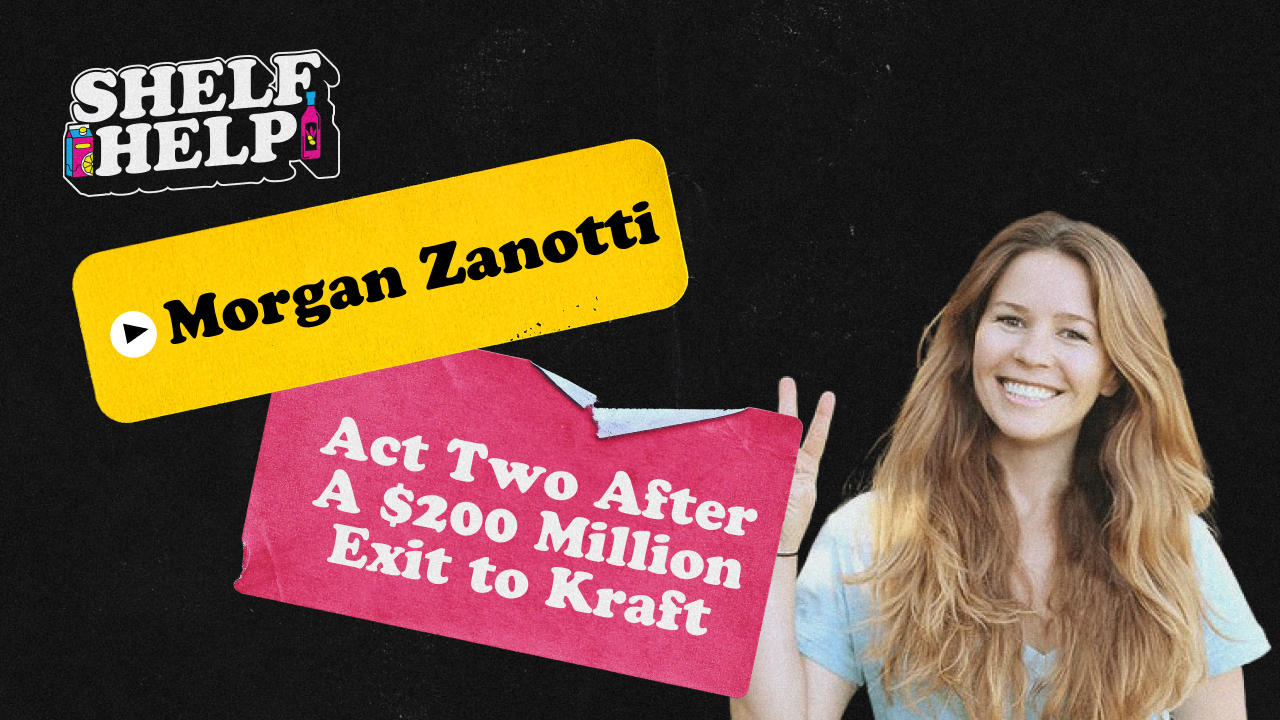



On this episode, we're joined by Morgan Zanotti, Founder and CEO of Waay - the sparkling protein water brand with 10 grams of protein, zero sugar, and 45 calories a can.
Morgan co-founded Primal Kitchen, which she helped grow from a kitchen to roughly $50 million in revenue before a $200 million exit to Kraft Heinz.
We get into the origin of Waay, starting with the clear whey protein isolate that made Morgan wonder why no one had put it in a sparkling water. Morgan walks through the rapid launch timeline, the rollout across Whole Foods, Sprouts, and a Target protein end cap, where a sparkling protein belongs on shelf, and why the brand took off on Amazon and TikTok Shop faster than she expected.
We also talk about the importance of reaching profitability ASAP in order to maintain ownership, what five years inside Kraft Heinz taught her, and what strategics and PE really look for in a brand.
---------------
Episode Highlights:
💡 The clear whey protein "aha" moment behind Waay
💪 Why the protein message finally tells women to eat more
🥤 10 grams of protein, zero sugar, 45 calories
🔁 Why a second-time founder gets back in the ring
📊 Chasing a $40 billion TAM instead of a niche
🛒 Landing a Whole Foods national yes with blank silver cans
⏱️ Three months to build a brand from scratch
🏁 Riding Target's protein end cap, and the risk
📦 Why beverage blew up on Amazon and TikTok Shop
💰 Staying profitable to keep ownership
🏢 Five years inside Kraft Heinz after the exit
🔭 The brands and trends she's watching now
---------------
Table of Contents:
00:00 – Intro
00:49 – The origin story: a millennial mom and clear whey protein
01:40 – How the message to women shifted to protein
03:06 – Why a second-time founder jumps back in
04:55 – True innovation and a $40 billion TAM
06:40 – How GLP-1 reshaped the category
08:13 – Selling Whole Foods national with silver cans and a trademark
10:43 – Three months to build a brand, find a co-packer, and nail the taste
14:09 – The protein arms race and a "support, not solution" position
14:55 – Sprouts, Target, and the end cap bet
16:31 – Where a sparkling protein sits on shelf
17:57 – Why beverage took off on Amazon and TikTok Shop
19:11 – Staying profitable to keep ownership
21:28 – Her cap table approach vs Primal Kitchen
22:30 – Five years inside Kraft Heinz and "keep being you"
24:40 – What acquirers actually look for
27:21 – Reading an exit, and why she loves Good Culture
29:56 – Brands and trends she's watching
---------------
Links:
Waay – https://drinkwaay.com/
Follow Morgan on LinkedIn – https://www.linkedin.com/in/morgan-buehler-zanotti-31989620/
Waay on LinkedIn – https://www.linkedin.com/company/drinkwaay/posts/?feedView=all
Follow me on LinkedIn – https://www.linkedin.com/in/adam-martin-steinberg/
For help with CPG production design - packaging and label design, product renders, POS assets, retail media assets, quick-turn sales and marketing assets and all the other work that bogs down creative teams - check out https://www.kitprint.co/.
Shout out to my friends over at Glimpse, the go-to partner for automating retail-related back-office operations and unlocking margin trapped in invalid fees and manual processes.
Episode Transcript
Speaker 1: 00:00
Welcome to Shelf Help. Today we're speaking with Morgan Zanati, founder and CEO of Whei Sparkling Protein Water Brand with 10 grams of protein, zero sugar. Morgan co-founded Primal Kitchen, I think back in 2014 or so. Her and the co-founders boots trapped it from zero to I think 50 million or so in three years before eventually exiting the craft for around 200 million or so. So now she's back in the arena building brand number two. A lot of great experience and super excited to dive into it. Um Morgan, just first off, for the listeners that maybe not as familiar with Whey, we'll love to start off just getting a quick lay of the land, just in terms of kind of the the origin story, the why behind the brand and core products in the lineup, and then uh we'll go from there.
Speaker: 00:49
Sure. Yeah. Thank you for having me. Um, Whey. So God, I'm just a millennial mom of three boys trying to get my hundred grams of protein a day and finding that, you know, like many other moms, we're like lucky if we're eating two meals a day. So I, you know, had all the chomps and the purse and the whole thing. And one day I was drinking a sparkling water and I had learned about Clear Whey protein isolate. And I was like, how does this ingredient exist? And I didn't know about it. I like personally and professionally have like lived and breed this industry for 20 years. How does this ingredient exist? I didn't know about it. And can't someone just take this and put it in my sparkling water and like let's just call it a day? Like, I would like to be not just, you know, buying expensive, kind of dirty sock tasting, like expensive pea wire, more or less. Like I feel like, you know, there's just more these beverages could be doing for us. So big believer in protein, especially for women. I think as women, you know, if I look even back to my mom, I'm 42. My whole life, right? I've watched the message to women and it's been very like, okay, ladies, calories are the problem. We're doing a hundred, like limit your calories. And then it was like, you know what, it's fat, no fat. And then they were like, actually, it's the carbs. You got to cut the carbs. And then they were like, you know what? We're not eating at all. We need you to just intermittent fast now. If you could just cut the food all together, that'd be great. And then protein came around, and it's like the first time in my life where the message to women has been like, hey, we want you to be eating more of something. It's clinically proven. It's probably the most clinically studied food group in the world, right? Like there's nothing that has more data behind it than protein. And hey, by the way, you don't have to like walk around restricting food all day, and you're gonna feel better and be stronger. So I'm just like really here for the protein movement for the women. I think it's just important uh from a health perspective and also just empowering from a mindset with food perspective. So here we are. We've got whey. Tastes kind of like uh poppy meat to spindrift but with 10 grams of sugar in it or 10 grams of protein. No sugar, zero sugar, 10 grams of protein. So that's whey.
Speaker 1: 02:49
Awesome, that's great. When we chatted a few weeks back, yeah, you know, you I think you mentioned to me that you'd spend a year and a half trying to talk yourself out of launching a beverage brand, and that, you know, I think you said like only someone, someone insane would launch a beverage company knowing what you know.
Speaker: 03:07
Um, I think like CPG is so interesting now. Like, I've, you know, we launched Frimo Kitchen in 2015. This is 11 years ago. It was a totally different world. There was no TikTok. We we executed an influencer playbook very early on before there was such a thing as an influencer, almost because Mark was like an OG influencer, my partner on the business. So we had all these like friends who launched paleo blogs and Instagram accounts that we just started sending free product to every quarter. And that was like, there literally wasn't a term called influencer then, right? Like we were super early on that movement and it paid off. I think that's how we built the brand. Um, and we had a great differentiated product. I think, you know, if I step back and look at how I ended up here, I've met enough second-time founders in the last eight, nine months, people who have had like huge exits, who don't need to work again, who are like back in the ring building. Like, and I've realized, like, for so for a while I was judging myself, like, what's wrong with you? Like, you must be like psycho. Why would you do this? It's knowing what it's so hard, right? So, like knowing what you know, why would you do it? And then, and then I met enough other people that are also doing hard things that have already had major success in this industry, and it's like we're just diseased humans, you know, we're just like sick in the head. And there's nothing more fun than building, like it's horrible, but it's also so fun. So, you know, it is what it is.
Speaker 1: 04:28
Like, yep, totally.
Speaker: 04:29
I'm not meant like for a boring, like, like I value like adventure and freedom. So it suits my personality well. It is definitely not for the faint of heart. I would actually recommend you don't do it to anyone listening. Like, I don't think this is a good idea for me or anybody else, but here we are. And I think it comes down to like, do you have something you're really like passionate about that you think you could, you think you have a unique position in the marketplace? So when we launched, when I started working on the product two years ago, there was like no other clear sparkling protein in the market. Um, and now there's like 50 brands that have launched in the last year, but it was true innovation. And I think true innovation is like fairly hard to come by these days. Like everything's kind of been cleaned up. We've seen, like, you know, 20 years ago, you you could just be organic and that would be enough. Like Annie, like, look at these brands like Organic Valley, Annie's, like it was enough to just be organic. And then it was like, okay, you know, now it has to be better for you. And now I don't even think it's enough to just be better for you. I think that's just like the expectation. Like, yeah, you know, you need to now do something for me. So we're in, we're just kind of seeing the industry evolve. And I think beverage is super challenging because it's super competitive. It's hard to stand out on shelf, there's a million different brands, but it's also like a massive TAM. Like the total adjustable markets, like, you know, mayonnaise might be 2 billion and sparkling water might be 40 billion, right? So you're talking about you don't need a huge percent of the consumption to flow into your business in order to have like high revenue. So I think you could have a really great idea in a $200 million category and find yourself up against a pretty hard wall when you realize like, okay, maybe only third there's only 13% of shoppers who want a better for you version of this. So I was excited about the big TAM personally, and I was excited about the innovation and doing something that like hasn't been done.
Speaker 1: 06:30
You mentioned that we're entering this GLP one era, which obviously speaking to the choir at this point, but like that I don't know, category level doesn't really like factor into the decision to actually launch this beverage in terms of the GLP one stuff, if at all.
Speaker: 06:46
I think like I think we're at the tip of the iceberg on GLP one. Like, I think we aren't, I think we talk about it so much and we're still not talking about it enough. Like, I don't think we can really see. I mean, I read an article recently that was like airlines are realizing more profit because the bodies in the seats weigh less and the fuel is now taking less fuel to fly the bodies from point A to point B. So like the downstream effects of this are just like it's like unbelievable every area of the of the world it touches, right? It's kind of crazy. So um, yeah, so I think that's interesting. But yeah, so I I don't know. I think people, I think GOP1, if it's done nothing else besides, you know, whatever, reduce everybody's appetite, it has brought this mass awareness to like what we're putting in our bodies. And the emphasis seems to be around protein and fiber, which is basically protein and vegetables, which is kind of like the basis of the paleo diet and what we should really be eating anyway. So, you know, I think there's that. But I think protein, if you're not eating like a steak and a burger and eggs and whatever, like has existed largely in just thick, powdery, milky, creamy shakes that are sold to gym bros. So I'm kind of like protein, but make it casual and fun and put it in a can. And like this doesn't need to be so serious.
Speaker 1: 08:07
Totally. From a launch standpoint, you you sold way into Whole Foods. I think it was like locally last April. I think it was, you know, you didn't even know if you want to launch the brand yet. And you know, you obviously know Whole Foods very well, know the space RL, I'm sure is that part of them trusting you. But they came back and said, Yeah, we'll take a nationwide in October. And I think at that point, you had no brand, no, no command, no package design, basically just the idea, maybe the formulation and and the trademark, I think, for just some of those other, you know, especially first-time founders that are in that similar stage. Maybe they didn't get a commitment from the retailer, but they're in that earlier stages and they have some sort of timeline they're trying to launch pretty quickly. Walk me through kind of what those few months actually look like between you know pulling together the co-man, the brand, the packaging design, all the stuff in a pretty short timeline. Three kids under seven at the same time.
unknown: 08:54
Yeah.
Speaker: 08:54
I'm on the hunt for a co-founder. So if you know anyone, send them my way because I'm like drowning over here. No, seriously, I am actually though. But I uh yeah, it was crazy. I like took a can actually that I'm drinking an RD sample. Like I'm launching two new flavors in the fall. So I'm like drinking a whole can of it to get the experience versus just like tasting. But I took these silver cans for those who can't see these like plain silver cans with no packaging on it to Whole Foods. They all the retailers review like each category at a certain like one month period. So you have, you know, a set time of year when that buyer for your category is looking at new items. So you submit like it's very formal. You like submit your PowerPoint presentation, you have a broker who requests a meeting, you send samples if they want them, and then like three or four months later, they make their decisions on what they're bringing in. And you don't roll on the shelf for six to nine to sometimes 12 months after that. It's a long process, but I had an idea and a registered trademark for the name Way, and I was like, let's just see what Whole Foods thinks. So I took it to Whole Foods. I will say I'm in like a bit of a unique situation. I have a relationship with Whole Foods. I've been selling to them for 12 years. They were a huge partner of ours at Primal Kitchens. Um, David Lafferty over there, I've known for a long time. He's like a great friend and I love him. I was, I was like, David, can you get me a meeting with the buyer? And I would love to like meet with you and show you this new thing I'm working on. So I went and met with them. No one else had presented clear protein last year to them. So I was like the only, they hadn't, we were early, right? Like a year ago with Whole Foods saying yes, like there wasn't really anything in market. That's what's crazy. Like there was nothing in market a year ago, hardly. Okay. We presented and they then they called a month later and they were like, we'll take it nationwide in October. And then I had like three months to like do the branding, find a co-man, reformulate everything. It was very stressful. I spent an entire girls' trip in Mexico, like going back and forth with graphic designers trying to get the package design figured out. So it was stressful.
Speaker 1: 10:56
For sure.
Speaker: 10:57
Yeah, it's all stressful.
Speaker 1: 10:59
Was it hard to find a co-packer that could do carbonated protein beverages, or was that not that hard?
Speaker: 11:05
It wasn't that hard because I had the right people on my team who like knew where to go. But I think if you didn't have someone who like knows beverage commands inside and out, it would be challenging. We've already moved into a new com-and since then.
Speaker 1: 11:18
So from a brand identity packaging design standpoint, what were the key variables that were top of mind for you as you were working at the brand identity and kind of the visual identity and all that kind of stuff?
Speaker: 11:29
I mean, I just knew I wanted to sell like fun protein to women, so I just was like kind of hitting that. We had like a version of the package design, and I was like, oh, it's like looking to like sports, and then I was like, I need like a gene fonda logo, and then that's how we like found the font for way, and then it kind of like brought the whole personality to life on the can.
Speaker 1: 11:48
From a formulation standpoint, no, obviously don't want to give you giving away too many trade secrets, but in terms of different kind of factors, variables you're playing around with actually get the product where it is today, where you know, you said it's a summer routine, I think you said a spindriff and a poppy.
Speaker: 12:06
I think part of the reason I didn't launch for so long was because I was like, oh, it doesn't like taste good enough, and I'm not gonna launch it if I don't like love it. So then I'd go back to the drawing board and then I would be like, oh, do I really want to do this beverage thing? And I'd be distracted with like, you know, my EIR program was summit, and then I, you know, it was just kind of like on to the next thing. I don't know.
Speaker 1: 12:24
You told me like the message for women the the last 40 years has been super restrictive. Focus on what you can cut out, and now it's finally like protein is a thing to take more of.
Speaker: 12:33
I mean, I think, like I said, I just feel like dieting has been just the messaging to women has just been so awful. And it is like, look, I'm just like a hundred and I'm I'm five feet tall, right? I'm super short. So like five pounds makes a is noticeable on me. And I feel like every one of my girlfriends, not every one of them, I live in Southern California, so there's a lot of just like naturally super skinny, beautiful women here, but like it seems a lot of my friends are like have been trying to lose five to ten pounds for like 30 years, right? So like imagine how much mental energy goes to just like trying to lose five to ten pounds. Then you get into like, you know, I have three kids, you get into like the postpartum phase. And we the way what we've been sending out, I think is just really like restrictive and awful and not healthy and not summing from a place of like true health, which is like, you know, enjoying my mental health, right? Like enjoying my life and not letting like some, you know, elusive body goal like derail me. And also like feeling good, you know, like I don't know, like, yeah. So I just think protein solves a lot of that for us. It's like it's very important like recovering from surgery, it's very important if you're pregnant, it's very important if you're aging, it's very important if you're perimenopausal or menopausal, it's very important if you're trying to like, you know, reduce hunger hormone signals the whole day that you start your day with a lot of protein and all these things. So we know these things. Um, yeah.
Speaker 1: 14:02
How do you think about the protein arms race is maybe a good way to put it where as this market gets more competitive, seems like you know, the natural progression is some brands that are gonna start just saying, hey, trying to differentiate themselves. Okay, this all the other competitors have 25 grams of protein, ours has 27. Okay, then the next one comes up, it has 28 grams of protein.
Speaker: 14:22
Yeah, I mean, I think there's been a lot of brands, like if you look at cloud popcorn or wild chips or chomps that have just like taken a more of like a eat your real food. And if you need a little like bump, we're here for you, right? Like it tastes good, it's very sessionable, it's very snackable. We're not trying to be your like protein solution. We're trying to be your like support person. You know what I mean? So I think that's kind of more of the position we're taking in the marketplace.
Speaker 1: 14:49
I think you went from local Whole Foods tests in that April to nationwide pretty quickly, then Sprouts, I think, uh in January, Target following that. Generally seemed like it's been a pretty aggressive expansion from a retail standpoint. What's been, have you been finding has been the biggest impact in terms of early July or driving those velocity numbers at some of those first key retailers?
Speaker: 15:11
I think look, it was like a known risk to go to Target this early, but we got an opportunity to be on like a protein front racetrack end cap for like, you know, it's a multi-month long through the summer end cap. So you're not gonna repeat that opportunity next year. It's not just like, oh, do you go into the Target set this year or do you go in next year? It's like Target's leaning in on clear protein. Do you want to be one of the brands that's leaning in with them now or do you want to wait? So the verdict's still out on if that was a good decision or not. But like most of the time, Whole Foods is really partnered with us on like building the brand. And they've been an amazing partner. And and they're approaching the category like different, right? They're kind of like, we picked our horse, we're betting on way. And like, you know, we're gonna help you kind of build the brand. And I think Target is more like wanting to be really early on the trend and they're leaning in too with this end cap, but they've rolled out a ton of different brands. So, you know, they're kind of gonna let us all duke it out and see who the winners are, is what I think is happening. But yeah, for me, I think it's more just about like, do you have the right like buyer relationships and retail partnerships? And is it versus just like chasing doors for the sake of chasing doors? I don't need any more distribution right now. Like, I think we're good. So there's that. But yeah.
Speaker 1: 16:30
Where does the brand sit? And is there a difference in terms of where you want it to sit versus does it sit in the sparkling water section, like you know, the functional beverage section? Is it in like the supplement section where like the protein powders are or multiple of those? And yeah, what where does it sit and where do you want it?
Speaker: 16:46
Yeah, we're in the functional beverage set in all of the stores. So Whole Foods, but the difference is the functional beverage set is different at Target than it is at Whole Foods, for instance. So like Whole Foods functional beverage has like shelf stable RTD proteins like organe and owen and slate milk, and it also has energy and it has like high O and trip. So it's kind of this mishmash. And then Sprouts has a lot of the similar maybe type of brands, more like RTD protein, et cetera. Functional beverage at Target, RTD protein that's like over 20 grams, is actually somewhere else. It's in like OTC set. So at Target, it's more like chow stable coconut water, trip and high, like the vitamin waters. It's all kind of like a random.
Speaker 1: 17:30
Okay. That's interesting. So their cutoff was like anything above 20 grams of protein goes in a different section.
Speaker: 17:36
Yeah, the retailers are trying to figure out where this goes. It's an interesting product in that it could probably live in four different places in the grocery store.
Speaker 1: 17:41
Yeah.
Speaker: 17:42
Could live next to LaCroix, could live in soda, could live in protein, and it could live in functional beverage.
Speaker 1: 17:46
So yeah. Are you thinking about D2C and Amazon and TikTok and all those e-commerce stores?
Speaker: 17:54
Well, we're on Amazon. We just launched on TikTok shop, or we are launching like a soon, but we're on we've been on Amazon since like October, November. That has actually taken off. Like, I was shocked. Like, I just didn't I didn't expect beverage to be so heavily shopped online. And I think I I'm then I heard someone say like liquid debt. I remember a few years ago, they're like number one and most profitable account was Amazon. Like, Americans don't like carrying like a case of something to their car and then to their doorsteps or into their fridge. So it's like, I think people do maybe over-index on beverage delivery if you're buying like 12 packs.
Speaker 1: 18:27
Yeah. Yeah.
Speaker: 18:28
It was interesting too.
Speaker 1: 18:29
That's a good point. Not wanting to carry it. I never thought about that. You mentioned about like jury still out was getting to Target that early, like, you know, the right call or not. Like for for other brands, especially with just all your experience in general, that are in their first, say, thousand, two thousand doors, probably some like natural channel or independence, they're evaluating when to make that jump to more conventional. Like, what signal should they be looking for that tells them they're ready?
Speaker: 18:54
Velocity. Just like it just costs so much money to go into every new retailer, so just don't go until you have like really strong velocity in the accounts you're in.
Speaker 1: 19:03
Talking about the Primal Kitchen experience for for a second, I think you guys own what 95% of the business at exit, assuming I got that right. For other founders that are trying to maintain ownership and can and control while scaling to, you know, nine figures, especially today, and maybe it's a little bit different than when you guys started, you know, 2015 in terms of it's just more expensive and whatnot to to win in the market today. But yeah, what should what should their playbook look like if they want to maintain as much ownership as possible?
Speaker: 19:33
Then if you want to maintain as much ownership as possible, you need to just get profitable from like as soon as humanly possible. Like that's the only way you're maintaining as much ownership as possible. So I feel like CPG has become like a billionaire's game. Like you're like, it just feels like you either need to go raise pre-revenue at some crazy valuation, like David Bar Goodles or Groons or whatever, and then you've got $80 million and you better figure it out because you raised $80 million. Or you need to like scrap by and get profitable as soon as possible. I didn't do the groons, David protein. I mean, it would that would have been great, but you know, I I was I didn't do that. I think that can also bite you in the ass more often than not. You raise it too high of a valuation, then you're doing down rounds and everybody just is over it and you end up folding the company. So I'm scrappy, like I'm not like, and I'm I'm learning how to manage like fundraising and having investors. And that's something like that is a mental that's something that's hard for me because I think I went in, everybody has this like maintain ownership and you don't want investors, but like some of these brands would never have exited if they didn't have like amazing strategic investors backing them, right? So I think investors are amazing. Like I have had amazing support from people who are on my cap table who are like, let me help make introductions for your next round. Let me have you talked to this person, have you thought about this? Like, so the whole experience for me has been much more pleasant than I thought it was gonna be. But I think you got to be picky about like who you take money from. But in the end of the day, like I would give up, yeah. I I'm not like super hyper focused on maintaining all equity. I'm just like, can I keep the business capitalized? And you know, do I am I working with like nice people?
Speaker 1: 21:20
Yeah. I mean, you mentioned the cap table. So are you taking a bit of a a different approach than uh Primal Kitchen and raising more capital here or trying to do to keep it to like friends and family?
Speaker: 21:29
And no, I do not have the risk tolerance of Mark, and there's no way I'm taking out a $9 million line of credit that I have a personal guarantee on. And I Mark didn't really have any business doing that either when we were at Primal, but he's been an entrepreneur his whole life. You know, I got to like reap the benefits of entrepreneurship with him, but it wasn't like a full, it wasn't like my house wasn't on the line, right? Like that's a different level of stress and anxiety that like I just certainly could not handle at 42 with three kids under the age of seven. So I've raised money um and will continue to. I'm actually raising again right now. So I raised money last summer before we launched, and I'm raising again. I'll probably, yeah, I'll raise a little bit now and then hopefully get to like a bigger number of revenue and I can bring on like an institutional partner.
Speaker 1: 22:15
Sure. What's the what is the the team look right now?
Speaker: 22:18
We have like three other people full time besides me and then and some contractors.
Speaker 1: 22:22
Circling back to the promplification stuff. So I think after the acquisition, you stayed at hot at craft for like four years, which seems pretty long compared to the average.
Speaker: 22:29
I'm still at craft. I'm still in craft.
Speaker 1: 22:31
You are still at craft. Oh wow, I didn't know that. Okay.
Speaker: 22:32
No, I mean I'm not full-time, but when I'm in an advisory role, but yeah, I did stay and run the day-to-day for five years after we sold.
Speaker 1: 22:39
Very rare. Yeah, very rare. Like well, I guess what did you learn about operating inside a company like that size, like the size of a Kraft Heinz that you're now applying at Way that you didn't know pre-craft pre-acquisition when you're building Primal Kitchen?
Speaker: 22:54
Like, what did I learn?
Speaker 1: 22:55
Being the Yeah, I guess any learnings that you've kind of gleaned from being in such a bigger, big organization.
Speaker: 22:59
Yeah, I mean, I think like you do professionalize the way you like look at the business a bit. Like in the zero to fifty million dollar pre-exit, you're like, you're like so emotionally tied to your business. It's not even like, it's like an extension of your identity. It's just such a different like ride versus you've exited and now you need to like, you know, be a professional, right? Like in this is a business and like all those things. I think I was really fortunate. The boss that I had when we were acquired, Steve Cornell, he was amazing. And I remember we had a review and he was like, What do you think you need to work on? And I was like, I think I need to like learn how to actually like anal, like put pivot tables together and like analyze the sales data. And he was like, What the fuck are you talking about? He's like, that's crazy. Like, that's what analysts do. Like, and I was like, okay, I think I could be more professional. Like, I'm a hugger, I can't really put a PowerPoint deck together. I like swear in business meetings. And he was like, he was like, no, you need to keep being exactly you. Like, so I just feel very lucky to have been surrounded by people who are like, you keep being you and not trying to make me something I'm not. And that's, you know, what I hope I could do for people who work for me, and what I think everyone should be striving for, if nothing else, is just like at least showing up authentically as yourself.
unknown: 24:14
Yeah.
Speaker: 24:14
If you've done that, you've done more than what most people are doing.
Speaker 1: 24:18
So at Craft, you in some of a MA role to a certain extent, where I think you're evaluating acquisitions for craft and the in the health and wellness space. Anything that you've learned about what some of these big strategic acquirers can often get wrong when they're acquiring acquiring these emerging brands? And is there anything you've seen some of these bigger operators can consistently miss?
Speaker: 24:43
Um, well, I think it's just like two different skill sets, right? Like, I'm not the person to like run the, you know, price elasticity test and know exactly what's gonna happen and be able to forecast and all this stuff. Like it's a bit of an art in a science. Like I feel like, you know, entrepreneurial businesses are very like art, it's more like intuitive. It's more of an art. You have a pulse on your business because it's like an extension of yourself, right? And then you get into more of a corporate, bigger environment, it just becomes more of a science. So it's like, you know, the forecast is happening earlier. The forecast is more important. It's not almost as important as what you do in revenue, just that you hit your forecast. Like they'd almost rather have you do less in revenue and hit your forecast than do more in revenue and not hit your forecast. So it's just a different, and then it's a lot of like fighting for resources, which, you know, the resources are constrained as an entrepreneur as well, but you at least can make quick decisions. I think in a big organization, it's a lot of like justifying people needs, justifying marketing needs. It's just a lot of resource management. Whereas that resource management in an entrepreneurial organization happens like just ongoing. It isn't like a big pre-planned, you know, discussion. It's just happening in real time.
Speaker 1: 25:58
For founders who are maybe lucky enough to be in a position where you guys were with Primal Kitchen where they're serious, seriously exploring an exit, have some interest from one serious party or maybe a few, just looking back now, and you've gone through that full process. What should founders kind of be keeping top of mind as they're going through this exit evaluation process?
Speaker: 26:18
Yeah, I mean, I think the days of like, oh, we're a hockey strict growth, but we're losing $20 million a year are kind of like over. So I think there is just, and it has been over for a while, right? Like, I think there's just a lot more emphasis on just unit economics and the viability of the business long term. I mean, we had 2 million of EBITDA and 50 million of revenue when we sold. So we weren't, you know, rolling in cash by any means, but we were at least like fiscally responsible. Because what's gonna happen when you go to sell your business is some team of analysts is gonna look at your business and say, like, where are the synergies? How could we make this more profitable? And where's the growth gonna come from? So you just need to be able to present a business that shows that there are either synergies or growth opportunities that warrant the purchase price, more or less. I mean, it's pretty simple at the end of the day. So when we sold to Kraft, we had never done a dollar through the register at Whole Foods or sorry, at Costco, Walmart, or Target. So we had just a ton of distribution white space available.
Speaker 1: 27:16
What have you felt like you've learned in terms of what these strategics or, you know, these bigger growth equity PE type groups are the things that are most important to them in terms of what they're looking for in an acquisition that maybe a lot of founders and operators may not actually know?
Speaker: 27:33
I mean, I think it's like they're so varied in their thesis. So, and it's all so dependent on like there's so many variables at play. I think like the truth is you just it's like it's just like marriage. Like it's like finding a person who you want each other equally at the right time in both of your lives. So like you might need a PE fund that's like we're not interested, but the truth is like they don't have any dry powder left and they're in the middle of raising their next fund. Or like, you know, or there's certain funds that have a very strict thesis going in. We write $1 million checks, we only write at valuations of $10 to $12 million. That, you know, we want, we don't want to be anybody, we have to, it has to be pre-revenue or seed. Or there's people who are like, we deploy a minimum of $150 million. We want a business that has a founder, owner, and doesn't have a lot of pee around the table, other pee, and we're gonna do a structured buyout and own 60, 70% of the business. I think there's just so many different options out there. It's all hard and it's about like finding the right people for where you're at.
Speaker 1: 28:40
When we were talking about your experience at Summit, you were talking about how you had mentioned that um you had hoped that that they would buy good culture. What was it about that good culture opportunity that especially got you excited about?
Speaker: 28:54
I mean, I think like everybody wants to buy good culture, right? Like, I don't think there's any like big magic there, but or big any big secret, right? I think looking at that business, there's like a great manufacturing cottage cheese is hard to do. There's not a lot of manufacturers in the United States, so there's a little bit of a mode around the product. I think they created like a great cultural, they kind of like created cottage cheese, to be quite honest. Like nobody was talking about cottage cheese, and they like had a bunch of stuff go viral on TikTok and kind of like turned cottage cheese into the like new cauliflower, although cauliflower peeped and died a long time ago. But so I just love the brand. I love Jesse. I think the founders over over there is amazing. And for for what the thesis was at Summit, they were big enough. There aren't a lot of like businesses who haven't transacted that are big enough and could support an EBITDA multiple, right? Like most businesses, if they are big, they don't they can't support an EBITDA multiple, or you know, so anyway, it was a good fit for a brand like for a business for a P firm that wants to buy a big company that needs 40 makes sense. Yeah.
Speaker 1: 29:55
Last question for you, Morgan. Outside of the clear protein beverage space, you obviously know CPG very well. Any particular brands in general or just categories that you're tracking?
Speaker: 30:07
Oh, there's a lot of interesting stuff out there. Companies, trends. I don't know. I mean, the seed oil movement's really funny because we like kicked it off in 2015 and I feel like it's having its moment now. So I think what's going on there is fun. I like uh that Smash company that I buy their jelly now. Like I think we kind of innovated in a super just kind of sleepy category. So that's fun.
Speaker 1: 30:31
That's a great brand. It's really good brand.
Speaker: 30:35
I like Sunny. I don't know if you know Sunny snacks, but they're like uh Yeah.
Speaker 1: 30:39
Yeah, yeah.
Speaker: 30:40
I like them. I like that person.
Speaker 1: 30:41
Yeah, my wife buys those through um what's it called? Imperfect produce misfits here and there.
Speaker: 30:46
Yeah. Yeah.
Speaker 1: 30:48
Um a lot of cool stuff. Well, yeah, Morgan, this has been awesome. Um what's the what's the best place for people to follow along with everything that you're working on? And then what's the best place these days for people to follow along with the Way brand as well?
Speaker: 31:00
Yeah, you can go by Way at Target uh Whole Foods or Sprouts. Um and uh we're at drinkway W A Y on Instagram and TikTok. And then I'm just Morgan Zanotti on social media. I don't have it on my phone, but I like and every once in a while and check it and they post for my account. But yeah.
Speaker 1: 31:15
Perfect.
Speaker: 31:16
Thanks, Adam. Awesome.
Speaker 1: 31:18
Appreciate the time. This has been awesome. I think that's the pub.
.svg)