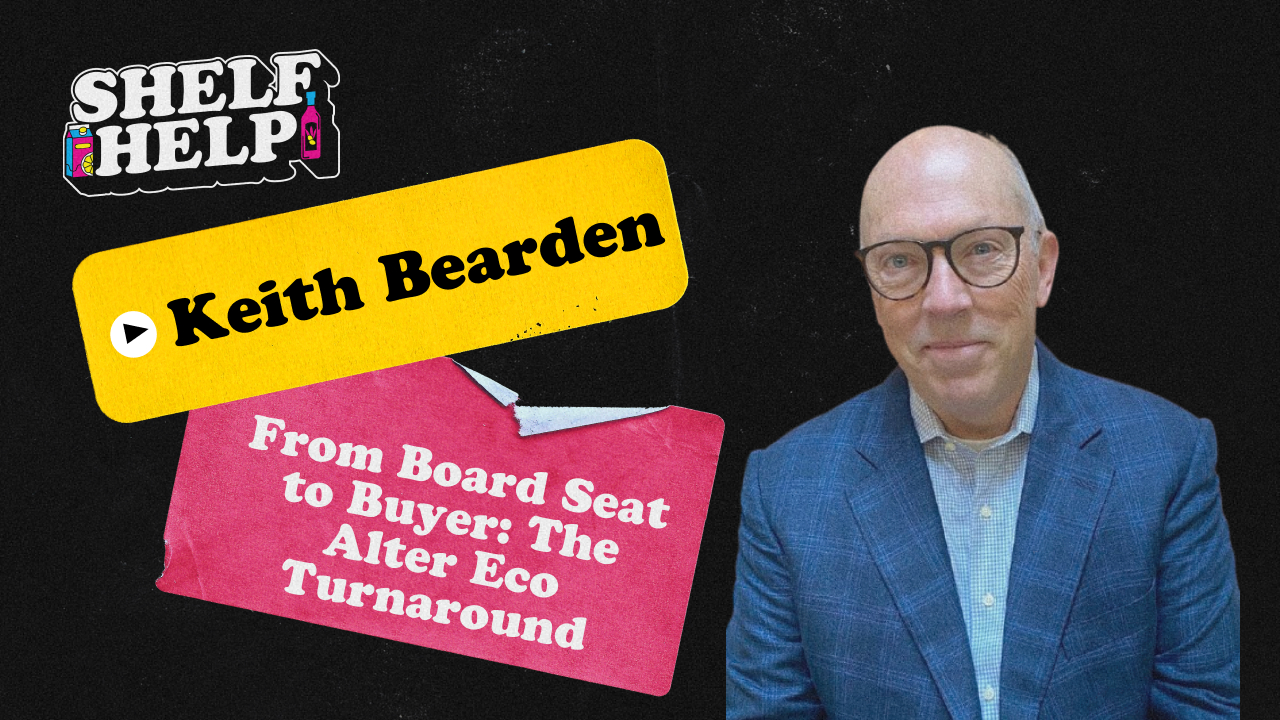



On this episode, we're joined by Keith Bearden, CEO of Alter Eco, No Cow and Good Karma - the Trek One Capital portfolio spanning organic Swiss-made chocolate, plant-based protein bars and flax milk. Keith previously led Yogi Tea's international division, served as CEO of Lifebrands US and American Botanicals, and spent 15 years at Dow Chemical.
Keith walks through how he went from Alter Eco board member to buyer, flying to Houston to pitch his path-to-profitability plan to Trek One Capital and closing on December 22, 2023. He breaks down the three levers behind a profitable first quarter of 2024: cutting headcount and outsourcing, moving the warehouse from Oakland to Columbus, Ohio (saving over $1M a year and roughly 20 days of lead time), and cutting trade spend from about 25% of sales to 19%.
We get into managing a cocoa market that more than tripled after the deal closed, a 39% tariff on Swiss imports, and Keith's bet to take a 12% price increase while competitors took 30 to 40%. We also dig into SKU rationalization without losing shelf space and why Alter Eco doesn't chase trends.
Keith also shares how a moment on a granola production floor in Canada became Oat Clusters, why his CMO pushed "delicious" over "organic" and moved "Made in Switzerland" to the front of pack, and how Alter Eco hit 1,400 Publix doors on day one by putting inventory on a plane.
---------------
Episode Highlights:
🍫 Alter Eco's origin and "taste is the price of admission"
🤝 From board seat to buyer: the Houston lunch that closed the deal
✂️ Turnaround lever one: headcount, outsourced QA and back office
🚚 Moving the warehouse from Oakland to Columbus, Ohio
💸 Cutting trade spend on truffles that saw no incremental lift
🔄 SKU rationalization and proactive swaps to protect shelf space
🌱 Pre-bought beans and loyal farmers through the cocoa spike
🧾 Eating a 39% tariff on Swiss-made chocolate in 2025
🏷️ The 12% price increase bet when competitors took 30 to 40%
✈️ From granola production floor to airport shelves: Oat Clusters
🇨🇭 Why "delicious" beat "organic" and put a Swiss logo on the front of pack
🛒 Landing 1,400 Publix doors on day one (and air-freighting inventory to do it)
🔮 GLP-1 tailwinds and why No Cow is built for that shopper
---------------
Table of Contents:
00:00 – Intro
01:04 – Alter Eco's origin and three core principles
03:36 – Running three brands as one CEO
06:30 – From board member to buyer
08:54 – Turnaround lever one: headcount and outsourcing
10:20 – Moving the warehouse to Columbus, Ohio
11:20 – Cutting trade spend that wasn't driving lift
12:36 – SKU rationalization without losing shelf space
14:16 – Hedging against cocoa's price spike
16:25 – Absorbing a 39% tariff on Swiss imports
19:56 – The 12% price increase bet
22:25 – From natural into conventional grocery
23:33 – Product roadmap and not chasing trends
26:44 – Granola and the Oat Clusters origin story
29:50 – The say-do gap and why "delicious" won
32:18 – Practical Magic 2 and brand collaborations
33:27 – Scaling doors and landing 1,400 at Publix
36:02 – No Cow, GLP-1 and what Keith's watching
---------------
Links:
Alter Eco - https://www.alterecofoods.com/
No Cow - https://www.nocow.com/
Good Karma - https://www.goodkarmafoods.com/
Follow Keith on LinkedIn - https://www.linkedin.com/in/keith-bearden-736821/
Follow me on LinkedIn - https://www.linkedin.com/in/adam-martin-steinberg/
For help with CPG production design - packaging and label design, product renders, POS assets, retail media assets, quick-turn sales and marketing assets and all the other work that bogs down creative teams - check out https://www.kitprint.co/
Shout out to my friends over at Glimpse, the go-to partner for automating retail-related back-office operations and unlocking margin trapped in invalid fees and manual processes.
Are you in the market for a new flexible packaging partner? Check out HD Packaging. Third-generation, family-owned and built for the needs of category leaders like Newman’s Own and A Dozen Cousins. Faster launches, lower costs, and no artwork fees.
Looking to dominate the cognitive health space? Upgrade your formula with Cognizin. It’s the branded, clinically backed citicoline trusted by top innovators in supplements, foods, and beverages. Differentiate your brand today at Cognizin.com.
Episode Transcript
Speaker 1: 00:00
All right. Welcome to Shelf Help. Today we're speaking with Keith Bearden, CEO of Ultra Ego Foods, the organic chocolate snack brand that's been really a leader in regenerative cacao and compostable packaging for a few decades. And Keith joined the Ultra Eco board a few years back, then eventually took this to CEO Sweden 2023, partnering with the PD group, Trek One Capital, to basically buy the company from another group. I think by his own account, that the business was on the verge of going under, but within a few months, really had things turned around, which I'm excited to dive into. Keith has a lot of experience in the CBG space. Prior to Alter Eco, earlier in his career, ran the international division at Yogi T was the CEO of Life Brands US and American Botanicals spent 15 years at Dow. So again, a lot of great experience. Keith, maybe just kind of first off, for maybe the small number of listeners in the CBG space that aren't that familiar with Alter Eco, maybe just to start, just getting a quick lay of the land just in terms of kind of the origin story and the why behind the brand and what the core product lineup looks like, and then uh we'll take it from there.
Speaker: 01:05
Yeah, sure. Well, first of all, thanks for having me. Yeah. It's a pleasure to be here. So yeah, Ultra Eco has been around for a little more than 20 years. Uh, was founded by a couple of guys, French guys, that actually did some traveling through Latin America and saw kind of the plight of some of the farmers and how they really didn't make a lot of money off of their cacao or any of their other products. And Ultra Eco had a number of other products outside of chocolate when they first started. They had quinoa and rice and coffee. Those were products that we had uh didn't have a lot of success in growing the distribution of those. And so over the years, those have kind of gotten faded out. And the primary focus of the company is chocolate. So they partnered with a bunch of farmers, and Ultra Eco, hence the name, is all about restoring ecosystems. They wanted to help the farmers not just by paying them a fair price for their products, they wanted to help them to restore the ecosystem. And so if you look at Ultra Eco as a whole, we we stand on three core principles: restoring ecosystems, improving livelihoods, fair trade products, and reducing waste. And you mentioned our compostable packaging. And all of our little truffle wrappers are actually in backyard compostable, certified backyard compostable wrappers, and we're the only company in the world that does that. Um, so that's what the company was founded on. We still live by those same three core principles. We look at everything we do to determine how we can make it better for the community, better for the supply chain, and better for the consumer. And so that's that's kind of the core mission of Altarico. But I tell my team all the time, taste is the price of admission. So it really has to taste good. And all of our chocolates are manufactured in Switzerland, and the Swiss have been making premium chocolates for 400 years. So they they know what they're doing. So I I think I'll I'll put our products up against any brand out there in terms of taste.
Speaker 1: 03:11
Definitely want to dive into all things alter eco, but before I did so, uh from what I understand, in addition to the alter eco role, I think you got like three CEO titles at the same time running at the same time right now. I think all these brands are, I think, Trek One portfolio companies. Assuming I got that all right. I'm just curious, how does that work for you on a kind of a day-to-day basis? What does the average week look like kind of splitting your time between the three different roles?
Speaker: 03:37
Yeah. Yeah. So about a little over about four months ago, Trek One acquired two more brands, No Cow, which is a protein bar, and Good Karma, which is a flaxseed plant-based milk product. And they, those brands were struggling, much like Alter Eco had been. Alter Eco before we acquired it had not been profitable. Very mission focused, but you can only have a mission if you can stay in business. And so I went in and turned it around. And so I was asked to take over these other two brands and execute basically the same playbook and turn them around. And I've done a lot of turnarounds throughout my career. That's kind of how I got involved with private equity I get brought in to help turn a company around, make it profitable, get it growing, and then they'd sell it. And so if you look at my LinkedIn, you'll see I have had a lot of jobs. I had a friend of mine tell me one time, he's like, dude, you look at your LinkedIn, it's like you can't keep a job. So but yeah, my day-to-day is, you know, I we've I've got a great team on across the whole portfolio. Interesting thing is, my entire team is all women, so they keep me in check very, very well. But we've got a great VP of sales on the no cow good karma side. And those two brands got merged together about two, a little over two years ago under one group. And uh so sales and marketing and operations team supports both of those brands. And then Alter Eco, Alter Eco is much larger. Alter Eco, the team that supports Alter Eco is pretty much dedicated to Alter Eco, with the exception of my chief marketing officer and brand manager. I've put them across all three brands as well. So my day just varies. It depends on who's got a crisis going on at the time.
Speaker 1: 05:29
Yeah, totally. Is there a long-term plan to eventually bring in, I guess, another CEO to run NoCow and good karma eventually as it continues to scale, or like feels like it's the setup you guys have got now is is great and no no reason to change it.
Speaker: 05:43
I think what we will do is we'll have more of dedicated brand managers that report into me. And so they'll have responsibility for that brand, including all the way up to the PL for the bring, but then they'll report into me. I don't think we'll have multiple CEOs. Now, Trek One is is actively looking for other acquisitions. So I told him, I said, you bring in too many more, I can't, I I'm not sure I can handle it.
Speaker 1: 06:08
You can't run 10 companies at the same time.
Speaker: 06:10
No. But you know, if you look, there there are other there are other companies out there that have, if you if you're familiar with second nature brands, for example. Sure. Yeah. Second nature brands owns brownie brittle, sanders, sahali, you know. So they've got a and they've got brand managers for each of those brands, but they have one CEO.
Speaker 1: 06:30
Yeah. That seems like a pretty common, common scenario in the CPG space in general, once you've got a portfolio of brands. Yeah. Diving into to the ultra-eco turnaround, first off, you know, understanding that the brand was in a pretty tough place. What did you and and Trek One see that maybe others didn't?
Speaker: 06:48
I think uh I had been on the board for about three years before we did the acquisition. So I kind of had under the hood, you know, visibility to everything that was going on. And so as a board member, I had been pushing for a lot of change and had kind of laid out a path to profitability, but it never got executed.
Speaker 2: 07:09
Yeah.
Speaker: 07:09
You know, and and so in 2023, the previous private equity group that owned it just said, hey, we're just we're gonna run a process and we're gonna sell it. And and they ran a process and they got a lot of really interested parties come to the table, got several LOIs, you know, submitted. Nothing really gave them the comfort that they would be able to get out of it. A lot of the LOIs wanted them to roll some equity, stay involved. Yeah, and they had reached a point where they're like, we're either in or we're out. And so they they kind of canceled the process with the broker and contacted me late July, early August, and asked me to step in as the CEO and execute some of these fundamental activities that I had been discussing in the board.
Speaker 2: 07:54
Yeah.
Speaker: 07:54
And I said, How about if I just buy the company from you? And they said, Love that. So I didn't know the guys at track one at all. Um, I reached out to a good friend of mine, an MA attorney that I had been involved with several deals. I we'd done several deals together, both on the buy side and the sell side.
Speaker 2: 08:13
Yeah.
Speaker: 08:14
And so I reached out to him and he said, I've got this client in Houston that is looking for diversified investment opportunities. They made most of their money in oil and gas, and they're looking to diversify into other things. Let me introduce you. So I literally flew to Houston, had lunch with them, presented my path to profitability plan, convinced them, and they said, okay, let's do it. So that's how we how we got it. We we closed on the deal December 22nd, 2023. And the same day that my one of my granddaughters was born.
Speaker 1: 08:52
Amazing. What a great day.
Speaker: 08:54
Yeah.
Speaker 1: 08:54
Wait, what's that sounds like the the majority of immediate changes when you stepped in and took over were a lot of operational efficiencies.
Speaker: 09:03
Yeah, it was it was a combination. It was a combination of really three, three categories, three things. One was a headcount, to be honest. And, you know, they had a they had a pretty big staff. They were California-based, very expensive, had an expensive office in San Francisco, was running Oracle Net Suite, costing them a couple hundred thousand dollars a year. I mean, just a lot of those things that didn't fit a company that size. I mean, all of our products are contract manufactured. Now we own the, you know, we own the formulations and the recipes and the and manage all of the ingredient, select the ingredient suppliers, but then everything's turnkey. And we had two full-time QA people. I'm like, we can contract that. And we contract with the lady that was the head of the QA department. She started her own consulting business and doing great. And she's got other clients now and doing doing very well. And I outsourced marketing. Trek One picked up the back office activities. So they picked up finance, IT, HR, those types of things. And uh so we were able to really downsize the company. And then second, one of the second levers that I pulled was logistics. When you're a startup company, I I understand you you build your network around where you're located. And so they had built a relationship with a 3PL in Oakland, California. But I remember I said all of our chocolates are made in Switzerland, so they were shipping them through the Panama Canal all the way up to Oakland. And now we're a much larger company, and 60% of our sales happen on the East Coast. And we're also climate neutral, so we were buying offsets for all of that. So we closed on December 22nd, 2023. On January 1st, 2024, we moved our warehouse to Columbus, Ohio.
Speaker 2: 11:05
Wow.
Speaker: 11:07
And it not only saved us over a million dollars a year, it cut our lead time in getting our product into the warehouse by about 20 days, and it and it reduced our carbon footprint by almost 30%. And then the third thing was managing trade spend. You know, as CPG, as everybody knows, trade spend is your biggest uh benefit and your biggest problem. And so we we have wonderful truffles. We have the best truffles in the world. And and I know Lent sells a lot more of theirs than we do, but ours are better. And but we sell a lot of them as singles. They're an impulse item at the cash register. You go to Sprouts or Natural Grocers or Whole Foods or you know, you you find them at the check stand. If we offered it for 79 cents versus 99 cents, it's not gonna make any difference. And we were promoting them three or four times a year, spending several hundred thousand dollars and seeing no incremental lift.
Speaker 1: 12:11
Yeah.
Speaker: 12:12
And so I really dug into the trade spin and cut it from you know twenty-five, twenty-six percent of sales down to about nineteen percent of sales. And that that made a huge difference. But you promote on things where you see a return and and a sustainable return. Right. And so those three things together, we were able to turn the company around. And actually the first quarter of 2024, we were profitable.
Speaker 1: 12:37
Wow. That's a quick turnout. That's amazing. I think there was also some skew rationalization going on. I think you guys killed, I think it was the killed off the coffee rice product. Yeah, I'm curious. Like, what was the I don't know the cut versus keep criteria?
Speaker: 12:50
A lot of it's driven around the MOQs of the manufacturer.
Speaker 1: 12:53
Okay, got it.
Speaker: 12:54
You know, because in 2023, I think we wrote off about five, six hundred thousand dollars worth of inventory, maybe it was more than that, it was around seven hundred thousand. In twenty twenty four, we wrote off less than seventy thousand. And so it, you know, we looked at velocities, we looked at you, you know, you also don't want to lose listings. And so I was very proactive about going out and meeting with the retailers and saying, hey, these SKUs aren't turning for you. You're not getting the the value of that shelf space. But these two over here are performing in these other three retailers. Let me swap these out for you. So we did that very proactively so we wouldn't lose shelf space. And and, you know, it virtually it didn't really cost us much of anything in terms of the relationship with the retailers. It had actually improved it.
Speaker 1: 13:49
Yep.
Speaker: 13:50
And we had uh we had a line of keto bar bombs, we called them too, and they were great products, don't get me wrong. But we we launched them on the tail end of the keto craze, and people were like, uh, keto, it probably doesn't taste good, didn't fit with our messaging around, you know, our our products. And so we may bring some of those flavor profiles back, but we won't call them keto.
Speaker 1: 14:16
Whole business is based around chocolate. I think cocoa was sitting between 2,500 and 3,500 a ton for almost two decades, shot up to 3,800, I think from 300 to even 12,000, almost 13,000 a ton. Yeah, in like early 2024. I think now it's still around 9,000. With the business so don't still depend on on cocoa. How do you plan around and I guess hedge against that much volatility?
Speaker: 14:43
It it's really difficult for sure, but we're fortunate enough to have direct relationships with the farmers and at least at a cooperative level, and uh even to some degree at the farm level with some of the bigger farmers.
Speaker 2: 14:56
Yeah.
Speaker: 14:57
And so we contract with them a year in advance. So it was funny. I had the first board meeting in April of 2024, and Trek One and the other, you know, a couple of other LPs that are part of Trek One, we had a board meeting, and when we acquired the company, chocolate was at $3,600 a metric ton. And that first quarterly board meeting, it was $12,800 a metric ton. And they looked at me and they're like, Did we do the right thing here? Like, well, if I'd have known this, we'd have probably all put our money in Coco Futures, but we didn't know that, you know? And so, but we had pre-purchased, we had pre-bought all of our beans for 2024. And our farmers were very loyal to us. They could have said, Oh, we can't meet the contract and sold them somewhere else for a lot more money, but they didn't do that.
Speaker 2: 15:48
Yeah.
Speaker: 15:48
And uh, and a lot of it is we we prepay for it too. So we'll contract and we'll pay 50% up front or 75% of you know, whatever they they think they need to secure that supply. And then but we grew faster than we expected in 2024, so we ran out of beans in about September or so, and that hurt. That that hurt. We had to go buy them on the spot market, and uh, but then we contracted the prices coming into 2025. Cocoa beans didn't kill us in 2025, tariffs did.
Speaker 1: 16:23
Yeah, sure. Right.
Speaker: 16:25
So, yeah. 25 was a tough year. I mean, Switzerland got hit with 39% tariff. And we already had a five percent duty, they didn't call it a tariff, on chocolate being imported into the U.S. And so we were paying forty-four percent for every bar coming in. Wow.
Speaker 1: 16:45
It's hard to absorb that level of of increase.
Speaker: 16:48
You can't for for very long. You know, fortunately, because of the spike in cacao prices, the whole entire chocolate industry took a major price increase in 24 and 25.
Speaker 1: 17:01
Right.
Speaker: 17:02
And so we were able to go up with everybody else.
Speaker 1: 17:05
Yeah.
Speaker: 17:07
The deal with the tariffs in Switzerland, I mean, we brag about the fact that our chocolate's made in Switzerland because the Swiss make some of the best chocolate in the world. But it's not that much differentiation to a chocolate that's made in Peru or Colombia or Italy or Belgium or Canada or the US that I can charge 44% more. And so we just had to eat that with the hope, with the hope that the tariffs would either come down or go away, and and ultimately they have, and well, to some degree, we're still paying 15% now. And and we're getting that money back, you know. So it's it's coming back in with six percent interest, which is kind of interesting, but and but we're getting it back, and we didn't go out and raise our prices because of tariffs. We raised our prices because of the cacao market.
Speaker 1: 18:00
Sure.
Speaker: 18:01
And so we just ate it for 2025. Yeah. And fortunately we were able to do that, you know, we had the financial support to do that. Now in 2026, you know, things are I wouldn't say back to normal because there is still volatility. The good news is that Trek One had made most of had most of their experience in oil and gas, and so they understand commodities. Okay. And so when I talk about commodities with them, they're like, oh yeah, well, everything that goes up, some eventually comes back down.
Speaker 1: 18:32
You know. Good point. Did you consider any formulation changes to mitigate it?
Speaker: 18:39
You know, and freezes? You know, a lot of the chocolate companies did.
Speaker 1: 18:43
Yeah.
Speaker: 18:44
You know, carob is a is a substitute for chocolate. When I was running American Botanicals, American Botanicals is the largest supplier of carob in the United States.
Speaker 3: 18:52
Oh, wow.
Speaker: 18:53
We bring in, we'd bring in carob and roast it to specifications and grind it and powder it and sell it to big companies like General Mills and Kellogg's and those guys. So I know the products very well, but that's not who Alter Eco is. We, you know, we're we're true to our mission of being a premium, high-quality, low sugar, you know, chocolate. And and we're a dark chocolate company. We don't even do milk chocolate. Yeah. And so, you know, it was it. I think staying true to who we are. I mean, we have such a loyal following of consumers. I mean, it when you mentioned yogi tea. When I was running yogi tea, we had such a loyal following of consumers. We changed our packaging. We didn't change our product, we changed our packaging. But people swore up and down we changed the product. You know, like it tastes different. I'm like, no, it it it doesn't. It's really the same product. But you know, you have those loyalists, and you you have to be really careful about that kind of stuff. Yeah, I actually I I kind of rolled the dice at the end of 2024. Okay. And and it didn't work out that well. But everybody else was coming out in second half of 2024, everybody in the chocolate space was coming out with anywhere between 25 and 40 percent price increases. Yeah. I mean some companies went all the way up to 40%. Wow. And because we had already pre-bought our beans through, you know, the majority of the year, and we only had to go out and do a spot buy one time, and I was expecting, and I think everybody in the industry was, was expecting the prices to come back down a little bit because all indications were that the crop, the 25, 24, 25 crop, because the crop cycle is the tail end of a year carrying over into the next year because everything's in the southern hemisphere. And so we were expecting the prices to come back down a bit. And so I felt like we could lock in 2025 without such a huge price increase. So I actually went to the retailers and said, I'm not taking a 30% price increase like everybody else. I'm gonna take 12%. Wow. But I I want more shelf space, yeah, and I'm gonna increase our velocities. And everybody played along. That part of it worked. The problem was the price didn't come back down. So 25, when we negotiated our contracts for 2025, it was still trading at like nine, 10,000 a ton. Yeah, and I didn't cover that much with 12%. And so I had to do another price increase in 2025, and that time I took about a 26% price increase to catch everything up.
Speaker 1: 21:52
Yeah.
Speaker: 21:54
But we maintained our velocities because everybody else had already taken those big, huge price increases. Sure. And I watched a lot of, you know, we get all the industry data. And some of the some of the companies that took that 30 to 40% price increase, their velocities just shrank. It fell off the edge of the table. And we were able to gain a lot of that market share.
Speaker 2: 22:16
Yeah.
Speaker: 22:17
And so, I mean, we'll finish the year this year with almost double the size of the company of when we bought it in 2023.
Speaker 1: 22:26
Amazing. That's huge. The brand was historically pretty laser focused on the natural channel, Whole Foods, Sprouts, Fresh Market. Now it seems like there's a push to Kroger, Publix, Albertsons, Harris Teeter, anything that had to change internally to be able to serve the retailers effectively as well as you were doing in the natural channel.
Speaker: 22:46
Yeah. I I think it's we didn't really change our strategy. I think what's happened is the consumer has changed. Okay. You know, the consumers are looking for a healthier product. They're looking for a more premium product, a cleaner label. Yeah. You know, those types of things being organic, fair trade, non-GMO, you know, climate neutral, all the things, all the attributes that we carry, that's what the consumers are looking for now. And especially if you look at the movement in the GLP1 environment, you know, snacking is actually going down as a whole. But what they're snacking on, they're looking for cleaner labels, lower sugar, more premium. If I'm going to snack and indulge myself, I want it to be good. Right. And so it's actually helping Alter Eco.
Speaker 1: 23:34
That's great. What does the journey or kind of process look like internally at Alter Eco that leads to the decision to say, okay, yeah, you know, with enough of these boxes that have been checked, we'll feel good about bringing this new product line or new SKU to market?
Speaker: 23:47
Yeah. So marketing and the brand manager drive the profile of what we're looking at. So they're they've got their pulse on the, you know, they've got the pulse of the market. And, you know, you you'll notice we didn't come out with a Dubai chocolate. Sure. We don't chase trends.
Speaker 2: 24:07
Yeah.
Speaker: 24:08
We try to look at where is the market going that has longevity, has sustainability.
Speaker 2: 24:14
Yeah.
Speaker: 24:15
You know, we we just we have a pretty robust roadmap in terms of not only flavor profiles, but formats.
Speaker 2: 24:24
Yeah.
Speaker: 24:25
So we're coming out this fall with a little mini square. Now Gira Delhi's had that forever. Sure. But many, mini anything now is popular. Yep. Yeah. It it I think people feel like it's not as indulgent. I'm just having just one little one. Right. You know. And so we're taking some of our best performing flavors and putting them in a mini and putting them in a variety pack so that we can hopefully it introduce the consumer into some additional flavors as well.
Speaker 2: 24:58
Yeah.
Speaker: 24:59
We have a we have a pretty robust product, product roadmap. Like I said, not just always taste profiles or or flavors, but also formats. But we also we're also embarking on some SKU rationalization. We've got some products that, you know, they're great products, they taste great, but they just don't perform. And so we're doing some market analysis around why they are not performing and you know, how do we get that swap, as I discussed earlier, if we take something out? Because you can't just continue to put new out there.
Speaker 1: 25:32
Totally. Yeah. So once you've decided, team decided, yes, approved, we're going to bring this new product line or SKU product form factor to market. What have you found has been the keys to a successful new product launch in terms of, you know, one, hitting your budget, and then two, actually launching on time?
Speaker: 25:53
We have a great RD partner with our manufacturer in Switzerland. They have a very robust RD team. They're a very large company. And so they will oftentimes even suggest things for us and say, hey, we see this trending in the market. Would you guys be interested in seeing some samples? And we go back and forth and iterate several times. Once we pull the trigger and say, yes, that's the one we want, or those are the format we want, whatever, we we lay out a project timeline. And we're we're pretty good at hitting those milestones. We've we've kind of, I mean, we've done it enough now. The biggest thing is getting getting the certifying bodies all to sign off and say, yep, okay, that that meets QAI, that meets, you know, that meets your fair trade.
Speaker 1: 26:44
That means, you know, so love to touch on the granola and the O clusters for a second. I think you launched granola 2022, now become I think 20% of sales, maybe not more at this point. Like what, I guess, why granola? What made you think a chocolate brand kind of had had permission to go there?
Speaker: 26:59
Well, that that was it was really a test as much as anything else. Because we, you know, we had been in the grain space. We had been we still had quinoa in 2022. Yeah. We phased it out over time, but we we had quinoa, we had rice, and so we're like grains, okay, something that's not just a commodity in a different bag. Right. You know, so we came up with granola, grain-based, regenerative was really big in oats. We use regenerative oats in our granola. We wanted to differentiate in some way, though, that was a healthier product. And so one of the things we looked at was a lot of granolas have a ton of sugar in them. And so we're like, okay, we're not going to use sugar. And so we sweeten with monk fruit and dates. Sure. And so much lower on the glycemic index, a much healthier product, not as sweet, but with our dark chocolate granola, we use our own chocolate. So that kind of bumps it up a little bit. And uh, but our granola's been extremely successful.
Speaker 1: 28:03
That's awesome.
Speaker: 28:04
And the oat clusters was literally just a it it was a moment in time. I was at the manufacturer when we were producing the granola one time, and we produce our granola in Canada. It's where most it's where most of the oats that we consume in the U.S. come from anyway.
Speaker 1: 28:21
I didn't know that.
Speaker: 28:22
Especially regenerative oats. A lot of them are coming out of Canada, Canada. But I was up at the production facility, and our granola comes out of the ovens on these big, huge commercial ovens, big sheets, and it was in big chunks. And then they run it through what's called a kibler to break it up in little pieces to put it in the bag, so it's granola. I'm like, I'm like, oh, those big chunks look tasty. I wonder if you can make a snack out of those. And the production manager said, if you poured your chocolate on them, man, that'd be really good. I'm like, yeah, it would. Let's do that. So that's what we did.
Speaker 1: 29:01
Yeah, it feels like some the best floors come on come up, or best ideas often come from the production floor, it feels like.
Speaker: 29:07
Yeah, absolutely. Absolutely. So that's what we did. We just left it in the big chunks and put our chocolate on the bottom of it. Yeah. And we launched it at Expo West and immediately got picked up by Paradise Lagader, the airline shops. And so it's in 150 airports now.
Speaker 1: 29:26
Wow. That's a great, that's a great place to start.
Speaker: 29:29
Yeah. Great brand awareness. Great brand awareness because millions of people are seeing it. Totally. You know, and so we're going into we ran a small production run because we didn't really know, you know, where it was going to land. They bought everything we had, so we just ran another production run a couple of weeks ago. And so we're going into some retailers coming up this fall.
Speaker 1: 29:50
Oh, that's exciting. I've heard you talk about what Nick Nielsen calls it the say do gap. And your read is that, you know, it it's closed with millennials, closing further with Gen Z, you know, with the Gen Alphas, there's there's no gap at all. Can you tell me tell me a bit more about your thought process around this?
Speaker: 30:09
Yeah, so it's it's kind of back to the clean label thing. Sure. You know, and transparency. I mean, if you go to our website, you can find our sustainability report. We publish a sustainability report every year. And we are very transparent in what we do. I mean, my marketing team says we have to show our receipts. And so we do. And we're we're very open about how much carbon we produce and what we're doing to offset it, how much plastic we put into the marketplace and what we do to offset it. You know, and uh EPR is forcing that in some states, but I that's a whole nother topic. We could talk a long time about EPR and and reporting and requirements. It needs to become a standard across the entire US for it to be effective for for small companies. But anyway, I digress. But yeah, we we look at the marketing side of it and trying to make sure that not only do we tell everybody what we're doing, but we tell them why we're doing it. We we've my chief marketing officer when when we brought her in, she interviewed me probably more than I interviewed her. And she said, Describe Alter Eco for me in one word. I'm like, wow, wait a minute. Organic. She's like, no, no, no, no, no, no, no. I said, sustainability, sustainable. She's like, Oh, that's worse. That's worse. And I said, Well, it's delicious. And she's like, Okay, that's why I buy chocolate. Tell me it's delicious. I said, Well, it's made in Switzerland. She's like, and you don't even tell me that. And I said, Yeah, we do. And she picked up a bar and she turned it around, and on the back of it it said made in Switzerland. She's like, I have to turn it around and look at the back of the bar to see that it's made in Switzerland in this fine print. So now we have a Swiss logo on the front of the package that says made in Switzerland. Little things like that just changed everything about who we are. Yeah. Doesn't change our core principles, but it puts taste forward.
Speaker 1: 32:13
Yeah. Yeah, that makes total sense. Sounds like you got a good CMO in that seed for you.
Speaker: 32:19
She's she's fantastic. She's fantastic. And she's so well connected. I mean, she, you know, we we uh we just launched a collaboration with Warner Brothers on their upcoming movie. The the trailer's already out for practical magic too. Okay. And we're a partner with them. We're all all over the social media. Actually, my CMO is going to the premiere in LA on Monday. And and so, I mean, it we're getting the recognition about from from the brand, from you know, from bigger players. I mean, I was telling my mom about some of this stuff, and she's like, wow, y'all are becoming a big little brand. So the some of the collaborations that we're doing are are really exciting coming out of the club.
Speaker 2: 33:08
Yeah, it's really cool.
Speaker: 33:09
Yeah, we've got two movie collaborations. We're doing a big collaboration with a big winery out of California. Yeah.
Speaker 1: 33:15
So which winery if you can, if you can, if you're allowed to say it yet.
Speaker: 33:19
Yeah, I think I think I can. We're doing with Monterra and Red Wine and Dark Chocolate go really well together.
Speaker 1: 33:28
I sure do. I sure do. Yeah, that's a great winery. I know that one very well. Really scaled, I had so much experience in the CBG space, really scaling up brands just from an operational standpoint. The keys to scaling from, let's just say, 100 doors to a thousand doors versus a thousand to twenty thousand doors.
Speaker: 33:47
It really is a different skill set. It it's and it happens at the broker level more so than internally. I mean, of course, internally, we have to have the operational supply chain to be able to support that. You never want to go out and I mean, we launched into Publix in February of this year, and we went into 1,400 doors day one. We didn't know we we got the call in January that we were going in 1,400 doors. We got the order the day after we got the call. We don't carry that much inventories to set around to go into 1,400 new doors.
Speaker 2: 34:31
Yeah.
Speaker: 34:33
Fortunately, we were uh timing is everything, you know. We had just run a big production in Switzerland, and it was literally two days from going on the boat to be shipped over.
Speaker 2: 34:46
Okay.
Speaker: 34:47
That would not have met the timeline. So we put it on a plane instead.
Speaker 1: 34:52
Right.
Speaker: 34:52
And got it in here, and we met the timeline and got it on the shelves on the day that they ask for it. So operationally you have to have all those things in place. Right. But you have to have a great broker network to be able, because you can't afford to hire that many people internally. Right. So you have to have a great broker network that really knows the retailers, knows what's important to the retailers because every retailer's different.
Speaker 1: 35:20
Sure, totally.
Speaker: 35:21
You know, every one of them has their unique USPs, if you will, on how they bring consumers in and what's important to them. You know, Publix is Publix is a really interesting one because they're kind of a bellwether. They're they're looked at as one of the premium retailers now. I mean, 1,400 doors, that's a lot of doors. Yeah, sure is. You know, and so you go into a public store and they're clean and they're bright and they carry well-known brands. And and so getting in there has actually propelled us to have better conversations with some of the other retailers now. They're like, oh, you're in publics? Oh, well, okay, let's talk. Sure. You know.
Speaker 1: 36:02
Well, yeah, Keith, this has been great. Last question for you outside of Altar Rico and the ones you're overseeing, any brands in particular, or just general trends overall that you've been tracking more closely or things that have just been in pique your interest at all?
Speaker: 36:16
Yeah, I mean, we obviously we look at a lot of brands, and and I mentioned you mentioned earlier on that we, you know, we have two more brands that I'm now managing. And I'm really excited about both of those brands. They're both so well positioned, especially NoCal right now is so well positioned for the GLP1 user. And GLP1 has penetrated 26% of U.S. households now.
Speaker 1: 36:41
I am, yeah.
Speaker: 36:42
And they're saying it'll go to 35% by 2030, you know. So NOCAW has 20 grams of protein, 15 grams of fiber, and one gram of sugar. And it's the perfect fit for that consumer. And so I'm really excited about those brands because I think they have, like Alter Eco, they have a differentiation in terms of what they stand for.
Speaker 1: 37:08
Yeah.
Speaker: 37:08
And, you know, you again, you have to be true to your brand. You have to be authentic. You can't, you know, some of the some of the brands that are out there, you can only play on a trend for so long.
Speaker 1: 37:18
Yeah, totally. Keith, this has been awesome. I really appreciate the time. I think this has been super valuable. What's the best place for people to fall along with you and any of your expertise? And then best place for people to follow along with the Ultra Eco and NoCal and Good Karma brands.
Speaker: 37:32
Yeah, so you can find me on LinkedIn. Perfect. I I've got a lot of followers, a lot of a lot of connections on LinkedIn. So you can find me on LinkedIn.
Speaker 2: 37:41
Perfect.
Speaker: 37:42
My marketing team will put me in front of the camera sometimes on Instagram, but I tell them I'm not, um, that's not my place. You can find AlterEco, NoCal, and Good Karma on on all the social platforms. Instagram, Facebook, TikTok, Pinterest, we're we're on all of them, YouTube. But UltraEco is ultraecofoods.com. Uh nocal is nocow.com, and goodkarma is goodkarmafoods.com.
Speaker 1: 38:09
Perfect.
Speaker: 38:10
Awesome.
Speaker 1: 38:11
That's great. Well, yeah, Kate, again, this is this has been great, super valuable. Appreciate the time.
Speaker: 38:15
I think uh absolutely thanks for having me.
.svg)