
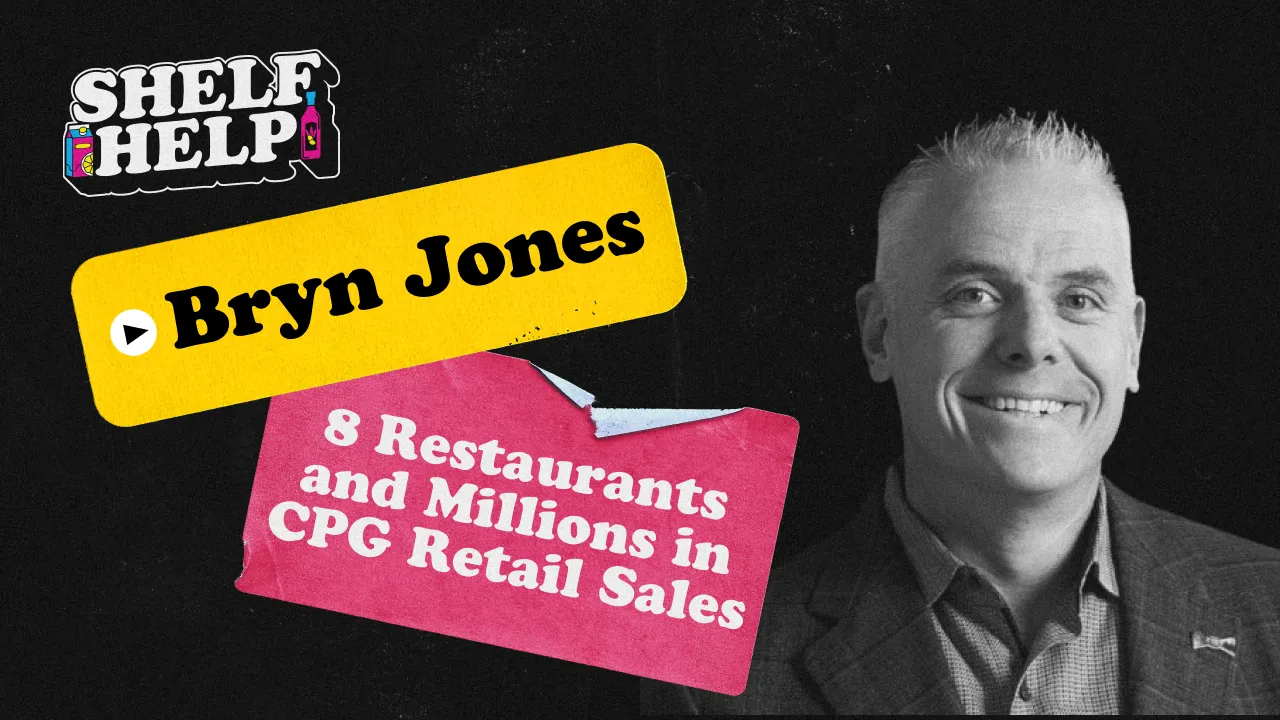



On this episode, we’re joined by Bryn Jones, the VP of Marketing & Retail at Huse Culinary, 123-year-old company with 8 restaurants in Indy and millions in CPG retail sales across the U.S.
While most guests enjoy St. Elmo for its legendary shrimp cocktail, Bryn has transformed the brand into a multi-category CPG powerhouse with sauces, spices, and spirits sold in over 3,000 stores nationwide. Bryn built the CPG division from the ground up.
Bryn shares the ulcer-inducing R&D stories behind his most successful launches, how they 10x’d their year 1 forecast, and the unique advantage of owning bars and restaurants as a CPG brand.
—---------------
Episode Highlights:
🍤 The origin of St. Elmo’s iconic cocktail sauce
📈 How a restaurant brand became a CPG growth engine
🧠 Bryn, the “intrapreneur”
🧪 Formulation stories and co-packer headaches
🥃 How they built a spirits line from in-house bar recipes
🛒 How to use restaurant data to pitch retail buyers
💰 The spirits SKU that 10x’d its year-one forecast
📦 Category strategy and GTM lessons
🧊 Managing refrigerated, shelf-stable, and alcohol supply chains
🚀 Trial is everything
📊 Bryn’s perspective on category trends and innovation
—---------------
Table of Contents:
00:00:00 – Huse origin story and portfolio
04:18:11 – Expanding from 8 restaurants into selling millions of units in CPG
05:55:28 – Bryn, the "intrapreneur"
07:46:13 – How Bryn splits his time between 8 restaurants and the CPG division
09:32:09 – Shrimp cocktail sauce, spices, then spirits + the difficulties of CPG
13:39:20 – Formulation and R&D, getting an ulcer or two
16:24:00 – Standing out in competitive categories like sauces and spices
18:42:09 – Spirits formulation process, leveraging Huse bars and their expert team
21:39:06 – The spirits SKU that 10x’d the year 1 forecast
24:13:16 – Leveraging restaurant and bar data for CPG production innovation
27:40:28 – Using restaurant/bar data to pitch retailers (or not)
30:23:18 – The foodservice and CPG flywheel
33:00:22 – How they 10x’d the year 1 forecast
34:43:15 – CPG retail go-to-market recommendations
36:55:08 – Catering to multiple buyer groups and retail stakeholders
39:57:21 – Trial is the north star
44:46:27 – Trends/brands Bryn is tracking
—---------------
Links:
Huse Culinary – https://www.huseculinary.com
Follow Bryn on LinkedIn – https://www.linkedin.com/in/1brynjones/
Follow me on LinkedIn – Ahttps://www.linkedin.com/in/adam-martin-steinberg/
For help with CPG production design - packaging and label design, product renders, POS assets, retail media assets, quick-turn sales and marketing assets and all the other work that bogs down creative teams - check out KitPrint.
Episode Transcript
Speaker: 00:00
Welcome to Shelf Help. Uh today we're speaking with Brynn Jones, who's joining us from the Indianapolis area. Ben is the VP of marketing at Hughes Culinary, which is a pretty diverse restaurant and CPG group based out of Indy. Brynn has been in the food and bed and CPG space for for quite a while, leading various spirits and restaurants ventures. So definitely excited to dive in. So just first off, for the listeners that aren't as familiar with Hughes or Bryn, maybe just kind of just give quickly the land, just in terms of maybe the origin story. I know the company's been around quite a while, brands under the Hughes umbrella on both the restaurant and the CPG side. And then maybe just a few places that people can get their hands on on the CPG products as well. And then we'll start there.
Speaker 1: 00:45
Yeah, absolutely. So yeah, Hughes Culinary uh started probably gosh, I guess close to about 40 years ago, really, in terms of our origin. So we're a hospitality company at heart. So our flagship brand and flagship restaurant is St. Omel Steakhouse. So, you know, consistently ranks amongst the top 25 independent restaurants in the US, you know, on all the lists of best steakhouses and wherever and XYZ. So we're really kind of that old school, classic, famous steakhouse, but also always looking to innovate and never rest on our lores, whether that's technology or innovation. So we're we're fortunate to have that be kind of the spearhead of a lot of the things we do. And that was our first leaning into uh the CPG side. But uh staying our restaurants, we've got uh other a few other restaurant brands. We've got Harry and Izzy's, which is uh kind of pays tribute homage to the former founder or the former owners of St. Oma was Harry Roth and Isidore Izzy Rosen. So that kind of pays homage to those guys. And Craig felt our owners, uh, really felt like, you know, doing a second St. Omo kind of cheapened the brand. And so as long as they're in charge, uh, there'll always only be one St. Omel Steakhouse. Uh, Harry and Izzy's we're up to three locations, uh, working on a fourth uh in Phoenix, Arizona. Up to this point, though, everything's located in Indianapolis. Uh, we have 1933 Lounge is another uh brand of ours. We've got multiple locations of that. We're up to uh three locations of 1933 Lounge. Uh and then the last one is we've got HC Tavern and Kitchen, which is uh kind of a new age American grill located in Fisher's. Yeah, we're uh we're growing. We're up to eight restaurants and growing. And on the CPG side, we've got essentially three different brands on that side. We've got St. Elmo Steakhouse, and so that's like seasoning, cocktail sauce, things like that. We have uh Spirit side also under St. Elmo. So that's like you know, old fashioned and Cherry Vanilla Bourbon is our our number one bestseller on that side. So that's a product that has just taken off and gone like wildfire. And uh we've got two other two other separate brands on the also on the spirit side. We've got Rare Saint, uh, which is a whiskey brand, some barrel finish stuff, a lot of it barrel strength. We don't do the distillation ourselves, we partner and work directly with uh some of the top distilling partners in the Midwest. Many of them are mainly in Indiana. One of the largest bourbon uh producers in the world is based in Indiana, which people don't know, and they're absolutely phenomenal. And so we've got a few partners on that side that we do some contract distilling on, just great partners. And then our our uh last brand that we have is uh Barkeep Vodka, which is an innovative process on a vodka. The way that vodka is distilled is fairly similar on that as what you'd see with any other top shelf vodka. Uh it's done as high-end as you can possibly do, but it's the finishing process is what makes it different. We partnered with a guy, he's actually a science-based entrepreneur in Indiana, who developed this process. Uh, it's been patented and it's really disrupting the spirits industry. But what it does is it it puts the product, uh any spirit under pressure, and that pressure releases the molecules that create bite, burn, and aftertaste. So I won't try to explain it further than that because he's got like 14 PhDs, I think, and just wicked, crazy smart dude. I was teaching molecular genetics at IU when he was 18, if that wants, if that validates how smart this guy is. But this process has kind of been a game changer uh in the spirits world, and we're the first uh to launch a vodka with it. So super excited about those. So that's that's kind of a rundown. We're a hospitality company, we're also a CPG brand at our core, and we make great products for people to enjoy, whether it's in our restaurants or in their homes.
Speaker: 04:18
Started focusing on the restaurants, obviously, had a lot of success there. I'm just curious about that journey that was kind of inside the company in terms of ultimately just coming to that decision or conclusion that it made sense to expand beyond the restaurant world and really put a big focus on the CPG space.
Speaker 1: 04:37
Yeah, I don't know that there was ever a strong like focus on we're gonna become a big CPG brand. I mean, last year we shipped over a million products, well over a million products, and we've become, you know, a fairly, a fairly fast growing company in that space. But it was never like that, I don't know that the intent was ever like that. The intent was simply so many people want our cocktail sauce and they keep asking for it. How do we make people happy? You know, we're in the hospitality business. And when people want something, we're in the business of wanting to say yes and giving them the thing that they're asking for. So really that's kind of where it started. And I'd say, I kind of say it was my side hustle to start, you know, Craig, our CEO and co-owner of St. Alma with his father, Steve Hughes. It was his idea to do it. And it the project just kind of fell on my lap. I'd done everything up to that point: business development, sales, marketing, you know, product, PL management, all of the things that kind of would be helpful to take that project and run. And I've been doing that for the last 12 years. So it what started off as a side hustle now is up to, I think we've got about eight people that pretty much are fully dedicated to that side of the business. And yeah, we continue to grow and it's expanded to now three product lines. So I don't know that it was intentional, like let's make this big splash and go throw a bunch of money at it. It's just grown naturally and organically based on giving people a product that they really wanted.
Speaker: 05:54
Yeah, that makes total sense. Whether you came on board to actually the goal was to build this out, or you came on board and then at some point decided to make this decision. But it seems like it to a certain extent, you've been kind of a an entrepreneur to a certain extent, like building this new business within a, you know, I know a company that's been around for 40, 50 plus years, as you mentioned. I'm just kind of curious, what's that, what's that experience been like?
Speaker 1: 06:15
Yeah, there are. I mean, uh an entrepreneur, I guess I I am that on the spirit side. You know, I was one of four founding partners on the spirit side. So I'm somewhat of an entrepreneur on that side in terms of these new products and and new brands that we're starting. But I really kind of put myself in the category of being an entrepreneur, which I think a lot of people fit into that role, you know, as somebody who really just takes ownership of a product and of a project. So I would never go, you know, to Craig, who's my boss and and partner on the spirit side. But when he was solely my boss, I mean, I'm I'm never going to him going, hey, here's this problem, help me fix it. You know, it was more along the lines of, here's the problem, here's the smarter people than me that helped me fix it and told me what we should do, you know, and and have the humility, uh, you know, the hunger to solve a problem and make something better, but the humility to not think you you have all the answers. And so I'd I was always coming to him with, hey, here's this new opportunity. This is how I think we should approach it. And, you know, he gave me a pretty long leash. I mean, he's, you know, he's managing a restaurant empire and a retail division with, you know, close to a thousand employees now. So he doesn't need people that bring him problems. He needs people that bring him solutions and help him solve things. So, and I think that's what an entrepreneur can do. And the benefit to me is I don't have the risk that he has. I don't have the exposure. You know, I don't need the financial capital to launch some of the things that we've been able to do. Um, and so it's a good balance of me providing value and adding value into his organization and doing it in a way that that reduces problems, but also creates opportunity.
Speaker: 07:45
Yeah. I think it's a great setup. Day restaurants is a lot, I would say, in its own right. Now you've got this big business, you're in, you know, I think two, three thousand plus doors at this point. What what have you found is the best way to effectively just really split your time between the the two divisions?
Speaker 1: 08:01
That's tough. I mean, it it I am I am ADD hardcore by trade. I think it it uh it uh on my on my health uh report to violate HIPAA laws, I believe it says chronic um is the term it says uh for my ADD. So um my ADHD, I'm always looking for the next thing or the next idea. You know, what I mean we got probably you know six figures worth of free press because somebody stole a a four-foot taxidermy fox out of one of our restaurants that was worth a thousand dollars. And instead of going to IMPD and saying, help us catch the people that stole this, I was like, just give me the video. We're gonna post this online. It goes viral, creates a ton of press and a ton of buzz. And, you know, so I'm I I think it's looking, it's trying to identify the greatest opportunity to drive attention to our company and just add value to everything that I do, whether that's my team, brands. So it's it's a little bit of a hard thing. I mean, a biggest focus of me right now is how do I make sure that the people that I work with have everything that they need. I mean, that's where I spend the most of my time, I think, and where I'm most valuable is making sure that I have the right people in the right place that I work with and everybody else that we try to support has everything that they need from us. So it's it's really, you know, we treat ourselves uh in the marketing department as I lead that group for both restaurants and CPG. I kind of almost I always tell them like we should be treating this like we're an internal ad agency. You know, we support everybody else in their roles. And if we help them win, we we're gonna win as an organization.
Speaker: 09:31
Yeah, I think that's a great approach. I think the shrimp cocktail sauce was the first you you brought out of the restaurant into retail and then spices a few years later, followed by the spirits. What was just that journey or kind of thought process around starting with sauces first, then spirits and then or then spices, then finally spirits?
Speaker 1: 09:50
Um yeah, I mean, it's it's a difficult, it was a it was a fun journey, a difficult journey, but it was one where I kind of went like, I'm I guess it's that idea of burn the boats. It was, we're famous for cocktail sauce. If this thing fails, I'm a failure. I mean, I really took it extremely personally and had a lot of I put way more pressure on myself than anybody else ever did, but it was it was hard out of the gate because it CPG and I didn't know how hard CPG was when I first got into it, but as a category, it sucks. I mean, it it's it's extremely difficult to launch anything in that category and be profitable. I mean, I think the failure rate I've been told is in the neighborhood of around 95% of new CPG products last five years. The failure rate is high. I think restaurants, uh, the 10-year success rate of restaurants is is like I'm gonna say it's it's a little bit higher than 10%. Make it that long. You know, maybe it's closer to 20%, but the failure rate and the difficulty of both of the industries that I've chosen to go into is both very hard. So it's it's challenging, but I think it's that mentality of like this is gonna be successful. We're gonna keep pushing it this until it is. Uh, and simply having that mentality, then it makes it more of a matter of time as opposed to if this is going to be successful. It's like it's gonna work, we just don't know how long it's gonna take. Again, surrounding myself and trying to find advocates and people that I'm connected to and that I know that and or that I can connect to that can help me or help us make you know wiser decisions. It it was a struggle. I uh I guess to really touch on your question, yes, we we launched with cocktail sauce right out of the gate. Really strong sales online, but had a hard time getting a foothold into restaurant or into retail. But you know, that took a year or so. And it was one of those where, you know, everybody at the time, if you're trying to do something like this with it, whether entrepreneur or in my case, entrepreneur, if you go to somebody who hasn't done it, they're probably gonna tell you you're crazy. They're going to say you shouldn't do this. Like I guarantee your business, if you went to your parents or your brother or your friend and said, hey, I'm thinking about doing this, I have this safe and successful, stable job. They likely said you're crazy, don't do it. I think that comes from one of two places. It either comes from a place of they're trying to help you and they don't want you to fail and they don't want you to see that hardship. That comes from a healthy place. Other people, I think, try to shoot things down and make it not happen because it comes from a place that they've never chased their dream or thing that they want it. They've never wrote that book or started that new thing. So you really can't talk to people who haven't done it because you're only gonna get negativity, whether it's coming from a place of positive or negative, it's still gonna be the same message. So you've got to really kind of block out the noise. And we were able to do that. And I was able to do that by, you know, somebody saying, Hey, you're a restaurant group. What do you know about CPG? You're not gonna be successful. And just being able to kind of put blinders on and go, we're gonna figure it out. We'll be fine. And you know, we did that in Indianapolis, and but it does, it never stops, right? It we we figured it out in Indy, and then it was like, well, you're an indie brand, but nobody knows you outside of Indy. Well, then we did it in the rest of the state. And then it was, well, you guys are Indiana, but let's be honest, you can't go anywhere else. And we've just kind of kept pushing those boundaries and kept being successful by figuring out, you know, kind of pattern recognition of what works well for us. Fast forward to today, you know, we're in, you know, close to close to 30 different states. So we're like we were just reading a report the other day where we're kicking ass with HEB all the way in Texas with with cocktail sauce and and and and cream horseradish. So we're getting some wins and we continue to kind of, you know, but it yeah, you I think the struggle is finding the right people that you can listen to and blocking out the negativity and and just kind of that mentality of going, this is going to be successful, we just don't know how how long it's gonna take.
Speaker: 13:39
Yeah. Talking about that formulation product development a bit, I think pretty sure I read somewhere that you went through 25 plus batches of the cocktail sauce to really get that e profile right, even and personally you personally tasted like everyone, maybe even to the point of getting an ulcer or two. I'm just curious, like without giving away any trade secrets. What were some of those like I guess key variables you were playing around with with all those different batches or key tweaks you made between that first version and that final version where you felt like uh this is this is right, this is the one.
Speaker 1: 14:09
Yeah. So our the initial group that we worked with is actually a local company um in uh in Indianapolis, and they're no longer uh around anymore, unfortunately for them. But but them kind of going out of businesses, not seeing that coming, the writing was on the wall. We needed to find somebody else uh and and do that fast. And I honestly, we got fortunate with the group that we found um that we partner with. Uh full disclosure, I'll tell you who they are. We partner with Solar Spring in Eau Claire, Wisconsin. And they are the number, they're the world's largest purveyor and processor of horseradish. So our cocktail sauce is all horseradish. So that was kind of a good natural fit there. And their team is amazing. We work directly with them. They have RD scientists, they know all the chemistry. And so on our end, essentially what we're doing is partnering with their experts and leaders to go, here is this product that they've done to our specifications, and then matching that against the restaurant. And then from there, they were going through a process of finding new innovations and really pushing themselves on kind of the limits of their expertise in terms of cocktail sauce and how to keep that heat in there. It's a weird product. If you heat cocktail sauce up, it'll lose all of its spiciness, which is just kind of weird. And so there's different things that they've learned over time of how to retain that heat. And they kind of kept getting even a little bit better and better. So it allowed us to continually improve our product uh to where it is today. It's it's really close to it's never going to be quite the experience that you get in the restaurant. And we understand that. But I mean, that's a product that's made fresh, you know, two or three times every shift. I mean, that's how fresh it is. So we know it'll never be that, but it's it's pretty damn close and it's really good. So, but yeah, it's it's just anybody that's in business knows that it's never about like you can't just stop, right? You you're always continually pushing for that next thing. And in that case, we had the North Star. We had this product that we're famous for and gets on, you know, ESPN and NFL and all these things is the thing that everybody loves to talk about already. We just had to go and just keep pushing to get it as close to where it matches the restaurant as possible. And that's where we finally ended up. But it was a struggle to get there.
Speaker: 16:20
Yeah, totally. That's that's that's great insight. On the spice side of things, how can a brand like how do your brands really kind of differentiate themselves in this category? Is it really proprietary blends? Is it, you know, more like proprietary suppliers? Do you just get, you know, better quality spices than everyone else? Or I'm what does this look like and kind of how are you how have you guys approached this in terms of trying to create a differentiated product in this category?
Speaker 1: 16:43
Yeah, I mean, to have success on the back end of answering that question, that's a tough question. I feel like this could be an hour-long answer in itself, but I'll try to keep it brief. I think differentiating yourself, something that we always look for, that I always kind of push our teams and we always look for, just based on what I see succeeding in the marketplace at the highest level, is I think there's three things that can make you successful on a product launch. Uh, in my mind at least, it's first best only. Are you the first one to roll out that product? Is it the best product on the market? Are you the only one with the ability to do something or position it in a certain way? So we were the only ones to say St. Omo, and we had a ton of brand recognition behind our name. So that helped on that one. You know, we're the only cocktail sauce out there that's as spicy as ours. And because of that, we're, we were also as defined the first to do it. So when you have all three, you've got something that that probably has a very high degree of success that it that it can be successful if you get the message out there and do things the right way. If you've got two, you have a really good chance of being successful. If you've got one, you might have a chance. Um, but if if you don't have something, you know, one of one or two out of those, those three, first best only, I probably wouldn't recommend trying it because great products die on the shelf every single day. Just because you have an amazing product doesn't mean it's gonna be successful. You've also got to get that trial in a marketplace where grocery stores have, you know, 30, 40,000, 50,000 different SKUs in this store. How are you gonna stand out when the average shopper only goes in and buys the 50, 60 things that they always buy? It's a weirdly tough category. So standing out is is how many of those three things can you get? And then how do you get somebody to hear your story and try the product? If you can figure those things out, you've got you're onto something. You know, first test only, and then hear the story, try the product. If you do those five, you're gonna win.
Speaker: 18:38
Yeah, totally. No, that's that makes a lot of sense. That makes a lot of sense. On the on the spirit side, in terms of developing these first few spirit SKUs, what's what's the formulation and kind of RD process look like? And how much, if at all, did you leverage the bars at the restaurant to kind of test things out?
Speaker 1: 18:57
Yeah, getting into spirits, and I will say getting into spirits has been a little bit more fun than the CPG on the cocktail sauce. I mean, going through the formulation and trying uh 20 different versions of cocktail sauce to get the right flavor, not nearly as fun as when I'm able to do that with vodka or whiskey. So certainly much more fun project in general, but absolutely the best thing that we have, I mean, the best marketing of any product restaurant business in general is great operations, you know, and and we have an amazing restaurant operations team. We have all stars at every level of our organization on that side. So when I'm going in, you know, complete brutal weird honesty on Barkeep Vodka, the brand that we've launched with recently with our name of that brand Barkeep Vodka. So we we never intended to launch Barkeep Vodka as its own product. We took that as a brand extension and created a brand around the vodka that we created because our bartending staff, you know, and again, these are people that have been doing it for 10 or 15 years. They have tried every single vodka ever on the market, like hundreds and thousands of different products over a decade career, and they they know what's good and they know what's not. And with this new innovation from a processing and filtering standpoint, they were like, this is the cleanest, smoothest tasting vodka. You almost don't taste vodka when you taste this vodka. And they were like, we need to create a brand around it. Everybody on the ownership side, we were literally going into this, going, we're not going to create anything other than this whiskey brand that we're already doing and St. Emo cocktails. And really the brand came out of our bartenders and service staff going, you need to need to make this available so we can buy it because it's that good. So that's kind of where that product came from. So yeah, we lean heavily on our team on the operating side. You know, I don't have to taste, I mean, I'm I enjoy whiskey, but I I'm not super passionate about the different flavors and mash bills, but I can have somebody on our team try that who's been a whiskey connoisseur and has been tasting it and sampling and trying and and you know, just evaluating different whiskeys. And he's been doing it for 35 years, close to 40 years. So we've got the team that will go, that's bullshit. Don't do that. You should absolutely do this. And so, yeah, I mean, our team on the back end is absolutely the kind of the secret sauce that makes everything that we do. You know, if we try to do something and it's not up to an all-star caliber A level, they'll call us on it and it'll get shut down, not by the ownership group or the management team. It'll get shot down by our bartenders. If they don't get behind it, they're not going to serve something that's not of the highest quality.
Speaker: 21:36
Yeah. Is it safe to assume I you can correct me if I'm wrong, but I think the cherry vanilla bourbon was like the first spirits product you guys launched. Was that, did that essentially come out of bartenders at your bars that have been already making those and taste great got really good feedback? And they were the ones that push should be like, you guys, if we're thinking about launching a spirits line, this should be the first flavor you launch. We just get amazing feedback on this one.
Speaker 1: 21:58
Yep, that's exactly it. It was so. Where where that product first came out was was about I was late 2012. And you know, this is when craft cocktails were really starting to take off, and people wanted something other than a Manhattan or whatever, you know, and and the idea of being really creative and coming up with one-off cocktails for different restaurants and brands was really taken off. And we wanted to join that. But instead of doing it with a vodka gin, which was commonplace at the time, we're like, let's do something that's bourbon that fits kind of the ambiance and the feel of a classic old school steak joint, uh, which is what St. Omo is. And so we were like, let's the idea was kind of to do something around there. And so our our lead uh bartender, the guy who's our also our bourbon expert, you know, he's been, you know, sipping and evaluating whiskey for you know over three decades. Uh Carrie was really kind of the driving force on our end for that product. And essentially what it is, is it's a it's it started off as a four-year-aged whiskey. And then it's uh infused and essentially aged, kind of finished with Luxardo cherries at the time and then natural vanilla paste. So basically, we took those flavors and aged that. So it has nice cherry sweetness and natural sweetness from the cherry. It's a really good bourbon that we start with and kind of the smoothness of a vanilla, and it really essentially makes a kind of an adult cherry coke, if you will. And it became our number one selling craft cocktail on that menu. So back to your back to the question of is that why we started was popular? Yeah, it was our number one craft cocktail on the menu. And if we're like, if we're gonna do a Spirits project, this is probably the one to try. We launched it the first year, and our distributor at the time said, hey, if you do 1500 cases in year one, it's gonna be a huge success. We were closer to 15,000 cases. Like it was astronomical, crazy success rate right out of the gate. And then that's given us kind of the ability to take that success and launch a vodka, launch a other St. Omo cocktails. You know, we've got an old fashioned that does really well, Espresso Martini, and then, you know, then take that additional success and then put that into uh, you know, barkeep vodka and rare Saint whiskey.
Speaker: 24:09
Yeah. As you as you guys think about you know, the next batch of SKUs in the Spirits line, are you starting to think about specific kind of customer data? Maybe they put a new cocktail on the menu and it's the number one selling cocktail for X months in a row or something along those lines? Or is it more just kind of anecdotal? You kind of make a you know, judgment by judgment basis based on just kind of what what the team is feeling in terms of how popular things are in the restaurants and bars?
Speaker 1: 24:34
I think I think great ideas can come from almost anywhere. They can come from bartenders that we talk with outside of our group. They can come from internally of someone on our team that knows our capabilities and what our production team is capable of. That can be where it originates or starts. But I think in general, a lot of times it's we're gonna go back to our bartending team and our staff because they're the ones that are working with customers and you know, our patrons and guests in our restaurants on a daily basis. And so they get the feedback, they know what works, they know what doesn't. But then we're also looking at, you know, how can we bring things out that are, you know, back to that idea kind of a first best only. One of the projects that we're working on right now, it's not ready yet, but it's it's it's it's essentially going to be a flavor of barkeep. Uh, it's barkeep vanilla. Where that came from is, you know, our bartenders kind of challenged us. They were like, can you come up with something better than the vanilla vodka that we're using? It goes in espresso martinis, things like that. So it's a very popular and a very well-used spirit. And and our team said, you know, can you make something better than anything that's available? So it was kind of a challenge, and we we went, let's get, let's give it a shot. We leveraged the technology that I mentioned where the this this local perpinie essentially puts a product under pressure, and then that pressure kind of removes the bitterness, bite, and burn of a product. And so we did that not only with the Madagascar vanilla, but also with the vodka, and it created this vanilla vodka. And you'll notice most vanilla vodkas that are on the market, they're they're clear, which they're clear because they're using a vodka flavoring, which is less expensive. Also doesn't taste as natural, as clean. Usually you have to put a lot more sugar in it. We've been told by a group that did the analysis on this that our our vodka has like 30 to 40 percent fewer calories than a typical vanilla vodka, but still has all the sweetness that the other ones have, because we don't need that added sugar to mask that bitterness coming from artificial vanilla, right? So essentially it's put top quality, fantastic, great ingredients in a bottle. Try to make something first best only. You know, if you're not improving on something in retail, it's extremely hard spaced. So if you're not doing something to level up what's being done before you, like don't even try because you have zero chance of success at that point. You've got to do all the things right, and you need a few wins and a bit of luck to go along with it. But that product, we're super excited about that. I mean, people are trying that. We weren't even planning on taking it to retail only for restaurants. And the demand has been so much that we're we are building a brand, not a brand, but building a label and a and retail packaging around that because the demand has been so high. So it's it's exciting. So, but yeah, I think that a long-winded answer. I think ideas can come for anywhere, but you really got to check all the right boxes if you're gonna actually take it to retail and you know, lean on people that are uh subject matter experts in this case our our bartenders and bar managers.
Speaker: 27:35
Yeah. When you're taking a new new SKU or a product to to retail and you get to that point, because you have that great benefit of having all those restaurants and all that anecdotal customer feedback, but also data, do you use is there any type of those data points from the restaurants and bars that you use when you're pitching retailers and showing, hey, look how well the sales in our restaurants and bars, or here's the feedback, or I'm just curious, yeah, are you able to leverage anything on that front when you guys are going into pitching a retailer to try to get the product on the shelf?
Speaker 1: 28:02
Uh that's a great question. Initially, I think I'm sure we did that, you know, of I mean St. Elma with our cocktail sauce, roughly two-thirds of our guests order an appetizer. The only appetizer on the menu is St. Elma Shrimp Cocktail, and it's famous because of that sauce, right? So you have arguably the most famous, you know, single appetizer in an independent restaurant in the US at least, that has this tremendous following. Sales results, two out of three guests, is is crazy for any restaurant in terms of how many people actually order an appetizer. So yes, we used it as a as a kind of a thing to kind of bolster our argument or prop it up. But ever since then, the the spaces are so different that we don't really use restaurant information for retail and vice versa. You know, we're really doing we've got a team that's solely dedicated on developing and and creating the best restaurant items we possibly can ever create. And we've got a retail team that very frequently is going, all right, this team of you know, 200 plus people in culinary who are constantly looking for innovation and creating this new product, new flavor, new dish, new item. We're we're going out of all of those things that all of these massively talented people are creating, what are the best that rise to the top? And then that's what we're taking to retail and not necessarily using the data to back it up. We just want a shot at, you know, put us on the shelf and let us prove to you that this is gonna work. We have the confidence, but a buyer's not gonna probably look at restaurant data and really take much credit or stock in that. Now, when we're winning with HEB out in Texas with a cocktail sauce, when somebody's gonna say, Hey, you guys are a local, you know, regional brand, you'll never survive outside. We can go, hey, we're four states away in the south in a market that is vastly different and very far from Indianapolis, and we're we're winning at a pretty high level. There's no reason why we can't do that on the East Coast, in the South, down in Florida, you know. So data within an industry will help influence and steer decisions within that same industry, but I don't know that there's a ton of crossover. There is for us in terms of evaluation and product creation, but that data won't necessarily help you, I think, with a specific buyer.
Speaker: 30:23
Yeah. I spoke with someone a while ago who runs sales and marketing for a pretty big produce company. I think they're like one of the biggest mushroom growers in the country. And he was talking about he's used the food service channel from their side of things as he called it kind of a brand building flywheel, meaning customers that try the product in a food service environment will then go looking looking for it at retail and vice versa. Do you guys find that to to a certain extent? Or you guys, based on what you're saying, do you see things as as pretty separate?
Speaker 1: 30:51
No, I think we're, you know, the retail side wants to support the restaurant side by, you know, innovating and giving them products on, especially on the spirit side that help them do their jobs better. And then there are the restaurants are a tremendous advocate to us on, you know, on Cherry Vanilla Bourbon, you know, that product had been served and raved about and enjoyed on our menus for 10 years before it was ever taken to retail, you know, or close to 10 years. And and so there's there's a huge benefit to getting trial. Again, you know, I guess going back to the idea of first best only, you know, Cherry Vanilla bourbon was first best only, which is great. But unless you have people that try the product and hear the story, you're never going to be truly successful. You've got to have all of those components. And that was something where we had a ton of trial on it. And the same thing's happening on Barkeep Vodka, Rare Saint. People are seeing the quality that we're putting in that bottle. We don't compromise, we do the hard things, we pay more for ingredients. You know, we're doing everything right to be successful and make sure that anything that we put in a bottle matches the expectation of what we serve in our restaurants. So they know we're not cutting corners. And that that helps give a presence and an understanding that we're putting things out there that are, you know, the best quality product we can put in a bottle. And we're more concerned about that than we ever are on price. One of the jokes that I think we say in the restaurant world a little bit on our world on our end is the experience will be remembered long after the price is forgotten. You know, and so when we're doing things on the spirit side is to make sure that we're we're kind of backing that up. Quality, doing things the right way come first. And all right, now is this a viable product? Does this fit into the marketplace from a cost standpoint? What does the packaging look like? How do we bring this to life? But it has to start with the quality. And if we do that, we know our teams and the restaurants are gonna get behind it. And simply by that happening, we know we're gonna get trial. We know we're gonna get people telling our story about this new vodka uh, you know, barkeep, about this new whiskey that we're doing and rare saying, uh, they're gonna be pushing it because they're excited and a lot of times they're a part of the origination of that idea.
Speaker: 33:01
You were forecasting 1500 cases of that in that year one. He ended up shipping 15,000. What what did you feel like was the key to such explosive growth?
Speaker 1: 33:12
I think, I think the learnings were, you know, it really, if I go back to why it was successful, is it it's just it was the most popular craft cocktail on the menu for a decade, you know, over a decade. And and that that uh that was really a huge driver of that, of that success, you know, not quite a decade. You know, 2012, I think, is when we launched it. And we launched the product in retail in 2019, right? So you've got uh about seven or eight years of trial on a product before we took it to retail. That's why it crushed because so many people already knew what it was. So when they saw it on the shelf, they just went, oh, I love that in the restaurant. You know, I'm paying 14 bucks for a drink. Yeah, I'm gonna pay 30 bucks so I can have 10 drinks at my house. It was a natural transition for that product and it really was successful. Same thing with our steak seasoning. You know, our our grills, uh a typical grill, uh grill guy and or gal in our restaurant, you know, that grill chef is they're serving literally millions of steaks in their career. And this is the seasoning that they're putting in on every steak. And so they've we've vetted the process. If there was a better, uh, if there was a better seasoning that was going to be more receptive and more positively received by our guests in the last over a hundred years, we would have changed it. And we we have changed it a few times, definitely over the years, but we've found something that people absolutely love. And it's just taking that thing that's being successful and finding a way to position that in into a different space, which is retail.
Speaker: 34:43
Yeah. What retailers did you decide to target first in that in that first year to where you had this explosive growth? Which one did you guys launch with initially?
Speaker 1: 34:51
Yeah, I guess I'd I'd answer that as, and I think this is probably, you know, CPG is a weird space right now with consumer package goods and the food industry is a weird space because you've got so many brands that are pulling back. Innovation is kind of leaning into health space and and things like that. People are consuming products differently. I think the large conglomerates that historically have dominated in that industry are, you know, their stock prices getting beaten up because there's a lot of innovation that's kind of taking, you know, their their lunch. And so when you start out, I think your your best bet is to start in a place where you can win and you need somebody to share that story. So what I would recommend is start with smaller groups, whether it's mom and pop, butcher shops, you know, if it's a seasoning or product like that. You want to be on the perimeter because if if there's you know 5,000 different seasoning bottles and you're one of those seasoning bottles, you're probably gonna get lost. So, you know, build a relationship with the meat, you know, the meat manager of that store and find a way to get a rack on the meat counter. You know, those things were were very helpful when we launched our seasoning. But same thing on cocktail sauce, start small and and make sure anybody that you partner with, you bust your ass to add value to what they're doing. And you're not just cool, we got this sale, let's move on. It is truly a partnership. You know, our salespeople, we don't typically refer to them as salespeople. I mean, they're they're partnership managers, they're managing relationships and they're coming to it with the approach of wanting to add value to anybody that that we're fortunate enough for them to lend us some space. And we're gonna bust our tail to add value and make sure that we never ask them to do anything that's not in their best interest. And simply that approach, start small, make sure any way, anywhere you go, you win. That's that's given us the credibility that, you know, when when we launched with Costco, we had enough sales that it was just throwing gasoline on the fire because we had the reputation of doing things the right way and kind of building our brand through just great partners all along the way and making sure they win first and and we put our need second.
Speaker: 36:54
Yeah. As you guys expanded the the product lines between the sauces, the the spices, the spirits, you had to, I think you had to pitch and manage multiple different buyers for each category. I know you spoke about this on another podcast, I think. So we can keep this one fairly brief, but guess it maybe at a high level. What's what's been your strategy for managing such a complex web of stakeholders?
Speaker 1: 37:16
Yeah, we have probably the the dumbest route to market possible in terms of the products that we create. We it started with cocktail sauce, and even that in itself, uh a group might be, you know, tell you we're gonna put you in the dairy department, which is a horrible idea for us, and we fight that wherever we can. We actually tell groups no now because it nobody looks for cocktail sauce in the dairy department. We could have even multiple products on that one product, right? So we're we might be the meat buyer, we might be the seafood buyer, we might be dairy, we're general grocery on seasoning, we're upwards of two, possibly three or four different buyers on our other sauces. Then we get into alcohol, which is a whole separate buyer. I mean, we're dealing with even within one grocery store, one grocery chain, we might be dealing with four or five different buyers, which is hard. You know, typically what you see in retail is somebody develops a relationship with that one specific buyer, and you develop a rapport of how to win not only with that person and with that brand, but you get recognition for people that shop in that same area and are familiar with your products. We're going, hey, we've got this amazing cocktail sauce. Try our seasoning, you know, totally different products, totally different, potentially consumers. Somebody might love our seasoning, but they don't drink alcohol or vice versa. So it's a hard way to go about it. It's been the right way for us because we've always taken the approach that we're not trying to put our name on St. Emil, you know, yogurt or something. You know, I always joke that I with Craig, I was like, man, why couldn't you have been famous for granola or yogurt? Like something that people consume every day, but it's cocktail sauce when a great customer you only buy three or four bottles in a whole year or so. But the reality is we've chosen that path deliberately and intentionally because these are the things that allow us to reduce mistakes and and also not cheapen or lessen St. Elmo's brand by trying to put our name on something that we don't have a unique story behind. It's not something that we created. It's not just a good product that we slap our name on. There's a story behind it, there's a reason we do it. And it's something that we've we've built up some integrity on making sure that we only launch products that are something that we we take pride in. It's something that we created and we're known for. And our customers want us to create these products for retail. That's been really the way that that we've been able to push these products out and be successful on virtually just about everything we've taken out, you know, and we've launched, we've been successful on because we've been diligent and and stayed true to the fact to only put out items that our customers love. And that way we can reduce the the risk and liability of new items.
Speaker: 39:58
What are some of just the tools or yeah, tools you found you and your team have found to be most impactful just in terms of really driving as much velocity as possible at retail? And these could be things like uh a really dial demo strategy, sampling, maybe it's like shelf talkers, Io ventilators, retail media stuff.
Speaker 1: 40:15
I think the the most impactful is like I said earlier, getting people to try the product for the first time. That is the hardest thing to do. You know, I mean, just think about it, focus group of one. I've never thought about it in these terms, but knowing what I know about grocery stores, and you know, if you go into a Meyer, there's 50,000 products in that store. I've probably tried a couple hundred. You know, like there's so many different items out there. So getting somebody to try something for the first time is incredibly difficult. That's the hardest thing. If you have a great product and people try it, they're probably gonna buy it. Like you win. So getting people to try about the try the product, hear the story, share that with others, that that is 100% has to be the the main priority of any sales and marketing team that that's trying to win in this space. Other things you can do to get that trial, like I think is another thing that you want to try to focus on. One of the first email blasts or the first successful marketing tools that we did for the cocktail sauce when we launched, and we've got a pretty robust and large email database uh from our uh uh you know reservations uh over the years of the restaurant. So, you know, I pushed an email blast that probably went out to 30 or 40,000 people. And I think maybe at the time we had probably had about 150, 200 cases in inventory. It was our first run, small run. So the email blast I put out it, and and it was when we first launched it online. The subject line of the email blast said warning from St. Omo Steakhouse. I knew this, like the word clickbait hadn't even been invented at this time, but it was totally clickbait. You know, like somebody's like, what did I get? Did I ate a bad steak? You know, like I knew the open rate was going to be astronomically high, and it was. We had like 2,000 orders within the first like 24 hours. We actually had to shut off orders because we're like, we're we're a month maybe longer out on production and being able to fulfill these orders based on how many were coming in. So we created a problem that we had to fix ourselves and be honest with customers and go, hey, we we didn't think this was gonna be this successful, but we'll let you know as soon as it's back in stock and your order is gonna ship as absolutely fast as possible. But that's a long way to answer the question, which is how do you get people to try the product for the first time? You've got to get their attention. That could be done with shelf talkers, that could be done with violators, shelf violators. You could do it through digital marketing and and kind of wow factor marketing. You know, liquid death is is kicking ass in this space. I mean, they're selling $4 bottles of, you know, or $4 cans of water. I don't know what the margin is on a can of water, but it's gotta be really good when you're selling it for $4. So they can invest that into unbelievably creative, talented people that that push out this badass marketing and it's fun, you know. And I've I've I've listened to them kind of speak on the topic a little bit. And it's like if your marketing and advertising isn't something that somebody's willing to share with somebody else, like it needs to be good enough that somebody would would consider watching it if they had to pay for a subscription to watch it. That's the approach that they take. So, which is crazy. Uh uh we're not to that level. I don't know, I don't think we'll ever be at that level. Um, but that's what you've got to do. You've got to do whatever you can to get people's attention. Thankfully for us, we we launched with a cocktail sauce that people love sharing with other people. So if I can get one person to buy that bottle for the first time, they're probably taking it to a holiday party, cookout, whatever. So it's a natural try vehicle to go back to challenge number one, which is get people to try the product, hear the story. We've got that kind of built into our products. Because of the way the majority of them are consumed. So that that's been a huge benefit to us. It hurts from the standpoint that nobody's consuming our products. They buy a bottle and they consume it, you know, in a day. Certainly, we hope they're not doing that on the spirit side. You know, somebody buys a bottle of St. Emo seasoning, that might last somebody six months, and that's okay. You know, but it's a more shareable product that way, which helps us get faster customers. So even though we don't have the turns of like a yogurt brand or, you know, some snack brand, it's okay because we have a lot more customers that kind of know who we are. Um, and and our breadth is going to be better than our depth within, you know, customers' purchasing decisions.
Speaker: 44:44
Yeah. Last question for you, Brynn. Any brands or just say general trends across CPG in general that kind of caught your eye or ones you gotten particularly excited about lately at all?
Speaker 1: 44:55
Um, I don't know. I I I love seeing other brands win, you know. Like I said, I think what Liquid Death is doing, I think is cool. Um cycling cans is, I don't know, it's it's kind of a cool thing. I think their their positioning is, you know, everybody told them they were idiots, and here they are dominating at a at a super high level and and maybe changing the planet a little bit in the process. So I think products that any any new product, very often, not any new product, but very often new products that win are products that somebody had a problem themselves or they identified a problem, sought out to fix it and make a difference and changed that. Everybody said they were crazy, they figured out how to do it, and then they were exponentially and hugely successful. So whether that's healthy products, I mean, I'm, you know, I'm I'm here selling, you know, whiskey and and and vodka and red meat with a lot of my products, seafood's healthy for you. But, you know, I see a big trend into healthy foods. I mean, one of the best ways that people, or one of the ways we hear people talk about our seasoning very often is they're putting it on vegetables and things that, you know, I'm they're trying to eat a little bit healthier and it's it's a lower sodium product. So I think you've seen that with Dano's really pushing low sodium has been successful for them. I think it products that go lean into what newer customers want, because if if your customers are you're going after all customers that are 60, by the time you dominate that category and it takes you 10 years to do that, you're starting to lose customers, unfortunately, right? So if you can go figure out what that next wave of customers want and develop products that they're going to enjoy and you can be profitable and successful with them, you might have a customer for 30 or 40 or 60 years. So that is, I think, what what I would be trying to position for are things that you know, newer customers are looking for, you know, on the vodka side. That's one of the things that we're excited about is we believe and we've got the scientific data from from our scientist friend to back it up that this is the cleanest vodka that's ever been made. And he's got, you know, he can share the graphs to prove that. So it is as far as vodka goes, it's it's a little bit cleaner than than maybe the vodka you're drinking now. So I think products that are maybe a little bit innovative, healthy, things like that, though those are that's what I think you want to uh try to look for. So that that's what I'm seeing. But I think it's companies that are that are having fun serving in need that somebody else has identified or they've identified and and having fun doing it. That that's typically who's gonna win. I totally agree with that.
Speaker: 47:30
I think that makes a lot of sense. Yeah, but this has been great, super insightful. What's the best place for people to follow along with you? And then I know there's a bunch of different brands on the Hughes umbrella. What's I don't know, what's the best way to follow along with the ones you maybe want to call out, let's say.
Speaker 1: 47:45
Yeah, I the only just about the only social media I consume and interact and engage with is on LinkedIn. So that's where you're gonna find me. Um, so just search for me on there. And if anybody has a question or wants to dive deeper, uh, I'm a nerd for all of this stuff. I love talking about it. So happy to engage there. Our brands, just you know, search Barkeep Vodka, search Rare Saint, find it there. We're we're fairly active on all our social media channels. But uh, but yeah, just the easiest thing is is search, and it'll wherever you want to consume that media, you can find a little bit about us and that story. And the the majority of our products you can buy online. Barkeep Vodka and Rare Saint whiskey, we we don't have that online. Just the complexities of shipping alcohol is extremely weird and difficult. So we expect to at some point, but all of our other products, uh including cherry vanilla bourbon and and all of our retail products you can buy and find from St. Emlys Uh.com. So perfect. Awesome, Brandon. Listen, great. Appreciate the time. I think that's the thanks. It's fun. I love talking about this stuff. It's easy to to sound like you've done some things smart when you only say the smart things you've done over a a 17 year career and you avoid the the 10 times the amount of the mistakes that I've done over that period. So totally. Yeah, I appreciate uh I appreciate the conversation. Yeah, likewise. Awesome. Thanks, Brian.
.svg)


