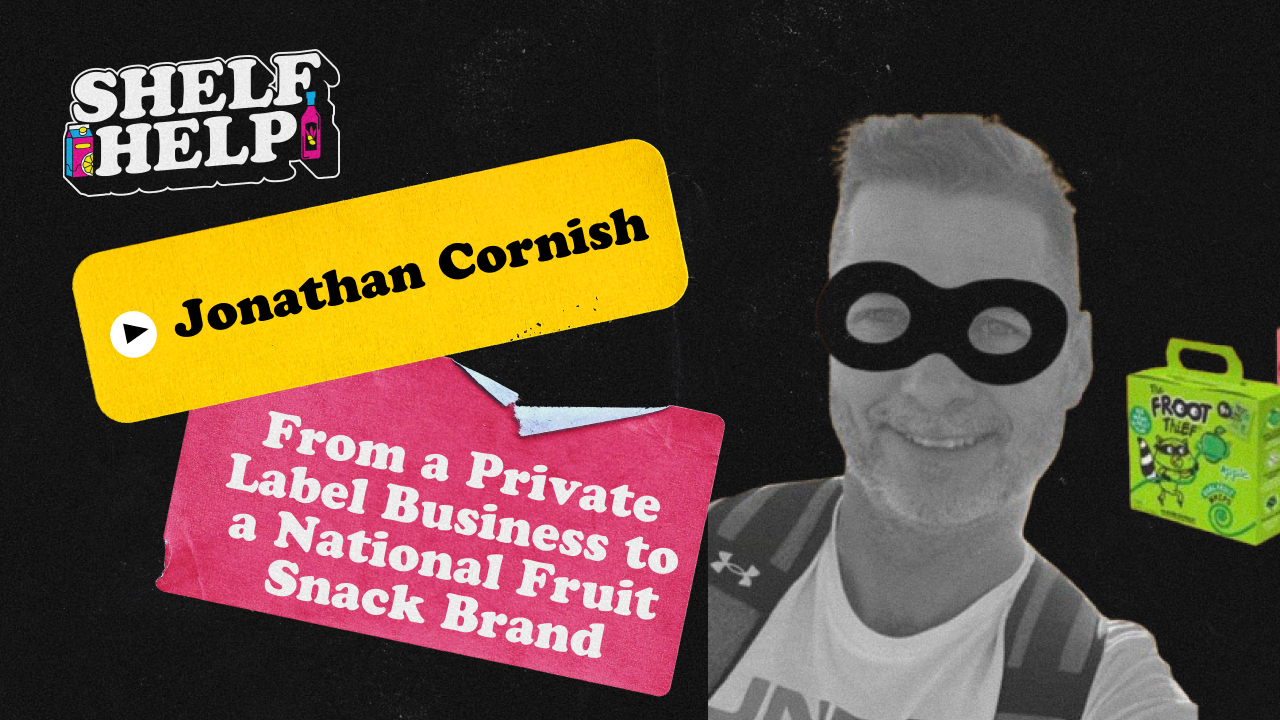
From a Private Label Business to a National Fruit Snack Brand | Jonathan Cornish, Froot Thief



On this episode, we're joined by Jonathan Cornish, Co-Founder and Head Bandit of The Froot Thief - the better-for-you fruit snack brand making real fruit whips with no added sugar that kids eat like candy.
Jonathan spent 25 years building a private label business that supplies some of the biggest retailers in the world before launching his own brand.
We dig into the Costco pitch that kicked it all off: a Zoom call in the middle of the pandemic with a buyer who had been looking for exactly this product for a long time. Jonathan breaks down what came next: scaling through natural first, then club, then conventional, planning raw fruit supply for a factory in South Africa, and the rule that kept the brand out of trouble - nothing gets produced without confirmed orders. He also walks through how 25 years of private label sourcing let them skip the usual learning curve on logistics, food safety, and on-time delivery.
We get into formulation (engineering a gummy, candy-like texture from what is essentially a fruit smoothie), pricing at a premium when sugar makes up most of the competition, and why in-store demos get the majority of the marketing budget. Jonathan is candid about distributors and deductions, including why the brand now has someone dedicated to managing them, plus the work of simplifying Amazon down to fewer SKUs.
---------------
Episode Highlights:
🛒 Pitching Costco over Zoom mid-pandemic and getting an immediate yes
📈 Scaling nationally (natural first, then club, then conventional)
🚢 Planning raw fruit supply for a factory in South Africa
✅ Only producing against confirmed orders
🏭 How 25 years of private label sourcing gave the brand a head start
🧪 Turning a fruit smoothie into a gummy, candy-like whip
🎭 Building a mischievous, Robin Hood-style brand world
🏷️ Pricing at a premium when sugar is the competition's main ingredient
👅 Why in-store demos get most of the marketing budget
🚚 Distributors, deductions, and a dedicated hire to manage them
📦 Simplifying Amazon to fewer, focused SKUs
💸 Self-funding today and when outside capital comes in
👀 Brands he's watching (Midday Squares, Blue Stripes)
---------------
Table of Contents:
00:00 – Intro
00:51 – Why Froot Thief exists
02:02 – The Costco pitch that started it all
04:03 – Scaling nationally and channel sequencing
05:57 – Production capacity and raw fruit supply
07:44 – Funding production and producing against orders
08:37 – Leveraging 25 years of private label
11:16 – Why he finally built his own brand
11:58 – Formulation and R&D with a trusted factory
13:55 – Engineering a candy-like texture
14:24 – Innovation pipeline and earning parent trust
16:00 – Building the bandit brand world
17:22 – Pricing a premium fruit snack
19:42 – Why demos get the marketing budget
20:19 – Distributors and the deductions problem
22:54 – Amazon and simplifying the SKU lineup
26:05 – Brands he's watching
28:07 – Self-funding and the next phase
---------------
Links:
The Froot Thief – https://frootthief.com/
The Froot Thief on LinkedIn – https://www.linkedin.com/company/the-froot-thief
Follow Jonathan on LinkedIn – https://www.linkedin.com/in/jonathan-cornish-a3b2ab/
Follow me on LinkedIn – https://www.linkedin.com/in/adam-martin-steinberg/
For help with CPG production design - packaging and label design, product renders, POS assets, retail media assets, quick-turn sales and marketing assets and all the other work that bogs down creative teams - check out https://www.kitprint.co/
Looking to dominate the cognitive health space? Upgrade your formula with Cognizin. It’s the branded, clinically backed citicoline trusted by top innovators in supplements, foods, and beverages. Differentiate your brand today at Cognizin.com.
Episode Transcript
Speaker: 00:00
Welcome to Shelf Help. Today we're speaking with Jonathan Cornish, co-founder, head bandit of the Fruit Thief, the real fruit whips brand that shows up in the fruit snack set looking like a coil of fruit spaghetti. Really great product. I buy it pretty frequently. Jonathan and his brother left South Africa for Canada about 25 years ago, built a private label sourcing business. Still based at Cape Town today, supplying some of the some of the biggest and best retailers around the world. So a lot of great experience in manufacturing sourcing space. Jonathan, first off, just for the listeners, maybe just aren't that familiar, just to just to set the stage. Love to just get a quick lay of the land, just in terms of Fruit Thief, in terms of the origin story, kind of why behind the brand, and then what the core product lineup looks like today, and then uh we'll take it from there. Cool. Thanks, Adam.
Speaker 1: 00:45
Thanks for having me on your show today.
Speaker: 00:47
Yeah.
Speaker 1: 00:47
Took us a while to get you, but uh, thank you for your patience.
Speaker: 00:50
Yeah, for sure.
Speaker 1: 00:52
I am the head bandit, as you say, of a brand that is entered the fruit snack category with a vengeance called Fruit Thief. We wanted to create a a product that was that was different and that would that would disrupt potentially the category. You know, when you speak to people, everyone knows fruit by the foot. They they there's some interactivity with some of the sort of nostalgic old school brands that are on the shelf today. But unfortunately, they are just riddled with just nasty things. And you know, for us as a brand, we wanted to come into the market to to bring something that was that was healthy for the kids, that that contained no added sugar, that that kids could could really just enjoy, and moms and dads could be like we are putting something into our kids' lunch boxes that that really delivered on health. And so that's what we've done. So we launched with Fruit Thief. As you said, it's a it's a spaghetti type of fruit snack. It's very fun and interactive. We uh are in a number of retailers across the US and uh and and we're growing every single week, week on week, we're growing like crazy. Um just uh there's just a frenzy with people wanting to get into Fruit Thief.
Speaker: 02:03
That's awesome. One of the things that uh I was reading about the first retailer you pitched was was Costco in the middle of the pandemic. Pitch him over Zoom. I I think it was something along the lines of the buyer just said, you know, essentially I've been looking for this product for years, I'll take every single unit you can produce, which probably set the stage for how much growth you're seeing today. What did what did it seem like Fruit Thief was really solving for that buyer that got him or her so excited?
Speaker 1: 02:26
That's a great question. I think for I think for us, you know, we we always as parents always trying to find fun ways to get fruits into the the the pores of our kids. And and for us, if you know, if you look at our ingredient deck, we've essentially got a smoothie really that we put through a specific production process that comes out on the other end as a as a as a speed up piece of spaghetti. Each pack that we have, one ounce bag, is essentially the uh the same as a cup of fruit. So I think for the buyer, she was back then she was looking for ways to get fruit, you know, I guess a unique fruit offering onto the shelf. And I think together we we sort of were aligned in in our vision of getting more fruit into the hands of kids. 60% of kids in America don't get their daily dose of fruits and vegetables, and it's a huge problem in America. And so we we felt like we were sort of ticking a box there by by offering her something that that was fun and playful and and that would resonate with kids. And that for us was was why we sort of, I guess we were totally aligned on that first uh on that first meeting. She had said that she had been looking for a long time, and I think it was just I think in business, Adam, to be honest, sometimes it's just pure luck. You know, I think it was just the right moment, the right time, the right day. Um, you know, if we'd pitched it a week late and someone else had come ahead of us, it would have been a different story, you know. But you know, I think we'll take a little bit of luck and and and the fact that we've got an amazing product here. You know, our product is our product really is from a from a taste perspective, from a from a quality perspective, it just really just resonates with kids. And and you know, for us, we you we want to sort of leverage that as we continue to grow the brand.
Speaker: 04:04
We've scaled pretty much like a national footprint almost almost overnight. I imagine that was partially due to some of those pre-existing relationships you had all those years with the private label stuff. Maybe it just resonated that much. But either either way, it sounds like you you really scaled up to a national footprint pretty quickly. What were some of the biggest growing pains operations standpoint and then funding all those costs?
Speaker 1: 04:24
You know, as an as an entrepreneur, you you always have these high hopes for products when they launch, and then when they when they launch, you then suddenly have to sort of figure out how to rob from Peter to pay Paul to keep uh your production lines going and your and your packaging going, and and not to disappoint any of the buyers too, because you know you work so hard to to to make well not to say promises, but you make you work so hard to to deliver on what you say to the buyers, and then all of a sudden you're sitting in a situation where scale just kind of just gets away from you. So we've been very we've been good, we've been we've been diligent, we have been very sort of slow and steady. I know it looks like we are growing, well, we are growing like crazy, but it looks, you know, uh we've been more controlled, let's put it that way, than than what we could have been. Um, you know, I'm a sales guy at heart and and and then you know for me I'm wanting to go and show everybody under the sun. Because it actually, to be honest with you, it's a very easy sell, you know, because just people just really just resonate with it very quickly and it and it's different, and it's a cheeky, it's a cheeky, it's a cheeky brand, and it just it resonates with buyers very quickly. So we've had to be very controlled in in our approach to the market. So we started with the special or the the national, uh, the natural channel, and and we really sort of got our seat our teeth sunk into that uh space. We uh we still stuck with with not stuck, we still sort of worked with uh with Costco to grow the national buy and just keep the the momentum growing with Costco. And then we've branched out into other clubs as we've continued to scale, and now we're sort of focusing more on conventional and and we're sort of you know growing that way. From a production perspective, you know, our facility has been able to scale with our growth. So we've been able to make sure that we we never sort of get ahead of our growth from a production perspective. And so I've got some very good planners on my team that make sure that we've always got inventory, we've always got packaging, we've always got product on the water. And one of the things that's been really good for us is you know, we we've been up front with our with our retailers and our customers to let them know that you know the the raw materials apples, mangoes, grapes, strawberries, you know, I don't have I don't have an apple machine that I just turn on and off, you know. So so you know, I I need to be able to, from a raw material perspective, I need to be able to procure enough raw material to make sure that it that it keeps consistent with my growth and it keeps consistent with with how we're producing down in South Africa. So it's been a it's been it's been a learning curve for us. I'm not gonna lie. It's we we have sort of got some you know burned one or two times, but it it's it's come with with great knowledge and great experience after that. And and I think you know, today we're in a very good position from a from a operations perspective. It it did take off much faster than we expected. You know, I think I wasn't expecting when I met with Costco that day for them to I just wanted to show her. Right. I wasn't expecting her to say, I'll you know, let's get cracking. So, you know, for me, you know, it it's and a lot of brands out there they they they'll start at a at a market and then they'll you know they'll go to a deli and then from there they'll go to a couple other delis and they'll grow sort of slow and organically, whereas we just jumped into the deepest ocean we could find. And and it's been good for us and our brand. And I think we've been I think we've been successful at it. I don't it's I don't think it's for everybody. I don't think that you know from a uh we were lucky in that our existing business was able to help us finance the the cost up front. And I think that's where a lot of business owners get burned is that they we we don't we we don't produce and then hope it'll sell. And I think that's where a lot of guys sometimes go wrong. You know, they're so confident in their product and they're so confident in in that it's gonna sell that they invest all of their money into the first production run and then and then sit with with a ton of stock that then are under pressure to sell. And so I think what where we were were we were slightly different is that we didn't start producing anything until we had confirmed orders. And and and that just gives you a bit of a hitch, eh, Adam? That just helps you just sort of like know that you've got a sale coming in and that you've got a guaranteed you know, off take on on what you're producing.
Speaker: 08:38
You built this private label business over 25 years and then eventually decided we're gonna think you're gonna jump into building your own brand here. Tell me a bit about the thought process journey that ultimately led you to say, I want to make a pivot here, build my own brand, and then what has all your private label experience, resources, backend support supply chain that you've all that experience and and infrastructure you build, how has that really helped? It's helped us immensely.
Speaker 1: 08:58
In fact, it's helped us leapfrog ahead of most brands that start out. We, if you really sort of look at our business from a 40-foot perspective, 40,000-foot perspective, I guess, we we need to deliver product from a factory and into a retailer in another country. And so there's a number of factors that you have to consider. You know, we're not just picking up a truckload from down the road and dropping it off at a distribution center. We we have oceans, we have we have lead times, we have production schedules, we have all of that. So I think our private label business really helped us sort of hone in on a set of skills that that that a a true brand would need in order to become successful, you know. So so we had um, you know, my existing business, which which is a very strong private label business that that works with some of the best retailers in the world. We have been able to lead with innovation. We've been able to say to them, these are the products that we have, or this is something that we can deliver. And no matter where that factory is, I can deliver it to the distribution center confidently every single time. And I think, you know, from a retailer's perspective, they cannot afford to have an empty shelf because that is very valuable real estate. And they need to have a supplier that can constantly deliver on time and make sure that they don't have those gaps. And so I think over 25 years, our private able business has got really good at at managing that process end-to-end, along with the the the the technical side of it or the food safety aspect of it, where you know the factories are vetted, the raw materials are vetted, the the food safety and and and the the sort of the the the controls of of the product and where it's produced are managed to very, very tight controls. And so that that business has allowed us to to have all of those fundamental sort of steps in place. And so when we came to market with Fruit Thief, we were just confident that it was just it was just like another product. It you know, it was like another, it was just like dealing with Marks and Spencer. It was just, you know, that's our brand, there's our product, we pick it up, we we warehouse it, we deliver it, we put it through this the the technical um hurdles that any retailer would put our product through. And so, you know, that that's kind of one of the reasons why I think we've been so successful at I in terms of why I wanted to start a brand, I think, I think for 20 years I was traveling around the world finding the most amazing product for retailers and eventually just got so frustrated because I was I was finding the most amazing stuff and I felt like I was just giving it away to to retailers to almost like butcher into their own way of of and I like I said to you before we started speaking, their own sort of guidelines.
Speaker: 11:42
Yeah.
Speaker 1: 11:42
And it was just in the days of lockdown where I just I just thought to myself, uh if if there was gonna be a time now to create a brand, now's the night time to create a brand. And uh let's let's leverage what we have uh with our existing business and let's see what happens. So that's kind of a little bit of a background to how we got going.
Speaker: 11:59
From a formulation RD standpoint, another big benefit, it sounds like you took the concept to a manufacturer you already worked with and knew well, trusted through your private label business without giving away too many trade secrets. You mentioned a little bit at the beginning, you kind of create the smoothie that ultimately turns into a spaghetti. But what were some of those key variables, different factors you're playing around with, let's just say from the first wisp or two to the final version where you said, okay, I feel great about this, I'm ready to take this to market. What did that process kind of look like? And what were the key different levers you're playing around with to get there?
Speaker 1: 12:29
I think, you know, when when you when you're doing product development, you have sort of an end goal in mind before you even go to the factory. And so I think it's the way that you communicate to to the factory. I think it's you know, going into that factory with a clear set of guidelines and a clear brief and a clear sort of like vision of what you want. And and once you can do that, it's really just sort of, you know, you have to be quite disciplined in the fact that you know you you need to almost accept. Oh don't accept, but you you need to, you know, once you're happy with what you have got, you can always you can always improve it, you can always refine it. But you know, there's only so much that a that a that a machine can do or a factory can do, you know. So for us, we knew exactly what we wanted. We wanted to disrupt the category, we knew that we wanted something that was healthy, we knew that we wanted something that would would be fun and interactive for kids, and we had a couple of iterations of what we thought going in. And then we've been very lucky with our facility in that the RD guys were quite creative themselves. And so we we sat together for for a long time to just go through different scenarios and different options, and and eventually we were like, We've got we've got it. This is what this is what's gonna be different, you know. And so, you know, for us, we we we and I think it was also the years of experience of of doing private label and and telling these factories what the retailers want, that I think it was just like second nature for us. What's been key to getting the texture right? So so for us, uh we we did a little bit of research. Our our texture on on the fruit beef is very gummy and and the a kid's sort of palette, you know, if you look at Haribo or any of those types of gummy type of candies, um, we wanted something that was similar to that, so that kids sort of had this perception that they were eating candy, but in fact they're actually eating a fruit snack. Right. And so we were very deliberate around what we wanted in that regard.
Speaker: 14:24
Yeah, makes sense. From a product roadmap standpoint, you got a pretty big innovation pipeline of of other products that are in the hoppers. I don't know what does that process look like for you to get something that that feels promising enough, meets the bar to be able to say, give this a yes and say, Yeah, we're gonna bring this to market.
Speaker 1: 14:38
So so at the moment we um continue to build lots of trust with moms and dads. You know, the the the product definitely is uh is a healthier, well healthy for you fruit snack. And so we've developed trust, I think, as we go into other div other products and and and and other categories, that that the trust that the parents will connect the dots when they see the product on shelf, that they know that that the product will will lead with quality and taste first, that it'll be healthier for children. We want to, you know, we want parents to be able to to confidently know that if they give their child something from the fruit thief home, house, you know, of of products, that that there's a real stamp of of quality and and and and and and health behind that. Um you know, as I said to you earlier, 60% of kids don't get their daily dose of fruit and vegetables. And if we can help in any way by giving them that that nutrition, vitamin D, vitamin C, you know, all of the different things that that are quite deficient in in kids at the moment, then then that's what we're gonna do. And we're always gonna come out into market with fun product, product that is, you know, customers are gonna walk down the aisle and they're gonna be like, Sheesh, that's smart, or gee, that's really clever, or why didn't I think of that? You know, so there's some fun stuff coming, and uh I will definitely uh have another podcast with you and tell you about the next wave of innovation that's coming too.
Speaker: 16:00
Fruit Thief is built around the built around a bandit, you're kind of the head bandit customers or young bandits building this whole world around this theme. I think the address on your site is behind the big swamp. What was her vision in terms of building this, building this brand identity, positioning voice, uh packaging design? What was your vision, how you want to present this this brand to market?
Speaker 1: 16:18
So so so the credit to that will go to my partner, Haley. She was the original founder of the Bear Yo-Yo. Um and she's just she's just got this wild, crazy imagination when it comes to building brands, and and she's always said that you know, you always want to support the underdog. And and for us, you know, the uh our brand, the fruit thief, is a is a mischievous little critter that that you know is gonna steal you know away from the big multinationals and and almost like a Robin Hood of type of sorts. And so she's been very good at at helping us drive a little bit of cheekiness into the category, you know, whether it's through our social media or um whether it's on pack or whether it's you know at uh at trade shows, uh there's always a a sense of of of little cheakiness. Uh and so you know, Haley, Haley's been very good at at helping us uh position ourselves in that way. I definitely resonates. And and and as we continue to grow and scale with new products and and new ideas, it's gonna get even it's gonna get even cooler. So so wait, we haven't we haven't uh we've scratched the surface and and there's a lot to come.
Speaker: 17:23
You started at Costco, now in Target Sprouts, Walmarts. What did your strategy process look like for nailing down your your go-to-market price? And has your pricing strategy structure evolved over time since you've come to market at all?
Speaker 1: 17:36
That's a that's a great question. Um You know, we we are governed by a lot of factors when we when we bring the product into South Africa. First of all, first and foremost, you know, we we want to make it affordable for parents. Um, you know, uh unfortunately the way that it's the way that the market is positioned is is healthier for you products cost more money. Sugar is sugar is cheap. And and so it's been it's been quite an education initially to to speak to the buyers because they would always look at the product and say, but why are you more expensive than Welch's, for example? Sure. And unfortunately, the the fact is it just boils down to the formulation. You know, we we have we have real fruit ingredients, it's governed by market. Sugar is, you know, I uh if you look at the competition, sugar is the majority of the product. And so we'll never compete from that perspective. So we will always trade at a premium above some of the big national brands. And we we are very sensitive to to parents and and their wallets at at the moment. Um, you know, inflation in the US is is creeping up and um you know people are tightening their belts a little bit. So so we we are we we've priced our products where we believe is fair. Um and we will continue to to drive down costs through efficiencies and and and scale. And as we grow in the market, we will definitely be holding the price. But I mean, if you look at all the other brands, we're all in and around the same price. You know, there's no we are a premium brand. I'm not gonna say to you that we're cheap and nasty, we're definitely a premium brand. Our ingredients and raw materials are are the best because that is what we wanted for for us, for our kids. You know, I I want to make sure that my kids eat the best and get the best. And so, you know, we we haven't shied away from that. And so I think from that perspective, we are we're on shelf for for a for a good price. And you know, we it's it's an education to to speak to parents and it's an education to speak to buyers and and really just say we we're not uh a Welch's or a Mott's or a foot by the foot. We're just not. And you know, once we sort of get that over the line, then I think then I think we you know our product sells itself after that.
Speaker: 19:43
From a velocity standpoint, what's whatever you feel like is is having the biggest impact in terms of really driving trial repeat purchase?
Speaker 1: 19:50
Demo, install demo for sure. We we apply the majority of our marketing budget to to install demo. It's it's it's Adam, it's it's the only way. You know, we can spend a lot of money putting nice fancy social media campaigns together and stuff like that, but people want to taste the product, you know. Once they taste the product, it's it's almost instinctive, like, oh yeah, that's amazing, I'll take that.
Speaker: 20:12
Yeah.
Speaker 1: 20:13
And so for us, demo is definitely the the only way that that we're spending our marketing budget.
Speaker: 20:19
What is your distributor broker ecosystem, partner ecosystem look like?
Speaker 1: 20:24
We we work with all the big distributors and the big national distributors out there. They are not the easiest to work with. You know, we we've built up through our private label business the ability to deliver directly. I don't need to work with the distributor. Nice. But uh a lot of retailers that we work with kind of force us to work with distributors. I think I think it's an unnecessary layer that doesn't really need to be there. Um I think a lot of retailers rely on a distributor to to do the heavy lifting on on stuff. But you know, unfortunately, or fortunately, I guess in in the US market, you know, the distributors are what sort of keep the the CPG sort of circles going. But I'm not gonna lie to you, it's it's not easy. You know, we get massive deductions, we get massive amounts of of of things that that are out of our control that we can't even, you know. I think I think a lot of these distributors have become too powerful and too big, and and and I think they have done a lot of damage to some really cool brands, you know, because of just their their hard, rigid rules in terms of how they operate. Uh we we have we have struggled from a distribution perspective on that, but we have direct uh relationships with a with a lot of our accounts and and my my business is is very good at at delivering on time because that's what I've done for retailers around the world. So we've been very lucky, but I can imagine for some other guys out there it's a it's a struggle. You know, you you you you send out an invoice for a hundred grand and you get back 27,000, and then you get 50 pages of deductions that you didn't authorize, you didn't know about, you didn't understand, you don't even understand. It's like reading Chinese. And so we've actually employed someone now dedicated to just managing the deductions of our invoices with these distributors. Yeah. And that's just and and again, I guess that that boils back down into your costing model, you know, that we spoke about earlier. You know, you you need to factor these things in. I need to factor the fact that, you know, I'm getting back what I'm getting back from these distributors. And there's no real accountability. There's no real sort of anyone holding them to task, I feel like. Uh I've seen I've seen on LinkedIn a couple of guys sort of really sort of trying to go for them. But I I I just think it's I think there needs to be a bigger sort of stance against some of the bigger guys.
Speaker: 22:47
On the topic of deductions, you know, it's it's uh pretty painful. There's definitely some some tools out there uh that seem to be helping. Glimpse is one of those guys pretty well. How's the Amazon journey been playing out for you guys thus far?
Speaker 1: 22:57
It's um so we have a dedicated person that's been helping us on Amazon. It's uh I think it's it's definitely a bigger beast than than than we thought it would be. I think it's also a lot more complicated than a lot of people give it credit for. You know, I think people think, oh, I just put your stuff on Amazon and it's gonna sell. It's you know, there's a there's you know, there's a special way to handle Amazon. And I think if you can handle it correctly, either it can burn you to the ground or it can be really good for you. We've we've we've been okay. It's it as I said, it's been a learning curve for us. We have someone specializing, specialized now that sort of focuses on our online because it's not just Amazon. There's you know, a lot of our retailer partners have an online channel too, and it's it's managing the inventory, it's managing the stock, it's it's making sure that you sort of uh you know can can always just be top of mind, top of the search. And so, you know, for us, I think we can we we we've got a long way to go on Amazon. We've just updated our website and we've just updated our sort of Amazon platform to make it a little bit more simpler to shop. I think at first it was a little bit more, I think it was very complicated and it just wasn't simple. I think at the end of the day, for us, simple is better. I'd rather have less on there than than masses amounts of of SKUs because those will need to be managed. So we we definitely have less on there more. We've got a little bit more bundles, but there's actually a bigger piece of work that that I started last week around cleaning up even what we have on on Amazon already. Um I think I think Amazon needs to be more focused in terms of of a couple of SKUs, and you just get good at selling a couple of skews, almost like what Aldi does or Trader Joe's, you know, you have less more, you know.
Speaker: 24:35
Yeah.
Speaker 1: 24:36
So so that's kind of been our our approach.
Speaker: 24:39
That makes sense. From a team building culture standpoint, obviously been building the company for 25 years and you've been building teams for a while. How do you think about building and maintaining culture as you grow? It's you know, it can be easier when it's a small group of people, but once you get as the team grows, it's harder to maintain uh that culture across organizations. What does that look like for you in terms of how you approach that?
Speaker 1: 24:56
We we have an amazing team of people working for us, both on the private label side and on the pro and on the branded side. Uh we I'm I'm based down in Cape Town. Quite a lot of our team members are down in South Africa also with me. And so we we we see each other. I think there's a lot of energy in the office. I think there's a lot of buzz when everyone's together. I think in the pandemic everyone ran off to Zoom and and it became quite impersonal. And and I know that I personally struggle through that. I'm a I'm a I'm a people's person, Adam. I like to sit in a room, I like to sit at a boardroom, I like to sit in the office and and the energy. So we we have that definitely down in in our South African side, where our office is based. We have quite a few team members that are scattered across the US and and a lot of them do work from home. We do a lot of trade shows together, we do a lot of tabletop events, we do a lot of sort of marketing sort of initiatives, and and and we really do have a lot of fun at those to keep sort of the the passion and the fun going. But we speak to each other every day, we engage every day, we we uh we definitely do have a lot of fun as as a brand, which uh we're very happy about.
Speaker: 26:05
That's great, that's awesome. Jonathan, last question for you any product trends that are maybe under the radar that you're seeing that you're particularly excited about, or just other brands in the market that you really respect and look up to?
Speaker 1: 26:15
Yeah, there's there's a couple of brands that that I'm kind of watching at the moment. I love the the there's a there's a Canadian brand called Midday Squares. Yeah. I've been following them quite a bit. I I think their product is really cool. It it's you know it sits on the shelf. Shelf, sits in the fridge on a shelf. But uh it sits in the fridge. But I I love the for me, I I I love healthy, uh sort of fresh type of product. For me, there there's just something about theirs that I really enjoy. There's there's another fruit snack brand called Blue Stripe. I like those guys. They they've come out with some some cool gummies and and some uh a drink too, which I think is really good. Um there's I just I think you know when you go to a lot of the trade shows that we go to, you start to see the same people and the same vendors. And uh, you know, I I think if you took all those founders and you put them in a room together, they're really a cool bunch of guys that are just on a on a drive to to really make change. You know, there there's I think for for the long well while we were probably all growing up, you know, we were just forced to eat stuff that just really wasn't good for you. And I think there was no real innovation in that time either. I think there's there's a group of people out there that that you know like the new uh noodles and you know the the brands that are that are really sort of trying to change the way that people eat. Yeah. And and I think and I think that's just a beautiful thing. I think people are eating healthier, I think they're more I I think they I think consumers are more aware of what they're putting in their mouth, I think they're more in aware of ingredients, I think they're more health focused. I think the new generation of children that are coming through now are gonna be much luckier than than than we were, I guess. Totally. Not to not to say that we were unlucky, but I think we just, you know, we are there there's a new wave of eating that's coming through that is fun and it's exciting and it's healthy and it's good for you and and it's driven by really cool founders.
Speaker: 28:07
Agreed. Pretty sure you've been all been self-funded up to this point. Is there any plans from a fundraising standpoint in the future? Are you gonna continue to own your own destiny, continue to grow this and self-fund it for the foreseeable future?
Speaker 1: 28:18
We are we are self-funded. Um we continue to self-fund. We we have a very smart bunch of uh financial people within our business that are helping us self-fund.
Speaker: 28:28
That's right.
Speaker 1: 28:28
I I think there's gonna come a point though, Adam, where we're gonna have to sort of relinquish, I guess, some to get us to the next phase of of growth, um, which I think is a natural evolution for a lot of brands. Uh we we're not um I'm not Microsoft, you know, with an unlimited uh balance sheet. So we we definitely are going to get to that stage um where we're gonna have to take on some sort of investment. Um but for now we're self-funding and and we're very disciplined in how we're funding it. So I think from that perspective, you know, we in time we're definitely gonna have to to to move a little bit.
Speaker: 29:01
Well, yeah, Jonathan, this has been uh this has been great. Um super interesting, super helpful, I think, for other people listening. What's the what's the best place for people to follow along with you and all your expertise? And then our best place for people to follow along with the fruit thief brand.
Speaker 1: 29:13
So so um thanks for your time, Adam. That's been great. We're on we're on uh Instagram, uh the Fruit Thief on Instagram. You can get us there. Um we I'm on LinkedIn. If anyone wants to find me on LinkedIn, I'm available on LinkedIn or Jonathan at fruitthief.com is my email address direct. If you want to reach out direct, uh I'm more than open to to chatting further. Thank you for you. I really enjoyed chatting with you. Yeah, likewise. All right, maybe that's a part.