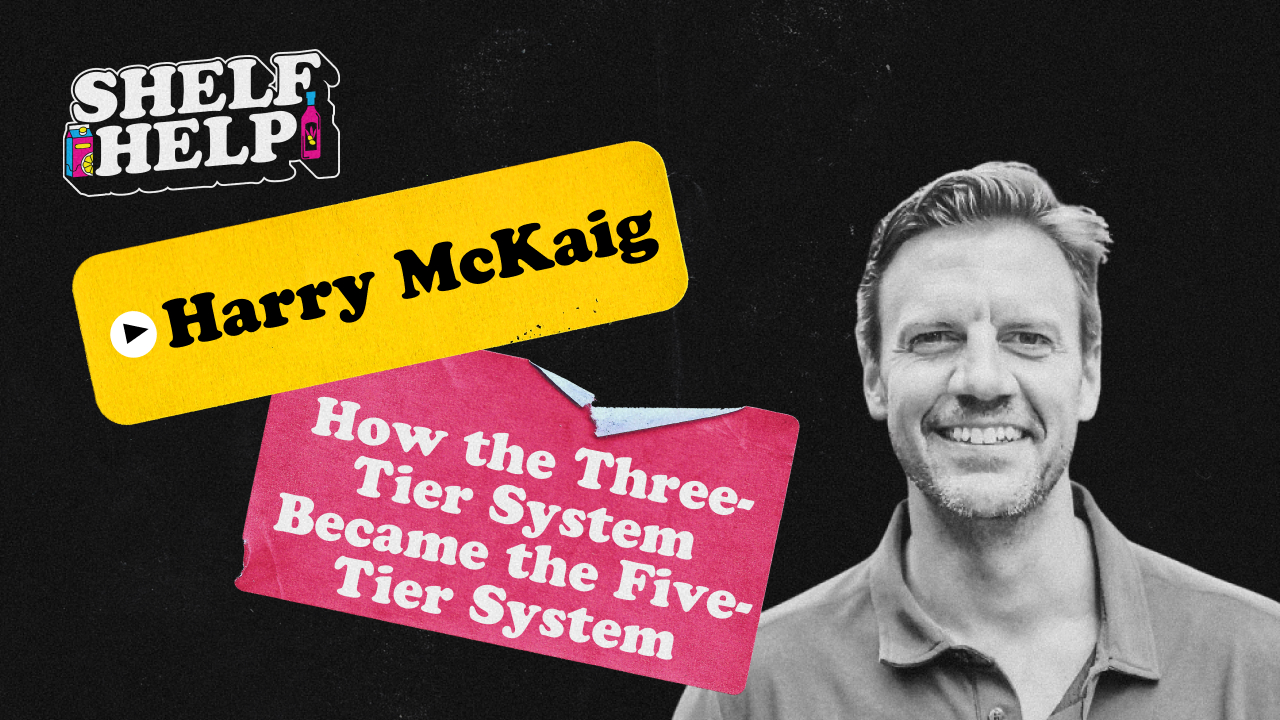
How the Three-Tier System Became the Five-Tier System | Harry McKaig, Double Cross Vodka



On this episode, we're joined by Harry McKaig, CEO of Double Cross Vodka - the premium vodka brand distilled in the Tatras Mountains of Slovakia by an 11th-generation distilling family, and one of the few vodkas to ever score 95 points from Wine Enthusiast.
Harry brings over 20 years of beverage industry experience spanning Anheuser-Busch, Diageo, Southern Glazer's, Pernod Ricard, and The Wine Group, where he oversaw a $250M+ business.
We get into the full arc of vodka premiumization from Smirnoff in the '50s through Absolut's legendary print campaigns, Grey Goose's dominance, and what the next wave looks like for premium spirits.
Harry breaks down how the three-tier distribution system has consolidated into what he calls a "five-tier" reality - with brokers on one end and delivery platforms like GoPuff and DoorDash on the other - and what that means for emerging brands trying to navigate route to market.
Harry walks through his return to Double Cross after the brand was nearly wiped out during the pandemic, and the disciplined three-phase rebuild strategy he's running now across New York, New Jersey, and Florida.
We also cover his thesis on Gen Z and the "intention-behavior gap," his take on non-alc, and why he thinks better-for-you fatigue may be on the horizon.
---------------
Episode Highlights:
🍸 The history of vodka premiumization (Smirnoff to Grey Goose to now)
🏔️ Double Cross origin story (68 distilleries, 11th-generation Slovak family)
🏆 Scoring 95 points from Wine Enthusiast in the vodka category
🛒 How the three-tier system evolved into five tiers
🤝 What brand owners don't learn without time on the distributor side
📞 Cold-calling e-commerce customers to understand the consumer base
🎯 Going deep not wide (250 doors vs. 900 in New Jersey)
🍹 "Build brands on, sell them off" and the post-pandemic on-premise reality
📊 The intention-behavior gap and Gen Z's delayed consumption habits
🧪 Why non-alc competes with soda, not spirits
🔮 Protein fatigue and the runway for better-for-you trends
---------------
Table of Contents:
00:00 – Intro
00:52 – Origin story and the premiumization of vodka
02:55 – How the founders found their distillery in Slovakia
04:12 – Current distribution strategy: going deep, not wide
04:54 – The state of BevAlc and why headlines are misleading
07:24 – The three-tier system and distributor consolidation
09:55 – How the three-tier became five tiers (brokers, e-comm, delivery)
11:38 – How to choose the right distributor
13:56 – Lessons from the distributor side that brand owners miss
16:22 – Harry's return to Double Cross and the rebuild plan
19:24 – Choosing focus markets and reverse-engineering consumer data
21:13 – Velocity tactics: on-premise, geofencing, paid social
23:56 – Gen Z, the intention-behavior gap, and the health paradox
27:28 – Double Cross brand positioning and consumer messaging
29:34 – The non-alc space and why it doesn't threaten spirits
31:37 – Trends: protein everywhere and better-for-you fatigue
---------------
Links:
Double Cross Vodka – https://www.doublecrossvodka.com/
Follow Harry on LinkedIn – https://www.linkedin.com/in/harrymckaig/
Follow me on LinkedIn – https://www.linkedin.com/in/adam-martin-steinberg/
For help with CPG production design - packaging and label design, product renders, POS assets, retail media assets, quick-turn sales and marketing assets and all the other work that bogs down creative teams - check out https://www.kitprint.co/
Episode Transcript
Speaker: 00:00
Welcome to Shelf Help. Today we're speaking with Harry McKegg, CEO of Double Cross Vodka. Harry's been uh definitely a beverage industry veteran over 20 years of experience. I think just spanning about every corner of the alcohol CPG world from Anheuser Busch, Diaggio, Southern Glazers, Pernod Ricard, as well as I think running the wine group or oversop 250 million plus run rate. So definitely a lot of great experience in the space. So excited to get into it. Um, maybe just kind of like first off, for listeners that maybe aren't that familiar with Double Cross, I'd love to just kind of start off with just kind of quick lay of the land, just in terms of kind of the origin story, why behind the brand, kind of core product, what makes it different. And then if you want to throw out a few places that people can get their hands on, and maybe new places, new doors, you just got in, and then uh we'll go from there.
Speaker 1: 00:52
Just having the time I've spent um, you know, working on brig brands like absolute and and just seeing the way the industry has evolved over the past several decades, because it's really been over decades. If you look at the largest category, which still remains vodka, and you go back all the way to the to the 50s and 60s, and you look at a brand like Smyrnoff, which was the first real spirits campaign in the US, you know, they were talking about it, it leaves you breathless. And it was this clean, light, versatile, everyday drinking kind of product. And it really brought a whole new wave of consumers into the vodka category as a premium product. Fast forward to the 70s and 80s, you called the kind of the golden age of print advertising. Swedish government, you know, uh, which owned Absolute at the time, really needed a new export market. And so they thought, okay, let's run some ads in the United States and see if this is something that uh that that grows on its own. And sure enough, we all know how well the print advertising campaigns did with Absolute. And all of a sudden you had people spending at the time, which was kind of crazy, you know, $12 or $13 on a bottle of Absolute in the seven uh in the 70s and 80s. Come the 90s, you start seeing the Nolette family with Kettle One, Sidney Frank, industry uh Titan at the time, real character in the 2000s with Gray Goose, and Gray Goose kind of owned the 2000s and 2010s. And and so you've seen this trade-up and this evolution, this premiumization on the vodka space. And when our founders went to go look at what type of spirit category they would like to build, they wanted to go for the biggest and the largest, and they knew that there was going to be a trade-up in the Vaka category. And so they went to probably close to all 68 different distilleries over the course of two years in search for who could make the next best product. And we landed on Double Cross, which really sits at the Tatra Mountains in Slovakia, which is just just south of Poland. And we found this wonderful distilling family who's been doing it for 11 generations and who had experience in beer, wine, and vodka making, and stole the best of all of it and developed uh the Double Cross brand, which if those are familiar with uh with the badge is really a um uh tribute to the Slovakian coat of arms. And so that that's really how the story developed and came to market. And we're one of the very few brands that have ever gotten, especially in the vodka category, a 95 points from wine enthusiasts. And as you and I have both been in the in the wine business, we know how hard it is to get 89 to 90s with wine, you know, flavorful, aged, you know, dynamic products. And so we think we we really nailed it with the quality of the packaging, and um we're positioning ourselves for that. And I think from uh from a latest and greatest kind of new doors, we've actually been much more disciplined over the past few months, especially, but primarily and just really focusing on where we have a really good consumer base, where we have excellent distribution and retail partners, and we are going much deeper and not wide, and really trying to leverage that brand equity and drive velocity versus spread ourselves too thin. And that strategy, I think, is starting to really take hold and giving us a bit of a J curve on not just sales, but just the number of consumers we're able to engage with and follow up and build customer loyalty and so far, so good.
Speaker: 04:10
It's funny you mentioned uh Absolute. I feel like they really transcended because I remember I would have friends that would like cut out the magazine ads of Absolute and they would create collages with them and like put them on their wall, and they weren't even close to drinking age, but they just thought they were so cool. So I definitely resonate with it, kind of transcended.
Speaker 1: 04:27
Yeah, no, it's it's wild. Those are the days where we actually had magazines delivered and we'd cut out our favorite cars and our favorite uh TV stars and all that stuff and litter our walls with other people's advertisement.
Speaker: 04:39
Exactly. Well, anyways, there's just a lot of volatility in Bev Alc in general, a lot of ups and downs depending on who you're talking about, which category, which brand. Like I'm just kind of curious, it's at like a high level from your perspective, what does the state of BevAlc look like today?
Speaker 1: 04:55
I think the headlines are a little misleading, right? There's a lot of them. People love to bash alcohol, but the core economic data that we see and the personal consumption expenditures, you know, show continued growth. If you look at some of the latest reporting from some of the large strategics, we're starting to finally normalize a little bit. And in our industry, it takes a little bit longer. You know, I'm lucky I can produce Fox off the still, put it in a boat, ship it to the US, sell it the next day. If you look at the portfolios from some of the larger strategics, they've got aged goods in there. Some things like scotch that might need to be laid down for 12 years. And so when you talk about forecasting into the future, it's very hard to kind of make these predictions. And the last thing you want is to not have enough product, but it's it takes much longer for the larger players to adapt financially because the investment, the CapEx, sometimes is five to 10 years out in a lot of these things. And so not every year looks good. So I really think you need to draw a straight line much further out into the future. And if you if you do that, the business looks much less volatile than the headlines would suggest.
unknown: 06:02
Yeah.
Speaker 1: 06:02
And listen, these products have been around since, you know, for thousands of years, 9,000 years at this point. Um they're core to socialization. As much as, you know, even the rest of the sin stocks like tobacco has shifted form to zins and snus and and vapes and some things. Like a lot of these things are, you know, are more ingrained than we'd like to think. And um, I just think more resilient than a lot of the short-term thinking investors really uh take note of. I think that's uh I think that's a great way to put it.
Speaker: 06:33
I had another guy on the podcast a while back uh he's had a lot of years in the Bevelk space as well. He works for a um a whiskey brand. And um he said something like resonated with me. The term that he used, he described it, he said the Bevelk kind of distro space has become like the NBA, just in terms of it's kind of a players league, meaning like, you know, the big conglomerates, they really kind of set the priorities for the distributors, command all the attention, and kind of leave like the smaller brands to kind of fend for themselves in terms of from a selling perspective and merchandising perspective, and can maybe only kind of rely on them more for just the logistics standpoint. Like I've heard you compare this something similar, compare like the big big tech monopolies in terms of how you've kind of got these gatekeepers that are kind of like the Amazon with the, you know, or are they the Apple App Store or you know, Amazon, you have to give them your 30% to sell on their platform? Can you kind of expand on that?
Speaker 1: 07:24
And yeah, I think there's probably two core questions in there. One is kind of how did the three-tier system evolve to just be uh, I don't like to use the term monopolized, but just so so aggregator can concentrate it like many other businesses. That's the first one. And to answer that one quickly, I think that for most of the big spirit suppliers, working in the United States is incredibly complicated. You know, it's really tough because it's almost like Europe. Every state, it's like working in 50 different markets. And so you need different distributors and route to market, and there's different laws and compliance. And so I think the smart and now very large distributors took note of that and said, okay, you know, we want to be that partner where we can get you in all 50 states. You work with one person, we handle all your inventory and pricing, we pay our bills on time, we can open up all the doors. And then you had the retail side as well. You look at like the total uh wine and more's the world and the Bevmos, and they thought, okay, you know, being a one-stop shop, you know, they they kept also expanding their footprint. And so there's the larger retailers kind of took over and the larger distributors kind of took over, and it created a very unified and a more simplistic system of operations. So you're out to market to get your brands to market. And you couple that with two or three decades of low interest rates and easy money, you know, to make the comparison, you look at like an Amazon, you forget how hard it is to physically pick up a product and import it, put it on a boat, get into the United States, get across country rail, over the road. It is incredibly complex. And so Bezos was very clear about it. He's like, I'm gonna spend billions and billions of dollars to build out the infrastructure that we need to in order to handle the volume. And once you do that, it's you know, you're basically the only person that can now distribute the millions of cases for these large suppliers. And so the investment in infrastructure and ease of access to the total market by the expansion of these distributors has made it very easy now for the larger players to partner with them. Now, the bad news is they probably can't go anywhere. There's no one else that's investing this type of money in infrastructure. And so it does, it does really, in order to attract the suppliers, building the infrastructure, the distributors really do lean heavily on their supplier partners because it's such a big piece of their portfolio. These guys are so entrenched that that um that's really the only way you can operate uh is to have control or the motion as much uh sway power as possible with your distributor.
Speaker: 09:51
Yeah.
Speaker 1: 09:53
The three-tier system, too, also has become incredibly complex because your your buddy in the whiskey business is right. And for those that don't know or are new to this space, you know, since prohibition, me as the producer or the marketer of the beverage, the owner of the beverage alcohol brand, I can't just go sell to the consumer, any consumer. Every state, I have to have a different distributor where I physically sell my product and then they own it. And then they sell it to the retailer who then owns it. Uh, and then they eventually, you know, then the consumer can go and and buy our products. And that's a really difficult system to operate in because you're only getting a fraction of the gross merchandise value. And then you spend millions of dollars to drive traffic to other people's retail stores. And so that that makes it a very challenging environment. And then you you mentioned five-tier. I really do believe for the smaller suppliers in the early stages, like you really kind of need a broker or somebody with the contacts and connections to get you into the right distributors and really understand how to get your bra uh, your market, your brand to market. And then from a consumer perspective, you see this with GoPuff and Uber Eats and DoorDash. And, you know, the consumers are getting more inept or more adapted to purchasing alcohol online. And so now you've got this front-end delivery service platform, you know, the e-commerce platform. And everywhere along in that entire supply chain and that five-tier system, you know, there's dis different uh additional costs that you incur as a brand owner. And it gets more expensive and more difficult at the end of the day. And I think that's um it's an inhibitor for a lot of people that are starting out.
Speaker: 11:36
What should the distributor search and kind of selection process look like? What should they be have top of mind any red and any red flags they should keep an eye out for?
Speaker 1: 11:45
Yeah, the the the biggest thing is I always think to like product basics, right? Like what's the total acquirable market? So if you look at the United States, the top 20 markets do 80 to sometimes 90% of the business. So I think everyone wants to be everywhere at once. That's probably not the right way to go. So be strategic first off on the size of the market. Make sure you start somewhere where there's enough share to go build your business. Once you do that, that'll kind of give you a sense of um who you need to partner with. And as you start looking state to state, there's really three different types of distributors, right? You've got your franchise, which is a whole other topic of conversation, control, in which the government actually owns sometimes the distributor and the retailer. And then you've got your open markets. And I would argue for a franchise or control market, that's the last place you want to go as a new supplier. Um, it limits your options and they're just not great environments to promote and build. And so then when you finally narrow an open state, you know, you have to be really conscious. You're cold chained, you know, wine, beer, what's your shelf stability? You know, if I don't have a distributor that's really good at handling products that need to be temperature controlled, so my options disappear right there. If I am a fast-moving consumer good at $599 and I'm convenience focused, and that's where I'm gonna win, I might want to choose a beer distributor who does daily deliveries and is really good at merchandising and is constantly doing turnover. You know, if you're a spirits brand, are you gonna be in grocery? You know, do you need the national account partnerships? And so you really need to understand the size of the market, kind of the space in the channels you're gonna play, and then I mean, talk a lot about it. But I mean, at that point too, you also have to bring the resources that make you attractive to your distributor, which generally means sales and marketing. And so if you don't have enough of that, you're not gonna get access to the big distributors at first. And it really is a ladder build on how you plan to enter a market.
Speaker: 13:39
You also spent a good amount of time on the distributor side as well. Anything that you felt like you learned in those years that you kind of been able to bring to now the brand side that operators that have not spent time in the distributor side may just not really know or things they would never learn that can actually be helpful for them from someone like you that actually has been on both sides.
Speaker 1: 14:00
Yeah, lots. The level of complexity at the distributor, you know, you you want to provide sales and service. Your job is to sell an account manage. The truth is though, for what we just talked about, there's different channels and types of restaurants. There's fine dining, there's casual dining. You're dealing with thousands of SKUs sometimes in these distributors, in which you're trying to figure out not only consulting with the consumer with a customer, what the customer wants, but trying to figure out like what's in the best interest of what to ship. And uh, and so I think the first lesson really learned really comes down to prioritization, is that you cannot take an already complex business and make it more complicated. And even working for some of the larger suppliers, you know, in some cases we'd have 50 to 100 brands. You know, how do you touch on 50 to 100 brands in the course of even 24 months? It's it's very difficult. And so I think that's where the next piece comes in is you really need to understand your consumer and the brand and your channel. And once you have that, you can have very specific asks for what you need. Certain number of accounts in a certain channel, maybe even with a with a specialized team that's that lives within the distributor, like a country club team or whatever, whatever it may be. And so I think the the asks and priority, the priorities need to be trimmed down to two or three things a year at most from the big ones. And your asks really need to be customized for what your distributor is good at. You know, if they've got a specialty team and you've got the right brand, just go focus on them until you win there. And once you win there, you can move on. And I and I think people are trying to move too quickly through too many priorities. And what ends up happening is I've been through so many annual meetings where we go back through our 25 must get done every year, and we haven't gotten done a single one.
Speaker: 15:52
Double-clicking on um the double cross stuff a bit more, I was just I was curious because I know you this is like your second stint there. You were you were there as a VP in a GM for a few years up until I think 2012 to 2015, uh, under like the original founder, then would have you know some successful runs at the Wine Group and some other um ventures, and then came back, I think, a year or two ago as the CEO under kind of new ownership. So I'm just kind of curious what um drew you back in.
Speaker 1: 16:23
Well, I'll touch quickly just on Malcolm Lloyd, who was the founder and fundraiser for the brand. I remember at the time I was with Prono Ricard, and I'm launching Absolute Miami at the Fountain Blue. And we spent probably 50 grand to deck out the pool and the bars and the whole nine yards. And this guy sitting there buying drinks right underneath our nose at our own party, promoting his brand Double Cross. And um, you know, met him for five minutes, didn't think much about it, and then started to take notice for the brand and saw it everywhere, every menu and back bar. And you know, at the time in South Florida, that's that's really hard to do. That's a really tough market to enter. And um, he convinced me six, seven months to basically quit my decent paying secure job at Purno and come to join this scrappy startup in New York. And I think what made it so interesting is I'd always been with large, entrenched institutional players at that point. Anheuser Busch, Diaggio. This was kind of a white dryer race board in a sense of like it was just pure growth and didn't know what team we needed, didn't know what marketing spend we needed. It was just kind of go, go, go and figure it out as you as you grow the brand. And so that was really, really, really exciting. And you know, fortunately, we we we lost the founder in an accident, which is what triggered my departure. That was a very sad time for the brand. But I think every entrepreneur wonders like, once you take your foot off the gas, do I actually have a brand? You know, do I have a consumer? Are people going to continue to come back to this? Is there any brand equity? And so I had departed and not thought much about it. And I was starting to get the itch, probably much like yourself has in the past, where it's like, ah, you know, wonderful job at a large wine supplier, working with great people. But I genuinely was just bored and disinterested in what I was doing. And I thought, okay, you know, now's the time to go do something else, right? Like get back into the brand building, hands-on, scrappy environment. You know, you think you learn enough over these jobs, it's like let's go find out, let's go put it to use. And so I originally went to go start something else. And sure enough, uh, just through fate, you know, and and through a couple connections, the owners, those that had taken over ownership of the brand, said, listen, we have double cross. You know, we got wiped out during the pandemic, you know, we couldn't, we couldn't import, we lost our distribution. We've spent so much time and energy on this brand. You know, how do we, how do we jumpstart it and and and bring it back to life? And that's kind of where I came in. And we, you know, we held hands, we've got a wonderful group of people on the cap table. There's only a handful of us, and they've known the brand for a long time, and and we've got uh basically a three-phase plan to to build this thing back up, but do it a little bit more disciplined because you you brought it up earlier. Like it one of the biggest mistakes I think we were doing in the beginning is we were going way too big, way too quick with way too many employees. And we basically ran out of money to to market and grow the brand every couple quarters. And so you need to be practical and and have a plan for having enough working capital to grow these things.
Speaker: 19:23
New York, New Jersey, Florida. What about those three markets made you feel like they're the right fit to really focus on?
Speaker 1: 19:30
So there's kind of lucky in that sense. Building a new brand, you don't you really don't know who your consumer is. You need time to talk to them and tease out what's working and what's not. We had the opposite problem. We had already been in 50 states, we had done a ton of business. So it was kind of reverse engineering or diagnosing it and saying, okay, let's look at the quality of distribution. Let's look at the quality of promotion, let's understand what our consumer looks like.
unknown: 19:53
Yeah.
Speaker 1: 19:54
And I think that's one cool tool lately that we've had that we didn't have 10 or 15 years ago, which is you can turn on e-commerce and you can transact almost directly with your consumers. And so, and then you can follow up with them. You can actually pick up the phone, which we did, and I called a ton of people that purchased our product unsolicited and really just, you know, ask them, what why do you like it? Where did you discover it? And what we basically came to find out is we kind of had a core demographic of consumers that had gravitated towards the brand. So the goal after we did that was really to build our route to market and be available where our consumers are and ignore everything else, right? It's just be when you think about their customer journey, where do they live, where do they shop, where is our best chance of success to continue to grow and build the brand equity that we were lucky enough to already have? And that has been the core of the strategy. And so that's why we've tuned up the markets we're in, because we feel like, and I see this a lot with other brands, and if you can't be really, really good in one market with one part of the consumer base, what makes you think you're gonna be good in 50 markets? And a lot of brands make that mistake and spend a fortune before they really have developed a good velocity and turn and base, and and these brands eventually go away.
Speaker: 21:12
Yeah. Like what you're founding as of late, what's really having the most impact from a velocity standpoint and really maximizing velocity again, both on, you know, either on premise, off-premise, whichever one you kind of want to focus on, if not both. Like what have you found are strategies, tools, and tactics that are having the biggest impact these days?
Speaker 1: 21:30
So I think the to touch on the on and off premise. On premise to me, and you've probably heard of this, you're build brands on, sell them off. And that's the way everyone had done it for a long time. And and because you you kill two birds with one stone. Not only do you get a menu placement and some visibility on the back bar, but you're sampling. You're it's all tastings and samplings, and you're part of people's experiences and and their occasions. And I still think that's a great way to do it. I just think, you know, it's not what I think. You can see it in the data is the on premise hospitality. In general, really took a hit during the pandemic. And it is its own skill set in bartending and hospitality and serving and back of the house. Like, and so we're in this kind of glut right now where we don't have as many restaurants as we did years ago. And more importantly, we don't have the enthusiasm and the workforce for the people that want to participate in hospitality like they used to. And so I think from an on-premise perspective, that's really, you know, we can see it and we can feel it. And there's still some really incredibly dedicated people that are in the space. But on-premise, generally, I'm trying to be a net promoter for is we need to bring back the bars, the nightclubs. We need to get more people that are interested in bartending again and interested in spirits and wine and beer. And so we need to be net promoters of that space. So I I still think for all the reasons that worked before, we still build on and sell off. But with the caveat that it's it's going to take longer because there's less places to do it in. And then the tactics that work best, I mean, nothing beats a recommendation from bar staff and from store staff. Nothing beats liquid to lips. But these have limitations in scaling. And so what we do find very helpful is, you know, paid social geofencing, certain types of retail accounts. And probably most importantly, the same tactic that that shouldn't always win is it goes back to what I keep saying, is like know where your consumer is, pick those regions and find the best stores that are most that are the best fit for your product. And that and that's what we do. We don't need 900 points of distribution in a state like New Jersey. We need 250 and we need to be very big in a small place, which means we need to show up huge where it matters. And that those are the core tactics that are working. And you can get more complex from there. Customer loyalty, follow-up, things like that, which I think play a huge part. You want to stay in touch with your customer, but but those are where you win.
Speaker: 23:53
I saw you write about Gen Z, and I think you called it the health paradox, where it's like real drivers for them are like economics, social sifts, and to like intention behavior gap, I think is what you called it. Assuming I got all that right, what's your kind of thesis here? And what should spirits brands be doing in the context of this?
Speaker 1: 24:12
Yeah, it's funny that I started writing and I always feel uh I'm a little embarrassed about it, just public thoughts on paper, right? But it really came down because my wife was tired of listening to me. So I needed to get it out and get it on paper. So I even appreciate you're probably one of the five people that that read it. So thank you for that. Uh really it comes down to this. Like to boil all down, it's like you what people say and what they do are very different, right? And and it'd be hard for me to use the term net promoter again. You know, I road bike, I run, I swim, I surf, like I'm a very active person. But it doesn't mean I'm completely giving up alcohol to be a healthier person. And at the same time, too, it's like I still eat pretty poorly. And so like I generally I would like to be healthier, but like like I uh my actions though don't always, you know, follow suit with that. And and so I think I think when when you look at kind of the health paradox, that's always the problem. And to go back to like personal consumption expenditures on tobacco and alcohol and fast food and and uh all you know, expenditures on supplementation and things like that, you know, all of this is going up. And you know, the nicotine and alcohol and all kind of your sin-based uh behaviors, people are still spending huge amounts of money every year, and it's growing every year on these types of activities. And I and I think, you know, more broadly, I don't think that I don't think that the headlines themselves, to just touch on that for a moment. The headlines are more much, much worse than the reality. And so the health paradox is that too is like we're always trying to do better things for ourselves, but at the end of the day, it's not at the complete and total utter sacrifice of some of the other things that we love in life, like alcohol and going out and fast food. I did a succinct enough job summarizing that, but but this also goes back to Gen Z as well. I think Gen Z gets a really bad rap for a lot of different things, but it's certain. It's like there's less going out for bars and restaurants. You know, you have matching apps to you know to find people online. Coffee shops are getting expensive. You know, it's seven, eight bucks for a latte. So I think generally Gen Z is losing the third space, you know, that they that we we had the luxury of being in. And even their education is migrating online. And so it's much more time in front of a screen for much longer. You're losing your third spaces, and then economically, every generation kind of matures a little bit later than the last one for a variety of reasons. And so Gen Z will be that generation that finishes grad school and starts family and gets their first job just a little bit later. And so there's a delay in their personal consumption habits and what they spend money on. But generally, what we're finding is like once you give somebody an opportunity to go get a job and earn some money and get ahead in life a little bit, they resort back to the same travel and leisure and going out and spending that everyone else does. And so I think if we just give them a little bit of a break for a couple extra years, let them catch up a little bit, I think you'll find a lot of the things that we grew up loving and doing will come back into trend purely for economic reasons.
Speaker: 27:16
Tying this all too back to double cross in terms of kind of where you feel like I don't know, the consumer landscape has kind of you know evolved over time and the Gen Z stuff is an example. Are there any ways in terms of you feel like the way that kind of doublecross's messaging, uh positioning and voice is intentionally takes some of these, I don't know, current vectors, variables into account. Would that make sense?
Speaker 1: 27:42
It does. Yeah, it's so funny because I come from a world where you have a hundred-page brand X, you know, where it's all voice archetyped, you know, padding and spacing on the logo. I mean, there was not a thing you actually had any decision making over except for not screwing it up, uh, which is its own challenge. And you know, we we've done a little bit of that. But like we understand you're gonna win on brand, you need to have an archetype and a voice, and there's a way you're gonna message to different segments of your audience, but we don't take ourselves too seriously at the end of the day, and we're not too rigid on that. Where we do have challenges is exactly where I just brought it up. The the person that can afford a $50 glass of scotch or a $50 bottle of double cross is probably not gonna be 24, fresh out of college, spending, spending that kind of money across the bar. And so we do skew a little bit older and we're conscious of that, but we're also conscious of the fact that if we're building it and getting it right right now with a little bit of an older demographic, which is our consumer base, you know, that eventually that when that younger generation does catch up, we'll have a lot of that messaging and kind of uh archetype together where I think we can reach that next wave of vodka consumers. And and you brought up earlier, I think, is something about just the cyclical cycle of trends. You know, things are on fat and and and some are not, but we're seeing lifts in premium spirits and we're seeing people come back to vodka and gin. I mean, it's really hard to have a wonderful, clean, crisp, versatile spirit. You know, when you're especially if you think about like the health paradox, right? Like I'm trying to be healthier, you see it in the RTDs to have an iced tea vodka, low calorie is kind of the way to go. And so we see a lot of that uh Aken style kind of behavior in the 90s resurfacing now or today. And so I have a funny feeling that just having a really world-class premium vodka is really going to be hard to beat if things really do get better for you in the next uh 10 years.
Speaker: 29:34
On the concept of better for you, what's um what's your take on kind of the non-ALC space? And is that something you guys have all at all talked about at Doublecross at all?
Speaker 1: 29:44
We do. It's it depends on how you categorize it, right? And to continue to use my tech analogies, it's just so prevalent. But if you like a you look at Google search, 90% of the of the search pie, right? Hard to believe they don't own the whole thing. But if you too, if you look at them as a tech and marketing company, you know, they're they're a much smaller player. And I look at non-alcohol kind of the same way. I look at it as really like I don't look at non-alcohol as being competitive to beverage alcohol because if someone is choosing not to drink, then what it actually does is it's not competing with beverage alcohol in the first place. They're just choosing to be in a different beverage category. And then they're really competing with sodas and spritzes and all these other types of uh non-alcoholic beverages or broader CPG. And so I and I don't see non-alcoholic really eating into that share. And even now, I only the best number I've seen is almost 1% of total spending in broad alcohol share. So I'm just not as worried about it. But I would say it is nice for those that for whatever reason choose or cannot drink or should not be drinking to get a nice phony Negroni. I'll promote that brand that tastes just like the real thing. It's viscous and flavorful and complex. To be able to get the experience of a Negroni, I think is really, really important. And vice versa. So I think there's a huge room for really creative, complex, flavorful beverages at the bar that's not alcoholic. But I don't really worry about it taking away from alcohol in the re in the grand scheme of things. It's like the Dow's down a thousand points. You're like, what does that even mean? And it's like 0.001% of the market, you know.
Speaker: 31:16
That is a great analogy. Yeah, that's been awesome, Harry. I'm curious, like last question for you in terms of um, this could be, I'll let you take it over if you want. This could be in the Bebox space, or maybe it's just another CPG verticals for whatever reason. Any brands in in general across all CBG or specific trends uh that you've been kind of, I don't know, keeping your eye on things that have kind of piqued your interest, things that you think are interesting that are happening as of late.
Speaker 1: 31:40
I would love to say that I'm gonna be ahead of the trend curve, but I always joke around. Like if you just go to uh you know the the uh product expos that that take place on both coasts, and you you kind of you know, you kind of see what's happening. It's like protein is undeniably going to be in everything from your coffee to your waffles, maybe even to your next vodka drink. I don't know. Yeah, yeah. There uh uh Mike the Situation owned a brand, the guy from um Jersey sure owned a brand called it's gonna escape me, but it was a protein-based vodka years and years and years ago. People thought he was crazy. I'm like, he was just too early. I guess so. Yeah, I know. So it's so funny. So you never know, but what I what I think is gonna eventually happen is I think you're gonna start seeing fatigue and better for you because if you look at the CPI, the price to get protein and everything now is way, way higher. Legos with protein are gonna run you 3x. AG1 has had some interesting studies done on being a really expensive glorified multivitamin. So what I worry about is that as everyone is spending a share of dollar to get healthier and do better, that the products themselves need to deliver on that. And that is one thing that worries me. But I think more broadly in the food trend, that's what I'm keeping an eye on is like how much runway and protein do we need, at least in the next two years? And we're about to find out. I think we are.
Speaker: 33:02
That's a yeah, I think we're done. We'll see. Hey, this has been awesome. I appreciate the time. This has been uh this has been super fun. Uh what's the best place to for people to follow along with you and some of your writings, like the health paradox stuff? And then what's uh what's the best place for people to follow along with with Double Cross as well?
Speaker 1: 33:19
Man, I would say anything doublecross related info at doublecrossfaka.com. We uh we live in that inbox. We talk to everybody through there. Please reach out. Also very active on LinkedIn, as I think most people have to be nowadays. That's become an evolving platform. Shoot me a note. I'm pretty uh pretty active there. And if not, I have someone keeping an eye on my inbox. Perfect. Awesome, Harry. Appreciate the time. I think that's the pod.
.svg)