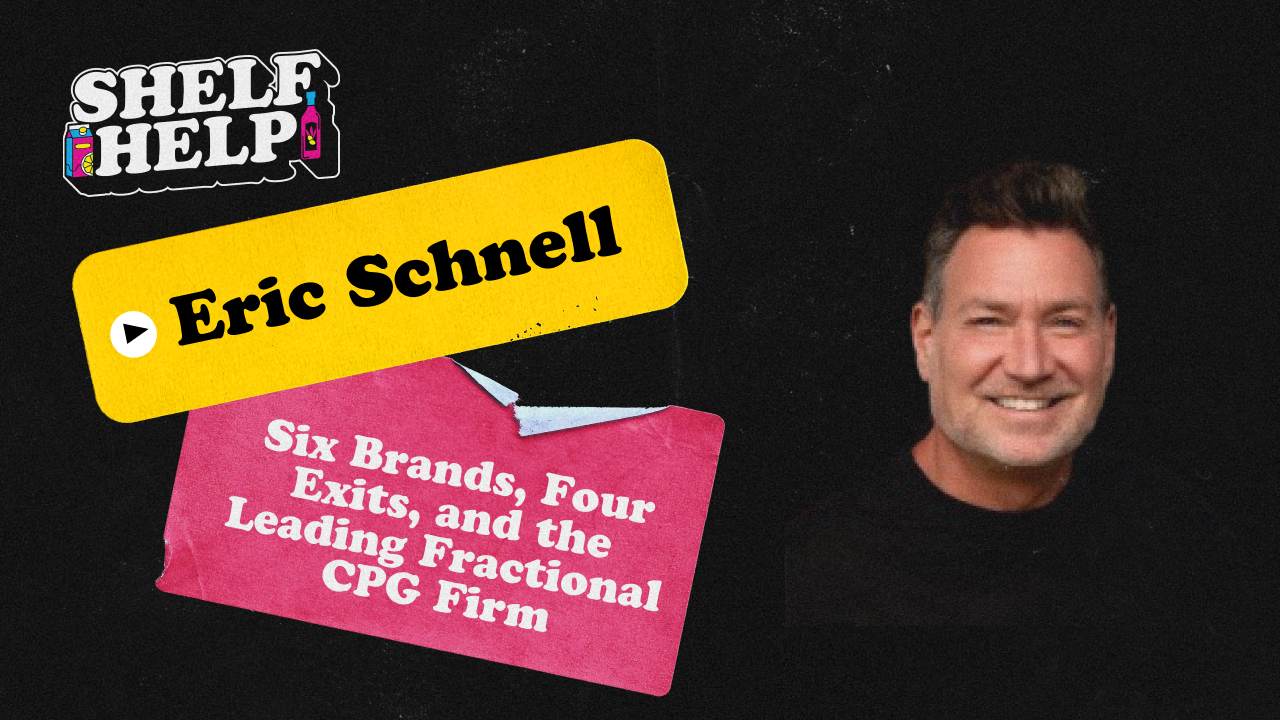
Six Brands, Four Exits, and the Leading Fractional CPG Firm | Eric Schnell, BeyondBrands



On this episode, we're joined by Eric Schnell, Founder of BeyondBrands - the 40-plus partner operating group that works as a fractional management team for early stage CPG brands. Eric co-founded Steaz in 2002 and has since co-founded or helped launch Good Catch, GoodSAM, Cool Beans, and Free Bird.
Eric breaks down the Quintuple Bottom Line model the firm runs on and the one test every brand they co-found has to pass: can it sit in front of any buyer and credibly claim it will be a category captain?
We get into the Good Catch story, from the seafood thesis they wrote with the Good Food Institute to extrusion R&D with help from friends at Beyond Meat, a Whole Foods launch, roughly $6 million in revenue, and a full exit inside three and a half years. Eric also walks through GoodSAM, where the team built direct trade relationships with regenerative organic farmers in Colombia and brought Thrive Market onto the cap table weeks before COVID shut down retail.
We also spend time talking about why most brands die from running out of capital rather than product fit, what a believable five-year plan shows an investor, the 17 seconds a shopper spends scanning a cooler door, and how freight and geography quietly eat a P&L.
---------------
Episode Highlights:
🫖 Selling $30 vitamins before selling $4 organic tea
🤝 The lawyer question that turned a favor into a firm
🌱 The Quintuple Bottom Line: passion, purpose, people, planet, prosperity
🐟 Why seafood, not meat, was the plant-based white space
🏆 The category captain test every new brand has to pass
🌎 Direct trade vs fair trade with farmers in Colombia
🛒 Putting Thrive Market on the cap table right before COVID
💸 Why most brands die in year one (it is capital, not product)
⏱️ The 17-second shelf window and the rainbow effect
📦 Why packaging gets fixed two or three times in year one
📈 56 equity positions and the ESOP model behind them
🧮 What a fundable five-year plan actually shows
🚚 Freight and geography, the black hole in the middle of the P&L
---------------
Table of Contents:
00:00 – Intro
01:06 – From $30 vitamins to $4 organic tea
02:19 – Exiting Steaz and choosing the next chapter
03:32 – The lawyer question that created BeyondBrands
04:45 – Backing pre-revenue founders nobody else would touch
06:34 – The Quintuple Bottom Line business model
08:22 – How BeyondBrands decides what to co-found
09:11 – The plant-based seafood thesis behind Good Catch
10:23 – Building flaky plant-based tuna from legumes
11:35 – Whole Foods, $6M, and a fast exit
12:48 – The category captain test
14:49 – GoodSAM, regenerative organic, and direct trade
18:38 – Thrive Market on the cap table before COVID
20:53 – Why most early brands run out of capital
24:35 – The 17-second shelf window and the rainbow effect
26:53 – 56 equity positions and the ESOP model
30:55 – What a fundable five-year plan looks like
34:37 – Freight, geography, and the P&L black hole
---------------
Links:
BeyondBrands – https://beyondbrands.org/
Follow Eric on LinkedIn – https://www.linkedin.com/in/eric-schnell-b133a425/
BeyondBrands on LinkedIn – https://www.linkedin.com/company/beyondbrands/
Follow me on LinkedIn – https://www.linkedin.com/in/adam-martin-steinberg/
For help with CPG production design - packaging and label design, product renders, POS assets, retail media assets, quick-turn sales and marketing assets and all the other work that bogs down creative teams - check out https://www.kitprint.co/
Shout out to my friends over at Glimpse, the go-to partner for automating retail-related back-office operations and unlocking margin trapped in invalid fees and manual processes.
Are you in the market for a new flexible packaging partner? Check out HD Packaging. Third-generation, family-owned and built for the needs of category leaders like Newman’s Own and A Dozen Cousins. Faster launches, lower costs, and no artwork fees.
Looking to dominate the cognitive health space? Upgrade your formula with Cognizin. It’s the branded, clinically backed citicoline trusted by top innovators in supplements, foods, and beverages. Differentiate your brand today at Cognizin.com.
Episode Transcript
Speaker: 00:00
Welcome to Shelf Help. Today we're speaking with Eric Schnell, founder of Beyond Brands, one of the more prolific brand builders in the natural products industry. I actually had Steven Kessler on the show a little while back. Steven and Eric co-founded Stees together back in 2002, the world's first USD organic ready-to-drink tea. Primarily focused more on sales, and Eric focused more on formulation brand packaging fundraising. Since Stees, both of them gone on to do a lot of cool things. Eric gone on to found like a half a dozen or so different food and beverage companies like Goodcatch, Good Sam, Cool Beans, some of the ones we're going to talk about, built Beyond Brands into 40 Plus Partner Operator Group, put together one of the more unique equity portfolios in CBG along the way, which is excited to dive into that as well. Also co-chair of Naturally New York, sits on the national board. So very plugged into CBG to say the least. So yeah, maybe Eric, just uh kind of first off for the listeners, maybe just the ones that aren't as familiar with Beyond Brands. I'll just kind of get a quick lay of the land, just in terms of kind of the origin story and the why behind Beyond Brands and what the kind of team does, actually does for founders today. And then we'll take it from there.
Speaker 1: 01:07
Sure. Well, thanks for having me on, Adam. Super excited to be here. Uh midsummer, talking to a good friend and uh getting to share some great stories and a lot of passion and purpose behind really everything I do and our team does. And it's great you mentioned Steve Kessler. And you know, we started our journey together 29 years ago in the uh on the vitamin side of our industry, kind of late 20s. Uh so almost three decades in our industry serving natural products and starting from the supplement side, we got really good training and education on how to sell complicated, expensive vitamins across health food stores nationwide. And if you could sell a $30 bottle of vitamins, you could sure sell a $4 can of delicious organic tea. So yeah, we we got we got lucky. I know you had Steven on. He's still my partner today at Beyond Brands and runs our sales group. But uh, you know, our our our passion back then founding Stees is really still our passion today as partners, as operators, as service providers to our industry. It's all about supporting the ecosystem of natural products, everything from supply chain to shelf and everything in between, from the people that touch the product to the distributors and brokers that work to get it out there, and all the great service providers and uh and and retailers across our industry, and really the tens of thousands of people that support natural products. That's what gets us excited every day about what we do and what we do at Beyond Brands. But the journey at Beyond Brands started when Stees ended. So, kind of the handoff, we spent 14 years building what we'd call a world-class household name organic soft drink and tea brand, starting 2002. We exited the business. It was a complete sale of the company in 2015 to a large global acquirer. And uh, as we woke up the next day wondering what the next chapter of our journey would be, we reflected on, you know, the 14 years of being founders in the early organic movement. What are some of the things we loved the most? And of course, you know, launching your babies, building your brand, and everything that goes into the culture of the company and all the shareholders and stakeholders and consumers that loved your brand was always obviously, you know, near and dear. But there was one other thing we did that was outside of Stees during that entire time that we felt it was just our right thing to do, kind of with good karma, paying it forward. We always helped other founders. So we, we, we generally, I'd probably say every year once we launched the business in 2003, got calls from just so many upstart, you know, early stage founders saying, How'd you do this? How'd you get Whole Foods? How'd you get UNFI? How'd you go organic certified? How'd you build an organic supply chain from scratch back when there really wasn't any in 2002? And so we always just felt like good karma. You know, we got in kind of lucky timing as organic pioneers. Let's just pay it forward and help everybody we can. And so we probably helped a few hundred founders over that decade plus, just out of the, you know, the goodness of our hearts to be any part of we could a helpful friend to their journey and maybe opened some doors too. And so we said, well, that was pretty cool. And our lawyer was talking to me one day, and he's like, why don't you, when I told him that story, he's like, why don't you just not do another brand by yourself? Why don't you create a model that helps every brand succeed and do it professionally this time? And we're like a law firm, it's my lawyer saying to us, we're kind of like the mirror of an operating team at a CPG brand where you've got a sales department, a marketing department, an ops department, and a finance department, most any CPG business, food, beverage, supplement, or beauty. Once kind of you scale past series A, 10 million plus, you're gonna start building out those internal operating teams in your own company. And so we've and so we had quite a few teammates that were out of work because we got acquired fully and they didn't take the team with them, the acquirer. So we said, this is great. We've got a core team right now that could stand up as battle-tested seasoned operators with a ton of passion to support early stage brands. And that was the genesis and birth of Beyond Brands 11 years ago. Started with a small group of us, there was eight of us in the beginning, and now we're over 40 partners nationwide. We handle, you know, brands from startup all the way, I'd say really to kind of series A. That's like our focus. So early on, where a lot of other friends of mine that were service providers, owned marketing agencies or formulation groups or operation groups, they a lot of them didn't want to touch, you know, year one or even pre-revenue founders because it's so risky. And we were like, but we understand that journey because we're actually from that world of being founders that were scrappy and made a million mistakes and always had to piece together payroll in the early years. Like we get that. We could help them, you know, uh get to market safer, smarter, faster as an operating group that could partner with them in a myriad of different ways. So at its core, you know, what we've always been is uh is an operating team of seasoned professionals that have got a lot of years of experience across those four areas. Um, and uh, and we also have access and always had access since we had raised a lot of money for Stees and had an exit to investors that would look at the next deals and partnerships we're involved in. So we kind of had that opportunity to possibly bring money to the table for early stage brands through our introductions. So 11 years later, Stees is, I think, at this point, um not Stees, Beyond Brands, sorry, at this point, the largest fractional VP level management team in the natural products industry. So our 40 partners, like lawyers, make their living working in their practices and builds their practices within Beyond Brands, but serves across those four functions that are critical. And our clients come to us for either project work, so it could be branding packaging design, formulation oversight, investor decks, business plans, and then all the way through to working with us as an early stage fractional management team in their first couple of years until they kind of get to series A. So we've we've graduated a couple hundred brands across food, beverage, supplement, spirits now, and beauty over the last 11 years, um, you know, to Series A and uh had a bunch of successes so far with brands that have got to exit over the last 10 years. We could talk about a couple today, which are super exciting to see that journey, you know, take place from concept all the way to an actual exit. And the founders have that success for the themselves and their stakeholders. And uh, and we're following our passion. You know, we we've always had a guide, kind of a guiding mission at Beyond Brands that makes us a bit different than, I guess, another consulting group or marketing group. We've we've always adhered to what we believe are conscious business values. And so we created a value system first year called the Quintuple Bottom Line Business Model, which is the five Ps, passion, purpose, people, planet, and prosperity, which I had read a book in in the late 90s called the Three P's, or, you know, it was called called Triple Bottom Line back then. That was what we called it. Um, and it was a book written, and a lot of us in the early 2000s read that book about people, planet, profit and just a better way to do business at that time. So we enhanced it to include prosperity and the planet and really going deep in people and ecosystems. And so those guideposts, you know, those five guideposts of quintuple bottom line business values have always been if we're going in really early stage to a company at concept, meeting founders, we're trying to instill these guideposts, these values to think about as they craft their vision statement, their mission statement, their company culture, how they work with shareholders and even especially how they look at their supply chain and all the all the farmers, because for the most part, in our industry, everything comes from a farm. That's the beauty of the natural products industry at some point in some part of the world. So really thinking about the whole ecosystem and the environment that the business thrives in. So it's been very helpful to us to have a guidepost and a mission and a platform from which to speak is more conscious business values. And it's been very helpful to a lot of the brands that we've seen get success with investors that are also looking for businesses that are aligned with values like that. So 11 years later, we're having a ton of fun. And I think we've got probably a strong couple decades to go because our businesses keeps growing organically every year, and it's amazing, and our partners are amazing, and uh, we just love meeting new founders every day. So, yeah, that's that's the the genesis of Beyond Brands.
Speaker: 08:22
You were chatting a few weeks ago and you were told me like every year we'll co-found something, if not go deep into something. Most people are lucky to build one company. You've had success in launching a few. How do you decide what to build?
Speaker 1: 08:33
Great question. So, again, with that entrepreneurial spirit of a lot of us on the founding team being, you know, former entrepreneurs. And now, you know, fast forward 11 years later, we've quite a few other partners that have built and exited brands also, like Cynthia Tice, who founded Lily's. She's one of our partners, you know, after her exit to Hershey's. So we have just an amazing group that likes to look at all options on the table. And sometimes we come up with our own ideas because we're a strong operating team with access to capital. We can fund them ourselves to start. So, and others are done in partnership, sometimes even with private equity groups. But generally, what we're looking for is as a group, if we find a white space that's a totally awesome opportunity that no one's really built anything in yet, we'll go in and we'll found a brand. So we've done six of them to date. Uh, we've had four of them are gotten to exit, like complete exit. And the first one was right when we founded the agency in December of uh 2016. This is when the plant-based meat alternative movement was just starting to explode. You had kind of uh Impossible Burger and Beyond Meat. This is again going back 10, 11, 12 years ago, starting to blow up, getting a lot of investor attention. And then everything else around kind of meat called land animals. Everything else is starting to explode too. And we met the Good Food Institute that year and kind of like almost wrote a white paper together about the thesis: why isn't anybody addressing seafood? And then we worked at the Good Food Institute in early 2016, just to look at all things from animal suffering to the damage of, you know, overfishing to, you know, all the trolling on the seas and the harm of the reefs. We were like, this is incredible that there's a story here of not only, you know, reinventing seafood, but saving the seas. We also knew, and the data was out there pretty public at the time, that you know, bluefin tuna would be completely extinct possibly by 2050. So there's a whole story there of saving the seas. And we thought that was even more exciting than possibly the stories about, you know, what's going on on land, you know, obviously saving factory farming and making a better supply chain and obviously doing meat analogs that taste similar, that are clean, are great. But we were like, this is the opportunity. So we partnered with the private equity group that year, went 50-50 in, in essence, that was our first brand we co-founded. And we had to figure out kind of how we were going to build a great tasting white fish, a tuna, a salmon, when that hadn't been done yet. And so we just got really lucky and reached out to a lot of friends. I guess that's the power of being in the industry a long time as relationships help. And so our friends at Beyond Meat actually helped us on the RD to use some of their technology to use extrusion technology to kind of make the base of what could be a flaky, great-tasting fish product that's uh that's meat-free and plant-based. And so our whole thing was let's go as clean as possible, though. And so we only use legumes and beans as kind of really the base with spices and oils, and created, you know, the very first what we would say was, you know, 10 out of 10, five-star plant-based seafood experience based on tuna. And uh, and so we quickly raised a series A. Uh, within a year, we raised a series B and got off and running. And within three years, we had interest from very large seafood companies such as Bumblebee and Starkist asking if they could invest. And of course, this is when the bubble was just you know starting to explode in a good way for everything plant-based meat alternative, 2017, 18, 19. And long story short, we finished about $2 million at RD, got the products launched to Whole Foods very successfully, got to about $6 million in revenue just in there to start. And all of a sudden, investors just started circling the company. And uh, and for us, because we are not Beyond Brands professional investors, I had not raised a fund uh to support follow-on investment. We always had to be careful of our picking our opportunity of when it's our our our kind of time to exit. So we actually were fully acquired our board seats or half the company ended 2019 as part of that whole round that happened post-Series B. And um, I guess I would say looking back, you know, Adam, we got really lucky. The universe kind of blessed us with timing. So we had what would be considered a very high multiple exit at Beyond Brands, our very first one within three and a half years of founding a new company. And uh within a couple of years, that business was eventually acquired, which was great for the company by a larger company, Wicked Kitchen. But then within about four or five years, unfortunately, COVID didn't help. The plant-based world kind of imploded in that category. So I think our timing was just uber lucky and uh and awesome, which then allowed us to do many more deals like that.
Speaker: 12:41
What were those like early retailer conversations look like when you told you were launching a plant-based seafood brand as opposed to meat?
Speaker 1: 12:48
Yeah. So to your question about like what do we look for? Obviously, white space hasn't been done, but can our brand sit in front of a buyer, any buyer, any channel across, you know, you know, food, and say, we are going to be your next category captain? And from a buyer perspective, a category captain is you're gonna be a top three brand. And it's generally always been in the three decades I've been serving our industry. It's always like three brands come around right at the same time to build a new category, it's like that 20 years ago with the coconut wars between OE and Zico and Vita Coco. They all launched like the same year in 2004, all speaking the same language about hydration through natural coconuts, all fighting each other, but then built, you know, a multi-billion dollar category. It's always like that. Even just recently, the last five years in the soft drink category with Olipop, Poppy, and Culture Pop doing probiotic, prebiotic, healthy sodas, they all built together, but fought together, but built a category. So we always love, if there's an opportunity, which is rare, to sit in front of a buyer and say, we are building you a new category. You don't have these consumers walking down your aisle now. And we're not going to steal or source volume from anyone that's doing well in your store. We're going to bring new consumers to the aisle. So finding brands like that, obviously with with good catch, we were able to sit in front of every single buyer and say, you do not have a plant-based seafood that tastes like seafood, do you? Nope. So again, timing, great there. And every one of the other, you know, companies we've kind of co-founded went really deep since then, has been the exact same thesis: white space and ability to sit in front of a buyer and say, we are going to be a category captain. And also tell the investors that we're not like number 10, the world doesn't need another dot, dot, dot, tenth item in that category. We're always going to be a top three. And that positioning really helps overall get a company scaled faster.
Speaker: 14:26
Yep. Totally. You mentioned interest in some of the bigger players. I think you guys did some type of JV with Bumblebee. I think was, I'm not sure if that was close to the case.
Speaker 1: 14:34
That was kind of the impetus for that round I mentioned that began the discussion to uh buy our equity out because that they they actually wanted to buy the company. The company wasn't for sale. Or well, then who else would give us a large stake? And it ended up being that's part of how our discussion happened for us.
Speaker: 14:50
I got it. Another one that that I that I know you guys have launched was was good, Sam. Spent a few years building out and have a direct trade regenerative supply chain across Colombia, Mexico, Kenya. Tell me a bit more about what the vision was here.
Speaker 1: 15:04
Yeah, so again, like in and I guess the third thing we if if these companies or these ideas can fit into our conscious business model of the quantum bottom line values, and we could see that as an opportunity, which which GoodSAM was, what we would call a 5P brand built on passion, purpose, people, planet, and prosperity, we'll go in there also and try to make a difference in the world to creating a new brand, a new opportunity. And so that was really more of a conscious business model for us to kind of go in. And it started with me. Um I've been a selection committee member and partner of NCN Nutrition Capital Network since 2010. So I'm going on 16 years of being a serial mentor and supporting that community. And it's great. If you don't know about it, check out Nutrition Capital Network. And so I mentor founders every year. A lot of them are international founders that are coming into America. And so I mentored a founder named Sam Strut back in 2018 at the New York City NCN conference, and we got very close. And he wanted to bring his fruits, his organic fruits, and um to America, but there was really no business model for it. But as we learned more and more through our mentorship, I realized his family and the relationship that he had had access to what we were just hearing around this time, 2018, the word regenerative organic. We were hearing about regenerative organic and Rodale Institute, which is one of the founding, you know, groups that started our industry 80 years ago, the Rodale Institute and their farms out in Pennsylvania. They had invited my wife and I the year prior to go visit the Rodale Institute farm to introduce regenerative organic agriculture and a regenerative organic certification program. And I'm coming from being a certified organic kind of pioneer, and I knew about conventional crop, organic crop, but I really didn't know about regenerative organic. And they showed us three different acres side by side, one of each. And the regenerative organic crop acre, when I learned about the ecosystem and the animal husbandry and the way that you know this that the crops are grown naturally, and it's just it's just this whole ecosystem, almost like a jungle next to an organic field, which has no pesticides, fungicides, or herbicides, which is super cool. That was what I built these on. I realized the difference. And the difference is really regenerative organic is how the world's been farmed naturally, organically for ever since time, 10,000 years ago, that farming's been going on. It's it's the way nature does it. And the soil is much richer and healthier. And that's something you don't necessarily always get in an organic certified farm or soil. So I kind of fell in love with that, and the opportunity came to mentor a founder that had access to regenerative organic or farms that wanted to be regenerative organic certified in Colombia. And then within about a year, we decided let's make this our next, our next brand to partner with. And so we went in 50-50 with Sam Stroot and Beyond Brands, you know, did all this, the leaning and standing up of the business, but then really went down um to explore the supply chains in Colombia first to see which farmers we could build direct trade relationships with. So instead of fair trade, like Stees is has always been a fair trade certified brand since 2004 when I got us our T estate in Sri Lanka Fair Trade certified. It means we're paying a premium. The business brand is paying a premium for the product so the farmers have a better life because they're going to get that premium somehow given back to them in many different ways that we can measure. But direct trade is when you're kind of cutting out that distributor, that middleman, and you're actually making a deal directly with the farmers themselves, the owners, the community, the families that run the farm, and you're giving them a fair wage, the wage they need. So there's no one taking a cut in the middle. You can really see, you know, kind of an immediate difference and improvement in the lives and the welfare of the farmers, in particular the people. So that was really important to us to learn about direct trade. And it kind of went right along Regenitive Organic. And so we stood up the brand in 2020, right before COVID. I got the very good fortune of being at Expo West. Before Expo West shut down that week, we went out early and I met with the owners of Thrive Markets, who are also investors in Goodcatch a couple of years before with me. And I said, this is our next deal at Beyond Brands. Do you want to be partners with it? We're going to form a small board. And so Thrive Markets leaned in and became our first kind of partner and put in capital and also joined our board. And that mark, that relationship with Thrive Markets that next year, as we launched, really was the critical pivotal difference to our success. Because it happened, COVID hit right away, and all retail for us would have just been a disaster. The lucky decision we had at the time, again, the universe blessing us again, I guess, with great timing. The deal we made with Thrive was for the next year, we're only going to sell on Thrive Markets. You're our partner while we figure out retail. So by default, we were perfectly positioned for the COVID world to happen to buy it to have where everyone went online direct, you know, to consumers. So that was our first year, did really well with Thrive, and then eventually went into retail the second year partner with Whole Foods.
Speaker: 19:32
Obviously, easier said than done. But if you know brands in the earlier stages have the opportunity to bring a retailer or marketplace like Thrive onto their cap table, would you say definitely always take advantage of that opportunity or be a bit cautious depending on who the partner is?
Speaker 1: 19:48
Well, look, so so much of that can only happen if there's relationships in place between, say, a founder and someone in a large, whether it's Whole Foods, which they have a program as well to do investment and also loans, or Thrive Market, which had a program at that time. Relationships are obviously critical and key. So, you know, my thesis myself is, you know, I'm in my 50s now. If I'm kind of founding anything new, especially with Beyond Brands, we always do look to partner with someone first out of the gate. So we kind of improve our chances for success and have guaranteed distribution. And that can be, you know, partnering with someone like UNFI, they've got programs as well. There's many ways to do it. Not every entrepreneur that's in their 20s would even know to think about these things. We, because of you know, our operating, you know, group at Beyond Brands and, you know, 500 years of experience, I guess, across all the partners. When we're working with our founders, our young founders, and they're thinking about raising capital, which we're very involved in helping our founders raise capital, we're always looking through that lens. What's different that we could do? What's who could be the right partner to come in day one versus you know the typical strategy of friends, family, and angels? Is there someone else? And again, that was my thesis, you know, at the beginning with GoodCatch, and it worked and did the same thing again with Thrive at the beginning of Good Sam.
Speaker: 20:54
Yeah. You've helped launch a number of brands. You've helped scale a lot of brands within Beyond Brands from those early stages. I imagine some patterns have emerged over the years. What jumps out in terms of patterns that have emerged? What are the ones that make it have in common? Ones that don't make it or struggle, what do they have in common?
Speaker 1: 21:09
Yeah, yeah. Great question. You know, look, it's it's a it's a it's so easy in essence for someone with because you can't really go to college to be a founder of a food and beverage or supplement or beauty or spirits company. You just kind of do it. And it's easy. Maybe you have a hundred grand you've saved up and you're in your mid-20s, early 30s. You could create something in RD and get it on a shelf. Like that's that's what the allure is, the excitement for everyone to come into food and beverage. And you hear about these brands that then in seven, eight years are exiting for hundreds of millions of dollars. That's the lure. And for three decades now that I've been an entrepreneur in this industry, it that's never changed. And it's still a fair playing game for everybody. What we try to do is look at okay, if we're gonna get involved with equity, and especially we're gonna be paid to be an advisor and be helpful to a brand, we want to make sure we're helping them position themselves as as best as possible. And what a lot of founders you know don't realize and think about is how much money they've got to raise those. First couple of years. So they get to either a path to profitability or a profitable year, or really the milestone would be a Series A. So they have a professional board and professional funds coming in to help them grow smartly. So really in that first couple of years, it's been, you know, for us, you know, super, I guess, choosy in a way of what founders to back if we're going to take a large equity stake. This is a brand that we would be another kind of back by beyond brands business model. Two years ago, we partnered with Jay, a wonderful entrepreneur out of Atlanta, Jay Williams. This is a brand called Freebird. So kind of positioning ourselves as the anti-liquid death. This is all about America, you know, uh spring-fed water from the Appalachian Mountains in Georgia, and just a beautiful story in a tall boy can that no one had done. But when we met Jay, he had extreme extreme access to capital in the Atlanta community. So we knew, okay, going into this deal, he's got access to capital. He's a former real estate developer, and this is his huge passion. We can partner with him and have a much better chance for success if we could bring in that community. So we're we're looking at with early stage founders, really talking to them honestly about their friends and family. Can they go to them? Can they not? About the communities outside of them in their business world, can they go to them or they not? What is their even opportunity look like, even if they were to get it super excited, they think the max they can even raise with? And if a founder comes back to us saying, well, if I tap out everybody I know, the most I could raise is probably 125, then I'm kind of tapped out. We got to be really honest with the, you know, the advice we give that that's not gonna take you too far. And so sometimes we're giving, you know, what may sound like sad advice, like you probably shouldn't do this unless you could see your way through to half a million million dollars in the next 24 months, which is what most early stage brands will need in their first 24 months once they start gaining traction. So, really being honest, a lot of like consultants probably don't want to talk like that or wouldn't know that if they're not, you know, former entrepreneurs, but we just know that early journey is so intensive. And so, you know, the reason why this number is like 80% of every new brand goes out of business by the end of the first year, it's not because wrong market fit, bad packaging, maybe sometimes, but not mostly. It's mostly they run out of capital. And the ones that survived that first year, you know, 10% of them are lucky to get to the end of the second year. That's when things start breaking down and money runs out. And so again, most founders, 22 to 33, which is our average client or portfolio partner beyond brands, they have never thought about, oh my God, I've got to be a professional fundraiser for myself now. How am I gonna do that? So, you know, really being honest and helpful, you know, we've got some really good angel networks we can introduce, but generally, you know, that early stage mindset of you know survival comes down to the founder's, you know, ability and bandwidth and an opportunity to raise capital. So we're very honest early on with our founders. And we also look for founders that are super backable that we think can raise money if they've got support.
Speaker: 24:35
Yeah. Specifically from packaging design standpoint, how these brands present on shelf the best velocity numbers? 100%.
Speaker 1: 24:42
So, you know, uh a lot of this may take time and just experience being in our in the industry, being an entrepreneur, but but let's just use beverage as an example. This is how hard it is, but it's also how important it is to get your branding right day one and fix it if it's not production run number two. 87% of every consumer that's going to buy a beverage in a store walks into that store already knowing which beverage they're gonna look for. They stand there in front of that, let's pretend it's Whole Foods, that big open cooler at lunch or dinner to grab and go. Average 17 seconds is the amount of eye contact they're staring at a shelf. And it's usually, you know, eye to thigh, that window, and they're 17 seconds looking for their beverage. You've got one opportunity if you're a new brand to stand out with your packaging and hopefully get some brand block or some way that they're gonna pick you up and then turn you over and read you. So a couple, I would say, best practices are we call it the rainbow effect, which is basically building a brand block on shelf, whether you have three or four SKUs, maybe they're different flavors or different functions, make sure they're different colors. This rainbow effect of colors has been proven out throughout decades in in CPG marketing analysis to be something that attracts eyeballs to a can or to a product. So, you know, important having differentation, important not looking like everybody else on shelf standing out. For example, this this this brand, this packaging actually hasn't changed since the founder first showed it to me at our very first meeting at a BevNet show two years ago. He actually just created the packaging himself, didn't do anything else, and then met me. And I fell in love with the packaging. I was like, how did you create what looks almost kind of, I guess, Anheuser Bushes like a beer, but it's water, it's southern spring water. He nailed like everything before he even met me. And that's why I fell in love and said, you know, we're we're all in because we could figure out the rest. We could figure out the business plan, the investor deck, the supply chain. That that's actually the easy part. The packaging, you did that on your own. So that was like a wow moment for us. So yeah, packaging, I'd say on average, you know, besides all the dis you know the scary stuff I just said about getting it right and the limited time you have to win a consumer's eyes in a store, you know, you generally are fixing your packaging as a new founder one or two or three times during the first year in business. So almost if you're doing three production runs, it's almost extremely normal 75% of the time that you're doing a tweak at each production run to packaging and maybe even formulation two.
Speaker: 26:54
When we chattled, yeah, a few weeks ago, you told me you've you guys have got 56 or so equity positions in the portfolio. And I think you focused on an Aesop model. I got that right. Yeah, tell me more about that. I'm very curious.
Speaker 1: 27:05
Yeah, we I think we have the most exciting, I call it funless fun in the industry because it just organically grew and there was no model for it. So, you know, I've raised about $100 million across seven businesses that I've co-founded in the last 24 years. Stees obviously being the largest I raised for, and I've had five exits. I've had two failures. You certainly do learn the failures how to wind things down and actually makes you a better advisor and helper to other brands if you fail. But what we didn't really set out professionally to do became a very professional part of our business. So in the beginning, and this is actually how it happened. We looked at the weaknesses of being a consultant because we are a consulting agency. And in just one of the ones of the of the couple we've we felt was at some point a consultant, when they get into their 70s, and that's what they say they've been doing since they retired from their full-time job in their 50s. If you don't, if you don't have equity opportunity in all those years, how do you really get to retire? And like, and I and I and it's really at some point it is also hard in our industry. You don't see like 80-year-olds often walking around the trade show floor with business cards. You you tend to age out. So you've got to find a way as a consultant, a service provider to have some kind of 401k or exit opportunity. So from the very beginning with Beyond Brands, we set up a separate LLC called Beyond Brands Ventures, and we said, in this model, let's take all the opportunity we can have for equity, we'll put it into that, and then all of our partners at Beyond Brands, in essence, we'll have a 401k being built organically. We got lucky because it started with GoodCatch in 2016, literally the quarter we started our company. So we set that model up and put our equity in there, had that exit three and a half years later. So it was actually returned to everybody, which was which was really great. But the model for us has been, you know, since we're going as a fractional management team, there could be VP ops, VP sales, VP Finance, VP marketing. We could be playing three or four roles under one brand. Example with Freebird, the first year and a half, we played every single role under the founder. We still play two of those roles on a fractional basis. So if we're in essence going in as the fractional management team, but are standing up calls with investors, we'll be considered, you know, as shareholders because we have some equity. It was really easy for us, and it is easy for us if we're going in deep to talk with founders about having some of the ESOP pool. ESOP pools are generally setting aside 10 to 15% of a new company. That's what a founder or co-founders normally do. And in essence, a lot of it goes to advisors and or the early management team. So we do both. We do advisory, and often those deals are a 1% equity grant to be on brands if we're just advising. So anyone of our team goes in and they're under a year contract, like a professional advisor forming an advisory board with a brand. And then if we're going in deeper, they're often 5% to 15% ESOP, you know, plays where we're being granted that. So on average, you know, now we're 11 years in and we're probably doing two, three a quarter of these kind of equity partnerships. We call it our backed by beyond brands model, meaning the founder, the business of being backed by beyond brands. When we have that kind of meaningful equity opportunity, we will help introduce and bring in capital, certainly be on every investor call and give the business the credibility and the founders the backing they need. But now, you know, I think when I spoke to you last, we I looked at our portfolio, we've got 56 equity positions. I'd probably say on average, they're about 5% each when you balance it all out. Some of them are actually like bigger when we're going to co-found a company. Those would be 50-50. But when I talk to my friends in private equity and we're, you know, sitting around and asking, Eric, how's all that equity doing? I'm like, well, this is what we've got 56 deals at 5% each. Like that, they say to me, like joking, that would be like if we invested $100 million across 56 CPG businesses, those are the equity stakes we'd have. That's nuts. So, like, I guess by default, again, the universe, you know, kind of blessed us with a lot of luck in different areas. We've been able to create, in essence, a great uh 401k-ish type model that, you know, exits happen every year for our operating partners that are part of Beyond Brains. And we are a we are an LLC where everybody has a stake at Beyond Brains. So we're really an employee-owned company.
Speaker: 30:56
You clearly have a lot of experience in success fundraising, as you just said. One of the biggest reasons that a lot of early stage brands go under is they just run out of capital. What does the most successful fundraising process look like? Approach you've seen that has the most chances of success and raising the target amount.
Speaker 1: 31:12
So I think it was the principles we shared earlier, you know, being first in a category or, you know, being able to be category captain, you know, those are the again, good catch, good Sam completed its Series A a year and a half ago as well. You know, other businesses that were involved, like Freebird, these are all like when we can sit in front of an investor, even if it's friends and family and angels, and say there isn't one of these, or there's only two other of these, and this is our unique space we're going to carve out, it's it's it's a lot easier to raise capital. And so certainly we're involved in in clients that do not have maybe that ability to be in the top five. And it's harder for sure. I think, you know, looking at the right investors in the right community first, you know, a lot of early stage brands make the mistake, you know, they're doing 10,000, 15 a month in revenue, and they think they should be talking to venture capital groups already. And there's really very rare instances I've seen call it a venture capital group, which would be maybe a fund 20 to 30 million that's writing checks for a quarter of a million, to invest in a business that's under 100,000 in revenue. So there's a mismatch with what founders often think they should go after. But again, this really comes down to I'd say for us, the most success we see, because it is always hard across the board, but we do a lot of business plans, a lot of financial work, a lot of five-year PLs, we call them go-to-market strategies. What we see having the most success is when an early stage founder, whether they're at zero revenue and it's their first quarter or they're already, you know, six months in and they're doing 10,000 a month, which is probably average, by the way, is that they've got a five-year business plan with financials that are well thought out, kind of a bottom-up build that's articulated in a way that investors can understand that addresses the size of the prize, like where is this business going to honestly be in five years? It doesn't look like, by the way, 100 million, because that's so rare, it's not even funny. It's more like if you are successful in a five-year plan, it's probably more like 25 million. And what you're trying to demonstrate, what we try to get our clients to demonstrate most in these five-year models, is pick the month or pick the quarter or pick the time we're gonna be profitable. So a path to profitability is like an early guidepost. We must articulate. It wasn't like this 10 years ago when we started Beyond Brands. Most of the, you know, funds back then did not care about profitability. It was about grow, grow, grow. COVID did change all that and it's not gone back. So we're we're generally trying to find a way to improve margins extremely the first couple of years and by kind of year three, show a profitable quarter. So investors check that box. Founders are thinking about path to profitability, big thing to check off. Being honest about where we should be in five years. And it's not a, and again, I meet founders all the time that still tell me I'm gonna exit in three years. Actually, I read a business plan today that the founder wrote in the plan is exiting in year three. Like that's almost never happened in history that I've seen in three decades. So it's it's about being honest and thoughtful. So we're actually trying to articulate what a national brand looks like in CPG and natural products in five years. And it's really about getting to Series A. That's the thing I would rather our founders talk about and articulate. I'm trying to get to Series A in my third year at five plus million in revenue. I'm not trying to get to exit my five year. And then most likely if I get to my year five at about 25 million, that's my series B year. And then being honest, it took us 14 years to sell STES to exit. It's probably more like seven to 10 years. So these helpful hints and advice that we could give, especially if we're doing the financial work, really show up well when we talk to investors with our clients and our partner brands because they they it's much more believable and credible, and it's what they're looking for. So those are the way, those are some of the ways we approach a business plan, especially approach wanting to talk to investors and get them excited about a deal. Not that it's going to be more of a bottomless pit that they're asking to put money in every year to save the company.
Speaker: 34:37
Where does ops quietly make or break things from an emerging brand perspective? Is in terms of having really good buttoned-up command relationships and then the marshes are working well, or is it really buttoned up inventory and calf tracking or accurate forecasting, or maybe another way to put it, what's the the ops mistake you see over and over that founders don't realize is kind of a problem until it gets expensive?
Speaker 1: 34:56
Such a great question. And I I just because my partner didn't want to do the ops when we started Steve's by default, I had to play the ops role. So I got good at living in bottling plants and you know, actually doing batching myself often and doing the numbers and learning it all from scratch and also understanding supply chain freight shipping logistics. So I kind of got my own mini MBA by default because I was the only one of the two partners that wanted to do that. And I got good at it. So every founder has their superpower. You know, some are great in sales, marketing, some some like ops, but not many, by the way. I don't meet many founders. Obviously, under 10% of our portfolio or client base wants to do ops themselves because it's a lot of hard work and figure out, and you need some experience to understand how to do it. So I kind of went through trial and error and I actually love it. So I'd say, you know, I it's funny in 2013 I was at a BevNet conference and they wanted me to talk about year one. And that was one of the questions in the room. So going back, I guess it's you know, over 10 years ago, what was the one mistake I see every founder generally make the same, whether it's food or beverage, and it's ops and it's freight. It's this black hole in the middle of your PL that most founders do not even understand to the end of their first year in business, or maybe they do their finance or their accounts in the second year of business, and they're wondering, I don't understand. My margin was 45. How am I just losing so much money? And then you analyze the PL, then you analyze the middle of the PL, and then you see freight, logistics, warehousing. And that's the part I still see is probably the biggest area to get smart about and address early on, but the biggest mistake founders make. I was on a call last week, and this happens every quarter with a young brand that's in LA, and I asked him what his distribution goals are for the year. And he says, Wegmans. So Wegmans is in the Northeast, and he's in LA and current bottling is in the LA and we're house in the LA. Wegmans. And I said, Wegmans, why Wegmans? Because I know investors are gonna like the Wegmans banner on my business plan. I said, Oh, and he met Wegmans at the recent fancy food show, and the buyer was friendly to him. He says, But do you realize the freight to ship a container across countries 5,000 versus shipping that same container on the West Coast is probably 1,200? No, I didn't even think about that. I said, would that have even turned you off? He goes, No, I want Wegmans. I said, Well, that's that's where you lose. And so that that is a repeatable mistake that most founders make. We call it the spray and pray or the shotgun approach, where a founder in their year one, year two, innocently is just so excited to get the right banners on their business plan or the right wins for their investors. They're not thinking about freight and geography and about owning your backyard first. They're going too wide, too fast, too narrow instead of a mile deep right there in Southern California to build out the brand and go to the next market, which should either be NORCAL or down southwest by Texas. But so that's a mistake we always look for. And that's also one of the quickest ways to turn around a PL and get on a path to profitability is correcting stuff like that.
Speaker: 37:38
The last question for you, this has been super great. If you had to pick uh, let's just say two trends in CPG right now, what are two things that jump out that maybe and maybe things that are maybe a bit more under the radar than everyone is thinking about?
Speaker 1: 37:49
Well, I would have definitely said if you asked me if there's a top five proteins in there. So, but not but not protein in shakes and not protein in foods, actually more enhanced, clear versions of protein that are odorless, tasteless that you can use in snack foods, candies, things that are just, you know, now becoming where people are putting their proteins as an acceptable form. So I do we do have a few brands launching right now, one called H2 Pro, which is a clear, odorless, tasteless protein water, kind of like a Gatorade without sugar, you know, 15 grams of protein per bottle in New York. So definitely protein, definitely fiber still. I I know you probably know those. We are still super uber bullish on regenerative organic, but like the organic industry when we started it in 2003, being one of the very first brands that year to be certified by the government, it was a very limited supply chain of organic suppliers from flavors to sweeteners, very limited, like three or four, barely in each category. So it took a good 10, 15 years for the organic industry, the supply chain to grow to meet the demand. And in the beginning, investors would tell me 2002, 300, no one's gonna buy organic in the future. It's just a trend, Eric. It's only gonna last for a year or two. Now look at us now, the organic industry now. Regenerative has that same challenge where to get a field regenerative certified and to go under like ROC certification, like we did with Stees last year, where we formulated we're the very first Red Editor Drink Tea brand to be regenerative organic certified under the ROC Alliance, which is awesome. So there's still this opportunity to come into Regenerative Organic now, whether you're a food, beverage, supplement, spirit, or beauty, there's opportunity in any one of those categories to get in. But it's also about finding and working with the supply chain, kind of like we did with GoodSAM, as I mentioned too. We have to go down to Columbia, hold hands, meet farmers, do direct deals. So the patience it's going to take to me is worth the wait. So I believe in the next decade, you will see many more brands and categories explode with Regen Organic and Regen Organic certification. So definitely that bet has not changed since we co-founded, you know, GoodSAM a while back. I think you're looking at the Spirits category now, which we're heavily involved in spirits products as part of our new portfolio two years ago that we enhanced our offerings into. So I see, you know, Delta 9, hemp, things like Kratom, um, you know, more plant-based uh nootropics. Mushrooms has obviously been its, you know, kind of its defining moment the last five years, but where we're going is into other maybe indigenous plants that have different effects on your serotonin, on your dopamine. They aren't the typical, you know, mushrooms that you're getting, but different. The kratom's one. Obviously, that we hope that things go well in the government this year and hemp drinks can still stick around in the form they're in now because we're seeing tons of growth in that category and representing some representing some really cool brands. So yeah, I think that that that's going to explode as well. Um, and having we're having a ton of fun, by the way, still learning every day as a company, as a group of new trends and new opportunities and new supply chains that we haven't discovered yet that should be brought to America and have a right to be on shelves.
Speaker: 40:38
Awesome, Ola, Eric. This has been great. Um, really appreciate the time. I think this has been super valuable for people. What's uh what's the best place for people to follow along with you and all your expertise and where you're sharing that expertise and then best place to follow along with kind of everything going on Beyond Brands? Thank you.
Speaker 1: 40:52
And I really appreciate you having me today. And we always are here to talk to anybody in the industry that would love a conversation with us. And believe it or not, 11 years later, I still take every first inbound inquiry to Beyond Brands, whether it's on LinkedIn or our website or our 800 number, I still speak to everybody first for half an hour. I love to meet founders. So please find us at beyondbrands.org or on LinkedIn. I'm Eric Schnell. You can go to my LinkedIn page. We have a Beyond Brands LinkedIn page as well. Those are the easiest probably ways to hit us up through the phone numbers that are on there in the emails. Cool.
Speaker: 41:20
Awesome, Eric. I appreciate the time. I think that's the pod.
.svg)