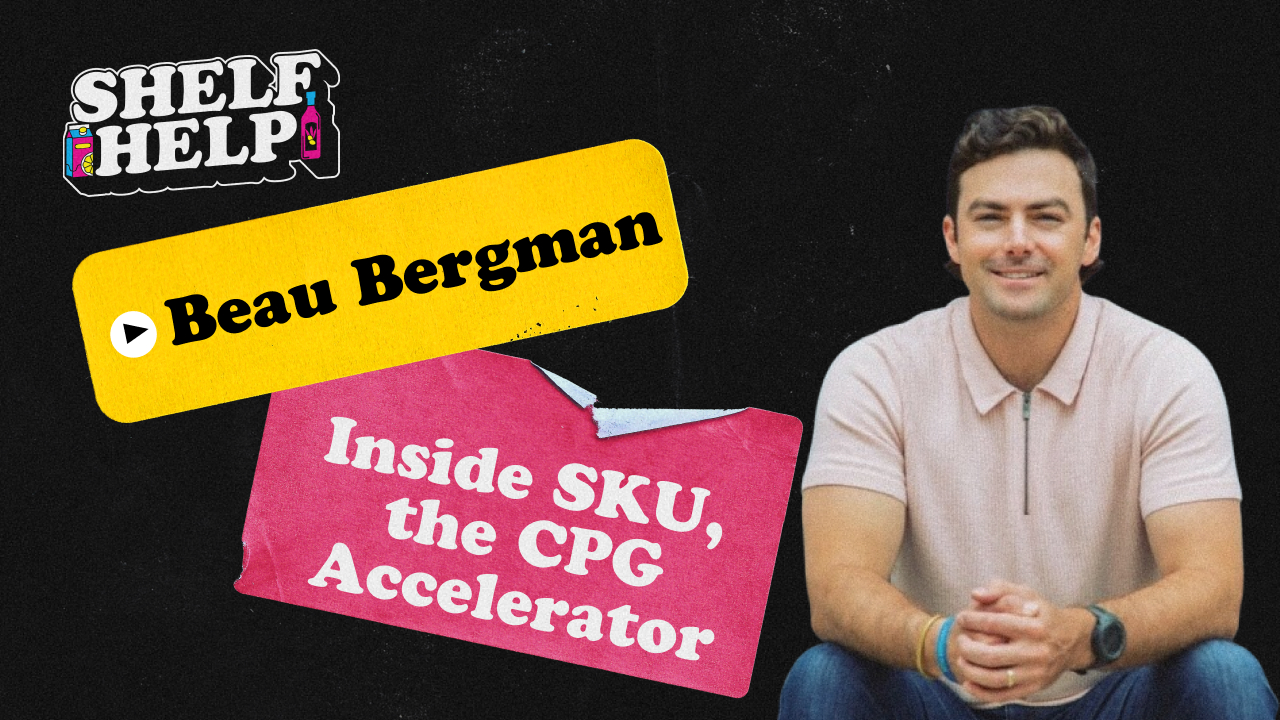



On this episode, we're joined by Beau Bergman, Executive Director of SKU - the CPG accelerator that has put more than 150 consumer brands through its program over the past 15 years, including Siete Foods, DUDE Wipes and EPIC.
Before SKU, Beau spent several years at VentureFuel building corporate backed accelerators for Comcast, NBCUniversal, Dick's Sporting Goods and the California Milk Advisory Board.
We dive into how the SKU program works: a 12 week track, eight companies per cohort, and the revenue band where Beau says SKU drives the most value, roughly $300,000 to $2.5 million.
We get into what founders get wrong once they are in the room, why fundraising strategy and hands on financial modeling are the most consistent knowledge gaps, and the value of mentors.
We also cover what corporate strategics look for in emerging brands, why chasing retail doors can be the kiss of death, and why a successful raise can make problems more complex instead of fewer.
---------------
Episode Highlights:
🚀 SKU's origin in Austin and 15 years of CPG alumni
📈 The revenue range where the program drives the most value
🧭 What a coachable founder actually looks like on day one
🔍 Diligence questions to ask before applying to any accelerator
🤝 How 800+ mentors get matched to eight companies
🗳️ The two rounds of mentor voting behind every cohort
⚠️ The fastest way to waste a mentor team
📊 Fundraising strategy and financial modeling as the recurring gap
🏭 Founders who switched co-packers mid-program
🥤 A beverage brand that moved from NA to RTD in 12 weeks
🏢 What corporate strategics screen for in emerging brands
💸 Why a successful raise can make problems more complex
🔭 TikTok Shop, protein, pet hydration and gut health
---------------
Table of Contents:
00:00 – Intro
01:06 – SKU's origin story and 15 years in Austin
02:10 – 150+ alumni brands and where they landed
02:42 – The revenue range SKU looks for
03:26 – What breakout founders look like on day one
05:09 – Diligence questions to ask any accelerator
07:39 – The mentor network and why it is the secret sauce
08:32 – Inside the mentor matching process
11:06 – How founders waste their mentorship
12:19 – Biggest knowledge gaps, from modeling to co-packers
14:27 – A beverage brand pivot from NA to RTD
15:35 – What corporate strategics actually look for
19:53 – What is broken in the accelerator model
21:35 – Where SKU grows next and the pet opportunity
24:24 – Know your numbers before anything else
26:18 – Which brands are VC fit and which never will be
28:53 – Alternative financing beyond equity
29:56 – The biggest opportunities in CPG right now
---------------
Links:
SKU – https://sku.is/
Follow Beau on LinkedIn – https://www.linkedin.com/in/beaubergman/
Follow me on LinkedIn – https://www.linkedin.com/in/adam-martin-steinberg/
For help with CPG production design - packaging and label design, product renders, POS assets, retail media assets, quick-turn sales and marketing assets and all the other work that bogs down creative teams - check out https://www.kitprint.co/
Shout out to my friends over at Glimpse, the go-to partner for automating retail-related back-office operations and unlocking margin trapped in invalid fees and manual processes.
Are you in the market for a new flexible packaging partner? Check out HD Packaging. Third-generation, family-owned and built for the needs of category leaders like Newman’s Own and A Dozen Cousins. Faster launches, lower costs, and no artwork fees.
Episode Transcript
Speaker: 00:00
All right. Welcome to Shelf Help. Today we're speaking with Bo Bergman, recently appointed executive director of SKU, Nation's leading consumer products accelerator. Before SKU, Bo spent several years at VentureFuel basically building corporate-backed accelerator programs within corporates for companies like Tomcast, NBC Universal, Dick Sporting Goods, California Mook Advisory Board, just to name a few. Definitely understands his accelerator very well. Also multiple-time founder himself, so understands really what it's like to build on the brand side as well. Yeah, super excited to get into it. I guess Bo, maybe just first off, for probably the small number of listeners in the CPG world that aren't as familiar with with SKU, maybe just love to just start off, just getting a quick lay of the land, just in terms of maybe as many, not as many people know about like the original origin story of SKU. Wake up a started, and then just high level just in terms of what the program structure looks like, and then kind of kind of brand states are at that tend to be the best fit for the program. And then uh we'll take it from there.
Speaker 1: 01:06
Yeah, happy to. And Adam, thanks for having me on. Uh really excited to chat.
Speaker 2: 01:11
Yeah.
Speaker 1: 01:12
So yeah, I was appointed executive director at SKU about six months ago. And I'm very fortunate because SKU is a longstanding program and reputation, and I get to build on top of that. So SKU started about 15 years ago in Austin, Texas, and was really influential in bringing Austin up as kind of the CPG hotbed that it is today. The original programs were all in person in Austin, and that really helped us build a very strong founder, alumni, and mentorship community that has continued on to what it is today, 15 years later, where we have a hybrid program. So we we kick off the program in person, typically in Austin. Then the program track itself is 12 weeks. And then the showcase, we bring everybody back together for a large pitch competition where we have a big audience, a panel of judges, and award prizes as well. You know, over the 15 years, we've worked with over 150 companies in the CPG world. Some big names that have come out of SKU are CATE Foods, Dude Wipes, Epic Bar, some more recent ones that have been growing quickly are like Leisure Hydration, uh Wild Wonder, Maza, and some pet products as well, like St. Rocco's Treats, Pup Centrals, Doggestry. So we kind of cover the whole CPG world, if you will. Yeah. And then in terms of stage of company that we like to work with, we we we like to see companies that are already, you know, in market and have a decent amount of traction. We've worked with companies anywhere from about 100,000 in annual revenue to about 5 million in annual revenue. But I would say even within that range, our sweet spot is is more along the lines of like three, $400,000 to about $2.5 million. That's really where we can we can really drive a ton of value for for those organizations. And not to say we can't for the for the outliers, but that that smaller range is is what we like to work with.
Speaker: 03:24
Yeah. Cool. SKU has definitely produced some of the biggest exits in CPG. When you look across all those success stories, is there anything that comes to top of mind in terms of common threads in terms of what those brands and our founders look like when they walk through the door at SKU initially?
Speaker 1: 03:47
Yeah, I think it's it's tough because you never know in the early days like what's truly going to take off. Obviously, you know, we we take bets on innovative products that are taking it, you know, taking advantage of or tapping into kind of more mac macro trends that are happening at the time. And I think the founder type that we like to work with are people that are just good people to begin with, you know, fun and nice to work with, smart and really just driven. Like we we like to work with the founders that if they get knocked down, they you know, they get back up with the mentality of, hey, I learned something from that, and I'm gonna put that to work to change the course of my business or you know, not let it really phase me or stop me. And on the other side of it too, we work with, you know, we we give these companies a ton of mentorship and coachability is a big thing. We we like to work with the founders that um you know are open to feedback, even even if it's even if it's tough feedback and you know, don't take it personally and really implement the suggestions or changes into their business to help get to that next level. So there's definitely a a a founder type, but it comes in all shapes and sizes, right?
Speaker: 05:05
For sure. Totally. When we chatted, I think it was a few months back at this point, we were talking about the accelerator landscape. And you I think I remember you calling out just that this accelerator mentorship landscape has become fairly saturated with various pitch competitions, programs, support resources for a founder that's evaluating all these different programs, which ones would be the best fit for them, which ones feel like it's gonna have the most value, and whether you know to apply to a program like STEW, what should their I guess diligence process look like? What are the key questions they should be asking when evaluating one of these programs?
Speaker 1: 05:42
Yeah, and there really are so many great resources out there. As like I wish I was a founder these days. It's there's just a ton of help and support and even capital that you can access through competitions or programs. So it's it's really great. I think the founders just need to be realistic with their expectations and where they are in their business at a given time when they're exploring programs. Not every program is for every founder or for every company. I think every community, every program brings their own different value. I think what SKU brings is a tremendously uh tight-knit and longstanding CPG expert ecosystem that has done this over and over again. And the community is very committed, and we've we've had a lot of success, and we've become really like a thought leader in the space. And you know, our goal is to help those companies scale to that next level, whether it's through strategic repositioning or preparation for fundraising or connections and introductions to investors and retailers. You know, that's that's what we bring. There are other programs out there that, you know, you may you may already be at a level where operationally or you know, strategically you feel like you're in a good position and you just need some introductions or something like that, you know, different programs might be a better fit for you at that point. But yeah, I think the founders just need to be really honest with themselves and and with their businesses and see, you know, hey, where do I need the most support? Is it support that I can get from a program type thing where where I have hands-on mentorship, or is it just you know meeting a few people and different networks?
Speaker: 07:37
And yeah, I think that's that's kind of like the high level. I think a lot of what I've heard about about SKU is that's that mentorship model is really uh a lot of the ways the secret sauce at SKU. I think you've got 250 or so plus mentors, a lot of them being founders of well-known brands like Vital Farms, Seventh Generation, Waterloo, Sparkling Water, etc. How does that mentor matching process work behind the scenes or stuff?
Speaker 1: 08:04
Yeah. Yeah, we actually over the 15 years, we have more like 800 plus mentors that have participated and have actually, you know, they they come back and they stay involved and engaged. And once you're in the SKU alumni or ecosystem, you know, you have access to those, those experts and those people for for the duration. And it's kind of like, you know, graduating from college, you're you're part of that alumni ecosystem. Uh yeah, the the matching process is interesting. We it's we always say it's kind of an art and a science. So we obviously have an open application period, and then we go through multiple stage evaluation process. Some of that evaluation involves uh virtual interviews with our team as well as a handful of our mentors. And the mentors have a hand in or have a say through voting on which companies make it to that final round stage that receive offers. So that's part of like the first phase of call it loose matching, where the mentors are like, okay, I believe in this business. I like this founder. I think my background or my experience could help get them to that next level. And then once we land on our eight companies who are offered a spot in the program, we, our team then sit down with each of the founders individually, and we have a rubric and like a list that we've built, you know, over the years and walk through line by line with them to discuss hey, where do you really need the most help? And this is where it's like, hey, we're really getting to know you here. We want to know the ins and outs of your business. There's no judgment here, there's none of that. And we help them prioritize, you know, the top three, four, five things that we think we can help them with in the 12 weeks, because 12 weeks goes pretty quickly. We then take that and bring the mentors together with our cohort of the of the companies that are accepted. And they it's essentially a welcome party or a launch party, and they introduce themselves. And based on our feedback that we have with the founders, they share to the broader mentor community hey, these are the three things that we really need help with. And then we go through another round of voting with the mentors voting on which companies, based on what they heard there, that they would like to work with and that they think they can provide the most value to. And then from there, we know a lot of our mentors' skills and expertise. We always try and build cross-functional mentor teams based on the mentors' backgrounds, the startups' needs, the voting. So it is it is a an art and a science. But it's always been, you know, we'll really well received for the mentors as well as the founders. And if there's ever a gap in our mentorship, we always you know fill that gap and and bring extra people in.
Speaker: 11:01
For some founders just recently got accepted, uh, they're gonna be part of the next cohort, they're gearing up to go through this matching process and everything. What are some like most common ways that you've seen thus far that founders may fail to get the most out of this mentorship partner?
Speaker 2: 11:22
Yeah, we always say you get out what you put in.
Speaker 1: 11:26
The founders that dedicate the time and show up willing and you know, ready to learn and ask questions, those founders get a lot out of this. And again, it goes it goes back to not have not having an ego, being honest with yourself about where your business is at and really opening up to the mentors because the mentors are here to to help you succeed. And at the end of the day, it's it's all relationship building. You know, we we provide a team of experts that you get to work with day in and day out who have incredible knowledge and years of experience. And we tell the founders, you know, run the meetings like you're running a board meeting almost. Like create relationships, be organized, keep people on track because the mentors are here to support, they're not gonna do all the work for you, basically.
Speaker: 12:16
Areas where you've seen thus far founders consistently coming in with the biggest knowledge gap?
Speaker 1: 12:23
Yeah, I think regardless of stage investor strategy, you know, fundraising strategies, do the due diligence classes that we go through to help them prepare to go on and fundraise and really like hands-on financial modeling, those are always extremely helpful for the founders. And I think it depends like on the cohort nick. Some companies are really strong on the D to C side of things and they're trying to break into retail.
Speaker: 12:52
Yeah.
Speaker 1: 12:53
So they they see kind of the the channel sales strategy courses uh class more helpful, or even like you know, distribution and and planning around that. Um but on the other side, if there's a company that is doing a decent job in retail but looking to do get better on D2C channels, get more efficient, you know, the paid advertising channel strategy on D2C, those classes are the ones that those types of businesses find more valuable too. So it really depends on the mix, but I would say fundraising, finance, just general channel sales strategy are always really, really valuable for the founders.
Speaker: 13:34
Yeah. And you think on the op side, like whether it's coming in and realizing uh their contracts with their co-packers or way out of whack or the 3PL they're working with is they ever charged.
Speaker 1: 13:44
Yeah, and we've yes, we we have had companies, you know, share with their mentor group, hey, here's here's my co-man, here's everything that we're doing, here's my my unit economics. And we've had companies change co-packers, you know, mid-mid-program because of the insight and support they've gotten from their mentorship and even connections to that next co-man. So, yeah, that's that's definitely a big part of it too. And we have worked with companies who are just producing at home and have gotten it to a level where they can no longer sustain and they're actually moving into uh co-manufacturers. So, you know, the guidance and support around that process is is super valuable for them.
Speaker: 14:27
Yeah. I know this is a really probably case-by-case basis, but maybe a specific example that came in with one plan left with like a completely different strategy, or they feel like they took, you know, a three-year jump in those 12 weeks.
Speaker 1: 14:41
Yeah, I think one of one of the more recent, or so this last track that we did, we we had a beverage company who was focused solely on kind of the NA category as either, you know, an alcoholic alternative or kind of a mixer type thing. And very early on in the program, they actually completely decided to shift their positioning to the RTDT category. Oh wow. So they went through, you know, somewhat of I wouldn't call it a rebrand, but they they started formulating new flavors, different can size, different conversations with the retailers that they were already in to reposition. And then, you know, the same goes for like rebranding and uh updating their marketing on their website and things like that, as hey, we're shifting from an A to more of an RTD beverage.
Speaker: 15:34
Yeah, that's a great example. Having built these accelerator programs on the on the corporate side for some some really big companies and going through that journey, what'd you learn from that experience about what strategics are are actually looking for when they're evaluating emerging CPG brands and what's on their checklist in terms of you know when they're looking at potential acquisitions?
Speaker 1: 15:57
Yeah, it's these are kind of case by case as well. Yeah. So I I'll talk about like California milk because we ran that program for five plus years, and their whole mandate was to increase the dairy consumption coming out of California. So volume of dairy used or gallons of of California dairy used and getting into the hands of of end customers. And it didn't, you know, the products didn't have to be in California as long as they use the California milk. So our whole goal with them was to find the most innovative companies that we thought were going to grow very quickly to use California dairy supply to get California dairy in the hands of of customers in unique ways. Uh smear Case is actually one of those, which I know they're kind of all over LinkedIn. They they went through the program, and that's just one example of kind of the innovative products that that did go through those programs. So I think for them it was very clear like, hey, we we need to work with companies that are going to drive the usage of California dairy.
Speaker 2: 17:06
That makes sense.
Speaker 1: 17:08
I think you know for other bigger strategics in in the space, and I'm not saying CMAB is not a big strategic, they they just had a very specific mandate. But um like the program I build at Comcast or or Dick Sporting Goods, they were looking at more obviously technology plays that were more strategically aligned to their core businesses. So anything that would help them, you know, make make their products or back of house more efficient, more profitable, that kind of stuff. I would I would think it's it's pretty similar if you look at like a Nestle or a Mondelez. Like I I didn't work with them directly, but I would imagine they're looking at products that are strategic strategically relevant to their core businesses or are potentially keeping lines of business relevant with different macro trends that are that are happening out there, whether it's gut health or nootropics or uh GLP1 uh type things.
Speaker: 18:16
As a result of some of those unique learnings that you got being on this corporate side for so long that you feel like are now have kind of shaped uh how you think about preparing brands in this in the SKU program that's maybe wasn't part of the SKU program before.
Speaker 1: 18:31
Yeah, I think you know, my experience working with the the large corporates, it whether it's in CPG or not, a lot of the thinking translates, you know, from a Comcast to Kellogg's or another big CPG type company. So I think we are trying to build SKU in a way that that is interesting in terms of like sponsorship or partnership with those larger corporates. There's some there's some other things that we're trying to do to get them more involved with the the companies that we are seeing and we are organizing and and working with because it really is like cutting edge. And a lot of those big corporates want to see what's they want to be first uh with everything. So if we can help them kind of open their their aperture and see what's coming earlier, um, I think that's a that's a big help. So, you know, I have one track under my belt, and I didn't, I'm not trying to rock the boat. I wanted to learn and understand everything and how it's run. And I think thinking through like big corporate partnerships for SKU is one of those things. Yeah, it makes sense. I think fundraising support and strategy for our founders is always really helpful, and we're gonna continue to do that. It's fundraising isn't the end all be all, but it does help those companies succeed and get to that next level.
Speaker: 19:52
This is a totally different different question, but I feel like it's useful for founders that are considering these programs. Anything, is there anything about the accelerator model in general that you feel like is is is broken currently or like ripe for disruption just in general across the overall accelerator landscape?
Speaker 1: 20:11
Yeah, and I I went through Techstars as a founder years ago. So I've been in the founder shoes, and I've also obviously built a number of accelerators. I think I don't know if it's necessarily broken, but it's always challenging. I it's the alumni, you know, keeping alumni engaged and supported is it can always be done better, and that's something that we're working on too, as as kind of our new team takes over in supporting our alumni better, whether it's through education, continued mentorship, support, like you're always part of the ecosystem, but structuring it in a way that is easier to access and things like that. And I I you know it's it's a hard thing to do because you're essentially building a new community after they just went through this intensive 12-week thing, everybody's really happy, and then the day after it ends, everyone's like, you know, almost sad, sad that it's over. So it's trying to continue that excitement and that momentum through organization of communication and resources and and all that kind of stuff. So I think that's something we're we're really focused on too, as as I, you know, as my new team takes the helm, and we have some exciting stuff coming up for for our alumni and and and our mentors as well.
Speaker: 21:31
SKU has expanded now into not just Austin, but I think it's in like Dallas, Fort Worth area, Atlanta, New York, Twin Cities where I'm at. Um where do you see the most opportunity for growth or or the next you know phase of growth for for SKU? Is it adding more cities, or what does that look like, if anything?
Speaker 1: 21:52
Yeah, so we actually we're fully remote. So we're nationwide. We we've done a a few, you know, before my time, there were a few of the Few city specific chapters that they did. We went back to the original just skew, uh fully remote. So we work with companies all across the country. We've worked with some international companies who are set up to do business in the U.S. In terms of growth. So we look at every everything CPG, whether it's uh beauty products, household goods, some apparel, uh, baby products, dog products. Food and beverage has always been our bread and butter, uh, no pun intended, but I think we're see we're starting to see a lot of growth in in the pet space. We we've worked with some really great recent pet companies, and you know, we're getting more involved in in that ecosystem. I'm I'm going out to SuperZoo and Vegas in August to speak on a panel, which is all pet products. So we're really excited about that. I think there's so many awesome beverage companies out there. Like we see a number of beverage companies apply each year, and everyone's doing something new and unique. Beverage is hard, but we we like some of the beverage stuff. But for us, it's really just going to the conferences, meeting people, getting getting insight from who's on the ground and staying ahead of the trends as we go through you know our application evaluation and things like that. So yeah. We just wrapped up our fall applications, and there's some really exciting companies that we're evaluating right now for this fall track. And yeah, we'll we'll continue to to kind of try and stay ahead of the the trends that are that are coming out.
Speaker: 23:40
Yeah. For a founder that's uh listening, uh they're in the early stages of of building their brand. They've definitely got some initial traction. Maybe they're selling in a few stores, or numbers are looking great on the D2C side of things. What's one thing, like top of mind thing that comes to mind first that you wish more early stage founders at this stage understood about scaling over the next phases that really start kicking things into gear?
Speaker 1: 24:06
I would say know your numbers, know your unit economics inside and out. Um, because that is the foundation for everything that you do. Um and obviously those those can change as you shift how you produce and and make your product. But that's really important because it helps you better strategize and build your channel strategy and ultimately your financial projections, which then goes into fine, you know, fundraising. So know your numbers, your your unit economics is really important. I think the other thing, you know, so these new brands get mesmerized with trying to get into retailers and number of retail doors, and they can be the kiss of death if you don't do it in a thoughtful way. If you overextend, you're always uh trying to keep your head above water. You know, working, there are costs associated with working with retailers, and and you really need to think through those and and get the type of support and mentorship if you don't understand those fully, to think through those opportunities. Because you know, going nationwide in a Sprouts or a Whole Foods off the bat would be awesome as a founder, but it it brings its own challenges and you have to be prepared for those the right way. Totally. You know, fundraising and thinking, you know, if you go out and successfully fundraise, that's gonna solve all your problems. That can potentially make problems more complex. Sure can. So I always try and tell founders like build a real solid business first. Yeah. And that goes back to the unit economics, that goes back to understanding your customer, what they like. You have to have a good tasting product or a good working product if it's not edible, right? And you you have to be solving a real need for your customers. And from there, you gotta have the good unit economics. So if you can build a sustainable business off the bat without having to go fundraise, like that's that's the best thing. The fundraising should really just be fuel on the fire to to reach more people.
Speaker: 26:17
Yeah. That's a great point. You just touched on the fact that not every brand is is VC ready at the time, or probably more importantly, are gonna be a VC fit ever, nor, nor do they need to be. Can you unpack that a bit?
Speaker 1: 26:31
Uh I think some of it depends on on what the founder ultimately wants, right?
Speaker 2: 26:35
Sure.
Speaker 1: 26:37
And I think product type too. Like if you have a very if your differentiator is like a beautifully handmade pastry or something that is really hard to recreate at scale, you're you're likely not a good fit for you know high growth DC, if you will, unless you can figure out a way to recreate that handmade version of your products at a larger facility. So, you know, there's real scare scale uh constraints. Uh, that's always one thing. I think there are other businesses where, you know, if you're like a pantry staple or or something like that, there's only I feel like it's only there's only so big you can get uh because it's very competitive and and oversaturated. And if you can carve out, you know, $100 million in revenue or $50 million in revenue, like that's that's really strong when people have you know a hundred different options to choose from, that's more of like a private equity route, right? As long as as long as you have uh the profitability in place and you have you know repeat customers and proven proven track record. I think it's tough too, being a founder, like you see all these companies get acquired for billions of dollars, you know, two two years into running. Uh yeah. And I think a lot of founders have that image in their mind and kind of chase that, which it can always happen, right? If you have a super unique product or a unique format, but that's that is the outlier. So it what is what kind of business do you want to build? Can you build it sustainably? And you know, nowadays too, it's it's all about like community and and social following and building almost like a habit around your product or business. I think that's what gets investors really excited is like, okay, there's more than just, hey, I'm gonna buy this drink once a week. It's like I live and breathe this drink, I wear the clothing, I have stickers everywhere. That's where I think investors really start to see those exponential growth opportunities.
Speaker: 28:53
Yeah. Outside of raising equity capital, which I think is the default for most people, what are any alternative financing options uh that founders should should know about that you sometimes recommend?
Speaker 1: 29:07
Yeah, and I'm I'm not the finance expert by any means. We we have people that come in for that. Um there's always you know PO financing, which you have to do very thoughtfully, but can can be very helpful. Um I always say like some of the pitch competitions and and grants are incredible opportunities. You know, you can get hundreds of thousands of dollars if you just put yourself out there and and pitch. Yeah. And you know, it ultimately helps you grow your network too.
Speaker 2: 29:37
So I think that's big.
Speaker 1: 29:41
Yeah, there there's a I I think there's a there's a lot of different options. You know, debt is is always an option, but like I said, I'm not I'm more of the the venture equity. Yeah, for sure, totally.
Speaker: 29:54
Uh last question or two for you. Uh you just see so many different brands, so many product categories. I feel like you have a really good grasp on what's happening in the space, where things are heading. Where do you see are some of the biggest opportunities in CPG right now in terms of whether it's categories or channels or business models?
Speaker 1: 30:15
Yeah, I think I don't I don't know if it's really a secret, but like TikTok shop is incredible and has completely taken off. And I think we are seeing a lot of like you know, social native CPG companies pop up and they're getting a tremendous following. And again, it goes back to that building that community of people who live and die by your your product or your company. You know, people are doing that just solely on social media, and that quickly garners a lot of attention and really helps you get bridge the gap in into into retail if if that's ultimately what you want to do. And by that time, everybody already knows who you are, which is which is you know really, really interesting and exciting. Obviously, protein, everything protein water, protein ice cream is is getting a lot of attention. I think I mentioned it earlier. I think there's a lot of excitement and opportunity in the pet space, whether it's like better for you pet treats, or you know, we're seeing products like pet hydration mixes, the the health and wellness uh focus that that humans have is now you know going to to the pets. And the I think that's that's really gonna blow up here soon. Specifically, this like pet hydration, uh electrolyte type thing, it's really cool. As well as you know, we had we had one of our portfolio companies pet packs, which is like dog nutrition on little almost like Listerine type strips. Oh, interesting. So it's a lot easier for the dogs to to you know ingest that. So I think there's a lot of innovation in the in the pet care space. I think with GLP ones and and everything going on there, it's it's all about gut health, whether it's pre or probiotic stuff and drinks and food and bars, uh, whatever you whatever format, like people are are trying to get more of that and as well as fiber, too.
Speaker: 32:20
Totally. Does all don't surprise me at all. I would agree with most of those. Those all make a lot a lot of sense. But yeah, but this has been awesome. I appreciate the time. I think this is gonna be super helpful for founders that are, you know, and about to in early stage, about to grow, considering SKU or some of these other programs. What's the best place for people to follow along with you and all your expertise, and then also best place to follow along with everything going on at SKU and where they should find if they're interested in applying for one of the upcoming cohorts?
Speaker 1: 32:48
Yeah, I would say feel free to connect with me on LinkedIn, just Bo Bergman. I'm not super vocal on any social channels, so if you what if you want to talk, just connect with me directly. In terms of in terms of SKU, you know, go to our website. We have a we have a newsletter where we post all of our upcoming programs, open application periods, events that we're hosting or going to be at. Uh, we will be at Summer Fancy Foods co hosting an event with uh the Well Network on the 29th. So if you're in New York, you can find us there. And yeah, go to our website, sign up uh for the the newsletter, and that's where you'll get all of our information. Perfect. That's great. That's a great place to point people.
Speaker 2: 33:28
Awesome.
Speaker 1: 33:29
Well, cool yeah, Bo appreciate the time. I think uh I think that's the pod.
.svg)