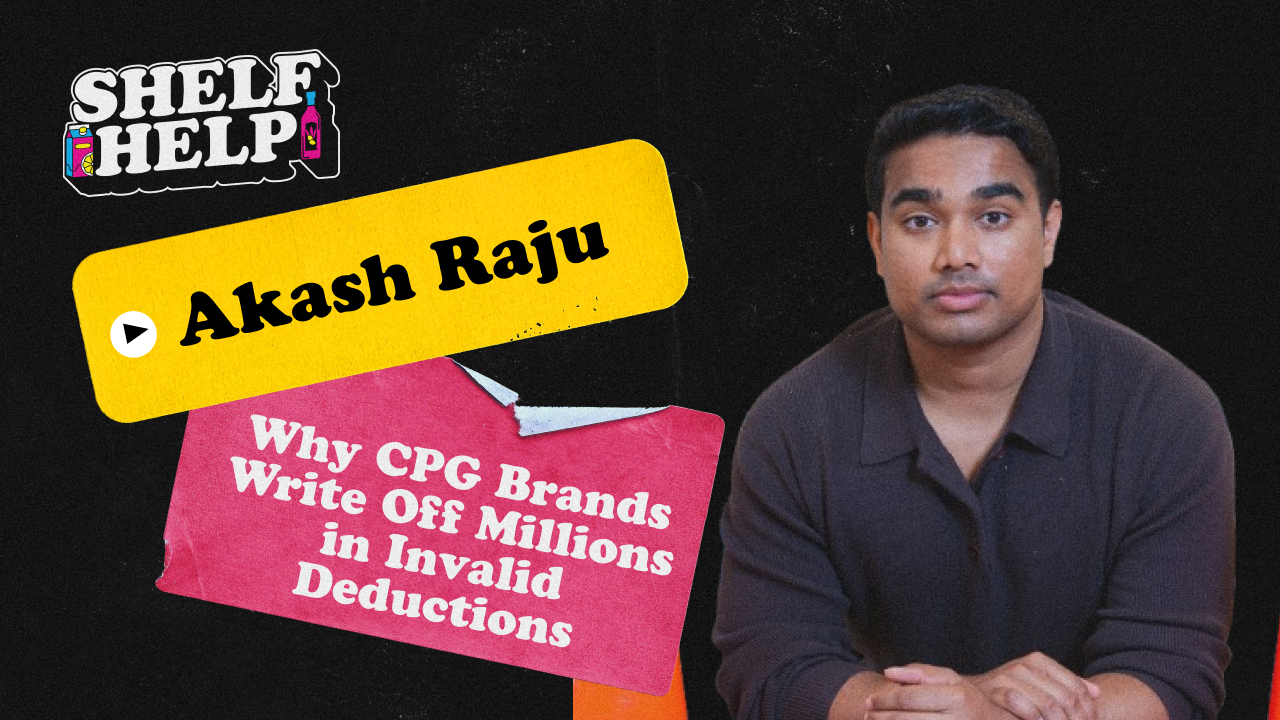



On this episode, we're joined by Akash Raju, Co-founder & CEO of Glimpse - the AI platform that automates deductions, revenue recovery, and cash application for CPG brands selling into retail.
Akash and his two Purdue classmates started Glimpse in 2020 as an Airbnb product placement business before hard pivoting into retail finance in 2024.
Akash breaks down the split between trade and non-trade, why brands hand back 20 to 30 percent of their margin to retailers, and why one to two percent of top line revenue gets written off as invalid whether you are doing $10 million or a billion. We get into what actually breaks scaling from $20 million to $200 million, and what a finance leader should triage in their first 90 days.
Akash explains why the industry missed the last decade of enterprise software entirely, why so many brands are stuck in pilot purgatory, and why he thinks real transformation starts at the data layer rather than the workflow layer.
---------------
Episode Highlights:
🏠 Placing CPG products inside luxury Airbnbs
🔄 Walking away from a seven-figure business to hard pivot
🗣️ 500 brand conversations across 15 months of pivot hell
📉 Why 20 to 30 percent of margin goes to retail deductions
⚖️ Trade vs non-trade and where invalid claims hide
🏪 Why mass retailers and distributors break differently
🧾 A finance leader's first 90 days on a messy deduction book
🎯 The 4x ROI pilot and the crawl, walk, run approach
🖥️ Why CPG missed the last decade of enterprise software
🤖 Getting out of pilot purgatory with measurable ROI
🧱 Why AI transformation starts at the data layer
📦 The shipping shortage dispute, line by line
🔍 Brands he's watching (BERO, Leisure Hydration, Create)
---------------
Table of Contents:
00:00 – Intro
01:10 – Purdue, Airbnbs, and the first business
03:01 – The hard pivot and 15 months in pivot hell
05:03 – Why deductions became the wedge
05:59 – The power imbalance between brands and retailers
08:42 – How the deduction profile changes as brands scale
09:30 – Trade vs non-trade deductions
11:42 – Concentrated retailers or death by a thousand cuts
13:44 – A finance leader's first 90 days
16:01 – The 4x ROI pilot and crawl, walk, run
17:23 – Why CPG missed the last enterprise software wave
21:04 – Getting out of pilot purgatory
24:56 – What AI transformation actually requires
27:43 – What breaks between $20M and $200M
30:15 – The shipping shortage deduction, line by line
34:52 – Trustworthy AI, human in the loop, build vs buy
37:33 – Faster, better, cheaper and the $40 deduction
39:45 – Brands he's watching and Martha Stewart's old test kitchen
---------------
Links:
Glimpse – https://www.tryglimpse.com/
Follow Akash on LinkedIn – https://www.linkedin.com/in/akash-raju/
Follow me on LinkedIn – https://www.linkedin.com/in/adam-martin-steinberg/
Shout out to my friends over at Glimpse, the go-to partner for automating retail-related back-office operations and unlocking margin trapped in invalid fees and manual processes.
Are you in the market for a new flexible packaging partner? Check out HD Packaging. Third-generation, family-owned and built for the needs of category leaders like Newman’s Own and A Dozen Cousins. Faster launches, lower costs, and no artwork fees.
Looking to dominate the cognitive health space? Upgrade your formula with Cognizin. It’s the branded, clinically backed citicoline trusted by top innovators in supplements, foods, and beverages. Differentiate your brand today at Cognizin.com.
Episode Transcript
Speaker: 00:00
Welcome to Shelf Help. Today we're speaking with Akash Raju, co-founder and CEO of Glimpse, AI native platform that's really becoming the go-to platform for CPG retail finance, whether it's deductions, revenue recovery, some cash applications, kind of the whole AR back office to a certain extent. Akash's co-founder started Glimps, I think back in 2020 or so, with a bit of a different focus, hard pivoted into deductions and focus at least initially on deductions in 2024 or so. I think I've been scaling pretty fast ever since. I think 200 plus brands, clients, 91 plus dispute win rate, north of a billion dollars in invoices flowing through the platform. Just raised, I think, upwards of 35 million or so. Series A led by Andreasen Horowitz, which is a very well-known firm. So a lot of exciting things going on. But yeah, Kosh, maybe just kind of first off, just kind of set the land. Anyone maybe that's not as familiar with Glimpse, love to just get kind of like a clickway of the land just in terms of origin story, maybe why behind the pivot into kind of what the focus is today, and then just kind of high-level overview in terms of what you know what the platform actually owns today across the kind of retail finance stack, and then who it's best for these days, and then we'll take it from there.
Speaker 1: 01:10
Yeah, of course. First of all, thank you so much for having me. Definitely, you know, really excited to share a little bit about our story and then yeah, big fan of the podcast. Um yeah, so I'm Akash, one of the founders and CEO at Glimps. Our journey is a little bit interesting. So Glimps as it is today, we've been in market for the last, you know, two, two and a half years since April of 2024. But our journey, yeah, is now six years in the making. So I met my two co-founders in college. So we all went to Purdue, it's not in the Midwest. We're all, you know, we're studying engineering, so technical by background, and actually started Glimps as a company back in 2020, right before COVID. And our first business, um, you know, was kind of serendipitous, but we got really deep into the CPG and consumer space because we were helping brands place their products through Airbnbs in boutique hotels as a form of experiential retail. So imagine a new up-and-coming coffee brand or a betting company could use, you know, luxury Airbnbs in a certain region as a form of product placement with a direct funnel for conversion. Really cool concept because we met a lot of brands that were, you know, direct to consumer first. And this was a good foray for them into retail. And, you know, we built this business for about three years, actually did really well during COVID because folks were staying more in Airbnbs as opposed to hotels. And you know, the business grew fast, grew to a seven-figure revenue quite quickly. But we kind of had some learnings along the journey where one, we learned a lot about the infrastructure of distribution and selling into retail. But, you know, for our business, we kind of realized, you know, that the business would plateau at some revenue scale. And, you know, we had the aspirations for raising a uh building a large venture scale company. So fast forward to the end of 2022, probably you know, one of the hardest decisions that I've had to make as a founder, we ultimately made the decision to move on from that business and effectively hard pivot. And for the next 15 months, we were kind of in like pivot land or pivot hell, whatever you want to call it, and spent that period effectively serving as like AI consultants for brands. So we learned a lot about like B2B distribution, shipping products, and we actually spent those 15 months. You know, we probably spoke to over 500 brands in that period and effectively kept just building solutions for brands across their back office. And, you know, as we got really deep into the world of the retail back office specifically, it was just fascinating, you know, retail C and CPG just generally, you know, it's a multi-trillion dollar industry in terms of just GMV and retail sales, but it's one of the like largest categories of back office labor as a result because of all the classic problems and what you see in like the AI landscape today. So a lot of messy, unstructured data, so PDFs, Excels, TIFF files, you know, everything you can imagine, a lot of disparate systems. So, you know, you think of like an ERP as a big expenditure in this industry, but that's just one source of data. You know, a lot of data from retailers comes in, you know, dozens of disparate retail portals with completely different formats. Portals were probably built 30 to 40 years ago. Um and then, you know, like a lot of data that lives on Excel, so like sales and trade plans. You know, you have some companies have warehouse management systems, but a lot of times it's bill of ladings on the factory floor that may be in like a file cabinet. So a lot of messy data. So as a result, a lot of the work happens on top of this across a lot of different teams. So finance works with supply chain, works with their marketing team, and you know, the data ends up becoming the fundamental bottleneck here. So as we kind of came up with this thesis, Glimpse, you know, ultimately our broader thesis is to be a system of action for broader retail operations. But when we kind of came to market, we saw a massive opportunity to really help in one specific area to start, which is the pro the space of deductions. So brands, when they sell them to retail, they allocate about 20 to 30 percent of their margin to retail deductions. A lot of these deductions are valid. You know, it's a lot of like trade spend, which is kind of like retail marketing and sales, and there's a lot that are kind of allocated to supply chain compliance, et cetera. And kind of like, you know, the big insight here is that about a percentage are invalid, and about, you know, brands lose about one to up to five percent of their top line revenue to invalid deductions, and it's usually just written off. So there's a really unique opportunity for us to basically deliver that outcome, putting direct dollars back into the PL while centralizing a lot of this messy data and building a full schema of this data that can talk to each other. And that's kind of what Glimps came to market with in April of 2024, and it's been a really exciting journey since then, which I'm sure we'll dive into.
Speaker: 06:00
Just for a long time, it just seems like the standing assumption in CPG was just kind of that deductions are just kind of a cost of doing business. You eat a couple points, move on, and you guys build glimpse on the premise that it doesn't necessarily have to be that way. And I think I've heard you talk about the power imbalance between brands and retailers. Where is that imbalance most maybe lopsided today? And and where do brands actually have maybe more leverage than they think?
Speaker 1: 06:26
Yeah, yeah. No, it's a really good question. And you know, taking a step back, ultimately just like deductions, it is just a form of communication between retailers and brands financially. It's like just in B2B transactions in general, the form, you know, you receive a purchase order, you fulfill it, later on you get paid. And then any line items on that payment are just a form of like how what sort of happened. So it's like the actuals. And you know, this kind of falls broadly into like the accounts receivable stack, you know, in finance, there's a parallel accounts payable stack. So this is all kind of just like the flow of communication. Um, but ultimately, you know, for a brand that's heavily based in retail, which is ultimately where most consumers shop, their relationships with retailers are what drives them revenue, and they're extremely important to maintain, um, to succeed in and allow them to scale. And retailers have all of these policies that are extremely important to follow, to work with them. And there's a lot of like in the journey of a brand, all the way from just starting a CPG brand to becoming, you know, a multi-nine-figure revenue business, you kind of grow through these channels through distributors, to retailers, you know, there's and then you break into the Walmarts and the Costco's that drive, you know, tens of millions to hundreds of millions of dollars of revenue. And I think that just creates a natural dynamic where ultimately, as a supplier, you have to follow the guidelines and allocate your trade spend in the, you know, it with the retailers. But the retailers are the ones setting those policies. And I think that's ultimately what drives a lot of, you know, this potential imbalance. I think for a brand, yeah, I think the biggest thing, right? There's a lot you can control in your operations to become a more excellent supplier, like there's supplier scorecards, etc. But there's also processes where if you have the opportunity to review like deductions that are a really good example, or optimize your trade spend, you can effectively improve your margin. So I think like the ability to automate some of these like really menial, like centralized data, make that data usable. It provides intelligence that can then power these operations and then ultimately get to the workflows like identifying any invalid deductions and recovering those dollars, or finding a way to improve your margin by twice because of an initiative. And that's like kind of what our thesis really is like help these brands just operate better.
Speaker: 08:43
That totally makes sense. More recently, you guys have started going up market again and started working with brands that are a bit bigger. And I'm curious in terms of how the deduction profile changes the brand scales, let's just say 10 million a year to 80, 100 million a year. How do things change as that brand scales?
Speaker 1: 08:58
Yeah, yeah, 100%. I think, you know, first taking a step back and like if we think about it from the lens of like a PL, deductions are, you know, the actuals that are kind of coming in. A lot of the types of deductions are a cost of doing business. So they linearly scale to revenue. So the general percentages of what your deductions percentage is in your PL is pretty consistent from a small business all the way to a multi-billion dollar business. But I think the important nuance here is there's kind of like two general buckets of deductions. So there's like trade deductions, which are basically the actuals of your trade spend, which is your like effectively when you're on shelf at a grocery store or any retailer, like the buy one, get one free hand tag, like the marketing promotion, anything like that, that is trade spend. It's basically like your marketing dollars. Yeah, exactly. And then there's non-trade, which is compliance fees, any issues with supply chain, uh any like technology or early payment, like non-trade is basically everything that's not trade and is the general bucket. And there's kind of like two areas of like how businesses kind of think about this. So on the non-trade side, that is where most of the invalid deductions kind of come in. And then trade is basically like it's a much larger dollar amount. But what you're trying to, most of the trade deductions you're receiving are valid. And it's really just how can you kind of optimize it? And for brands, in terms of their marketing strategy and the type of business they are, like that's ultimately what changes on the trade side in terms of like the overall budget. Like a really efficient, large business household name, their trade deductions might only be like 10 to 15%. Whereas an early stage brand might be spending 20 to 25% of their revenue because they need to brute force their presence in the market. But I think the thing that holds true is their non-trade deductions, that percentage and the percentage that are invalid in terms of revenue loss, it's kind of pretty consistent all the way from a small brand to a really large company, where it's about like one to two percent of their top line revenue that's being written off. The things in control of the business as they keep getting larger is just more resources to become excellent at their supply chain, to become a lot more efficient in their trade spend. And then I think the other thing that kind of changes from a PL point of view is how much labor are you allocating to improve these things, to recover dollars, and ultimately use this general bucket of deductions as a way to improve, to improve your PL. And small businesses don't really have labor or bandwidth tackling this, and large companies typically have teams of people dedicated to this.
Speaker: 11:42
When a brand has gotten to a certain scale where they're in 20,000, 30, 40, 50,000 plus doors, have you found that it's concentrated at kind of a handful of retailers and Mandor kind of distributor relationships, or is it pretty death by a thousand cuts?
Speaker 1: 11:55
Yeah, yeah. I mean, you know, honestly, both answers are kind of true. Where I think ultimately, like the types of deductions that come in that come from a retailer, it is really ultimately their process in which they provide the deductions and the mechanism as a result. So for example, some of the mass retailers, you know, like um are such high velocity. So then like the deductions they're sending can get a higher frequency and lower dollar amounts because like a high frequency. Whereas the complexity with distributors is that they're a middleman. So then each deduction being received is super complicated because it's like what retailer is it then tied to? Because you're receiving the deduction from the distributor. And then there is, you know, the long tail of so many different types of retailers where systems are just older. So processing the deductions is way harder. So there's kind of like two workflows that I like to think of in terms of like complexity. So there's one, which is like the mechanism of like processing and clearing the deductions, where it's like, yeah, like a lot of the long tail retailers, it's like really like really antiquated processes. You're receiving things in like email, completely different formats. And there's like frequency of deductions, which a lot of the large retailers that can be concentrated, like like an Amazon, Walmart may have. So I think, you know, the like this, it's both. It's like there is just like so many deductions, which I would consider like a bottleneck in the reconciliation process, which you know, even if you're not disputing deductions, it's just a bottleneck to close the books, which is like a fixed process that the team has to do every single month. But in terms of invalid deductions and the opportunity for like recovery, I think that kind of varies a little bit retailer by retailer, and complexities are like dependent on the retailer as well.
Speaker: 13:44
Yeah. For um, I don't know, finance leader that's stepping into a new leadership role, or they're getting promoted, or maybe they're coming to a new company and they're inheriting a fairly messy deduction book and kind of processes internally at a you know, brand that's somewhat scaled, 50 million plus a year. What would be two or three things they should from your experience, what you've learned building glimpse thus far, that they should triage or focus on first in the in the first 90 days that may have the biggest impact?
Speaker 1: 14:13
Yeah, yeah. Yeah. You know, I think at this point I've spoken to well over thousand CFOs, both from a discovery and a sales prospect across all revenue stages. But I you know, again, like I like, and I think this is how I think a CFO thinks, but it really is kind of like I think like an axis of like working backwards from the PL and like areas of opportunity, and then an axis of difficulty of implementation and like where do the wins kind of come from? So, like, yeah, you know, it's like your trade budget is a big area of opportunity to optimize, but like the way to kind of make that happen may start by working with the sales team as opposed to like going to like look for a software solution because that is a process automation thing. On the flip side, like you go to your supply chain and there's analyses and things to be done around like which retailers are more consistent, you know, pain points of late fees, et cetera, et cetera. Or is there a specific relationship on like how you ship to a retailer? Like those are like bigger wins that are more like I would say like analytical, needs a lot of deep dive. And then there's a lot of like finance processes. Like, are there ways to like speed up AR processes, AP processes, et cetera? And then in terms of ease, I like to kind of think about it as like where can you find like quick wins or like no-brainer use cases in terms of like bringing technology in to help these processes? Because I don't think every solution for a CFO is a technology or an AI optimization. It really is like looking at the PL holistically and showing a PL improvement. And that's kind of like like the way we designed Glimps was kind of with that thesis of like thinking about that end user, where like for us, we try to like, I like to think of it as like a crawl walk run where like when we work with a CFO, I like to call Glimps like a practical use case of AI. Like this is like a right, this is something that's being written off or like not being tackled before, and it's like not a good use case of labor in terms of the revenue recovery piece. And we actually run like a pilot where we're just like, let us just show you how the AI kind of works by looking back at your historic deductions, and then you'll you'll always find some optimization, and then glimpse adds no incremental cost to PL because it's all like covered multiple times over. Like we target like a 4x return on investment, so that's like a quick win. And I think that can be in parallel to like, you know, for example, a lot of CFOs and CIOs also like come in and they're like, Oh, we need to like you know, bring in a new ERP, and that's like a 12 to 18 month investment because it's a full change in like business processes, and that is like a big win in like a tenure of a C-suite exec, but that's like especially in a world of AI where you can find quick wins, it's like a much longer investment, and that's kind of how I like to think about it in like that two by two axis.
Speaker: 17:05
There's a lot of talk about AI and CPG, right? Probably more talk than than action, I would say. Yeah. You just talked about AI pilots. It seemed like a lot of people are running AI pilots. What separates the brands that are actually getting real ROI from the what from the ones that are just stuck in pilot purgatory?
Speaker 1: 17:24
Yeah, no, it's a really good question. It's something that like I feel like very uniquely in the weeds around both from uh both from obviously glimpse, but then just generally like learning in the field. And yeah, it's it's really interesting. I again, I think like, you know, this industry, it's really fascinating, especially coming from a tech point of view where it's like you see a lot of tech companies selling to other tech companies. Like because you know, I I think maybe like my most like like aggressive take here is that the last decade of like enterprise software companies that came to market, it didn't really impact the CPG industry, which is why in the CPG industry you really see like a lot of the like like Oracle SAP, like these are the types of companies that have like really strong like market share and like what executives think about, like you know, it's like a very natural progression to move from QuickBooks to NetSuite, right? Yeah. And at the enterprise, you'll kind of see like Microsoft Dynamics or like there's a really massive SAP ecosystem. And in the other extreme, if you think about a lot of like the like consulting firms, like Accenture, IBM, Deloitte, like in these businesses, one of their largest verticals of practices are is CPG and retail, because this industry, by not really being impacted by the last wave of enterprise software, it's really evolved a lot in the frame of like a lot of back office labor. You see a lot of like outsourced labor shops, BPO, which is business process outsourcing, like a lot of those types of solutions kind of implemented in these companies. And it's because I think it ultimately ties to like the data is just ultimately fragmented. The data kind of moves in like unstructured data sources like PDFs, Excels, and a lot of communication and the work happens in the classic, like a million Excels. Like if you kind of go to any back office of a CPG doing over even 30 million or 20 million, yeah, like and you meet an operator, it's just a ton of ton of Excel's. And as a result, there's no like APIs in the industry. There's none of the fundamental things that enabled software to impact other industries. So now when you kind of think about AI, I think there's like an extremely aggressive AI mandate that's kind of come to this industry more generally, but there's not like there's not a way to kind of measure success because you kind of have three buckets of like how a CIO or CFO is like thinking about AI. There's like, oh yeah, we see chat GPT and stuff colloquially, like in our day-to-day lives. You know, it's like a massive rollout of licenses there. It's like something that's just changing work of like day-to-day employees. Then there's you know, this concept of measurable ROI. But you know, I think like one thing that's been really interesting in this glimpse journey is like the definition of ROI can be very stretched out and like in a multitude of like like what actually is delivering ROI. Like, you can run an analysis of like a software implementation and then create a lot of different metrics and say that that was impacted ROI. Like you're trying to find a way to impact the PNL through being three steps detached. And then I think like one thing that's been really fascinating in I think the world that Glimpse is playing in, which is like workflow automation. Like, can you actually like deliver an end-ten workflow that can either be measured in direct dollars back to the PNL or like measurable, like a like a labor automation or like time saved, or something that can be like very directly measured, which I think AI can fundamentally do for the first time. Yeah. Um, so I think as these executives are kind of like thinking about AI, I think that is what's really happening in terms of this like concept of like pilot purgatory, which is the ROI is like not measurable, but there's an aggressive AI mandate. So it's really hard to know like if is this actually making the business better. And yeah, you know, I I think there's like two extremes of this. Like, I think very much in the lens of like bottom-stop, like measurable workflows, dollars, etc. And then you also have the top down where it's like board level priorities and like insights and stuff are extremely important. And I think there's a place for both and also a place to kind of marry them. But ultimately, I think like right now, at least my advice to executives is this like like if you're gonna like dupe like always ask for pilots, like sh try to show a very clear ROI and expand. And if a company is not willing to do that, like that means the ROI is not clear.
Speaker: 21:52
Yeah. That's yeah, that's that's gonna kind of answer the next question I have I have. I was like, why does it feel like things like deductions and trade spend reconciliation are you know kind of of a I don't know the right a wedge for AI rather than you might call them flashier use cases like demand forecasting marketing and that I now kind of answers my question is like you can clearly say you're helping reduce deductions that clue saving money. That's a much more clear ROI versus those other ones that yeah flashier but maybe a bit more ambiguous in terms of what they're actually you know impacting from an ROI standpoint. Is that basically kind of what you're saying?
Speaker 1: 22:23
Yeah at a high level you know I I think in an in in an industry like this that's extremely low margin, there's basically only two things that I would consider like extremely useful from an external vendor point of view, even if it's software or service you're either driving top line revenue growth or improving bottom line margins. Like anything else in the middle is just really hard to measure value. And in an industry like this that's so low margin, I just don't see like how like it can be like that useful. Yeah. So for example like I think like something like demand forecasting has been a hot category for a long time and practically you'd think like oh like like AI can help with this. I think like the fundamental problem with demand forecasting is the data wrangling work. Like you need all the right data to then actually be able to drive insights and that's the biggest bottleneck. And so a company that will do that well has to solve that problem first. So like in terms of like art my thesis around glimpse deductions trade spend optimization optimization even trade spend optimization actually it's like very useful. If you can impact trade spend and help improve the quality of it very useful but fundamentally very hard to do without the data being in one place. So that's why like you see a lot of analysts and teams at enterprises focus on this because that's where the Excel work is coming into place because the analysts are stitching together all that data. I think that you know I think that is being solved more a part of why like at Glimpse like deductions is also useful because we ingest a lot of different data sources so the data's already kind of talking to each other so the workloads can be faster. But yeah I I think in an industry like this I think back office automation is very valuable because it's very measurable and direct impact on PL. But I do think in like winners in the space and just like more generally impacting the industry for the better with AI, those are the two buckets that if you can drive measurable growth or improve margins like you're useful.
Speaker: 24:24
Yeah that makes sense too when people say AI transformation like I feel like I hear a lot of people generally seem like more outside of the CPG space and more the tech space in general like maybe it's the guys on the all-in podcast or something where I feel like a lot of times you hear people saying that some of the challenges are patterns where where companies that are implementing AI but are not really seeing the level of impact that they think they might is like they're trying to just implement AI within their existing the way that their their business works versus really having a transformational change in their company via AI they actually have to change the way that their company like operates holistically if that kind of makes sense. When you hear the term AI transformation, what does that mean for you?
Speaker 1: 25:00
It's it's really interesting because digital transformation has just been a term like for so long. That's like what one of the biggest practices of consulting yeah I I don't think like fundamental AI transformation is possible without impacting each step of like like the way I kind of think about it is like the data layer, the app layer and this is also where like a lot of the team is and then the workflow layer like even workflow automation which you know I I find very interesting like that isn't really like like that if you go end to end is useful but the concept of like like for example there's like some broader workflow automation companies like Zapier and things like that. Like sell that to like a CPG enterprise is quite hard because you know like when they were selling to other startups it was interesting because they were like it's like you can just make an account and then start figuring out your workflows you want to automate. But that's because me as the end user knows that I want to do that. But if you're trying to transform like that behavior doesn't naturally exist. So you can't just try to transform at the workflow layer. And all I I still think everything in an industry like this starts at the data layer. Like the data's like not in a place that's like generally like can be talking to each other like agents and the concept of agentic AI can't really do anything. And then I think the other thing is like you we've kind of even in the AI era we've seen the evolution from like co-pilots to agents. Like if you think about like just marketing in the last like five years like when GPT 3 came out and chat GPT first like became popular you're hearing the term of a lot of like AI copilots for X, AI copilots for Y. And now you're hearing AI agents for X and AI agents for Y. And this is like the evolution of going from like being parallel to someone doing a workflow to trying to automate the workflows. And I think if we tie this back to the concept of AI transformation I think this is ultimately what happens where if you're not you do have to drive change management all the way from the data source to the people and then you either have to free up time reallocate labor or upskill. Like I think like those all have to happen to actually drive transformation within a business and even like in our company right like one of our core values is like AI in our bones and like we like like shout out whenever someone's AI pilled driving an AI use case. Like that's just like an example of like AI like being AI pilled and I think like that also has to happen at an organization. So yeah I I think that's why like AI transformations like fail. Like it's just culturally not changing or they're trying to just impact it at the workflow layer and not actually impact the data underneath.
Speaker: 27:43
Yeah. You you you touched on you know workflows and back office workflows there a few times. Like let's just say from again you've seen you've talked to so many finance leaders at this point when a brand is scaling from there's just say 20 million to 200 million what's the some of the first things that really start to break when they're scaling but they're not really ever implementing any real fixes from a back office workflow standpoint.
Speaker 1: 28:07
Yeah. I mean just like so if you think about 20 to 200 million, right? Like every process that includes a repetitive workflow right now just scales exactly one to one to that. So that can be all the way from like if you have an ops team member that is like looking like comparing two documents for every transaction or like even putting data into a system like like pushing data to an ERP or like if we use the deductions example since it's like easily understandable. It's like if you pull deductions from the retail report every week or every day or whatever it is like all of those processes scale linearly. So then with people even if you have like like you know it's like in the ops world right like the term is like an SOP a standard operating procedure like that is like the current solution to solve problems. Like you map out a workflow you create an SOP and that just occurs repeatedly and then you basically find the max capacity in which one person can do this follow this SOP and then you hire another person. Like that is the linear way of like scaling and it does kind of require taking a step back and like doing an audit of all of these processes at certain points of time and and innovating on them. And then you know I keep harping on this one point but this is how you kind of make like incremental changes in terms of like workflow automation. You find repeated workflows you automate them and then that can just do it scalably. I think to find like truly like fundamental changes to process it does start at the data level I like I'll keep kind of saying this in an industry like CPG where every single document sort like every single source of data you're receiving is unstructured data which is like PDFs, Excel, etc if that data doesn't fundamentally talk to each other, you're only going to be able to make optimizations on like the one data source in the workflow tied to that. Like for example, deductions easy for me to speak about a really good example here is in one type of invalid deduction, it's when a retailer or distributor is claiming a shipping shortage. So they're saying that you didn't ship enough inventory on time. You receive a shortage deduction that has a PO number on it like you read the document as a human it has a PO number on it and different SKU quantities. You then have to go ping to your ops team to get that specific bill of lading and proof of delivery from that purchase order. And then you're manually looking at that the SKU names are kind of different but then you're going line by line and seeing like this is saying we shipped in full this is saying we didn't it's matched up on the PO forever in a business these will live in different systems. If that data was in the same system and the PO numbers were already linked that becomes a fundamental optimization for running that workflow. So I think like you can make incremental changes with workflow automation by just finding any manual repeated workflows that you have to keep scaling with people. Real innovation I think comes if your data can talk to each other. Yeah for all these finance teams and leaders that you're talking talking to what have they what have they told you in terms what they've been able to start focusing on spending more time implementing and that they haven't been able to historically I guess like the one other reason that re revenue recovery especially and just like deductions is a really interesting like use case for wedge for automation is because there's like no one that like like wants to do this work in a way. And you know it's like you don't go to college to study deductions. You go to college to study finance and accounting and you and then you know it's like you come into the CPG industry and then 80% of your job when you're scaling becomes pulling these deductions and trying to like categorize what they are just so you can close the books. Because closing the books is ultimately the job of an FPA team. And the beauty of something like this, but also I think like the glimpse model specifically which is end to end which is like like I like to think of us like less so as a software company and more as like an AI service, which means we deliver an end outcome which is like the measure of success less so than just dollars back is has this been completely taken off your plate? And like I like to think about it like I've been as a as an operator myself I get pitched so many AI tools all the time so many software companies all the time if I still have to think about it it's like not like it's like this doesn't save me any time like my brain is like the thing that's most like like I want to free up time there. So I I think with this like when we're able to successfully work with the client and this can be taken off the plate like all of the actual work a finance team needs to do which is like I like to think about it in like a three pronged way of like like the most useful times when you can focus on like driving insights and real analysis, board level reporting and like tie to your board level objectives as a business. Then it's like where can you free up like labor time and then it's like this sort of like reconciliation type work. So I think like what we most commonly see is closing the books can become more of a priority. You can close the books faster like that can be measurable. You can focus on analysis and insights to improve trade spend you can focus on insights to like drive strategic projects that are like board level objectives. And that's like when I think a finance team can like really thrive and flourish. And same thing like we talk we're talking about finance now. The other thing about something like deductions is it's a inherently a cross functional workflow because finance is just receiving the source of information but the people that are like I guess like driving the deductions are sales and marketing supply chain and if you talk to any sales operator right like in any industry the KPI of a sales operator is to sell. So anytime that they get stuck in like manual processes explaining deductions that is less time for them to make revenue. And the same thing a scale a scaling team a supply chain team's job is to ship inventory on time and improve processes to keep doing that. So anytime they get stuck in like pulling documents trying to find a PO that was happened like six months ago they can effectively do their KPIs I think maybe the simplest answer is to like actually do the tasks and the projects that are tied to their true KPIs because this isn't like deduction processing is ultimately like an ancillary workflow which is like and but it ends up there's a power law off time and like ideally in an ancillary workflow you're only spending 20% of your time it's like flipped for a lot of scaling teams.
Speaker: 34:42
Comparatively it seems like finance is is more unforgiving when it comes to errors and accurate numbers how should CFO finance team kind of think about the risk of AI getting something wrong what is kind of trust trustworthy AI and finance look like in this kind of multipart question that's and then kind of related to that how should the CFOs and people making these decisions especially with all these AI tools out there thinking about build versus buy scenarios?
Speaker 1: 35:07
Yeah that is you know a very very good question. And it's actually something that I think is like a very real thing that if I was on the other side of the table or even me with like tech company like I'm evaluating as well because this kind of goes back to what I was mentioning on like ancillary workflow versus like core workflow where like trust in AI as an output matters a lot. And the trust thing is what then it's like even if it's automated you then have to go back and like check or whatever. So I think like you know very obvious use cases you know it's like ancillary workflows. I think it's like you know f fine to kind of use an end-to-end AI type thing because it's an ancillary workflow. It doesn't change like core business processes like something with like deduction disputing right like like we claim to be best in class that can be measured but it doesn't have to be a hundred percent in terms of the dispute being submitted but yeah something like ERP reconciliation in the cash application process which is another thing that Glimpse does like accuracy of like the coding to the general ledger being pushed like that is a core workflow because that is like a and trust becomes really important there. So then who you're partnering with like we have a lot of checks and balances and actually have a human in the loop that becomes trained on an account to understand these types of things because then you can trust that full automation. And then you know there's cases where like more of the traditional like co-pilot format becomes useful where it's like a person is still owning the workflow but can they become 20% more efficient because one part of it's automated like if that can be measured and there's an actual optimization to the workflow like that becomes a better format of work in certain things which we see like in all types of use cases. But that's kind of the triage I think like core workflow versus anti workflow. And that is kind of like with the grade of salt like I I use Claude for like a lot of things but there's certain things that I'm like reviewing all the work and like making sure that it's doing X, Y, and C and other things that it's like okay for it to be foregone.
Speaker: 37:11
Let's just say old map with $40 shortage deduction probably costs more from a labor standpoint to actually dispute it. Costs more than it was actually worth it dispute it. And that's probably why a lot of these brands are just kind of writing this off and say it's a part of doing business. How does Glenn flip those the economics so it actually makes sense and is is worth it to dispute all the all these little things that add up yeah yeah a little pitch here.
Speaker 1: 37:33
But basically there's three like three core tenets I think to why AI is good for something like this and these types of workflows is basically like faster, better cheaper. So if we use the example of deductions and write-offs for a lot of businesses yeah it just fundamentally is just like uneconomical to spend like you can directly measure the time of labor to the dollar recouped. So as a result in most businesses especially in like larger companies there ends up being actually no I guess in all companies there ends up being like a dollar threshold. Like if a deduction is less than this amount we won't look at it. And that just becomes a way to kind of optimize. Two deductions age out so every retailer and distributor has their own window in which you can submit a dispute. So that becomes a measure of time not of dollars where like you just didn't get to it and then this aged out and that becomes like a sliding scale of just like okay like we need to have a KPI of how fast we're reviewing these for that reason. And then finally it's like the type of like labor I guess that's tackling a workflow like this which is like yeah like if you're a controller or like someone that's like a really you know it's like like strategic hire is spending a lot of time doing this like that is a very expensive dollar per output. And you see a lot of companies implement like offshore teams and that can be trained up and that that becomes one layer of cost optimization. And then yeah like I think AI the cost is effectively zero to kind of do this especially if you use like a third party partner. I think and then I think this all then ties back to like this can be very economically measured but then it's the same thing. It's like are you still spending time on it? Like for example one of the things we've kind of seen in uh the market is like yeah maybe there's a tool that can submit once but then if your team then has to handle all the follow-ups and like making sure that it gets paid back the brain space then comes back.
Speaker: 39:31
Last question for you is like totally totally unrelated to this finance stuff but do you see some of your brands see under the hood of a lot of brands any specific brands or just kind of trends in general in the C BG space that have kind of particularly piqued your interest or things that have seemed like ex especially interesting to you.
Speaker 1: 39:45
Yeah yeah yeah so many. I mean I think part of what's so fun about this job is it also just piques my like general curiosity of like trying new brands all the time. One brand that I love that I rep all the time I didn't wear my hat today was like Bureau has now become like a staple in our house like my household like when I go out like any of these things just as like a non-alcoholic beer and I think like you know that category has been rising in general but it's been really interesting in the types of like venues it showed up as like an alternative like outside of just like bars and things like that. Yeah that's that's one you know personal favorite. I'm a really big fan of like leisure hydration um just as like like a personal taste like you know there's a huge category of like sparkling like sparkling beverages but I actually very much like like still beverages so when I first tried it for the first time it completely changed like it has become something I'm just like addicted to um so in terms of beverages I think those are two that are really like really exciting for me. And then in terms of snacks trying to think has been like a recent favorite. So part of I mean just separate from I guess my personal favorites like our office and a lot of our office culture and we're an in-person company in New York and um our current office is actually has a full commercial kitchen. It used to be Martha the Stewart's like old test kitchen. So we've actually turned it into like a little CPG hub of like constant brands like cycling in we're always bringing in new brands and we're moving to new office space and we're designing like a little like a grocery store concept so that brands can kind of cycle through so it's a really fun like cultural team thing as well. But that's awesome. Trying to think of a new snack that I really liked. Create you know pine pioneering a lot of like the uh creatine stuff but I recently tried their creatine electrolyte mix and that's like a new form factor that um is really interesting because I drink electrolytes just a lot a lot of times but that concept of them being together while still tasting positive is really interesting.
Speaker: 41:58
Totally yeah I agree with that. Cosh hasn't been awesome what's the what's the best place for people to follow along with you and you've got a lot of expertise and everything going on CPG especially all the back office world and then best place for people to follow along with everything going on updates with with Glimps.
Speaker 1: 42:11
Yeah yeah so I guess for Glimpse you know all of our socials and our website just tryglimps.com we're you know pretty active on LinkedIn my personal LinkedIn I try to post a lot of content in this intersection um you can always reach out to me directly just my first name at triglimpse.com and then yeah I love just like like for me like applied AI especially in CPG has been um a very fun like it's just really like it's what piques my interest I'm always happy to jam with folks about that. And then yeah if you're also building a brand always happy to chat personally.
Speaker: 42:44
Perfect. Awesome Akash appreciate the time this has been super helpful. I think that's the POB
.svg)