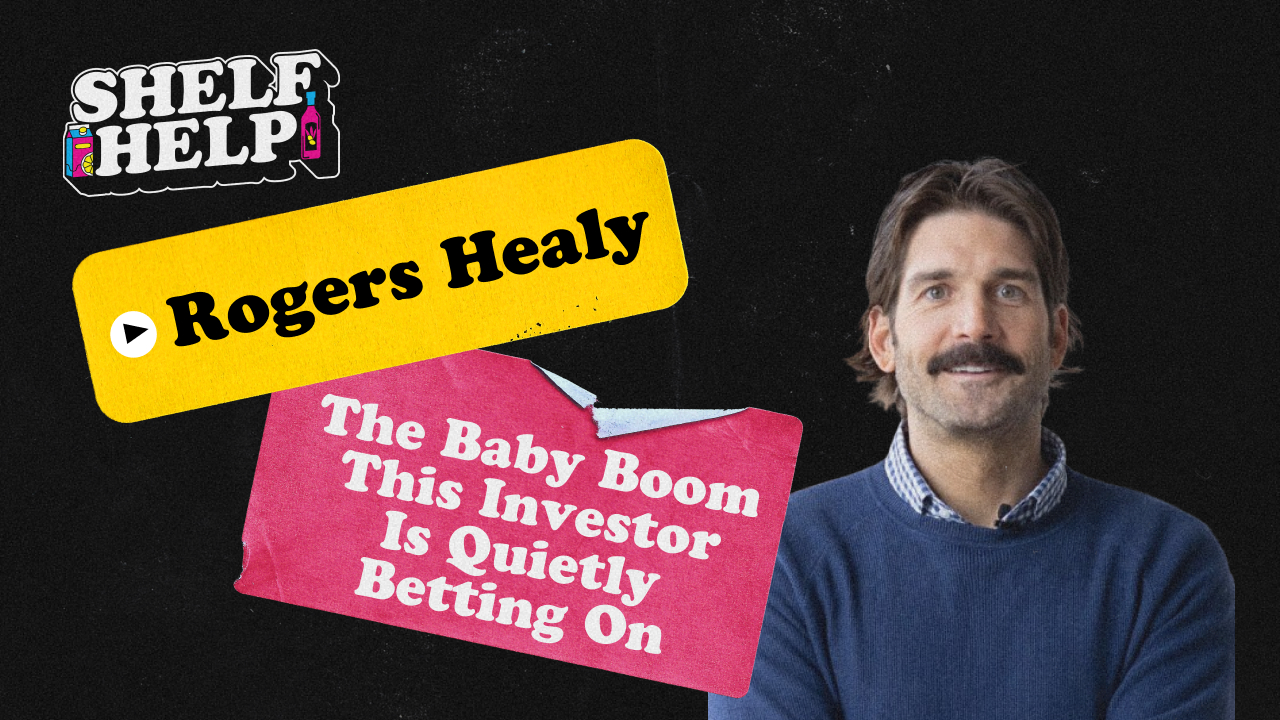
The Baby Boom This Investor Is Quietly Betting On | Rogers Healy, Morrison Seger Ventural Capital Partners



On this episode, we're joined by Rogers Healy, Founder and CEO of Morrison Seger Venture Capital Partners, the Dallas-based venture firm backing consumer and CPG brands like Waterloo, MOSH, WHOOP, and G.O.A.T. Fuel.
Before going all in on venture, Rogers spent two decades building one of Texas' largest independently owned real estate brokerages.
We dive into how Rogers built Morrison Seger as a deal-by-deal SPV firm, and how he only writes checks for simple, non-controversial consumer products he can authentically pitch himself. He breaks down his thesis across beverage, food, snacks, pet, and family, and what it actually takes to get conviction in a crowded category.
Rogers shares the founder traits he bets on, the talent he says can't be taught, and the single habit that separates founders who survive from the ones who stall out: relentless over-communication.
We also talk about why he's so focused on women-led brands when less than 3% of venture funding goes to them, the parent and family space he's watching, and the baby boom he's betting on next.
---------------
Episode Highlights:
🎸 Naming a VC firm after Van Morrison and Bob Seger
🥤 Why he only backs simple, non-controversial consumer brands
💵 Running a self-funded firm on deal-by-deal raises
🔎 The founder talent that can't be taught
📣 Over-communication as the No. 1 survival trait
⚠️ The one thing that makes him walk away from a deal
⭐ What gives celebrity-backed brands real staying power
📉 Why deals actually fall apart
🚺 Backing women-led brands when under 3% of VC goes to them
🍪 Miracle Mama and spotting under-the-radar founders
👶 The baby boom he's betting on next
📧 What a strong investor update actually includes
🔮 The unconventional path into CPG venture capital
---------------
Table of Contents:
00:00 – Intro
00:49 – Origin story and naming the firm
03:55 – The investment thesis
06:48 – What non-controversial really means
09:45 – The self-funded, deal-by-deal model
10:44 – Writing checks in crowded categories like beverage
12:37 – Spotting talent that can't be taught
15:53 – The trait that separates founders who survive
17:26 – The dealbreaker that makes him walk away
18:00 – Celebrity-backed brands and real staying power
20:08 – Why deals fall apart
21:58 – Backing women-led brands
23:39 – The parent and family space and Miracle Mama
25:10 – The baby boom call
26:23 – What makes a great elevator pitch
29:24 – What a great investor update looks like
30:51 – Breaking into VC from an unconventional path
32:42 – Where to find Morrison Seger
---------------
Links:
Morrison Seger – https://www.morrisonseger.com/
Follow Rogers on LinkedIn – https://www.linkedin.com/in/rogershealy/
Morrison Seger on LinkedIn – https://www.linkedin.com/company/morrison-seger/posts/?feedView=all
Follow me on LinkedIn – https://www.linkedin.com/in/adam-martin-steinberg/
For help with CPG production design - packaging and label design, product renders, POS assets, retail media assets, quick-turn sales and marketing assets and all the other work that bogs down creative teams - check out https://www.kitprint.co/.
Shout out to my friends over at Glimpse, the go-to partner for automating retail-related back-office operations and unlocking margin trapped in invalid fees and manual processes.
Episode Transcript
Speaker: 00:00
Welcome to Shelf Help. Today we're speaking with Rogers Healy, founder and CEO of Morrison Seager Venture Capital Partners, highly respected Dallas-based venture firm. Portfolio includes Waterloo, Sparkling Water, Mosh, Pathwater, Sanzo, Goat Fuel, Free Rain Coffee, just to name a few. Definitely a pretty interesting background from what I know. Before focusing a lot of his time in VC, Roger spent a decade or two building what was, I think, one of the largest independently owned real estate brokerage firms, eventually merging with Compass. Yeah, a lot of really cool experience. Excited to have you on, Rogers. Maybe just first off, for the listeners that maybe aren't that familiar with Morgan Seeger, Morrison Seeger, would love to just get kind of a quick lay of the land just in terms of like the origin story when you started the firm and the kind of why behind the firm, and then uh we'll go from there.
Speaker 1: 00:54
Great first question. Thanks for having me. The origin story is right behind me. Van Morrison, Bob Seeger. I love music, I love branding, my background in real estate. I wish it was a decade, but it was two and a half decades, and everything was named after me because I thought that's what a business owner was supposed to do. You name your company after yourself, and that's how you brand it. And Frankenstein's monster punched me in the face, and um, it caused anxiety, it caused unhappiness, and um, yeah, I was just a shell of a human. And I've been investing, you know, I started investing consumer deals in 2011, and there's a men's clothing company called Mizin in Maine, based out of Dallas, that just through random happenstance, um, I was one of their first investors, and I just fell in love with it. I was like, man, this is amazing. I love helping, I love giving the shirts out, I love wearing the shirts. It was so fun to watch them grow. And I kind of just started investing at bulk. I was single, I was making money, I had access to decent deals, and I had a great group of friends that would just know that if they hear consumer and Rogers is available, he'll probably invest. So it just kind of took on a mind of its own. And I never thought I would leave or had left the real estate industry. But over the course of time, you know, it's like with you or whoever watching this or that you've had on before, I guarantee at one point you're like, what the hell am I doing? Like, I'm not happy. And I there's this thing that I think I can do, but I'm stuck in this vertical that you know, we're married. And and I the only way to potentially consider getting out is to get a really nasty business divorce. And the thought of that was nauseating. And so yeah, just kind of kept investing and kept investing, and then met my wife. My wife is my hero, she's my best friend, and she's also just happy. And I was like, man, I I want to be like that, but I have this, and I have this monster. And so to land the plane, I love music, and we have three children named after musicians: Don Henley, our oldest daughter is Henley, Phil Collins, our middle daughter is Collins, and our son is Winwood after Steve Winwood. If they're watching, please call me. But I was at dinner with some high school friends like seven, eight years ago, and a buddy of mine, Jeff Sears, said, Rogers, you're gonna kick out of this. One of my friends started a company called Winwood Collins. Funny enough, now I have two kids named after them. I go after Steve Winwood and Phil Collins, and he said, Yeah. I said, What is it? He's like, It's nothing. That and I go, that is badass. I'm gonna start Morris and Seager after Van Morrison Bob Seeger. So it just kind of metastasized. And then I'm the kind of guy that once I make a decision, it's it's gonna happen. And so yeah, here we are. And I also am finally on the other side of exiting my real estate companies, which, you know, wasn't as bad as a divorce, but it also wasn't something that, you know, I'm I'm not taking up any new hobbies. I love to work. And here we are and grateful to be a part of this.
Speaker: 03:55
How would you define your investment thesis when it comes to CPG? What stages do you like to come in at? What are you looking for in a founder or a product before you write a check?
Speaker 1: 04:04
Yeah, sure. All stages. Um, kind of, you know, kind of the baseline as far as the consumer stuff. It's it's non-controversial stuff that's easy to understand. I'm a simple guy. I mean, I'm kind of simple, but you know, there's stuff that I like in consumer is simple. It's beverage, it's clothing, it's food, it's snack, it's family, it's pet. But I'm not really investing in furniture. I'm not really investing in stuff that's like, whoa, what is that? Tell me more. How do you drink that tea? Right. It's it's simple stuff because everything we do is a one-off raise. And in order for me to, you know, pitch tomahawk shades or bird dog or goat fuel or whoop or whatever it is, I have to know about it. So not only am I an investor in this stuff, but I'm also a consumer. And it's easy to go and reference a Waterloo when you're pitching Waterloo because I literally drink 12 of these a day. And so that has become kind of part of my repertoire, which really brings back the real estate side of me, right? You have a listing in real estate, you gotta hustle it, you gotta pitch it, you gotta know the square footage, you gotta know the room dimensions, you gotta know what makes it special because there's more than one house probably for sale. And that to me, you know, I can be grateful for my career in real estate versus resentful because I, you know, I got pretty good at that side of the business. I just didn't like what I was selling. I wanted to sell, you know, stuff versus a house. So yeah, it starts with a feeling, you know, and it starts with me just kind of gut checking do I know this? Can I help with this? Can I add value? Is it a great deal? You know, and learned in real estate a long time ago that a great deal is usually a deal that just makes you feel great, right? But in raising money, it's got to make sense. And the multiples have to be there because one of the reasons we do this is to make money. And so um, yeah, it all has to kind of check out. But I'm not a lawyer, I'm not an accountant, but I have lawyers and accountants that work with me. But the rest is kind of just me doing stuff like this, right? Like show up on time, say my name, follow up, send me product, ask me what I think. And if that doesn't happen initially, you know, that's the best version of a founder you're probably gonna get. Totally. And the handful of times that I have gone against my initial gut, a month into it, I'm like, son of a bitch. This is like I knew. I knew I should have done it. Yeah, but it's it's gotta make sense. But there also has to be a path to actually making some money because when you bring in outside money, you know, the goal is for them to probably see more money on the other side.
Speaker: 06:34
I think I've heard you say that you typically go for, I think it was quote, like non-controversial companies that are easy to understand with a heavy emphasis on consumers. That might be kind of building upon what you said about something simple, you know, something that's simple, it's easy to understand, but can you kind of expand on what you mean mean by non-controversial?
Speaker 1: 06:50
So your background before our podcast, I probably would not have invested in it. Nothing wrong with it. Just that, you know, that to me could be interpreted potentially as controversial. And that's, you know, again, nothing wrong with it. And it obviously was successful and you and you learned a lot, and you had, you know, a lot of great blessings, but I'm not a consumer, right? And so, yeah, we wouldn't do anything that's in the, you know, I've been pitched quite a few like adult pleasure toys. And I'm just like, first of all, what? Why would you come to me? Um, okay, I get it, but like, what? But you know, it's it's I can't like in an authentic way pitch it, right? And if my friends call, like, we're in some awesome deals that I'm not a consumer of, but I know the bit, I know the founder, and my wife is a consumer, and my kids are consumers, and that's that's an authentic version of me. And, you know, all the founders that are watching this and listening today, as crazy as this sounds, I think the last thing that every founder on Planet Earth should be doing is raising money, which means you need to have a great team behind you that is pitching this because if you're out raising money, who's running the company? And so having someone like me or someone from our team or someone that is watching this be your extension is so valuable and it's so effective if it's the right person. And for me, I know my lane. And my lane is like I'm a simple guy with a lot of layers and a lot of stuff, right? But all these things in my office that are signed by all these founders, no one ever walked in and said, What is oatmeal? Or what is a landline phone? What is hydration powder? What is an energy drink? It's like it's it's simple, and then I can tell them about it. But even if I was running a fund, which I probably will in the near future, I'm not I'm not gonna invest in something just because everyone says it's a great deal. I've got to understand it. Uh yeah, but again, the common theme is relatively simple, but definitely non-controversial. I'm invested in some sports betting platforms. Controversial, yeah, probably, but I didn't see it in bet invest in OnlyFans, right? Just the stuff that makes somebody question, you know, who knows? Like it, you know, you can make money. If you find it's something that you're great at for the most part, you can make a lot of money. I just I don't want to have that, yeah, but we have it's like, no, this is what I stand for. And you know, whether it's legal or not, you know, I'm I like to drink alcohol. I'm really good at drinking alcohol. We're invested in a tequila company. Controversial, maybe, not to me though, right? So it's all based off kind of my perception, which isn't really fair to the masses. But look, I get it. All that stuff really is on paper better for you than alcohol. And I understand. I just would like the high school or college version of me would feel guilty taking a sip of it.
Speaker: 09:36
Yeah. So yeah, I'm a rule follower. I could have told you that. You mentioned that you're maybe gonna start a fund in the future. So is Morrison Seager uh to this day, it's all all self-funded at this point.
Speaker 1: 09:48
I mean, that's I my wife and I are uh contributors to all the deals, contributors, but it's it's outside raises. Like I've my network very supportive, very kind. Um, but I am you know raising anywhere between probably a million to 15 million per deal, um, which is awesome, but it's also exhausting, right? It's like we just launched a secondary raise for Whoop, and I've already had probably 200 phone calls in the past two days, which is great. I'm hoping that 10% of them decide to invest versus just picking my track record in my company. So yeah, there's there's pluses and minuses to all of it.
Speaker: 10:27
We've definitely done a lot of deals. I'm sure some of those deals were in categories that are pretty competitive and crowded. Is an example like the energy drinks category or sparkling water, I guess water is a good example. Like what do you what do you need to see to write a check from a differentiation standpoint?
Speaker 1: 10:48
Yeah, it just depends on the stage. You know, I think that and that's a that's a kind of crappy response, but I hope you know it's genuine. It it just depends, you know, and and beverage, you know, beverage is maybe my favorite vertical, and it's in large part in like my desk right now. I have two Yetis, I have three Waterloos, Liquidef, a Juni, and a Stiller Soda. And then I have a uh commercial size refrigerator in my other room with like 500 drinks. And by the way, I don't have people over. That's just for me. It just depends on the stage, and it depends on you know, every vertical in beverage is crowded, but beverage is also so freaking expensive, right? There's a reason a lot of these companies, energy drink companies included, are also having these powders. It's cheaper to make, the margins are better, it's you know, the shelf life is longer, it's subscription based, blah, blah, blah. But I like early stage stuff, you know, I like late stage. Late stage stuff is easier to raise money for because it's less risky. And, you know, you write a million dollar check in Waterloo late stage, you're probably not gonna lose your money, but you're also probably not gonna go and retire once it exits. So, yeah, it just depends, you know, and the beauty of my real estate background, God was kind of preparing me that, you know, every house is different, but it's easier to comp a house in Beverly Hills to another house in Beverly Hills versus a house in Beverly Hills to a house in Pasadena, right? And so, in beverage, there's alcoholic beverages, there's sugary sodas, there's better for you sodas, there's sugar-free sodas, there's energy drinks, there's better for you energy drinks. And so just to kind of learn this like non-stop, right? And we get we we're so lucky to have incredible inbound deal flow, and I read every one and I I study it, and I think just over the course of time, it's like, holy crap, I'm really learning this stuff, but there's some deals that I'm always going to gravitate towards.
Speaker: 12:37
From what I've heard, you've got a somewhat of a special eye for talent. What are some of the kind of key top of mind things for you that you look for in a founder or a founding team in order to be able to write a check?
Speaker 1: 12:50
Yeah, I mean, look, whether I have an eye for talent or not, I I've never I met my wife because she was at dinner with her mom and I went up to the table and introduced myself. I was like, hey, this is gonna be kind of weird and creepy, but I'd love to talk to your daughter. Now we're married with three children. Um, and so wait, hold on. What was the question? I just answered. Oh, you're good.
Speaker: 13:10
I was just saying, what do you what do you look for in in founders or or founding team that kind of gets you given eye for talent thing?
Speaker 1: 13:16
By the way, terrible analogy. I said I have an eye for talent that I referenced my wife. So let's leave that in there, but man, I'm sure I'll get some nice messages from that. It's it's the stuff that can't be taught, right? Um, my real estate company, you know, it was it was large, and we had thousands and thousands of people that work there. But you know, the one common well, I'm not saying that from an ego perspective. I'm like, it was a lot of people in, a lot of people out, and we just kind of kept, you know, doing it, but you just know when you find somebody that's got it, right? And there's stuff in life, and I don't know if you're a father, and you know, if if you are great, if you're not, you will be okay. Well, it's the greatest thing ever, right? My all my kids are different, even though they're four, two, and seven months, but I know that some of them have different gifts than others, and you're born with that. Uh, being a talent scout, uh, as a business owner and as a leader, there's stuff that you're gonna see in somebody that cannot be taught, it cannot be purchased, it cannot be learned. They either have it or they don't. And so that's part of finding great founders, right? Like Bird Dog, this is a software-based company that helps landowners leverage their land in way that, in ways that you never knew could happen before. Like, what? Right? But like, I love the founder and they're crushing it. And we are their largest investor, their first investor, one of their first investors, and the right people got it, right? And so the bet was on the jockey, not the horse. Now the horse is doing awesome too. But I think that's kind of part of it is you can run your diligence and hire your fancy analysts all you want, but you just know. Like, you know that when somebody has it, they're worth investing in. And then you got to put a team around them to protect them, but also find a way to go and help them scale because it can't all be around about that person. The problem with real estate is that people would come, they would trust me, they would do incredibly well, and then they would bail. They would bigger, better deal me over and over and over. And I finally was just like, oh my gosh, this is crushing my soul. And venture, if I invest in Adam's best company, you can't kick me out. You can't, you can't say, thanks for everything, you've helped change my life. I'm on the next investor because I'm on your cap table. And that to me is really liberating.
Speaker: 15:29
You've done enough deals, I imagine, you know, good have worked out. Some of them haven't worked out. Um, anything come things come top of mind in terms of traits that separate founders who survive, you know, that pre-seed from going from idea to market and don't stall out before that series A, which seems like can be that kind of transition, is where a lot of founders can can struggle and not make it over the hump.
Speaker 1: 15:52
Great question. Simple to answer. Overcommunication. Period. Proactive overcommunication. When things are great, overcommunicate. When things aren't great, overcommunicate. When you think you should over-communicate, that's it. Right? It's like any relationship. They're all going to tell you the same cheesy response. What's the secret to a great marriage? Communication, right? And you know, I think that that's it's it's surprising to me, right? We have some awesome portfolio companies, but there's a handful that I'm just like, why am I reminding you to send me a freaking investor update? Why? Because we're busy. No, no, no, no, no. You find five minutes to type an email, you put it into AI, like it's not hard. And that's really frustrating, right? And that was an awkward thing for me to get over the first few years of doing this, and finally, like, wait a second, you probably wouldn't have a company if it wasn't for my group of investors. Like, have some freaking integrity and keep us updated. But then there's some that email us once a week, right? What an easy bet to make. Even if things aren't going great, right? Like, here's the weekly update, as it freaking should be. So, you know, it's gotta be communication, but it's also good, just gotta have that mindset, like with me. Like, I burn the ships when doing this. I literally am a walking example at a 46-year-old man that left a successful real estate career because my heart was telling me to do venture capital. And I think that just takes some kind of psychopathic wiring that honestly is an easy investment because you just know you're gonna find ways to be resourceful enough to get it figured out.
Speaker: 17:21
What's the number one red flag that you've seen a founder that's made you walk away from an otherwise deal that looked very interesting?
Speaker 1: 17:29
Ego.
Speaker: 17:31
I think your portfolio includes a uh a good handful of celebrity bag brands, goat fuel Jerry Rice, Dr. Bombay with Snoop Dogg, Free Rain Coffee with with Kohlhauser. Seem like you've had some some success with these. It seems like um a lot of these have a tendency to to fizzle out, but I think from what I know, at Goat Fuels and crushing it there in 25,000 plus fuss doors at this point. What have you found is the key to finding, I don't know if you want to call it real celebrity back brands that have real staying power.
Speaker 1: 18:04
Yeah. Well, Cole's my best friend. I was his realtor back in the day. So I knew I knew Cole, that was an easy bet. I knew Jerry's son through real estate. Again, like there's never a guarantee, right? But I think like, again, it's it's Jerry Rice, the greatest football player of all time. He works his ass off at 60 years old, like he did when he was 15 years old, which means he's got that mindset that like failure, like what, like, what? Right? But sometimes it takes time, whether it's an athlete or a musician or an actor, because a lot of them, and that's okay, they don't have a background in business and scaling a company. And so you gotta be really intentional. You know, it's the Schwarzenegger family, it's the Schreiber family, it's Cole Hauser, it's Barry Rice. We're doing a deal with Ben Stiller. It's it's the ones that, you know, back to the non-controversial thing, you know, never say never, but I would have a hard time thinking some of these celebrities we work with could get canceled, right? And like which I hate the fact that's even a term that we all know so well, but it's true. And I think that find somebody who is kind of you know beloved or well respected or well known that just happens to be part of the brand versus someone who is the brand, right? Like Cole's, you know, Cole is the greatest guy ever, and he's a hard worker, but he's not running free rent coffee. But his name, language, and likeness are a huge part of it, and that means that our brand is like such a like it's just a rifle approach. We know exactly who the consumers are, but he's he's pulling a ton of weight. He helped us get into Walmart. He helped, it's just it's doing this, right? But uh, you know, they don't all work out. I was in a whiskey deal with Jamie Foxx that didn't work, and that's in large part, you know, Jamie Foxx had some health issues, and the alcohol space is not having the best time ever. But, you know, it didn't work, and that's okay. But you know, the celebrity can't be the only reason, which at first was hard for me because I am a fan of, you know, your heroes, and you want to just do whatever you can to be like, oh no, but like this is why. But you gotta have a team that is supporting them and surrounding them that makes it a justifiable investment.
Speaker: 20:07
On that topic of deals that that didn't work out, um, especially for just some up-and-coming founders that are listening and things that they can avoid, looking back now on the ones that didn't work out, any clear patterns that that emerge over time in terms of why things didn't work out?
Speaker 1: 20:25
Sure. I mean, look, there's always factors that like you can't predict, you know, like tariffs did not really help anybody. Thankfully, I think most of our companies that had some kind of impact are on the other side of it now. But again, like aluminum prices all of a sudden, it's like you can't predict this stuff. Like cotton, it it just it's not cotton, but what's the word I'm looking for? What whatever it anyway, just stuff that Mizin and Maine, Mizen and Maine changed their production to Malaysia like a month before tariffs, and all of a sudden I'm like, what? You just can't make it up. But I think that's the bet on the team is that you want to just make sure they can be, you know, just strong willed to get through it. But the ones that have not worked out, you know, the common theme for the most part is the founders and the leaders and spending too much money. You know, you mentioned there's been some experiences you've had where you raise a lot and you spend a lot. Just because you have money in your bank account doesn't mean you have to spend it, right? But it also doesn't mean you have to be so afraid to spend a dollar. It's like be intentional, bring in some counsel that's going to help you, you know, invest wisely. But every once in a while, something just happens, right? You can have a group that wants to be in Costco, they get nationwide distribution at Costco, and then all of a sudden they have a contaminated order. You're screwed. That's it. You're screwed. And I think that that's the kind of stuff that you do this enough, you have enough experiences, and you get a phone call, you're like, okay, here's how we deal with this, versus like, holy shit. Like, you know, and I think that that took some time to get there as well.
Speaker: 21:54
I've seen you be very vocal about putting a focus on women led women led brands, especially. ones that are going after the producing goods for for parents. Tell me more about why that's a focus for you.
Speaker 1: 22:07
As I pull up my pink cell phone case, I heard a saying a long time ago. If you want to get shit done, hire a mom. Okay? And I'm so glad you asked this question. Less than 3% of venture funding goes to female led companies. That's pathetic. Women are the greatest leaders on planet Earth, whether they're a mom or not. Their instincts are stronger than men, their discernment is stronger than men, and their ideas are usually better than every men's, every man's idea combined. And so I've loved that. And I've loved the fact that, you know, initially a lot of these female led companies were like, man, we really need you. I'm like, why? They're like, because you're a guy. It's like, no, you don't. You don't. And so it's been fun doing that. And so yeah, I think that that's a that's a huge mission for me personally, uh, in large part, because my mom is the best mom, my wife is the best wife, my wife is the other best mom. And so, you know, just finding a way to honor them, especially, you know, a lot of these women have full-time jobs as well. Don't let that be a red flag for those of y'all that are watching this. If they can find a way to navigate and have their product have any kind of significance while having a full-time job, you need to take a meeting and you need to listen. So, yeah, that's that's an awesome question. Thank you. Not that men aren't greaters, but you know, we all have our wiring. And, you know, I'm a sensitive guy that's in touch with his feelings, but I'm not a woman. So yeah. Great question.
Speaker: 23:37
Are there specific categories within the I guess parent-family space that you're out of particularly excited about or ones that you feel like are underfunded, underserved right now?
Speaker 1: 23:48
Um, you know, I think that's where, you know, the interesting question because it's hard where you still got to think like an investor and logically versus just like, man, I really want to help conquer this one random niche that maybe doesn't have a lot of upside. And I've trained myself that when I get an inbound deal, I'm like, oh my gosh, really cool founder, really cool story, but it's like so super niche that the outcome might not be really worth the time, which I hate to say. Uh, but look, one of my favorite founders is a girl named Whitney Rowell. And she is the founder and the face and the brand behind a company called Miracle Mama. Uh, initially connected over her because my wife was using her brand. It was a it's a cookie company initially that helped um women produce breast milk. Well, breastfeeding, I was like, What's this? And my wife's like, Oh, this is one of my oldest friends from childhood. I was like, huh, I want to reach out to her. And so we got a deal done, worked together for a while, and then, you know, helped her turn it into just a powerhouse brand that's got mass distribution. It's now cookies for women that are breastfeeding for moms that are, I mean, not cookies for women that are um pregnant, then breastfeeding, and then postpartum. And, you know, it it's just great. But like, I don't breastfeed, I never have, but I can get behind it. So, you know, I like the parenting space, I like the mom space. I hope that um as the world continues to turn, I think we're gonna see another baby boom in the next few years. And I've said this a few years, but crazy enough, I think one of the people that could go and catalyze one of the biggest baby booms ever is Taylor Swift. If they decide to have trading, I'm not kidding. People laugh about it and I get it, but if Taylor Swift and Travis Kelsey are watching this, hello. Secondly, if y'all have a child, I think we're going to see one of the biggest baby booms of all time. And I think it's also gonna bring, you know, back, you know, like old wholesome life. Um, there's more weddings uh in 2021, I think, uh from any year other than like 1980.
Speaker: 25:50
So many weddings. So many weddings.
Speaker 1: 25:52
But I think that's gonna lead to another baby boom. People are getting married later in life, right? I became a dad at 42, and now we have three and we want more. So um, yeah, I I I love that, right? But I also got to study that and be like, okay, this is very logically gonna happen. How can I go and be on the forefront of something that might be kind of wack-a-doodle right now, but over the time, you know, I look like a fortune teller.
Speaker: 26:17
Yeah, totally. In terms of pit pitching investors, what would you say like separates a great, you know, 60, 90 second elevator pitch from a bad one?
Speaker 1: 26:28
Preparation and authenticity, right? I I and I again I can't imagine it's gotta be nerve-wracking doing it. I'm on a TV show called Entrepreneur Elevator Pitch, and it's literally them coming down an elevator and pitching. I can't imagine, right? But like, don't think about it too much. If you go and you're like, this could be the greatest moment of my life, this is what it's like, no, no, no, no. It's your job, right? It is your job. Just show up, be prepared, and be believable. And you're gonna mess up, own it. Who cares? I mess up every single day, and I don't try to cover it up. It's like I'm freaking human. I'm human. So yeah, I I think just people that have a reason, and you can you can tell there's people that are building the company because they want to, versus people that are building the company because they want the next billion dollars. It's like, no, no, no, no. Like if you have belief behind it, that's a big part of the reason to invest. So yeah, I think just kind of what you'd imagine.
Speaker: 27:18
Yeah, fair enough. Maybe for the founder that's not a natural salesperson, uh, what's one thing they can do to materially increase the quality of their pitch if you've got any ideas? Drink alcohol. Yeah, it's not a bad one.
Speaker 1: 27:34
You know, I think again, we all have our gifts. I'm not a technical engineering-brained person. I'm a creative that likes to tell stories, like real stories, which means I gotta have people in my life that can go and do the things that I'm not decent at or even good at. But you know, I think again, like life in the world of sales is about confidence and it's about building the flywheel of confidence. And eventually, once you get there, after enough reps and after enough experiences, you're like, wait a second, like I now believe what these people are saying, right? So, how do I keep that going while remaining humble? And I think that as a founder, you know, you try it enough, somebody is eventually gonna say yes. The problem for some people, myself included, is that that yes ends up becoming the most overwhelming thing ever because you're so used to them saying no. And so, how do you actually go and leverage that to become, you know, like this real, this real person. So, yeah, just get over yourself and realize, you know, I love talking about music, right? I I love finding conversations that bring it back to my family, my faith, or music. And if I talk about Van Morrison and Bob Seeger to start a podcast, you got me. That's it. I'm comfortable, I'm casual, I'm myself. Uh, but if we start talking about real estate and like uh, right, like that's not that doesn't excite me. And so I found ways to kind of control the narrative in almost every conversation, in large part because of Van Morrison and Bob Seeger, who I've never met yet. And that just kind of brings the level down where it's like, he's a normal guy, right? And this is just business. So yeah, easier said than done, but you know, just be yourself, but get over it and realize that it's your job.
Speaker: 29:12
You mentioned um earlier over communication, giving regular updates on that topic. I'm sure you get a lot of these at this point for the founders that are listening and want to do it the right way. What does a well-structured, ideal investor update email look like or include?
Speaker 1: 29:29
I think quarterly needs to be about the financials and and maybe the asks. And I think, you know, sporadically, it can just be like, hey, this happened heads up, or even better, like, hey, we got distribution into XYZ. It's just celebrate the wins, right? And and you guys that are watching this that have sent these, you're gonna know it's it's rare that you get a response when it's great news, but when it's not great news, people respond. And I think that you know, just being consistent with it is is really, really important. And, you know, I just don't think too much. And it's okay if it's a casual update. It's okay if it's something that is just a link to an article. If I see it in my mind and Adam is one of my investors in Bird Dog, I'd imagine you'd want to see it. So just send it.
Speaker: 30:13
Yeah.
Speaker 1: 30:13
I think that you know, again, you'd be surprised that eventually the people that are custom or seasoned investors are gonna be like, Why are you sending me all these updates? I'm like, because you deserve to see them. And then they're like, oh man, I wish that all the other companies I was in did it. So I think just you know, put yourself in the shoes of the investor, and that is not that hard to do. Yeah, totally. And use AI freaking use AI. You have no excuse not to. No excuse.
Speaker: 30:41
Yeah. Um, last question for you, Rogers, especially I feel like you have a probably unique answer to this question because you have a bit of an unconventional way, you kind of came into to venture capital. If someone yet with an unconventional background really wants to move into early stage VC in in in the CPG consumer space, they're willing to just kind of do whatever it takes. From your perspective, what what what should or could they do to give themselves a real a real shot at whether they want to get a job?
Speaker 1: 31:10
Do it. Do it. Do your research, not too much. Trust your gut, find an army of people that are gonna believe in you, have your story, and burn your freaking ships. Or burn the ships. You know, you gotta have some kind of plan. But if you sit there and strategize too much, a dummy like me is already blown past you because I don't want to sit there for too long. And again, like every vertical has room for another. Okay, beverage, right? God knows how many beverage companies are starting today. There's probably 50 new beverage companies in the U.S. launching today.
Speaker: 31:44
Probably, yeah.
Speaker 1: 31:45
Like, have a cool story, have great tasting liquid, have a reason, and find a support group and put your freaking blinders on and go.
Speaker: 31:54
Totally.
Speaker 1: 31:56
So, yeah, I think that's kind of a hoo-rouse response, but again, I hope that I'm living proof. I literally left a very successful career because I wasn't happy. And nobody, myself included, five years ago, two years ago, twenty years ago, would have thought that because it was kind of all about me. And no matter what anyone says, that eventually gets really lonely. And you want to share life and you want community and you want friends. There's not people in real estate calling me from another company being like, hey, Rogers, will you be on my podcast? They would never do that. And this is so inviting and kind and supportive that latch on. And when you find your crew, and when you know there's people that you don't mesh with, that's okay. Drown them out. And that's just kind of the story of my life.
Speaker: 32:41
That's a great way to close it. What's the best place for people to follow along with you? Along with the firm, or I'm sure you yeah, your inbound deal flow doesn't seem to be hurting, but what's the best place for founders to be more?
Speaker 1: 32:53
Morrison Seager, like on this Pathwater bottle. Go to Morrisonseager.com. For you founders, fill out one of our founder forms. For all you accredited investors that are interested in participating with us, fill out one of our forms as well. We're always looking for new investors, we're always looking for new deals, and there is no end goal. And so we're grateful to be a part of this. And um, yeah, I has anyone ever asked to take a sh a shelf helpy selfie? No, but I've a first for everything. Okay, thumbs up, here we go. I took it. I got the first shelf help selfie.
Speaker: 33:27
Love it. Perfect. That'll be that'll that'll you're starting to trend. I like it. I love it.
Speaker 1: 33:31
Well, congrats on what you're doing on a hundred episodes, amazing. Um thanks for helping share the story of people that um that deserve it. And female founders, you got this. You got it.
Speaker: 33:42
Love it. Well, I think that's it. I think the thing that's the pod.

.svg)